

ASTM D2797/D2797M-21a
(Practice)Standard Practice for Preparing Coal Samples for Microscopical Analysis by Reflected Light
General Information
- Abstract
SIGNIFICANCE AND USE
4.1 Briquets of granular bituminous coals and anthracite prepared in accordance with the laboratory procedures of this practice will have flat, scratch-free surfaces suitable for examination with a microscope using reflected light illumination. The polished surfaces of briquettes prepared by this practice will contain particles representative of the original gross sample.
4.2 Samples prepared by this practice are used for microscopical determination of the reflectance of the organic components in a polished specimen of coal (Test Method D2798) and for microscopical determination of the volume percent of physical components of coal (Test Method D2799).
SCOPE
1.1 This practice covers laboratory procedures for the preparation of granular samples of bituminous coal and anthracite samples for examination with a microscope using reflected light illumination. It does not apply to the preparation of oriented blocks of coal.
1.2 Units—The values stated in either SI units or non-SI units are to be regarded separately as standard. The values stated in each system are not necessarily exact equivalents; therefore, to ensure conformance with the standard, each system shall be used independently of the other, and values from the two systems shall not be combined.
1.3 This standard does not purport to address all of the safety concerns, if any, associated with its use. It is the responsibility of the user of this standard to establish appropriate safety, health, and environmental practices and determine the applicability of regulatory limitations prior to use.
1.4 This international standard was developed in accordance with internationally recognized principles on standardization established in the Decision on Principles for the Development of International Standards, Guides and Recommendations issued by the World Trade Organization Technical Barriers to Trade (TBT) Committee.
- Status
- Published
- Publication Date
- 31-Aug-2021
- Technical Committee
- D05 - Coal and Coke
- Drafting Committee
- D05.28 - Petrographic Analysis of Coal and Coke
Buy Documents
ASTM D2797/D2797M-21a - Standard Practice for Preparing Coal Samples for Microscopical Analysis by Reflected Light
REDLINE ASTM D2797/D2797M-21a - Standard Practice for Preparing Coal Samples for Microscopical Analysis by Reflected Light
Overview
ASTM D2797/D2797M-21a: Standard Practice for Preparing Coal Samples for Microscopical Analysis by Reflected Light provides internationally recognized laboratory procedures for preparing granular samples of bituminous coal and anthracite for reflected light microscopy. The standard is issued by ASTM International and is essential for ensuring coal briquets with flat, scratch-free surfaces, representative of the original coal sample, for accurate petrographic evaluation. This practice supports consistent preparation methods for petrographic and reflectance testing, critical for the coal, coke, and energy industries.
Key Topics
- Laboratory Sample Preparation
- Describes step-by-step methods to crush, mix, bind, mold, and polish coal samples.
- Specifies that only granular bituminous coals and anthracite are applicable – not oriented blocks of coal.
- Equipment and Materials
- Details the use of grinders, sieves, molds, mounting presses, and lap polishing equipment.
- Recommends suitable binders (epoxy resins, heat-setting powders) and release agents that do not react with coal.
- Lists appropriate abrasives (silicon carbide papers, aluminum oxide powders) and cleaning practices.
- Quality and Suitability
- Stresses the importance of creating scratch-free, flat briquet surfaces.
- Ensures resulting briquets are suitable for high-precision microscopical determination, including reflectance testing.
- Safety and Compliance
- Highlights the need for users to implement appropriate safety, health, and environmental practices.
- Notes that values stated in SI and non-SI units should not be mixed.
Applications
This standard practice is widely used in:
- Coal Petrography and Quality Control
- Preparation of coal samples for analysis is fundamental in determining coal rank, maceral composition, and other petrographic properties.
- Ensures reliable measurement of reflectance (per ASTM D2798) and maceral composition (per ASTM D2799).
- Industrial and Academic Research
- Supports coal classification, geology, and energy resource studies by providing uniform sample quality.
- Energy Sector and Mining
- Used in routine coal quality assessments for power generation, coking, and mining operations.
- Aids regulatory compliance and international trade by ensuring consistency in sample preparation methods.
- Environmental and Safety Assessments
- Enables accurate analysis of coal components, supporting environmental monitoring and health impact assessments related to coal usage.
Related Standards
- ASTM D2013: Practice for Preparing Coal Samples for Analysis
Outlines procedures for sample reduction and subdivision before final preparation. - ASTM D2234/D2234M: Practice for Collection of a Gross Sample of Coal
Details sampling procedures to obtain representative samples. - ASTM D2798: Test Method for Microscopical Determination of the Vitrinite Reflectance of Coal
Relies on samples prepared according to D2797/D2797M-21a for accurate results. - ASTM D2799: Test Method for Microscopical Determination of the Maceral Composition of Coal
Employs prepared briquets for quantifying coal macerals. - ASTM D4596: Practice for Collection of Channel Samples of Coal in a Mine
Addresses channel sampling as input for preparation. - ASTM E11: Specification for Woven Wire Test Sieve Cloth and Test Sieves
Sets requirements for sieves used during sample size reduction.
Practical Value
Implementing ASTM D2797/D2797M-21a ensures:
- Reliable and reproducible coal sample surfaces for advanced microscopy.
- Consistency in petrographic data across laboratories and organizations.
- Easier compliance with industry and international standards in coal testing.
- Scientifically defensible results for research, quality assurance, and regulatory purposes.
Keywords: coal sample preparation, petrographic analysis, reflected light microscopy, coal briquet, vitrinite reflectance, ASTM D2797, maceral composition, standard practice, coal microscopy, laboratory coal analysis.
Relations
- Effective Date
- 01-Dec-2019
- Effective Date
- 01-Nov-2019
- Effective Date
- 15-Oct-2017
- Effective Date
- 01-Mar-2016
- Effective Date
- 01-Oct-2013
- Effective Date
- 01-Sep-2012
- Effective Date
- 01-Jun-2011
- Effective Date
- 15-Apr-2011
- Effective Date
- 01-Apr-2011
- Effective Date
- 01-Sep-2010
- Effective Date
- 01-Jan-2010
- Effective Date
- 01-Oct-2009
- Effective Date
- 01-Sep-2009
- Effective Date
- 01-Sep-2009
- Effective Date
- 01-Jun-2009
Buy Documents
ASTM D2797/D2797M-21a - Standard Practice for Preparing Coal Samples for Microscopical Analysis by Reflected Light
REDLINE ASTM D2797/D2797M-21a - Standard Practice for Preparing Coal Samples for Microscopical Analysis by Reflected Light
Get Certified
Connect with accredited certification bodies for this standard

Bureau Veritas Chile
Bureau Veritas certification services in Chile.
Bureau Veritas Peru
Bureau Veritas certification services in Peru.
BVQI Peru
Bureau Veritas certification in Peru.
Sponsored listings
Frequently Asked Questions
ASTM D2797/D2797M-21a is a standard published by ASTM International. Its full title is "Standard Practice for Preparing Coal Samples for Microscopical Analysis by Reflected Light". This standard covers: SIGNIFICANCE AND USE 4.1 Briquets of granular bituminous coals and anthracite prepared in accordance with the laboratory procedures of this practice will have flat, scratch-free surfaces suitable for examination with a microscope using reflected light illumination. The polished surfaces of briquettes prepared by this practice will contain particles representative of the original gross sample. 4.2 Samples prepared by this practice are used for microscopical determination of the reflectance of the organic components in a polished specimen of coal (Test Method D2798) and for microscopical determination of the volume percent of physical components of coal (Test Method D2799). SCOPE 1.1 This practice covers laboratory procedures for the preparation of granular samples of bituminous coal and anthracite samples for examination with a microscope using reflected light illumination. It does not apply to the preparation of oriented blocks of coal. 1.2 Units—The values stated in either SI units or non-SI units are to be regarded separately as standard. The values stated in each system are not necessarily exact equivalents; therefore, to ensure conformance with the standard, each system shall be used independently of the other, and values from the two systems shall not be combined. 1.3 This standard does not purport to address all of the safety concerns, if any, associated with its use. It is the responsibility of the user of this standard to establish appropriate safety, health, and environmental practices and determine the applicability of regulatory limitations prior to use. 1.4 This international standard was developed in accordance with internationally recognized principles on standardization established in the Decision on Principles for the Development of International Standards, Guides and Recommendations issued by the World Trade Organization Technical Barriers to Trade (TBT) Committee.
SIGNIFICANCE AND USE 4.1 Briquets of granular bituminous coals and anthracite prepared in accordance with the laboratory procedures of this practice will have flat, scratch-free surfaces suitable for examination with a microscope using reflected light illumination. The polished surfaces of briquettes prepared by this practice will contain particles representative of the original gross sample. 4.2 Samples prepared by this practice are used for microscopical determination of the reflectance of the organic components in a polished specimen of coal (Test Method D2798) and for microscopical determination of the volume percent of physical components of coal (Test Method D2799). SCOPE 1.1 This practice covers laboratory procedures for the preparation of granular samples of bituminous coal and anthracite samples for examination with a microscope using reflected light illumination. It does not apply to the preparation of oriented blocks of coal. 1.2 Units—The values stated in either SI units or non-SI units are to be regarded separately as standard. The values stated in each system are not necessarily exact equivalents; therefore, to ensure conformance with the standard, each system shall be used independently of the other, and values from the two systems shall not be combined. 1.3 This standard does not purport to address all of the safety concerns, if any, associated with its use. It is the responsibility of the user of this standard to establish appropriate safety, health, and environmental practices and determine the applicability of regulatory limitations prior to use. 1.4 This international standard was developed in accordance with internationally recognized principles on standardization established in the Decision on Principles for the Development of International Standards, Guides and Recommendations issued by the World Trade Organization Technical Barriers to Trade (TBT) Committee.
ASTM D2797/D2797M-21a is classified under the following ICS (International Classification for Standards) categories: 73.040 - Coals. The ICS classification helps identify the subject area and facilitates finding related standards.
ASTM D2797/D2797M-21a has the following relationships with other standards: It is inter standard links to ASTM D2234/D2234M-19, ASTM D2798-11a(2019), ASTM D2234/D2234M-17, ASTM D2234/D2234M-16, ASTM E11-13, ASTM D2799-12, ASTM D2798-11a, ASTM D2798-11, ASTM D2799-11, ASTM D2799-10, ASTM D2234/D2234M-10, ASTM D2234/D2234M-09a, ASTM D2798-09a, ASTM D2799-09, ASTM D4596-09. Understanding these relationships helps ensure you are using the most current and applicable version of the standard.
ASTM D2797/D2797M-21a is available in PDF format for immediate download after purchase. The document can be added to your cart and obtained through the secure checkout process. Digital delivery ensures instant access to the complete standard document.
Standards Content (Sample)
This international standard was developed in accordance with internationally recognized principles on standardization established in the Decision on Principles for the
Development of International Standards, Guides and Recommendations issued by the World Trade Organization Technical Barriers to Trade (TBT) Committee.
Designation:D2797/D2797M −21a
Standard Practice for
Preparing Coal Samples for Microscopical Analysis by
Reflected Light
This standard is issued under the fixed designation D2797/D2797M; the number immediately following the designation indicates the
year of original adoption or, in the case of revision, the year of last revision. A number in parentheses indicates the year of last
reapproval. A superscript epsilon (´) indicates an editorial change since the last revision or reapproval.
1. Scope Maceral Composition of Coal
D4596Practice for Collection of Channel Samples of Coal
1.1 This practice covers laboratory procedures for the
in a Mine
preparationofgranularsamplesofbituminouscoalandanthra-
E11Specification forWovenWireTest Sieve Cloth andTest
citesamplesforexaminationwithamicroscopeusingreflected
Sieves
light illumination. It does not apply to the preparation of
oriented blocks of coal.
3. Summary of Practice
1.2 Units—The values stated in either SI units or non-SI
3.1 Arepresentativesampleiscrushedtoaspecifiedparticle
units are to be regarded separately as standard. The values
size, air-dried, mixed with a binder, and formed into a briquet.
stated in each system are not necessarily exact equivalents;
The briquet is then polished to a flat, scratch-free surface for
therefore, to ensure conformance with the standard, each
examination by vertical illumination.
system shall be used independently of the other, and values
from the two systems shall not be combined.
4. Significance and Use
1.3 This standard does not purport to address all of the
4.1 Briquets of granular bituminous coals and anthracite
safety concerns, if any, associated with its use. It is the
prepared in accordance with the laboratory procedures of this
responsibility of the user of this standard to establish appro-
practicewillhaveflat,scratch-freesurfacessuitableforexami-
priate safety, health, and environmental practices and deter-
nation with a microscope using reflected light illumination.
mine the applicability of regulatory limitations prior to use.
The polished surfaces of briquettes prepared by this practice
1.4 This international standard was developed in accor-
will contain particles representative of the original gross
dance with internationally recognized principles on standard-
sample.
ization established in the Decision on Principles for the
4.2 Samples prepared by this practice are used for micro-
Development of International Standards, Guides and Recom-
scopical determination of the reflectance of the organic com-
mendations issued by the World Trade Organization Technical
ponents in a polished specimen of coal (Test Method D2798)
Barriers to Trade (TBT) Committee.
and for microscopical determination of the volume percent of
physical components of coal (Test Method D2799).
2. Referenced Documents
2.1 ASTM Standards:
5. Apparatus
D2013Practice for Preparing Coal Samples for Analysis
5.1 Grinder, Pulverizer, or Mill, for final crushing of the
D2234/D2234MPractice for Collection of a Gross Sample
sample to pass a 850µm [No. 20] U.S. Standard Sieve. Mortar
of Coal
and pestle or other equipment suitable for reducing the particle
D2798Test Method for Microscopical Determination of the
size of a 250g sample that already passes a 4.75mm [No. 4]
Vitrinite Reflectance of Coal
U.S. Standard Sieve until all of it passes a 850µm [No. 20]
D2799Test Method for Microscopical Determination of the
U.S. Standard Sieve (see 6.5).
5.2 Coarse Riffle Sampler—A riffle with at least twelve
This practice is under the jurisdiction of ASTM Committee D05 on Coal and
divisions of not less than 12.7 mm [ ⁄2 in.] and not greater than
Coke and is the direct responsibility of Subcommittee D05.28 on Petrographic
19.1 mm [ ⁄4 in.].
Analysis of Coal and Coke.
Current edition approved Sept. 1, 2021. Published September 2021. Originally
5.3 Fine Riffle Sampler—A riffle with at least twelve divi-
approved in 1969. Last previous edition approved in 2021 as D2797/D2797M–21.
sions of not less than 3.2 mm [ ⁄8 in.] and not greater than
DOI: 10.1520/D2797_D2797M-21A.
2 1
For referenced ASTM standards, visit the ASTM website, www.astm.org, or 6.4mm [ ⁄4 in.].
contact ASTM Customer Service at service@astm.org. For Annual Book of ASTM
5.4 Sieves—A4.75mm [No. 4] and a 850µm [No. 20] U.S.
Standards volume information, refer to the standard’s Document Summary page on
the ASTM website. Standard Sieve (Specification E11).
Copyright © ASTM International, 100 Barr Harbor Drive, PO Box C700, West Conshohocken, PA 19428-2959. United States
D2797/D2797M−21a
5.5 Molds—Containers to hold the coal binder mixture 5.9 Containers—If samples are to be transported or stored
while the binder hardens. before briquets are prepared, glass jars, bottles, or metal cans
having tight-fitting closures shall be used. Metal cans shall
5.5.1 The mold shall be capable of withstanding pressures
upto70MPa[10000psi],andshallbemadeofseparableparts have plastic liners.
so that the briquet can be ejected after it has hardened.
6. Materials
5.5.2 Themoldshallbelargeenoughtoprovideaplanearea
of4cm or more on one side of the briquet. (Designs of
6.1 Binder—Any binding material fulfilling the following
suitable 25mm [1in.] and 32mm [1 ⁄4in.] inside-diameter
requirements may be used for preparing the coal briquet:
molds are shown in Fig. 1.)
6.1.1 Thebindershallholdallcoalparticlessecurelyduring
grinding, polishing, and observing the sample.
5.6 Mounting Press—A manual or automated press that is
6.1.2 The binder and the hardening process used shall not
capableofproducingapressureupto35MPa[5000psi]onthe
briquet, and has an attachment to eject the briquet after react with the coal or the atmosphere or expose the coal to
thermal oxidation.
solidificationofthebinder.Aheat-settingautomatedpressshall
be used with an appropriate thermoset binder. 6.1.3 Under the microscope, the binder shall contrast mark-
edly with constituents being measured when immersed in oil
5.7 GrindingandPolishingEquipment—Oneorseverallaps
having an index of refraction of about 1.518.
on which the coal briquet can be ground and polished to a flat,
6.1.4 The binder shall be such that a substantially flat and
scratch-free surface. Laps may be made of aluminum, iron,
scratch-free surface can be obtained as a result of the grinding
brass, bronze, lead, glass, wax, or wood. Equipment that has
and polishing procedure.
203mm [8in.] diameter disk laps, gear-driven at 160r⁄min to
6.1.4.1 Relief, or difference in level, particularly between
170r⁄min,andthathasanautomaticsampleholderattachment
the coal and the binder, is undesirable for reflectance determi-
is suitable. For notes on grinding and polishing practices, see
nation. Although relief depends to a great extent on the
Appendix X1.
polishing technique, use of a binder with a hardness compa-
5.8 Sample Cleaner—Some equipment is essential for
rable to that of the coal is very helpful.
cleaning coal briquets between the different grinding or pol-
6.1.4.2 Various types of epoxy resins and heat-setting pow-
ishing stages. This may be a simple stream of water or an air
ders are suitable as a binder.
jet, but an ultrasonic cleaner is recommended.
6.2 Release Agent—Any preparation that does not damage
the molds or adversely affect the coal or mounting medium
may be used to coat the inside of the mold and facilitate
ejection of the briquet.
6.3 Grinding Abrasives—Water-resistant, adhesive-backed
or magnetic-backed silicon carbide papers of coarse grit. Two
or three of these are used according to a plan such as one of
those listed in Table 1.
6.4 Polishing Abrasives—Aluminum oxide powders of de-
creasing sizes. Two or three of these are used according to a
plan such as one of those listed in Table 1.
6.5 Lap Coverings—Nap-free cloths of cotton and silk, and
chemotextile material backed with water-resistant adhesive.
6.6 Detergent—Any nonoxidizing detergent may be used
for cleaning briquets after each grinding or polishing stage.
7. Sampling
7.1 Obtain samples of coal in accordance with Practice
D2234/D2234M and Practice D4596, when appropriate.
7.2 If the coal sample has not previously been air dried,
bring the sample to room conditions by exposure to the
laboratory atmosphere.
7.3 Crush and divide the gross sample in accordance with
PracticeD2013toobtainarepresentative2.36mm[No.8]U.S.
StandardSievesubsample(Note1).Dividetoaminimummass
NOTE 1—Material: cold rolled or stainless steel. Dimensions a and b
of 500g (for cleaned coal) or 1000g (for unknown or all other
(inside diameters) are nominally 32 mm [1 ⁄4 in.] and 25 mm [1 in.]. If an
coals.)
automatic polishing attachment is to be used, these dimensions should be
specified to yield a briquet fitting snugly in the briquet holder.
NOTE 1—The terms gross sample and subsample are defined, and the
FIG. 1Molds Suitable for Briquetting Coal Samples quality and amount of the subsample are specified, in Practice D2013.
D2797/D2797M−21a
TABLE 1 Suggested Abrasive Sequences for Polishing of Briquets
Grinding with Silicon Carbide Paper Polishing with Alumina on Fabric Support
Step Coarse Intermediate Fine Fine Fine Fine
-6 -6
1 53.5 µm 23.6 µm 16 µm 3µm[118.11*10 in.] 0.05 µm [1.968 x 10 in.] on -
[240 grit] [400 grit] [600 grit] on non-woven napless one or two layers of silk
textile cloth over chemotextile
-6 -6
2 23.6 µm 16 µm - 3 µm [118.11 * 10 in.] 0.05 µm
...
This document is not an ASTM standard and is intended only to provide the user of an ASTM standard an indication of what changes have been made to the previous version. Because
it may not be technically possible to adequately depict all changes accurately, ASTM recommends that users consult prior editions as appropriate. In all cases only the current version
of the standard as published by ASTM is to be considered the official document.
Designation: D2797/D2797M − 21 D2797/D2797M − 21a
Standard Practice for
Preparing Coal Samples for Microscopical Analysis by
Reflected Light
This standard is issued under the fixed designation D2797/D2797M; the number immediately following the designation indicates the
year of original adoption or, in the case of revision, the year of last revision. A number in parentheses indicates the year of last
reapproval. A superscript epsilon (´) indicates an editorial change since the last revision or reapproval.
1. Scope
1.1 This practice covers laboratory procedures for the preparation of granular samples of bituminous coal and anthracite samples
for examination with a microscope using reflected light illumination. It does not apply to the preparation of oriented blocks of coal.
1.2 Units—The values stated in either SI units or non-SI units are to be regarded separately as standard. The values stated in each
system are not necessarily exact equivalents; therefore, to ensure conformance with the standard, each system shall be used
independently of the other, and values from the two systems shall not be combined.
1.3 This standard does not purport to address all of the safety concerns, if any, associated with its use. It is the responsibility
of the user of this standard to establish appropriate safety, health, and environmental practices and determine the applicability of
regulatory limitations prior to use.
1.4 This international standard was developed in accordance with internationally recognized principles on standardization
established in the Decision on Principles for the Development of International Standards, Guides and Recommendations issued
by the World Trade Organization Technical Barriers to Trade (TBT) Committee.
2. Referenced Documents
2.1 ASTM Standards:
D2013 Practice for Preparing Coal Samples for Analysis
D2234/D2234M Practice for Collection of a Gross Sample of Coal
D2798 Test Method for Microscopical Determination of the Vitrinite Reflectance of Coal
D2799 Test Method for Microscopical Determination of the Maceral Composition of Coal
D4596 Practice for Collection of Channel Samples of Coal in a Mine
E11 Specification for Woven Wire Test Sieve Cloth and Test Sieves
3. Summary of Practice
3.1 A representative sample is crushed to a specified particle size, air-dried, mixed with a binder, and formed into a briquet. The
briquet is then polished to a flat, scratch-free surface for examination by vertical illumination.
4. Significance and Use
4.1 Briquets of granular bituminous coals and anthracite prepared in accordance with the laboratory procedures of this practice
This practice is under the jurisdiction of ASTM Committee D05 on Coal and Coke and is the direct responsibility of Subcommittee D05.28 on Petrographic Analysis
of Coal and Coke.
Current edition approved May 15, 2021Sept. 1, 2021. Published May 2021September 2021. Originally approved in 1969. Last previous edition approved in 20202021 as
D2797/D2797M – 20a.D2797/D2797M – 21. DOI: 10.1520/D2797_D2797M-21.10.1520/D2797_D2797M-21A.
For referenced ASTM standards, visit the ASTM website, www.astm.org, or contact ASTM Customer Service at service@astm.org. For Annual Book of ASTM Standards
volume information, refer to the standard’s Document Summary page on the ASTM website.
Copyright © ASTM International, 100 Barr Harbor Drive, PO Box C700, West Conshohocken, PA 19428-2959. United States
D2797/D2797M − 21a
will have flat, scratch-free surfaces suitable for examination with a microscope using reflected light illumination. The polished
surfaces of briquettes prepared by this practice will contain particles representative of the original gross sample.
4.2 Samples prepared by this practice are used for microscopical determination of the reflectance of the organic components in
a polished specimen of coal (Test Method D2798) and for microscopical determination of the volume percent of physical
components of coal (Test Method D2799).
5. Apparatus
5.1 Grinder, Pulverizer, or Mill, for final crushing of the sample to pass a 850 μm [No. 20] U.S. Standard Sieve. Mortar and pestle
or other equipment suitable for reducing the particle size of a 250 g sample that already passes a 4.75 mm [No. 4] U.S. Standard
Sieve until all of it passes a 850 μm [No. 20] U.S. Standard Sieve (see 6.5).
5.2 Coarse Riffle Sampler—A riffle with at least twelve divisions of not less than 12.7 mm [ ⁄2 in.] and not greater than 19.1 mm
[ ⁄4 in.].
1 1
5.3 Fine Riffle Sampler—A riffle with at least twelve divisions of not less than 3.2 mm [ ⁄8 in.] and not greater than 6.4 mm [ ⁄4
in.].
5.4 Sieves—A 4.75 mm [No. 4] and a 850 μm [No. 20] U.S. Standard Sieve (Specification E11).
5.5 Molds—Containers to hold the coal binder mixture while the binder hardens.
5.5.1 The mold shall be capable of withstanding pressures up to 70 MPa [10 000 psi], and shall be made of separable parts so that
the briquet can be ejected after it has hardened.
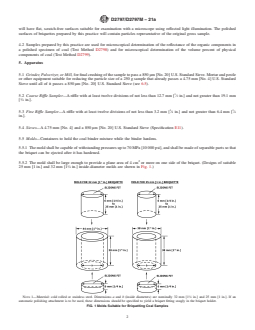
5.5.2 The mold shall be large enough to provide a plane area of 4 cm or more on one side of the briquet. (Designs of suitable
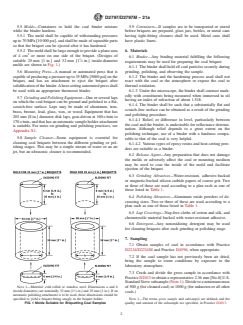
25 mm [1 in.] and 32 mm [1 ⁄4 in.] inside-diameter molds are shown in Fig. 1.)
NOTE 1—Material: cold rolled or stainless steel. Dimensions a and b (inside diameters) are nominally 32 mm [1 ⁄4 in.] and 25 mm [1 in.]. If an
automatic polishing attachment is to be used, these dimensions should be specified to yield a briquet fitting snugly in the briquet holder.
FIG. 1 Molds Suitable for Briquetting Coal Samples
D2797/D2797M − 21a
5.6 Mounting Press—A manual or automated press that is capable of producing a pressure up to 35 MPa [5000 psi] on the briquet,
and has an attachment to eject the briquet after solidification of the binder. A heat-setting automated press shall be used with an
appropriate thermoset binder.
5.7 Grinding and Polishing Equipment—One or several laps on which the coal briquet can be ground and polished to a flat,
scratch-free surface. Laps may be made of aluminum, iron, brass, bronze, lead, glass, wax, or wood. Equipment that has 203 mm
[8 in.] diameter disk laps, gear-driven at 160 r ⁄min to 170 r ⁄min, and that has an automatic sample holder attachment is suitable.
For notes on grinding and polishing practices, see Appendix X1.
5.8 Sample Cleaner—Some equipment is essential for cleaning coal briquets between the different grinding or polishing stages.
This may be a simple stream of water or an air jet, but an ultrasonic cleaner is recommended.
5.9 Containers—If samples are to be transported or stored before briquets are prepared, glass jars, bottles, or metal cans having
tight-fitting closures shall be used. Metal cans shall have plastic liners.
6. Materials
6.1 Binder—Any binding material fulfilling the following requirements may be used for preparing the coal briquet:
6.1.1 The binder shall hold all coal particles securely during grinding, polishing, and observing the sample.
6.1.2 The binder and the hardening process used shall not react with the coal or the atmosphere or expose the coal to thermal
oxidation.
6.1.3 Under the microscope, the binder shall contrast markedly with constituents being measured when immersed in oil having
an index of refraction of about 1.518.
6.1.4 The binder shall be such that a substantially flat and scratch-free surface can be obtained as a result of the grinding and
polishing procedure.
6.1.4.1 Relief, or difference in level, particularly between the coal and the binder, is undesirable for reflectance determination.
Although relief depends to a great extent on the polishing technique, use of a binder with a hardness comparable to that of the coal
is very helpful.
6.1.4.2 Various types of epoxy resins and heat-setting powders are suitable as a binder.
6.2 Release Agent—Any preparation that does not damage the molds or adversely affect the coal or mounting medium may be used
to coat the inside of the mold and facilitate ejection of the briquet.
6.3 Grinding Abrasives—Water-resistant, adhesive-backed or magnetic-backed silicon carbide papers of grit Nos. 240, 320, 400,
and 600. coarse grit. Two or three of these are used according to a plan such as one of those listed in Table 1.
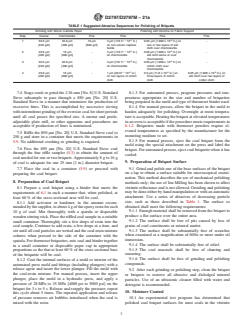
TABLE 1 Suggested Abrasive Sequences for Polishing of Briquets
Grinding with Silicon Carbide Paper Polishing with Alumina on Fabric Support
Step Coarse Intermediate Fine Fine Fine Fine
-6 -6
1 53.5 μm 23.6 μm 16 μm 3 μm [118.11 * 10 in.] 0.05 μm [1.968 x 10 in.] on -
[240 grit] [400 grit] [600 grit] on non-woven napless one or two layers of silk
textile cloth over chemotextile
-6 -6
2 23.6 μm 16 μm - 3 μm [118.11 * 10 in.] 0.05 μm [1.968 x 10 in.] on -
[400 grit] [600 grit] on chemotextile silk cloth alone or over
chemotextile
-6 -6
3 53.5 μm 23.6 μm - 3 μm [118.11 * 10 in.] 0.05 μm [1.968 x 10 in.] on -
[240 grit] [400 grit] on chemotextile cotton cloth over
chemotextile
-6 -6 -6
4 23.6 μm 16 μm - 1 μm [39.37 * 10 in.] 0.3 μm [11.8 x 10 in.] on 0.05 μm [1.968 x 10 in.] on
[400 grit] [600 grit] on two layers of cotton three layers of cotton silk cloth over two layers of
cloth cloth cotton cloth
D2797/D2797M − 21a
6.4 Polishing Abrasives—Aluminum oxide powders of 3 μm, 1 μm, 0.3 μm, and 0.05 μm decreasing sizes. Two or three of these
are used according to a plan such as one of those listed in Table 1.
6.5 Lap Coverings—Nap-free cloths of cotton and silk, and chemotextile material backed with water-resistant adhesive.
6.6 Detergent—Any nonoxidizing detergent may be used for cleaning briquets after each grinding or polishing stage.
7. Sampling
7.1 Obtain samples of coal in accordance w
...