

ASTM E609-23
(Terminology)Standard Terminology Relating to Pesticides
General Information
- Abstract
- Status
- Published
- Publication Date
- 31-Dec-2022
- Technical Committee
- E35 - Pesticides, Antimicrobials, and Alternative Control Agents
- Drafting Committee
- E35.22 - Pesticide Formulations and Delivery Systems



Overview
ASTM E609-23: Standard Terminology Relating to Pesticides offers a comprehensive, standardized vocabulary for professionals working with pesticides. Developed by ASTM Committee E35 on Pesticides, Antimicrobials, and Alternative Control Agents, this standard provides precise definitions for terms commonly used in pesticide science, formulation, application, and safety documentation. By harmonizing terminology, ASTM E609-23 ensures clear communication and understanding among manufacturers, applicators, researchers, regulators, and other stakeholders in the pesticide industry.
Key Topics
ASTM E609-23 defines technical terminology fundamental to the formulation, application, and regulation of pesticides. Important defined terms include:
- Absorption: Describes the process by which one material takes in another.
- Surfactants: Includes amphoteric, anionic, and nonionic surfactants used to enhance spreading, emulsifying, and dispersing of pesticide formulations.
- Application Methods: Explains types such as band application, broadcast application, directed application, soil application, and soil injection.
- Formulation Components: Covers ingredients like carriers, diluents, binders, emulsifiers, suspension stabilizers, and thickeners.
- Pesticide Types: Specifies avicide, piscicide, contact herbicide, preemergence and postemergence herbicides, among others.
- Performance Factors: Defines concepts like drift, rainfastness, volatility reduction, and corrosion inhibition.
- Toxicological and Environmental Terms: Includes dermal toxicity, carrier, carcinogen, parasitic and systemic disease, and preservative.
These terms are essential for correct product labeling, regulatory compliance, and technical documentation across agriculture, horticulture, pest control, and environmental protection.
Applications
The consistent terminology outlined in ASTM E609-23 is critical across several practical domains:
- Product Development & Manufacturing: Ensures formulation scientists and quality control professionals use harmonized terms for components and properties in product specifications and technical sheets.
- Regulatory Compliance: Regulatory bodies and compliance officers reference these definitions to align with industry-standard language in documentation, safety data sheets, and registration dossiers.
- Training & Safety: Enhances clarity in training materials for pesticide applicators and field personnel, supporting correct handling, application, and hazard communication.
- Research & Innovation: Researchers and technical experts rely on standard definitions for accurate reporting and interpretation of scientific studies and efficacy trials.
- International Trade: Facilitates mutual understanding between suppliers, regulators, and customers worldwide by establishing a shared language for products and procedures.
By using ASTM E609-23, organizations can reduce ambiguity, prevent misinterpretation, and support safe, responsible pesticide use.
Related Standards
ASTM E609-23 frequently references and aligns with other industry and regulatory standards:
- ASTM D483 - Test Method for Unsulfonated Residue of Petroleum Plant Spray Oils
- ASTM D1160 - Test Method for Distillation of Petroleum Products at Reduced Pressure
- FDA 21CFR178.3620(c) - Regulations relating to mineral oil used in pesticide formulations
Organizations may also consult related standards from ASTM and other bodies addressing pesticide formulation, application equipment, environmental and safety testing, and agricultural chemicals management.
Practical Value
Adopting ASTM E609-23 as the core reference for pesticide terminology promotes clear communication, regulatory alignment, safety awareness, and technical consistency across the entire pesticide supply chain. Whether you are developing, registering, distributing, or using pesticide products, referencing this standard minimizes misunderstandings and enhances operational effectiveness in the global pesticides industry.
Relations
- Refers
ASTM D483-04(2018) - Standard Test Method for Unsulfonated Residue of Petroleum Plant Spray Oils - Effective Date
- 01-Oct-2018
- Refers
ASTM D1160-15 - Standard Test Method for Distillation of Petroleum Products at Reduced Pressure - Effective Date
- 01-Feb-2015
- Refers
ASTM D483-04(2014) - Standard Test Method for Unsulfonated Residue of Petroleum Plant Spray Oils - Effective Date
- 01-May-2014
- Refers
ASTM D1160-13 - Standard Test Method for Distillation of Petroleum Products at Reduced Pressure - Effective Date
- 01-Oct-2013
- Refers
ASTM D1160-12 - Standard Test Method for Distillation of Petroleum Products at Reduced Pressure - Effective Date
- 01-Dec-2012
- Refers
ASTM D483-04(2009)e1 - Standard Test Method for Unsulfonated Residue of Petroleum Plant Spray Oils - Effective Date
- 15-Apr-2009
- Refers
ASTM D1160-06 - Standard Test Method for Distillation of Petroleum Products at Reduced Pressure - Effective Date
- 01-Jul-2006
- Effective Date
- 01-Dec-2004
- Refers
ASTM D1160-03 - Standard Test Method for Distillation of Petroleum Products at Reduced Pressure - Effective Date
- 10-Jun-2003
- Refers
ASTM D1160-02a - Standard Test Method for Distillation of Petroleum Products at Reduced Pressure - Effective Date
- 10-Apr-2002
- Refers
ASTM D1160-99 - Standard Test Method for Distillation of Petroleum Products at Reduced Pressure - Effective Date
- 10-Jan-2002
- Effective Date
- 10-Dec-2000
Get Certified
Connect with accredited certification bodies for this standard

Control Union Certifications
Global certification for agriculture and sustainability.

ECOCERT
Organic and sustainability certification.

FSC International
Forest Stewardship Council certification.
Sponsored listings
Frequently Asked Questions
ASTM E609-23 is a standard published by ASTM International. Its full title is "Standard Terminology Relating to Pesticides". This standard covers: Standard Terminology Relating to Pesticides
Standard Terminology Relating to Pesticides
ASTM E609-23 is classified under the following ICS (International Classification for Standards) categories: 01.040.65 - Agriculture (Vocabularies); 65.100.01 - Pesticides and other agrochemicals in general. The ICS classification helps identify the subject area and facilitates finding related standards.
ASTM E609-23 has the following relationships with other standards: It is inter standard links to ASTM D483-04(2018), ASTM D1160-15, ASTM D483-04(2014), ASTM D1160-13, ASTM D1160-12, ASTM D483-04(2009)e1, ASTM D1160-06, ASTM D483-04, ASTM D1160-03, ASTM D1160-02a, ASTM D1160-99, ASTM D483-00. Understanding these relationships helps ensure you are using the most current and applicable version of the standard.
ASTM E609-23 is available in PDF format for immediate download after purchase. The document can be added to your cart and obtained through the secure checkout process. Digital delivery ensures instant access to the complete standard document.
Standards Content (Sample)
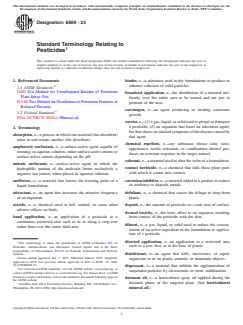
This international standard was developed in accordance with internationally recognized principles on standardization established in the Decision on Principles for the
Development of International Standards, Guides and Recommendations issued by the World Trade Organization Technical Barriers to Trade (TBT) Committee.
Designation: E609 − 23
Standard Terminology Relating to
Pesticides
This standard is issued under the fixed designation E609; the number immediately following the designation indicates the year of
original adoption or, in the case of revision, the year of last revision. A number in parentheses indicates the year of last reapproval. A
superscript epsilon (´) indicates an editorial change since the last revision or reapproval.
1. Referenced Documents binder, n—a substance used in dry formulations to produce or
enhance cohesion of solid particles.
1.1 ASTM Standards:
D483 Test Method for Unsulfonated Residue of Petroleum
broadcast application, n—the distribution of a material uni-
Plant Spray Oils
formly over the entire area to be treated and not just to
D1160 Test Method for Distillation of Petroleum Products at
portions of the area.
Reduced Pressure
carcinogen, n—an agent producing or inciting cancerous
1.2 Federal Standard:
growth.
FDA 21CFR178.3620(c) Mineral oil
carrier,n—(1)agas,liquid,orsolidusedtopropel or transport
a pesticide; (2) an organism that bears an infectious agent,
2. Terminology
butthatshowsnomarkedsymptomsofthediseasecausedby
absorption,n—aprocessinwhichonematerial(theabsorbent)
that agent.
takes in and retains another (the absorbate).
chemical repellent, n—any substance whose odor, taste,
amphoteric surfactant, n—a surface-active agent capable of
appearance, tactile sensation, or combination thereof pro-
forming, in aqueous solution, either surface-active anions or
duces an aversion response in the target animal.
surface-active cations depending on the pH.
colorant,n—a material used to alter the color of a formulation.
anionic surfactant, n—surface-active agent in which the
contact herbicide, n—a chemical that kills those plant parts
hydrophilic portion of the molecule forms exclusively a
negative ion (anion) when placed in aqueous solution. with which it comes into contact.
antifreeze, n—a material that lowers the freezing point of a corrosion inhibitor,n—amaterialaddedtoaproducttoreduce
liquid formulation. its tendency to degrade metals.
attractant, n—an agent that increases the attentive frequency defoliant, n—a chemical that causes the foliage to drop from
plants.
of an organism.
avicide, n—a chemical used to kill, control, or cause other deposit, n—the amount of pesticide on a unit area of surface.
adverse effects on birds.
dermal toxicity, n—the toxic effect to an organism resulting
band application, n—an application of a pesticide to a from contact of the pesticide with the skin.
continuous restricted area such as in or along a crop row
diluent, n—a gas, liquid, or solid used to reduce the concen-
rather than over the entire field area.
tration of an active ingredient in the formulation or applica-
tion of a pesticide.
directed application, n—an application to a restricted area
This terminology is under the jurisdiction of ASTM Committee E35 on
Pesticides, Antimicrobials, and Alternative Control Agents and is the direct such as a row, bed, or at the base of plants.
responsibility of Subcommittee E35.22 on Pesticide Formulations and Delivery
Systems. disinfestant, n—an agent that kills, inactivates, or repels
Current edition approved Jan. 1, 2023. Published January 2023. Originally
organisms in or on plants, animals, or inanimate objects.
approved in 1978. Last previous edition approved in 2021 as E609 – 21. DOI:
10.1520/E0609-23.
dispersant, n—a material that inhibits the agglomeration of
For referenced ASTM standards, visit the ASTM website, www.astm.org, or
suspended particles by electrostatic or steric stabilization.
contact ASTM Customer Service at service@astm.org. For Annual Book of ASTM
Standards volume information, refer to the standard’s Document Summary page on
dormant oil, n—a horticultural spray oil applied during the
the ASTM website.
dormant phase of the targeted plant. (See horticultural
Available from DLA Document Services, Building 4/D, 700 Robbins Ave.,
Philadelphia, PA 19111-5094, http://quicksearch.dla.mil. mineral oil.)
Copyright © ASTM International, 100 Barr Harbor Drive, PO Box C700, West Conshohocken, PA 19428-2959. United States
E609 − 23
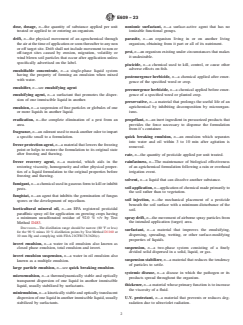
dose, dosage, n—the quantity of substance applied per unit nonionic surfactant, n—a surface-active agent that has no
treated or applied to or entering an organism. ionizable functional groups.
drift, n—the physical movement of an agrochemical through
parasite, n—an organism living in or on another living
theairatthetimeofapplicationorsoonthereaftertoanynon organism, obtaining from it part or all of its nutriment.
or off target site. Drift shall not include movement to non or
pest, n—an organism existing under circumstances that makes
off-target sites caused by erosion, migration, volatility or
it undesirable.
wind blown soil particles that occur after application unless
specifically advertised on the label.
piscicide,
...
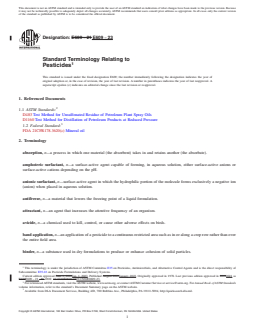
This document is not an ASTM standard and is intended only to provide the user of an ASTM standard an indication of what changes have been made to the previous version. Because
it may not be technically possible to adequately depict all changes accurately, ASTM recommends that users consult prior editions as appropriate. In all cases only the current version
of the standard as published by ASTM is to be considered the official document.
Designation: E609 − 21 E609 − 23
Standard Terminology Relating to
Pesticides
This standard is issued under the fixed designation E609; the number immediately following the designation indicates the year of
original adoption or, in the case of revision, the year of last revision. A number in parentheses indicates the year of last reapproval. A
superscript epsilon (´) indicates an editorial change since the last revision or reapproval.
1. Referenced Documents
1.1 ASTM Standards:
D483 Test Method for Unsulfonated Residue of Petroleum Plant Spray Oils
D1160 Test Method for Distillation of Petroleum Products at Reduced Pressure
1.2 Federal Standard:
FDA 21CFR178.3620(c) Mineral oil
2. Terminology
absorption, n—a process in which one material (the absorbent) takes in and retains another (the absorbate).
amphoteric surfactant, n—a surface-active agent capable of forming, in aqueous solution, either surface-active anions or
surface-active cations depending on the pH.
anionic surfactant, n—surface-active agent in which the hydrophilic portion of the molecule forms exclusively a negative ion
(anion) when placed in aqueous solution.
antifreeze, n—a material that lowers the freezing point of a liquid formulation.
attractant, n—an agent that increases the attentive frequency of an organism.
avicide, n—a chemical used to kill, control, or cause other adverse effects on birds.
band application, n—an application of a pesticide to a continuous restricted area such as in or along a crop row rather than over
the entire field area.
binder, n—a substance used in dry formulations to produce or enhance cohesion of solid particles.
This terminology is under the jurisdiction of ASTM Committee E35 on Pesticides, Antimicrobials, and Alternative Control Agents and is the direct responsibility of
Subcommittee E35.22 on Pesticide Formulations and Delivery Systems.
Current edition approved June 1, 2021Jan. 1, 2023. Published August 2021January 2023. Originally approved in 1978. Last previous edition approved in 20192021 as
E609E609 – 21.–19. DOI: 10.1520/E0609-2110.1520/E0609-23.
For referenced ASTM standards, visit the ASTM website, www.astm.org, or contact ASTM Customer Service at service@astm.org. For Annual Book of ASTM Standards
volume information, refer to the standard’s Document Summary page on the ASTM website.
Available from DLA Document Services, Building 4/D, 700 Robbins Ave., Philadelphia, PA 19111-5094, http://quicksearch.dla.mil.
Copyright © ASTM International, 100 Barr Harbor Drive, PO Box C700, West Conshohocken, PA 19428-2959. United States
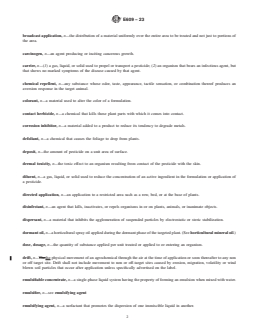
E609 − 23
broadcast application, n—the distribution of a material uniformly over the entire area to be treated and not just to portions of
the area.
carcinogen, n—an agent producing or inciting cancerous growth.
carrier, n—(1) a gas, liquid, or solid used to propel or transport a pesticide; (2) an organism that bears an infectious agent, but
that shows no marked symptoms of the disease caused by that agent.
chemical repellent, n—any substance whose odor, taste, appearance, tactile sensation, or combination thereof produces an
aversion response in the target animal.
colorant, n—a material used to alter the color of a formulation.
contact herbicide, n—a chemical that kills those plant parts with which it comes into contact.
corrosion inhibitor, n—a material added to a product to reduce its tendency to degrade metals.
defoliant, n—a chemical that causes the foliage to drop from plants.
deposit, n—the amount of pesticide on a unit area of surface.
dermal toxicity, n—the toxic effect to an organism resulting from contact of the pesticide with the skin.
diluent, n—a gas, liquid, or solid used to reduce the concentration of an active ingredient in the formulation or application of
a pesticide.
directed application, n—an application to a restricted area such as a row, bed, or at the base of plants.
disinfestant, n—an agent that kills, inactivates, or repels organisms in or on plants, animals, or inanimate objects.
dispersant, n—a material that inhibits the agglomeration of suspended particles by electrostatic or steric stabilization.
dormant oil, n—a horticultural spray oil applied during the dormant phase of the targeted plant. (See horticultural mineral oil.)
dose, dosage, n—the quantity of substance applied per unit treated or applied to or entering an organism.
drift, n—Thethe physical movement of an agrochemical through the air at the time of application or soon thereafter to any non
or off target site. Drift shall not include movement to non or off-target sites caused by erosion, migration, volatility or wind
blown soil particles that occur after application unless specifically advertised on the label.
emulsifiable concentrate, n—a single-phase liquid system having the property of forming an emulsion when mixed with water.
emulsifier, n—see emulsifying agent
emulsifying agent, n—a surfactant that promotes the dispersion
...