


ASTM D7613-17(2019)
(Specification)Standard Specification for Flexible Polypropylene Reinforced (fPP-R) and Nonreinforced (fPP) Geomembranes
Standard Specification for Flexible Polypropylene Reinforced (fPP-R) and Nonreinforced (fPP) Geomembranes
SCOPE
1.1 This specification covers flexible polypropylene reinforced (fPP-R) and nonreinforced (fPP) geomembranes made from flexible polypropylene as the principal polymer prepared by the polymerization of propylene with or without other alpha olefin monomers.
1.2 The tests and property limits used to characterize the sheet are values intended to ensure minimum quality. In-place system design criteria, such as field-seaming strength and material compatibility, among others, are factors that should be considered but are beyond the scope of this specification.
1.3 The values stated in SI units are to be regarded as standard. No other units of measurement are included in this standard.
1.4 This standard does not purport to address all of the safety concerns, if any, associated with its use. It is the responsibility of the user of this standard to establish appropriate safety, health, and environmental practices and determine the applicability of regulatory limitations prior to use.
1.5 This international standard was developed in accordance with internationally recognized principles on standardization established in the Decision on Principles for the Development of International Standards, Guides and Recommendations issued by the World Trade Organization Technical Barriers to Trade (TBT) Committee.
General Information
Buy Standard
Standards Content (Sample)
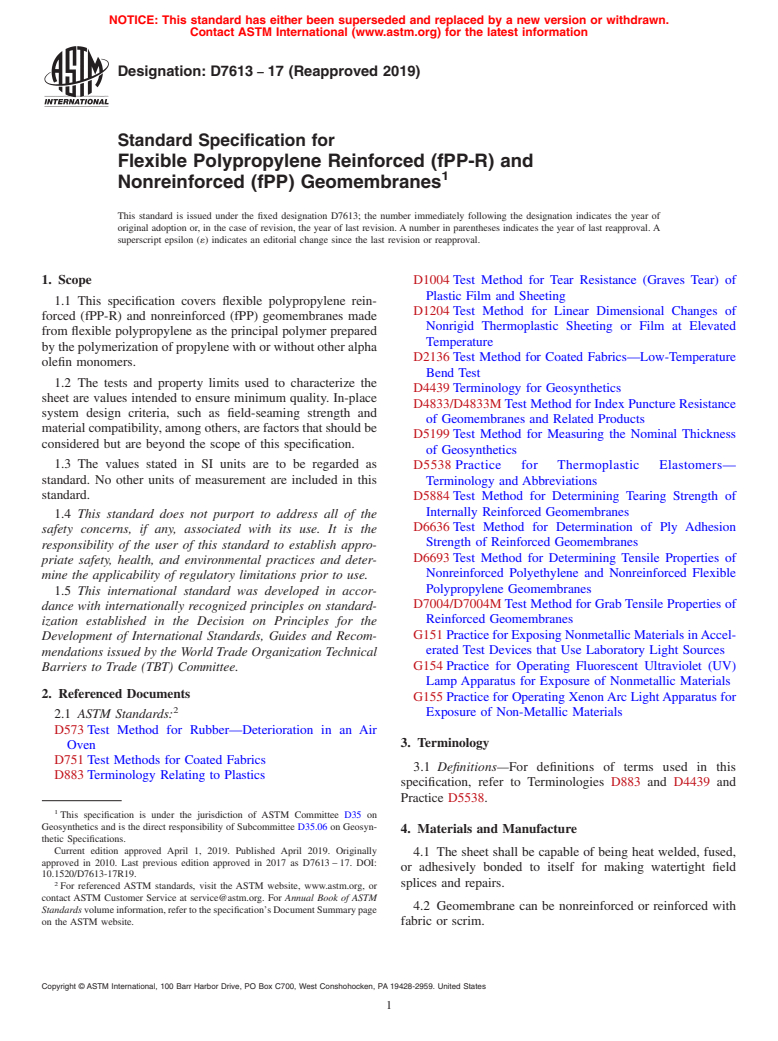
NOTICE: This standard has either been superseded and replaced by a new version or withdrawn.
Contact ASTM International (www.astm.org) for the latest information
Designation: D7613 − 17 (Reapproved 2019)
Standard Specification for
Flexible Polypropylene Reinforced (fPP-R) and
Nonreinforced (fPP) Geomembranes
This standard is issued under the fixed designation D7613; the number immediately following the designation indicates the year of
original adoption or, in the case of revision, the year of last revision. A number in parentheses indicates the year of last reapproval. A
superscript epsilon (´) indicates an editorial change since the last revision or reapproval.
1. Scope D1004 Test Method for Tear Resistance (Graves Tear) of
Plastic Film and Sheeting
1.1 This specification covers flexible polypropylene rein-
D1204 Test Method for Linear Dimensional Changes of
forced (fPP-R) and nonreinforced (fPP) geomembranes made
Nonrigid Thermoplastic Sheeting or Film at Elevated
from flexible polypropylene as the principal polymer prepared
Temperature
by the polymerization of propylene with or without other alpha
D2136 Test Method for Coated Fabrics—Low-Temperature
olefin monomers.
Bend Test
1.2 The tests and property limits used to characterize the
D4439 Terminology for Geosynthetics
sheet are values intended to ensure minimum quality. In-place
D4833/D4833M Test Method for Index Puncture Resistance
system design criteria, such as field-seaming strength and
of Geomembranes and Related Products
material compatibility, among others, are factors that should be
D5199 Test Method for Measuring the Nominal Thickness
considered but are beyond the scope of this specification.
of Geosynthetics
1.3 The values stated in SI units are to be regarded as D5538 Practice for Thermoplastic Elastomers—
standard. No other units of measurement are included in this
Terminology and Abbreviations
standard.
D5884 Test Method for Determining Tearing Strength of
Internally Reinforced Geomembranes
1.4 This standard does not purport to address all of the
D6636 Test Method for Determination of Ply Adhesion
safety concerns, if any, associated with its use. It is the
Strength of Reinforced Geomembranes
responsibility of the user of this standard to establish appro-
D6693 Test Method for Determining Tensile Properties of
priate safety, health, and environmental practices and deter-
Nonreinforced Polyethylene and Nonreinforced Flexible
mine the applicability of regulatory limitations prior to use.
Polypropylene Geomembranes
1.5 This international standard was developed in accor-
D7004/D7004M Test Method for Grab Tensile Properties of
dance with internationally recognized principles on standard-
Reinforced Geomembranes
ization established in the Decision on Principles for the
G151 Practice for Exposing Nonmetallic Materials in Accel-
Development of International Standards, Guides and Recom-
erated Test Devices that Use Laboratory Light Sources
mendations issued by the World Trade Organization Technical
G154 Practice for Operating Fluorescent Ultraviolet (UV)
Barriers to Trade (TBT) Committee.
Lamp Apparatus for Exposure of Nonmetallic Materials
2. Referenced Documents
G155 Practice for Operating Xenon Arc Light Apparatus for
Exposure of Non-Metallic Materials
2.1 ASTM Standards:
D573 Test Method for Rubber—Deterioration in an Air
3. Terminology
Oven
D751 Test Methods for Coated Fabrics
3.1 Definitions—For definitions of terms used in this
D883 Terminology Relating to Plastics
specification, refer to Terminologies D883 and D4439 and
Practice D5538.
This specification is under the jurisdiction of ASTM Committee D35 on
Geosynthetics and is the direct responsibility of Subcommittee D35.06 on Geosyn-
4. Materials and Manufacture
thetic Specifications.
Current edition approved April 1, 2019. Published April 2019. Originally
4.1 The sheet shall be capable of being heat welded, fused,
approved in 2010. Last previous edition approved in 2017 as D7613 – 17. DOI:
or adhesively bonded to itself for making watertight field
10.1520/D7613-17R19.
splices and repairs.
For referenced ASTM standards, visit the ASTM website, www.astm.org, or
contact ASTM Customer Service at service@astm.org. For Annual Book of ASTM
4.2 Geomembrane can be nonreinforced or reinforced with
Standards volume information, refer to the specification’s Document Summary page
on the ASTM website. fabric or scrim.
Copyright © ASTM International, 100 Barr Harbor Drive, PO Box C700, West Conshohocken, PA 19428-2959. United States
D7613 − 17 (2019)
5. Chemical Composition nicks and cuts, voids, thin areas, delaminations, or other
manufacturing defects that might adversely affect serviceabil-
5.1 The geomembrane shall be formulated from virgin
ity.
flexible polypropylene, in amounts greater than 85 %, by
weight of the total polymer content. The remaining 15 % shall
9. Test Methods
be comprised of compatible polymers or pigments (or both),
stabilizers, and colorants that are suitably compounded to
9.1 Dimensions—Test Methods D751 for reinforced and
satisfy the physical requirements in the specification (see
nonreinforced, after permitting the sheet to relax at 23 °C for
Practice D5538 for definitions).
1 h.
NOTE 1—The compound shall not contain postconsumer (PCR) com- 9.2 Thickness—Test Method D5199 for reinforced and non-
ponents containing bitumen or any other ingredients that could interfere
reinforced.
with the long-term stability of the geomembrane. No more than 10 %
9.3 Thickness of Coating Over Scrim (Reinforcing
rework resin is allowed for the production of the membrane and shall be
fully compatible with the parent material.
Fabric)—Optical method described in Annex A1 for rein-
forced.
6. Properties
9.4 Breaking Strength—Test Method D7004/D7004M for
6.1 Each sheet specimen shall meet or exceed the property
reinforced.
requirements prescribed in Table 1 (fPP-R) or Table 2 (fPP).
9.5 Tensile Strength—Test Method D6693 for nonrein-
6.2 The tolerance for time conditions (aging, weathering,
forced.
and so forth) is 615 min or 61 % of the period, whichever is
9.6 Elongation at Break—Test Method D7004/D7004M for
greater, unless otherwise specified.
reinforced.
6.3 The tolerance for temperature conditions (aging and so
9.7 Ultimate Elongation %—Test Method D6693 for non-
forth) is 62 °C of the specified temperature, unless otherwise
reinforced.
specified.
9.8 Tearing Strength—Test Method D5884 for reinforced.
7. Dimensions, Mass, and Permissible Variations
9.9 Tear Resistance—Test Method D1004 for nonrein-
7.1 The width and length of the sheet shall be agreed upon
forced.
between the purchaser and the supplier.
9.10 Low-Temperature Bend—Test Method D2136 at
7.2 The tolerance for both width and length shall be +3 %,
–40 °C for reinforced and nonreinforced.
–1 %.
9.11 Heat Aging—Test Method D573 for reinforced and
7.3 The thickness tolerance shall be +15 %, –10 % of
nonreinforced.
thickness agreed upon by the purchaser and supplier, but in no
9.11.1 Age sheet specimens for 670 h at 116 °C.
case shall the thickness be less than the minimum in Table 1 or
9.11.2 After exposure, remove the sheet specimens from the
Table 2.
oven.
9.11.3 Specimens are then cut from the aged sheet for
8. Workmanship, Finish, and Appearance
testing of breaking or tensile strength, elongation at break or
8.1 The sheet, including factory seams, if present, shall be ultimate elongation, and tearing strength or resistance.
watertight and free of pinholes, particles of foreign matter, 9.11.4 Specimens are then wrapped around a 75-mm diam-
protruding fibers or reinforcement, undispersed raw material, eter mandrel.
TABLE 1 Property Requirements for Flexible Polypropylene Reinforced (fPP-R)
Nominal Thickness, mm [in.]
Property Requirements Method
0.76 [0.030] 0.91 [0.036] 1.14 [0.045] 1.52 [0.060]
Thickness, minimum average, mm [in.] D5199 0.68 [0.027] 0.82 [0.032] 1.03 [0.040] 1.35 [0.054]
Thickness over scrim, minimum, mm [in.] Annex A1 0.20 [0.008] 0.25 [0.010] 0.33 [0.013] 0.46 [0.018]
Breaking strength, minimum, N [lbf] D7004/D7004M 750 [170] 890 [200] 1100 [250] 1100 [250]
Elongation at break, minimum, % D7004/D7004M 15 15 15 15
Tearing strength, minimum N [lbf] D5884 220 [50] 244 [55] 310 [70] 310 [70]
Low-temperature bend, °C [°F] D2136 –40 [–40] –40 [–40] –40 [–40] –40 [–40]
Properties after heat aging & weathering D573, G151, G154,
G155
Retention of breaking strength, minimum, % 85 85 85 85
Retention of elongation at break, minimum, % 85 85 85 85
Retention of tearing strength, minimum, % 60 60 60 60
Visual inspection, no cracks or crazing (10×) Pass Pass Pass Pass
Linear dimensional change, maximum change, % D1204 1.0 1.0 1.0 1.0
Puncture resistance, minimum, N [lbf] D4833/D4833M 220 [50] 330 [75] 378 [85] 400 [90]
Factory prepared, ply adhesion strength, D6636 2630 [15] 2630 [15] 2630 [15] 2630 [15]
minimum, N/m [lbf/in.]
D7613 − 17 (2019)
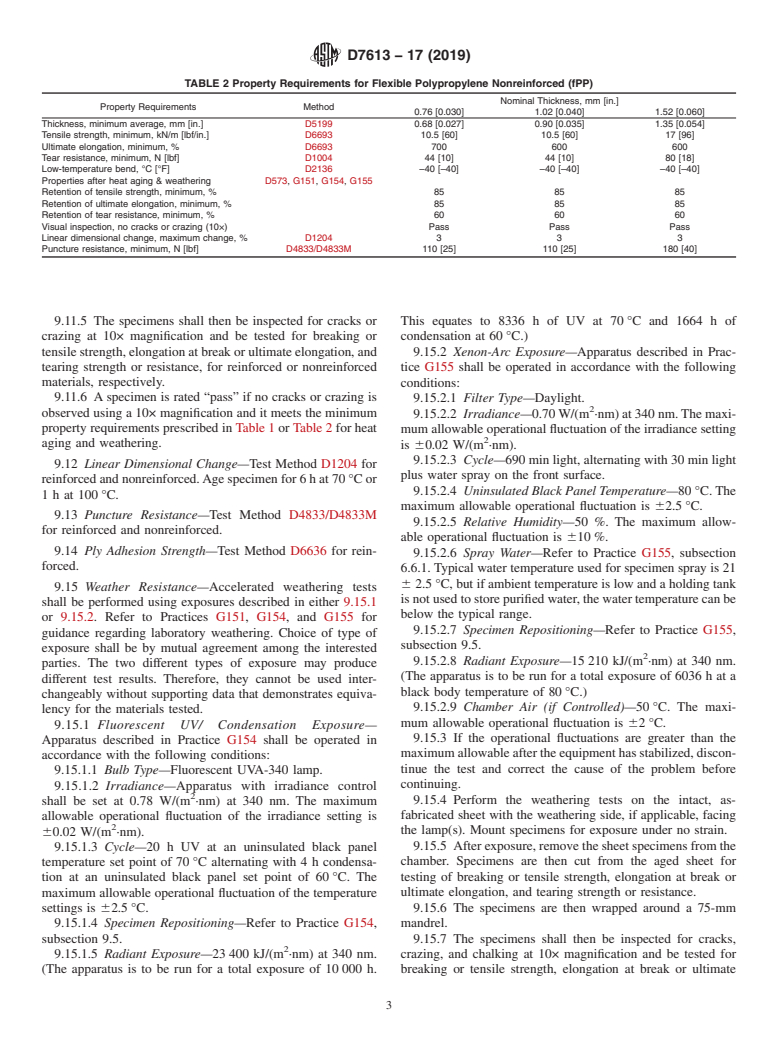
TABLE 2 Property Requirements for Flexible Polypropylene Nonreinforced (fPP)
Nominal Thickness, mm [in.]
Property Requirements Method
0.76 [0.030] 1.02 [0.040] 1.52 [0.060]
Thickness, minimum average, mm [in.] D5199 0.68 [0.027] 0.90 [0.035] 1.35 [0.054]
Tensile strength, minimum, kN/m [lbf/in.] D6693 10.5 [60] 10.5 [60] 17 [96]
Ultimate elongation, minimum, % D6693 700 600 600
Tear resistance, minimum, N [lbf] D1004 44 [10] 44 [10] 80 [18]
Low-temperature bend, °C [°F] D2136 –40 [–40] –40 [–40] –40 [–40]
Properties after heat aging & weathering D573, G151, G154, G155
Retention of tensile strength, minimum, % 85 85 85
Retention of ultimate elongation, minimum, % 85 85 85
Retention of tear resistance, minimum, % 60 60 60
Visual inspection, no cracks or crazing (10×) Pass Pass Pass
Linear dimensional change, maximum change, % D1204 3 3 3
Puncture resistance, minimum, N [lbf] D4833/D4833M 110 [25] 110 [25] 180 [40]
9.11.5 The specimens shall then be inspected for cracks or This equates to 8336 h of UV at 70 °C and 1664 h of
crazing at 10× magnification and be tested for breaking or condensation at 60 °C.)
tensile strength, elongation at break or ultimate elongation, and 9.15.2 Xenon-Arc Exposure—Apparatus described in Prac-
tearing strength or resistance, for reinforced or nonreinforced tice G155 shall be operated in accordance with the following
materials, respectively. con
...
This document is not an ASTM standard and is intended only to provide the user of an ASTM standard an indication of what changes have been made to the previous version. Because
it may not be technically possible to adequately depict all changes accurately, ASTM recommends that users consult prior editions as appropriate. In all cases only the current version
of the standard as published by ASTM is to be considered the official document.
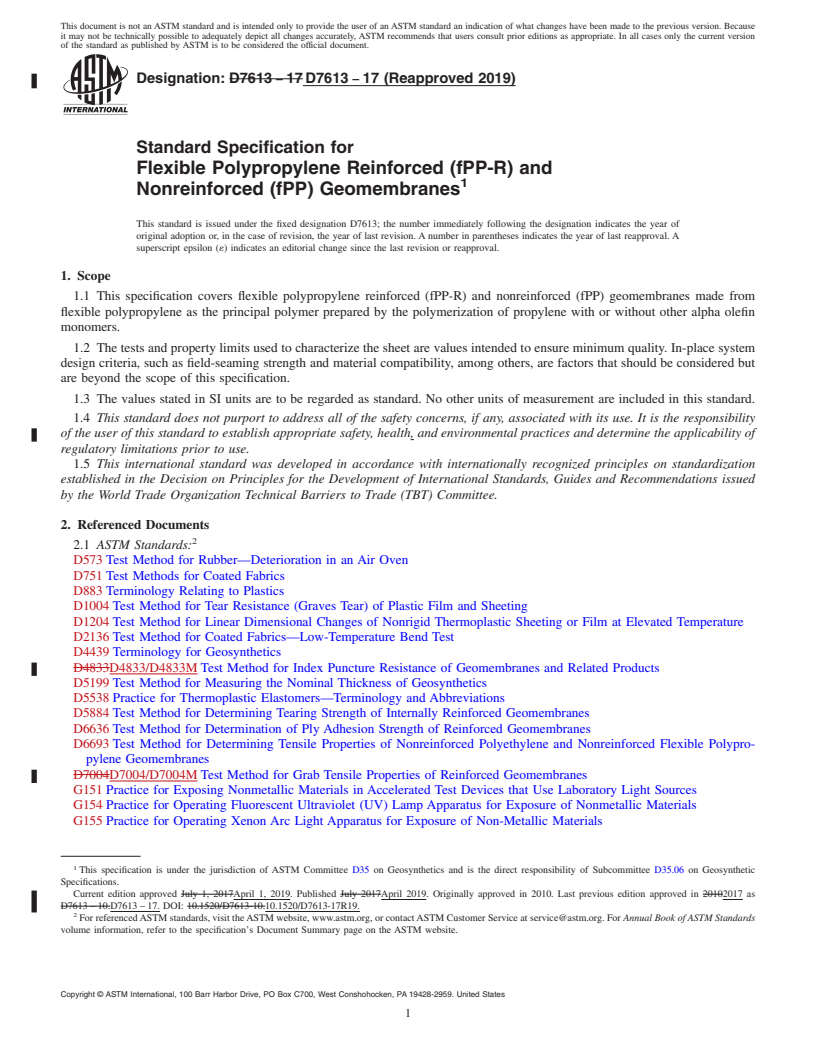
Designation: D7613 − 17 D7613 − 17 (Reapproved 2019)
Standard Specification for
Flexible Polypropylene Reinforced (fPP-R) and
Nonreinforced (fPP) Geomembranes
This standard is issued under the fixed designation D7613; the number immediately following the designation indicates the year of
original adoption or, in the case of revision, the year of last revision. A number in parentheses indicates the year of last reapproval. A
superscript epsilon (´) indicates an editorial change since the last revision or reapproval.
1. Scope
1.1 This specification covers flexible polypropylene reinforced (fPP-R) and nonreinforced (fPP) geomembranes made from
flexible polypropylene as the principal polymer prepared by the polymerization of propylene with or without other alpha olefin
monomers.
1.2 The tests and property limits used to characterize the sheet are values intended to ensure minimum quality. In-place system
design criteria, such as field-seaming strength and material compatibility, among others, are factors that should be considered but
are beyond the scope of this specification.
1.3 The values stated in SI units are to be regarded as standard. No other units of measurement are included in this standard.
1.4 This standard does not purport to address all of the safety concerns, if any, associated with its use. It is the responsibility
of the user of this standard to establish appropriate safety, health, and environmental practices and determine the applicability of
regulatory limitations prior to use.
1.5 This international standard was developed in accordance with internationally recognized principles on standardization
established in the Decision on Principles for the Development of International Standards, Guides and Recommendations issued
by the World Trade Organization Technical Barriers to Trade (TBT) Committee.
2. Referenced Documents
2.1 ASTM Standards:
D573 Test Method for Rubber—Deterioration in an Air Oven
D751 Test Methods for Coated Fabrics
D883 Terminology Relating to Plastics
D1004 Test Method for Tear Resistance (Graves Tear) of Plastic Film and Sheeting
D1204 Test Method for Linear Dimensional Changes of Nonrigid Thermoplastic Sheeting or Film at Elevated Temperature
D2136 Test Method for Coated Fabrics—Low-Temperature Bend Test
D4439 Terminology for Geosynthetics
D4833D4833/D4833M Test Method for Index Puncture Resistance of Geomembranes and Related Products
D5199 Test Method for Measuring the Nominal Thickness of Geosynthetics
D5538 Practice for Thermoplastic Elastomers—Terminology and Abbreviations
D5884 Test Method for Determining Tearing Strength of Internally Reinforced Geomembranes
D6636 Test Method for Determination of Ply Adhesion Strength of Reinforced Geomembranes
D6693 Test Method for Determining Tensile Properties of Nonreinforced Polyethylene and Nonreinforced Flexible Polypro-
pylene Geomembranes
D7004D7004/D7004M Test Method for Grab Tensile Properties of Reinforced Geomembranes
G151 Practice for Exposing Nonmetallic Materials in Accelerated Test Devices that Use Laboratory Light Sources
G154 Practice for Operating Fluorescent Ultraviolet (UV) Lamp Apparatus for Exposure of Nonmetallic Materials
G155 Practice for Operating Xenon Arc Light Apparatus for Exposure of Non-Metallic Materials
This specification is under the jurisdiction of ASTM Committee D35 on Geosynthetics and is the direct responsibility of Subcommittee D35.06 on Geosynthetic
Specifications.
Current edition approved July 1, 2017April 1, 2019. Published July 2017April 2019. Originally approved in 2010. Last previous edition approved in 20102017 as
D7613 – 10.D7613 – 17. DOI: 10.1520/D7613-10.10.1520/D7613-17R19.
For referenced ASTM standards, visit the ASTM website, www.astm.org, or contact ASTM Customer Service at service@astm.org. For Annual Book of ASTM Standards
volume information, refer to the specification’s Document Summary page on the ASTM website.
Copyright © ASTM International, 100 Barr Harbor Drive, PO Box C700, West Conshohocken, PA 19428-2959. United States
D7613 − 17 (2019)
3. Terminology
3.1 Definitions—For definitions of terms used in this specification, refer to Terminologies D883 and D4439 and Practice D5538.
4. Materials and Manufacture
4.1 The sheet shall be capable of being heat welded, fused, or adhesively bonded to itself for making watertight field splices
and repairs.
4.2 Geomembrane can be nonreinforced or reinforced with fabric or scrim.
5. Chemical Composition
5.1 The geomembrane shall be formulated from virgin flexible polypropylene, in amounts greater than 85 %, by weight of the
total polymer content. The remaining 15 % shall be comprised of compatible polymers or pigments (or both), stabilizers, and
colorants that are suitably compounded to satisfy the physical requirements in the specification (see Practice D5538 for definitions).
NOTE 1—The compound shall not contain postconsumer (PCR) components containing bitumen or any other ingredients that could interfere with the
long-term stability of the geomembrane. No more than 10 % rework resin is allowed for the production of the membrane and shall be fully compatible
with the parent material.
6. Properties
6.1 Each sheet specimen shall meet or exceed the property requirements prescribed in Table 1 (fPP-R) or Table 2 (fPP).
6.2 The tolerance for time conditions (aging, weathering, and so forth) is 615 min or 61 % of the period, whichever is greater,
unless otherwise specified.
6.3 The tolerance for temperature conditions (aging and so forth) is 62 °C of the specified temperature, unless otherwise
specified.
7. Dimensions, Mass, and Permissible Variations
7.1 The width and length of the sheet shall be agreed upon between the purchaser and the supplier.
7.2 The tolerance for both width and length shall be +3 %, –1 %.
7.3 The thickness tolerance shall be +15 %, –10 % of thickness agreed upon by the purchaser and supplier, but in no case shall
the thickness be less than the minimum in Table 1 or Table 2.
8. Workmanship, Finish, and Appearance
8.1 The sheet, including factory seams, if present, shall be watertight and free of pinholes, particles of foreign matter, protruding
fibers or reinforcement, undispersed raw material, nicks and cuts, voids, thin areas, delaminations, or other manufacturing defects
that might adversely affect serviceability.
9. Test Methods
9.1 Dimensions—Test Methods D751 for reinforced and nonreinforced, after permitting the sheet to relax at 23 °C for 1 h.
9.2 Thickness—Test Method D5199 for reinforced and nonreinforced.
TABLE 1 Property Requirements for Flexible Polypropylene Reinforced (fPP-R)
Nominal Thickness, mm [in.]
Property Requirements Method
0.76 [0.030] 0.91 [0.036] 1.14 [0.045] 1.52 [0.060]
Thickness, minimum average, mm [in.] D5199 0.68 [0.027] 0.82 [0.032] 1.03 [0.040] 1.35 [0.054]
Thickness over scrim, minimum, mm [in.] Annex A1 0.20 [0.008] 0.25 [0.010] 0.33 [0.013] 0.46 [0.018]
Breaking strength, minimum, N [lbf] D7004 750 [170] 890 [200] 1100 [250] 1100 [250]
Breaking strength, minimum, N [lbf] D7004/D7004M 750 [170] 890 [200] 1100 [250] 1100 [250]
Elongation at break, minimum, % D7004 15 15 15 15
Elongation at break, minimum, % D7004/D7004M 15 15 15 15
Tearing strength, minimum N [lbf] D5884 220 [50] 244 [55] 310 [70] 310 [70]
Low-temperature bend, °C [°F] D2136 –40 [–40] –40 [–40] –40 [–40] –40 [–40]
Properties after heat aging & weathering D573, G151, G154,
G155
Retention of breaking strength, minimum, % 85 85 85 85
Retention of elongation at break, minimum, % 85 85 85 85
Retention of tearing strength, minimum, % 60 60 60 60
Visual inspection, no cracks or crazing (10×) Pass Pass Pass Pass
Linear dimensional change, maximum change, % D1204 1.0 1.0 1.0 1.0
Puncture resistance, minimum, N [lbf] D4833 220 [50] 330 [75] 378 [85] 400 [90]
Puncture resistance, minimum, N [lbf] D4833/D4833M 220 [50] 330 [75] 378 [85] 400 [90]
Factory prepared, ply adhesion strength, D6636 2630 [15] 2630 [15] 2630 [15] 2630 [15]
minimum, N/m [lbf/in.]
D7613 − 17 (2019)
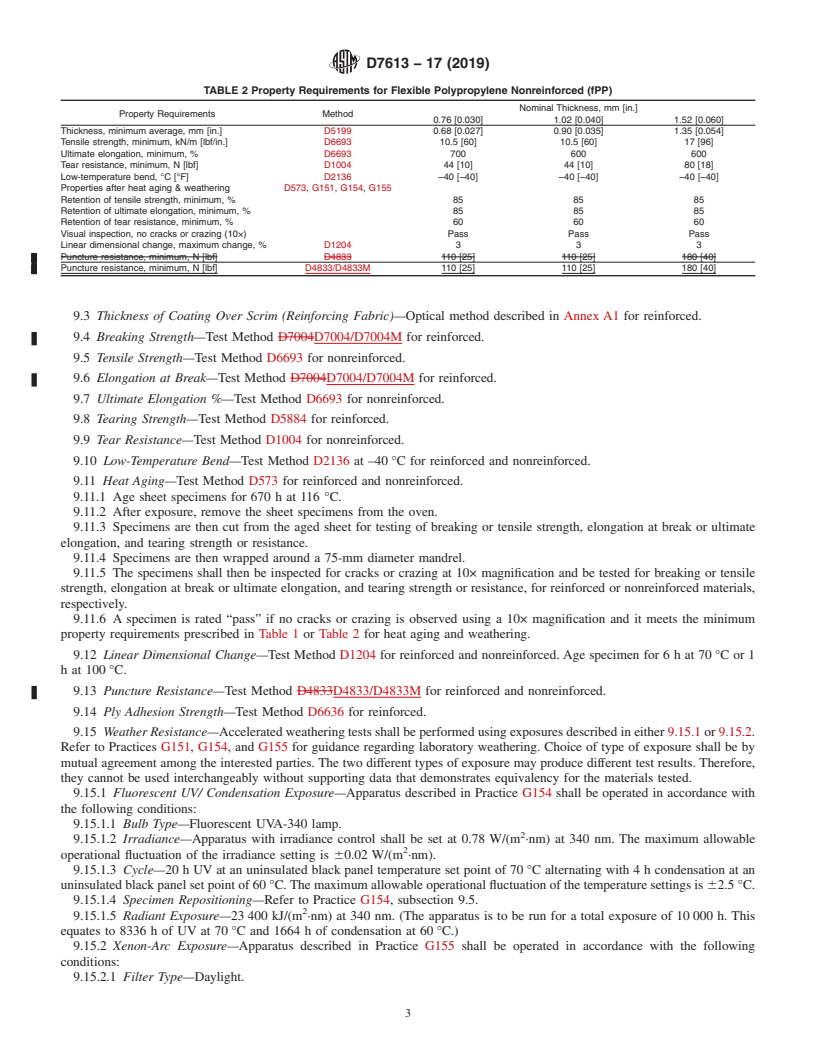
TABLE 2 Property Requirements for Flexible Polypropylene Nonreinforced (fPP)
Nominal Thickness, mm [in.]
Property Requirements Method
0.76 [0.030] 1.02 [0.040] 1.52 [0.060]
Thickness, minimum average, mm [in.] D5199 0.68 [0.027] 0.90 [0.035] 1.35 [0.054]
Tensile strength, minimum, kN/m [lbf/in.] D6693 10.5 [60] 10.5 [60] 17 [96]
Ultimate elongation, minimum, % D6693 700 600 600
Tear resistance, minimum, N [lbf] D1004 44 [10] 44 [10] 80 [18]
Low-temperature bend, °C [°F] D2136 –40 [–40] –40 [–40] –40 [–40]
Properties after heat aging & weathering D573, G151, G154, G155
Retention of tensile strength, minimum, % 85 85 85
Retention of ultimate elongation, minimum, % 85 85 85
Retention of tear resistance, minimum, % 60 60 60
Visual inspection, no cracks or crazing (10×) Pass Pass Pass
Linear dimensional change, maximum change, % D1204 3 3 3
Puncture resistance, minimum, N [lbf] D4833 110 [25] 110 [25] 180 [40]
Puncture resistance, minimum, N [lbf] D4833/D4833M 110 [25] 110 [25] 180 [40]
9.3 Thickness of Coating Over Scrim (Reinforcing Fabric)—Optical method described in Annex A1 for reinforced.
9.4 Breaking Strength—Test Method D7004D7004/D7004M for reinforced.
9.5 Tensile Strength—Test Method D6693 for nonreinforced.
9.6 Elongation at Break—Test Method D7004D7004/D7004M for reinforced.
9.7 Ultimate Elongation %—Test Method D6693 for nonreinforced.
9.8 Tearing Strength—Test Method D5884 for reinforced.
9.9 Tear Resistance—Test Method D1004 for nonreinforced.
9.10 Low-Temperature Bend—Test Method D2136 at –40 °C for reinforced and nonreinforced.
9.11 Heat Aging—Test Method D573 for reinforced and nonreinforced.
9.11.1 Age sheet specimens for 670 h at 116 °C.
9.11.2 After exposure, remove the sheet specimens from the oven.
9.11.3 Specimens are then cut from the aged sheet for testing of breaking or tensile strength, elongation at break or ultimate
elongation, and tearing strength or resistance.
9.11.4 Specimens are then wrapped around a 75-mm diameter mandrel.
9.11.5 The specimens shall then be inspected for cracks or crazing at 10× magnification and be tested for breaking or tensile
strength, elongation at break or ultimate elongation, and tearing stren
...
Questions, Comments and Discussion
Ask us and Technical Secretary will try to provide an answer. You can facilitate discussion about the standard in here.