

ASTM D5007-99(2017)
(Test Method)Standard Test Method for Wet-to-Dry Hiding Change
General Information
- Abstract
SIGNIFICANCE AND USE
5.1 Many architectural paints, particularly white and light tints, change significantly in film opacity as they dry. An increase in hiding is sometimes associated with porosity and poor film integrity with conventionally formulated coatings. A decrease can result in a disappointing paint job. The wet-to-dry hiding change is therefore a property of great practical importance.
5.2 This test method can be used in paint specifications and as a short, simple procedure for evaluation and quality control.
SCOPE
1.1 This test method covers the determination of the change in hiding power of an architectural coating during drying, by visual evaluation of the wet and dry film.
1.2 This test method is not recommended for colors other than white and tints.
1.3 The values stated in SI units are to be regarded as the standard. The values given in parentheses are for information only.
1.4 This standard does not purport to address all of the safety concerns, if any, associated with its use. It is the responsibility of the user of this standard to establish appropriate safety and health practices and determine the applicability of regulatory limitations prior to use.
1.5 This international standard was developed in accordance with internationally recognized principles on standardization established in the Decision on Principles for the Development of International Standards, Guides and Recommendations issued by the World Trade Organization Technical Barriers to Trade (TBT) Committee.
- Status
- Published
- Publication Date
- 31-May-2017
- Technical Committee
- D01 - Paint and Related Coatings, Materials, and Applications
- Drafting Committee
- D01.42 - Architectural Coatings
Overview
ASTM D5007-99(2017), the "Standard Test Method for Wet-to-Dry Hiding Change," is a key international standard developed by ASTM International. This standard specifies a visual evaluation test for measuring the change in hiding power, or opacity, of architectural coatings-mainly white and light-tinted paints-during the transition from wet to dry states. The ability to assess wet-to-dry hiding change is critically important in architectural painting, as it directly impacts product performance and end-user satisfaction, especially where uniform appearance and coverage are required.
Key Topics
- Wet-to-Dry Hiding Change (WDHC): The standard focuses on determining the shift in a paint's opacity as it dries, measured in terms of the hiding index difference between the wet and dry film states.
- Visual Evaluation: The test is performed visually by comparing the wet and dry film of a coating to a prepared standard on a contrasting black and white chart.
- Applicability: This method is best suited for white and light-tint paints, as strong or deep colors may not provide reliable results with this visual approach.
- Quality Control and Specification: ASTM D5007 is utilized for routine quality control procedures and for formulating paint specifications that guarantee consistent product performance.
- Standardization Principles: Developed in line with international guidelines, ensuring global relevance and facilitating trade in architectural coatings.
Applications
- Architectural Coating Manufacturing: Paint manufacturers rely on this test method to ensure product consistency, to verify that opacity in both wet and dry states meets market and regulatory expectations.
- Quality Control: Regular application of this method supports reliable production and reduces the risk of poor coverage, customer complaints, and unsatisfactory results in building projects.
- Specification Development: Building and paint professionals use these test results to draft or evaluate specifications for coatings on architectural surfaces, enhancing reliability and ensuring visual uniformity.
- R&D and Product Improvement: The ability to quantify and compare the changes in hiding power during drying allows researchers to formulate coatings with optimal opacity and film integrity.
Related Standards
- ASTM D2805 - Hiding Power of Paints by Reflectometry: Provides an instrumental method for evaluating hiding power, complementing the visual approach of D5007.
- ASTM D3924 - Specification for Environment for Conditioning and Testing Paint, Varnish, Lacquer, and Related Materials: Offers guidelines for environmental conditions during testing, supporting reproducibility (withdrawn, but referenced for context).
- International Standardization: Developed according to WTO TBT Committee principles, making this method recognized for international trade and regulatory compliance.
Keywords: ASTM D5007, wet-to-dry hiding change, architectural coatings, hiding power, opacity, paint test method, quality control, standardization, paint specification, visual evaluation.
Implementing ASTM D5007 ensures that architectural paints deliver both immediate and long-term visual performance, supporting manufacturers and end-users in achieving high-quality finishes and satisfied clients. This standard is essential for anyone involved in the production, specification, or application of architectural coatings where opacity and visual consistency matter.
Relations
- Effective Date
- 01-Jun-2017
- Effective Date
- 01-Apr-2016
- Effective Date
- 01-Jun-2011
- Effective Date
- 01-Jun-2011
- Effective Date
- 01-Feb-2005
- Effective Date
- 10-May-2003
- Effective Date
- 10-Dec-1996
- Effective Date
- 01-Jan-1996
- Effective Date
- 01-Jun-2017
Frequently Asked Questions
ASTM D5007-99(2017) is a standard published by ASTM International. Its full title is "Standard Test Method for Wet-to-Dry Hiding Change". This standard covers: SIGNIFICANCE AND USE 5.1 Many architectural paints, particularly white and light tints, change significantly in film opacity as they dry. An increase in hiding is sometimes associated with porosity and poor film integrity with conventionally formulated coatings. A decrease can result in a disappointing paint job. The wet-to-dry hiding change is therefore a property of great practical importance. 5.2 This test method can be used in paint specifications and as a short, simple procedure for evaluation and quality control. SCOPE 1.1 This test method covers the determination of the change in hiding power of an architectural coating during drying, by visual evaluation of the wet and dry film. 1.2 This test method is not recommended for colors other than white and tints. 1.3 The values stated in SI units are to be regarded as the standard. The values given in parentheses are for information only. 1.4 This standard does not purport to address all of the safety concerns, if any, associated with its use. It is the responsibility of the user of this standard to establish appropriate safety and health practices and determine the applicability of regulatory limitations prior to use. 1.5 This international standard was developed in accordance with internationally recognized principles on standardization established in the Decision on Principles for the Development of International Standards, Guides and Recommendations issued by the World Trade Organization Technical Barriers to Trade (TBT) Committee.
SIGNIFICANCE AND USE 5.1 Many architectural paints, particularly white and light tints, change significantly in film opacity as they dry. An increase in hiding is sometimes associated with porosity and poor film integrity with conventionally formulated coatings. A decrease can result in a disappointing paint job. The wet-to-dry hiding change is therefore a property of great practical importance. 5.2 This test method can be used in paint specifications and as a short, simple procedure for evaluation and quality control. SCOPE 1.1 This test method covers the determination of the change in hiding power of an architectural coating during drying, by visual evaluation of the wet and dry film. 1.2 This test method is not recommended for colors other than white and tints. 1.3 The values stated in SI units are to be regarded as the standard. The values given in parentheses are for information only. 1.4 This standard does not purport to address all of the safety concerns, if any, associated with its use. It is the responsibility of the user of this standard to establish appropriate safety and health practices and determine the applicability of regulatory limitations prior to use. 1.5 This international standard was developed in accordance with internationally recognized principles on standardization established in the Decision on Principles for the Development of International Standards, Guides and Recommendations issued by the World Trade Organization Technical Barriers to Trade (TBT) Committee.
ASTM D5007-99(2017) is classified under the following ICS (International Classification for Standards) categories: 87.040 - Paints and varnishes. The ICS classification helps identify the subject area and facilitates finding related standards.
ASTM D5007-99(2017) has the following relationships with other standards: It is inter standard links to ASTM D5007-99(2013), ASTM D3924-16, ASTM D2805-11, ASTM D3924-80(2011), ASTM D3924-80(2005), ASTM D2805-96a(2003), ASTM D2805-96a, ASTM D3924-80(1996), ASTM D5324-16(2022). Understanding these relationships helps ensure you are using the most current and applicable version of the standard.
ASTM D5007-99(2017) is available in PDF format for immediate download after purchase. The document can be added to your cart and obtained through the secure checkout process. Digital delivery ensures instant access to the complete standard document.
Standards Content (Sample)
This international standard was developed in accordance with internationally recognized principles on standardization established in the Decision on Principles for the
Development of International Standards, Guides and Recommendations issued by the World Trade Organization Technical Barriers to Trade (TBT) Committee.
Designation: D5007 − 99 (Reapproved 2017)
Standard Test Method for
Wet-to-Dry Hiding Change
This standard is issued under the fixed designation D5007; the number immediately following the designation indicates the year of
original adoption or, in the case of revision, the year of last revision.Anumber in parentheses indicates the year of last reapproval.A
superscript epsilon (´) indicates an editorial change since the last revision or reapproval.
1. Scope 3.1.1 hiding index (h ), n—the Spreading Index at a stan-
S
dard film opacity.
1.1 Thistestmethodcoversthedeterminationofthechange
3.1.1.1 Discussion—In this test method the latter is a visual
in hiding power of an architectural coating during drying, by
contrast standard prepared by applying a semi-opaque white
visual evaluation of the wet and dry film.
coating on a black and white hiding-power chart to give a
1.2 This test method is not recommended for colors other
contrast ratio of 0.98 (98%) which is just short of complete
than white and tints.
hiding, and is the conventional so-called full hiding end point
1.3 The values stated in SI units are to be regarded as the
in photometric hiding-power methods such as Test Method
standard. The values given in parentheses are for information
D2805. Refer to the hiding indices of the wet and dry films as
only.
h and h respectively.
SW SD
1.4 This standard does not purport to address all of the Since this test method is intended to measure hiding-power
difference rather than hiding power itself, a 0.98 (98%)
safety concerns, if any, associated with its use. It is the
responsibility of the user of this standard to establish appro- contrast ratio standard is not required. It is necessary only that
the same standard be used for measuring both wet and dry
priate safety and health practices and determine the applica-
films. See 3.1.8. For this purpose the standard needs to lie
bility of regulatory limitations prior to use.
withinthecontrastrangeofboththewetanddrystripes,which
1.5 This international standard was developed in accor-
is true of the 0.98 (98%) contrast-ratio standard for most
dance with internationally recognized principles on standard-
commercial paints. With paints of unusually low hiding, a
ization established in the Decision on Principles for the
lower contrast standard may be required, which can be simply
Development of International Standards, Guides and Recom-
one of the stripes taken from a drawdown of the test paint.
mendations issued by the World Trade Organization Technical
Barriers to Trade (TBT) Committee.
3.1.2 hiding power, n—the spreading rate of a paint applied
uniformly on a standard black and white hiding power chart to
2. Referenced Documents
giveastandarddegreeofcontrastjustshortofcompletehiding.
2.1 ASTM Standards:
3.1.2.1 Discussion—In reflectometry the standard contrast
D2805Test Method for Hiding Power of Paints by Reflec-
for hiding power measurements is generally accepted as the
tometry
contrast ratio C =0.98 (98%), which with white and light
D3924Specification for Environment for Conditioning and
tinted coatings is equivalent to a visual color difference of
Testing Paint, Varnish, Lacquer, and Related Materials
about0.75CIELABunits.Thatamountofcolordifferencecan
(Withdrawn 2016)
reasonably be described as “just-short-of complete-hiding.”
Sincethisisavisualmethoditemploysavisualcomparatoras
3. Terminology
a standard, which is a hiding power chart with a white coating
3.1 Definitions of Terms Specific to This Standard:
applied at a contrast ratio of 0.98 (98%).
3.1.3 logicator, n—amulti-notchapplicatorwithclearances,
and corresponding wet film thicknesses and spreading rates, in
This test method is under the jurisdiction of ASTM Committee D01 on Paint
equal percentage steps.
and Related Coatings, Materials, andApplications and is the direct responsibility of
Subcommittee D01.42 on Architectural Coatings.
3.1.4 logicator scale, n—a scale with values directly related
Current edition approved June 1, 2017. Published June 2017. Originally
to the logarithms of corresponding spreading rates.
approved in 1989. Last previous edition approved in 2013 as D5007–99(2013).
DOI: 10.1520/D5007-99R17.
3.1.4.1 Discussion—A specified change in scale value rep-
For referenced ASTM standards, visit the ASTM website, www.astm.org, or
resents the same percentage change in spreading rate over any
contact ASTM Customer Service at service@astm.org. For Annual Book of ASTM
part of such a scale.
Standards volume information, refer to the standard’s Document Summary page on
the ASTM website.
3.1.5 spreading index (h), n—the spreading rate expressed
The last approved version of this historical standard is referenced on
www.astm.org. in logicator scale units (LU) as described in 3.1.4 and 3.1.7.
Copyright © ASTM International, 100 Barr Harbor Drive, PO Box C700, West Conshohocken, PA 19428-2959. United States
D5007 − 99 (2017)
TABLE 1 Equations Relating the Logicator Scale Value or
3.1.6 spreading rate (H), n—the area covered per unit
Spreading Index, h, to the Notch Clearance, N, Wet Film
quantity of coating.
Thickness, T, and Spreading Rate, H
3.1.6.1 Discussion—In this test method the quantity is
NOTE 1—The relationships involving T and H are based on a presumed
volumetric.
T/N ratio of 0.55, which ratio is approximate and somewhat variable,
3.1.7 TG19 logicator, n—a logicator designed for this test
depending on coating rheology, drawdown technique, and clearance.
methodwitheightnotchesnumberedatfour-unitintervalsona
Inch-Pound Units Metric Units
2 2
scale from 20 to 48, the notch clearances ranging from 67 to
(mils, ft /gal): (µm, m /L):
68-h h 68-h h
N = 1.05 = 27.6 ÷ 1.05 N =25.4×1.05 =701÷1.05
264 µm (2.65 to 10.4 mils) corresponding to wet film thick-
h = 68 − 47.2 logNh = 134.3 − 47.2 log N
nessesfrom37to145µm(1.46to5.7mils)andspreadingrates
h h
T = 0.55 N = 15.18÷ 1.05 T = 0.55 N = 385.5÷ 1.05
2 2
from 6.9 to 27 m /L (280 to 1100 ft /gal), with one scale unit
h = 55.75 − 47.2 logTh = 122.05 − 47.2 log T
h h
H = 105.7 × 1.05 H =2.594×1.05
representingachangeof5%andthefour-unitintervalbetween
h = 47.2 log H − 95.52 h = 47.2 log H − 19.54
notches a cumulative change of 21.55% in the clearance and
corresponding film thicknesses and spreading rates. Refer to
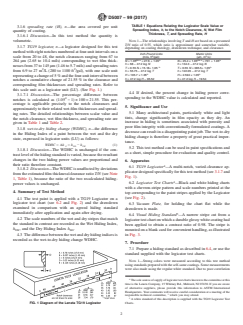
this scale unit as a logicator unit (LU). (See Fig. 1.)
4.4 If desired, the percent change in hiding power corre-
3.1.7.1 Discussion—The percentage difference between
sponding to the WDHC value is calculated and reported.
notches is calculated as (1.05 −1)×100=21.55. This per-
centage is applicable precisely to the notch clearances and
5. Significance and Use
approximatelytotheirrelatedwet-filmthicknessesandspread-
5.1 Many architectural paints, particularly white and light
ing rates. The detailed relationships between scalar value and
tints, change significantly in film opacity as they dry. An
the notch clearance, wet film thickness, and spreading rate are
increase in hiding is sometimes associated with porosity and
given in Table 1 and Table 2.
poor film integrity with conventionally formulated coatings.A
3.1.8 wet-to-dry hiding change (WDHC), n—the difference
decreasecanresultinadisappointingpaintjob.Thewet-to-dry
in the Hiding Index of a paint between the wet and the dry
hiding change is therefore a property of great practical impor-
state, expressed in logicator units (LU) as follows:
tance.
WDHC 5∆h 5 h 2 h (1)
S SD SW
5.2 This test method can be used in paint specifications and
3.1.8.1 Discussion—The WDHC is unchanged if the con-
as a short, simple procedure for evaluation and quality control.
trastlevelofthehidingstandardisvaried,becausetheresultant
changes in the two hiding power values are proportional and
6. Apparatus
their ratio therefore constant.
6.1 TG19 Logicator —A multi-notch, varied-clearance ap-
3.1.8.2 Discussion—TheWDHCisunaffectedbydeviations
plicatordesignedspecificallyforthistestmethod(see3.1.7and
fromtheestimatedfilmthickness/clearanceratio T/N(seeNote
Fig. 1).
1, Table 1), because the ratio of the two recalculated hiding-
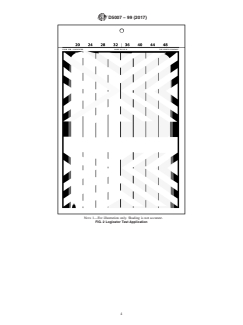
6.2 Logicator Test Charts —Black and white hiding charts
power values is unchanged.
with a chevron-stripe pattern and scale numbers printed at the
4. Summary of Test Method
top corresponding to the paint stripes applied by the Logicator
(see Fig. 2).
4.1 The test paint is applied with a TG19 Logicator on a
logicator test chart (see 6.2 and Fig. 2) and the drawdown
6.3 Vacuum Plate, for holding the chart flat while the
examined in comparison wit
...