

ASTM D7756-19
(Test Method)Standard Test Method for Residues in Liquefied Petroleum (LP) Gases by Gas Chromatography with Liquid, On-Column Injection
General Information
- Abstract
SIGNIFICANCE AND USE
5.1 Control over the residue content as specified in Specification D1835 is of considerable importance in end-use applications of LPG. Oily residue in LPG is contamination which can occur during production, transportation, or storage.
5.2 This test method is quicker and much more sensitive than manual methods, such as Test Method D2158, which is based on evaporation of large sample volumes followed by visual or gravimetric estimation of residue content.
5.3 This test method provides enhanced sensitivity in measurements of heavier (oily) residues, with a quantification limit of 10 mg/kg total residue.
5.4 This test method gives both quantitative results and information about contaminant composition such as boiling point range and fingerprint, which can be very useful in tracing the source of a particular contaminant.
SCOPE
1.1 This test method covers the determination, by gas chromatography, of soluble hydrocarbon materials, sometimes called “oily residue,” which can be present in liquefied petroleum (LP) gases and which are substantially less volatile than the LPG product.
1.2 This test method quantifies, in the range of 10 mg/kg to 600 mg/kg (ppm mass), the residue with a boiling point between 174 °C and 522 °C (C10 to C40) in LPG. Higher boiling materials, or materials that adhere permanently to the chromatographic column, will not be detected.
1.3 Appendix X3, Appendix X4, and Appendix X6 describe additional applications which could be performed based on the hardware and procedures described in this test method. Appendix X3 describes a test procedure for expanding the analysis range to benzene, Appendix X4 describes a test procedure for the analysis of diisopropanolamine, and Appendix X6 describes a test procedure for the analysis of heavy residues or contaminants from C40 to about C60 in LPG.
1.4 The values stated in SI units are to be regarded as standard. The values given in parentheses after SI units are provided for information only and are not considered standard.
1.5 This standard does not purport to address all of the safety concerns, if any, associated with its use. It is the responsibility of the user of this standard to establish appropriate safety, health, and environmental practices and determine the applicability of regulatory limitations prior to use.
1.6 This international standard was developed in accordance with internationally recognized principles on standardization established in the Decision on Principles for the Development of International Standards, Guides and Recommendations issued by the World Trade Organization Technical Barriers to Trade (TBT) Committee.
- Status
- Published
- Publication Date
- 30-Apr-2019
- Technical Committee
- D02 - Petroleum Products, Liquid Fuels, and Lubricants
- Drafting Committee
- D02.H0 - Liquefied Petroleum Gas
Buy Documents
ASTM D7756-19 - Standard Test Method for Residues in Liquefied Petroleum (LP) Gases by Gas Chromatography with Liquid, On-Column Injection
REDLINE ASTM D7756-19 - Standard Test Method for Residues in Liquefied Petroleum (LP) Gases by Gas Chromatography with Liquid, On-Column Injection
Overview
ASTM D7756-19 sets out the standard test method for determining residues, often called "oily residues," in liquefied petroleum (LP) gases using gas chromatography with liquid, on-column injection. Managing residue levels in LPG is crucial for compliance with ASTM D1835 specifications and for ensuring product quality during storage, transportation, and end-use. The method described in ASTM D7756-19 is considerably more sensitive and faster than manual testing approaches, enabling accurate quantification and identification of hydrocarbon contaminants down to a 10 mg/kg limit.
Key Topics
- Enhanced Sensitivity and Speed: Gas chromatography provides far greater sensitivity than traditional manual methods such as evaporation and gravimetric analysis.
- Residue Quantification: The test quantifies residues with boiling points between 174 °C and 522 °C (C10 to C40 hydrocarbons) in the concentration range 10 mg/kg to 600 mg/kg.
- Detailed Composition Analysis: The technique not only quantifies total residue but also profiles the boiling point range and chemical fingerprint of contaminants, aiding in source tracking and contamination troubleshooting.
- Scope of Application:
- Detects hydrocarbon residues soluble in LPG but less volatile than the main LPG components.
- Additional appendices extend the method to the analysis of benzene, toluene, diisopropanolamine (DIPA), and heavier residues up to C60.
- Reliability and Quality Control: Emphasizes daily validation, calibration, and use of quality control (QC) procedures to ensure data integrity.
Applications
The ASTM D7756-19 test method is vital in several areas of the LPG industry:
- Production Quality Control: Ensures LPG products meet residue tolerances as set out in industry standards, thereby preventing equipment fouling or performance issues in downstream usage.
- Transportation & Storage: Identifies and quantifies oily residue that may result from transfer processes, preventing operational issues or regulatory breaches.
- Compliance with Product Specification: Supports certification to standards like ASTM D1835 by providing a sensitive, dependable test for residue content.
- Forensic Contamination Assessment: By profiling residue composition, the method helps trace the origin of contaminants, facilitating root-cause analysis and corrective actions.
- Specialty Analyses: Appendices provide guidance for:
- Expanding to lighter hydrocarbons such as benzene and toluene,
- Analyzing the presence of industrial chemicals (e.g., diisopropanolamine),
- Detecting heavy hydrocarbon fractions which may not be apparent in standard testing.
Related Standards
Several ASTM and industry documents compliment or reference ASTM D7756-19. These include:
- ASTM D1835 - Specification for Liquefied Petroleum (LP) Gases
- ASTM D2158 - Test Method for Residues in LP Gases (manual method)
- ASTM D1265 and D3700 - Practices for Sampling LPG
- ASTM D2163 - Test Method for Hydrocarbons in LP Gases by Gas Chromatography
- ASTM D2421 and D2598 - Practices for Conversions and Physical Properties of LPG
- ASTM D6299 - Statistical Quality Assurance & Control Charting
- ASTM D6667 - Determination of Sulfur in Gaseous Hydrocarbons and LPG
- ASTM E355 and E594 - Practices and Terminology for Gas Chromatography
Practical Value
Implementing ASTM D7756-19 gives laboratories and LPG producers a robust, reproducible, and internationally recognized method for controlling the quality of liquefied petroleum gases. Its sensitivity, speed, and extended compositional insight protect equipment, ensure compliance, and safeguard product reliability across the LPG supply chain.
Keywords: ASTM D7756-19, LPG residue, gas chromatography, oily residue, liquefied petroleum gas analysis, hydrocarbon contaminants, LPG quality control, ASTM standards.
Relations
- Effective Date
- 01-Mar-2024
- Effective Date
- 01-Dec-2023
- Effective Date
- 01-Dec-2023
- Effective Date
- 01-Dec-2023
- Effective Date
- 01-Dec-2019
- Effective Date
- 01-Sep-2019
- Effective Date
- 15-Dec-2017
- Effective Date
- 15-Nov-2017
- Effective Date
- 01-Jan-2017
- Effective Date
- 01-Dec-2016
- Effective Date
- 01-Apr-2016
- Effective Date
- 01-Jun-2015
- Effective Date
- 01-Jun-2014
- Effective Date
- 01-Jun-2014
- Effective Date
- 01-May-2014
Buy Documents
ASTM D7756-19 - Standard Test Method for Residues in Liquefied Petroleum (LP) Gases by Gas Chromatography with Liquid, On-Column Injection
REDLINE ASTM D7756-19 - Standard Test Method for Residues in Liquefied Petroleum (LP) Gases by Gas Chromatography with Liquid, On-Column Injection
Get Certified
Connect with accredited certification bodies for this standard

Element Materials Technology
Materials testing and product certification.

ABS Group Brazil
ABS Group certification services in Brazil.

ABS Quality Evaluations Inc.
American Bureau of Shipping quality certification.
Sponsored listings
Frequently Asked Questions
ASTM D7756-19 is a standard published by ASTM International. Its full title is "Standard Test Method for Residues in Liquefied Petroleum (LP) Gases by Gas Chromatography with Liquid, On-Column Injection". This standard covers: SIGNIFICANCE AND USE 5.1 Control over the residue content as specified in Specification D1835 is of considerable importance in end-use applications of LPG. Oily residue in LPG is contamination which can occur during production, transportation, or storage. 5.2 This test method is quicker and much more sensitive than manual methods, such as Test Method D2158, which is based on evaporation of large sample volumes followed by visual or gravimetric estimation of residue content. 5.3 This test method provides enhanced sensitivity in measurements of heavier (oily) residues, with a quantification limit of 10 mg/kg total residue. 5.4 This test method gives both quantitative results and information about contaminant composition such as boiling point range and fingerprint, which can be very useful in tracing the source of a particular contaminant. SCOPE 1.1 This test method covers the determination, by gas chromatography, of soluble hydrocarbon materials, sometimes called “oily residue,” which can be present in liquefied petroleum (LP) gases and which are substantially less volatile than the LPG product. 1.2 This test method quantifies, in the range of 10 mg/kg to 600 mg/kg (ppm mass), the residue with a boiling point between 174 °C and 522 °C (C10 to C40) in LPG. Higher boiling materials, or materials that adhere permanently to the chromatographic column, will not be detected. 1.3 Appendix X3, Appendix X4, and Appendix X6 describe additional applications which could be performed based on the hardware and procedures described in this test method. Appendix X3 describes a test procedure for expanding the analysis range to benzene, Appendix X4 describes a test procedure for the analysis of diisopropanolamine, and Appendix X6 describes a test procedure for the analysis of heavy residues or contaminants from C40 to about C60 in LPG. 1.4 The values stated in SI units are to be regarded as standard. The values given in parentheses after SI units are provided for information only and are not considered standard. 1.5 This standard does not purport to address all of the safety concerns, if any, associated with its use. It is the responsibility of the user of this standard to establish appropriate safety, health, and environmental practices and determine the applicability of regulatory limitations prior to use. 1.6 This international standard was developed in accordance with internationally recognized principles on standardization established in the Decision on Principles for the Development of International Standards, Guides and Recommendations issued by the World Trade Organization Technical Barriers to Trade (TBT) Committee.
SIGNIFICANCE AND USE 5.1 Control over the residue content as specified in Specification D1835 is of considerable importance in end-use applications of LPG. Oily residue in LPG is contamination which can occur during production, transportation, or storage. 5.2 This test method is quicker and much more sensitive than manual methods, such as Test Method D2158, which is based on evaporation of large sample volumes followed by visual or gravimetric estimation of residue content. 5.3 This test method provides enhanced sensitivity in measurements of heavier (oily) residues, with a quantification limit of 10 mg/kg total residue. 5.4 This test method gives both quantitative results and information about contaminant composition such as boiling point range and fingerprint, which can be very useful in tracing the source of a particular contaminant. SCOPE 1.1 This test method covers the determination, by gas chromatography, of soluble hydrocarbon materials, sometimes called “oily residue,” which can be present in liquefied petroleum (LP) gases and which are substantially less volatile than the LPG product. 1.2 This test method quantifies, in the range of 10 mg/kg to 600 mg/kg (ppm mass), the residue with a boiling point between 174 °C and 522 °C (C10 to C40) in LPG. Higher boiling materials, or materials that adhere permanently to the chromatographic column, will not be detected. 1.3 Appendix X3, Appendix X4, and Appendix X6 describe additional applications which could be performed based on the hardware and procedures described in this test method. Appendix X3 describes a test procedure for expanding the analysis range to benzene, Appendix X4 describes a test procedure for the analysis of diisopropanolamine, and Appendix X6 describes a test procedure for the analysis of heavy residues or contaminants from C40 to about C60 in LPG. 1.4 The values stated in SI units are to be regarded as standard. The values given in parentheses after SI units are provided for information only and are not considered standard. 1.5 This standard does not purport to address all of the safety concerns, if any, associated with its use. It is the responsibility of the user of this standard to establish appropriate safety, health, and environmental practices and determine the applicability of regulatory limitations prior to use. 1.6 This international standard was developed in accordance with internationally recognized principles on standardization established in the Decision on Principles for the Development of International Standards, Guides and Recommendations issued by the World Trade Organization Technical Barriers to Trade (TBT) Committee.
ASTM D7756-19 is classified under the following ICS (International Classification for Standards) categories: 75.160.30 - Gaseous fuels. The ICS classification helps identify the subject area and facilitates finding related standards.
ASTM D7756-19 has the following relationships with other standards: It is inter standard links to ASTM D6300-24, ASTM D1265-23a, ASTM D6299-23a, ASTM D6300-23a, ASTM D6300-19a, ASTM E594-96(2019), ASTM D6299-17b, ASTM D6299-17a, ASTM D6299-17, ASTM D2158-16, ASTM D6300-16, ASTM D6300-15, ASTM D6300-14a, ASTM D6300-14ae1, ASTM D6300-14. Understanding these relationships helps ensure you are using the most current and applicable version of the standard.
ASTM D7756-19 is available in PDF format for immediate download after purchase. The document can be added to your cart and obtained through the secure checkout process. Digital delivery ensures instant access to the complete standard document.
Standards Content (Sample)
This international standard was developed in accordance with internationally recognized principles on standardization established in the Decision on Principles for the
Development of International Standards, Guides and Recommendations issued by the World Trade Organization Technical Barriers to Trade (TBT) Committee.
Designation: D7756 −19
Standard Test Method for
Residues in Liquefied Petroleum (LP) Gases by Gas
Chromatography with Liquid, On-Column Injection
This standard is issued under the fixed designation D7756; the number immediately following the designation indicates the year of
original adoption or, in the case of revision, the year of last revision.Anumber in parentheses indicates the year of last reapproval.A
superscript epsilon (´) indicates an editorial change since the last revision or reapproval.
1. Scope* 2. Referenced Documents
2.1 ASTM Standards:
1.1 This test method covers the determination, by gas
D1265Practice for Sampling Liquefied Petroleum (LP)
chromatography, of soluble hydrocarbon materials, sometimes
Gases, Manual Method
called “oily residue,” which can be present in liquefied
D1835Specification for Liquefied Petroleum (LP) Gases
petroleum (LP) gases and which are substantially less volatile
D2158Test Method for Residues in Liquefied Petroleum
than the LPG product.
(LP) Gases
1.2 This test method quantifies, in the range of 10mg⁄kg to
D2163Test Method for Determination of Hydrocarbons in
600mg⁄kg (ppm mass), the residue with a boiling point
Liquefied Petroleum (LP) Gases and Propane/Propene
between 174°C and 522°C (C to C ) in LPG. Higher
10 40
Mixtures by Gas Chromatography
boiling materials, or materials that adhere permanently to the
D2421Practice for Interconversion of Analysis of C and
chromatographic column, will not be detected.
Lighter Hydrocarbons to Gas-Volume, Liquid-Volume, or
Mass Basis
1.3 AppendixX3,AppendixX4,andAppendixX6describe
D2598Practice for Calculation of Certain Physical Proper-
additional applications which could be performed based on the
ties of Liquefied Petroleum (LP) Gases from Composi-
hardwareandproceduresdescribedinthistestmethod.Appen-
tional Analysis
dix X3 describes a test procedure for expanding the analysis
D3700Practice for Obtaining LPG Samples Using a Float-
range to benzene, Appendix X4 describes a test procedure for
ing Piston Cylinder
the analysis of diisopropanolamine, and Appendix X6 de-
D6299Practice for Applying Statistical Quality Assurance
scribes a test procedure for the analysis of heavy residues or
and Control Charting Techniques to Evaluate Analytical
contaminants from C to about C in LPG.
40 60
Measurement System Performance
1.4 The values stated in SI units are to be regarded as
D6300Practice for Determination of Precision and Bias
standard. The values given in parentheses after SI units are
Data for Use in Test Methods for Petroleum Products and
providedforinformationonlyandarenotconsideredstandard.
Lubricants
D6667Test Method for Determination of Total Volatile
1.5 This standard does not purport to address all of the
Sulfur in Gaseous Hydrocarbons and Liquefied Petroleum
safety concerns, if any, associated with its use. It is the
Gases by Ultraviolet Fluorescence
responsibility of the user of this standard to establish appro-
E355PracticeforGasChromatographyTermsandRelation-
priate safety, health, and environmental practices and deter-
ships
mine the applicability of regulatory limitations prior to use.
E594Practice for Testing Flame Ionization Detectors Used
1.6 This international standard was developed in accor-
in Gas or Supercritical Fluid Chromatography
dance with internationally recognized principles on standard-
ization established in the Decision on Principles for the
3. Terminology
Development of International Standards, Guides and Recom-
mendations issued by the World Trade Organization Technical 3.1 Definitions of Terms Concerning Chromatography—
Barriers to Trade (TBT) Committee. This test method makes reference to many common gas
chromatographicprocedures,terms,andrelationships.Detailed
definitions of these can be found in Practices E355 and E594.
This test method is under the jurisdiction of ASTM Committee D02 on
Petroleum Products, Liquid Fuels, and Lubricants and is the direct responsibility of
Subcommittee D02.H0 on Liquefied Petroleum Gas. For referenced ASTM standards, visit the ASTM website, www.astm.org, or
Current edition approved May 1, 2019. Published June 2019. Originally contact ASTM Customer Service at service@astm.org. For Annual Book of ASTM
approved in 2011. Last previous edition approved in 2018 as D7756–18. Standards volume information, refer to the standard’s Document Summary page on
DOI:10.1520 ⁄D7756-19. the ASTM website.
*A Summary of Changes section appears at the end of this standard
Copyright © ASTM International, 100 Barr Harbor Drive, PO Box C700, West Conshohocken, PA 19428-2959. United States
D7756 − 19
3.2 Definitions of Terms Concerning Liquefied Petroleum 4.8 Total residue is quantified using area summation of
Gases—This test method makes reference to the definitions of componentscorrespondingtotheexpectedrangeofC toC
10 40
liquefied petroleum gases as described in Specification D1835. (174°C to 522°C).
3.3 Definitions of Terms Specific to This Standard:
5. Significance and Use
3.3.1 high pressure liquefied gas injector, n—sample intro-
duction device which injects liquefied gas samples under
5.1 Control over the residue content as specified in Speci-
pressure and at room temperature directly onto the chromato-
fication D1835 is of considerable importance in end-use
graphiccolumntherebymaintainingthesampleinliquidphase
applications of LPG. Oily residue in LPG is contamination
during the injection process.
which can occur during production, transportation, or storage.
3.3.2 pressure station, n—devicethatsupplieshighpressure
5.2 This test method is quicker and much more sensitive
nitrogen to a suitable sample cylinder and therefore maintains
than manual methods, such as Test Method D2158, which is
sample in the liquid phase during the injection procedure.
based on evaporation of large sample volumes followed by
visual or gravimetric estimation of residue content.
4. Summary of Test Method
5.3 This test method provides enhanced sensitivity in mea-
4.1 A sample cylinder of LPG is pressurized to 2500kPa
surementsofheavier(oily)residues,withaquantificationlimit
(363psi) using nitrogen or helium.
of 10mg⁄kg total residue.
4.2 TheinjectionsystemisflushedwithLPGinliquidphase
5.4 This test method gives both quantitative results and
at room temperature.
information about contaminant composition such as boiling
4.3 After flushing, the injection device is routed to the GC
pointrangeandfingerprint,whichcanbeveryusefulintracing
injector port and LPG (25 milliseconds activation time equiva-
the source of a particular contaminant.
lent to 30µL) is introduced via a high pressure valve and
needle which is inserted into a large volume cold on-column
6. Apparatus
injector.
6.1 Gas Chromatograph (GC)—Gas chromatographic in-
4.4 The gas chromatograph is equipped with a solvent vent
strument equipped with a large volume cold on-column injec-
which routes most of the LPG light components out of the
tor(LVOCI),alineartemperatureprogrammablecolumnoven,
analyticalsystemandleavesbehindthecomponentsofinterest.
and a flame ionization detector (FID).The temperature control
shall be capable of obtaining a retention time repeatability of
4.5 The oily residue to be determined is retained on a
0.05min (3s) throughout the scope of this analysis.
pre-column.
6.2 Data Acquisition—Any commercial integrator or com-
4.6 After venting the LPG, the flow from the pre-column is
puterized data acquisition system may be used for display of
switchedtotheanalyticalcolumnandatemperatureprogramis
the chromatographic detector signal and peak area integration.
started.
4.7 Oily residue contaminants are separated and identified 6.3 Solvent Vent—A controlled vent for venting the major
based on differences in boiling point temperature. part of the matrix.
TABLE 1 Typical Operating Conditions
Oven program 35 °C for 3 min
35 °C to 340 °C at 25 °C ⁄min
340 °C for 10 min
Inlet program Type: cool on-column
Temperature: 65 °C for 3 min
55 °C to 340 °C at 25 °C ⁄min
340 °C for 9 min
Detector settings Air flow: 400 mL/min
Hydrogen flow: 40 mL/min
Make up gas flow: 45 mL/min
Temperature: 350 °C
Data rate: 20 Hz
A
Column Retention gap: Sulfinert stainless steel capillary with inner diameter 0.53 mm and
length of 5 m
Retaining pre-column: 3 m 100 %
Dimethylpolysiloxane: 0.53 mm, 2.65 µm
Analytical column: 100 %
Dimethylpolysiloxane 30 m, 0.32 mm, 0.25 µm
Pressure station Sample flow: 2 mL/min
Nitrogen pressure: 2500 kPa
Nitrogen purge pressure: 500 kPa
Liquefied Gas Injection: 25 ms
Injector
A
Sulfinert is a trademark of SilcoTek, 112 Benner Circle, Bellefonte, PA 16823, www.SilcoTek.com.
D7756 − 19
6.4 Retention Gap—Uncoated stainless steel capillary. Suc- 7.2 Mineral Oil in Pentane Calibration Mixture—Prepare a
cessfully used columns and conditions are given in Table 1. calibration standard of mineral oil in pentane. Record the
weighed value to the nearest milligram of mineral oil and
6.5 Retaining Pre-Column—A column with a polydimeth-
calculate the concentration in mg/kg. The concentration of the
ylsiloxane stationary phase. Successfully used columns and
mineral oil shall be close to the expected concentration of the
conditions are given in Table 1.
contamination in the LPG sample.
6.6 Analytical Column—A column with a polydimethylsi-
7.2.1 Standards that are prepared in pentane, normally
loxane stationary phase. Successfully used columns and con-
liquid at room temperature, should be stored in suitable
ditions are given in Table 1.
containers under refrigeration and transferred to sample cylin-
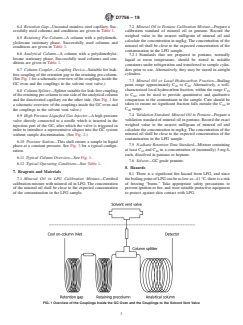
6.7 Column Coupler—Coupling Device—Suitable for leak- ders prior to use. Alternatively, they may be stored in airtight
cylinders.
free coupling of the retention gap to the retaining pre-column.
(SeeFig.1foraschematicoverviewofthecouplingsinsidethe
7.3 Mineral Oil or Local Hydrocarbon Fraction—Boiling
GC oven and the couplings to the solvent vent valve.)
point range approximately C to C . Alternatively, a well-
10 40
characterized local hydrocarbon fraction, within the range C
6.8 Column Splitter—Splittersuitableforleak-freecoupling
to C , can be used to provide quantitative and qualitative
oftheretainingpre-columntoonesideoftheanalyticalcolumn
comparison to the contaminant in the sample. Care should be
and the deactivated capillary on the other side. (See Fig. 1 for
taken to ensure no significant fraction falls outside the C to
a schematic overview of the couplings inside the GC oven and
C range.
the couplings to the solvent vent valve.)
7.4 Validation Standard, Mineral Oil in Pentane—Prepare a
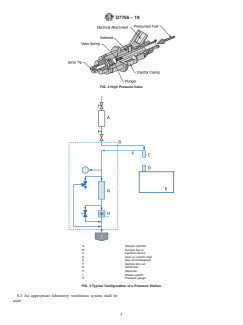
6.9 High Pressure Liquefied Gas Injector—Ahigh pressure
validation standard of mineral oil in pentane. Record the exact
valve directly connected to a needle which is inserted in the
weighed value to the nearest milligram of mineral oil and
injection port of the GC, after which the valve is triggered in
calculate the concentration in mg/kg. The concentration of the
order to introduce a representative aliquot into the GC system
mineral oil shall be close to the expected concentration of the
without sample discrimination. (See Fig. 2.)
contamination in the LPG sample.
6.10 Pressure Station—This shall ensure a sample in liquid
7.5 N-alkane Retention Time Standard—Mixture containing
phase at a constant pressure. See Fig. 3 for a typical configu-
and C in a concentration of (nominally) 5mg⁄L
at least C
10 40
ration.
each, dissolved in pentane or heptane.
6.11 Typical Column Overview—See Fig. 1.
7.6 Solvent—GC grade pentane.
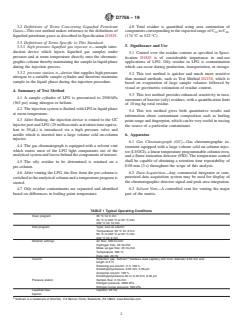
6.12 Typical Operating Conditions—See Table 1.
8. Hazards
7. Reagents and Materials
8.1 There is a significant fire hazard from LPG, and since
7.1 Mineral Oil in LPG Calibration Mixture—Certified theboilingpointofLPGcanbeaslowas–41°C,thereisarisk
calibrationmixturewithmineraloilinLPG.Theconcentration of freezing “burns.” Take appropriate safety precautions to
of the mineral oil shall be close to the expected concentration preventignitionorfire,andwearsuitableprotectiveequipment
of the contamination in the LPG sample. to protect against skin contact with LPG.
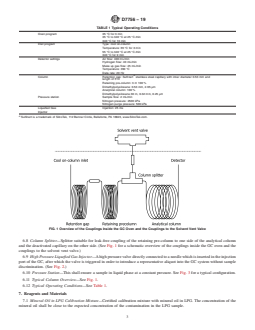
FIG. 1 Overview of the Couplings Inside the GC Oven and the Couplings to the Solvent Vent Valve
D7756 − 19
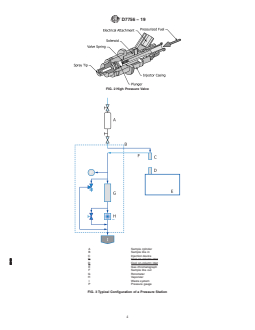
FIG. 2 High Pressure Valve
A Sample cylinder
B Sample line in
C Injection device
D Cool on-column inlet
E Gas chromatograph
F Sample line out
G Rotometer
H Vaporizer
I Waste system
P Pressure gauge
FIG. 3 Typical Configuration of a Pressure Station
8.2 An appropriate laboratory ventilation system shall be
used.
D7756 − 19
8.3 An appropriate waste line shall be installed. The pres- validation, or sample shall be equal or higher than the blank
sure station and injector shall be connected to this line. The baseline. A signal higher than 5% could indicate a poorly
waste line should vent outside the building. conditioned column or the elution of sample components with
aboilingpointhigherthan522°C.Refertothedatasheetofthe
8.4 Pressure station, cylinder, injector, and controller shall
column for instructions on conditioning the column.
be grounded appropriately.
10.4 Analyzethen-alkaneretentiontimestandard(7.6),and
9. Preparation of Apparatus
establish the retention time for C and C . There should be
10 40
baseline separation between the solvent and the first normal
9.1 Gas Chromatograph—Install and verify performance in
alkane peak (C ). If the separation is not sufficient, adjust the
accordance with the manufacturer’s instructions. Typical oper-
ating conditions are shown in Table 1. temperatureprogram,re-establishthebaseline,andthenreana-
lyze the retention time standard.An example is shown in Fig.
9.2 Pressure Station—Install in accordance with the manu-
4.
facturer’s instructions. Purge sample and check carefully for
10.5 Analyze the calibration mixture. The calibration mix-
leaks.
ture is either in LPG or in pentane (7.1 and 7.2).
9.3 High Pressure Liquefied Gas Injector—Install in accor-
10.6 Integrate the oily residue by summing the area from
dance with the manufacturer’s instructions.
C through C .
10 40
9.4 Column Configuration—Installthecolumnsasshownin
10.7 Determine the response factor by dividing the known
Fig. 1. Use low dead volume connections, and check for leaks.
concentration by the total area, and use this for the calculation
10. Calibration
of unknown samples under the assumption that all sample
components have the same response factor.
10.1 Perform a one-point calibration at the startup of the
instrument, when the result of the validation sample falls
10.8 Analyze the validation sample using the liquefied gas
outside the acceptable SQC limits in accordance with Section
injector. Analyze the validation sample once per day of use
14 or after changes in the application hardware or gas supply,
before the samples. Repeat the analysis when the result of the
or both.
validation sample falls outside the acceptable SQC limits in
accordance with Section 14.
10.2 To verify system linearity over the range of expected
sample residues, a linearity check should be performed. More
11. Procedure
information can be found in Appendix X5.
11.1 Collect a representative sample according to Practice
10.3 Run a blank run, without sample injection. Cycle the
D1265 or D3700.
GC several times until the baseline is stable. A baseline is
stablewhenthestartandendsignal(inpA)oftwoconsecutive 11.2 Connectthesamplecylindertothepressurestationand
blank runs are within 5%.An unstable baseline can be caused pressurize to approximately 2500kPa 6 200kPa (363psi 6
by a leak, detector gases, or by high boiling point components 29psi). It is important to maintain and reproduce this pressure
or materials that have not yet eluted from the column. The as closely as possible to ensure sample size injection repeat-
signal height (in pA) at the end of an analysis of a calibration, ability.
FIG. 4 Chromatogram of C through C :
10 40
oven 40 °C 5 min, 40 °C to 325 °C at 25 °C⁄min, 325 °C for 13.6 min
D7756 − 19
11.3 Openthecylinderatbothsidesandflushthesamplefor 12.4 Calculationoftheresponsefactor,usingthecalibration
approximately 3min with a flow rate of about 5mL⁄min. mixture:
11.4 Injectsample(triggerpulse25msat2500kPa,equiva- Rf 5 Scg/Ac (1)
lent to approximately 30µL).
where:
11.5 Analyze each sample in duplicate. If the difference
Rf = response factor,
between the results of the two analyses is >5%, perform an
Scg = mineral oil content in the LPG calibration standard or
extra analysis and average the two closest results.
in the standard in pentane in mg/kg weight, and
Ac = summed area of the peaks in the range of C to C
11.6 Close the sample cylinder after injection and repeat 10 40
in the LPG calibration standard or in the pentane
11.3 for the next injection. When all analyses are finished,
standard.
close the sample cylinder and release the system pressure.
Remove the sample cylinder.
12.5 Calculation of the sample residue concentration; when
the calibration mixture and the sample have the same density:
11.7 Integrate the oily residue by summing the area from
C through C .
10 40 S 5 Area 3Rf (2)
11.8 To inject the validation sample, fill a sample cylinder
where:
with the standard and use the same injection procedure as for
S = mineral oil content in the sample in mg/kg,
LPG samples.
Area = summed area of the peaks in the range of C to C
10 40
in the sample, and
12. Calculation or Interpretation of Results
Rf = response factor = mineral oil content in the calibra-
12.1 Verify whether the separation between the matrix peak
tion standard in mg/kg divided by the area.
and C is sufficient for correct integration of the residue. An
12.6 Calculation of the sample residue concentration with
example is shown in Fig. 5.
correction for the density; to be used when the density of the
12.2 Start the integration at the retention time of C or at
calibration mixture and the sample differ.
the point where the slope of the solvent peak reaches a
S 5 Area 3Rf 3Dc/D (3)
minimum(thevalley).Thispointshouldnotbehigherthantwo
where:
times the value of the baseline in pA.
S = oily residue content in the sample in mg/kg,
12.3 Calculation is based on a response factor and correc-
Area = summed area of the peaks in the range of C to C
10 40
tion for the difference in density between the sample and the
in the sample,
calibration mixture. Correction for the difference in density
Rf = response factor = mineral oil content in the calibra-
between the sample and the calibration standard is performed
tion standard in mg/kg divided by the area,
as in Test Method D6667 (see Appendix X1).
FIG. 5 Chromatogram of 50 mg⁄kg Mineral Oil:
Oven 40 °C 5 min, 40 °C to 325 °C at 25 °C⁄min, 325 °C for 13.6 min
D7756 − 19
TABLE 2 Example of r and R Values at Various Oil Residue
D = density of the sample solution at measurement
Concentrations
temperature, g/mL, and
Oil Residue Level (mg/kg) Rr
Dc = density of calibration standard at measurement
10.0 5.35
...
This document is not an ASTM standard and is intended only to provide the user of an ASTM standard an indication of what changes have been made to the previous version. Because
it may not be technically possible to adequately depict all changes accurately, ASTM recommends that users consult prior editions as appropriate. In all cases only the current version
of the standard as published by ASTM is to be considered the official document.
Designation: D7756 − 18 D7756 − 19
Standard Test Method for
Residues in Liquefied Petroleum (LP) Gases by Gas
Chromatography with Liquid, On-Column Injection
This standard is issued under the fixed designation D7756; the number immediately following the designation indicates the year of
original adoption or, in the case of revision, the year of last revision. A number in parentheses indicates the year of last reapproval. A
superscript epsilon (´) indicates an editorial change since the last revision or reapproval.
1. Scope*
1.1 This test method covers the determination, by gas chromatography, of soluble hydrocarbon materials, sometimes called
“oily residue,” which can be present in liquefied petroleum (LP) gases and which are substantially less volatile than the LPG
product.
1.2 This test method quantifies, in the range of 10 mg ⁄kg to 600 mg ⁄kg (ppm mass), the residue with a boiling point between
174 °C and 522 °C (C to C ) in LPG. Higher boiling materials, or materials that adhere permanently to the chromatographic
10 40
column, will not be detected.
1.3 Appendix X3, Appendix X4and, Appendix X4and Appendix X6 describe additional applications which could be performed
based on the hardware and procedures described in this test method. Appendix X3 describes a test procedure for expanding the
analysis range to benzene, and Appendix X4 describes a test procedure for the analysis of diisopropanolamine diisopropanolamine,
and Appendix X6 describes a test procedure for the analysis of heavy residues or contaminants from C to about C in LPG.
40 60
1.4 The values stated in SI units are to be regarded as standard. The values given in parentheses after SI units are provided for
information only and are not considered standard.
1.5 This standard does not purport to address all of the safety concerns, if any, associated with its use. It is the responsibility
of the user of this standard to establish appropriate safety, health, and environmental practices and determine the applicability of
regulatory limitations prior to use.
1.6 This international standard was developed in accordance with internationally recognized principles on standardization
established in the Decision on Principles for the Development of International Standards, Guides and Recommendations issued
by the World Trade Organization Technical Barriers to Trade (TBT) Committee.
2. Referenced Documents
2.1 ASTM Standards:
D1265 Practice for Sampling Liquefied Petroleum (LP) Gases, Manual Method
D1835 Specification for Liquefied Petroleum (LP) Gases
D2158 Test Method for Residues in Liquefied Petroleum (LP) Gases
D2163 Test Method for Determination of Hydrocarbons in Liquefied Petroleum (LP) Gases and Propane/Propene Mixtures by
Gas Chromatography
D2421 Practice for Interconversion of Analysis of C and Lighter Hydrocarbons to Gas-Volume, Liquid-Volume, or Mass Basis
D2598 Practice for Calculation of Certain Physical Properties of Liquefied Petroleum (LP) Gases from Compositional Analysis
D3700 Practice for Obtaining LPG Samples Using a Floating Piston Cylinder
D6299 Practice for Applying Statistical Quality Assurance and Control Charting Techniques to Evaluate Analytical Measure-
ment System Performance
D6300 Practice for Determination of Precision and Bias Data for Use in Test Methods for Petroleum Products and Lubricants
D6667 Test Method for Determination of Total Volatile Sulfur in Gaseous Hydrocarbons and Liquefied Petroleum Gases by
Ultraviolet Fluorescence
E355 Practice for Gas Chromatography Terms and Relationships
This test method is under the jurisdiction of ASTM Committee D02 on Petroleum Products, Liquid Fuels, and Lubricants and is the direct responsibility of Subcommittee
D02.H0 on Liquefied Petroleum Gas.
Current edition approved Oct. 1, 2018May 1, 2019. Published November 2018June 2019. Originally approved in 2011. Last previous edition approved in 20132018 as
D7756 – 13.D7756 – 18. DOI:10.1520/D7756-18.DOI:10.1520 ⁄D7756-19.
For referenced ASTM standards, visit the ASTM website, www.astm.org, or contact ASTM Customer Service at service@astm.org. For Annual Book of ASTM Standards
volume information, refer to the standard’s Document Summary page on the ASTM website.
*A Summary of Changes section appears at the end of this standard
Copyright © ASTM International, 100 Barr Harbor Drive, PO Box C700, West Conshohocken, PA 19428-2959. United States
D7756 − 19
E594 Practice for Testing Flame Ionization Detectors Used in Gas or Supercritical Fluid Chromatography
3. Terminology
3.1 Definitions of Terms Concerning Chromatography—This test method makes reference to many common gas chromato-
graphic procedures, terms, and relationships. Detailed definitions of these can be found in Practices E355 and E594.
3.2 Definitions of Terms Concerning Liquefied Petroleum Gases—This test method makes reference to the definitions of
liquefied petroleum gases as described in Specification D1835.
3.3 Definitions of Terms Specific to This Standard:
3.3.1 high pressure liquefied gas injector, n—Samplesample introduction device which injects liquefied gas samples under
pressure and at room temperature directly onto the chromatographic column thereby maintaining the sample in liquid phase during
the injection process.
3.3.2 pressure station, n—Devicedevice that supplies high pressure nitrogen to a suitable sample cylinder and therefore
maintains sample in the liquid phase during the injection procedure.
4. Summary of Test Method
4.1 A sample cylinder of LPG is pressurized to 2500 kPa (363 psi) using nitrogen or helium.
4.2 The injection system is flushed with LPG in liquid phase at room temperature.
4.3 After flushing, the injection device is routed to the GC injector port and LPG (25 milliseconds activation time equivalent
to 30 μL) is introduced via a high pressure valve and needle which is inserted into a large volume cold on-column injector.
4.4 The gas chromatograph is equipped with a solvent vent which routes most of the LPG light components out of the analytical
system and leaves behind the components of interest.
4.5 The oily residue to be determined is retained on a pre-column.
4.6 After venting the LPG, the flow from the pre-column is switched to the analytical column and a temperature program is
started.
4.7 Oily residue contaminants are separated and identified based on differences in boiling point temperature.
4.8 Total residue is quantified using area summation of components corresponding to the expected range of C to C (174 °C
10 40
to 522 °C).
5. Significance and Use
5.1 Control over the residue content as specified in Specification D1835 is of considerable importance in end-use applications
of LPG. Oily residue in LPG is contamination which can occur during production, transportation, or storage.
5.2 This test method is quicker and much more sensitive than manual methods, such as Test Method D2158, which is based on
evaporation of large sample volumes followed by visual or gravimetric estimation of residue content.
5.3 This test method provides enhanced sensitivity in measurements of heavier (oily) residues, with a quantification limit of
10 mg ⁄kg total residue.
5.4 This test method gives both quantitative results and information about contaminant composition such as boiling point range
and fingerprint, which can be very useful in tracing the source of a particular contaminant.
6. Apparatus
6.1 Gas Chromatograph (GC)—Gas chromatographic instrument equipped with a large volume cold on-column injector
(LVOCI), a linear temperature programmable column oven, and a flame ionization detector (FID). The temperature control shall
be capable of obtaining a retention time repeatability of 0.05 min (3 s) throughout the scope of this analysis.
6.2 Data Acquisition—Any commercial integrator or computerized data acquisition system may be used for display of the
chromatographic detector signal and peak area integration.
6.3 Solvent Vent—A controlled vent for venting the major part of the matrix.
6.4 Retention Gap—Uncoated stainless steel capillary. Successfully used columns and conditions are given in Table 1.
6.5 Retaining Pre-Column—A column with a polydimethylsiloxane stationary phase. Successfully used columns and conditions
are given in Table 1.
6.6 Analytical Column—A column with a polydimethylsiloxane stationary phase. Successfully used columns and conditions are
given in Table 1.
6.7 Column Coupler—Coupling Device—Suitable for leak-free coupling of the retention gap to the retaining pre-column. (See
Fig. 1 for a schematic overview of the couplings inside the GC oven and the couplings to the solvent vent valve.)
D7756 − 19
TABLE 1 Typical Operating Conditions
Oven program 35 °C for 3 min
35 °C to 340 °C at 25 °C ⁄min
340 °C for 10 min
Inlet program Type: cool on-column
Temperature: 65 °C for 3 min
55 °C to 340 °C at 25 °C ⁄min
340 °C for 9 min
Detector settings Air flow: 400 mL/min
Hydrogen flow: 40 mL/min
Make up gas flow: 45 mL/min
Temperature: 350 °C
Data rate: 20 Hz
A
Column Retention gap: Sulfinert stainless steel capillary with inner diameter 0.53 mm and
length of 5 m
Retaining pre-column: 3 m 100 %
Dimethylpolysiloxane: 0.53 mm, 2.65 μm
Analytical column: 100 %
Dimethylpolysiloxane 30 m, 0.32 mm, 0.25 μm
Pressure station Sample flow: 2 mL/min
Nitrogen pressure: 2500 kPa
Nitrogen purge pressure: 500 kPa
Liquefied Gas Injection: 25 ms
Injector
A
Sulfinert is a trademark of SilcoTek, 112 Benner Circle, Bellefonte, PA 16823, www.SilcoTek.com.
FIG. 1 Overview of the Couplings Inside the GC Oven and the Couplings to the Solvent Vent Valve
6.8 Column Splitter—Splitter suitable for leak-free coupling of the retaining pre-column to one side of the analytical column
and the deactivated capillary on the other side. (See Fig. 1 for a schematic overview of the couplings inside the GC oven and the
couplings to the solvent vent valve.)
6.9 High Pressure Liquefied Gas Injector—A high pressure valve directly connected to a needle which is inserted in the injection
port of the GC, after which the valve is triggered in order to introduce a representative aliquot into the GC system without sample
discrimination. (See Fig. 2.)
6.10 Pressure Station—This shall ensure a sample in liquid phase at a constant pressure. See Fig. 3 for a typical configuration.
6.11 Typical Column Overview—See Fig. 1.
6.12 Typical Operating Conditions—See Table 1.
7. Reagents and Materials
7.1 Mineral Oil in LPG Calibration Mixture—Certified calibration mixture with mineral oil in LPG. The concentration of the
mineral oil shall be close to the expected concentration of the contamination in the LPG sample.
D7756 − 19
FIG. 2 High Pressure Valve
A Sample cylinder
B Sample line in
C Injection device
D Cool on column inlet
D Cool on-column inlet
E Gas chromatograph
F Sample line out
G Rotometer
H Vaporizer
I Waste system
P Pressure gauge
FIG. 3 Typical Configuration of a Pressure Station
D7756 − 19
7.2 Mineral Oil in Pentane Calibration Mixture—Prepare a calibration standard of mineral oil in pentane. Record the weighed
value to the nearest milligram of mineral oil and calculate the concentration in mg/kg. The concentration of the mineral oil shall
be close to the expected concentration of the contamination in the LPG sample.
7.2.1 Standards that are prepared in pentane, normally liquid at room temperature, should be stored in suitable containers under
refrigeration and transferred to sample cylinders prior to use. Alternatively, they may be stored in airtight cylinders.
7.3 Mineral Oil or Local Hydrocarbon Fraction—Boiling point range approximately C to C . Alternatively, a well
10 40
characterized well-characterized local hydrocarbon fraction, within the range C to C , can be used to provide quantitative and
10 40
qualitative comparison to the contaminant in the sample. Care should be taken to ensure no significant fraction falls outside the
C to C range.
10 40
7.4 Validation Standard, Mineral Oil in Pentane—Prepare a validation standard of mineral oil in pentane. Record the exact
weighed value to the nearest milligram of mineral oil and calculate the concentration in mg/kg. The concentration of the mineral
oil shall be close to the expected concentration of the contamination in the LPG sample.
7.5 N-alkane Retention Time Standard—Mixture containing at least C and C in a concentration of (nominally) 5 mg ⁄L each,
10 40
dissolved in pentane or heptane.
7.6 Solvent—GC grade pentane.
8. Hazards
8.1 There is a significant fire hazard from LPG, and since the boiling point of LPG can be as low as –41 °C, there is a risk of
freezing “burns.” Take appropriate safety precautions to prevent ignition or fire, and wear suitable protective equipment to protect
against skin contact with LPG.
8.2 An appropriate laboratory ventilation system shall be used.
8.3 An appropriate waste line shall be installed. The pressure station and injector shall be connected to this line. The waste line
should vent outside the building.
8.4 Pressure station, cylinder, injector, and controller shall be grounded appropriately.
9. Preparation of Apparatus
9.1 Gas Chromatograph—Install and verify performance in accordance with the manufacturer’s instructions. Typical operating
conditions are shown in Table 1.
9.2 Pressure Station—Install in accordance with the manufacturer’s instructions. Purge sample and check carefully for leaks.
9.3 High Pressure Liquefied Gas Injector—Install in accordance with the manufacturer’s instructions.
9.4 Column Configuration—Install the columns as shown in Fig. 1. Use low dead volume connections, and check for leaks.
10. Calibration
10.1 Perform a one point one-point calibration at the startup of the instrument, when the result of the validation sample falls
outside the acceptable SQC limits in accordance with Section 14 or after changes in the application hardware or gas supply, or both.
10.2 To verify system linearity over the range of expected sample residues, a linearity check should be performed. More
information can be found in Appendix X5.
10.3 Run a blank run, without sample injection. Cycle the GC several times until the baseline is stable. A baseline is stable when
the start and end signal (in pA) of two consecutive blank runs are within 5 %. An unstable baseline can be caused by a leak, detector
gases, or by high boiling point components or materials that have not yet eluted from the column. The signal height (in pA) at the
end of an analysis of a calibration, validation, or sample shall be equal or higher than the blank baseline. A signal higher than 5 %
could indicate a poorly conditioned column or the elution of sample components with a boiling point higher than 522 °C. Refer
to the datasheet of the column for instructions on conditioning the column.
10.4 Analyze the n-alkane retention time standard (7.6), and establish the retention time for C and C . There should be
10 40
baseline separation between the solvent and the first normal alkane peak (C ). If the separation is not sufficient, adjust the
temperature program, re-establish the baseline, and then reanalyze the retention time standard. An example is shown in Fig. 4.
10.5 Analyze the calibration mixture. The calibration mixture is either in LPG or in pentane (7.1 and 7.2).
10.6 Integrate the oily residue by summing the area from C through C .
10 40
10.7 Determine the response factor by dividing the known concentration by the total area, and use this for the calculation of
unknown samples under the assumption that all sample components have the same response factor.
10.8 Analyze the validation sample using the liquefied gas injector. Analyze the validation sample once per day of use before
the samples. Repeat the analysis when the result of the validation sample falls outside the acceptable SQC limits in accordance
with Section 14.
D7756 − 19
FIG. 4 Chromatogram of C through C :
10 40
oven 40 °C 5 min, 40 °C to 325 °C at 25 °C ⁄min, 325 °C for 13.6 min
11. Procedure
11.1 Collect a representative sample according to Practice D1265 or D3700.
11.2 Connect the sample cylinder to the pressure station and pressurize to approximately 2500 kPa 6 200 kPa (363 psi 6
29 psi). It is important to maintain and reproduce this pressure as closely as possible to ensure sample size injection repeatability.
11.3 Open the cylinder at both sides and flush the sample for approximately 3 min with a flow rate of about 5 mL ⁄min.
11.4 Inject sample (trigger pulse 25 ms at 2500 kPa, equivalent to approximately 30 μL).
11.5 Analyze each sample in duplicate. If the difference between the results of the two analyses is >5 %, perform an extra
analysis and average the two closest results.
11.6 Close the sample cylinder after injection and repeat 11.3 for the next injection. When all analyses are finished, close the
sample cylinder and release the system pressure. Remove the sample cylinder.
11.7 Integrate the oily residue by summing the area from C through C .
10 40
11.8 To inject the validation sample, fill a sample cylinder with the standard and use the same injection procedure as for LPG
samples.
12. Calculation or Interpretation of Results
12.1 Verify whether the separation between the matrix peak and C is sufficient for correct integration of the residue. An
example is shown in Fig. 5.
12.2 Start the integration at the retention time of C or at the point where the slope of the solvent peak reaches a minimum
(the valley). This point should not be higher than two times the value of the baseline in pA.
12.3 Calculation is based on a response factor and correction for the difference in density between the sample and the calibration
mixture. Correction for the difference in density between the sample and the calibration standard is performed as in Test Method
D6667 (see Appendix X1).
12.4 Calculation of the response factor, using the calibration mixture:
Rf 5 Scg/Ac (1)
where:
Rf = Response factor,
Scg = Mineral oil content in the LPG calibration standard or in the standard in pentane in mg/kg weight, and
Ac = Summed area of the peaks in the range of C to C in the LPG calibration standard or in the pentane standard.
10 40
Rf = response factor,
Scg = mineral oil content in the LPG calibration standard or in the standard in pentane in mg/kg weight, and
D7756 − 19
FIG. 5 Chromatogram of 50 mg ⁄kg Mineral Oil:
Oven 40 °C 5 min, 40 °C to 325 °C at 25 °C ⁄min, 325 °C for 13.6 min
Ac = summed area of the peaks in the range of C to C in the LPG calibration standard or in the pentane standard.
10 40
12.5 Calculation of the sample residue concentration; when the calibration mixture and the sample have the same density:
S 5 Area 3 Rf (2)
where:
S = Mineral oil content in the sample in mg/kg,
Area = Summed area of the peaks in the range of C to C in the sample, and
10 40
Rf = Response factor = mineral oil content in the calibration standard in mg/kg divided by the area.
S = mineral oil content in the sample in mg/kg,
Area = summed area of the peaks in the range of C to C in the sample, and
10 40
Rf = response factor = mineral oil content in the calibration standard in mg/kg divided by the area.
12.6 Calculation of the sample residue concentration with correction for the density; to be used when the density of the
calibration mixture and the sample differ.
S 5 Area 3 Rf 3Dc/D (3)
where:
S = oily residue content in the sample in mg/kg,
Area = Summed area of the peaks in the range of C to C in the sample,
10 40
Area = summed area of the peaks in the range of C to C in the sample,
10 40
Rf = Response factor = mineral oil content in the calibration standard in mg/kg divided by the area,
Rf = response factor = mineral oil content in the calibration standard in mg/kg divided by the area,
D = Density of the sample solution at measurement temperature, g/mL, and
D = density of the sample solution at measurement temperature, g/mL, and
Dc = Density of calibration standard at measurement temperature, g/mL.
Dc = density of calibration standard at measurement temperature, g/mL.
13. Report
13.1 Report the results to the nearest mg/kg oily residue in LPG, referencing this test method.
14. Quality Control
14.1 Confirm the performance of the instrument or the test procedure by analyzing validation samples (see 7.4) after
...