

ASTM F2754/F2754M-21
(Test Method)Standard Test Method for Measurement of Camber, Cast, Helix, and Direction of Helix of Coiled Wire
General Information
- Abstract
SIGNIFICANCE AND USE
4.1 The process of coiling wire causes the wire to take on a curvature from the process of being mechanically deformed into a coiled geometry. The curvature in the wire is permanent unless the wire is straightened. It will affect how the coiled wire will react when it is subjected to additional wire forming operations. In addition, residual stresses induced from the coiling operation can cause elastic recoil or spring back in subsequent wire forming operations unless the material is straightened and stress relieved prior to forming. These residual stresses can create wide variations in the dimensions of components and/or parts that have been built using the coiled wire (cast).
4.2 The direction that the wire has been coiled affects how the wire will be taken off of the coil for subsequent wire forming operations (helix direction).
4.3 Lift or spacing between adjacent coils also affects how the wire will be taken off of the coil and can also affect the dimensions of components and/or parts that have been built using the coiled wire due to residual stresses (helix).
SCOPE
1.1 This test method covers the various standard methods that are used for measuring camber, cast, helix, and helix direction. The wire may be coiled with or without a spool.
1.2 This test method applies to round wire that has a diameter between 0.0127 to 4.78 mm [0.0005 to 0.188 in.]. It also applies to flat or shaped wire.
1.3 This test method does not apply to superelastic nitinol wire. It does apply to the as-drawn condition of nitinol wire.
1.4 This test method does not apply to the measurement of the straightness of straightened to length wire and tubing.
1.5 The values stated in either SI units or inch-pound units are to be regarded separately as standard. The values stated in each system may not be exact equivalents; therefore, each system shall be used independently of the other. Combining values from the two systems may result in nonconformance with the standard.
1.6 This standard does not purport to address all of the safety concerns, if any, associated with its use. It is the responsibility of the user of this standard to establish appropriate safety, health, and environmental practices and determine the applicability of regulatory limitations prior to use.
1.7 This international standard was developed in accordance with internationally recognized principles on standardization established in the Decision on Principles for the Development of International Standards, Guides and Recommendations issued by the World Trade Organization Technical Barriers to Trade (TBT) Committee.
- Status
- Published
- Publication Date
- 30-Sep-2021
- Technical Committee
- F04 - Medical and Surgical Materials and Devices
- Drafting Committee
- F04.15 - Material Test Methods
Buy Documents

ASTM F2754/F2754M-21 - Standard Test Method for Measurement of Camber, Cast, Helix, and Direction of Helix of Coiled Wire
REDLINE ASTM F2754/F2754M-21 - Standard Test Method for Measurement of Camber, Cast, Helix, and Direction of Helix of Coiled Wire
Overview
ASTM F2754/F2754M-21 is the globally recognized standard test method for the measurement of camber, cast, helix, and direction of helix of coiled wire. Developed by ASTM International, this standard provides detailed methodologies for evaluating the geometric properties of coiled round, flat, or shaped wire. These properties are critical for manufacturers and users of wire in numerous industries, where dimensional consistency and material integrity are essential for subsequent forming operations and end-use performance.
By applying the procedures outlined in ASTM F2754/F2754M-21, organizations can ensure quality control and achieve reliable results when producing components from coiled wire, reducing the risk of dimensional inconsistencies caused by residual stresses and improper handling.
Key Topics
Significance of Camber, Cast, and Helix:
- Camber measures side-to-side deflection in flat or shaped wire.
- Cast refers to the natural curvature diameter of a wire when laid flat.
- Helix involves the lift or spacing between adjacent coils, measured through free end lift or hanging methods.
- Direction of Helix (right- or left-handed) affects how the wire unspools and is critical for downstream processing.
Scope of Application:
- Applies to round wires (0.0127 mm to 4.78 mm in diameter), as well as flat and shaped wires.
- Covers wires both with and without a spool.
- Excludes superelastic nitinol wire, but applies to as-drawn nitinol wire.
- Not intended for measuring the straightness of straightened wire or tubing.
Measurement Methodologies:
- Use of linear scales, coordinate measurement machines, or optical comparators.
- Specimen preparation steps to minimize end effects and tangling.
- Specific approaches based on wire type and geometry to achieve accurate and reproducible results.
Data Reporting:
- Results to be presented in either SI or inch-pound units, not mixed.
- Reporting includes material identification and all measured values as specified.
Applications
The test methods described in ASTM F2754/F2754M-21 are vital in industries where coiled wire is subject to further forming, assembly, or fabrication processes, including:
- Medical devices: Ensuring the dimensional integrity of wire-based components used in surgical instruments and implants.
- Industrial manufacturing: Maintaining consistent properties for springs, fasteners, and intricate wire forms.
- Automotive and aerospace: Guaranteeing reliable wire performance under strict tolerances.
- Construction and electronics: Verifying the suitability of coiled wire for structural or conductive uses.
By implementing these standard practices, manufacturers can reduce production variability, optimize forming processes, and improve quality assurance for wire-based components.
Related Standards
Professionals working with ASTM F2754/F2754M-21 may also reference related standards for comprehensive material testing and processing, such as:
- ASTM A228/A228M: Standard Specification for Steel Wire, Music Spring Quality
- ASTM A313/A313M: Specification for Stainless Steel Spring Wire
- ASTM F963: Specification for Toy Safety (contains relevant wire requirements)
- ISO 6892-1: Metallic materials - Tensile testing, Part 1: Method of test at room temperature
Integration of ASTM F2754/F2754M-21 into quality systems helps ensure product reliability, compliance with global requirements, and optimal performance of products utilizing coiled wire. For official content and the latest updates, always consult the most recent edition from ASTM International.
Buy Documents
ASTM F2754/F2754M-21 - Standard Test Method for Measurement of Camber, Cast, Helix, and Direction of Helix of Coiled Wire
REDLINE ASTM F2754/F2754M-21 - Standard Test Method for Measurement of Camber, Cast, Helix, and Direction of Helix of Coiled Wire
Get Certified
Connect with accredited certification bodies for this standard

Element Materials Technology
Materials testing and product certification.

Inštitut za kovinske materiale in tehnologije
Institute of Metals and Technology. Materials testing, metallurgical analysis, NDT.
Sponsored listings
Frequently Asked Questions
ASTM F2754/F2754M-21 is a standard published by ASTM International. Its full title is "Standard Test Method for Measurement of Camber, Cast, Helix, and Direction of Helix of Coiled Wire". This standard covers: SIGNIFICANCE AND USE 4.1 The process of coiling wire causes the wire to take on a curvature from the process of being mechanically deformed into a coiled geometry. The curvature in the wire is permanent unless the wire is straightened. It will affect how the coiled wire will react when it is subjected to additional wire forming operations. In addition, residual stresses induced from the coiling operation can cause elastic recoil or spring back in subsequent wire forming operations unless the material is straightened and stress relieved prior to forming. These residual stresses can create wide variations in the dimensions of components and/or parts that have been built using the coiled wire (cast). 4.2 The direction that the wire has been coiled affects how the wire will be taken off of the coil for subsequent wire forming operations (helix direction). 4.3 Lift or spacing between adjacent coils also affects how the wire will be taken off of the coil and can also affect the dimensions of components and/or parts that have been built using the coiled wire due to residual stresses (helix). SCOPE 1.1 This test method covers the various standard methods that are used for measuring camber, cast, helix, and helix direction. The wire may be coiled with or without a spool. 1.2 This test method applies to round wire that has a diameter between 0.0127 to 4.78 mm [0.0005 to 0.188 in.]. It also applies to flat or shaped wire. 1.3 This test method does not apply to superelastic nitinol wire. It does apply to the as-drawn condition of nitinol wire. 1.4 This test method does not apply to the measurement of the straightness of straightened to length wire and tubing. 1.5 The values stated in either SI units or inch-pound units are to be regarded separately as standard. The values stated in each system may not be exact equivalents; therefore, each system shall be used independently of the other. Combining values from the two systems may result in nonconformance with the standard. 1.6 This standard does not purport to address all of the safety concerns, if any, associated with its use. It is the responsibility of the user of this standard to establish appropriate safety, health, and environmental practices and determine the applicability of regulatory limitations prior to use. 1.7 This international standard was developed in accordance with internationally recognized principles on standardization established in the Decision on Principles for the Development of International Standards, Guides and Recommendations issued by the World Trade Organization Technical Barriers to Trade (TBT) Committee.
SIGNIFICANCE AND USE 4.1 The process of coiling wire causes the wire to take on a curvature from the process of being mechanically deformed into a coiled geometry. The curvature in the wire is permanent unless the wire is straightened. It will affect how the coiled wire will react when it is subjected to additional wire forming operations. In addition, residual stresses induced from the coiling operation can cause elastic recoil or spring back in subsequent wire forming operations unless the material is straightened and stress relieved prior to forming. These residual stresses can create wide variations in the dimensions of components and/or parts that have been built using the coiled wire (cast). 4.2 The direction that the wire has been coiled affects how the wire will be taken off of the coil for subsequent wire forming operations (helix direction). 4.3 Lift or spacing between adjacent coils also affects how the wire will be taken off of the coil and can also affect the dimensions of components and/or parts that have been built using the coiled wire due to residual stresses (helix). SCOPE 1.1 This test method covers the various standard methods that are used for measuring camber, cast, helix, and helix direction. The wire may be coiled with or without a spool. 1.2 This test method applies to round wire that has a diameter between 0.0127 to 4.78 mm [0.0005 to 0.188 in.]. It also applies to flat or shaped wire. 1.3 This test method does not apply to superelastic nitinol wire. It does apply to the as-drawn condition of nitinol wire. 1.4 This test method does not apply to the measurement of the straightness of straightened to length wire and tubing. 1.5 The values stated in either SI units or inch-pound units are to be regarded separately as standard. The values stated in each system may not be exact equivalents; therefore, each system shall be used independently of the other. Combining values from the two systems may result in nonconformance with the standard. 1.6 This standard does not purport to address all of the safety concerns, if any, associated with its use. It is the responsibility of the user of this standard to establish appropriate safety, health, and environmental practices and determine the applicability of regulatory limitations prior to use. 1.7 This international standard was developed in accordance with internationally recognized principles on standardization established in the Decision on Principles for the Development of International Standards, Guides and Recommendations issued by the World Trade Organization Technical Barriers to Trade (TBT) Committee.
ASTM F2754/F2754M-21 is classified under the following ICS (International Classification for Standards) categories: 77.140.65 - Steel wire, wire ropes and link chains. The ICS classification helps identify the subject area and facilitates finding related standards.
ASTM F2754/F2754M-21 is available in PDF format for immediate download after purchase. The document can be added to your cart and obtained through the secure checkout process. Digital delivery ensures instant access to the complete standard document.
Standards Content (Sample)
This international standard was developed in accordance with internationally recognized principles on standardization established in the Decision on Principles for the
Development of International Standards, Guides and Recommendations issued by the World Trade Organization Technical Barriers to Trade (TBT) Committee.
Designation: F2754/F2754M −21
Standard Test Method for
Measurement of Camber, Cast, Helix, and Direction of Helix
of Coiled Wire
This standard is issued under the fixed designation F2754/F2754M; the number immediately following the designation indicates the year
of original adoption or, in the case of revision, the year of last revision. A number in parentheses indicates the year of last reapproval.
A superscript epsilon (´) indicates an editorial change since the last revision or reapproval.
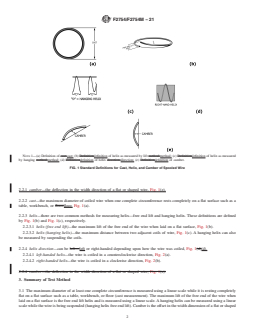
1. Scope* 2.2.1 camber—the deflection in the width direction of a flat
or shaped wire, Fig. 1(e).
1.1 This test method covers the various standard methods
2.2.2 cast—the maximum diameter of coiled wire when one
that are used for measuring camber, cast, helix, and helix
complete circumference rests completely on a flat surface such
direction. The wire may be coiled with or without a spool.
as a table, workbench, or floor, Fig. 1(a).
1.2 This test method applies to round wire that has a
2.2.3 helix—there are two common methods for measuring
diameter between 0.0127 to 4.78 mm [0.0005 to 0.188 in.]. It
helix—free end lift and hanging helix. These definitions are
also applies to flat or shaped wire.
defined by Fig. 1(b) and Fig. 1(c), respectively.
1.3 This test method does not apply to superelastic nitinol
2.2.3.1 helix (free end lift)—the maximum lift of the free
wire. It does apply to the as-drawn condition of nitinol wire.
end of the wire when laid on a flat surface, Fig. 1(b).
1.4 This test method does not apply to the measurement of
2.2.3.2 helix (hanging helix)—the maximum distance be-
the straightness of straightened to length wire and tubing.
tween two adjacent coils of wire, Fig. 1(c).Ahanging helix can
1.5 The values stated in either SI units or inch-pound units
also be measured by suspending the coils.
are to be regarded separately as standard. The values stated in
2.2.4 helix direction—can be left or right-handed depending
each system may not be exact equivalents; therefore, each
upon how the wire was coiled, Fig. 1(d).
system shall be used independently of the other. Combining
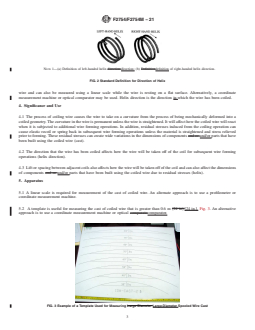
2.2.4.1 left-handed helix—the wire is coiled in a counter-
values from the two systems may result in nonconformance
clockwise direction, Fig. 2(a).
with the standard.
2.2.4.2 right-handed helix—the wire is coiled in a clockwise
1.6 This standard does not purport to address all of the
direction, Fig. 2(b).
safety concerns, if any, associated with its use. It is the
responsibility of the user of this standard to establish appro-
3. Summary of Test Method
priate safety, health, and environmental practices and deter-
3.1 The maximum diameter of at least one complete cir-
mine the applicability of regulatory limitations prior to use.
cumference is measured using a linear scale while it is resting
1.7 This international standard was developed in accor-
completely flat on a flat surface such as a table, workbench, or
dance with internationally recognized principles on standard-
floor (cast measurement). The maximum lift of the free end of
ization established in the Decision on Principles for the
the wire when laid on a flat surface is the free end lift helix and
Development of International Standards, Guides and Recom-
is measured using a linear scale. A hanging helix can be
mendations issued by the World Trade Organization Technical
measuredusingalinearscalewhilethewireisbeingsuspended
Barriers to Trade (TBT) Committee.
(hanging helix free end lift). Camber is the offset in the width
dimension of a flat or shaped wire and can also be measured
2. Terminology
using a linear scale while the wire is resting on a flat surface.
2.1 Fig. 1(a) through Fig. 1(e) illustrate the physical mean-
Alternatively, a coordinate measurement machine or optical
ing of cast, helix, direction of helix, and camber.
comparator may be used. Helix direction is the direction in
2.2 Definitions:
which the wire has been coiled.
4. Significance and Use
4.1 The process of coiling wire causes the wire to take on a
This test method is under the jurisdiction ofASTM Committee F04 on Medical
and Surgical Materials and Devices and is the direct responsibility of Subcommittee
curvature from the process of being mechanically deformed
F04.15 on Material Test Methods.
into a coiled geometry. The curvature in the wire is permanent
Current edition approved Oct. 1, 2021. Published October 2021. Originally
unless the wire is straightened. It will affect how the coiled
approved in 2009. Last previous edition approved in 2013 as F2754/F2754M – 09
(2013). DOI: 10.1520/F2754_F2754M-21. wire will react when it is subjected to additional wire forming
*A Summary of Changes section appears at the end of this standard
Copyright © ASTM International, 100 Barr Harbor Drive, PO Box C700, West Conshohocken, PA 19428-2959. United States
F2754/F2754M − 21
NOTE 1—(a) Definition of cast; (b) definition of helix as measured by lift method; (c) definition of helix as measured by hanging method; (d) definition
of helix direction; (e) definition of camber.
FIG. 1 Standard Definitions for Cast, Helix, and Camber of Spooled Wire
dimensions of components and/or parts that have been built
using the coiled wire due to residual stresses (helix).
5. Apparatus
5.1 Alinear scale is required for measurement of the cast of
coiled wire. An alternate approach is to use a profilometer or
coordinate measurement machine.
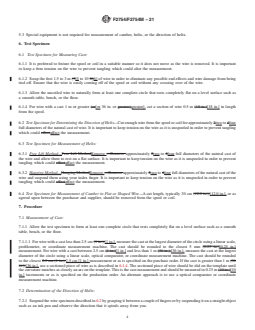
5.2 A template is useful for measuring the cast of coiled
wire that is greater than 0.6 m [24 in.], Fig. 3. An alternative
NOTE 1—(a) Definition of left-handed helix direction; (b) definition of
right-handed helix direction.
approach is to use a coordinate measurement machine or
optical comparator.
FIG. 2 Standard Definition for Direction of Helix
5.3 Special equipment is not required for measurement of
camber, helix, or the direction of helix.
6. Test Specimen
operations. In addition, residual stresses induced from the
6.1 Test Specimen for Measuring Cast:
coiling operation can cause elastic recoil or spring back in
6.1.1 It is preferred to fixture the spool or coil in a suitable
subsequent wire forming operations unless the material is
manner so it does not move as the wire is removed. It is
straightened and stress relieved prior to forming. These re-
important to keep a firm tension on the wire to prevent tangling
sidual stresses can create wide variations in the dimensions of
which could alter the measurement.
components and/or parts that have been built using the coiled
6.1.2 Scrap the first 1.5 to3m[5to10ft]of wire in order
wire (cast).
to eliminate any possible end effects and wire damage from
4.2 The direction that the wire has been coiled affects how
being tied off. Ensure that the wire is easily coming off of the
the wire will be taken off of the coil for subsequent wire
spool or coil without any crossing over of the wire.
forming operations (helix direction).
6.1.3 Allow the uncoiled wire to naturally form at least one
4.3 Lift or spacing between adjacent coils also affects how complete circle that rests completely flat on a level surface
the wire will be taken off of the coil and can also affect the such as a smooth table, bench, or the floor.
...
This document is not an ASTM standard and is intended only to provide the user of an ASTM standard an indication of what changes have been made to the previous version. Because
it may not be technically possible to adequately depict all changes accurately, ASTM recommends that users consult prior editions as appropriate. In all cases only the current version
of the standard as published by ASTM is to be considered the official document.
Designation: F2754/F2754M − 09 (Reapproved 2013) F2754/F2754M − 21
Standard Test Method for
Measurement of Camber, Cast, Helix, and Direction of Helix
of Coiled Wire
This standard is issued under the fixed designation F2754/F2754M; the number immediately following the designation indicates the year
of original adoption or, in the case of revision, the year of last revision. A number in parentheses indicates the year of last reapproval.
A superscript epsilon (´) indicates an editorial change since the last revision or reapproval.
1. Scope Scope*
1.1 This test method covers the various standard methods that are used for measuring camber, cast, helix, and helix direction. The
wire may be coiled with or without a spool.
1.2 This test method applies to round wire that has a diameter between 0.0127 to 4.78 mm (0.0005[0.0005 to 0.188 in.).in.]. It
also applies to flat or shaped wire.
1.3 This test method does not apply to superelastic nitinol wire. It does apply to the as-drawn condition of nitinol wire.
1.4 This test method does not apply to the measurement of the straightness of straightened to length wire and tubing.
1.5 The values stated in either SI units or inch-pound units are to be regarded separately as standard. The values stated in each
system may not be exact equivalents; therefore, each system shall be used independently of the other. Combining values from the
two systems may result in non-conformancenonconformance with the standard.
1.6 This standard does not purport to address all of the safety concerns, if any, associated with its use. It is the responsibility of
the user of this standard to establish appropriate safety and health practices and determine the applicability of regulatory
limitations prior to use.
1.6 This standard does not purport to address all of the safety concerns, if any, associated with its use. It is the responsibility
of the user of this standard to establish appropriate safety, health, and environmental practices and determine the applicability of
regulatory limitations prior to use.
1.7 This international standard was developed in accordance with internationally recognized principles on standardization
established in the Decision on Principles for the Development of International Standards, Guides and Recommendations issued
by the World Trade Organization Technical Barriers to Trade (TBT) Committee.
2. Terminology
2.1 Fig. 1(a) through Fig. 1(e) illustrate the physical meaning of cast, helix, direction of helix, and camber.
2.2 Definitions:
This test method is under the jurisdiction of ASTM Committee F04 on Medical and Surgical Materials and Devices and is the direct responsibility of Subcommittee
F04.15 on Material Test Methods.
Current edition approved Oct. 1, 2013Oct. 1, 2021. Published October 2013October 2021. Originally approved in 2009. Last previous edition approved in 20092013 as
F2754/F2754M – 09. 09 (2013). DOI: 10.1520/F2754_F2754M-09R13.10.1520/F2754_F2754M-21.
*A Summary of Changes section appears at the end of this standard
Copyright © ASTM International, 100 Barr Harbor Drive, PO Box C700, West Conshohocken, PA 19428-2959. United States
F2754/F2754M − 21
NOTE 1—(a) Definition of cast.cast; (b) Definitiondefinition of helix as measured by lift method.method; (c) Definitiondefinition of helix as measured
by hanging method.method; (d) Definitiondefinition of helix direction.direction; (e) Definitiondefinition of camber.
FIG. 1 Standard Definitions for Cast, Helix, and Camber of Spooled Wire
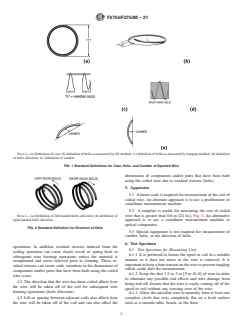
2.2.1 camber—the deflection in the width direction of a flat or shaped wire, Fig. 1(e).
2.2.2 cast—the maximum diameter of coiled wire when one complete circumference rests completely on a flat surface such as a
table, workbench, or floor.floor, Fig. 1(a).
2.2.3 helix—there are two common methods for measuring helix—free end lift and hanging helix. These definitions are defined
by Fig. 1(b) and Fig. 1(c), respectively.
2.2.3.1 helix (free end lift)—the maximum lift of the free end of the wire when laid on a flat surface, Fig. 1(b).
2.2.3.2 helix (hanging helix)—the maximum distance between two adjacent coils of wire, Fig. 1(c). A hanging helix can also
be measured by suspending the coils.
2.2.4 helix direction—can be left—left or right-handed depending upon how the wire was coiled, Fig. 1(d)(d).
2.2.4.1 left-handed helix—the wire is coiled in a counterclockwise direction, Fig. 2(a).
2.2.4.2 right-handed helix—the wire is coiled in a clockwise direction, Fig. 2(b).
2.2.4 camber—the deflection in the width direction of a flat or shaped wire, Fig. 1(e).
3. Summary of Test Method
3.1 The maximum diameter of at least one complete circumference is measured using a linear scale while it is resting completely
flat on a flat surface such as a table, workbench, or floor (cast measurement). The maximum lift of the free end of the wire when
laid on a flat surface is the free end lift helix and is measured using a linear scale. A hanging helix can be measured using a linear
scale while the wire is being suspended (hanging helix free end lift). Camber is the offset in the width dimension of a flat or shaped
F2754/F2754M − 21
NOTE 1—(a) Definition of left-handed helix direction.direction; (b) Definitiondefinition of right-handed helix direction.
FIG. 2 Standard Definition for Direction of Helix
wire and can also be measured using a linear scale while the wire is resting on a flat surface. Alternatively, a coordinate
measurement machine or optical comparator may be used. Helix direction is the direction in which the wire has been coiled.
4. Significance and Use
4.1 The process of coiling wire causes the wire to take on a curvature from the process of being mechanically deformed into a
coiled geometry. The curvature in the wire is permanent unless the wire is straightened. It will affect how the coiled wire will react
when it is subjected to additional wire forming operations. In addition, residual stresses induced from the coiling operation can
cause elastic recoil or spring back in subsequent wire forming operations unless the material is straightened and stress relieved
prior to forming. These residual stresses can create wide variations in the dimensions of components and or and/or parts that have
been built using the coiled wire (cast).
4.2 The direction that the wire has been coiled affects how the wire will be taken off of the coil for subsequent wire forming
operations (helix direction).
4.3 Lift or spacing between adjacent coils also affects how the wire will be taken off of the coil and can also affect the dimensions
of components and or and/or parts that have been built using the coiled wire due to residual stresses (helix).
5. Apparatus
5.1 A linear scale is required for measurement of the cast of coiled wire. An alternate approach is to use a profilometer or
coordinate measurement machine.
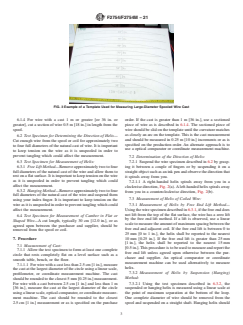
5.2 A template is useful for measuring the cast of coiled wire that is greater than 0.6 m (24 in),[24 in.], Fig. 3. An alternative
approach is to use a coordinate measurement machine or optical comparatocomparator.
FIG. 3 Example of a Template Used for Measuring Large Diameter Large-Diameter Spooled Wire Cast
F2754/F2754M − 21
5.3 Special equipment is not required for measurement of camber, helix, or the direction of helix.
6. Test Specimen
6.1 Test Specimen for Measuring Cast:
6.1.1 It is preferred to fixture the spool or coil in a suitable manner so it does not move as the wire is removed. It is important
to keep a firm tension on the wire to prevent tangling which could alter the measurement.
6.1.2 Scrap the first 1
...