

ASTM E2904-22
(Practice)Standard Practice for Characterization and Verification of Linear Phased Array Ultrasonic Probes
General Information
- Abstract
SIGNIFICANCE AND USE
5.1 This practice is intended to provide standardized procedures for evaluating linear phased-array ultrasonic probes. It is not intended to define performance and acceptance criteria, but rather to provide data from which such criteria may be established.
5.2 Implementation may require more detailed procedural instructions in a format of the using facility.
5.3 The measurement data obtained may be employed by users of this guide to specify, describe, or provide performance criteria for procurement and quality assurance, or service evaluation of the operating characteristics of linear phased-array ultrasonic probes. All or portions of the standard practice may be used as determined by the user.
5.4 The measurements are made primarily under pulse-echo conditions. To determine the relative performance of a probe element as either a transmitter or a receiver may require additional tests.
5.5 While these procedures relate to many of the significant parameters, others that may be important in specific applications may not be treated. These might include power handling capability, breakdown voltage, wear properties of contact units, radio-frequency interference, and the like.
5.6 Care must be taken to ensure that comparable measurements are made and that users of the standard practice follow similar procedures. The conditions specified or selected (if optional) may affect the test results and lead to apparent differences.
5.7 Interpretation of some test results, such as the shape of the frequency response curve, may be subjective. Small irregularities may be significant. Interpretation of the test results is beyond the scope of this practice.
5.8 Certain results obtained using the procedures outlined may differ from measurements made with phased-array ultrasonic test instruments. These differences may be attributed to differences in the nature of the experiment or the electrical characteristics of the instrumentation.
5.9 The pulse generator used t...
SCOPE
1.1 This practice covers measurement procedures for evaluating certain characteristics of phased-array ultrasonic probes that are used with phased-array ultrasonic examination instrumentation.
1.2 This practice describes means for obtaining performance data that may be used to define the acoustic and electric responses of phased-array ultrasonic probes including contact (with or without a wedge) and immersion linear phased-array probes used for ultrasonic nondestructive testing with central frequencies ranging from 0.5 MHz to 10 MHz. Frequencies outside of this range may use the same methods but the testing equipment may vary.
1.3 When ultrasonic values dependent on material are specified in this practice, they are based on carbon steel with an ultrasonic wave propagation speed of 5920 m/s (±50 m/s) for longitudinal wave modes and 3255 m/s (±30 m/s) for transverse or shear wave modes.
1.4 This practice describes some of the characterization and verification procedures that can be carried out at the end stage of the manufacturing process of linear phased array probes. This practice does not describe the methods or acceptance criteria used to verify the performance of the combined phased array ultrasonic instrument and probe system.
1.5 While this practice is intended to provide standardized procedures for evaluating linear phased-array ultrasonic probes, it may, with suitable modifications, be used for evaluation of configurations other than linear; for example, 1.5D or 2D matrix array probes.
1.6 Units—The values stated in SI units are to be regarded as the standard. The values given in parentheses after SI units are provided for information only and are not considered standard.
1.7 This standard does not purport to address all of the safety concerns, if any, associated with its use. It is the responsibility of the user of this standard to establish appropriate safety, health, and environmental practice...
- Status
- Published
- Publication Date
- 30-Nov-2022
- Technical Committee
- E07 - Nondestructive Testing
- Drafting Committee
- E07.06 - Ultrasonic Method
Buy Documents
ASTM E2904-22 - Standard Practice for Characterization and Verification of Linear Phased Array Ultrasonic Probes
REDLINE ASTM E2904-22 - Standard Practice for Characterization and Verification of Linear Phased Array Ultrasonic Probes
Overview
ASTM E2904-22: Standard Practice for Characterization and Verification of Linear Phased Array Ultrasonic Probes provides standardized measurement procedures for evaluating key physical, acoustic, and electrical characteristics of linear phased array ultrasonic probes. Developed by ASTM International’s Committee E07 on Nondestructive Testing, this standard ensures consistency and reliability in the assessment of phased array ultrasonic technology used with examination instrumentation. ASTM E2904 is designed to generate quantitative data that can help define performance specifications, ensure quality assurance, and facilitate the procurement and servicing of phased array probes, particularly in ultrasonic non-destructive testing (NDT) applications.
Key Topics
- Scope: ASTM E2904-22 covers the procedures for measuring characteristics of phased-array ultrasonic probes, including both contact (with or without a wedge) and immersion linear array probes with central frequencies typically ranging from 0.5 MHz to 10 MHz.
- Standardization of Measurements: The practice provides detailed steps for acquiring data on center frequency, bandwidth, time response, sensitivity, and crosstalk among probe elements, essential for characterizing device performance.
- Physical and Acoustic Evaluation: Procedures address probe identification, dimension assessment, and examination of external and internal features for both quality assurance and post-manufacturing verification.
- Adaptability: While optimized for linear array configurations, the methods may be adapted, with suitable modifications, to evaluate other geometries such as 1.5D or 2D matrix array ultrasonic probes.
Applications
ASTM E2904-22 is widely applicable in various industries where ultrasonic non-destructive testing (NDT) is critical, such as:
- Manufacturing and Quality Control: Used by manufacturers to certify probe performance at the end of the production process, supporting both batch and individual probe verification.
- Procurement and Specification: Assists end-users and purchasers in defining and assessing performance criteria of ultrasonic phased array probes for specific applications.
- Service and Maintenance: Enables facilities to evaluate probe characteristics during service intervals or after suspected probe damage, guiding decisions about continuing service or repair.
- Adaptation in Various Environments: Suitable for both laboratory and field environments, as it provides flexibility for users to select relevant portions of the practice according to their needs and instruments.
The standard is not intended to establish acceptance or rejection criteria, but rather to inform and support the development of such criteria based on reliable, comparable data. Test conditions, including material types (commonly carbon steel), are standardized where possible to improve data consistency.
Related Standards
For enhanced utility and context, ASTM E2904-22 references and aligns with several related standards in ultrasonic nondestructive testing, including:
- ASTM E1065: Practice for Evaluating Characteristics of Ultrasonic Search Units, which offers fundamental test methods for ultrasonic probes.
- ASTM E1316: Terminology for Nondestructive Examinations, providing standardized definitions for terms used across NDT disciplines.
ASTM E2904-22 complements and builds on these documents by focusing specifically on phased array probe characterization, and by providing procedures relevant for a wide range of industries that utilize ultrasonic phased-array technology.
Keywords: ASTM E2904, phased array ultrasonic probes, ultrasonic nondestructive testing, probe characterization, probe verification, quality assurance, linear phased-array, NDT standards, acoustic measurement, probe performance.
Relations
- Effective Date
- 01-Feb-2024
- Effective Date
- 01-Dec-2019
- Effective Date
- 01-Mar-2019
- Effective Date
- 01-Jan-2018
- Effective Date
- 15-Jun-2017
- Effective Date
- 01-Feb-2017
- Effective Date
- 01-Aug-2016
- Effective Date
- 01-Feb-2016
- Effective Date
- 01-Dec-2015
- Effective Date
- 01-Sep-2015
- Effective Date
- 01-Jun-2014
- Effective Date
- 01-Jun-2014
- Effective Date
- 01-Dec-2013
- Effective Date
- 15-Jun-2013
- Effective Date
- 01-Jun-2013
Buy Documents
ASTM E2904-22 - Standard Practice for Characterization and Verification of Linear Phased Array Ultrasonic Probes
REDLINE ASTM E2904-22 - Standard Practice for Characterization and Verification of Linear Phased Array Ultrasonic Probes
Get Certified
Connect with accredited certification bodies for this standard

IMP NDT d.o.o.
Non-destructive testing services. Radiography, ultrasonic, magnetic particle, penetrant, visual inspection.
Inštitut za kovinske materiale in tehnologije
Institute of Metals and Technology. Materials testing, metallurgical analysis, NDT.
Q Techna d.o.o.
NDT and quality assurance specialist. 30+ years experience. NDT personnel certification per ISO 9712, nuclear and thermal power plant inspections, QA/
Sponsored listings
Frequently Asked Questions
ASTM E2904-22 is a standard published by ASTM International. Its full title is "Standard Practice for Characterization and Verification of Linear Phased Array Ultrasonic Probes". This standard covers: SIGNIFICANCE AND USE 5.1 This practice is intended to provide standardized procedures for evaluating linear phased-array ultrasonic probes. It is not intended to define performance and acceptance criteria, but rather to provide data from which such criteria may be established. 5.2 Implementation may require more detailed procedural instructions in a format of the using facility. 5.3 The measurement data obtained may be employed by users of this guide to specify, describe, or provide performance criteria for procurement and quality assurance, or service evaluation of the operating characteristics of linear phased-array ultrasonic probes. All or portions of the standard practice may be used as determined by the user. 5.4 The measurements are made primarily under pulse-echo conditions. To determine the relative performance of a probe element as either a transmitter or a receiver may require additional tests. 5.5 While these procedures relate to many of the significant parameters, others that may be important in specific applications may not be treated. These might include power handling capability, breakdown voltage, wear properties of contact units, radio-frequency interference, and the like. 5.6 Care must be taken to ensure that comparable measurements are made and that users of the standard practice follow similar procedures. The conditions specified or selected (if optional) may affect the test results and lead to apparent differences. 5.7 Interpretation of some test results, such as the shape of the frequency response curve, may be subjective. Small irregularities may be significant. Interpretation of the test results is beyond the scope of this practice. 5.8 Certain results obtained using the procedures outlined may differ from measurements made with phased-array ultrasonic test instruments. These differences may be attributed to differences in the nature of the experiment or the electrical characteristics of the instrumentation. 5.9 The pulse generator used t... SCOPE 1.1 This practice covers measurement procedures for evaluating certain characteristics of phased-array ultrasonic probes that are used with phased-array ultrasonic examination instrumentation. 1.2 This practice describes means for obtaining performance data that may be used to define the acoustic and electric responses of phased-array ultrasonic probes including contact (with or without a wedge) and immersion linear phased-array probes used for ultrasonic nondestructive testing with central frequencies ranging from 0.5 MHz to 10 MHz. Frequencies outside of this range may use the same methods but the testing equipment may vary. 1.3 When ultrasonic values dependent on material are specified in this practice, they are based on carbon steel with an ultrasonic wave propagation speed of 5920 m/s (±50 m/s) for longitudinal wave modes and 3255 m/s (±30 m/s) for transverse or shear wave modes. 1.4 This practice describes some of the characterization and verification procedures that can be carried out at the end stage of the manufacturing process of linear phased array probes. This practice does not describe the methods or acceptance criteria used to verify the performance of the combined phased array ultrasonic instrument and probe system. 1.5 While this practice is intended to provide standardized procedures for evaluating linear phased-array ultrasonic probes, it may, with suitable modifications, be used for evaluation of configurations other than linear; for example, 1.5D or 2D matrix array probes. 1.6 Units—The values stated in SI units are to be regarded as the standard. The values given in parentheses after SI units are provided for information only and are not considered standard. 1.7 This standard does not purport to address all of the safety concerns, if any, associated with its use. It is the responsibility of the user of this standard to establish appropriate safety, health, and environmental practice...
SIGNIFICANCE AND USE 5.1 This practice is intended to provide standardized procedures for evaluating linear phased-array ultrasonic probes. It is not intended to define performance and acceptance criteria, but rather to provide data from which such criteria may be established. 5.2 Implementation may require more detailed procedural instructions in a format of the using facility. 5.3 The measurement data obtained may be employed by users of this guide to specify, describe, or provide performance criteria for procurement and quality assurance, or service evaluation of the operating characteristics of linear phased-array ultrasonic probes. All or portions of the standard practice may be used as determined by the user. 5.4 The measurements are made primarily under pulse-echo conditions. To determine the relative performance of a probe element as either a transmitter or a receiver may require additional tests. 5.5 While these procedures relate to many of the significant parameters, others that may be important in specific applications may not be treated. These might include power handling capability, breakdown voltage, wear properties of contact units, radio-frequency interference, and the like. 5.6 Care must be taken to ensure that comparable measurements are made and that users of the standard practice follow similar procedures. The conditions specified or selected (if optional) may affect the test results and lead to apparent differences. 5.7 Interpretation of some test results, such as the shape of the frequency response curve, may be subjective. Small irregularities may be significant. Interpretation of the test results is beyond the scope of this practice. 5.8 Certain results obtained using the procedures outlined may differ from measurements made with phased-array ultrasonic test instruments. These differences may be attributed to differences in the nature of the experiment or the electrical characteristics of the instrumentation. 5.9 The pulse generator used t... SCOPE 1.1 This practice covers measurement procedures for evaluating certain characteristics of phased-array ultrasonic probes that are used with phased-array ultrasonic examination instrumentation. 1.2 This practice describes means for obtaining performance data that may be used to define the acoustic and electric responses of phased-array ultrasonic probes including contact (with or without a wedge) and immersion linear phased-array probes used for ultrasonic nondestructive testing with central frequencies ranging from 0.5 MHz to 10 MHz. Frequencies outside of this range may use the same methods but the testing equipment may vary. 1.3 When ultrasonic values dependent on material are specified in this practice, they are based on carbon steel with an ultrasonic wave propagation speed of 5920 m/s (±50 m/s) for longitudinal wave modes and 3255 m/s (±30 m/s) for transverse or shear wave modes. 1.4 This practice describes some of the characterization and verification procedures that can be carried out at the end stage of the manufacturing process of linear phased array probes. This practice does not describe the methods or acceptance criteria used to verify the performance of the combined phased array ultrasonic instrument and probe system. 1.5 While this practice is intended to provide standardized procedures for evaluating linear phased-array ultrasonic probes, it may, with suitable modifications, be used for evaluation of configurations other than linear; for example, 1.5D or 2D matrix array probes. 1.6 Units—The values stated in SI units are to be regarded as the standard. The values given in parentheses after SI units are provided for information only and are not considered standard. 1.7 This standard does not purport to address all of the safety concerns, if any, associated with its use. It is the responsibility of the user of this standard to establish appropriate safety, health, and environmental practice...
ASTM E2904-22 is classified under the following ICS (International Classification for Standards) categories: 19.100 - Non-destructive testing. The ICS classification helps identify the subject area and facilitates finding related standards.
ASTM E2904-22 has the following relationships with other standards: It is inter standard links to ASTM E1316-24, ASTM E1316-19b, ASTM E1316-19, ASTM E1316-18, ASTM E1316-17a, ASTM E1316-17, ASTM E1316-16a, ASTM E1316-16, ASTM E1316-15a, ASTM E1316-15, ASTM E1316-14e1, ASTM E1316-14, ASTM E1316-13d, ASTM E1316-13c, ASTM E1316-13b. Understanding these relationships helps ensure you are using the most current and applicable version of the standard.
ASTM E2904-22 is available in PDF format for immediate download after purchase. The document can be added to your cart and obtained through the secure checkout process. Digital delivery ensures instant access to the complete standard document.
Standards Content (Sample)
This international standard was developed in accordance with internationally recognized principles on standardization established in the Decision on Principles for the
Development of International Standards, Guides and Recommendations issued by the World Trade Organization Technical Barriers to Trade (TBT) Committee.
Designation:E2904 −22
Standard Practice for
Characterization and Verification of Linear Phased Array
Ultrasonic Probes
This standard is issued under the fixed designation E2904; the number immediately following the designation indicates the year of
original adoption or, in the case of revision, the year of last revision. A number in parentheses indicates the year of last reapproval. A
superscript epsilon (´) indicates an editorial change since the last revision or reapproval.
1. Scope* 1.7 This standard does not purport to address all of the
safety concerns, if any, associated with its use. It is the
1.1 This practice covers measurement procedures for evalu-
responsibility of the user of this standard to establish appro-
ating certain characteristics of phased-array ultrasonic probes
priate safety, health, and environmental practices and deter-
that are used with phased-array ultrasonic examination instru-
mine the applicability of regulatory limitations prior to use.
mentation.
1.8 This international standard was developed in accor-
1.2 This practice describes means for obtaining perfor-
dance with internationally recognized principles on standard-
mance data that may be used to define the acoustic and electric
ization established in the Decision on Principles for the
responses of phased-array ultrasonic probes including contact
Development of International Standards, Guides and Recom-
(with or without a wedge) and immersion linear phased-array
mendations issued by the World Trade Organization Technical
probes used for ultrasonic nondestructive testing with central
Barriers to Trade (TBT) Committee.
frequencies ranging from 0.5 MHz to 10 MHz. Frequencies
outside of this range may use the same methods but the testing
2. Referenced Documents
equipment may vary. 2
2.1 ASTM Standards:
1.3 Whenultrasonicvaluesdependentonmaterialarespeci- E1065 Practice for Evaluating Characteristics of Ultrasonic
Search Units
fied in this practice, they are based on carbon steel with an
ultrasonic wave propagation speed of 5920 m/s (650 m/s) for E1316 Terminology for Nondestructive Examinations
longitudinal wave modes and 3255 m/s (630 m/s) for trans-
3. Terminology
verse or shear wave modes.
3.1 Definitions:
1.4 This practice describes some of the characterization and
3.1.1 For definitions of terms used in this practice, see
verification procedures that can be carried out at the end stage
Terminology E1316.
of the manufacturing process of linear phased array probes.
3.1.2 Technical Specification of the Phased Array Probes:
This practice does not describe the methods or acceptance
3.1.2.1 certification, n—defined as measured performance
criteria used to verify the performance of the combined phased
of an individual probe. This is the document that reports the
array ultrasonic instrument and probe system.
measured performance of a specific probe (specific to a serial
1.5 While this practice is intended to provide standardized
number).
procedures for evaluating linear phased-array ultrasonic
3.1.2.2 datasheet, n—defined as specification. This is the
probes, it may, with suitable modifications, be used for
document that defines the general geometry and expected
evaluation of configurations other than linear; for example,
performance of a specific model or part number.
1.5D or 2D matrix array probes.
3.1.2.3 probe shape and size, n—probe form and dimen-
1.6 Units—The values stated in SI units are to be regarded
sions.
as the standard. The values given in parentheses after SI units
3.1.2.4 probe type, n—contact or immersion.
are provided for information only and are not considered
standard. 3.1.3 Terminology for Array Probes:
3.1.3.1 active aperture, n—pitch times the number of ele-
ments.
This practice is under the jurisdiction of ASTM Committee E07 on Nonde-
structive Testing and is the direct responsibility of Subcommittee E07.06 on
Ultrasonic Method. For referenced ASTM standards, visit the ASTM website, www.astm.org, or
Current edition approved Dec. 1, 2022. Published January 2023. Originally contact ASTM Customer Service at service@astm.org. For Annual Book of ASTM
approved in 2012. Last previous edition approved in 2017 as E2904 – 17. DOI: Standards volume information, refer to the standard’s Document Summary page on
10.1520/E2904-22. the ASTM website.
*A Summary of Changes section appears at the end of this standard
Copyright © ASTM International, 100 Barr Harbor Drive, PO Box C700, West Conshohocken, PA 19428-2959. United States
E2904−22
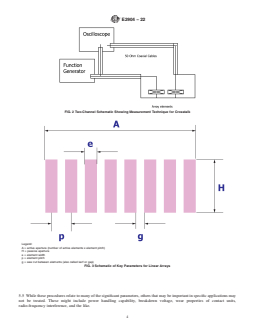
3.1.3.2 element length, n—in a rectangular element, the 4.2 Physical Aspects—Identification and physical dimen-
acoustic element’s long dimension. See passive aperture (also sion aspects of the probe should be noted. Details to be noted
called element elevation) and Fig. 3. are described in 7.1.
3.1.3.3 element pitch (or pitch), n—thedistancebetweenthe 4.3 Center Frequency, Bandwidth And Time Response—
centers of two adjacent array elements. Section 7.2 describes procedures for determining center
frequency, bandwidth, and time response of the individual
3.1.3.4 element width, n—in a rectangular element, the
elements of the linear array probe.
acoustic element’s short dimension.
4.4 Sensitivity Range Of Elements—Section 7.3 describes a
3.1.3.5 passive aperture, n—the dimension of an array
procedure to determine variation of sensitivity from one
element’s length.
element to the next based on a fixed input voltage.
3.1.3.6 saw cut, n—also called “kerf,” space or gap. The
4.5 Probe Sensitivity—The overall sensitivity performance
space between adjacent elements.
of all the elements in the array is assessed in the procedure
4. Summary of Practice
described in 7.4.
4.1 The physical, acoustic and electrical characteristics 4.6 Element Crosstalk—A procedure for assessment of
which can be described from the data obtained by procedures dampingbetweenelementstoeliminatecrosstalkisprovidedin
outlined in this guide are described as follows. 7.5.
FIG. 1Schematic Showing Digitization Rate
E2904−22
FIG. 2Two-Channel Schematic Showing Measurement Technique for Crosstalk
Legend:
A = active aperture (number of active elements x element pitch)
H = passive aperture
e = element width
p = element pitch
g = saw cut between elements (also called kerf or gap)
FIG. 3Schematic of Key Parameters for Linear Arrays
5. Significance and Use not intended to define performance and acceptance criteria, but
rather to provide data from which such criteria may be
5.1 This practice is intended to provide standardized proce-
established.
dures for evaluating linear phased-array ultrasonic probes. It is
E2904−22
5.2 Implementation may require more detailed procedural duration,andspectralcontentsufficienttoexcitetheprobeover
instructions in a format of the using facility. its full bandwidth, otherwise time distortion and erroneous
results may result.
5.3 The measurement data obtained may be employed by
users of this guide to specify, describe, or provide performance
6. Instrumentation
criteria for procurement and quality assurance, or service
6.1 Electronic Instruments:
evaluation of the operating characteristics of linear phased-
6.1.1 Thetypeofinstrument(s)usedforthetestsspecifiedin
array ultrasonic probes.All or portions of the standard practice
Section 7 shall be the same as that indicated on the Certifica-
may be used as determined by the user.
tion report and Table 2. They shall also be compliant with the
5.4 The measurements are made primarily under pulse-echo
applicable verification standard for the inspection unit.
conditions. To determine the relative performance of a probe
6.1.2 The following equipment is required in order to
element as either a transmitter or a receiver may require
evaluate the probes in compliance with this practice:
additional tests.
6.1.2.1 A pulser/receiver with a minimum bandwidth of 20
5.5 While these procedures relate to many of the significant
MHz, digitizing to 100 MHz, or better, and an oscilloscope (or
parameters, others that may be important in specific applica-
equivalent) with a minimum bandwidth of 100 MHz. A
tions may not be treated. These might include power handling phased-array instrument which contains the equivalent combi-
capability,breakdownvoltage,wearpropertiesofcontactunits,
nation may be used.
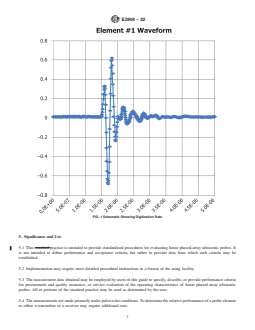
radio-frequency interference, and the like. 6.1.2.2 Digitizing should be able to get 10 samples in
maximum slope of waveform, as illustrated in Fig. 1.
5.6 Care must be taken to ensure that comparable measure-
6.1.2.3 A frequency spectrum analyzer with a minimum
ments are made and that users of the standard practice follow
bandwidth of 100 MHz or a digital oscilloscope/converter
similar procedures. The conditions specified or selected (if
capable of performing fast Fourier transforms (FFT), or wave-
optional) may affect the test results and lead to apparent
form capture and digital analysis, or a combination thereof.
differences.
6.1.2.4 An impedance analyzer.
5.7 Interpretation of some test results, such as the shape of
6.1.2.5 A waveform generator with burst-mode capability
the frequency response curve, may be subjective. Small irregu-
for a sine wave at the nominal frequency of the probe.
larities may be significant. Interpretation of the test results is
6.1.3 The following additional equipment is optional:
beyond the scope of this practice.
6.1.3.1 A hydrophone with an active diameter two times
5.8 Certain results obtained using the procedures outlined smaller than the central ultrasonic wavelength of the probe
may differ from measurements made with phased-array ultra- being tested, but no less than 0.5 mm.
sonic test instruments. These differences may be attributed to
6.2 Test Blocks and Other Equipment:
differences in the nature of the experiment or the electrical
6.2.1 For Contact Arrays with Integral Wedges:
characteristics of the instrumentation.
6.2.1.1 Blocks made of the same material as the wedge
5.9 The pulse generator used to obtain the frequency re- (acrylic, polystyrene, etc.) in shapes complementary to the
sponse and time response of the probe must have a rise time, wedge, allowing sound paths to be equalized.
TABLE 1 List of Variables for Probe Manufacture and Testing
Information Type Optional or
Information Needed Observations
A
(C,I,M) Required
Name of Manufacturer I Required
Probe type I Required
Instruments and settings used in the test process I Required See Table 2
Test conditions I Required Coupling medium, sound path, target, fixturing
See Table 2
Probe Dimensions or shape M or I Optional Casing dimensions
Elemen
...
This document is not an ASTM standard and is intended only to provide the user of an ASTM standard an indication of what changes have been made to the previous version. Because
it may not be technically possible to adequately depict all changes accurately, ASTM recommends that users consult prior editions as appropriate. In all cases only the current version
of the standard as published by ASTM is to be considered the official document.
Designation: E2904 − 17 E2904 − 22
Standard Practice for
Characterization and Verification of Linear Phased Array
Ultrasonic Probes
This standard is issued under the fixed designation E2904; the number immediately following the designation indicates the year of
original adoption or, in the case of revision, the year of last revision. A number in parentheses indicates the year of last reapproval. A
superscript epsilon (´) indicates an editorial change since the last revision or reapproval.
1. Scope*
1.1 This standard practice covers measurement procedures for evaluating certain characteristics of phased-array ultrasonic probes
that are used with phased-array ultrasonic examination instrumentation.
1.2 This standard practice describes means for obtaining performance data that may be used to define the acoustic and electric
responses of phased-array ultrasonic probes including contact (with or without a wedge) and immersion linear phased-array probes
used for ultrasonic nondestructive testing with central frequencies ranging from 0.5 MHz to 10 MHz. Frequencies outside of this
range may use the same methods but the testing equipment may vary.
1.3 When ultrasonic values dependent on material are specified in this document,practice, they are based on carbon steel with an
ultrasonic wave propagation speed of 5920 m/s (650 m/s) for longitudinal wave modes and 3255 m/s (630 m/s) for transverse
or shear wave modes.
1.4 This documentpractice describes some of the characterization and verification procedures that can be carried out at the end
stage of the manufacturing process of linear phased array probes. This documentpractice does not describe the methods or
acceptance criteria used to verify the performance of the combined phased array ultrasonic instrument and probe system.
1.5 While this practice is intended to provide standardized procedures for evaluating linear phased-array ultrasonic probes, it may,
with suitable modifications, be used for evaluation of configurations other than linear; for example, 1.5D or 2D matrix array probes.
1.6 Units—The values stated in SI units are to be regarded as the standard. The values given in parentheses are for information
only.after SI units are provided for information only and are not considered standard.
1.7 This standard does not purport to address all of the safety concerns, if any, associated with its use. It is the responsibility
of the user of this standard to establish appropriate safety, health, and environmental practices and determine the applicability of
regulatory limitations prior to use.
1.8 This international standard was developed in accordance with internationally recognized principles on standardization
established in the Decision on Principles for the Development of International Standards, Guides and Recommendations issued
by the World Trade Organization Technical Barriers to Trade (TBT) Committee.
This practice/guidepractice is under the jurisdiction of ASTM Committee E07 on Nondestructive Testing and is the direct responsibility of Subcommittee E07.06 on
Ultrasonic Method.
Current edition approved Nov. 1, 2017Dec. 1, 2022. Published December 2017January 2023. Originally approved in 2012. Last previous edition approved in 20122017
as E2904E2904 – 17.–12. DOI: 10.1520/E2904-17.10.1520/E2904-22.
*A Summary of Changes section appears at the end of this standard
Copyright © ASTM International, 100 Barr Harbor Drive, PO Box C700, West Conshohocken, PA 19428-2959. United States
E2904 − 22
2. Referenced Documents
2.1 ASTM Standards:
E1065 Practice for Evaluating Characteristics of Ultrasonic Search Units
E1316 Terminology for Nondestructive Examinations
3. Terminology
3.1 Definitions:
3.1.1 For definitions of terms used in this practice, see Terminology E1316.
3.1.2 Technical Specification of the Phased Array Probes:
3.1.2.1 datasheet—defined as specification. This is the document that defines the general geometry and expected performance
of a specific model or part number.
3.1.2.1 certification—certification, n—defined as measured performance of an individual probe. This is the document that
reports the measured performance of a specific probe (specific to a serial number).
3.1.2.2 probedatasheet, type—n—contact or immersion.defined as specification. This is the document that defines the general
geometry and expected performance of a specific model or part number.
3.1.2.3 probe shape and size—size, n—probe form and dimensions.
3.1.2.4 probe type, n—contact or immersion.
3.1.3 Terminology for Array Probes:
3.1.3.1 active aperture—aperture, n—pitch times the number of elements.
3.1.3.2 element width—in a rectangular element, the acoustic element’s short dimension.
3.1.3.2 element length—length, n—in a rectangular element, the acoustic element’s long dimension. See passive aperture (also
called element elevation) and Fig. 3.
3.1.3.3 element pitch (or pitch)—pitch), n—the distance between the centers of two adjacent array elements.
3.1.3.4 element width, n—in a rectangular element, the acoustic element’s short dimension.
3.1.3.5 passive aperture—aperture, n—the dimension of an array element’s length.
3.1.3.6 saw cut—cut, n—also called “kerf,” space or gap. The space between adjacent elements.
4. Summary of Practice
4.1 The physical, acoustic and electrical characteristics which can be described from the data obtained by procedures outlined in
this guide are described as follows.
4.2 Physical Aspects—Identification and physical dimension aspects of the probe should be noted. Details to be noted are
described in 7.1.
4.3 Center Frequency, Bandwidth And Time Response—Section 7.2 describes procedures for determining center frequency,
bandwidth, and time response of the individual elements of the linear array probe.
4.4 Sensitivity Range Of Elements—Section 7.3 describes a procedure to determine variation of sensitivity from one element to
the next based on a fixed input voltage.
4.5 Probe Sensitivity—The overall sensitivity performance of all the elements in the array is assessed in the procedure described
in 7.4.
4.6 Element Crosstalk—A procedure for assessment of damping between elements to eliminate crosstalk is provided in 7.5.
For referenced ASTM standards, visit the ASTM website, www.astm.org, or contact ASTM Customer Service at service@astm.org. For Annual Book of ASTM Standards
volume information, refer to the standard’s Document Summary page on the ASTM website.
E2904 − 22
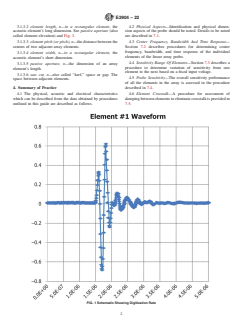
FIG. 1 Schematic Showing Digitization Rate
5. Significance and Use
5.1 This standard practice is intended to provide standardized procedures for evaluating linear phased-array ultrasonic probes. It
is not intended to define performance and acceptance criteria, but rather to provide data from which such criteria may be
established.
5.2 Implementation may require more detailed procedural instructions in a format of the using facility.
5.3 The measurement data obtained may be employed by users of this guide to specify, describe, or provide performance criteria
for procurement and quality assurance, or service evaluation of the operating characteristics of linear phased-array ultrasonic
probes. All or portions of the standard practice may be used as determined by the user.
5.4 The measurements are made primarily under pulse-echo conditions. To determine the relative performance of a probe element
as either a transmitter or a receiver may require additional tests.
E2904 − 22
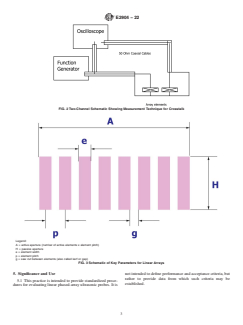
FIG. 2 Two-Channel Schematic Showing Measurement Technique for Crosstalk
Legend:
A = active aperture (number of active elements x element pitch)
H = passive aperture
e = element width
p = element pitch
g = saw cut between elements (also called kerf or gap)
FIG. 3 Schematic of Key Parameters for Linear Arrays
5.5 While these procedures relate to many of the significant parameters, others that may be important in specific applications may
not be treated. These might include power handling capability, breakdown voltage, wear properties of contact units,
radio-frequency interference, and the like.
E2904 − 22
5.6 Care must be taken to ensure that comparable measurements are made and that users of the standard practice follow similar
procedures. The conditions specified or selected (if optional) may affect the test results and lead to apparent differences.
5.7 Interpretation of some test results, such as the shape of the frequency response curve, may be subjective. Small irregularities
may be significant. Interpretation of the test results is beyond the scope of this standard practice.
5.8 Certain results obtained using the procedures outlined may differ from measurements made with phased-array ultrasonic test
instruments. These differences may be attributed to differences in the nature of the experiment or the electrical characteristics of
the instrumentation.
5.9 The pulse generator used to obtain the frequency response and time response of the probe must have a rise time, duration, and
spectral content sufficient to excite the probe over its full bandwidth, otherwise time distortion and erroneous results may result.
5.10 While this standard practice is intended to provide standardized procedures for evaluating linear phased-array ultrasonic
probes, it may, with suitable modifications, be used for evaluation of configurations other than linear; e.g. 1.5D or 2D matrix array
probes.
6. Instrumentation
6.1 Electronic Instruments:
6.1.1 The type of instrument(s) used for the tests specified in Section 7 shall be the same as that indicated on the Certification
report and Table 2. They shall also be compliant with the applicable verification standard for the inspection unit.
6.1.2 The following equipment is required in order to evaluate the probes in compliance with this standard:practice:
6.1.2.1 A pulser/receiver with a minimum bandwidth of 20 MHz, digitizing to 100 MHz, or better, and an oscilloscope (or
equivalent) with a minimum bandwidth of 100 MHz. A phased-array instrument which contains the equivalent combination may
be used.
6.1.2.2 Digitizing should be able to get 10 samples in maximum slope of waveform, as illustrated in Fig. 1.
TABLE 1 List of Variables for Probe Manufacture and Testing
Information Type Optional or
Information Needed Observations
A
(C, I, M) Required
Name of Manufacturer I Required
Probe type I Required
Instruments and settings used in the test process I Required See Table 2
Test conditions I Required Coupling medium, sound path, target, fixturing
See Table 2
Probe Dimensions or shape M or I Optional Casing dimensions
Element shape and size (active and passive I Optional Arrangement of the array(s)
apertures) Dimensions and geometry of the array(s)
Relative position of array in housing I Optional Location of first or last element in relation to the
housing
Pitch, gap between elements, element width, I Required Pitch, gap between elements (saw cut), and
length and dimensions element dimensions (length and width)
Connector type I Required
Dimensions and material of integrated wedge I Optional Applicable to contact probes
Dimensions and geometry of integrated wedge(s)
Wiring I Optional Cable length and external diameter
Center frequency, bandwidth, and time response M Required
Relative Sensitivity Range of the Elements M or C in dB Required Basic voltage indication of each element
Probe sensitivity M Required
Probe crosstalk I or C in dB Optional Must state medium if crosstalk reported
A
Legend:
C = Calculations
I = Information
M = Measurement
E2904 − 22
TABLE 2 Instrumentation and Target Requirements
NOTE 1—Table 2 gives a list of the instrumentation requirements to
evaluate arrays.
Optional or
Instrument and Target Comments
Required
Inst
...