

ASTM D3482-07a(2023)
(Practice)Standard Practice for Determining Electrolytic Corrosion of Copper by Adhesives
General Information
- Abstract
SIGNIFICANCE AND USE
5.1 Adhesives can be exposed to both electrical potential and humidity in many electrical and electronic applications. It is therefore desirable to provide a means of examining the corrosive tendencies of certain adhesives towards metals.
5.2 Although electrolytic corrosion is a direct result of ionic conduction in the adhesive, the nature of the exposed metals will have a bearing on both the severity of metal attack and the visibility of corrosion products. Because it gives a visual indication of corrosion and because of its widespread use in electrical circuits, copper is used in this practice. However, this would not preclude the use of other metals for specific interests.
5.3 This procedure is a subjective test in that determinations of the presence of corrosion is based on a visual inspection for a green discoloration or other evidence of corrosion.
SCOPE
1.1 This practice covers the determination of whether an adhesive has any corrosive effect on copper. It is ordinarily intended to distinguish materials that might cause corrosion in electrical and electronic equipment. This procedure is a subjective test for which precision and accuracy have not been established. It is not recommended for adhesives on backing.
1.2 The values stated in SI units are to be regarded as the standard. The values given in parentheses are for information only.
1.3 This standard does not purport to address all of the safety concerns, if any, associated with its use. It is the responsibility of the user of this standard to establish appropriate safety, health, and environmental practices and determine the applicability of regulatory limitations prior to use.
1.4 This international standard was developed in accordance with internationally recognized principles on standardization established in the Decision on Principles for the Development of International Standards, Guides and Recommendations issued by the World Trade Organization Technical Barriers to Trade (TBT) Committee.
- Status
- Published
- Publication Date
- 31-Dec-2022
- Technical Committee
- D14 - Adhesives
- Drafting Committee
- D14.80 - Metal Bonding Adhesives


Overview
ASTM D3482-07a(2023) is the internationally recognized standard practice for determining the electrolytic corrosion of copper by adhesives. Developed by ASTM International, this standard provides guidelines for evaluating whether an adhesive can cause corrosive effects on copper, a material widely used in electrical and electronic equipment. Given the critical role of adhesives in environments exposed to electrical potential and humidity, this standard is essential for ensuring the reliability and longevity of electronic assemblies.
Key Topics
Electrolytic Corrosion Assessment:
Electrolytic corrosion is a process where copper metal is corroded due to electrical current flow under potential in the presence of moisture, often resulting in green discoloration or other visible signs of corrosion. This standard outlines a practical, visual inspection method for assessing such corrosion.Visual Inspection Method:
The procedure involves applying the adhesive to parallel helices of fine copper wire on a glass tube, subjecting the assembly to controlled humidity and voltage, and then visually inspecting for signs of corrosion.Subjectivity and Limitations:
The test provides a qualitative, subjective determination based on the appearance of corrosion products. Precision and accuracy are not established, and it is not recommended for testing adhesives with backing materials.Copper as the Test Metal:
Copper is chosen for its widespread use in electrical circuits and the clear visual indicators it provides when corrosion occurs. The method can be adapted to other metals if required for specific interests.Significance for Electrical and Electronic Industries:
Since adhesives in these applications are often exposed to varied electrical and moisture conditions, evaluating corrosive tendencies is vital for product reliability.
Applications
ASTM D3482-07a(2023) is mainly used in:
Electrical and Electronic Manufacturing:
Suitable for manufacturers of printed circuit boards (PCBs), electrical connectors, and components, it helps qualify adhesives for use in environments where moisture and electrical potentials are present.Adhesive Development and Quality Control:
Adhesive formulators and quality assurance teams utilize the standard to screen new or existing products for compatibility with copper and to avoid potential corrosion issues in the final application.Component Testing:
Design engineers and testing laboratories apply this standard early in product development to ensure adhesives will not compromise the performance or integrity of copper conductors and joints in electronics.Risk Mitigation:
The procedure supports efforts to minimize the risk of adhesive-induced corrosion failures in critical assemblies, especially in high-reliability sectors such as aerospace, automotive, and telecommunications.
Related Standards
ASTM D907 – Terminology of Adhesives
Provides standardized definitions pertinent to adhesive testing and evaluation.ASTM D996 – Terminology of Packaging and Distribution Environments
Useful for understanding terms relevant to environmental exposures.ASTM E104 – Practice for Maintaining Constant Relative Humidity by Means of Aqueous Solutions
Details methods for controlling the environmental conditions required during corrosion testing.ASTM G15 – Terminology Relating to Corrosion and Corrosion Testing
(Withdrawn 2010 but still referenced for terminology related to corrosion processes.)
Practical Value
The ASTM D3482-07a(2023) standard offers an effective, visual means to assess the potential for adhesive-induced copper corrosion, supporting the selection of adhesives for use in sensitive electrical and electronic environments. Following this standard helps organizations ensure the reliability of their products while meeting industry best practices for material selection and testing. For professionals involved in material selection, product design, or quality assurance within electronics manufacturing, adherence to this standard can prevent costly failures and enhance product lifespan.
Keywords: electrolytic corrosion, copper, adhesives, corrosion testing, ASTM D3482, electronic equipment, reliability, visual inspection, corrosion of metals, electrical industry adhesives.
Relations
- Effective Date
- 01-Jul-2012
- Effective Date
- 01-May-2012
- Effective Date
- 01-Apr-2012
- Effective Date
- 01-Dec-2011
- Effective Date
- 01-Jan-2011
- Effective Date
- 01-Dec-2010
- Effective Date
- 01-Oct-2008
- Effective Date
- 15-Aug-2008
- Effective Date
- 01-Mar-2008
- Effective Date
- 01-Oct-2007
- Effective Date
- 01-Apr-2007
- Effective Date
- 01-Dec-2006
- Effective Date
- 01-Jul-2006
- Effective Date
- 15-Jun-2005
- Effective Date
- 01-Apr-2005
Get Certified
Connect with accredited certification bodies for this standard

DIN CERTCO
DIN Group product certification.

Smithers Quality Assessments
US management systems and product certification.
Sponsored listings
Frequently Asked Questions
ASTM D3482-07a(2023) is a standard published by ASTM International. Its full title is "Standard Practice for Determining Electrolytic Corrosion of Copper by Adhesives". This standard covers: SIGNIFICANCE AND USE 5.1 Adhesives can be exposed to both electrical potential and humidity in many electrical and electronic applications. It is therefore desirable to provide a means of examining the corrosive tendencies of certain adhesives towards metals. 5.2 Although electrolytic corrosion is a direct result of ionic conduction in the adhesive, the nature of the exposed metals will have a bearing on both the severity of metal attack and the visibility of corrosion products. Because it gives a visual indication of corrosion and because of its widespread use in electrical circuits, copper is used in this practice. However, this would not preclude the use of other metals for specific interests. 5.3 This procedure is a subjective test in that determinations of the presence of corrosion is based on a visual inspection for a green discoloration or other evidence of corrosion. SCOPE 1.1 This practice covers the determination of whether an adhesive has any corrosive effect on copper. It is ordinarily intended to distinguish materials that might cause corrosion in electrical and electronic equipment. This procedure is a subjective test for which precision and accuracy have not been established. It is not recommended for adhesives on backing. 1.2 The values stated in SI units are to be regarded as the standard. The values given in parentheses are for information only. 1.3 This standard does not purport to address all of the safety concerns, if any, associated with its use. It is the responsibility of the user of this standard to establish appropriate safety, health, and environmental practices and determine the applicability of regulatory limitations prior to use. 1.4 This international standard was developed in accordance with internationally recognized principles on standardization established in the Decision on Principles for the Development of International Standards, Guides and Recommendations issued by the World Trade Organization Technical Barriers to Trade (TBT) Committee.
SIGNIFICANCE AND USE 5.1 Adhesives can be exposed to both electrical potential and humidity in many electrical and electronic applications. It is therefore desirable to provide a means of examining the corrosive tendencies of certain adhesives towards metals. 5.2 Although electrolytic corrosion is a direct result of ionic conduction in the adhesive, the nature of the exposed metals will have a bearing on both the severity of metal attack and the visibility of corrosion products. Because it gives a visual indication of corrosion and because of its widespread use in electrical circuits, copper is used in this practice. However, this would not preclude the use of other metals for specific interests. 5.3 This procedure is a subjective test in that determinations of the presence of corrosion is based on a visual inspection for a green discoloration or other evidence of corrosion. SCOPE 1.1 This practice covers the determination of whether an adhesive has any corrosive effect on copper. It is ordinarily intended to distinguish materials that might cause corrosion in electrical and electronic equipment. This procedure is a subjective test for which precision and accuracy have not been established. It is not recommended for adhesives on backing. 1.2 The values stated in SI units are to be regarded as the standard. The values given in parentheses are for information only. 1.3 This standard does not purport to address all of the safety concerns, if any, associated with its use. It is the responsibility of the user of this standard to establish appropriate safety, health, and environmental practices and determine the applicability of regulatory limitations prior to use. 1.4 This international standard was developed in accordance with internationally recognized principles on standardization established in the Decision on Principles for the Development of International Standards, Guides and Recommendations issued by the World Trade Organization Technical Barriers to Trade (TBT) Committee.
ASTM D3482-07a(2023) is classified under the following ICS (International Classification for Standards) categories: 83.180 - Adhesives. The ICS classification helps identify the subject area and facilitates finding related standards.
ASTM D3482-07a(2023) has the following relationships with other standards: It is inter standard links to ASTM D907-12a, ASTM D907-12, ASTM E104-02(2012), ASTM D907-11a, ASTM D907-11, ASTM D996-10a, ASTM D907-08b, ASTM D907-08a, ASTM D907-08, ASTM E104-02(2007), ASTM G15-07, ASTM D907-06, ASTM G15-06, ASTM G15-05, ASTM D907-05. Understanding these relationships helps ensure you are using the most current and applicable version of the standard.
ASTM D3482-07a(2023) is available in PDF format for immediate download after purchase. The document can be added to your cart and obtained through the secure checkout process. Digital delivery ensures instant access to the complete standard document.
Standards Content (Sample)
This international standard was developed in accordance with internationally recognized principles on standardization established in the Decision on Principles for the
Development of International Standards, Guides and Recommendations issued by the World Trade Organization Technical Barriers to Trade (TBT) Committee.
Designation: D3482 − 07a (Reapproved 2023)
Standard Practice for
Determining Electrolytic Corrosion of Copper by Adhesives
This standard is issued under the fixed designation D3482; the number immediately following the designation indicates the year of
original adoption or, in the case of revision, the year of last revision. A number in parentheses indicates the year of last reapproval. A
superscript epsilon (´) indicates an editorial change since the last revision or reapproval.
This standard has been approved for use by agencies of the U.S. Department of Defense.
1. Scope 3. Terminology
1.1 This practice covers the determination of whether an 3.1 Definitions—Definitions of terms in this test method
adhesive has any corrosive effect on copper. It is ordinarily may be found in Terminologies D907, D996, and G15.
intended to distinguish materials that might cause corrosion in 3.1.1 electrolytic corrosion, n—the corrosion of metal re-
electrical and electronic equipment. This procedure is a sub- sulting from current flow under an electrical potential in the
jective test for which precision and accuracy have not been presence of moisture.
established. It is not recommended for adhesives on backing.
4. Summary of Practice
1.2 The values stated in SI units are to be regarded as the
4.1 Two parallel helices of fine copper wire are laid in
standard. The values given in parentheses are for information
only. etched grooves on a glass tube.The adhesive material is coated
over the wires and the tube and then allowed to set or cure.The
1.3 This standard does not purport to address all of the
wired tube is exposed to high humidity with a d-c potential
safety concerns, if any, associated with its use. It is the
applied between the wires. Corrosion products are observed
responsibility of the user of this standard to establish appro-
visually.
priate safety, health, and environmental practices and deter-
mine the applicability of regulatory limitations prior to use.
5. Significance and Use
1.4 This international standard was developed in accor-
dance with internationally recognized principles on standard- 5.1 Adhesives can be exposed to both electrical potential
ization established in the Decision on Principles for the and humidity in many electrical and electronic applications. It
Development of International Standards, Guides and Recom- is therefore desirable to provide a means of examining the
mendations issued by the World Trade Organization Technical corrosive tendencies of certain adhesives towards metals.
Barriers to Trade (TBT) Committee.
5.2 Although electrolytic corrosion is a direct result of ionic
conduction in the adhesive, the nature of the exposed metals
2. Referenced Documents
will have a bearing on both the severity of metal attack and the
2.1 ASTM Standards:
visibility of corrosion products. Because it gives a visual
D907 Terminology of Adhesives
indication of corrosion and because of its widespread use in
D996 Terminology of Packaging and Distribution Environ-
electrical circuits, copper is used in this practice. However, this
ments
would not preclude the use of other metals for specific
E104 Practice for Maintaining Constant Relative Humidity
interests.
by Means of Aqueous Solutions
5.3 This procedure is a subjective test in that determinations
G15 Terminology Relating to Corrosion and Corrosion Test-
3 of the presence of corrosion is based on a visual inspection for
ing (Withdrawn 2010)
a green discoloration or other evidence of corrosion.
This practice is under the jurisdiction ofASTM Committee D14 on Adhesives
6. Apparatus and Material
and is the direct responsibility of Subcommittee D14.80 on Metal Bonding
Adhesives. 6.1 Motor (Optional), low-speed, approximately 10 r/min
Current edition approved Jan. 1, 2023. Published January 2023. Originally
for winding wire helices.
approved in 1976. Last previous edition approved in 2014 as D3482 – 07a (2014).
DOI: 10.1520/D3482-07AR23. 6.2 Oven (or Temperature-Controlled Chamber),
For referenced ASTM standards, visit the ASTM website, www.astm.org, or
circulating-air, or chamber controlled at 39.5 °C 6 1 °C (95 °F
contact ASTM Customer Service at service@astm.org. For Annual Book of ASTM
6 2 °F), unless otherwise specified.
Standards volume information, refer to the standard’s Document Summary page on
the ASTM website.
6.3 Battery, 45-V, or equivalent source of d-c power.
The last approved version of this historical standard is referenced on
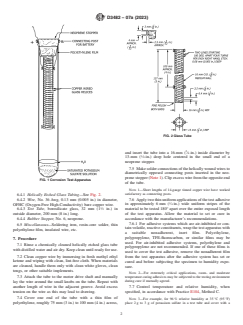
www.astm.org. 6.4 Corrosion Test Apparatus—See Fig. 1.
Copyright © ASTM International, 100 Barr Harbor Drive, PO Box C700, West Conshohocken, PA 19428-2959. United States
D3482 − 07a (2023)
FIG. 2 Glass Tube
and insert the tube into a 16-mm ( ⁄8-in.) inside diameter by
13-mm ( ⁄2-in.) deep hole centered in the small end of a
neoprene stopper.
7.5 Makesolderconnectionsofthehelicallywoundwiresto
diametrically opposed connecting posts inserted in the neo-
prene stopper (Note 1). Clip excess wire from the opposite end
FIG. 1 Corrosion Test Apparatus
of the tube.
NOTE 1—Short lengths of 14-gauge tinned copper wire have worked
satisfactory as connecting posts.
6.4.1 Helically Etched Glass Tubing—See Fig. 2.
6.4.2 Wire, No. 36 Awg, 0.13 mm (0.005 in.) in diameter, 7.6 Apply two thin uniform applications of the test adhesiv
...