

ASTM F3058-16(2021)
(Practice)Standard Practice for Preliminary Field Testing of Thermoplastic Pipe Joints for Gravity Flow (Non-Pressure) Sewer Lines
General Information
- Abstract
SIGNIFICANCE AND USE
5.1 The values recorded are applicable only to the sewer joint being tested and at the time of testing.
SCOPE
1.1 This practice covers procedures for testing single joints of thermoplastic pipe for gravity flow (non-pressure) sewer lines, when using either air or water under low pressure to demonstrate the integrity of the joint. This practice is used for testing 27 in. (675 mm) and larger inside diameter PVC (Polyvinyl Chloride), HDPE (High Density Polyethylene) and PP (Polypropylene) sewer lines utilizing flexible gasketed joints with elastomeric seals, Specification F477.
1.2 This practice is used for assessing the watertight integrity of a joint at the time of the test. It is not a pipeline acceptance test as it does not evaluate the integrity of the pipe barrel or any long-term pipeline deformation effects from backfill settlement
Note 1: The user of this practice is advised that methods described herein is typically used as a preliminary test to enable the installer to demonstrate the integrity of a sewer pipe joint prior to placement of final backfill. Such testing after initial backfill can detect if a gasket has rolled or dirt was pushed into the joint during the mating of the pipe. Repair of these types of installation problems can be done very quickly and effectively prior to final backfill, but once final backfill is placed, repairs are very difficult and costly.
Note 2: This practice may be used at any time to check the integrity of a joint prior to acceptance testing or to locate a leaking joint when a pipeline fails a hydrostatic infiltration/exfiltration test, vacuum test or air pressure test during any time of the installation and acceptance process.
Note 3: The user of this practice is advised that no correlation has been found between air loss and water leakage.
1.3 The values stated in inch-pound units are to be regarded as standard. The values given in parentheses are mathematical conversions to SI units that are provided for information only and are not considered standard.
1.4 This standard does not purport to address all of the safety concerns, if any, associated with its use. It is the responsibility of the user of this standard to establish appropriate safety, health, and environmental practices and determine the applicability of regulatory limitations prior to use.
1.5 This international standard was developed in accordance with internationally recognized principles on standardization established in the Decision on Principles for the Development of International Standards, Guides and Recommendations issued by the World Trade Organization Technical Barriers to Trade (TBT) Committee.
- Status
- Published
- Publication Date
- 14-Apr-2021
- Technical Committee
- F17 - Plastic Piping Systems
- Drafting Committee
- F17.40 - Test Methods


Overview
ASTM F3058-16(2021), Standard Practice for Preliminary Field Testing of Thermoplastic Pipe Joints for Gravity Flow (Non-Pressure) Sewer Lines, provides guidelines for preliminary testing of single joints in large-diameter thermoplastic pipe systems. Specifically, it addresses gravity flow (non-pressure) sewer lines using materials such as PVC, HDPE, and PP. This standard is used to evaluate the integrity of flexible gasketed joints with elastomeric seals prior to final backfill placement.
Using either air or water under low pressure, the practice helps to identify installation issues-such as rolled or contaminated gaskets-before final backfilling, thereby enabling early, efficient repairs.
Key Topics
- Target Applications: For sewer pipe joints 27 inches (675 mm) or larger in diameter, made from polyvinyl chloride (PVC), high-density polyethylene (HDPE), or polypropylene (PP).
- Flexible Gasketed Joints: Applies to joints that rely on elastomeric seals specified by ASTM F477.
- Field Testing Procedures: Covers the use of low-pressure air or water to preliminarily test joint watertightness.
- Isolated Joint Testing: Focuses on testing only the joint area, not the surrounding pipe barrel or long-term pipeline deformations.
- Timing of Tests: Intended for installation phases, specifically before final backfill, but may be used at other stages to diagnose leaks.
- Safety Considerations: Emphasizes safety when using compressed air or water, and proper pipe preparation.
Applications
ASTM F3058-16(2021) is valuable in several practical scenarios, notably in the construction and installation phases of sewer infrastructure:
- Quality Assurance in Pipe Installation: Installers use this practice to verify that each joint is leak-free before proceeding with backfilling, minimizing costly repairs after earthwork is complete.
- Early Detection of Installation Errors: Detects issues such as gasket misalignment or dirt within the joint, which are easiest and least expensive to fix before the pipe is fully buried.
- Supplement to Acceptance Testing: While not a full pipeline acceptance test, it provides confidence in joint integrity ahead of more comprehensive tests (such as infiltration, exfiltration, or vacuum tests).
- Targeted Leak Diagnosis: Useful when a pipeline fails a pressure or infiltration/exfiltration acceptance test, as the method helps pinpoint the specific leaking joint.
Related Standards
Several ASTM standards are referenced or commonly used with ASTM F3058-16(2021):
- ASTM F477 - Specification for Elastomeric Seals (Gaskets) for Joining Plastic Pipe, defining materials and requirements for gaskets used in the tested joints.
- ASTM F2487 - Practice for Infiltration and Exfiltration Acceptance Testing of Installed Corrugated HDPE and PP Pipelines, often used for comprehensive pipeline acceptance.
- ASTM F412 - Terminology Relating to Plastic Piping Systems, supplying definitions relevant to field testing and piping materials.
Practical Value
Adopting ASTM F3058-16(2021) as a standard practice in sewer pipeline projects ensures:
- Early Assurance of Joint Integrity: Field crews can quickly verify watertightness at the joint level, preventing future leaks.
- Minimized Repair Costs: Problems are addressed when they are easiest to repair, reducing downtime and mitigating risk of costly post-backfill excavation.
- Enhanced Project Documentation: Consistent testing processes and records facilitate smoother final acceptance and regulatory compliance.
- Improved Installation Quality: Frequent, reliable testing supports quality workmanship and long-term pipeline performance.
By following this ASTM standard, construction and inspection teams can improve the quality control of non-pressure sewer pipe installations and ensure durable, leak-free sewerage infrastructure.
Relations
- Effective Date
- 01-Apr-2020
- Effective Date
- 01-Jan-2019
- Effective Date
- 01-Aug-2017
- Effective Date
- 01-Feb-2017
- Effective Date
- 15-Nov-2016
- Effective Date
- 01-Aug-2016
- Effective Date
- 01-Jun-2015
- Effective Date
- 01-Nov-2013
- Effective Date
- 15-Feb-2013
- Effective Date
- 01-Aug-2012
- Effective Date
- 01-Apr-2012
- Refers
ASTM F477-10 - Standard Specification for Elastomeric Seals (Gaskets) for Joining Plastic Pipe - Effective Date
- 15-Mar-2010
- Effective Date
- 01-May-2009
- Refers
ASTM F477-08 - Standard Specification for Elastomeric Seals (Gaskets) for Joining Plastic Pipe - Effective Date
- 01-Jul-2008
- Effective Date
- 15-Dec-2007
Get Certified
Connect with accredited certification bodies for this standard

Institut za varilstvo d.o.o. (Welding Institute)
Slovenia's leading welding institute since 1952. ISO 3834, EN 1090, pressure equipment certification, NDT personnel, welder qualification. Only IIW Au
Sponsored listings
Frequently Asked Questions
ASTM F3058-16(2021) is a standard published by ASTM International. Its full title is "Standard Practice for Preliminary Field Testing of Thermoplastic Pipe Joints for Gravity Flow (Non-Pressure) Sewer Lines". This standard covers: SIGNIFICANCE AND USE 5.1 The values recorded are applicable only to the sewer joint being tested and at the time of testing. SCOPE 1.1 This practice covers procedures for testing single joints of thermoplastic pipe for gravity flow (non-pressure) sewer lines, when using either air or water under low pressure to demonstrate the integrity of the joint. This practice is used for testing 27 in. (675 mm) and larger inside diameter PVC (Polyvinyl Chloride), HDPE (High Density Polyethylene) and PP (Polypropylene) sewer lines utilizing flexible gasketed joints with elastomeric seals, Specification F477. 1.2 This practice is used for assessing the watertight integrity of a joint at the time of the test. It is not a pipeline acceptance test as it does not evaluate the integrity of the pipe barrel or any long-term pipeline deformation effects from backfill settlement Note 1: The user of this practice is advised that methods described herein is typically used as a preliminary test to enable the installer to demonstrate the integrity of a sewer pipe joint prior to placement of final backfill. Such testing after initial backfill can detect if a gasket has rolled or dirt was pushed into the joint during the mating of the pipe. Repair of these types of installation problems can be done very quickly and effectively prior to final backfill, but once final backfill is placed, repairs are very difficult and costly. Note 2: This practice may be used at any time to check the integrity of a joint prior to acceptance testing or to locate a leaking joint when a pipeline fails a hydrostatic infiltration/exfiltration test, vacuum test or air pressure test during any time of the installation and acceptance process. Note 3: The user of this practice is advised that no correlation has been found between air loss and water leakage. 1.3 The values stated in inch-pound units are to be regarded as standard. The values given in parentheses are mathematical conversions to SI units that are provided for information only and are not considered standard. 1.4 This standard does not purport to address all of the safety concerns, if any, associated with its use. It is the responsibility of the user of this standard to establish appropriate safety, health, and environmental practices and determine the applicability of regulatory limitations prior to use. 1.5 This international standard was developed in accordance with internationally recognized principles on standardization established in the Decision on Principles for the Development of International Standards, Guides and Recommendations issued by the World Trade Organization Technical Barriers to Trade (TBT) Committee.
SIGNIFICANCE AND USE 5.1 The values recorded are applicable only to the sewer joint being tested and at the time of testing. SCOPE 1.1 This practice covers procedures for testing single joints of thermoplastic pipe for gravity flow (non-pressure) sewer lines, when using either air or water under low pressure to demonstrate the integrity of the joint. This practice is used for testing 27 in. (675 mm) and larger inside diameter PVC (Polyvinyl Chloride), HDPE (High Density Polyethylene) and PP (Polypropylene) sewer lines utilizing flexible gasketed joints with elastomeric seals, Specification F477. 1.2 This practice is used for assessing the watertight integrity of a joint at the time of the test. It is not a pipeline acceptance test as it does not evaluate the integrity of the pipe barrel or any long-term pipeline deformation effects from backfill settlement Note 1: The user of this practice is advised that methods described herein is typically used as a preliminary test to enable the installer to demonstrate the integrity of a sewer pipe joint prior to placement of final backfill. Such testing after initial backfill can detect if a gasket has rolled or dirt was pushed into the joint during the mating of the pipe. Repair of these types of installation problems can be done very quickly and effectively prior to final backfill, but once final backfill is placed, repairs are very difficult and costly. Note 2: This practice may be used at any time to check the integrity of a joint prior to acceptance testing or to locate a leaking joint when a pipeline fails a hydrostatic infiltration/exfiltration test, vacuum test or air pressure test during any time of the installation and acceptance process. Note 3: The user of this practice is advised that no correlation has been found between air loss and water leakage. 1.3 The values stated in inch-pound units are to be regarded as standard. The values given in parentheses are mathematical conversions to SI units that are provided for information only and are not considered standard. 1.4 This standard does not purport to address all of the safety concerns, if any, associated with its use. It is the responsibility of the user of this standard to establish appropriate safety, health, and environmental practices and determine the applicability of regulatory limitations prior to use. 1.5 This international standard was developed in accordance with internationally recognized principles on standardization established in the Decision on Principles for the Development of International Standards, Guides and Recommendations issued by the World Trade Organization Technical Barriers to Trade (TBT) Committee.
ASTM F3058-16(2021) is classified under the following ICS (International Classification for Standards) categories: 23.040.80 - Seals for pipe and hose assemblies. The ICS classification helps identify the subject area and facilitates finding related standards.
ASTM F3058-16(2021) has the following relationships with other standards: It is inter standard links to ASTM F412-20, ASTM F412-19, ASTM F412-17a, ASTM F412-17, ASTM F412-16a, ASTM F412-16, ASTM F412-15, ASTM F2487-13, ASTM F412-13, ASTM F2487-06(2012), ASTM F412-12, ASTM F477-10, ASTM F412-09, ASTM F477-08, ASTM F412-07. Understanding these relationships helps ensure you are using the most current and applicable version of the standard.
ASTM F3058-16(2021) is available in PDF format for immediate download after purchase. The document can be added to your cart and obtained through the secure checkout process. Digital delivery ensures instant access to the complete standard document.
Standards Content (Sample)
This international standard was developed in accordance with internationally recognized principles on standardization established in the Decision on Principles for the
Development of International Standards, Guides and Recommendations issued by the World Trade Organization Technical Barriers to Trade (TBT) Committee.
Designation: F3058 − 16 (Reapproved 2021)
Standard Practice for
Preliminary Field Testing of Thermoplastic Pipe Joints for
Gravity Flow (Non-Pressure) Sewer Lines
This standard is issued under the fixed designation F3058; the number immediately following the designation indicates the year of
original adoption or, in the case of revision, the year of last revision. A number in parentheses indicates the year of last reapproval. A
superscript epsilon (´) indicates an editorial change since the last revision or reapproval.
1. Scope 1.5 This international standard was developed in accor-
dance with internationally recognized principles on standard-
1.1 This practice covers procedures for testing single joints
ization established in the Decision on Principles for the
of thermoplastic pipe for gravity flow (non-pressure) sewer
Development of International Standards, Guides and Recom-
lines, when using either air or water under low pressure to
mendations issued by the World Trade Organization Technical
demonstrate the integrity of the joint. This practice is used for
Barriers to Trade (TBT) Committee.
testing 27 in. (675 mm) and larger inside diameter PVC (Poly-
vinyl Chloride), HDPE (High Density Polyethylene) and PP
2. Referenced Documents
(Polypropylene) sewer lines utilizing flexible gasketed joints
2.1 ASTM Standards:
with elastomeric seals, Specification F477.
F412 Terminology Relating to Plastic Piping Systems
1.2 This practice is used for assessing the watertight integ-
F477 Specification for Elastomeric Seals (Gaskets) for Join-
rity of a joint at the time of the test. It is not a pipeline
ing Plastic Pipe
acceptance test as it does not evaluate the integrity of the pipe
F2487 Practice for Infiltration and Exfiltration Acceptance
barrel or any long-term pipeline deformation effects from
Testing of Installed Corrugated High Density Polyethyl-
backfill settlement
ene and Polypropylene Pipelines
NOTE 1—The user of this practice is advised that methods described
3. Terminology
herein is typically used as a preliminary test to enable the installer to
demonstrate the integrity of a sewer pipe joint prior to placement of final
3.1 Defintions—For definitions of terms relating to plastic
backfill. Such testing after initial backfill can detect if a gasket has rolled
pipe, see Terminology F412.
or dirt was pushed into the joint during the mating of the pipe. Repair of
these types of installation problems can be done very quickly and
4. Summary of Practice
effectively prior to final backfill, but once final backfill is placed, repairs
are very difficult and costly.
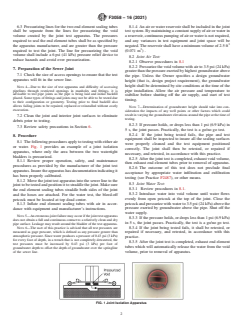
4.1 The joint in the sewer line to be tested is covered on the
NOTE 2—This practice may be used at any time to check the integrity
inside of the pipe by a ring with two end element sealing tubes.
of a joint prior to acceptance testing or to locate a leaking joint when a
pipeline fails a hydrostatic infiltration/exfiltration test, vacuum test or air Air or water is introduced at low pressure through a connection
pressure test during any time of the installation and acceptance process.
on the ring into the annular space between the ring and joint.
NOTE 3—The user of this practice is advised that no correlation has
The amount of air, or water, loss is used to determine the
been found between air loss and water leakage.
acceptability of the joint.
1.3 The values stated in inch-pound units are to be regarded
as standard. The values given in parentheses are mathematical 5. Significance and Use
conversions to SI units that are provided for information only
5.1 The values recorded are applicable only to the sewer
and are not considered standard.
joint being tested and at the time of testing.
1.4 This standard does not purport to address all of the
6. Safety Precautions
safety concerns, if any, associated with its use. It is the
responsibility of the user of this standard to establish appro-
6.1 The use of compressed air is dangerous.Always observe
priate safety, health, and environmental practices and deter-
proper sewer line preparation and procedures.
mine the applicability of regulatory limitations prior to use.
6.2 It is imperative that all pressures be relieved completely
before the test apparatus is loosened for removal.
This practice is under the jurisdiction of ASTM Committee F17 on Plastic
Piping Systems and is the direct responsibility of Subcommittee F17.40 on Test
Methods. For referenced ASTM standards, visit the ASTM website, www.astm.org, or
Current edition approved April 15, 2021. Published April 2021. Originally contact ASTM Customer Service at service@astm.org. For Annual Book of ASTM
approved in 2016. Last previous edition approved in 2016 as F3058–16. DOI: Standards volume information, refer to the standard’s Document Summary page on
10.1520/F3058–16R21 the ASTM website.
Copyright © ASTM International, 100 Barr Harbor Drive, PO Box C700, West Conshohocken, PA 19428-2959. United States
F3058 − 16 (2021)
6.3 Pressurizing lines for the two end element sealing tubes 8.1.4 An air or water reservoir shall be included in the joint
shall be separate from the lines for pressurizing the void test system. By maintaining a constant supply of air or water in
volume created by the joint test apparatus. The pressures a reservoir, continuous pumping of air or water is not required,
required to seal the end element tubes shall be as specified by and any variances in test equipment and joint space will be
the apparatus manufacturer, and are greater than the pressure negated. The reservoir shall have a minimum volume of 2.5 ft
required to test the joint. The line for pressurizing the void (0.071 m).
volume shall include a 6 psi (41 kPa) pressure relief device to
8.2 Joint Air Test:
reduce hazards and avoid over pressurization.
8.2.1 Observe procedures in 8.1
8.2.2 Pressurize the v
...