

ASTM D524-15(2019)
(Test Method)Standard Test Method for Ramsbottom Carbon Residue of Petroleum Products
General Information
- Abstract
SIGNIFICANCE AND USE
5.1 The carbon residue value of burner fuel serves as a rough approximation of the tendency of the fuel to form deposits in vaporizing pot-type and sleeve-type burners. Similarly, provided alkyl nitrates are absent (or if present, provided the test is performed on the base fuel without additive) the carbon residue of diesel fuel correlates approximately with combustion chamber deposits.
5.2 The carbon residue value of motor oil, while at one time regarded as indicative of the amount of carbonaceous deposits a motor oil would form in the combustion chamber of an engine, is now considered to be of doubtful significance due to the presence of additives in many oils. For example, an ash-forming detergent additive can increase the carbon residue value of an oil yet will generally reduce its tendency to form deposits.
5.3 The carbon residue value of gas oil is useful as a guide in the manufacture of gas from gas oil, while carbon residue values of crude oil residuum, cylinder and bright stocks, are useful in the manufacture of lubricants.
SCOPE
1.1 This test method covers the determination of the amount of carbon residue (Note 1) left after evaporation and pyrolysis of an oil, and it is intended to provide some indication of relative coke-forming propensity. This test method is generally applicable to relatively nonvolatile petroleum products which partially decompose on distillation at atmospheric pressure. This test method also covers the determination of carbon residue on 10 % (V/V) distillation residues (see Section 10). Petroleum products containing ash-forming constituents as determined by Test Method D482, will have an erroneously high carbon residue, depending upon the amount of ash formed (Notes 2 and 3).
Note 1: The term carbon residue is used throughout this test method to designate the carbonaceous residue formed during evaporation and pyrolysis of a petroleum product. The residue is not composed entirely of carbon, but is a coke which can be further changed by pyrolysis. The term carbon residue is continued in this test method only in deference to its wide common usage.
Note 2: Values obtained by this test method are not numerically the same as those obtained by Test Method D189, or Test Method D4530. Approximate correlations have been derived (see Fig. X2.1) but need not apply to all materials which can be tested because the carbon residue test is applicable to a wide variety of petroleum products. The Ramsbottom Carbon Residue test method is limited to those samples that are mobile below 90 °C.
Note 3: In diesel fuel, the presence of alkyl nitrates such as amyl nitrate, hexyl nitrate, or octyl nitrate, causes a higher carbon residue value than observed in untreated fuel, which can lead to erroneous conclusions as to the coke-forming propensity of the fuel. The presence of alkyl nitrate in the fuel can be detected by Test Method D4046.
Note 4: The test procedure in Section 10 is being modified to allow the use of a 100 mL volume automated distillation apparatus. No precision data is available for the procedure at this time, but a round robin is being planned to develop precision data. The 250 mL volume bulb distillation method described in Section 10 for determining carbon residue on a 10 % distillation residue is considered the referee test.
1.2 The values stated in SI units are to be regarded as standard. No other units of measurement are included in this standard.
1.3 WARNING—Mercury has been designated by many regulatory agencies as a hazardous substance that can cause serious medical issues. Mercury, or its vapor, has been demonstrated to be hazardous to health and corrosive to materials. Use Caution when handling mercury and mercury-containing products. See the applicable product Safety Data Sheet (SDS) for additional information. The potential exists that selling mercury or mercury-containing products, or both, is prohibited by local or national law. Users...
- Status
- Published
- Publication Date
- 30-Nov-2019
- Technical Committee
- D02 - Petroleum Products, Liquid Fuels, and Lubricants
- Drafting Committee
- D02.06 - Analysis of Liquid Fuels and Lubricants
Overview
ASTM D524-15(2019), the Standard Test Method for Ramsbottom Carbon Residue of Petroleum Products, establishes a widely used procedure for determining the amount of carbon residue left after evaporation and pyrolysis of petroleum products. Developed by ASTM International, this standard provides valuable insights into the coke-forming propensity of relatively nonvolatile petroleum products. The method is particularly relevant for assessing fuels, motor oils, and crude oil derivatives where carbon deposit formation impacts performance and processing. The results from ASTM D524 help industries estimate a product’s tendency to form deposits under high-temperature conditions, ensuring better process control and product selection.
Key Topics
- Purpose: Measures carbon residue as an indicator of coke-forming tendency in petroleum products that are partially decomposed during distillation at atmospheric pressure.
- Applicability: Useful for nonvolatile samples, including burner fuels, diesel fuels (when free of alkyl nitrates), motor oils, gas oils, residuum, and lubricating stocks.
- Limitations:
- Results are not equivalent to those from other methods such as ASTM D189 or D4530, although approximate correlations exist.
- Presence of ash-forming constituents or alkyl nitrates (in diesel) affects results and may lead to overestimation of carbon residue.
- Units & Safety:
- Results are reported in SI units.
- Special caution is advised due to possible mercury usage in associated apparatus-compliance with health and safety regulations is required.
Applications
ASTM D524 is frequently applied within the petroleum and petrochemical industries to:
- Estimate deposit-forming tendency of fuels in pot-type and sleeve-type burners. Carbon residue values give a rough approximation of how likely burner fuel is to leave carbon deposits.
- Guide diesel engine operation by correlating carbon residue of base diesel fuels (without alkyl nitrate additives) with potential combustion chamber deposits.
- Manufacture of gas and lubricants: Assists in the handling and processing of gas oils, residuum, cylinder, and bright stocks for producing lubricants or synthetic gas.
- Quality control: Enables comparative analysis among different batches or grades of oil regarding their tendency to form coke under high-heat conditions.
- Regulatory compliance and specification checks: Results support meeting industry and governmental standards for petroleum product quality and performance.
It is important to note that for modern motor oils, carbon residue alone is no longer a reliable indicator of combustion chamber deposit formation due to the prevalent use of additives (like ash-forming detergents) that can alter the residue independently of actual deposit tendencies.
Related Standards
For comprehensive product testing and to interpret Ramsbottom carbon residue results accurately, the following standards are relevant:
- ASTM D189: Conradson Carbon Residue of Petroleum Products - another method for carbon residue determination with different applicability.
- ASTM D482: Ash from Petroleum Products - crucial for identifying ash-forming constituents that may influence carbon residue outcomes.
- ASTM D4530: Determination of Carbon Residue (Micro Method) - an alternative, micro-scale procedure.
- ASTM D86: Distillation of Petroleum Products and Liquid Fuels - supports sample preparation for the carbon residue test.
- ASTM D4046: Alkyl Nitrate in Diesel Fuels by Spectrophotometry - used to detect additives that can bias residue measurements.
By adhering to ASTM D524 and complementary test methods, organizations can effectively evaluate and compare the coke-forming propensities of diverse petroleum products, aiding in process optimization, product development, and specification compliance. The Ramsbottom Carbon Residue test remains integral to petroleum quality assurance worldwide.
Relations
- Refers
ASTM D4175-23a - Standard Terminology Relating to Petroleum Products, Liquid Fuels, and Lubricants - Effective Date
- 15-Dec-2023
- Effective Date
- 01-Dec-2023
- Effective Date
- 01-Dec-2023
- Refers
ASTM D4175-23e1 - Standard Terminology Relating to Petroleum Products, Liquid Fuels, and Lubricants - Effective Date
- 01-Jul-2023
- Effective Date
- 15-Apr-2019
- Effective Date
- 01-Jul-2016
- Effective Date
- 01-Jun-2014
- Effective Date
- 01-May-2013
- Effective Date
- 01-Dec-2012
- Refers
ASTM D86-11b - Standard Test Method for Distillation of Petroleum Products at Atmospheric Pressure - Effective Date
- 01-Dec-2011
- Effective Date
- 01-Jun-2011
- Refers
ASTM D4057-06(2011) - Standard Practice for Manual Sampling of Petroleum and Petroleum Products - Effective Date
- 01-Jun-2011
- Effective Date
- 15-May-2011
- Refers
ASTM D189-06(2010)e1 - Standard Test Method for Conradson Carbon Residue of Petroleum Products - Effective Date
- 15-Nov-2010
- Effective Date
- 01-Jul-2010
Get Certified
Connect with accredited certification bodies for this standard

Element Materials Technology
Materials testing and product certification.

ABS Group Brazil
ABS Group certification services in Brazil.

ABS Quality Evaluations Inc.
American Bureau of Shipping quality certification.
Sponsored listings
Frequently Asked Questions
ASTM D524-15(2019) is a standard published by ASTM International. Its full title is "Standard Test Method for Ramsbottom Carbon Residue of Petroleum Products". This standard covers: SIGNIFICANCE AND USE 5.1 The carbon residue value of burner fuel serves as a rough approximation of the tendency of the fuel to form deposits in vaporizing pot-type and sleeve-type burners. Similarly, provided alkyl nitrates are absent (or if present, provided the test is performed on the base fuel without additive) the carbon residue of diesel fuel correlates approximately with combustion chamber deposits. 5.2 The carbon residue value of motor oil, while at one time regarded as indicative of the amount of carbonaceous deposits a motor oil would form in the combustion chamber of an engine, is now considered to be of doubtful significance due to the presence of additives in many oils. For example, an ash-forming detergent additive can increase the carbon residue value of an oil yet will generally reduce its tendency to form deposits. 5.3 The carbon residue value of gas oil is useful as a guide in the manufacture of gas from gas oil, while carbon residue values of crude oil residuum, cylinder and bright stocks, are useful in the manufacture of lubricants. SCOPE 1.1 This test method covers the determination of the amount of carbon residue (Note 1) left after evaporation and pyrolysis of an oil, and it is intended to provide some indication of relative coke-forming propensity. This test method is generally applicable to relatively nonvolatile petroleum products which partially decompose on distillation at atmospheric pressure. This test method also covers the determination of carbon residue on 10 % (V/V) distillation residues (see Section 10). Petroleum products containing ash-forming constituents as determined by Test Method D482, will have an erroneously high carbon residue, depending upon the amount of ash formed (Notes 2 and 3). Note 1: The term carbon residue is used throughout this test method to designate the carbonaceous residue formed during evaporation and pyrolysis of a petroleum product. The residue is not composed entirely of carbon, but is a coke which can be further changed by pyrolysis. The term carbon residue is continued in this test method only in deference to its wide common usage. Note 2: Values obtained by this test method are not numerically the same as those obtained by Test Method D189, or Test Method D4530. Approximate correlations have been derived (see Fig. X2.1) but need not apply to all materials which can be tested because the carbon residue test is applicable to a wide variety of petroleum products. The Ramsbottom Carbon Residue test method is limited to those samples that are mobile below 90 °C. Note 3: In diesel fuel, the presence of alkyl nitrates such as amyl nitrate, hexyl nitrate, or octyl nitrate, causes a higher carbon residue value than observed in untreated fuel, which can lead to erroneous conclusions as to the coke-forming propensity of the fuel. The presence of alkyl nitrate in the fuel can be detected by Test Method D4046. Note 4: The test procedure in Section 10 is being modified to allow the use of a 100 mL volume automated distillation apparatus. No precision data is available for the procedure at this time, but a round robin is being planned to develop precision data. The 250 mL volume bulb distillation method described in Section 10 for determining carbon residue on a 10 % distillation residue is considered the referee test. 1.2 The values stated in SI units are to be regarded as standard. No other units of measurement are included in this standard. 1.3 WARNING—Mercury has been designated by many regulatory agencies as a hazardous substance that can cause serious medical issues. Mercury, or its vapor, has been demonstrated to be hazardous to health and corrosive to materials. Use Caution when handling mercury and mercury-containing products. See the applicable product Safety Data Sheet (SDS) for additional information. The potential exists that selling mercury or mercury-containing products, or both, is prohibited by local or national law. Users...
SIGNIFICANCE AND USE 5.1 The carbon residue value of burner fuel serves as a rough approximation of the tendency of the fuel to form deposits in vaporizing pot-type and sleeve-type burners. Similarly, provided alkyl nitrates are absent (or if present, provided the test is performed on the base fuel without additive) the carbon residue of diesel fuel correlates approximately with combustion chamber deposits. 5.2 The carbon residue value of motor oil, while at one time regarded as indicative of the amount of carbonaceous deposits a motor oil would form in the combustion chamber of an engine, is now considered to be of doubtful significance due to the presence of additives in many oils. For example, an ash-forming detergent additive can increase the carbon residue value of an oil yet will generally reduce its tendency to form deposits. 5.3 The carbon residue value of gas oil is useful as a guide in the manufacture of gas from gas oil, while carbon residue values of crude oil residuum, cylinder and bright stocks, are useful in the manufacture of lubricants. SCOPE 1.1 This test method covers the determination of the amount of carbon residue (Note 1) left after evaporation and pyrolysis of an oil, and it is intended to provide some indication of relative coke-forming propensity. This test method is generally applicable to relatively nonvolatile petroleum products which partially decompose on distillation at atmospheric pressure. This test method also covers the determination of carbon residue on 10 % (V/V) distillation residues (see Section 10). Petroleum products containing ash-forming constituents as determined by Test Method D482, will have an erroneously high carbon residue, depending upon the amount of ash formed (Notes 2 and 3). Note 1: The term carbon residue is used throughout this test method to designate the carbonaceous residue formed during evaporation and pyrolysis of a petroleum product. The residue is not composed entirely of carbon, but is a coke which can be further changed by pyrolysis. The term carbon residue is continued in this test method only in deference to its wide common usage. Note 2: Values obtained by this test method are not numerically the same as those obtained by Test Method D189, or Test Method D4530. Approximate correlations have been derived (see Fig. X2.1) but need not apply to all materials which can be tested because the carbon residue test is applicable to a wide variety of petroleum products. The Ramsbottom Carbon Residue test method is limited to those samples that are mobile below 90 °C. Note 3: In diesel fuel, the presence of alkyl nitrates such as amyl nitrate, hexyl nitrate, or octyl nitrate, causes a higher carbon residue value than observed in untreated fuel, which can lead to erroneous conclusions as to the coke-forming propensity of the fuel. The presence of alkyl nitrate in the fuel can be detected by Test Method D4046. Note 4: The test procedure in Section 10 is being modified to allow the use of a 100 mL volume automated distillation apparatus. No precision data is available for the procedure at this time, but a round robin is being planned to develop precision data. The 250 mL volume bulb distillation method described in Section 10 for determining carbon residue on a 10 % distillation residue is considered the referee test. 1.2 The values stated in SI units are to be regarded as standard. No other units of measurement are included in this standard. 1.3 WARNING—Mercury has been designated by many regulatory agencies as a hazardous substance that can cause serious medical issues. Mercury, or its vapor, has been demonstrated to be hazardous to health and corrosive to materials. Use Caution when handling mercury and mercury-containing products. See the applicable product Safety Data Sheet (SDS) for additional information. The potential exists that selling mercury or mercury-containing products, or both, is prohibited by local or national law. Users...
ASTM D524-15(2019) is classified under the following ICS (International Classification for Standards) categories: 75.080 - Petroleum products in general. The ICS classification helps identify the subject area and facilitates finding related standards.
ASTM D524-15(2019) has the following relationships with other standards: It is inter standard links to ASTM D4175-23a, ASTM D86-23ae1, ASTM D86-23a, ASTM D4175-23e1, ASTM D4046-14(2019), ASTM D86-16, ASTM D4046-14, ASTM E1-13, ASTM D482-12, ASTM D86-11b, ASTM D4046-11, ASTM D4057-06(2011), ASTM D4530-11, ASTM D189-06(2010)e1, ASTM E133-92(2010). Understanding these relationships helps ensure you are using the most current and applicable version of the standard.
ASTM D524-15(2019) is available in PDF format for immediate download after purchase. The document can be added to your cart and obtained through the secure checkout process. Digital delivery ensures instant access to the complete standard document.
Standards Content (Sample)
This international standard was developed in accordance with internationally recognized principles on standardization established in the Decision on Principles for the
Development of International Standards, Guides and Recommendations issued by the World Trade Organization Technical Barriers to Trade (TBT) Committee.
Designation: D524 − 15 (Reapproved 2019)
Designation: 14/94
Standard Test Method for
Ramsbottom Carbon Residue of Petroleum Products
This standard is issued under the fixed designation D524; the number immediately following the designation indicates the year of
original adoption or, in the case of revision, the year of last revision. A number in parentheses indicates the year of last reapproval. A
superscript epsilon (´) indicates an editorial change since the last revision or reapproval.
This standard has been approved for use by agencies of the U.S. Department of Defense.
1. Scope 1.2 The values stated in SI units are to be regarded as
standard. No other units of measurement are included in this
1.1 Thistestmethodcoversthedeterminationoftheamount
standard.
of carbon residue (Note 1) left after evaporation and pyrolysis
of an oil, and it is intended to provide some indication of 1.3 WARNING—Mercury has been designated by many
relative coke-forming propensity. This test method is generally regulatory agencies as a hazardous substance that can cause
applicable to relatively nonvolatile petroleum products which serious medical issues. Mercury, or its vapor, has been dem-
partially decompose on distillation at atmospheric pressure. onstrated to be hazardous to health and corrosive to materials.
This test method also covers the determination of carbon Use Caution when handling mercury and mercury-containing
residue on 10 % (V/V) distillation residues (see Section 10). products. See the applicable product Safety Data Sheet (SDS)
Petroleum products containing ash-forming constituents as for additional information. The potential exists that selling
determined by Test Method D482, will have an erroneously mercury or mercury-containing products, or both, is prohibited
highcarbonresidue,dependingupontheamountofashformed by local or national law. Users must determine legality of sales
(Notes 2 and 3). in their location.
1.4 This standard does not purport to address all of the
NOTE 1—The term carbon residue is used throughout this test method
to designate the carbonaceous residue formed during evaporation and safety concerns, if any, associated with its use. It is the
pyrolysis of a petroleum product. The residue is not composed entirely of
responsibility of the user of this standard to establish appro-
carbon, but is a coke which can be further changed by pyrolysis.The term
priate safety, health, and environmental practices and deter-
carbon residue is continued in this test method only in deference to its
mine the applicability of regulatory limitations prior to use.
wide common usage.
1.5 This international standard was developed in accor-
NOTE 2—Values obtained by this test method are not numerically the
same as those obtained by Test Method D189, or Test Method D4530.
dance with internationally recognized principles on standard-
Approximate correlations have been derived (see Fig. X2.1) but need not
ization established in the Decision on Principles for the
apply to all materials which can be tested because the carbon residue test
Development of International Standards, Guides and Recom-
is applicable to a wide variety of petroleum products. The Ramsbottom
mendations issued by the World Trade Organization Technical
Carbon Residue test method is limited to those samples that are mobile
Barriers to Trade (TBT) Committee.
below 90 °C.
NOTE 3—In diesel fuel, the presence of alkyl nitrates such as amyl
nitrate, hexyl nitrate, or octyl nitrate, causes a higher carbon residue value 2. Referenced Documents
than observed in untreated fuel, which can lead to erroneous conclusions
2.1 ASTM Standards:
astothecoke-formingpropensityofthefuel.Thepresenceofalkylnitrate
D86 Test Method for Distillation of Petroleum Products and
in the fuel can be detected by Test Method D4046.
NOTE 4—The test procedure in Section 10 is being modified to allow
Liquid Fuels at Atmospheric Pressure
theuseofa100 mLvolumeautomateddistillationapparatus.Noprecision
D189 Test Method for Conradson Carbon Residue of Petro-
data is available for the procedure at this time, but a round robin is being
leum Products
planned to develop precision data. The 250 mL volume bulb distillation
D482 Test Method for Ash from Petroleum Products
method described in Section 10 for determining carbon residue on a 10 %
distillation residue is considered the referee test. D4046 Test Method for Alkyl Nitrate in Diesel Fuels by
Spectrophotometry (Withdrawn 2019)
This test method is under the jurisdiction of ASTM Committee D02 on
Petroleum Products, Liquid Fuels, and Lubricants and is the direct responsibility of For referenced ASTM standards, visit the ASTM website, www.astm.org, or
Subcommittee D02.06 on Analysis of Liquid Fuels and Lubricants. contact ASTM Customer Service at service@astm.org. For Annual Book of ASTM
Current edition approved Dec. 1, 2019. Published December 2019. Originally Standards volume information, refer to the standard’s Document Summary page on
approved in 1939. Last previous edition approved in 2015 as D524 – 15. the ASTM website.
In the IP, this test method is under the jurisdiction of the Standardization The last approved version of this historical standard is referenced on
Committee. DOI: 10.1520/D0524-15R19. www.astm.org.
Copyright © ASTM International, 100 Barr Harbor Drive, PO Box C700, West Conshohocken, PA 19428-2959. United States
D524 − 15 (2019)
D4057 Practice for Manual Sampling of Petroleum and
Petroleum Products
D4175 Terminology Relating to Petroleum Products, Liquid
Fuels, and Lubricants
D4177 Practice for Automatic Sampling of Petroleum and
Petroleum Products
D4530 Test Method for Determination of Carbon Residue
(Micro Method)
E1 Specification for ASTM Liquid-in-Glass Thermometers
E133 Specification for Distillation Equipment
2.2 Energy Institute Standard:
Appendix AP-A Specifications—IP Thermometers
3. Terminology
3.1 Definitions:
3.1.1 carbon residue, n—the residue formed by evaporation
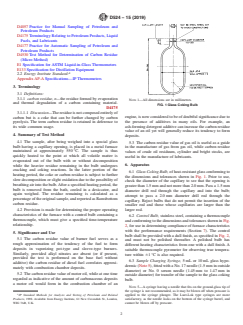
NOTE 1—All dimensions are in millimetres.
and thermal degradation of a carbon containing material.
FIG. 1 Glass Coking Bulb
D4175
3.1.1.1 Discussion—Theresidueisnotcomposedentirelyof
engine, is now considered to be of doubtful significance due to
carbon but is a coke that can be further changed by carbon
the presence of additives in many oils. For example, an
pyrolysis. The term carbon residue is retained in deference to
ash-forming detergent additive can increase the carbon residue
its wide common usage.
value of an oil yet will generally reduce its tendency to form
4. Summary of Test Method
deposits.
4.1 The sample, after being weighed into a special glass
5.3 The carbon residue value of gas oil is useful as a guide
bulb having a capillary opening, is placed in a metal furnace
in the manufacture of gas from gas oil, while carbon residue
maintained at approximately 550 °C. The sample is thus
values of crude oil residuum, cylinder and bright stocks, are
quickly heated to the point at which all volatile matter is
useful in the manufacture of lubricants.
evaporated out of the bulb with or without decomposition
while the heavier residue remaining in the bulb undergoes 6. Apparatus
cracking and coking reactions. In the latter portion of the
6.1 Glass Coking Bulb,ofheat-resistantglassconformingto
heating period, the coke or carbon residue is subject to further
the dimensions and tolerances shown in Fig. 1. Prior to use,
slowdecompositionorslightoxidationduetothepossibilityof
check the diameter of the capillary to see that the opening is
breathing air into the bulb.After a specified heating period, the
greater than 1.5 mm and not more than 2.0 mm. Pass a 1.5 mm
bulb is removed from the bath, cooled in a desiccator, and
diameter drill rod through the capillary and into the bulb;
again weighed. The residue remaining is calculated as a
attempt to pass a 2.0 mm diameter drill rod through the
percentageoftheoriginalsample,andreportedasRamsbottom
capillary. Reject bulbs that do not permit the insertion of the
carbon residue.
smaller rod and those whose capillaries are larger than the
larger rod.
4.2 Provision is made for determining the proper operating
characteristics of the furnace with a control bulb containing a
6.2 Control Bulb, stainless steel, containing a thermocouple
thermocouple, which must give a specified time-temperature
andconformingtothedimensionsandtolerancesshowninFig.
relationship.
2, for use in determining compliance of furnace characteristics
with the performance requirements (Section 7). The control
5. Significance and Use
bulb shall be provided with a dull finish, as specified in Fig. 2,
5.1 The carbon residue value of burner fuel serves as a
and must not be polished thereafter. A polished bulb has
rough approximation of the tendency of the fuel to form
different heating characteristics from one with a dull finish. A
deposits in vaporizing pot-type and sleeve-type burners.
suitable thermocouple pyrometer for observing true tempera-
Similarly, provided alkyl nitrates are absent (or if present,
ture within 61 °C is also required.
provided the test is performed on the base fuel without
6.3 Sample Charging Syringe, 5 mL or 10 mL glass hypo-
additive) the carbon residue of diesel fuel correlates approxi-
dermic (Note 5), fitted with a No. 17 needle (1.5 mm in outside
mately with combustion chamber deposits.
diameter) or No. 0 serum needle (1.45 mm to 1.47 mm in
5.2 The carbon residue value of motor oil, while at one time
outside diameter) for transfer of the sample to the glass coking
regarded as indicative of the amount of carbonaceous deposits
bulb.
a motor oil would form in the combustion chamber of an
NOTE 5—A syringe having a needle that fits on the ground-glass tip of
the syringe is not recommended, as it may be blown off when pressure is
applied to the syringe plunger. The Luer-Lok type syringes are more
IP Standard Methods for Analysis and Testing of Petroleum and Related
Products, 1998. Available from Energy Institute, 61 New Cavendish St., London, satisfactory, as the needle locks on the bottom of the syringe barrel, and
WIG 7AR, U.K. cannot be blown off by pressure.
D524 − 15 (2019)
make certain that as used they conform to the requirements of
the method. Consider the furnace as having standard
performance, and use it with any degree of loading, when the
operating requirements described for each coking bulb well are
met,whilethebathisfullyloadedaswellassinglyloaded.Use
only a furnace that has successfully passed the performance or
control tests given in this section.
7.1.1 Thermocouple—At least once every 50 h of use of the
control bulb, calibrate the thermocouple in the control bulb
against a standard thermocouple.
NOTE 8—In use at the high temperature of the test, iron-constantan
thermocouples oxidize and their calibration curves change.
7.1.2 Fully Loaded Furnace—When the furnace tempera-
ture is within a previously chosen 2 °C temperature range
(which range is to be used thereafter with that particular
furnace for both standardization and routine operation) and
within the general range 550 °C 6 5°C, insert the control bulb
in one well and, within 15 s, insert in each of the other wells a
glass coking bulb containing 4 g 6 0.1 g of a viscous neutral
petroleum lubricating oil with a viscosity within the SAE 30
2 2
range or 60 mm to 100 mm /s (cSt) at 40 °C. With a suitably
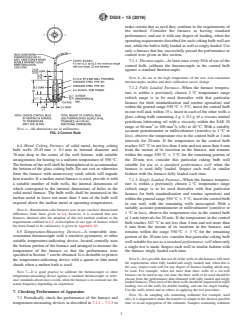
NOTE 1—All dimensions are in millimetres.
accurate potentiometer or millivoltmeter (sensitive to 1 °C or
FIG. 2 Control Bulb
less), observe the temperature rise in the control bulb at 1 min
intervals for 20 min. If the temperature in the control bulb
6.4 Metal Coking Furnace of solid metal, having coking reaches 547 °C in not less than 4 min and not more than 6 min
bulb wells 25.45 mm 6 0.1 mm in internal diameter and from the instant of its insertion in the furnace, and remains
76 mm deep to the center of the well bottom, with suitable within the range 550 °C 6 3 °C for the remaining portion of
arrangements for heating to a uniform temperature of 550 °C. the 20 min test, consider that particular coking bulb well
The bottom of the well shall be hemispherical to accommodate suitable for use as a standard performance well when the
the bottom of the glass coking bulb. Do not cast or otherwise furnace is used fully loaded. Inspect each well in similar
form the furnace with unnecessary voids which will impede fashion with the furnace fully loaded each time.
heat transfer. If a molten metal furnace is used, provide it with
7.1.3 Singly Loaded Furnace—When the furnace tempera-
a suitable number of bulb wells, the internal dimensions of
ture is within a previously chosen 2 °C temperature range
which correspond to the internal dimensions of holes in the
(which range is to be used thereafter with that particular
solid metal furnace. The bulb wells shall be immersed in the
furnace for both standardization and routine operation) and
molten metal to leave not more than 3 mm of the bulb well
within the general range 550 °C 6 5 °C, insert the control bulb
exposed above the molten metal at operating temperatures.
in one well, with the remaining wells unoccupied. With a
suitably accurate potentiometer or millivoltmeter (sensitive to
NOTE 6—Ramsbottom coke furnaces now in use can have dimensional
1 °C or less), observe the temperature rise in the control bulb
differences from those given in 6.4; however, it is essential that new
furnaces obtained after the adoption of this test method conform to the
at 1 min intervals for 20 min. If the temperature in the control
requirements outlined in 6.4. A description of one type of furnace which
bulb reaches 547 °C in not less than 4 min and not more than
has been found to be satisfactory is given in Appendix X1.
6 min from the instant of its insertion in the furnace, and
6.5 Temperature-Measuring Devices—A removable iron-
remains within the range 550 °C 6 3 °C for the remaining
constantan thermocouple with a sensitive pyrometer, or other
portion of the 20 min test, consider that particular coking bulb
suitable temperature-indicating device, located centrally near
wellsuitableforuseasa standard performance wellwhenonly
the bottom portion of the furnace and arranged to measure the
a single test is made. Inspect each well in similar fashion with
temperature of the furnace so that the performance tests
the furnace singly loaded each time.
specified in Section 7 can be obtained. It is desirable to protect
NOTE 9—It is possible that not all of the wells in old furnaces will meet
the temperature-indicating device with a quartz or thin metal
the requirements when fully loaded and singly loaded; and, when this is
sheath when a molten bath is used.
the case, inspect each well for any degree of furnace loading which may
be used. For example, when not more than three wells of a six-well
NOTE 7—It is good practice to calibrate the thermocouple or other
furnace can be used at any one time, the three wells to be used should be
temperature-measuring device against a standard thermocouple or refer-
chosen from the performance data obtained with fully loaded and singly
ence standards about once a week, when the furnace is in constant use, the
loadedfurnaces.Theneachofthethreewellsshouldbeinspectedfortriple
actual frequency depending on experience.
loading, two of the wells for double loading, and one for single loading.
Use the wells tested and no others in applying the test procedure.
7. Checking Performance of Apparatus
NOTE 10—In sampling oils containing sediment (for example, used
7.1 Periodically check the performance of the furnace and
oils), it is important to make the transfer of sample in the shortest possible
temperature
...