

ASTM D3385-18
(Test Method)Standard Test Method for Infiltration Rate of Soils in Field Using Double-Ring Infiltrometer
General Information
- Abstract
SIGNIFICANCE AND USE
5.1 This test method is useful for field measurement of the infiltration rate of soils. Infiltration rates have application to such studies as liquid waste disposal, evaluation of potential septic-tank disposal fields, leaching and drainage efficiencies, irrigation requirements, water spreading and recharge, and canal or reservoir leakage, among other applications.
5.2 Although the units of infiltration rate and hydraulic conductivity of soils are similar, there is a distinct difference between these two quantities. They cannot be directly related unless the hydraulic boundary conditions are known, such as hydraulic gradient and the extent of lateral flow of water, or can be reliably estimated.
5.3 The purpose of the outer ring is to promote one-dimensional, vertical flow beneath the inner ring.
5.4 Many factors affect the infiltration rate, for example the soil structure, soil layering, condition of the soil surface, degree of saturation of the soil, chemical and physical nature of the soil and of the applied liquid, head of the applied liquid, temperature of the liquid, and diameter and depth of embedment of rings.3 Thus, tests made at the same site are not likely to give identical results and the rate measured by the test method described in this standard is primarily for comparative use.
5.5 Some aspects of the test, such as the length of time the tests should be conducted and the head of liquid to be applied, must depend upon the experience of the user, the purpose for testing, and the kind of information that is sought.
Note 1: The quality of the result produced by this standard is dependent on the competence of the personnel performing it, and the suitability of the equipment and facilities used. Agencies that meet the criteria of Practice D3740 are generally considered capable of competent and objective testing/sampling/inspection/etc. Users of this standard are cautioned that compliance with Practice D3740 does not in itself assure reliable re...
SCOPE
1.1 This test method describes a procedure for field measurement of the rate of infiltration of liquid (typically water) into soils using double-ring infiltrometer.
1.2 The infiltrometer is installed by driving into the soil. The infiltrometer also may be installed in a trench excavated in dry or stiff soils.
1.3 Soils should be regarded as natural occurring soils or processed materials or mixtures of natural soils and processed materials, or other porous materials, and which are basically insoluble and are in accordance with requirements of 1.6.
1.4 This test method is particularly applicable to relatively uniform fine-grained soils, with an absence of very plastic (fat) clays and gravel-size particles and with moderate to low resistance to ring penetration.
1.5 This test method may be conducted at the ground surface or at given depths in pits, and on bare soil or with vegetation in place, depending on the conditions for which infiltration rates are desired. However, this test method cannot be conducted where the test surface is below the groundwater table or perched water table.
1.6 This test method is difficult to use or the resultant data may be unreliable, or both, in very pervious or impervious soils (soils with a hydraulic conductivity greater than about 10−2 cm/s or less than about 1 × 10⁻⁵ cm/s) or in dry or stiff soils if these fracture when the rings are installed. For soils with hydraulic conductivity less than 1 × 10⁻⁵ cm/s refer to Test Method D5093.
1.7 This test method cannot be used directly to determine the hydraulic conductivity (coefficient of permeability) of the soil (see 5.2).
1.8 Units—The values stated in SI units are to be regarded as the standard. The inch-pound units given in parentheses are mathematical conversions, which are provided for information purposes only and are not considered standard.
1.9 This standard does not purport to address all of the safety concerns,...
- Status
- Published
- Publication Date
- 28-Feb-2018
- Technical Committee
- D18 - Soil and Rock
- Drafting Committee
- D18.04 - Hydrologic Properties and Hydraulic Barriers
Buy Documents
ASTM D3385-18 - Standard Test Method for Infiltration Rate of Soils in Field Using Double-Ring Infiltrometer
REDLINE ASTM D3385-18 - Standard Test Method for Infiltration Rate of Soils in Field Using Double-Ring Infiltrometer
Overview
ASTM D3385-18: Standard Test Method for Infiltration Rate of Soils in Field Using Double-Ring Infiltrometer is an internationally recognized standard from ASTM International. This test method provides a procedure for the field measurement of the rate at which liquids (usually water) infiltrate soils, using the double-ring infiltrometer apparatus. Field determination of soil infiltration rates is crucial for various geotechnical, environmental, and civil engineering applications, including liquid waste disposal, septic field evaluation, irrigation planning, drainage studies, groundwater recharge, and leak detection in canals or reservoirs.
Key Topics
- Infiltration Rate Measurement: The double-ring infiltrometer test assesses how quickly water enters the soil under specific conditions, delivering incremental infiltration velocities and infiltration rates.
- Test Apparatus and Setup: Relies on two concentric cylindrical rings driven into the soil to maintain one-dimensional vertical flow beneath the inner ring for accurate results.
- Applicable Soils: Especially suitable for relatively uniform, fine-grained soils that lack plastic clays or large gravel particles and allow moderate to low resistance to ring penetration.
- Field Considerations: Measurements can be conducted on bare or vegetated surfaces, at the ground surface, or at depth in pits. However, the test is not suitable below the groundwater table or in highly pervious/impervious soils.
- Data Interpretation: Results are primarily for comparative use due to influence from soil structure, layering, degree of saturation, head of applied liquid, and other environmental or test-specific variables.
- Limitations: This method determines infiltration rate-not hydraulic conductivity-unless boundary conditions such as hydraulic gradient and water flow direction are well defined.
Applications
The ASTM D3385-18 double-ring infiltrometer method is widely used across several sectors:
- Environmental Site Assessment: Evaluation of potential septic tank drainage fields and the adequacy of liquid waste disposal sites.
- Civil Engineering and Construction: Planning and inspection of infiltration-based drainage systems, identifying risk of leaks in canals and reservoirs, and designing water management infrastructure.
- Agricultural Engineering: Understanding irrigation requirements, drainage efficiency, and groundwater recharge potential.
- Soil Science and Research: Assessing the infiltration capacity of soils under different treatments, vegetation states, and environmental conditions.
- Regulatory Compliance: Providing documented, standardized infiltration data for permitting and environmental impact studies.
The test method enhances project reliability by providing practical infiltration rates for site selection, system design, and ongoing land management.
Related Standards
Professionals referencing ASTM D3385-18 may also find the following ASTM standards relevant:
- ASTM D653 - Terminology relating to soil, rock, and contained fluids.
- ASTM D1452 - Practice for soil exploration and sampling by auger borings.
- ASTM D2216 - Test methods for laboratory determination of water (moisture) content of soil and rock by mass.
- ASTM D2488 - Practice for description and identification of soils (visual-manual procedures).
- ASTM D3740 - Practice for minimum requirements for agencies engaged in testing and/or inspection of soil and rock as used in engineering design and construction.
- ASTM D5093 - Test method for field measurement of infiltration rate using double-ring infiltrometer with sealed-inner ring (especially for soils with very low hydraulic conductivity).
Practical Value
By following ASTM D3385-18, engineers and environmental professionals obtain reliable, field-based data on soil infiltration rates, crucial for effective design and regulatory compliance. While site-specific variability requires careful interpretation, consistent adherence to this standard ensures a sound basis for comparison and informed decision-making in water management, construction, and environmental stewardship.
For more details and updates on ASTM D3385-18, consult the official ASTM International publication and related referenced standards.
Relations
- Effective Date
- 01-Mar-2018
- Effective Date
- 01-Nov-2023
- Effective Date
- 01-Oct-2019
- Effective Date
- 01-Mar-2019
- Effective Date
- 15-Jul-2017
- Effective Date
- 01-Jun-2015
- Effective Date
- 01-Aug-2014
- Effective Date
- 01-May-2012
- Effective Date
- 01-Mar-2012
- Effective Date
- 01-Sep-2011
- Effective Date
- 01-Sep-2011
- Effective Date
- 01-Jul-2010
- Effective Date
- 01-Mar-2010
- Effective Date
- 15-Jun-2009
- Effective Date
- 15-May-2009
Buy Documents
ASTM D3385-18 - Standard Test Method for Infiltration Rate of Soils in Field Using Double-Ring Infiltrometer
REDLINE ASTM D3385-18 - Standard Test Method for Infiltration Rate of Soils in Field Using Double-Ring Infiltrometer
Get Certified
Connect with accredited certification bodies for this standard

Zavod za gradbeništvo Slovenije (ZAG) - Inšpekcija
ZAG inspection body for construction products, structures, and materials.
Sponsored listings
Frequently Asked Questions
ASTM D3385-18 is a standard published by ASTM International. Its full title is "Standard Test Method for Infiltration Rate of Soils in Field Using Double-Ring Infiltrometer". This standard covers: SIGNIFICANCE AND USE 5.1 This test method is useful for field measurement of the infiltration rate of soils. Infiltration rates have application to such studies as liquid waste disposal, evaluation of potential septic-tank disposal fields, leaching and drainage efficiencies, irrigation requirements, water spreading and recharge, and canal or reservoir leakage, among other applications. 5.2 Although the units of infiltration rate and hydraulic conductivity of soils are similar, there is a distinct difference between these two quantities. They cannot be directly related unless the hydraulic boundary conditions are known, such as hydraulic gradient and the extent of lateral flow of water, or can be reliably estimated. 5.3 The purpose of the outer ring is to promote one-dimensional, vertical flow beneath the inner ring. 5.4 Many factors affect the infiltration rate, for example the soil structure, soil layering, condition of the soil surface, degree of saturation of the soil, chemical and physical nature of the soil and of the applied liquid, head of the applied liquid, temperature of the liquid, and diameter and depth of embedment of rings.3 Thus, tests made at the same site are not likely to give identical results and the rate measured by the test method described in this standard is primarily for comparative use. 5.5 Some aspects of the test, such as the length of time the tests should be conducted and the head of liquid to be applied, must depend upon the experience of the user, the purpose for testing, and the kind of information that is sought. Note 1: The quality of the result produced by this standard is dependent on the competence of the personnel performing it, and the suitability of the equipment and facilities used. Agencies that meet the criteria of Practice D3740 are generally considered capable of competent and objective testing/sampling/inspection/etc. Users of this standard are cautioned that compliance with Practice D3740 does not in itself assure reliable re... SCOPE 1.1 This test method describes a procedure for field measurement of the rate of infiltration of liquid (typically water) into soils using double-ring infiltrometer. 1.2 The infiltrometer is installed by driving into the soil. The infiltrometer also may be installed in a trench excavated in dry or stiff soils. 1.3 Soils should be regarded as natural occurring soils or processed materials or mixtures of natural soils and processed materials, or other porous materials, and which are basically insoluble and are in accordance with requirements of 1.6. 1.4 This test method is particularly applicable to relatively uniform fine-grained soils, with an absence of very plastic (fat) clays and gravel-size particles and with moderate to low resistance to ring penetration. 1.5 This test method may be conducted at the ground surface or at given depths in pits, and on bare soil or with vegetation in place, depending on the conditions for which infiltration rates are desired. However, this test method cannot be conducted where the test surface is below the groundwater table or perched water table. 1.6 This test method is difficult to use or the resultant data may be unreliable, or both, in very pervious or impervious soils (soils with a hydraulic conductivity greater than about 10−2 cm/s or less than about 1 × 10⁻⁵ cm/s) or in dry or stiff soils if these fracture when the rings are installed. For soils with hydraulic conductivity less than 1 × 10⁻⁵ cm/s refer to Test Method D5093. 1.7 This test method cannot be used directly to determine the hydraulic conductivity (coefficient of permeability) of the soil (see 5.2). 1.8 Units—The values stated in SI units are to be regarded as the standard. The inch-pound units given in parentheses are mathematical conversions, which are provided for information purposes only and are not considered standard. 1.9 This standard does not purport to address all of the safety concerns,...
SIGNIFICANCE AND USE 5.1 This test method is useful for field measurement of the infiltration rate of soils. Infiltration rates have application to such studies as liquid waste disposal, evaluation of potential septic-tank disposal fields, leaching and drainage efficiencies, irrigation requirements, water spreading and recharge, and canal or reservoir leakage, among other applications. 5.2 Although the units of infiltration rate and hydraulic conductivity of soils are similar, there is a distinct difference between these two quantities. They cannot be directly related unless the hydraulic boundary conditions are known, such as hydraulic gradient and the extent of lateral flow of water, or can be reliably estimated. 5.3 The purpose of the outer ring is to promote one-dimensional, vertical flow beneath the inner ring. 5.4 Many factors affect the infiltration rate, for example the soil structure, soil layering, condition of the soil surface, degree of saturation of the soil, chemical and physical nature of the soil and of the applied liquid, head of the applied liquid, temperature of the liquid, and diameter and depth of embedment of rings.3 Thus, tests made at the same site are not likely to give identical results and the rate measured by the test method described in this standard is primarily for comparative use. 5.5 Some aspects of the test, such as the length of time the tests should be conducted and the head of liquid to be applied, must depend upon the experience of the user, the purpose for testing, and the kind of information that is sought. Note 1: The quality of the result produced by this standard is dependent on the competence of the personnel performing it, and the suitability of the equipment and facilities used. Agencies that meet the criteria of Practice D3740 are generally considered capable of competent and objective testing/sampling/inspection/etc. Users of this standard are cautioned that compliance with Practice D3740 does not in itself assure reliable re... SCOPE 1.1 This test method describes a procedure for field measurement of the rate of infiltration of liquid (typically water) into soils using double-ring infiltrometer. 1.2 The infiltrometer is installed by driving into the soil. The infiltrometer also may be installed in a trench excavated in dry or stiff soils. 1.3 Soils should be regarded as natural occurring soils or processed materials or mixtures of natural soils and processed materials, or other porous materials, and which are basically insoluble and are in accordance with requirements of 1.6. 1.4 This test method is particularly applicable to relatively uniform fine-grained soils, with an absence of very plastic (fat) clays and gravel-size particles and with moderate to low resistance to ring penetration. 1.5 This test method may be conducted at the ground surface or at given depths in pits, and on bare soil or with vegetation in place, depending on the conditions for which infiltration rates are desired. However, this test method cannot be conducted where the test surface is below the groundwater table or perched water table. 1.6 This test method is difficult to use or the resultant data may be unreliable, or both, in very pervious or impervious soils (soils with a hydraulic conductivity greater than about 10−2 cm/s or less than about 1 × 10⁻⁵ cm/s) or in dry or stiff soils if these fracture when the rings are installed. For soils with hydraulic conductivity less than 1 × 10⁻⁵ cm/s refer to Test Method D5093. 1.7 This test method cannot be used directly to determine the hydraulic conductivity (coefficient of permeability) of the soil (see 5.2). 1.8 Units—The values stated in SI units are to be regarded as the standard. The inch-pound units given in parentheses are mathematical conversions, which are provided for information purposes only and are not considered standard. 1.9 This standard does not purport to address all of the safety concerns,...
ASTM D3385-18 is classified under the following ICS (International Classification for Standards) categories: 93.020 - Earthworks. Excavations. Foundation construction. Underground works. The ICS classification helps identify the subject area and facilitates finding related standards.
ASTM D3385-18 has the following relationships with other standards: It is inter standard links to ASTM D3385-09, ASTM D3740-23, ASTM D3740-19, ASTM D2216-19, ASTM D2488-17, ASTM D5093-15, ASTM D653-14, ASTM D3740-12a, ASTM D3740-12, ASTM D653-11, ASTM D3740-11, ASTM D2216-10, ASTM D3740-10, ASTM D2488-09a, ASTM D2488-09. Understanding these relationships helps ensure you are using the most current and applicable version of the standard.
ASTM D3385-18 is available in PDF format for immediate download after purchase. The document can be added to your cart and obtained through the secure checkout process. Digital delivery ensures instant access to the complete standard document.
Standards Content (Sample)
This international standard was developed in accordance with internationally recognized principles on standardization established in the Decision on Principles for the
Development of International Standards, Guides and Recommendations issued by the World Trade Organization Technical Barriers to Trade (TBT) Committee.
Designation:D3385 −18
Standard Test Method for
Infiltration Rate of Soils in Field Using Double-Ring
Infiltrometer
This standard is issued under the fixed designation D3385; the number immediately following the designation indicates the year of
original adoption or, in the case of revision, the year of last revision.Anumber in parentheses indicates the year of last reapproval.A
superscript epsilon (´) indicates an editorial change since the last revision or reapproval.
This standard has been approved for use by agencies of the U.S. Department of Defense.
1. Scope* 1.8 Units—The values stated in SI units are to be regarded
as the standard. The inch-pound units given in parentheses are
1.1 This test method describes a procedure for field mea-
mathematical conversions, which are provided for information
surement of the rate of infiltration of liquid (typically water)
purposes only and are not considered standard.
into soils using double-ring infiltrometer.
1.9 This standard does not purport to address all of the
1.2 Theinfiltrometerisinstalledbydrivingintothesoil.The
safety concerns, if any, associated with its use. It is the
infiltrometer also may be installed in a trench excavated in dry
responsibility of the user of this standard to establish appro-
or stiff soils.
priate safety, health, and environmental practices and deter-
mine the applicability of regulatory limitations prior to use.
1.3 Soils should be regarded as natural occurring soils or
1.10 This international standard was developed in accor-
processed materials or mixtures of natural soils and processed
dance with internationally recognized principles on standard-
materials, or other porous materials, and which are basically
ization established in the Decision on Principles for the
insoluble and are in accordance with requirements of 1.6.
Development of International Standards, Guides and Recom-
1.4 This test method is particularly applicable to relatively
mendations issued by the World Trade Organization Technical
uniformfine-grainedsoils,withanabsenceofveryplastic(fat)
Barriers to Trade (TBT) Committee.
clays and gravel-size particles and with moderate to low
resistance to ring penetration.
2. Referenced Documents
1.5 This test method may be conducted at the ground
2.1 ASTM Standards:
surface or at given depths in pits, and on bare soil or with D653Terminology Relating to Soil, Rock, and Contained
vegetation in place, depending on the conditions for which
Fluids
infiltration rates are desired. However, this test method cannot D1452Practice for Soil Exploration and Sampling byAuger
be conducted where the test surface is below the groundwater
Borings
table or perched water table. D2216Test Methods for Laboratory Determination ofWater
(Moisture) Content of Soil and Rock by Mass
1.6 This test method is difficult to use or the resultant data
D2488Practice for Description and Identification of Soils
maybeunreliable,orboth,inveryperviousorimpervioussoils
−2 (Visual-Manual Procedures)
(soils with a hydraulic conductivity greater than about 10
D3740Practice for Minimum Requirements for Agencies
−5
cm/s or less than about 1×10 cm/s) or in dry or stiff soils if
Engaged in Testing and/or Inspection of Soil and Rock as
these fracture when the rings are installed. For soils with
Used in Engineering Design and Construction
−5
hydraulic conductivity less than 1×10 cm/s refer to Test
D5093Test Method for Field Measurement of Infiltration
Method D5093.
Rate Using Double-Ring Infiltrometer with Sealed-Inner
1.7 This test method cannot be used directly to determine
Ring
the hydraulic conductivity (coefficient of permeability) of the
3. Terminology
soil (see 5.2).
3.1 Definitions—For common definitions of technical terms
in this standard, refer to Terminology D653.
ThistestmethodisunderthejurisdictionofASTMCommitteeD18onSoiland
Rock and is the direct responsibility of Subcommittee D18.04 on Hydrologic
Properties and Hydraulic Barriers. For referenced ASTM standards, visit the ASTM website, www.astm.org, or
Current edition approved March 1, 2018. Published April 2018. Originally contact ASTM Customer Service at service@astm.org. For Annual Book of ASTM
approved in 1975. Last previous edition approved in 2009 as D3385–09. DOI: Standards volume information, refer to the standard’s Document Summary page on
10.1520/D3385-18. the ASTM website.
*A Summary of Changes section appears at the end of this standard
Copyright © ASTM International, 100 Barr Harbor Drive, PO Box C700, West Conshohocken, PA 19428-2959. United States
D3385−18
3.2 Definitions of Terms Specific to This Standard: 5.5 Some aspects of the test, such as the length of time the
3.2.1 incremental infiltration velocity—the quantity of flow tests should be conducted and the head of liquid to be applied,
per unit area over an increment of time. It has the same units must depend upon the experience of the user, the purpose for
as the infiltration rate. testing, and the kind of information that is sought.
3.2.2 infiltration—the downward entry of liquid into the
NOTE 1—The quality of the result produced by this standard is
soil. dependent on the competence of the personnel performing it, and the
suitability of the equipment and facilities used. Agencies that meet the
3.2.3 infiltration rate—the rate, based on measured incre-
criteria of Practice D3740 are generally considered capable of competent
mental infiltration velocities, at which liquid can enter the soil
and objective testing/sampling/inspection/etc. Users of this standard are
under specified conditions. During infiltration, this rate may
cautioned that compliance with Practice D3740 does not in itself assure
reliable results. Reliable results depend on many factors; Practice D3740
decrease with time until reaching a quasi-steady value.
provides a means of evaluating some of those factors.
3.2.4 infiltrometer—a device for measuring the rate of entry
of liquid into a porous body, for example, water into soil.
6. Apparatus
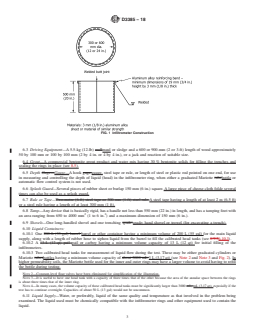
6.1 Infiltrometer Rings—Cylinders approximately 500 mm
4. Summary of Test Method
(20 in.) high and having diameters of about 300 and 600 mm
4.1 Thedouble-ringinfiltrometermethodconsistsofinstall-
(12 and 24 in.). Larger cylinders may be used but the ratio of
ing two open cylinders, one inside the other, into the ground,
the outer to inner cylinder diameters is about two times.
partially filling the rings with water or other liquid, and then
Cylinders can be made of 3-mm ( ⁄8-in.), hard-alloy, aluminum
maintainingtheliquidataconstantlevel.Thevolumeofliquid
sheet or other material sufficiently strong to withstand hard
added to the inner ring, to maintain the liquid level constant is
driving,withthebottomedgebeveled(seeFig.1).Thebeveled
themeasureofthevolumeofliquidthatinfiltratesthesoil.The
edges shall be kept sharp. Stainless steel or strong plastic rings
volume infiltrated during timed intervals is converted to an
may have to be used when working with corrosive fluids.
incremental infiltration velocity by dividing by the area of the
6.2 Driving Caps—Disksof13-mm( ⁄2-in.)thickhard-alloy
inner ring, usually expressed in centimeter per hour (or inch
aluminum with centering pins around the edge, or preferably
per hour) and plotted versus elapsed time. The maximum
having a recessed groove about 5 mm (0.2 in.) deep with a
steady-state or average incremental infiltration velocity, de-
width about 1 mm (0.05 in.) wider than the thickness of the
pending on the purpose/application of the test is equivalent to
ring. The diameters of the disks should be slightly larger than
the infiltration rate.
those of the infiltrometer rings.
5. Significance and Use
6.3 Driving Equipment—A 5.5-kg (12-lb) maul or sledge
5.1 This test method is useful for field measurement of the anda600or900-mm(2or3-ft)lengthofwoodapproximately
infiltration rate of soils. Infiltration rates have application to 50 by 100 mm or 100 by 100 mm (2 by 4 in. or 4 by 4 in.), or
such studies as liquid waste disposal, evaluation of potential a jack and reaction of suitable size.
septic-tank disposal fields, leaching and drainage efficiencies,
6.4 Grout—Acommercialbentonitegroutproductandwater
irrigation requirements, water spreading and recharge, and
mix having 30% bentonite solids for filling the trenches and
canal or reservoir leakage, among other applications.
sealing the rings in place (see 8.5).
5.2 Although the units of infiltration rate and hydraulic
6.5 Depth Gauge—A hook gauge, steel tape or rule, or
conductivity of soils are similar, there is a distinct difference
length of steel or plastic rod pointed on one end, for use in
between these two quantities. They cannot be directly related
measuring and controlling the depth of liquid (head) in the
unless the hydraulic boundary conditions are known, such as
infiltrometer ring, when either a graduated Mariotte bottle or
hydraulicgradientandtheextentoflateralflowofwater,orcan
automatic flow control system is not used.
be reliably estimated.
6.6 Splash Guard—Several pieces of rubber sheet or burlap
5.3 The purpose of the outer ring is to promote one-
150 mm (6 in.) square. A large piece of cheese cloth folde
dimensional, vertical flow beneath the inner ring.
several times can also be used as a splash guard.
5.4 Many factors affect the infiltration rate, for example the
6.7 Rule or Tape—Asteel tape having a length of at least 2
soil structure, soil layering, condition of the soil surface,
m (6.5 ft) or a steel rule having a length of at least 300 mm (1
degreeofsaturationofthesoil,chemicalandphysicalnatureof
ft).
the soil and of the applied liquid, head of the applied liquid,
6.8 Tamp—Any device that is basically rigid, has a handle
temperature of the liquid, and diameter and depth of embed-
notlessthan550mm(22in.)inlength,andhasatampingfoot
ment of rings. Thus, tests made at the same site are not likely
2 2
with an area ranging from 650 to 4000 mm (1 to 6 in. ) and
to give identical results and the rate measured by the test
a maximum dimension of 150 mm (6 in.).
method described in this standard is primarily for comparative
use.
6.9 Shovels—One long-handled shovel and one trenching
spade; hand shovel or trowel (for excavating a trench).
6.10 Liquid Containers:
Discussion of factors affecting infiltration rate is contained in the following
6.10.1 One barrel or other container having a minimum
reference: Johnson, A. I., A Field Method for Measurement of Infiltration, U.S.
Geological Survey Water-Supply Paper 1544-F, 1963, pp. 4–9. volumeof200L(55gal)forthemainliquidsupply,alongwith
D3385−18
FIG. 1 Infiltrometer Construction
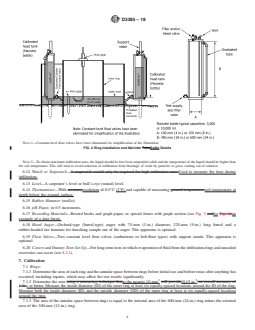
a length of rubber hose to siphon liquid from the barrel to fill (3.17 qt) (see Note 2 and Note 3 and Fig. 2). In higher
the calibrated head tanks (see 6.10.3). permeability soils, the Mariotte bottle used for the inner and
6.10.2 Apail or carboy having a minimum volume capacity outer rings may have a larger volume to avoid having to refill
of 13 L (12 qt) for initial filling of the infiltrometers. the bottle during testing.
6.10.3 Two calibrated head tanks for measurement of liquid
NOTE 2—Constant-level float valves have been eliminated for simpli-
flowduringthetest.Thesemaybeeithergraduatedcylindersor
fication of the illustration.
Mariotte bottles having a minimum volume capacity of 3 L NOTE 3—It is useful to have one head tank with a capacity of three
NOTE 1—Constant-level float valves have been eliminated for simplification of the illustration
FIG. 2Ring Installation and Mariotte Bottle Details
D3385−18
times that of the other because the area of the annular space between the from blockage of voids by particles or gases coming out of solution.
rings is about three times that of the inner ring.
6.12 Watch or Stopwatch—Used to measure the time during
NOTE 4—In many cases, the volume capacity of these calibrated head
infiltration.
tanksmustbesignificantlylargerthan3000mL(3.17qt),especiallyifthe
testhastocontinueovernight.Capacitiesofabout50L(13gal)wouldnot
6.13 Level—Acarpenter’s level or bull’s-eye (round) level.
be uncommon.
6.14 Thermometer—With resolution of 0.5°C (1°F) and
6.11 Liquid Supply—Water,orpreferably,liquidofthesame
capable of measuring soil temperature at depth below the
quality and temperature as that involved in the problem being
ground surface.
examined.Theliquidusedmustbechemicallycompatiblewith
the infiltrometer rings and other equipment used to contain the
6.15 Rubber Hammer (mallet).
liquid.
6.16 pH Paper, in 0.5 increments.
NOTE5—Toobtainmaximuminfiltrationrates,theliquidshouldbefree
6.17 Recording Materials—Record books and graph paper,
from suspended solids and the temperature of the liquid should be higher
or special forms with graph section (see Fig. 3 for an example
than the soil temperature. This will tend to avoid reduction of infiltration
FIG. 3 Data Form for Infiltration Test with Sample Data
D3385−18
of a data form). through a small hole or tube. In addition, make measurements
to verify that the rate of evaporation in a similar test configu-
6.18 Hand Auger—Orchard-type (barrel-type) auger with
ration(withoutanyinfiltrationintothesoil)islessthan20%of
75-mm (3-in.) diameter, 225-mm (9-in.) long barrel and a
the infiltration rate being measured.
rubber-headed tire hammer for knocking sample out of the
8.2.2 Makeprovisionstoprotectthetestapparatusandfluid
auger. This apparatus is optional.
from direct sunlight and temperature variations that are large
6.19 Float Valves—Two constant level float valves (carbu-
enough to affect the slow measurements significantly, espe-
retorsorbob-floattypes)withsupportstands.Thisapparatusis
cially for test durations greater than a few hours or those using
optional.
aMariottebottle.Theexpansionorcontractionoftheairinthe
6.20 Covers and Dummy Tests Set-Up—For long-term tests
Mariotte bottle above the water due to temperature changes
in which evaporation of fluid from the infiltration rings and may cause changes in the rate of flow of the liquid from the
unsealed reservoirs can occur (see 8.2.1). bottle which will result in a fluctuating water level in the
infiltrometer rings.
7. Calibration
8.3 Driving Infiltration Rings with a Sledge:
7.1 Rings:
NOTE 7—Driving rings with a jack is preferred; see 8.4.
7.1.1 Determine the area of each ring and the annular space
betweenringsbeforeinitialuseandbeforereuseafteranything 8.3.1 Place the driving cap on the outer ring and center it
has occurred, including repairs, which may affect the test thereon. Place the wood block (see 6.3) on the driving cap.
results significantly.
8.3.2 Drivetheouterringintothesoilwithblowsofaheavy
2 2
7.1.2 Determinetheareatothenearest10mm (0.15in. )or
sledge on the wood block to a depth that will (a) minimize the
better. Measure the inside diameter (ID) of the
...
This document is not an ASTM standard and is intended only to provide the user of an ASTM standard an indication of what changes have been made to the previous version. Because
it may not be technically possible to adequately depict all changes accurately, ASTM recommends that users consult prior editions as appropriate. In all cases only the current version
of the standard as published by ASTM is to be considered the official document.
Designation: D3385 − 09 D3385 − 18
Standard Test Method for
Infiltration Rate of Soils in Field Using Double-Ring
Infiltrometer
This standard is issued under the fixed designation D3385; the number immediately following the designation indicates the year of
original adoption or, in the case of revision, the year of last revision. A number in parentheses indicates the year of last reapproval. A
superscript epsilon (´) indicates an editorial change since the last revision or reapproval.
This standard has been approved for use by agencies of the U.S. Department of Defense.
1. Scope Scope*
1.1 This test method describes a procedure for field measurement of the rate of infiltration of liquid (typically water) into soils
using double-ring infiltrometer.
1.2 The infiltrometer is installed by driving into the soil. The infiltrometer also may be installed in a trench excavated in dry
or stiff soils.
1.3 Soils should be regarded as natural occurring fine or coarse-grained soils or processed materials or mixtures of natural soils
and processed materials, or other porous materials, and which are basically insoluble and are in accordance with requirements of
1.51.6.
1.4 This test method is particularly applicable to relatively uniform fine-grained soils, with an absence of very plastic (fat) clays
and gravel-size particles and with moderate to low resistance to ring penetration.
1.5 This test method may be conducted at the ground surface or at given depths in pits, and on bare soil or with vegetation in
place, depending on the conditions for which infiltration rates are desired. However, this test method cannot be conducted where
the test surface is below the groundwater table or perched water table.
1.6 This test method is difficult to use or the resultant data may be unreliable, or both, in very pervious or impervious soils (soils
−2 −6−5
with a hydraulic conductivity greater than about 10 cm/s or less than about 1 × 10 cm/s) or in dry or stiff soils that most
−6−5
likely will if these fracture when the rings are installed. For soils with hydraulic conductivity less than 1 × 10 cm/s refer to
Test Method D5093.
1.7 This test method cannot be used directly to determine the hydraulic conductivity (coefficient of permeability) of the soil (see
5.2).
1.8 Units—The values stated in SI units are to be regarded as the standard. The inch-pound units given in parentheses are
mathematical conversions, which are provided for information purposes only and are not considered standard.
1.9 This standard does not purport to address all of the safety concerns, if any, associated with its use. It is the responsibility
of the user of this standard to establish appropriate safety safety, health, and healthenvironmental practices and determine the
applicability of regulatory limitations prior to use.
1.10 This international standard was developed in accordance with internationally recognized principles on standardization
established in the Decision on Principles for the Development of International Standards, Guides and Recommendations issued
by the World Trade Organization Technical Barriers to Trade (TBT) Committee.
2. Referenced Documents
2.1 ASTM Standards:
D653 Terminology Relating to Soil, Rock, and Contained Fluids
D1452 Practice for Soil Exploration and Sampling by Auger Borings
D2216 Test Methods for Laboratory Determination of Water (Moisture) Content of Soil and Rock by Mass
This test method is under the jurisdiction of ASTM Committee D18 on Soil and Rock and is the direct responsibility of Subcommittee D18.04 on Hydrologic Properties
and Hydraulic Barriers.
Current edition approved March 1, 2009March 1, 2018. Published March 2009April 2018. Originally approved in 1975. Last previous edition approved in 20032009 as
D3385 – 03.D3385 – 09. DOI: 10.1520/D3385-09.10.1520/D3385-18.
For referenced ASTM standards, visit the ASTM website, www.astm.org, or contact ASTM Customer Service at service@astm.org. For Annual Book of ASTM Standards
volume information, refer to the standard’s Document Summary page on the ASTM website.
*A Summary of Changes section appears at the end of this standard
Copyright © ASTM International, 100 Barr Harbor Drive, PO Box C700, West Conshohocken, PA 19428-2959. United States
D3385 − 18
D2488 Practice for Description and Identification of Soils (Visual-Manual Procedures)
D3740 Practice for Minimum Requirements for Agencies Engaged in Testing and/or Inspection of Soil and Rock as Used in
Engineering Design and Construction
D5093 Test Method for Field Measurement of Infiltration Rate Using Double-Ring Infiltrometer with Sealed-Inner Ring
3. Terminology
3.1 Definitions—For common definitions of technical terms in this standard, refer to Terminology D653.
3.2 Definitions of Terms Specific to This Standard:
3.2.1 incremental infiltration velocity—the quantity of flow per unit area over an increment of time. It has the same units as the
infiltration rate.
3.2.2 infiltration—the downward entry of liquid into the soil.
3.2.3 infiltration rate—a selected the rate, based on measured incremental infiltration velocities, at which liquid can enter the
soil under specified conditions, including the presence of an excess of liquid. It has the dimensions of velocity (that is,
3 −2 −1 −1
cmconditions. During infiltration, this rate may decrease with time until reaching a quasi-steady value. cm h = cm h ).
3.2.4 infiltrometer—a device for measuring the rate of entry of liquid into a porous body, for example, water into soil.
4. Summary of Test Method
4.1 The double-ring infiltrometer method consists of drivinginstalling two open cylinders, one inside the other, into the ground,
partially filling the rings with water or other liquid, and then maintaining the liquid at a constant level. The volume of liquid added
to the inner ring, to maintain the liquid level constant is the measure of the volume of liquid that infiltrates the soil. The volume
infiltrated during timed intervals is converted to an incremental infiltration velocity, velocity by dividing by the area of the inner
ring, usually expressed in centimetrecentimeter per hour or(or inch per hourhour) and plotted versus elapsed time. The
maximum-steady statemaximum steady-state or average incremental infiltration velocity, depending on the purpose/application of
the test is equivalent to the infiltration rate.
5. Significance and Use
5.1 This test method is useful for field measurement of the infiltration rate of soils. Infiltration rates have application to such
studies as liquid waste disposal, evaluation of potential septic-tank disposal fields, leaching and drainage efficiencies, irrigation
requirements, water spreading and recharge, and canal or reservoir leakage, among other applications.
5.2 Although the units of infiltration rate and hydraulic conductivity of soils are similar, there is a distinct difference between
these two quantities. They cannot be directly related unless the hydraulic boundary conditions are known, such as hydraulic
gradient and the extent of lateral flow of water, or can be reliably estimated.
5.3 The purpose of the outer ring is to promote one-dimensional, vertical flow beneath the inner ring.
5.4 Many factors affect the infiltration rate, for example the soil structure, soil layering, condition of the soil surface, degree of
saturation of the soil, chemical and physical nature of the soil and of the applied liquid, head of the applied liquid, temperature
of the liquid, and diameter and depth of embedment of rings. Thus, tests made at the same site are not likely to give identical
results and the rate measured by the test method described in this standard is primarily for comparative use.
5.5 Some aspects of the test, such as the length of time the tests should be conducted and the head of liquid to be applied, must
depend upon the experience of the user, the purpose for testing, and the kind of information that is sought.
NOTE 1—The quality of the result produced by this standard is dependent on the competence of the personnel performing it, and the suitability of the
equipment and facilities used. Agencies that meet the criteria of Practice D3740 are generally considered capable of competent and objective
testing/sampling/inspection/etc. Users of this standard are cautioned that compliance with Practice D3740 does not in itself assure reliable results. Reliable
results depend on many factors; Practice D3740 provides a means of evaluating some of those factors.
6. Apparatus
6.1 Infiltrometer Rings—Cylinders approximately 500 mm (20 in.) high and having diameters of about 300 and 600 mm (12 and
24 in.). Larger cylinders may be used, providingused but the ratio of the outer to inner cylinders cylinder diameters is about two.
two times. Cylinders can be made of 3-mm ( ⁄8-in.), hard-alloy, aluminum sheet or other material sufficiently strong to withstand
hard driving, with the bottom edge bevelledbeveled (see Fig. 1). The bevelledbeveled edges shall be kept sharp. Stainless steel or
strong plastic rings may have to be used when working with corrosive fluids.
6.2 Driving Caps—Disks of 13-mm ( ⁄2-in.) thick hard-alloy aluminum with centering pins around the edge, or preferably
having a recessed groove about 5 mm (0.2 in.) deep with a width about 1 mm (0.05 in.) wider than the thickness of the ring. The
diameters of the disks should be slightly larger than those of the infiltrometer rings.
Discussion of factors affecting infiltration rate is contained in the following reference: Johnson, A. I., A Field Method for Measurement of Infiltration, U.S. Geological
Survey Water-Supply Paper 1544-F, 1963, pp. 4–9.
D3385 − 18
FIG. 1 Infiltrometer Construction
6.3 Driving Equipment—A 5.5-kg (12-lb) mallmaul or sledge and a 600 or 900-mm (2 or 3-ft) length of wood approximately
50 by 100 mm or 100 by 100 mm (2 by 4 in. or 4 by 4 in.), or a jack and reaction of suitable size.
6.4 Grout—A commercial bentonite grout product and water mix having 30 % bentonite solids for filling the trenches and
sealing the rings in place (see 8.5).
6.5 Depth Gage—Gauge—A hook gage,gauge, steel tape or rule, or length of steel or plastic rod pointed on one end, for use
in measuring and controlling the depth of liquid (head) in the infiltrometer ring, when either a graduated Mariotte tubebottle or
automatic flow control system is not used.
6.6 Splash Guard—Several pieces of rubber sheet or burlap 150 mm (6 in.) square. A large piece of cheese cloth folde several
times can also be used as a splash guard.
6.7 Rule or Tape—Two-metre (6-ft) steel tape or 300-mm (1-ft) steel rule.A steel tape having a length of at least 2 m (6.5 ft)
or a steel rule having a length of at least 300 mm (1 ft).
6.8 Tamp—Any device that is basically rigid, has a handle not less than 550 mm (22 in.) in length, and has a tamping foot with
2 2
an area ranging from 650 to 4000 mm (1 to 6 in. ) and a maximum dimension of 150 mm (6 in.).
6.9 Shovels—One long-handled shovel and one trenching spade.spade; hand shovel or trowel (for excavating a trench).
6.10 Liquid Containers:
6.10.1 One 200-L (55-gal) barrel barrel or other container having a minimum volume of 200 L (55 gal) for the main liquid
supply, along with a length of rubber hose to siphon liquid from the barrel to fill the calibrated head tanks (see 6.9.36.10.3).
6.10.2 A 13-L (12-qt) pail pail or carboy having a minimum volume capacity of 13 L (12 qt) for initial filling of the
infiltrometers.
6.10.3 Two calibrated head tanks for measurement of liquid flow during the test. These may be either graduated cylinders or
Mariotte tubesbottles having a minimum volume capacity of about 3000 mL 3 L (3.17 qt) (see Note 2 and Note 3 and Fig. 2). In
higher permeability soils, the Mariotte bottle used for the inner and outer rings may have a larger volume to avoid having to refill
the bottle during testing.
NOTE 2—Constant-level float valves have been eliminated for simplification of the illustration.
NOTE 3—It is useful to have one head tank with a capacity of three times that of the other because the area of the annular space between the rings
is about three times that of the inner ring.
NOTE 4—In many cases, the volume capacity of these calibrated head tanks must be significantly larger than 3000 mL, mL (3.17 qt), especially if the
test has to continue overnight. Capacities of about 50 L (13 gal) would not be uncommon.
6.11 Liquid Supply—Water, or preferably, liquid of the same quality and temperature as that involved in the problem being
examined. The liquid used must be chemically compatible with the infiltrometer rings and other equipment used to contain the
liquid.
D3385 − 18
NOTE 1—Constant-level float valves have been eliminated for simplification of the illustration
FIG. 2 Ring Installation and Mariotte TubeBottle Details
NOTE 5—To obtain maximum infiltration rates, the liquid should be free from suspended solids and the temperature of the liquid should be higher than
the soil temperature. This will tend to avoid reduction of infiltration from blockage of voids by particles or gases coming out of solution.
6.12 Watch or Stopwatch—A stopwatch would only be required for high infiltration rates.Used to measure the time during
infiltration.
6.13 Level—A carpenter’s level or bull’s-eye (round) level.
6.14 Thermometer—With accuracyresolution of 0.5°C (1°F) and capable of measuring ground temperature.soil temperature at
depth below the ground surface.
6.15 Rubber Hammer (mallet).
6.16 pH Paper, in 0.5 increments.
6.17 Recording Materials—Record books and graph paper, or special forms with graph section (see Fig. 3 andfor Fig. 4).an
example of a data form).
6.18 Hand Auger—Orchard-type (barrel-type) auger with 75-mm (3-in.) diameter, 225-mm (9-in.) long barrel and a
rubber-headed tire hammer for knocking sample out of the auger. This apparatus is optional.
6.19 Float Valves—Two constant level float valves (carburetors or bob-float types) with support stands. This apparatus is
optional.
6.20 Covers and Dummy Tests Set-Up—For long-term tests in which evaporation of fluid from the infiltration rings and unsealed
reservoirs can occur (see 8.2.1).
7. Calibration
7.1 Rings:
7.1.1 Determine the area of each ring and the annular space between rings before initial use and before reuse after anything has
occurred, including repairs, which may affect the test results significantly.
2 2
7.1.2 Determine the area using a measuring technique thatto the nearest 10 mm will provide(0.15 in. an overall accuracy of
1 %.) or better. Measure the inside diameter (ID) of the outer ring at least six equally-spaced locations around the ID of the ring.
Measure both the inside diameter (ID) and the outside diameter (OD) of the inner ring at least at six equally-spaced locations
around the ring.
7.1.3 The area of the annular space between rings is equal to the internal area of the 600-mm (24-in.) ring minus the external
area of the 300-mm (12-in.) ring.
D3385 − 18
FIG. 3 Data Form for Infiltration Test with Sample Data
7.2 Liquid Containers—For each graduated cylinder or graduated Mariotte tube,bottle, establish the relationship between the
change in elevation of liquid (fluid) level and change in volume of fluid. This relationship shall have an overall accuracy of
1 %.
8. Procedure
8.1 Test Site:
8.1.1 Establish the soil strata to be tested from the soil profile determined by the classification of soil samples from an adjacent
auger hole.
NOTE 6—For the test results to be valid for soils below the test zone, the valid, the soil directly below the test zone must have equal or greater flow
rates than the test zone.
8.1.2 The test requires an area of approximately 3 by 3 m (10 by 10 ft) accessible by a truck.accessible for delivery of test
equipment and sufficiently large for the set up and use of the test system.
8.1.3 The test site should be nearly level, or a l
...