

ASTM D5458-95(2020)
(Test Method)Standard Test Method for Peel Cling of Stretch Wrap Film
General Information
- Abstract
SIGNIFICANCE AND USE
5.1 Cling is of critical importance in maintaining a tight wrap after a load is stretch wrapped.
SCOPE
1.1 This test method measures cling between two layers of film, in both a stretched and unstretched condition.
1.2 The values stated in inch-pound units are to be regarded as standard. The values given in parentheses are mathematical conversions to SI units that are provided for information only and are not considered standard.
1.3 This standard does not purport to address all of the safety concerns, if any, associated with its use. It is the responsibility of the user of this standard to establish appropriate safety, health, and environmental practices and determine the applicability of regulatory limitations prior to use.
1.4 This international standard was developed in accordance with internationally recognized principles on standardization established in the Decision on Principles for the Development of International Standards, Guides and Recommendations issued by the World Trade Organization Technical Barriers to Trade (TBT) Committee.
- Status
- Published
- Publication Date
- 31-Oct-2020
- Technical Committee
- D10 - Packaging
- Drafting Committee
- D10.25 - Palletizing and Unitizing of Loads
Overview
ASTM D5458-95(2020), Standard Test Method for Peel Cling of Stretch Wrap Film, is an internationally recognized method developed by ASTM International for measuring the cling property between two layers of stretch wrap film. This standard addresses cling in both stretched and unstretched conditions, using an established peel test to quantify the adhesive force required to separate the film layers. Cling is fundamental in ensuring load stability and maintaining a secure and tight wrap during storage and transport. This method follows the principles outlined by the World Trade Organization Technical Barriers to Trade (TBT) Committee for global standardization.
Key Topics
- Cling Measurement: Defines cling as the tendency of a stretch wrap film to adhere to itself, a property critical for containment and stabilization of palletized loads.
- Test Conditions: Outlines procedures for testing peel cling in both stretched and unstretched film conditions to capture real-world application scenarios.
- Sampling and Preparation: Specifies details for sample selection, conditioning, and specimen preparation to ensure repeatable and reliable results.
- Equipment Specifications: Lists requirements for necessary apparatus, including a universal testing machine, clamps, load cells, and other accessories vital for accurate measurement.
- Reporting Requirements: Details on documenting results, including sample identification, stretch percentages, average cling values, and standard deviations.
Applications
ASTM D5458-95(2020) is widely utilized across industries where stretch wrap film is deployed for packaging and securing goods. Its primary uses include:
- Packaging Industry: Ensures quality control in production and application of stretch wrap, optimizing cling performance for consistent load unitization.
- Logistics and Distribution: Validates that stretch wrap films maintain proper pallet stability during handling and transportation, reducing the risk of load shifting and product damage.
- Film Manufacturing: Supports product development and comparative benchmarking by providing a standardized cling test for different film formulations or product lines.
- Quality Assurance: Serves as an essential tool for confirming that stretch wrap films conform to industry requirements and customer specifications regarding cling properties.
Testing as per this standard benefits end-users by preventing common issues such as load unraveling or insufficient adhesion, directly contributing to supply chain reliability and safety.
Related Standards
Several other ASTM standards and practices complement or are referenced by ASTM D5458-95(2020) for comprehensive testing of packaging materials:
- ASTM D996: Terminology of Packaging and Distribution Environments - for definitions relevant to packaging and testing.
- ASTM D4332: Practice for Conditioning Containers, Packages, or Packaging Components for Testing - for sample conditioning before testing.
- ASTM E122: Practice for Calculating Sample Size to Estimate, With Specified Precision, the Average for a Characteristic of a Lot or Process.
- ASTM E691: Practice for Conducting an Interlaboratory Study to Determine the Precision of a Test Method.
- (Withdrawn) ASTM D1898: Practice for Sampling of Plastics.
Practical Value
Implementing ASTM D5458-95(2020) enables stakeholders in the packaging and logistics sectors to quantify and compare the cling strength of stretch wrap films, supporting quality improvement, product consistency, and regulatory compliance. Utilizing standardized cling testing:
- Promotes reliable product performance during wrapping and transit
- Reduces product loss and damage through effective load containment
- Allows benchmarking and validation among suppliers and customers
- Supports continuous improvement and innovation in stretch film technology
Keywords: ASTM D5458, peel cling, stretch wrap film, packaging standard, film testing, load containment, ASTM packaging, film performance.
Relations
- Effective Date
- 29-Sep-2023
- Effective Date
- 01-May-2013
- Effective Date
- 15-Mar-2013
- Effective Date
- 01-Nov-2011
- Effective Date
- 01-Aug-2011
- Effective Date
- 01-Dec-2010
- Effective Date
- 01-Aug-2009
- Effective Date
- 01-Oct-2008
- Effective Date
- 01-Oct-2007
- Effective Date
- 01-Nov-2006
- Effective Date
- 01-Nov-2005
- Effective Date
- 01-Apr-2004
- Effective Date
- 10-Apr-2002
- Effective Date
- 10-Apr-2002
- Effective Date
- 10-Apr-2001
Get Certified
Connect with accredited certification bodies for this standard

BRCGS (Brand Reputation Compliance Global Standards)
Global food safety and quality standards owner.
Sponsored listings
Frequently Asked Questions
ASTM D5458-95(2020) is a standard published by ASTM International. Its full title is "Standard Test Method for Peel Cling of Stretch Wrap Film". This standard covers: SIGNIFICANCE AND USE 5.1 Cling is of critical importance in maintaining a tight wrap after a load is stretch wrapped. SCOPE 1.1 This test method measures cling between two layers of film, in both a stretched and unstretched condition. 1.2 The values stated in inch-pound units are to be regarded as standard. The values given in parentheses are mathematical conversions to SI units that are provided for information only and are not considered standard. 1.3 This standard does not purport to address all of the safety concerns, if any, associated with its use. It is the responsibility of the user of this standard to establish appropriate safety, health, and environmental practices and determine the applicability of regulatory limitations prior to use. 1.4 This international standard was developed in accordance with internationally recognized principles on standardization established in the Decision on Principles for the Development of International Standards, Guides and Recommendations issued by the World Trade Organization Technical Barriers to Trade (TBT) Committee.
SIGNIFICANCE AND USE 5.1 Cling is of critical importance in maintaining a tight wrap after a load is stretch wrapped. SCOPE 1.1 This test method measures cling between two layers of film, in both a stretched and unstretched condition. 1.2 The values stated in inch-pound units are to be regarded as standard. The values given in parentheses are mathematical conversions to SI units that are provided for information only and are not considered standard. 1.3 This standard does not purport to address all of the safety concerns, if any, associated with its use. It is the responsibility of the user of this standard to establish appropriate safety, health, and environmental practices and determine the applicability of regulatory limitations prior to use. 1.4 This international standard was developed in accordance with internationally recognized principles on standardization established in the Decision on Principles for the Development of International Standards, Guides and Recommendations issued by the World Trade Organization Technical Barriers to Trade (TBT) Committee.
ASTM D5458-95(2020) is classified under the following ICS (International Classification for Standards) categories: 55.040 - Packaging materials and accessories. The ICS classification helps identify the subject area and facilitates finding related standards.
ASTM D5458-95(2020) has the following relationships with other standards: It is inter standard links to ASTM D1898-68(1989), ASTM E691-13, ASTM D4332-13, ASTM E691-11, ASTM E122-09e1, ASTM D996-10a, ASTM E122-09, ASTM E691-08, ASTM E122-07, ASTM D4332-01(2006), ASTM E691-05, ASTM D996-04, ASTM D996-02, ASTM D996-99, ASTM D4332-99. Understanding these relationships helps ensure you are using the most current and applicable version of the standard.
ASTM D5458-95(2020) is available in PDF format for immediate download after purchase. The document can be added to your cart and obtained through the secure checkout process. Digital delivery ensures instant access to the complete standard document.
Standards Content (Sample)
This international standard was developed in accordance with internationally recognized principles on standardization established in the Decision on Principles for the
Development of International Standards, Guides and Recommendations issued by the World Trade Organization Technical Barriers to Trade (TBT) Committee.
Designation: D5458 − 95 (Reapproved 2020)
Standard Test Method for
Peel Cling of Stretch Wrap Film
This standard is issued under the fixed designation D5458; the number immediately following the designation indicates the year of
original adoption or, in the case of revision, the year of last revision. A number in parentheses indicates the year of last reapproval. A
superscript epsilon (´) indicates an editorial change since the last revision or reapproval.
1. Scope 3. Terminology
1.1 This test method measures cling between two layers of 3.1 Definitions—General definitions for packaging and dis-
film, in both a stretched and unstretched condition. tribution environments are found in Terminology D996.
1.2 The values stated in inch-pound units are to be regarded 3.2 Definitions of Terms Specific to This Standard:
as standard. The values given in parentheses are mathematical 3.2.1 cling—the property of a material’s ability to adhere to
conversions to SI units that are provided for information only itself.
and are not considered standard.
3.2.2 stretch wrap material—a material used for over-
1.3 This standard does not purport to address all of the wrapping which, when applied under tension, elongates, and
safety concerns, if any, associated with its use. It is the through elastic recovery, conforms to the item(s) packaged.
responsibility of the user of this standard to establish appro-
4. Summary of Test Method
priate safety, health, and environmental practices and deter-
mine the applicability of regulatory limitations prior to use.
4.1 This test method is a peel cling procedure. A 1 in. (25
1.4 This international standard was developed in accor-
mm) wide film strip is adhered to a flat film attached to an
dance with internationally recognized principles on standard-
inclined surface. The force required to remove the film strip
ization established in the Decision on Principles for the
from the flat film is measured.
Development of International Standards, Guides and Recom-
mendations issued by the World Trade Organization Technical
5. Significance and Use
Barriers to Trade (TBT) Committee.
5.1 Cling is of critical importance in maintaining a tight
wrap after a load is stretch wrapped.
2. Referenced Documents
6. Equipment and Preparation
2.1 ASTM Standards:
D996 Terminology of Packaging and Distribution Environ-
6.1 Apparatus—Auniversal testing machine with a constant
ments
rate of grip separation equipped, as follows:
D1898 Practice for Sampling of Plastics (Withdrawn 1998)
6.1.1 One lightweight jaw equipped with 1 by 1.5 in. (25 by
D4332 Practice for Conditioning Containers, Packages, or
38 mm) flat rubber-faced grips,
Packaging Components for Testing
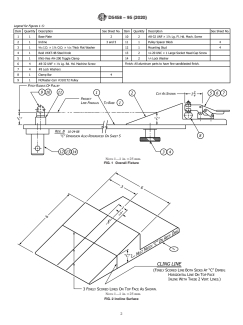
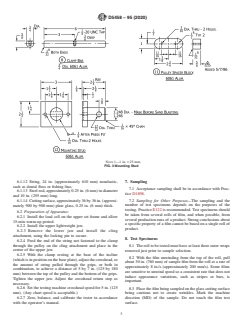
6.1.2 Cling attachment (see Figs. 1-5),
E122 Practice for Calculating Sample Size to Estimate,With
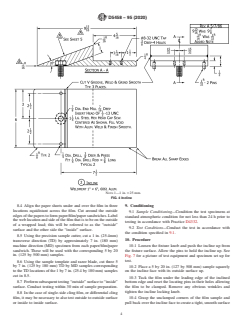
6.1.3 Cling clamp (see Fig. 6),
Specified Precision, the Average for a Characteristic of a
6.1.4 Load cell, 500-g load capacity,
Lot or Process
6.1.5 If using pneumatic grips, air supply, 60 to 70 psi with
E691 Practice for Conducting an Interlaboratory Study to
appropriate filter,
Determine the Precision of a Test Method
6.1.6 Sample template, picture-frame style with inside di-
mensions of 5 by 20 in. (125 by 500 mm),
6.1.7 Precision sample cutter, 1 6 0.001 in. (25.4 6 0.03
mm)width,withprecisionof1 60.001in.(25.4 60.03mm),
This test method is under the jurisdiction of ASTM Committee D10 on
Packaging and is the direct responsibility of Subcommittee D10.25 on Palletizing
6.1.8 Single-edged safety razor blade,
and Unitizing of Loads.
6.1.9 Synthetic bristle paint brush, 2 in. (50 mm) wide,
Current edition approved Nov. 1, 2020. Published November 2020. Originally
6.1.10 Ruler, 12 in. (approximately 300 mm),
approved in 1994. Last previous edition approved in 2012 as D5458 – 95 (2012).
DOI: 10.1520/D5458-95R20. 6.1.11 Separation paper, 8.5 by 12 in. (approximately 125
For referenced ASTM standards, visit the ASTM website, www.astm.org, or
by 280 mm) bond,
contact ASTM Customer Service at service@astm.org. For Annual Book of ASTM
Standards volume information, refer to the standard’s Document Summary page on
the ASTM website.
3 4
The last approved version of this historical standard is referenced on JDC-1-10 Cutter is available from Thwing-Albert Instrument Co., 10960
www.astm.org. Dutton Rd., Philadelphia, PA 19154 or other manufacturers.
Copyright © ASTM International, 100 Barr Harbor Drive, PO Box C700, West Conshohocken, PA 19428-2959. United States
D5458 − 95 (2020)
NOTE 1—1 in. = 25 mm.
FIG. 1 Overall Fixture
NOTE 1—1 in. = 25 mm.
FIG. 2 Incline Surface
D5458 − 95 (2020)
NOTE 1—1 in. = 25 mm.
FIG. 3 Mounting Stud
6.1.12 String, 24 in. (approximately 610 mm) nonelastic, 7. Sampling
such as dental floss or fishing line,
7.1 Acceptance sampling shall be in accordance with Prac-
6.1.13 Steel rod, approximately 0.25 in. (6 mm) in diameter
tice D1898.
and 10 in. (255 mm) long.
7.2 Sampling for Other Purposes—The sampling and the
6.1.14 Cuttingsurface,approximately36by36in.(approxi-
number of test specimens depends on the purposes of the
mately 900 by 900 mm) plate glass, 0.25 in. (6 mm) thick.
testing. Practice E122 is recommended. Test specimens should
6.2 Preparation of Apparatus:
be taken from several rolls of film, and when possible, from
6.2.1 Install the load cell on the upper set frame and allow
several production runs of a product. Strong conclusions about
15-min warm-up period.
a specific property of a film cannot be based on a single roll of
6.2.2 Install the upper lightweight jaw.
product.
6.2.3 Remove the lower jaw and install the cling
attachment, using the locking pin to secure.
8. Test Specimens
6.2.4 Feed the end of the string not fastened to the clamp
through the pulley on the cling attachment and place in the
8.1 The roll to be tested must have at least three outer wraps
center of the upper jaw.
removed just prior to sample selection.
6.2.5 With the clamp resting at the base of the incline
8.2 With the film unwinding from the top of the roll, pull
(which is in position on the base plate), adjust the crosshead, or
about 30 in. (760 mm) of sample film from the roll at a rate of
the amount of string pulled through the grips, or both in
approximately 8 in./s (approximately 200 mm/s). Some films
combination, to achieve a distance of 5 by 7 in. (125 by 180
are sensitive to unwind speed so a consistent rate that does not
mm) between the top of the pulley and the bottom of the grips.
induce appearance variations, such as stripes or bars, is
Tighten the upper jaw. Adjust the crosshead return stop as
important.
necessary.
6.2.6 Set the testing machine crosshead speed for 5 in. (125 8.3 Placethefilmbeingsampledontheglasscuttingsurface
mm). (Any chart speed is acceptable.) being cautious not to create wrinkles. Mark the machine
6.2.7 Zero, balance, and calibrate the tester in accordance direction (MD) of the sample. Do not touch the film test
with the operator’s manual. surface.
D5458 − 95 (2020)
NOTE 1—1 in. = 25 mm.
FIG. 4 Incline
8.4 Align the paper sheets under and over the film in three 9. Conditioning
locations equidistant across the film. Cut around the outside
9.1 Sample Conditioning—Condition the test specimens at
edgesofthepaperstoformpaper/film/papersandwiches.Label
standard atmospheric condition for not less than 24 h prior to
the web location and side of the film that is to be on the outside
testing in accorda
...