

ASTM D5572-95(2019)
(Specification)Standard Specification for Adhesives Used for Finger Joints in Nonstructural Lumber Products
General Information
- Abstract
ABSTRACT
This specification establishes the performance levels for adhesives to be used in finger joints in nonstructural bonded-lumber products. Such products include, but are not limited to, interior and exterior mouldings, window and door components or parts, and bonded-lumber panels. The apparatus shall consist of environmental chamber for moist-heat aging, oven with sufficient air circulation to remove moisture from the chamber, tanks for soaking and boiling, testing machines for the flexure and tension specimens, and vacuum-pressure vessel. Tests shall be conducted such as dry, soak, elevated-temperature, and temperature-humidity tests for dry-use classification and dry, boil, elevated-temperature, and vacuum-pressure tests for the wet-use classification. The adhesives shall be tested for performance which shall meet the following requirements: moisture content; specific gravities of wood species; tensile strength; wood failure for soft and hard woods; and rupture modulus.
SIGNIFICANCE AND USE
5.1 Adhesives are classified as dry use or wet use. Each classification includes consideration of short-term in-transit exposure conditions at elevated temperatures up to 220°F (104°C).
5.2 The initial development of Specification D3110 was based on finger-joint assemblies made under controlled laboratory conditions. In the development of this revised specification the results obtained with laboratory-made specimens (see 12.1.2) were compared to those obtained with industrially manufactured specimens (see 12.1.1). These finger joints were prepared using previously certified adhesives in cooperation with a manufacturer or equipment supplier who had the necessary finger-joint cutter and assembly equipment. These finger joints may vary in geometry and length from manufacturer to manufacturer, and this variation could affect the performance of the bonded-finger-joint assembly.5 (See 12.1, 12.4, and 12.5.) Fig. 3 depicts a sample finger-joint configuration.
5.2.1 When changes are made in the design of the industrially manufactured finger joint, the new design should be compared to a control design that has been used successfully.
5.3 An industrially manufactured finger joint should be evaluated using the requirements for compliance with this specification, in accordance with 4.1. When this specification is used to evaluate specimens made from field-manufactured assemblies, the results may not compare favorably with those run on specimens made from laboratory-made assemblies.
5.4 Test requirements are provided to determine if the adhesive is suitable for dry use or wet use.
5.5 The dry test and exposure conditions and treatments are to evaluate adhesives used in nonstructural finger joints for typical service conditions.
5.5.1 The 220°F (104°C) test, a more severe test, is designed to evaluate the product after exposure to short-term elevated-temperature conditions. This test is intended to simulate conditions that might be experienced in transit, furthe...
SCOPE
1.1 This specification establishes performance levels for adhesives to be used in finger joints in nonstructural bonded-lumber products. Such products include, but are not limited to, interior and exterior mouldings, window and door components or parts, and bonded-lumber panels. Adhesives that meet the requirements of the various performance classes are considered capable of providing an adequate bond for use under the conditions described for the class. This specification is to be used to evaluate adhesives as well as the adhesive bonds in the finger joints. See Section 5, Significance and Use, for limitations when using this specification to evaluate industrially manufactured finger joints.
Note 1: This specification supersedes the finger-joint portion of the 1990 edition of Specification D3110.
1.2 The following index is provided as a guide to the test methods in this specification:
Section
Apparatus
6
Equipmen...
- Status
- Published
- Publication Date
- 31-Jan-2019
- Technical Committee
- D14 - Adhesives
- Drafting Committee
- D14.30 - Wood Adhesives
Overview
ASTM D5572-95(2019): Standard Specification for Adhesives Used for Finger Joints in Nonstructural Lumber Products defines the performance criteria for adhesives intended for use in finger joints in nonstructural bonded-lumber products. Developed by ASTM International, this standard ensures adhesives meet minimum requirements for strength, durability, and suitability when bonding wood components such as interior and exterior mouldings, window and door parts, and laminated panels. The specification covers both laboratory and industrial environments and is essential for manufacturers, quality control professionals, and laboratories seeking reliable, certified bonding solutions for nonstructural applications.
Key Topics
Adhesive Classification: The standard classifies adhesives into two primary categories: dry use and wet use. Dry use adhesives are suitable for environments where the equilibrium moisture content (EMC) of wood does not exceed 16%, while wet use adhesives are for settings with EMC equal to or greater than 16%.
Performance Testing: Adhesives are verified through rigorous test methods such as:
- Dry, soak, elevated-temperature, and temperature-humidity tests for dry-use classification
- Dry, boil, elevated-temperature, and vacuum-pressure tests for wet-use classification
Test Requirements: The standard specifies how adhesives must be tested for:
- Moisture content control
- Wood species compatibility through specific gravity recommendations
- Tensile strength and modulus of rupture
- Evaluation of wood failure for both softwoods and hardwoods
Test Methods and Equipment: Key apparatus includes environmental chambers (for moisture and temperature exposure), ovens, soaking and boiling tanks, flexure and tension testing machines, and vacuum-pressure vessels.
Precision and Compliance: Procedures are outlined to ensure repeatability and reproducibility of test results, considering variations in finger joint geometry, wood species, and manufacturing processes.
Applications
ASTM D5572 is widely used across the wood products industry for:
- Quality Assurance: Ensuring adhesives deliver consistent performance in the manufacture of finger-jointed nonstructural lumber products.
- Product Certification: Providing an industry-recognized benchmark for adhesive suitability, supporting regulatory compliance and ISO-based quality management systems.
- Manufacturing Process Control: Helping manufacturers select appropriate adhesives and optimize assembly processes to produce reliable finger joints for trim, mouldings, window frames, door components, and wood panels.
- R&D and Product Development: Aiding laboratories in evaluating new adhesive formulations and wood combinations for improved product durability and environmental resistance.
The standard is particularly valuable where finger-jointed lumber must withstand varying moisture and temperature conditions typical of both indoor and outdoor installations, enhancing overall product life and customer satisfaction.
Related Standards
ASTM D5572 references several other ASTM standards to ensure a comprehensive approach to adhesive evaluation in nonstructural wood products. Notable related standards include:
- ASTM D907: Terminology of Adhesives
- ASTM D143: Test Methods for Small Clear Specimens of Timber
- ASTM D4442: Test Methods for Direct Moisture Content Measurement of Wood and Wood-Based Materials
- ASTM D5266: Practice for Estimating the Percentage of Wood Failure in Adhesive Bonded Joints
- ASTM E4: Practices for Force Verification of Testing Machines
Manufacturers and laboratories should consult these standards for detailed procedures and terminology when implementing ASTM D5572.
Keywords: ASTM D5572, finger joint adhesives, nonstructural lumber, adhesive performance test, wood bonding standard, flexure and tension testing, wood species compatibility, quality control, ASTM wood adhesive standards.
Relations
- Effective Date
- 15-Nov-2023
- Effective Date
- 01-Apr-2020
- Effective Date
- 01-Mar-2020
- Effective Date
- 15-Nov-2016
- Effective Date
- 01-Jun-2015
- Effective Date
- 01-Jun-2014
- Effective Date
- 01-May-2014
- Effective Date
- 01-Oct-2013
- Effective Date
- 01-May-2013
- Effective Date
- 01-May-2013
- Effective Date
- 01-May-2013
- Effective Date
- 01-Jul-2012
- Effective Date
- 01-May-2012
- Effective Date
- 01-Dec-2011
- Effective Date
- 01-Nov-2011
Get Certified
Connect with accredited certification bodies for this standard

DIN CERTCO
DIN Group product certification.

Smithers Quality Assessments
US management systems and product certification.
Sponsored listings
Frequently Asked Questions
ASTM D5572-95(2019) is a technical specification published by ASTM International. Its full title is "Standard Specification for Adhesives Used for Finger Joints in Nonstructural Lumber Products". This standard covers: ABSTRACT This specification establishes the performance levels for adhesives to be used in finger joints in nonstructural bonded-lumber products. Such products include, but are not limited to, interior and exterior mouldings, window and door components or parts, and bonded-lumber panels. The apparatus shall consist of environmental chamber for moist-heat aging, oven with sufficient air circulation to remove moisture from the chamber, tanks for soaking and boiling, testing machines for the flexure and tension specimens, and vacuum-pressure vessel. Tests shall be conducted such as dry, soak, elevated-temperature, and temperature-humidity tests for dry-use classification and dry, boil, elevated-temperature, and vacuum-pressure tests for the wet-use classification. The adhesives shall be tested for performance which shall meet the following requirements: moisture content; specific gravities of wood species; tensile strength; wood failure for soft and hard woods; and rupture modulus. SIGNIFICANCE AND USE 5.1 Adhesives are classified as dry use or wet use. Each classification includes consideration of short-term in-transit exposure conditions at elevated temperatures up to 220°F (104°C). 5.2 The initial development of Specification D3110 was based on finger-joint assemblies made under controlled laboratory conditions. In the development of this revised specification the results obtained with laboratory-made specimens (see 12.1.2) were compared to those obtained with industrially manufactured specimens (see 12.1.1). These finger joints were prepared using previously certified adhesives in cooperation with a manufacturer or equipment supplier who had the necessary finger-joint cutter and assembly equipment. These finger joints may vary in geometry and length from manufacturer to manufacturer, and this variation could affect the performance of the bonded-finger-joint assembly.5 (See 12.1, 12.4, and 12.5.) Fig. 3 depicts a sample finger-joint configuration. 5.2.1 When changes are made in the design of the industrially manufactured finger joint, the new design should be compared to a control design that has been used successfully. 5.3 An industrially manufactured finger joint should be evaluated using the requirements for compliance with this specification, in accordance with 4.1. When this specification is used to evaluate specimens made from field-manufactured assemblies, the results may not compare favorably with those run on specimens made from laboratory-made assemblies. 5.4 Test requirements are provided to determine if the adhesive is suitable for dry use or wet use. 5.5 The dry test and exposure conditions and treatments are to evaluate adhesives used in nonstructural finger joints for typical service conditions. 5.5.1 The 220°F (104°C) test, a more severe test, is designed to evaluate the product after exposure to short-term elevated-temperature conditions. This test is intended to simulate conditions that might be experienced in transit, furthe... SCOPE 1.1 This specification establishes performance levels for adhesives to be used in finger joints in nonstructural bonded-lumber products. Such products include, but are not limited to, interior and exterior mouldings, window and door components or parts, and bonded-lumber panels. Adhesives that meet the requirements of the various performance classes are considered capable of providing an adequate bond for use under the conditions described for the class. This specification is to be used to evaluate adhesives as well as the adhesive bonds in the finger joints. See Section 5, Significance and Use, for limitations when using this specification to evaluate industrially manufactured finger joints. Note 1: This specification supersedes the finger-joint portion of the 1990 edition of Specification D3110. 1.2 The following index is provided as a guide to the test methods in this specification: Section Apparatus 6 Equipmen...
ABSTRACT This specification establishes the performance levels for adhesives to be used in finger joints in nonstructural bonded-lumber products. Such products include, but are not limited to, interior and exterior mouldings, window and door components or parts, and bonded-lumber panels. The apparatus shall consist of environmental chamber for moist-heat aging, oven with sufficient air circulation to remove moisture from the chamber, tanks for soaking and boiling, testing machines for the flexure and tension specimens, and vacuum-pressure vessel. Tests shall be conducted such as dry, soak, elevated-temperature, and temperature-humidity tests for dry-use classification and dry, boil, elevated-temperature, and vacuum-pressure tests for the wet-use classification. The adhesives shall be tested for performance which shall meet the following requirements: moisture content; specific gravities of wood species; tensile strength; wood failure for soft and hard woods; and rupture modulus. SIGNIFICANCE AND USE 5.1 Adhesives are classified as dry use or wet use. Each classification includes consideration of short-term in-transit exposure conditions at elevated temperatures up to 220°F (104°C). 5.2 The initial development of Specification D3110 was based on finger-joint assemblies made under controlled laboratory conditions. In the development of this revised specification the results obtained with laboratory-made specimens (see 12.1.2) were compared to those obtained with industrially manufactured specimens (see 12.1.1). These finger joints were prepared using previously certified adhesives in cooperation with a manufacturer or equipment supplier who had the necessary finger-joint cutter and assembly equipment. These finger joints may vary in geometry and length from manufacturer to manufacturer, and this variation could affect the performance of the bonded-finger-joint assembly.5 (See 12.1, 12.4, and 12.5.) Fig. 3 depicts a sample finger-joint configuration. 5.2.1 When changes are made in the design of the industrially manufactured finger joint, the new design should be compared to a control design that has been used successfully. 5.3 An industrially manufactured finger joint should be evaluated using the requirements for compliance with this specification, in accordance with 4.1. When this specification is used to evaluate specimens made from field-manufactured assemblies, the results may not compare favorably with those run on specimens made from laboratory-made assemblies. 5.4 Test requirements are provided to determine if the adhesive is suitable for dry use or wet use. 5.5 The dry test and exposure conditions and treatments are to evaluate adhesives used in nonstructural finger joints for typical service conditions. 5.5.1 The 220°F (104°C) test, a more severe test, is designed to evaluate the product after exposure to short-term elevated-temperature conditions. This test is intended to simulate conditions that might be experienced in transit, furthe... SCOPE 1.1 This specification establishes performance levels for adhesives to be used in finger joints in nonstructural bonded-lumber products. Such products include, but are not limited to, interior and exterior mouldings, window and door components or parts, and bonded-lumber panels. Adhesives that meet the requirements of the various performance classes are considered capable of providing an adequate bond for use under the conditions described for the class. This specification is to be used to evaluate adhesives as well as the adhesive bonds in the finger joints. See Section 5, Significance and Use, for limitations when using this specification to evaluate industrially manufactured finger joints. Note 1: This specification supersedes the finger-joint portion of the 1990 edition of Specification D3110. 1.2 The following index is provided as a guide to the test methods in this specification: Section Apparatus 6 Equipmen...
ASTM D5572-95(2019) is classified under the following ICS (International Classification for Standards) categories: 83.180 - Adhesives. The ICS classification helps identify the subject area and facilitates finding related standards.
ASTM D5572-95(2019) has the following relationships with other standards: It is inter standard links to ASTM D143-23, ASTM D5266-13(2020), ASTM D4442-20, ASTM D4442-16, ASTM D4442-15, ASTM E4-14, ASTM E177-14, ASTM D4688-99(2013), ASTM D5266-13, ASTM E691-13, ASTM E177-13, ASTM D907-12a, ASTM D907-12, ASTM D907-11a, ASTM E691-11. Understanding these relationships helps ensure you are using the most current and applicable version of the standard.
ASTM D5572-95(2019) is available in PDF format for immediate download after purchase. The document can be added to your cart and obtained through the secure checkout process. Digital delivery ensures instant access to the complete standard document.
Standards Content (Sample)
This international standard was developed in accordance with internationally recognized principles on standardization established in the Decision on Principles for the
Development of International Standards, Guides and Recommendations issued by the World Trade Organization Technical Barriers to Trade (TBT) Committee.
Designation:D5572 −95 (Reapproved 2019)
Standard Specification for
Adhesives Used for Finger Joints in Nonstructural Lumber
Products
This standard is issued under the fixed designation D5572; the number immediately following the designation indicates the year of
original adoption or, in the case of revision, the year of last revision.Anumber in parentheses indicates the year of last reapproval.A
superscript epsilon (´) indicates an editorial change since the last revision or reapproval.
1. Scope 1.5 The following precautionary caveat pertains only to the
apparatus and test methods portions, Sections6–11 of this
1.1 This specification establishes performance levels for
specification: This standard does not purport to address all of
adhesives to be used in finger joints in nonstructural bonded-
the safety concerns, if any, associated with its use. It is the
lumber products. Such products include, but are not limited to,
responsibility of the user of this standard to establish appro-
interior and exterior mouldings, window and door components
priate safety, health, and environmental practices and deter-
or parts, and bonded-lumber panels. Adhesives that meet the
mine the applicability of regulatory limitations prior to use.
requirementsofthevariousperformanceclassesareconsidered
1.6 This international standard was developed in accor-
capable of providing an adequate bond for use under the
dance with internationally recognized principles on standard-
conditions described for the class. This specification is to be
ization established in the Decision on Principles for the
usedtoevaluateadhesivesaswellastheadhesivebondsinthe
Development of International Standards, Guides and Recom-
finger joints. See Section 5, Significance and Use, for limita-
mendations issued by the World Trade Organization Technical
tions when using this specification to evaluate industrially
Barriers to Trade (TBT) Committee.
manufactured finger joints.
NOTE 1—This specification supersedes the finger-joint portion of the
2. Referenced Documents
1990 edition of Specification D3110.
2.1 ASTM Standards:
1.2 The following index is provided as a guide to the test
methods in this specification: D143Test Methods for Small Clear Specimens of Timber
D907Terminology of Adhesives
Section
Apparatus 6
D3110Specification forAdhesives Used in Laminate Joints
Equipment, Material, and Preparation of Assemblies and Specimens 7
for Nonstructural Glued Lumber Products (Withdrawn
Conditioning for Factory-Manufactured Assemblies, Laboratory-Made 8
1996)
Assemblies, and Test Specimens
Testing in Flexure 9 D4442Test Methods for Direct Moisture Content Measure-
Testing in Tension 10
ment of Wood and Wood-Based Materials
Exposure Conditions and Treatments 11
D4688Test Method for Evaluating StructuralAdhesives for
1. Dry Use Tests: Dry, 3-cycle Soak, Elevated Temperature, 11.1
and Temperature-Humidity
Finger Jointing Lumber
2. Wet Use Tests: Dry, Boil, Elevated Temperature, and 11.2
D5266Practice for Estimating the Percentage of Wood
Vacuum-Pressure
Failure in Adhesive Bonded Joints
NOTE 2—The conditioning needed for various stages in the preparation
E4Practices for Force Verification of Testing Machines
of both types of specimens and for the exposure tests are given.
E6Terminology Relating to Methods of MechanicalTesting
NOTE 3—Specific guidelines for specimen size, exposure conditions,
E41Terminology Relating to Conditioning (Withdrawn
testing, calculation, and reporting are given for flexure specimens in
Sections 9 and 11, and for tension specimens in Sections 10 and 11.
2019)
E177Practice for Use of the Terms Precision and Bias in
1.3 For the definitions of dry use and wet use, see 3.2.1.1
ASTM Test Methods
and 3.2.1.2.
E691Practice for Conducting an Interlaboratory Study to
1.4 Thevaluesstatedininch-poundunitsaretoberegarded
Determine the Precision of a Test Method
as standard. The SI units given in parentheses are for informa-
tion only.
1 2
This specification is under the jurisdiction of ASTM Committee D14 on For referenced ASTM standards, visit the ASTM website, www.astm.org, or
Adhesives and is the direct responsibility of Subcommittee D14.30 on Wood contact ASTM Customer Service at service@astm.org. For Annual Book of ASTM
Adhesives. Standards volume information, refer to the standard’s Document Summary page on
Current edition approved Feb. 1, 2019. Published February 2019. Originally the ASTM website.
approved in 1994. Last previous edition approved in 2012 as D5572–95(2012). The last approved version of this historical standard is referenced on
DOI: 10.1520/D5572-95R19. www.astm.org.
Copyright © ASTM International, 100 Barr Harbor Drive, PO Box C700, West Conshohocken, PA 19428-2959. United States
D5572−95 (2019)
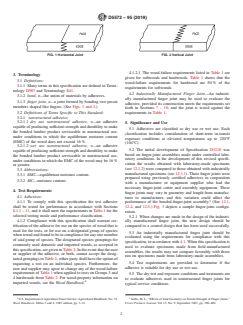
FIG. 2Vertical Joint
FIG. 1Horizontal Joint
4.1.2.1 The wood-failure requirements listed in Table 1 are
3. Terminology
given for softwoods and hardwoods. Table 1 shows that the
3.1 Definitions:
wood-failure requirements for hardwood are 50% of the
3.1.1 Many terms in this specification are defined in Termi-
requirements for softwoods.
nology D907 and Terminology E41.
4.2 Industrially Manufactured Finger Joint—An industri-
3.1.2 bond, n—the union of materials by adhesives.
ally manufactured finger joint may be used to evaluate the
3.1.3 finger joint, n—a joint formed by bonding two precut
adhesive, provided its construction meets the requirements set
members shaped like fingers. (See Figs. 1 and 2.)
forth in Sections7–10, and the joint is tested against the
3.2 Definitions of Terms Specific to This Standard: requirements in Table 1.
3.2.1 nonstructural adhesive:
3.2.1.1 dry use nonstructural adhesive, n—an adhesive 5. Significance and Use
capable of producing sufficient strength and durability to make
5.1 Adhesives are classified as dry use or wet use. Each
the bonded lumber product serviceable in nonstructural use,
classification includes consideration of short-term in-transit
under conditions in which the equilibrium moisture content
exposure conditions at elevated temperatures up to 220°F
(EMC) of the wood does not exceed 16%.
(104°C).
3.2.1.2 wet use nonstructural adhesive, n—an adhesive
5.2 The initial development of Specification D3110 was
capable of producing sufficient strength and durability to make
based on finger-joint assemblies made under controlled labo-
the bonded lumber product serviceable in nonstructural use,
ratory conditions. In the development of this revised specifi-
under conditions in which the EMC of the wood may be 16%
cation the results obtained with laboratory-made specimens
or greater.
(see 12.1.2) were compared to those obtained with industrially
3.3 Abbreviations:
manufactured specimens (see 12.1.1). These finger joints were
3.3.1 EMC—equilibrium moisture content.
prepared using previously certified adhesives in cooperation
3.3.2 MC—moisture content.
with a manufacturer or equipment supplier who had the
necessary finger-joint cutter and assembly equipment. These
4. Test Requirements
finger joints may vary in geometry and length from manufac-
4.1 Adhesives:
turer to manufacturer, and this variation could affect the
4.1.1 To comply with this specification the test adhesive
performance of the bonded-finger-joint assembly. (See 12.1,
shall be tested for performance in accordance with Sections
12.4, and 12.5.) Fig. 3 depicts a sample finger-joint configu-
8.1.1–11,anditshallmeettherequirementsinTable1forthe
ration.
selected testing mode and performance classification.
5.2.1 When changes are made in the design of the industri-
4.1.2 Compliance with this specification shall warrant cer-
ally manufactured finger joint, the new design should be
tification of the adhesive for use on the species of wood that is
compared to a control design that has been used successfully.
used for the tests, or for use on a designated group of species
5.3 An industrially manufactured finger joint should be
whentestedandfoundtobeincomplianceforanyonemember
evaluated using the requirements for compliance with this
of said group of species. The designated species groupings for
specification,inaccordancewith4.1.Whenthisspecificationis
commonly used domestic and imported woods, as accepted in
used to evaluate specimens made from field-manufactured
thisspecification,aregiveninTable2.Intheeventthattheuser
assemblies, the results may not compare favorably with those
or supplier of the adhesive, or both, cannot accept the desig-
run on specimens made from laboratory-made assemblies.
natedgroupingsinTable2,eitherpartyshallhavetheoptionof
5.4 Test requirements are provided to determine if the
requesting a test on an individual species. Furthermore, the
adhesive is suitable for dry use or wet use.
user and supplier may agree to change any of the wood-failure
requirements of Table 1 when applied to tests on Groups 3 and
5.5 The dry test and exposure conditions and treatments are
4 hardwoods from Table 2. For wood-property information on
to evaluate adhesives used in nonstructural finger joints for
imported woods, see the Wood Handbook.
typical service conditions.
4 5
U.S.DepartmentofAgricultureForestService;AgriculturalHandbook,No.72, Selbo, M. L., “Effects of Joint Geometry onTensile Strength of Finger Joints,”
Wood Handbook, Tables3 and 4, 1987 edition, pp. 3–11. Forest Products Journal, Vol 13, No. 9, September 1963, pp. 390–400.
D5572−95 (2019)
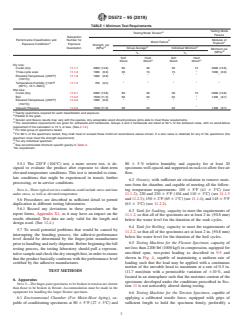
TABLE 1 Minimum Test Requirements
Testing Mode
B
Testing Mode Tension
Flexure
Subsection
Modulus of
Performance Classification and Number for D
Wood Failure
C
A
Rupture
Exposure Conditions Exposure
Strength, psi
C E F
Description
(MPa) Group Average Individual Minimum
Minimum psi
G
(MPa)
%%
Soft Hard Soft Hard
H H
Wood Wood Wood Wood
Dry Use:
Cured (dry) 11.1.1 2000 (13.8) 60 30 30 15 2000 (13.8)
I
Three-cycle soak 11.1.2 1000 (6.9) 30 15 15 1000 (6.9)
II I I I
Elevated Temperature ((220°F) 11.1.3 1000 (6.9)
(104°C))
II I I I
Temperature-Humidity ((140°F 11.1.4 750 (5.2)
(60°C), 16 % EMC))
Wet Use:
Cured (dry) 11.2.1 2000 (13.8) 60 30 30 15 2000 (13.8)
I
Boil 11.2.2 1600 (11.0) 50 25 25 1400 (9.7)
II I I I
Elevated Temperature ((220°F) 11.2.3 1000 (6.9)
(104°C))
I
Vacuum Pressure 11.2.4 1600 (11.0) 50 25 25 1400 (9.7)
A
Twenty specimens required for each classification and exposure.
B
Parallel to the grain.
C
Tension and flexure results may vary with the species. Any acceptable wood should produce joints able to meet these requirements.
D
The wood-failure requirements are given for softwoods and hardwoods. Groups 3 and 4 hardwoods are listed at 50 % of the softwood value, with no wood-failure
requirement if the calculation is 15 % or less. (See 4.1.2.)
E
For total group of specimens tested.
F
For 90 % of the specimens tested, they shall meet or exceed these minimum wood-failure values shown. If a zero value is obtained for any of the specimens (the
specimen must meet the strength requirement).
G
For any individual specimen.
H
See recommended minimum specific gravity in Table 2.
I
No requirement.
5.5.1 The 220°F (104°C) test, a more severe test, is de- 80 6 5% relative humidity and capacity for at least 20
signed to evaluate the product after exposure to short-term specimenswell-spacedandsupportedonrackstoallowfreeair
elevated-temperature conditions. This test is intended to simu- flow.
late conditions that might be experienced in transit, further
6.2 Oven(s), with sufficient air circulation to remove mois-
processing, or in-service conditions.
ture from the chamber, and capable of meeting all the follow-
NOTE4—Thesetypicalserviceconditionscouldincludestressandtime ing temperature requirements: 105 6 5°F (41 6 3°C) (see
under stress, as well as elevated temperature.
11.1.2); 220 and 230 6 5°F (104 and 110 6 3°C) (see 11.1.3
and11.2.3);150 62°F(65 61°C)(see11.1.4);and145 65°F
5.6 Procedures are described in sufficient detail to permit
(63 6 3°C) (see 11.2.2).
duplication in different testing laboratories.
5.6.1 Record any deviations in these procedures on the
6.3 Tank for Soaking, capacity to meet the requirements of
report forms, Appendix X1, as it may have an impact on the
11.1.2, so that all of the specimens are at least 2 in. (50.8 mm)
results obtained. Test data are only valid for the length and
below the water level for the duration of the soak cycles.
design used. (See 12.4.)
6.4 Tank for Boiling, capacity to meet the requirements of
5.7 To avoid potential problems that would be caused by
11.2.2, so that all of the specimens are at least 2 in. (50.8 mm)
interrupting the bonding process, the adhesive-performance
below the water level for the duration of the boil cycles.
level should be determined by the finger-joint manufacturer
6.5 Testing Machine for the Flexure Specimen, capacity of
priortohandlingandearlyshipment.Beforebeginningthefull
not less than 2200 lbf (1000 kgf) in compression, equipped for
testing process, the testing laboratory should pull a represen-
one-third span, two-point loading as described in 9.5 and
tativesampleandcheckthedrystrengthfirst,inordertoensure
shown in Fig. 4, capable of maintaining a uniform rate of
that the product basically conforms with the performance level
loading such that the load may be applied with a continuous
certified by the adhesive manufacturer.
motion of the movable head to maximum at a rate of 0.5 in.
TEST METHODS
(11.7 mm)/min with a permissible variation of 610%, and
located in an atmosphere such that the moisture content of the
6. Apparatus
specimens developed under the conditions prescribed in Sec-
NOTE 5—The finger-joint specimens to be broken in tension are shorter
tion 11 is not noticeably altered during testing.
than those to be broken in flexure. Accommodation must be made in the
equipment for handling the larger flexure specimen.
6.6 Testing Machine for the Tension Specimen, capable of
6.1 Environmental Chamber (For Moist-Heat Aging), ca- applying a calibrated tensile force, equipped with grips of
pable of conditioning specimens at 80 6 5°F (27 6 3°C) and sufficient length to hold the specimen firmly, preferably a
D5572−95 (2019)
TABLE 2 Bondability Groupings of Commonly Used Domestic
A
and Imported Wood
U.S. Hardwoods U.S. Softwoods Imported Woods
B
Group 1—Bond Easily
Alder Cedar, incense Balsa Hura
Aspen Fir: Cativo Purpleheart
Basswood White Courbaril Roble
C
Cottonwood Grand Determa
Chestnut, Noble
American
Magnolia Pacific
Willow, black Pine:
Eastern white
Western white
Redcedar, western
Redwood
Spruce, Sitka
D
Group 2—Bond Well
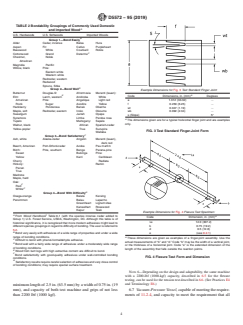
Example Dimensions for Fig. 3 Test Standard Finger Joint:
Butternut Douglas-fir Afrormosia Meranti (lauan):
A
E
Code Dimensions, in. (mm) Degrees
Elm: Larch, western Andiroba White
American Pine: Angelique Light red
a 1.312 (33.32) .
Rock Sugar Avodire Yellow
f 0.250 (6.25) .
Hackberry Ponderosa Banak Obeche
wt 0.047 (1.19) .
Maple, soft Redcedar, eastern Iroko Okoume
wb 0.092 (2.34) .
Sweetgum Jarrah Opepe
s (Slope) 5°
Sycamore Limba Peroba rosa
A
The dimensions given are for a typical horizontal finger joint and are examples
Tupelo Mahogany: Sapele
only.
Walnut, black African Spanish-cedar
Yellow-poplar True Sucupira
FIG. 3Test Standard Finger-Joint Form
Wallaba
F
Group 3—Bond Satisfactory
Ash, white Alaska-cedar Angelin Meranti (lauan),
dark red
Beech, American Port-Orford-cedar Azobe Pau marfim
Birch: Pine, southern Benge Parana-pine
Sweet Bubinga Pine:
Yellow Karri Caribbean
Cherry Radiata
Hickory: Ramin
Pecan
True
Madrone
Maple, hard
Oak:
C
Red
C
White
G
Group 4—Bond With Difficulty
Osage-orange Balata Keruing
Persimmon Balau Lapacho
Greenheart Lignumvitae
Kaneelhart Rosewood
Kapur Teak
Example Dimensions for Fig. 4 Flexure Test Specimen:
A 7
From Wood Handbook Table 9-1 (with the species incense cedar added to
A
Code Dimension, in. (mm)
Group 1) U.S. Forest Service, USDA, Washington, DC. Although this table is of
Ls 12.0 (307.2)
historical significance, it is recognized that more modern adhesives might lead to
b 0.75 (19.2)
differentspeciesgroupingsinregardtodifficultyofbonding.Theuserisreferredto
d 0.5 (12.8)
5.2.
B
e (see 9.2.1)
Bond very easily with adhesives of a wide range of properties and under a wide
range of bonding conditions. A
These dimensions are given as examples of a finger-joint assembly. Use the
C
Difficult to bond with phenol-formaldehyde adhesive.
actual measurements of “b” and “d.” Code “b” may be the width of a vertical joint,
D
Bond well with a fairly wide range of adhesives under a moderately wide range
or the thickness of a horizontal joint. Code “e” is the extended dimension of the
of bonding conditions.
length of the assembly that falls outside the reaction points.
E
Wood from butt logs with high extractive content are difficult to bond.
F
Bond satisfactorily with good-quality adhesives under well-controlled bonding
FIG. 4Flexure Test Form and Dimension
conditions.
G
Satisfactory results require careful selection of adhesives and very close control
of bonding conditions; may require special surface treatment.
NOTE 6—Depending on the design and adaptability, the same machine
with a 2200-lbf (1000-kgf) capacity, described in 6.5 for the flexure
testing,canbeusedforthetensiontestdescribedin6.6.(SeePracticesE4
and Terminology E6.)
minimumlengthof2.5in.(63.5mm)byawidthof0.75in.(19
mm), and capacity of both test machine and grips of not less 6.7 Vacuum-PressureVessel,capableofmeetingtherequire-
than 2200 lbf (1000 kgf). ments of 11.2.4, and capacity to meet the requirement that all
D5572−95 (2019)
TABLE 3 Recommended Minimum Specific Gravities by Species
A,B
Species Specific Gravity
Douglas Fir, East 0.48
Douglas fir, Interior South 0.46
Cedar, Alaska 0.44
Fir, White 0.39
Hemlock, Western 0.45
Larch, Western 0.52
Pine, Lodgepole 0.41
Pine, Loblolly 0.51
Pine, Ponderosa 0.40
A 7
Values have been taken from Table 4-2, Wood Handbook.
B
Values are averages based on oven-dry weight and volume at 10 to 12 %
moisture content.
FIG. 5Feathered Finger Joint
of the specimens are at least 2 in. (50.8 mm) below the water
level for the duration of the complete vacuum-pressure cycles.
blies in the field, control the MC of the specimens throughout
thetestingprocessasshownin8.1.2.1and8.1.3forlaboratory-
7. Preparation of Finger Joint
made specimens.
8.1.2 Laboratory-Made Assemblies—Select lumber as de-
7.1 Equipment—Prepare the finger-joint assemblies in co-
scribed in 7.2.1, except determine the MC of the lumber by
operation with a wood-products manufacturer, an equipment
Test Method A, Oven-Dry; or by Test Method B, Electronic
manufacturer, or a laboratory having all of the proper equip-
Moisture Meter Method, of Test Methods D4442, when agree-
ment.
ment within 61% MC with Test Method A has been deter-
7.2 Preparation of Assemblies:
mined.
7.2.1 Material—Use lumber that conforms to the require-
8.1.2.1 If needed, condition the assemblies to the original
ments:maximumslopeofgrainof1in14onanyfaceoredge;
MC, 61% MC, by use of an environmental chamber (see 6.1)
EMC of 8 to 12%, preferably brought to 10 to 12% MC prior
prior to cutting the specimens.
to cutting and bonding; free of knots and decay; free of
8.1.3 Specimen Conditioning During the Testing Process—
machining defects such as chipped grain, feed-roll polish,
The allowable variation in MC at the completion of a drying
coarse knife marks, and feed-roll compression; free of drying
cycle or before testing dry is 61% MC. For example, if the
effects, such as case hardening, collapse, or splits or checks.
MC of the specimen before exposure is 9%, the acceptable
Recommended minimum specific gravities are given in Table
range for testing is 8 to 10%. Wood failure is estimated on
3. Finger joints are to be cut on the day the assemblies are to
specimens after they have been conditioned to less than 8%,
be made. See 4.1.2 for species compliance rules relative to
exceptforthedrytestdescribedin11.1.1and11.2.1,wherethe
testing,andTable2forinformationonthebondabilityofsome
specimens have never been taken from the dry state. Wood
species of wood.
failure may be read on these test specimens following the
7.2.2 Adhesive—Follow the adhesive manufacturer’s in-
strength testing, with no further conditioning to reduce MC.
structions for conditions and procedures for preparing and
applying the adhesive, as well as for assembling, pressing, and
9. Testing in Flexure
curing the assembly.
9.1 Conditioning—Follow instructions in Section 8.
7.2.3 Number of Specimens—For each unique combination
9.2 Preparation of Test Specimen:
of specimen type, mode of testing, and exposure condition, a
9.2.1 Form and Dimension—From a finger-jointed assem-
test group consists of 20 specimens, representing at least four
bly (see 7.2), cut the flexure-test specimens with sufficient
different assemblies with no more than five specimens from
length for the joint to be centered at midspan as in Fig. 4, and
each assembly.
withadistancebetweenreactionpointsof24multipliedbythe
8. Conditioning depth, d. Allow at least 1 in. (25 mm) at both ends of the
specimen outside the reaction points. On each edge of the
8.1 Measuring Moisture Content—There are several stages
specimen, feather out the finger at the midpoint of the joint,
in this test method where it is necessary to determine the MC
adjusting the width of the specimen accordingly. (See Fig. 5.)
as follows: on the lumber before bonding, on the assemblies
before cutting into specimens, and on the specimens during
NOTE 7—In this application, “to feather” means to remove any portion
extending beyond the normal surface of the outer finger so that the stress
several tests when they must be dried to a given MC before
riser (butt joint effect) is not present on the surface. See Fig. 5.
testing.
8.1.1 Factory-Manufactured Assemblies—When construct- 9.3 ExposureConditions—Subjectthespecimenstothetests
ing the assemblies, select lumber within the range from 10 to for the selected wet-use or dry-use classification, or both, in
12% MC before bonding, (see 7.2.1). Determine the MC by accordancewiththeapplicableconditionsandtreatmentsgiven
use of an electronic moisture meter, in accordance with Test in Section 11. Consult Table 1 for the tests required for each
Method B in Test Methods D4442. After bonding the assem- testing mode and performance classification.
D5572−95 (2019)
Example Dimensions for Fig. 6:
A,B
(L) 10 in. (254.0 mm)
(H) 0.75 in. (19.05 mm)
(W) 0.25 in. (6.35 mm)
A
The dimensions are given as examples only.
B
The recommended length is 10 in. Some testing machines cannot accommodate this length. See Note 7.
FIG. 6Tension Test Multifinger Form and Dimension
9.4 Testing Machine—See 6.5. 10.5 Testing—Apply the load at a rate of 0.5 in. (12.7
mm)/min.
9.5 Testing Procedure—Apply the load with a continuous
motion of the movable head at a rate of 0.5 in. (12.7 mm)/min 10.6 Calculation—Calculate the ultimate tensile stress in
(610%), testing the specimens by one-third span, two-point pounds-force per square inch or megapascals based on tensile
loadingwiththeloadappliedperpendiculartothefaceshowing breaking load and the cross-sectional area at the finger joint.
the fingers, as shown in Fig. 4.
10.7 Report—Report the tensile-stress values together with
9.6 Calculation—Calculate the modulus of rupture in the estimated percentages of wood failure on the form shown
pounds-force per square inch or kilopascals as follows: in Fig. X1.1 for dry use or Fig. X1.3 for wet use. Indicate
2 whether the assemblies were field-manufactured or laboratory-
R 5 Pl/bd (1)
made.Also, report the wood species and indicate whether it is
where:
classified as soft wood or hard wood. Report the slope of the
R = modulus of rupture, psi (MPa), finger in degrees and the dimensions to the nearest 0.01 in.
P = maximum loa
...