

ASTM D6405-99(2020)
(Practice)Standard Practice for Extraction of Tannins from Raw and Spent Materials
General Information
- Abstract
SIGNIFICANCE AND USE
5.1 This practice provides a standard procedure for obtaining the water-soluble materials (including tannins) from any material that can be prepared for and charged to the steam-jacketed extractor. The extraction solutions are then analyzed according to Test Methods D4903, D6401, and D6402.
SCOPE
1.1 This practice covers extracting the tannin from raw and spent materials. The water extract obtained by this method is used to determine the tannin content of the original material. Analysis for total solids, soluble solids, and soluble non-tannins of the water extract from a material provides the information necessary to calculate the extractable tannin content of that material. The types of materials typically analyzed by this practice are products of plants such as woods, barks, leaves, nuts, fruits, roots, etc. and any of a wide variety of by-products (spent materials) from industrial processes utilizing plant products.
1.2 The values stated in SI units are to be regarded as the standard. The inch-pound units given in parentheses are for information only.
1.3 This standard does not purport to address all of the safety concerns, if any, associated with its use. It is the responsibility of the user of this standard to establish appropriate safety, health, and environmental practices and determine the applicability of regulatory limitations prior to use.
1.4 This international standard was developed in accordance with internationally recognized principles on standardization established in the Decision on Principles for the Development of International Standards, Guides and Recommendations issued by the World Trade Organization Technical Barriers to Trade (TBT) Committee.
- Status
- Published
- Publication Date
- 30-Nov-2020
- Technical Committee
- D31 - Leather
- Drafting Committee
- D31.01 - Vegetable Leather


Overview
ASTM D6405-99(2020), titled Standard Practice for Extraction of Tannins from Raw and Spent Materials, is an internationally recognized standard developed by ASTM. This practice outlines the procedures for extracting water-soluble tannins from plant-based raw and spent materials using a steam-jacketed extractor. The extract produced through this method is used to determine the tannin content of the original material, ensuring consistency and quality across industries reliant on plant-derived tannins, such as leather production and other related sectors.
Key Topics
- Tannin Extraction: Provides a uniform and reproducible method for obtaining water-soluble components, including tannins, from various plant materials.
- Material Types: Applies to a broad range of plant tissues, such as woods, barks, leaves, nuts, fruits, roots, and industrial by-products (“spent materials”).
- Sample Preparation: Detailed guidelines are given for grinding, drying, and sieving samples to attain suitable moisture equilibrium and particle size for efficient extraction.
- Extraction Process: Utilizes specialized laboratory equipment, including steam-jacketed glass extractors and analytical balances, to standardize the extraction procedure.
- Analysis: The resulting extracts are then analyzed for tannin content as well as total solids, soluble solids, and soluble non-tannins using referenced ASTM test methods.
- Safety and Compliance: Users are required to establish appropriate safety, health, and environmental practices and ensure compliance with applicable regulations.
Applications
Adopting ASTM D6405-99(2020) in laboratory and industrial settings offers several practical benefits:
- Leather Industry: Standardized tannin extraction is vital for producing consistent vegetable-tanned leather, verifying the quality of both raw tannin materials and spent by-products.
- Quality Control: Ensures reliable assessment of tannin concentrations, supporting the optimization and verification of extractable tannin in production inputs or outputs.
- Research and Development: Provides a validated, repeatable method for analyzing tannin content, critical for R&D in natural product chemistry and the development of new applications for plant extracts.
- Industrial By-product Utilization: Facilitates the evaluation of spent materials from plant processing industries, enabling effective resource recovery or waste management.
- Regulatory Compliance: The standard supports compliance with international requirements for quality and performance, particularly where tannin levels have implications for product classification and trade.
Related Standards
The standard references several related ASTM documents and test methods critical for users seeking comprehensive tannin analysis:
- ASTM D4903: Test Method for Total Solids and Water in Vegetable Tanning Material Extracts.
- ASTM D6401: Test Method for Determining Non-Tannins and Tannin in Extracts of Vegetable Tanning Materials.
- ASTM D6402: Test Method for Determining Soluble Solids and Insolubles in Extracts of Vegetable Tanning Materials.
- ASTM D6403: Test Method for Determining Moisture in Raw and Spent Materials.
- ASTM D6404: Practice for Sampling Vegetable Materials Containing Tannin.
- ASTM D1517: Terminology Relating to Leather.
These standards ensure that users of ASTM D6405-99(2020) have access to a full suite of supporting methodologies, promoting accuracy and consistency in tannin extraction and analysis.
By incorporating ASTM D6405-99(2020) into laboratory and industrial practice, organizations can ensure the systematic extraction of tannins from diverse plant materials, underpinning reliable quality control, efficient material utilization, and compliance with internationally recognized procedures in tannin analysis.
Relations
- Effective Date
- 01-Dec-2015
- Effective Date
- 01-Oct-2010
- Effective Date
- 01-Apr-2009
- Effective Date
- 01-Apr-2009
- Refers
ASTM D6403-99(2009) - Standard Test Method for Determining Moisture in Raw and Spent Materials - Effective Date
- 01-Apr-2009
- Effective Date
- 01-Apr-2009
- Effective Date
- 01-Apr-2009
- Effective Date
- 01-Apr-2009
- Effective Date
- 01-Oct-2006
- Effective Date
- 01-Sep-2004
- Effective Date
- 01-Sep-2004
- Effective Date
- 01-Apr-2004
- Effective Date
- 01-Apr-2004
- Effective Date
- 01-Apr-2004
- Refers
ASTM D6403-99(2004) - Standard Test Method for Determining Moisture in Raw and Spent Materials - Effective Date
- 01-Apr-2004
Get Certified
Connect with accredited certification bodies for this standard

Control Union Certifications
Global certification for agriculture and sustainability.

Hohenstein Institut
Textile testing and certification.

Bureau Veritas Bangladesh
Bureau Veritas certification services in Bangladesh.
Sponsored listings
Frequently Asked Questions
ASTM D6405-99(2020) is a standard published by ASTM International. Its full title is "Standard Practice for Extraction of Tannins from Raw and Spent Materials". This standard covers: SIGNIFICANCE AND USE 5.1 This practice provides a standard procedure for obtaining the water-soluble materials (including tannins) from any material that can be prepared for and charged to the steam-jacketed extractor. The extraction solutions are then analyzed according to Test Methods D4903, D6401, and D6402. SCOPE 1.1 This practice covers extracting the tannin from raw and spent materials. The water extract obtained by this method is used to determine the tannin content of the original material. Analysis for total solids, soluble solids, and soluble non-tannins of the water extract from a material provides the information necessary to calculate the extractable tannin content of that material. The types of materials typically analyzed by this practice are products of plants such as woods, barks, leaves, nuts, fruits, roots, etc. and any of a wide variety of by-products (spent materials) from industrial processes utilizing plant products. 1.2 The values stated in SI units are to be regarded as the standard. The inch-pound units given in parentheses are for information only. 1.3 This standard does not purport to address all of the safety concerns, if any, associated with its use. It is the responsibility of the user of this standard to establish appropriate safety, health, and environmental practices and determine the applicability of regulatory limitations prior to use. 1.4 This international standard was developed in accordance with internationally recognized principles on standardization established in the Decision on Principles for the Development of International Standards, Guides and Recommendations issued by the World Trade Organization Technical Barriers to Trade (TBT) Committee.
SIGNIFICANCE AND USE 5.1 This practice provides a standard procedure for obtaining the water-soluble materials (including tannins) from any material that can be prepared for and charged to the steam-jacketed extractor. The extraction solutions are then analyzed according to Test Methods D4903, D6401, and D6402. SCOPE 1.1 This practice covers extracting the tannin from raw and spent materials. The water extract obtained by this method is used to determine the tannin content of the original material. Analysis for total solids, soluble solids, and soluble non-tannins of the water extract from a material provides the information necessary to calculate the extractable tannin content of that material. The types of materials typically analyzed by this practice are products of plants such as woods, barks, leaves, nuts, fruits, roots, etc. and any of a wide variety of by-products (spent materials) from industrial processes utilizing plant products. 1.2 The values stated in SI units are to be regarded as the standard. The inch-pound units given in parentheses are for information only. 1.3 This standard does not purport to address all of the safety concerns, if any, associated with its use. It is the responsibility of the user of this standard to establish appropriate safety, health, and environmental practices and determine the applicability of regulatory limitations prior to use. 1.4 This international standard was developed in accordance with internationally recognized principles on standardization established in the Decision on Principles for the Development of International Standards, Guides and Recommendations issued by the World Trade Organization Technical Barriers to Trade (TBT) Committee.
ASTM D6405-99(2020) is classified under the following ICS (International Classification for Standards) categories: 59.140.10 - Processes and auxiliary materials. The ICS classification helps identify the subject area and facilitates finding related standards.
ASTM D6405-99(2020) has the following relationships with other standards: It is inter standard links to ASTM D1517-15, ASTM D1517-10, ASTM D6402-99(2009), ASTM D6404-99(2009), ASTM D6403-99(2009), ASTM D4903-99(2009), ASTM D4904-99(2009), ASTM D6401-99(2009), ASTM D1517-06, ASTM D1517-04, ASTM D1517-04e1, ASTM D6401-99(2004), ASTM D4903-99(2004), ASTM D4904-99(2004), ASTM D6403-99(2004). Understanding these relationships helps ensure you are using the most current and applicable version of the standard.
ASTM D6405-99(2020) is available in PDF format for immediate download after purchase. The document can be added to your cart and obtained through the secure checkout process. Digital delivery ensures instant access to the complete standard document.
Standards Content (Sample)
This international standard was developed in accordance with internationally recognized principles on standardization established in the Decision on Principles for the
Development of International Standards, Guides and Recommendations issued by the World Trade Organization Technical Barriers to Trade (TBT) Committee.
Designation: D6405 − 99 (Reapproved 2020)
Standard Practice for
Extraction of Tannins from Raw and Spent Materials
This standard is issued under the fixed designation D6405; the number immediately following the designation indicates the year of
original adoption or, in the case of revision, the year of last revision. A number in parentheses indicates the year of last reapproval. A
superscript epsilon (´) indicates an editorial change since the last revision or reapproval.
1. Scope D6401 Test Method for Determining Non-Tannins and Tan-
nin in Extracts of Vegetable Tanning Materials
1.1 This practice covers extracting the tannin from raw and
D6402 Test Method for Determining Soluble Solids and
spent materials. The water extract obtained by this method is
Insolubles in Extracts of Vegetable Tanning Materials
used to determine the tannin content of the original material.
D6403 Test Method for Determining Moisture in Raw and
Analysis for total solids, soluble solids, and soluble non-
Spent Materials
tannins of the water extract from a material provides the
D6404 Practice for Sampling Vegetable Materials Contain-
information necessary to calculate the extractable tannin con-
ing Tannin
tent of that material. The types of materials typically analyzed
2.2 ALCA Methods:
by this practice are products of plants such as woods, barks,
A5 Extraction of Raw and Spent Materials
leaves, nuts, fruits, roots, etc. and any of a wide variety of
by-products (spent materials) from industrial processes utiliz-
3. Terminology
ing plant products.
3.1 Definitions:
1.2 The values stated in SI units are to be regarded as the
3.1.1 For definitions of general leather and tanning terms
standard. The inch-pound units given in parentheses are for
used in this practice refer to Terminology D1517.
information only.
3.1.2 raw material—any of the various parts of plants that
1.3 This standard does not purport to address all of the
are used as a source of vegetable tannins.
safety concerns, if any, associated with its use. It is the
3.1.3 spent material—plant tissue by-products from indus-
responsibility of the user of this standard to establish appro-
trial processes which may contain significant quantities of
priate safety, health, and environmental practices and deter-
vegetable tannins.
mine the applicability of regulatory limitations prior to use.
3.1.4 tannin—an astringent substance found in the various
1.4 This international standard was developed in accor-
parts of plants such as bark, wood, leaves, nuts, fruits, roots,
dance with internationally recognized principles on standard-
etc.
ization established in the Decision on Principles for the
Development of International Standards, Guides and Recom- 3.1.5 vegetable tannins—mixtures of substances (natural
mendations issued by the World Trade Organization Technical
products) obtained from plant tissues by water extraction
Barriers to Trade (TBT) Committee. which have the chemical and physical properties necessary to
convert animal hides and skins into leather.
2. Referenced Documents
4. Summary of Practice
2.1 ASTM Standards:
4.1 The sample of material to be analyzed for tannin content
D1517 Terminology Relating to Leather
is first brought to moisture equilibrium with the laboratory
D4903 Test Method for Total Solids and Water in Vegetable
atmosphere (that is, wet materials such as spent materials are
Tanning Material Extracts
first dried under ambient laboratory conditions) and then
D4904 Practice for Cooling of Analytical Solutions
ground sufficiently to pass through a sieve.This ground sample
is then extracted with water in a steam-jacketed extractor.
This practice is under the jurisdiction of ASTM Committee D31 on Leather
5. Significance and Use
This test method has been adapted from and is a replacement for MethodA5 of the
Official Methods of the American Leather Chemists Association.
5.1 This practice provides a standard procedure for obtain-
Current edition approved Dec. 1, 2020. Published December 2020. Originally
ing the water-soluble materials (including tannins) from any
approved in 1999. Last previous edition approved in 2014 as D6405 – 99 (2014).
DOI: 10.1520/D6405-99R20.
For referenced ASTM standards, visit the ASTM website, www.astm.org, or
contact ASTM Customer Service at service@astm.org. For Annual Book of ASTM Official Methods of the American Leather Chemists Association. Available
Standards volume information, refer to the standard’s Document Summary page on from the American Leather Chemists Association, University of Cincinnati, P.O.
the ASTM website. Box 210014, Cincinnati, OH 45221-0014.
Copyright © ASTM International, 100 Barr Harbor Drive, PO Box C700, West Conshohocken, PA 19428-2959. United States
D6405 − 99 (2020)
material that can be prepared for and charged to the steam- 6.12 Volumetric Flask, 1-L capacity for spent materials or
jacketed extractor. The extraction solutions are then analyzed 2-Lcapacity for raw materials. ClassAflasks with a bulb in the
according to Test Methods D4903, D6401, and D6402. neck (M.C.A. type) are especially suitable for this work.
6. Apparatus and Reagents
7. Preparation of Sample
6.1 Sieve, with circular openings 1.27 cm (0.50 in.) in
7.1 All of the sample, drawn as directed in Practice D6404,
diameter.
shall first be ground in a rough grinder, or shredded, to pass a
sieve having round openings 1.27 cm (0.50 in.) in diameter.
6.2 Sieve, with circular openings of 2 mm diameter (U.S.
Afterthisgrinding,thesampleshallbemixedandquartered,as
Std. Sieve Series No. 10).
described in the Quartering Samples section of Practice D6404
6.3 Glass Rods, soft glass stirring rods with rounded,
until about 450 g (1 lb) remains. This material shall then be
fire-polished ends.
ground to pass a sieve having circular openings of 2 mm
6.4 Borosilicate Glass Wool, made of soft, pliable fibers.
diameter (U.S. Standard Sieve Series No. 10). This grinding
shall be conducted in a Wiley mill or similar grinder.
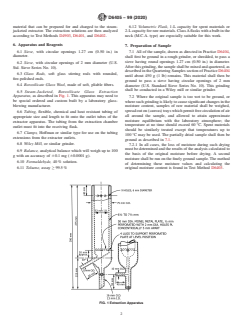
6.5 Steam-Jacketed, Borosilicate Glass Extraction
Apparatus, as described in Fig. 1. This apparatus may need to
7.2 Where the original sample is too wet to be ground, or
be special ordered and custom built by a laboratory glass-
wheresuchgrindingislikelytocausesignificantchangesinthe
blowing manufacturer.
moisture content, samples of raw material shall be weighed,
spreadou
...