

ASTM C899-79(2022)
(Practice)Standard Practice for Use of Metric Units of Measure for Reporting Properties of Refractory Materials
General Information
- Abstract
SIGNIFICANCE AND USE
3.1 This practice is provided to facilitate comparison of physical and mechanical properties of refractory materials by establishing uniform presentation of data.
3.2 Units have been chosen, where possible, to result in numbers of magnitude familiar in the refractories industry, that is, g/cm3 rather than the SI preferred unit kg/m3. It is recommended that SI prefixes be selected for use with the units such that the resulting numerical values lie between 0.1 and 1000. For most properties, the prefixes kilo (k) and mega (M) are preferred. Other prefixes are given in the following table:
Multiplication
Factor
Prefix
Symbol
109
giga
G
106
mega
M
103
kilo
k
102
hectoA
h
101
dekaA
da
10−1
deciA
d
10−2
centiA
c
10−3
milli
m
10−6
micro
μ
10−9
nano
n (A) To be avoided where practical.
3.3 The conversion factors, which have been selected for their general utility in the refractories industry, have been taken from Practice E380, where possible. For uniformity, they have been presented to four decimal places. In use, the converted values should be rounded to the same number of significant figures as in the original value.
SCOPE
1.1 This practice presents the units to be employed for reporting the properties of refractories, such as density, crushing stress, modulus of rupture, tensile stress, thermal conductivity, and permeability.
1.2 For convenience, a table of conversion factors between inch-pound units and SI units is included.
1.3 This international standard was developed in accordance with internationally recognized principles on standardization established in the Decision on Principles for the Development of International Standards, Guides and Recommendations issued by the World Trade Organization Technical Barriers to Trade (TBT) Committee.
- Status
- Published
- Publication Date
- 31-Aug-2022
- Technical Committee
- C08 - Refractories


Overview
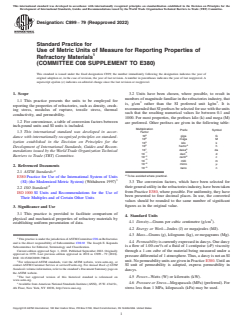
ASTM C899-79(2022): Standard Practice for Use of Metric Units of Measure for Reporting Properties of Refractory Materials is an established standard from ASTM International. This standard outlines the recommended metric units to be used when reporting the physical and mechanical properties of refractory materials. By providing a uniform system for unit selection and conversion, ASTM C899-79(2022) enables clear comparison and consistency in reporting throughout the refractories industry.
This standard supports global harmonization by adhering to internationally recognized principles for standardization and aligns with the World Trade Organization Technical Barriers to Trade (TBT) Committee guidelines.
Key Topics
- Uniform Data Presentation: The standard ensures that properties such as density, crushing stress, modulus of rupture, tensile stress, thermal conductivity, and permeability are reported using consistent metric units.
- Selection of Units: Where applicable, units have been chosen to give values of a familiar magnitude to those in the refractories industry (e.g., using g/cm³ instead of the SI preferred kg/m³).
- SI Prefixes and Symbols: Guidance is given on using SI prefixes such as kilo (k) and mega (M) to keep values within a practical range (between 0.1 and 1000). Other prefixes such as giga (G), milli (m), and micro (μ) are also listed, though some, like hecto (h) and centi (c), are recommended to be avoided if possible.
- Conversion Factors: The document includes a convenient table of conversion factors between inch-pound (imperial) and SI (metric) units, facilitating easy international adoption and reporting.
- Rounding Rules: Converted values should be rounded to the same number of significant figures as the original data, maintaining reporting accuracy.
Applications
The ASTM C899-79(2022) standard is vital for:
- Manufacturers and Suppliers: Ensuring all physical and mechanical material properties are reported according to industry-accepted metric units, improving communication and compatibility across markets.
- Laboratories and Testing Facilities: Standardizing the format for test results when evaluating characteristics like density, crush strength, or modulus of rupture.
- Purchasing and Specification: Assisting procurement teams and engineers in accurately comparing products and materials specified in metric units, reducing the risk of conversion errors.
- Regulatory Compliance and International Trade: Facilitating easier adherence to technical regulations and trade agreements that require metric unit usage and standardized reporting.
Common properties covered include:
- Density (g/cm³)
- Crushing stress (MPa)
- Modulus of rupture (MPa)
- Tensile stress (MPa)
- Permeability (expressed in darcys until an SI unit is established)
- Thermal conductivity (W/m·K)
- Thermal expansion coefficient (per kelvin)
- Energy and work (Joules, MJ)
- Mass (grams, kilograms, megagrams)
- Power (watts, kilowatts)
Related Standards
For a comprehensive approach to SI units and further guidance, the following standards are referenced:
- ASTM E380: Practice for Use of the International System of Units (SI) (withdrawn but widely cited for conversion factors within the industry).
- ISO 1000: SI Units and Recommendations for the Use of their Multiples and Certain Other Units.
These documents support ASTM C899-79(2022) by providing foundational principles and conversion factors for adopting metric units in technical documentation.
Keywords: metric units, refractory materials, ASTM C899, SI units, standard practice, conversion factors, physical properties, mechanical properties, reporting standards, refractories industry
Frequently Asked Questions
ASTM C899-79(2022) is a standard published by ASTM International. Its full title is "Standard Practice for Use of Metric Units of Measure for Reporting Properties of Refractory Materials". This standard covers: SIGNIFICANCE AND USE 3.1 This practice is provided to facilitate comparison of physical and mechanical properties of refractory materials by establishing uniform presentation of data. 3.2 Units have been chosen, where possible, to result in numbers of magnitude familiar in the refractories industry, that is, g/cm3 rather than the SI preferred unit kg/m3. It is recommended that SI prefixes be selected for use with the units such that the resulting numerical values lie between 0.1 and 1000. For most properties, the prefixes kilo (k) and mega (M) are preferred. Other prefixes are given in the following table: Multiplication Factor Prefix Symbol 109 giga G 106 mega M 103 kilo k 102 hectoA h 101 dekaA da 10−1 deciA d 10−2 centiA c 10−3 milli m 10−6 micro μ 10−9 nano n (A) To be avoided where practical. 3.3 The conversion factors, which have been selected for their general utility in the refractories industry, have been taken from Practice E380, where possible. For uniformity, they have been presented to four decimal places. In use, the converted values should be rounded to the same number of significant figures as in the original value. SCOPE 1.1 This practice presents the units to be employed for reporting the properties of refractories, such as density, crushing stress, modulus of rupture, tensile stress, thermal conductivity, and permeability. 1.2 For convenience, a table of conversion factors between inch-pound units and SI units is included. 1.3 This international standard was developed in accordance with internationally recognized principles on standardization established in the Decision on Principles for the Development of International Standards, Guides and Recommendations issued by the World Trade Organization Technical Barriers to Trade (TBT) Committee.
SIGNIFICANCE AND USE 3.1 This practice is provided to facilitate comparison of physical and mechanical properties of refractory materials by establishing uniform presentation of data. 3.2 Units have been chosen, where possible, to result in numbers of magnitude familiar in the refractories industry, that is, g/cm3 rather than the SI preferred unit kg/m3. It is recommended that SI prefixes be selected for use with the units such that the resulting numerical values lie between 0.1 and 1000. For most properties, the prefixes kilo (k) and mega (M) are preferred. Other prefixes are given in the following table: Multiplication Factor Prefix Symbol 109 giga G 106 mega M 103 kilo k 102 hectoA h 101 dekaA da 10−1 deciA d 10−2 centiA c 10−3 milli m 10−6 micro μ 10−9 nano n (A) To be avoided where practical. 3.3 The conversion factors, which have been selected for their general utility in the refractories industry, have been taken from Practice E380, where possible. For uniformity, they have been presented to four decimal places. In use, the converted values should be rounded to the same number of significant figures as in the original value. SCOPE 1.1 This practice presents the units to be employed for reporting the properties of refractories, such as density, crushing stress, modulus of rupture, tensile stress, thermal conductivity, and permeability. 1.2 For convenience, a table of conversion factors between inch-pound units and SI units is included. 1.3 This international standard was developed in accordance with internationally recognized principles on standardization established in the Decision on Principles for the Development of International Standards, Guides and Recommendations issued by the World Trade Organization Technical Barriers to Trade (TBT) Committee.
ASTM C899-79(2022) is classified under the following ICS (International Classification for Standards) categories: 01.060 - Quantities and units; 81.080 - Refractories. The ICS classification helps identify the subject area and facilitates finding related standards.
ASTM C899-79(2022) is available in PDF format for immediate download after purchase. The document can be added to your cart and obtained through the secure checkout process. Digital delivery ensures instant access to the complete standard document.
Standards Content (Sample)
This international standard was developed in accordance with internationally recognized principles on standardization established in the Decision on Principles for the
Development of International Standards, Guides and Recommendations issued by the World Trade Organization Technical Barriers to Trade (TBT) Committee.
Designation: C899 − 79 (Reapproved 2022)
Standard Practice for
Use of Metric Units of Measure for Reporting Properties of
Refractory Materials
(COMMITTEE C08 SUPPLEMENT TO E380)
This standard is issued under the fixed designation C899; the number immediately following the designation indicates the year of
original adoption or, in the case of revision, the year of last revision. A number in parentheses indicates the year of last reapproval. A
superscript epsilon (´) indicates an editorial change since the last revision or reapproval.
1. Scope 3.2 Units have been chosen, where possible, to result in
numbers of magnitude familiar in the refractories industry, that
1.1 This practice presents the units to be employed for
3 3
is, g/cm rather than the SI preferred unit kg/m.Itis
reporting the properties of refractories, such as density, crush-
recommended that SI prefixes be selected for use with the units
ing stress, modulus of rupture, tensile stress, thermal
such that the resulting numerical values lie between 0.1 and
conductivity, and permeability.
1000. For most properties, the prefixes kilo (k) and mega (M)
1.2 For convenience, a table of conversion factors between
are preferred. Other prefixes are given in the following table:
inch-pound units and SI units is included.
Multiplication
Prefix Symbol
1.3 This international standard was developed in accor- Factor
10 giga G
dance with internationally recognized principles on standard-
10 mega M
ization established in the Decision on Principles for the 3
10 kilo k
2 A
10 hecto h
Development of International Standards, Guides and Recom-
1 A
10 deka da
mendations issued by the World Trade Organization Technical
−1 A
10 deci d
−2 A
Barriers to Trade (TBT) Committee.
10 centi c
−3
10 milli m
−6
10 micro µ
2. Referenced Documents
−9
10 nano n
2.1 ASTM Standards:
A
To be avoided where practical.
E380 Practice for Use of the International System of Units
(SI) (the Modernized Metric System) (Withdrawn 1997)
3.3 The conversion factors, which have been selected for
theirgeneralutilityintherefractoriesindustry,havebeentaken
2.2 ISO Standard:
from Practice E380, where possible. For uniformity, they have
ISO 1000 SI Units and Recommendations for the Use of
been presented to four decimal places. In use, the converted
Their Multiples and of Certain Other Units
values should be rounded to the same number of significant
figures as in the original value.
3. Significance and Use
3.1 This practice is provided to facilitate comparison of
4. Standard Units
physical and mechanical properties of refractory materials by
4.1 Density—Grams per cubic centimetre (g/cm ).
establishing uniform presentation of data.
4.2 Energy or Work—Joules (J) or megajoules (MJ).
4.3 Mass—Grams (g), kilograms (kg), or megagrams (Mg).
ThispracticeisunderthejurisdictionofASTMCommitteeC08onRefractories
4.4 Permeabilityiscurrentlyexpressedindarcys.Onedarcy
and is the direct responsibility of Subcommittee C08.92 The Joseph E. Kopanda
...