

ASTM D7874-13(2022)
(Guide)Standard Guide for Applying Failure Mode and Effect Analysis (FMEA) to In-Service Lubricant Testing
General Information
- Abstract
SIGNIFICANCE AND USE
5.1 This guide is intended as a guideline for fluid analysis programs and serves as an initial justification for selecting fluid tests and sampling frequencies. Plant operating experience along with the review and benchmarking of similar applications is required to ensure that lessons learned are implemented.
5.2 Selection of proper fluid tests for assessing in-service component condition may have both safety and economic implications. Some failure modes may cause component disintegration, increasing the safety hazard. Thus, any fluid test that can predict such conditions should be included in the condition-monitoring program. Conversely, to maintain a sustainable and successful fluid-monitoring program, the scope of the fluid tests and their frequency should be carefully balanced between the associated risks versus expected program cost savings and benefits.
5.3 The failure modes monitored may be similar from one application to the next, but the risk and consequences of failure may differ.
5.4 This analysis can be used to determine which in-service lubricant analysis tests would be of highest value and which would be ineffective for the failure modes of interest. This information can also be used to determine the best monitoring strategy for a suite of failure modes and how often assessment is needed to manage the risk of failure.
SCOPE
1.1 This guide describes a methodology to select tests to be used for in-service lubricant analysis. The selection of fluid tests for monitoring failure mode progression in industrial applications applies the principles of failure mode and effect analysis (FMEA).
1.2 Although typical FMEA addresses all possible product failure modes, the focus of this guide is not intended to address failures that have a very high probability of unsafe operation as these should immediately be addressed by other means.
1.3 This guide is limited to components selected for condition-monitoring programs by providing a methodology to choose fluid tests associated with specific failure modes for the purpose of identifying their earliest developing stage and monitoring fault progression. The scope of this guide is also focused on those failure modes and their consequences that can effectively be detected and monitored by fluid analysis techniques.
1.4 This guide pertains to a process to be used to ensure an appropriate amount of condition monitoring is performed with the objective of improving equipment reliability, reducing maintenance costs, and enhancing fluid analysis monitoring of industrial machinery. This guide can also be used to select the monitoring frequencies needed to make the failure determinations and provide an assessment of the strengths and weaknesses of a current condition-monitoring program.
1.5 This guide does not eliminate the programmatic requirements for appropriate assembly, operational, and maintenance practices.
1.6 This standard does not purport to address all of the safety concerns, if any, associated with its use. It is the responsibility of the user of this standard to establish appropriate safety, health, and environmental practices and determine the applicability of regulatory limitations prior to use.
1.7 This international standard was developed in accordance with internationally recognized principles on standardization established in the Decision on Principles for the Development of International Standards, Guides and Recommendations issued by the World Trade Organization Technical Barriers to Trade (TBT) Committee.
- Status
- Published
- Publication Date
- 30-Sep-2022
- Technical Committee
- D02 - Petroleum Products, Liquid Fuels, and Lubricants
- Drafting Committee
- D02.96.04 - Guidelines for In-Services Lubricants Analysis
Overview
ASTM D7874-13(2022), "Standard Guide for Applying Failure Mode and Effect Analysis (FMEA) to In-Service Lubricant Testing," provides a structured methodology for selecting appropriate fluid tests and frequencies in industrial lubricant condition-monitoring programs. Developed by ASTM International, this standard leverages FMEA principles to identify, prioritize, and manage risks associated with equipment failure modes detectable through lubricant analysis. The guide aims to improve equipment reliability, lower maintenance costs, and optimize the effectiveness of fluid analysis in monitoring the health of machinery.
Key Topics
- Failure Mode and Effect Analysis (FMEA) in Lubricant Testing
The standard outlines how to systematically apply FMEA to choose lubricant testing methods that align with the risks and priorities found in specific industrial applications. - Risk-Based Test Selection
Tests are prioritized based on severity and likelihood of potential failure modes, ensuring that resources focus on the most critical risks. - Sampling Frequency Determination
Guidance is provided for establishing optimal sampling intervals that balance risk mitigation, cost, and program benefits. - Condition Monitoring Program Evaluation
The methodology facilitates ongoing assessment of the effectiveness and comprehensiveness of lubricant analysis programs. - Continuous Improvement and Documentation
The guide underscores the need for documentation and regular review to maintain program effectiveness and integrate new lessons learned.
Applications
ASTM D7874 is widely applicable in industries utilizing complex machinery with lubricated components, such as manufacturing, power generation, and transportation. Key practical uses include:
- Optimizing Maintenance Strategies
By applying FMEA, organizations can identify which lubricant tests are most relevant for their specific failure risks, helping to predict and prevent costly breakdowns or safety incidents. - Condition-Based Maintenance
The standard supports condition-based maintenance programs, reducing unplanned downtime and extending equipment lifecycle through timely detection and intervention. - Resource Allocation
By focusing testing on the highest-risk failure modes, companies can allocate resources efficiently, avoiding unnecessary tests while ensuring critical risks are managed. - Safety and Compliance
Proper application of this guide can help reduce the likelihood of failures leading to hazardous conditions, supporting both operational safety and regulatory compliance. - Program Benchmarking and Continuous Improvement
Organizations can use the methodology to benchmark their condition-monitoring programs against best practices, identify gaps, and justify the adoption of advanced testing or sensing techniques.
Related Standards
For a comprehensive lubricant analysis and risk management approach, ASTM D7874 references and complements several important standards:
- ASTM D7684 - Guide for Microscopic Characterization of Particles from In-Service Lubricants: Provides guidelines on particle analysis to support failure mode identification.
- ASTM D7720 - Guide for Statistically Evaluating Measurand Alarm Limits: Offers methods for setting and verifying alarm thresholds to improve lubricant monitoring accuracy.
- IEC 60812 - Analysis Techniques for System Reliability – Procedure for Failure Mode and Effects Analysis (FMEA): International standard referenced for general FMEA methodology, supporting broader compatibility and best practices.
Practical Value
Implementing ASTM D7874 ensures a systematic, risk-based, and cost-effective lubricant analysis program that directly supports maintenance optimization, improved reliability, and safety in industrial operations. The standard enables organizations to:
- Identify early signs of equipment degradation via appropriate lubricant tests
- Establish rational testing frequencies based on actual risk
- Continuously assess and improve their condition-monitoring approach
- Align their practices with internationally recognized standards in reliability and maintenance
By centering maintenance planning around data-driven, risk-informed analysis, ASTM D7874 helps organizations achieve operational excellence and reduce the total cost of ownership for complex machinery.
Keywords: lubricant testing, FMEA, condition monitoring, failure mode analysis, ASTM D7874, maintenance optimization, industrial fluid analysis.
Relations
- Effective Date
- 01-Jun-2011
- Effective Date
- 01-Jan-2011
Get Certified
Connect with accredited certification bodies for this standard

Element Materials Technology
Materials testing and product certification.

ABS Group Brazil
ABS Group certification services in Brazil.

ABS Quality Evaluations Inc.
American Bureau of Shipping quality certification.
Sponsored listings
Frequently Asked Questions
ASTM D7874-13(2022) is a guide published by ASTM International. Its full title is "Standard Guide for Applying Failure Mode and Effect Analysis (FMEA) to In-Service Lubricant Testing". This standard covers: SIGNIFICANCE AND USE 5.1 This guide is intended as a guideline for fluid analysis programs and serves as an initial justification for selecting fluid tests and sampling frequencies. Plant operating experience along with the review and benchmarking of similar applications is required to ensure that lessons learned are implemented. 5.2 Selection of proper fluid tests for assessing in-service component condition may have both safety and economic implications. Some failure modes may cause component disintegration, increasing the safety hazard. Thus, any fluid test that can predict such conditions should be included in the condition-monitoring program. Conversely, to maintain a sustainable and successful fluid-monitoring program, the scope of the fluid tests and their frequency should be carefully balanced between the associated risks versus expected program cost savings and benefits. 5.3 The failure modes monitored may be similar from one application to the next, but the risk and consequences of failure may differ. 5.4 This analysis can be used to determine which in-service lubricant analysis tests would be of highest value and which would be ineffective for the failure modes of interest. This information can also be used to determine the best monitoring strategy for a suite of failure modes and how often assessment is needed to manage the risk of failure. SCOPE 1.1 This guide describes a methodology to select tests to be used for in-service lubricant analysis. The selection of fluid tests for monitoring failure mode progression in industrial applications applies the principles of failure mode and effect analysis (FMEA). 1.2 Although typical FMEA addresses all possible product failure modes, the focus of this guide is not intended to address failures that have a very high probability of unsafe operation as these should immediately be addressed by other means. 1.3 This guide is limited to components selected for condition-monitoring programs by providing a methodology to choose fluid tests associated with specific failure modes for the purpose of identifying their earliest developing stage and monitoring fault progression. The scope of this guide is also focused on those failure modes and their consequences that can effectively be detected and monitored by fluid analysis techniques. 1.4 This guide pertains to a process to be used to ensure an appropriate amount of condition monitoring is performed with the objective of improving equipment reliability, reducing maintenance costs, and enhancing fluid analysis monitoring of industrial machinery. This guide can also be used to select the monitoring frequencies needed to make the failure determinations and provide an assessment of the strengths and weaknesses of a current condition-monitoring program. 1.5 This guide does not eliminate the programmatic requirements for appropriate assembly, operational, and maintenance practices. 1.6 This standard does not purport to address all of the safety concerns, if any, associated with its use. It is the responsibility of the user of this standard to establish appropriate safety, health, and environmental practices and determine the applicability of regulatory limitations prior to use. 1.7 This international standard was developed in accordance with internationally recognized principles on standardization established in the Decision on Principles for the Development of International Standards, Guides and Recommendations issued by the World Trade Organization Technical Barriers to Trade (TBT) Committee.
SIGNIFICANCE AND USE 5.1 This guide is intended as a guideline for fluid analysis programs and serves as an initial justification for selecting fluid tests and sampling frequencies. Plant operating experience along with the review and benchmarking of similar applications is required to ensure that lessons learned are implemented. 5.2 Selection of proper fluid tests for assessing in-service component condition may have both safety and economic implications. Some failure modes may cause component disintegration, increasing the safety hazard. Thus, any fluid test that can predict such conditions should be included in the condition-monitoring program. Conversely, to maintain a sustainable and successful fluid-monitoring program, the scope of the fluid tests and their frequency should be carefully balanced between the associated risks versus expected program cost savings and benefits. 5.3 The failure modes monitored may be similar from one application to the next, but the risk and consequences of failure may differ. 5.4 This analysis can be used to determine which in-service lubricant analysis tests would be of highest value and which would be ineffective for the failure modes of interest. This information can also be used to determine the best monitoring strategy for a suite of failure modes and how often assessment is needed to manage the risk of failure. SCOPE 1.1 This guide describes a methodology to select tests to be used for in-service lubricant analysis. The selection of fluid tests for monitoring failure mode progression in industrial applications applies the principles of failure mode and effect analysis (FMEA). 1.2 Although typical FMEA addresses all possible product failure modes, the focus of this guide is not intended to address failures that have a very high probability of unsafe operation as these should immediately be addressed by other means. 1.3 This guide is limited to components selected for condition-monitoring programs by providing a methodology to choose fluid tests associated with specific failure modes for the purpose of identifying their earliest developing stage and monitoring fault progression. The scope of this guide is also focused on those failure modes and their consequences that can effectively be detected and monitored by fluid analysis techniques. 1.4 This guide pertains to a process to be used to ensure an appropriate amount of condition monitoring is performed with the objective of improving equipment reliability, reducing maintenance costs, and enhancing fluid analysis monitoring of industrial machinery. This guide can also be used to select the monitoring frequencies needed to make the failure determinations and provide an assessment of the strengths and weaknesses of a current condition-monitoring program. 1.5 This guide does not eliminate the programmatic requirements for appropriate assembly, operational, and maintenance practices. 1.6 This standard does not purport to address all of the safety concerns, if any, associated with its use. It is the responsibility of the user of this standard to establish appropriate safety, health, and environmental practices and determine the applicability of regulatory limitations prior to use. 1.7 This international standard was developed in accordance with internationally recognized principles on standardization established in the Decision on Principles for the Development of International Standards, Guides and Recommendations issued by the World Trade Organization Technical Barriers to Trade (TBT) Committee.
ASTM D7874-13(2022) is classified under the following ICS (International Classification for Standards) categories: 75.100 - Lubricants, industrial oils and related products. The ICS classification helps identify the subject area and facilitates finding related standards.
ASTM D7874-13(2022) has the following relationships with other standards: It is inter standard links to ASTM D7720-11, ASTM D7684-11. Understanding these relationships helps ensure you are using the most current and applicable version of the standard.
ASTM D7874-13(2022) is available in PDF format for immediate download after purchase. The document can be added to your cart and obtained through the secure checkout process. Digital delivery ensures instant access to the complete standard document.
Standards Content (Sample)
This international standard was developed in accordance with internationally recognized principles on standardization established in the Decision on Principles for the
Development of International Standards, Guides and Recommendations issued by the World Trade Organization Technical Barriers to Trade (TBT) Committee.
Designation: D7874 − 13 (Reapproved 2022)
Standard Guide for
Applying Failure Mode and Effect Analysis (FMEA) to In-
Service Lubricant Testing
This standard is issued under the fixed designation D7874; the number immediately following the designation indicates the year of
original adoption or, in the case of revision, the year of last revision. A number in parentheses indicates the year of last reapproval. A
superscript epsilon (´) indicates an editorial change since the last revision or reapproval.
1. Scope 1.7 This international standard was developed in accor-
dance with internationally recognized principles on standard-
1.1 This guide describes a methodology to select tests to be
ization established in the Decision on Principles for the
used for in-service lubricant analysis. The selection of fluid
Development of International Standards, Guides and Recom-
tests for monitoring failure mode progression in industrial
mendations issued by the World Trade Organization Technical
applications applies the principles of failure mode and effect
Barriers to Trade (TBT) Committee.
analysis (FMEA).
1.2 Although typical FMEA addresses all possible product
2. Referenced Documents
failure modes, the focus of this guide is not intended to address
2.1 ASTM Standards:
failures that have a very high probability of unsafe operation as
D7684 Guide for Microscopic Characterization of Particles
these should immediately be addressed by other means.
from In-Service Lubricants
1.3 This guide is limited to components selected for
D7720 Guide for Statistically Evaluating Measurand Alarm
condition-monitoring programs by providing a methodology to
Limits when Using Oil Analysis to Monitor Equipment
choose fluid tests associated with specific failure modes for the
and Oil for Fitness and Contamination
purpose of identifying their earliest developing stage and
2.2 IEC Standard:
monitoring fault progression. The scope of this guide is also
IEC 60812 Analysis Techniques for System Reliability—
focusedonthosefailuremodesandtheirconsequencesthatcan
ProcedureforFailureModeandEffectsAnalysis(FMEA),
effectively be detected and monitored by fluid analysis tech-
niques.
1.4 This guide pertains to a process to be used to ensure an 3. Terminology
appropriate amount of condition monitoring is performed with
3.1 Definitions:
the objective of improving equipment reliability, reducing
3.1.1 cause(s) of failure, n—underlying source(s) for each
maintenance costs, and enhancing fluid analysis monitoring of
potential failure mode that can be identified and described by
industrial machinery. This guide can also be used to select the
analytical testing.
monitoring frequencies needed to make the failure determina-
3.1.2 component incipient failure, n—moment a component
tions and provide an assessment of the strengths and weak-
begins to deteriorate or undergo changes that will eventually
nesses of a current condition-monitoring program.
lead to the loss of its design function.
1.5 This guide does not eliminate the programmatic require-
3.1.2.1 Discussion—This moment may not be easily detect-
ments for appropriate assembly, operational, and maintenance
ablebecauseofsensitivitylimitationsofmonitoringinstrumen-
practices.
tation or a lack of measurable change in performance charac-
1.6 This standard does not purport to address all of the teristics or both.
safety concerns, if any, associated with its use. It is the
3.1.3 criticality number, C, n—product of the severity (S)
responsibility of the user of this standard to establish appro-
and occurrence (O) numbers for a given failure mode’s causes
priate safety, health, and environmental practices and deter-
and effects.
mine the applicability of regulatory limitations prior to use.
3.1.4 design function, n—function or task that the system or
component should perform.
This guide is under the jurisdiction of ASTM Committee D02 on Petroleum
Products, Liquid Fuels, and Lubricants and is the direct responsibility of Subcom-
mittee D02.96.04 on Guidelines for In-Services Lubricants Analysis. For referenced ASTM standards, visit the ASTM website, www.astm.org, or
Current edition approved Oct. 1, 2022. Published October 2022. Originally contact ASTM Customer Service at service@astm.org. For Annual Book of ASTM
approved in 2013. Last previous edition approved in 2018 as D7874 – 13 (2018). Standards volume information, refer to the standard’s Document Summary page on
DOI: 10.1520/D7874-13R22. the ASTM website.
Copyright © ASTM International, 100 Barr Harbor Drive, PO Box C700, West Conshohocken, PA 19428-2959. United States
D7874 − 13 (2022)
3.1.5 detection ability number, D, n—ranking number that 3.1.15 severity number, S, n—ranking number that describes
describes the ability of a specific fluid test to successfully the seriousness of the consequences of each failure mode’s
detect a failure mode’s causes or effects. A scale is used to causes and effects on potential injury, component or equipment
grade detection ability numbers; see an example in 6.4.7. damage, and system availability.
3.1.15.1 Discussion—A scale is used to grade severity
3.1.6 effect(s) of failure, n—potential outcome(s) of each
numbers. See an example in 6.3.1.
failure mode on the system or component.
3.1.7 failure-developing period, FDP, n—period from com-
4. Summary of Guide
ponent’s incipient failure to functional failure.
4.1 This guide is designed to aid the user to optimize their
3.1.8 failure mode, n—physical description of the manner in
condition-monitoring program.
which a failure occurs.
4.2 Failure mode and effect analysis (FMEA) is applied by
3.1.9 failure mode and effect analysis, FMEA, n—analytical
the user of this guide to those machines selected in their
approach to determine and address methodically all possible
condition-monitoring program based on their significance to
system or component failure modes and their associated causes
production and safety. The user of this guide determines the
and effects on system performance.
possible failure modes for each machine and applies FMEA
3.1.9.1 Discussion—This approach can be used to evaluate
separately for each failure mode. A severity number (S)is
designs and track risk-reducing improvements to equipment
assigned for each failure mode’s causes and effects.
reliability.
4.3 The user of this guide then determines how frequently
3.1.10 failure modes, effects, and criticality analysis,
the failure mode’s causes or effects are likely to occur based on
FMECA, n—extension to FMEAthat involves ranking the risk
past operating experience under similar applications for a
associated with failure modes to allow prioritization and
predetermined time period. An occurrence number (O)is
selection of an appropriate maintenance strategy.
assigned for each failure mode’s causes and effects.
3.1.10.1 Discussion—A metric-describing criticality is de-
4.4 The severity and occurrence numbers are constant for
termined by the product of a severity number (S) and its
each failure mode’s specific cause or effect. Calculating the
occurrence number (O) for each given failure mode’s causes
product of the severity and occurrence numbers (criticality
and effects.
number) for all failure modes’ causes and effects allows the
3.1.11 functional failure, n—inability of the component or
user to establish a ranked hierarchy of the risk associated with
system to perform its required design function.
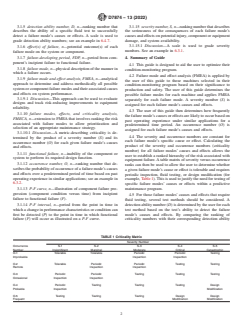
equipment failure.Atable matrix of severity versus occurrence
3.1.12 occurrence number, O, n—ranking number that de-
ranks can then be used to allow the user to determine whether
scribes the probability of occurrence of a failure mode’s causes
a given failure mode’s cause or effect is tolerable and requires
and effects over a predetermined period of time based on past
periodic inspection, fluid testing, or design modification (for
operating experience in similar applications; see an example in
example, Table 1).This is used to justify the need for testing of
6.3.2.
specific failure modes’ causes or effects within a predictive
3.1.13 P-F curve, n—illustration of component failure pro- maintenance program.
gression (component condition versus time) from incipient
4.5 For those failure modes’ causes and effects that require
failure to functional failure (F).
fluid testing, several test methods should be considered. A
3.1.14 P-F interval, n—period from the point in time in detection ability number (D) is determined by the user for each
which a change in performance characteristics or condition can test method based on the test’s ability to detect the failure
first be detected (P) to the point in time in which functional mode’s causes and effects. By comparing the ranking of
failure (F) will occur as illustrated on a P-F curve. criticality numbers with their corresponding detection ability
TABLE 1 Criticality Matrix
Severity Number
Occurrence S-1 S-2 S-3 S-4 S-5
Number Insignificant Marginal Moderate Critical Catastrophic
O-1 Tolerable Tolerable Periodic Periodic Testing
Improbable Inspection Inspection
O-2 Tolerable Periodic Periodic Testing Testing
Remote Inspection Inspection
O-3 Periodic Periodic Testing Testing Testing
Occasional Inspection Inspection
O-4 Periodic Testing Testing Testing Design
Probable Inspection Modification
O-5 Testing Testing Testing Design Design
Frequent Modification Modification
D7874 − 13 (2022)
numbers, the user may assess the strengths and weaknesses of 6.3.1.1 Number S-1 indicates an insignificant condition that
their fluid testing program. Cases in which the detection ability has little to no effect on component performance.
numbers are low compared to a high corresponding criticality
6.3.1.2 Number S-2 indicates a marginal condition that
number indicates weakness within a fluid testing program. causes a minor effect on component performance without the
need for repair.
4.6 An optimal sampling interval with consideration to the
6.3.1.3 Number S-3 indicates a moderate condition that
cost of sampling and benefits to the monitoring program can
reduces component performance and requires repair.
also be determined to implement a balanced testing approach.
6.3.1.4 Number S-4 indicates a critical condition caused by
5. Significance and Use
the loss of component design function that makes the compo-
nent inoperable.
5.1 This guide is intended as a guideline for fluid analysis
6.3.1.5 Number S-5 indicates a catastrophic condition
programsandservesasaninitialjustificationforselectingfluid
caused by the loss of component design function that may
tests and sampling frequencies. Plant operating experience
endanger the operator and others.
along with the review and benchmarking of similar applica-
6.3.2 For in-service fluid analysis applications, O is catego-
tions is required to ensure that lessons learned are imple-
rized according to a ranked-number scale. An example is
mented.
provided here of a five-rank scale. As previously mentioned,
5.2 Selection of proper fluid tests for assessing in-service
users may modify this scale to satisfy their specific require-
component condition may have both safety and economic
ments.
implications. Some failure modes may cause component
6.3.2.1 Number O-1 indicates improbable occurrence based
disintegration, increasing the safety hazard.Thus, any fluid test
on no identified failures in similar applications.
that can predict such conditions should be included in the
6.3.2.2 Number O-2 indicates remote occurrence based on a
condition-monitoring program. Conversely, to maintain a sus-
very few number of failures in similar applications for a
tainable and successful fluid-monitoring program, the scope of
predetermined operational period.
the fluid tests and their frequency should be carefully balanced
6.3.2.3 Number O-3 indicates occasional occurrence based
between the associated risks versus expected program cost
on a moderate number of failures in similar applications for a
savings and benefits.
predetermined operational period.
5.3 The failure modes monitored may be similar from one
6.3.2.4 Number O-4 indicates probable occurrence based on
application to the next, but the risk and consequences of failure
a high number of failures in similar applications for a prede-
may differ.
termined operational period.
5.4 This analysis can be used to determine which in-service 6.3.2.5 Number O-5 indicates frequent occurrence based on
lubricant analysis tests would be of highest value and which a very high number of failures in similar applications for a
would be ineffective for the failure modes of interest. This predetermined operational period.
information can also be used to determine the best monitoring 6.3.3 The predetermined operational period is selected by
strategy for a suite of failure modes and how often assessment the user based on factors such as production schedules, outage
is needed to manage the risk of failure. and inspection intervals, and so forth.
6.4 Failure mode, effects, and criticality analysis (FMECA)
6. Failure Mode and Effect Analysis (FMEA)
is a part of FMEA.
6.1 The FMEA process requires a thorough understanding
6.4.1 Criticality numbers are calculated for all failure
of machine design requirements and equipment operating
modes’ causes and effects by
...