

ASTM C1872-18e2
(Test Method)Standard Test Method for Thermogravimetric Analysis of Hydraulic Cement
General Information
- Abstract
SIGNIFICANCE AND USE
5.1 This test method is intended for use in acquiring, analyzing, and reporting thermogravimetric data obtained from hydraulic cement powders.
5.2 This test method can be used to determine the calcium carbonate content of cements with interground limestone if the calcium carbonate content of the limestone is known.
5.3 This test method can be used to determine the calcium hydroxide content of hydraulic cement powder.
5.4 This test method can be used to determine the mass loss upon heating hydraulic cement powders within a specific temperature range.
5.5 This test method can be used for qualitative and quantitative characterization, under certain conditions, of various sulfate mineral components including calcium sulfate dihydrate, calcium sulfate hemihydrate, and syngenite.
5.6 Different kinds of thermogravimetric analyzers are available with different configurations and controllers. Therefore, the parameters described should be considered as guidelines. They may be altered to conform to the instrument manufacturer’s instructions, provided the changes are noted in the report.
SCOPE
1.1 This test method provides a technique incorporating a thermogravimetric analyzer to determine the mass changes of hydraulic cement upon heating in an inert gas environment. The data can be used to determine the abundance of some mineralogical components in hydraulic cement powders.
1.2 Units—The values stated in SI units are to be regarded as standard. No other units of measurement are included in this standard.
1.3 This test method is applicable to hydraulic cement powders.
1.4 This standard does not purport to address all of the safety concerns, if any, associated with its use. It is the responsibility of the user of this standard to establish appropriate safety, health, and environmental practices and determine the applicability of regulatory limitations prior to use.
1.5 Warning—Fresh hydraulic cementitious mixtures are caustic and may cause burns to skin and tissue upon prolonged exposure. The use of gloves, protective clothing, and eye protection is recommended. Wash contact area with copious amounts of water after contact. Wash eyes for a minimum of 15 min. Avoid exposure of the body to clothing saturated with the liquid phase of the unhardened material. Remove contaminated clothing immediately after exposure.
1.6 This international standard was developed in accordance with internationally recognized principles on standardization established in the Decision on Principles for the Development of International Standards, Guides and Recommendations issued by the World Trade Organization Technical Barriers to Trade (TBT) Committee.
- Status
- Published
- Publication Date
- 14-May-2018
- Technical Committee
- C01 - Cement
- Drafting Committee
- C01.23 - Compositional Analysis
Overview
ASTM C1872-18e2: Standard Test Method for Thermogravimetric Analysis of Hydraulic Cement provides a standardized procedure for using thermogravimetric analysis (TGA) to assess the mass changes of hydraulic cement powders when subjected to controlled heating in an inert gas environment. As cement composition is crucial to its performance, this test method aids in determining key minerals and compounds, such as calcium carbonate, calcium hydroxide, and sulfate minerals, present in cement. The method is applicable to all types of hydraulic cement powders and supports both qualitative and quantitative analysis.
Key Topics
- Thermogravimetric Analysis (TGA): Use of TGA to monitor mass loss in hydraulic cement as the sample is heated at a constant rate under inert conditions.
- Identification of Mineral Components: Determination of specific mineralogical constituents such as calcium carbonate, calcium hydroxide, calcium sulfate dihydrate, hemihydrate, and syngenite.
- Mass Loss Evaluation: Precise recording of mass loss across defined temperature ranges, enabling insight into cement composition and aging.
- Sample Handling and Calibration: Emphasizes best practices for sampling, storage, appropriate pan materials, and the importance of instrument calibration for temperature and mass.
- Interference and Accuracy: Awareness of factors affecting accuracy, particularly overlapping decomposition ranges and sample prehydration or aging.
- Safety Precautions: Highlights potential hazards, advising on personal protection due to the caustic nature of fresh cementitious mixtures.
Applications
- Quality Control in Cement Production: Enables manufacturers to ensure consistency and compliance with compositional specifications by monitoring the content of calcium carbonate, calcium hydroxide, and sulfate minerals-critical for cement performance.
- Supporting Material Certification: Assists in the certification and grading of cements, particularly those with interground limestone, by providing a method for verifying calcium carbonate content if the limestone's composition is known.
- Research and Development: Facilitates R&D efforts within cement laboratories by allowing precise tracking of changes in mineralogical composition due to formulation changes or aging.
- Comparative Analysis: Offers a baseline for comparing as-received versus aged cement samples, supporting the assessment of hydration, carbonation, or degradation during storage and handling.
- Supplement to Chemical Test Methods: TGA analysis complements wet chemical procedures for more comprehensive understanding of cement properties, especially for analysis of minor or secondary phases.
Related Standards
- ASTM C114: Test Methods for Chemical Analysis of Hydraulic Cement, frequently used in conjunction for comprehensive compositional analysis.
- ASTM C219: Terminology Relating to Hydraulic Cement, for precise definitions.
- ASTM C670: Standard Practice for Preparing Precision and Bias Statements for Test Methods for Construction Materials.
- ASTM E1131: Test Method for Compositional Analysis by Thermogravimetry, foundational for TGA procedure setup.
- ASTM E691: Practice for Conducting an Interlaboratory Study to Determine the Precision of a Test Method.
- ASTM E1582 & E2040: Test Methods for Calibration of Thermogravimetric Analyzers (Temperature and Mass Scales).
- ASTM E473 & E1142: Terminology standards for thermal analysis and thermophysical properties.
Practical Value
Implementing ASTM C1872-18e2 ensures high-confidence evaluation of hydraulic cement composition, underpins product consistency, and improves the traceability of quality across the cement industry. The method enables manufacturers, laboratories, and researchers to accurately determine critical constituents using TGA, directly supporting performance evaluation, compliance, and innovation in cement materials. The guidance provided by this standard aligns with international trade and quality requirements, ensuring global reliability and comparability of analytical results.
Relations
- Effective Date
- 15-May-2018
- Effective Date
- 01-Apr-2024
- Effective Date
- 01-Feb-2024
- Effective Date
- 01-Jan-2024
- Effective Date
- 01-Oct-2023
- Effective Date
- 01-Oct-2023
- Effective Date
- 01-Oct-2023
- Effective Date
- 01-Aug-2020
- Effective Date
- 01-Apr-2020
- Effective Date
- 15-Mar-2020
- Refers
ASTM E2040-19 - Standard Test Method for Mass Scale Calibration of Thermogravimetric Analyzers - Effective Date
- 01-Dec-2019
- Effective Date
- 15-Nov-2019
- Effective Date
- 01-Jun-2019
- Effective Date
- 01-May-2015
- Effective Date
- 15-Aug-2014
Get Certified
Connect with accredited certification bodies for this standard

DIBt (Deutsches Institut für Bautechnik)
German Institute for Building Technology.
DIN CERTCO
DIN Group product certification.

Aboma Certification B.V.
Specialized in construction, metal, and transport sectors.
Sponsored listings
Frequently Asked Questions
ASTM C1872-18e2 is a standard published by ASTM International. Its full title is "Standard Test Method for Thermogravimetric Analysis of Hydraulic Cement". This standard covers: SIGNIFICANCE AND USE 5.1 This test method is intended for use in acquiring, analyzing, and reporting thermogravimetric data obtained from hydraulic cement powders. 5.2 This test method can be used to determine the calcium carbonate content of cements with interground limestone if the calcium carbonate content of the limestone is known. 5.3 This test method can be used to determine the calcium hydroxide content of hydraulic cement powder. 5.4 This test method can be used to determine the mass loss upon heating hydraulic cement powders within a specific temperature range. 5.5 This test method can be used for qualitative and quantitative characterization, under certain conditions, of various sulfate mineral components including calcium sulfate dihydrate, calcium sulfate hemihydrate, and syngenite. 5.6 Different kinds of thermogravimetric analyzers are available with different configurations and controllers. Therefore, the parameters described should be considered as guidelines. They may be altered to conform to the instrument manufacturer’s instructions, provided the changes are noted in the report. SCOPE 1.1 This test method provides a technique incorporating a thermogravimetric analyzer to determine the mass changes of hydraulic cement upon heating in an inert gas environment. The data can be used to determine the abundance of some mineralogical components in hydraulic cement powders. 1.2 Units—The values stated in SI units are to be regarded as standard. No other units of measurement are included in this standard. 1.3 This test method is applicable to hydraulic cement powders. 1.4 This standard does not purport to address all of the safety concerns, if any, associated with its use. It is the responsibility of the user of this standard to establish appropriate safety, health, and environmental practices and determine the applicability of regulatory limitations prior to use. 1.5 Warning—Fresh hydraulic cementitious mixtures are caustic and may cause burns to skin and tissue upon prolonged exposure. The use of gloves, protective clothing, and eye protection is recommended. Wash contact area with copious amounts of water after contact. Wash eyes for a minimum of 15 min. Avoid exposure of the body to clothing saturated with the liquid phase of the unhardened material. Remove contaminated clothing immediately after exposure. 1.6 This international standard was developed in accordance with internationally recognized principles on standardization established in the Decision on Principles for the Development of International Standards, Guides and Recommendations issued by the World Trade Organization Technical Barriers to Trade (TBT) Committee.
SIGNIFICANCE AND USE 5.1 This test method is intended for use in acquiring, analyzing, and reporting thermogravimetric data obtained from hydraulic cement powders. 5.2 This test method can be used to determine the calcium carbonate content of cements with interground limestone if the calcium carbonate content of the limestone is known. 5.3 This test method can be used to determine the calcium hydroxide content of hydraulic cement powder. 5.4 This test method can be used to determine the mass loss upon heating hydraulic cement powders within a specific temperature range. 5.5 This test method can be used for qualitative and quantitative characterization, under certain conditions, of various sulfate mineral components including calcium sulfate dihydrate, calcium sulfate hemihydrate, and syngenite. 5.6 Different kinds of thermogravimetric analyzers are available with different configurations and controllers. Therefore, the parameters described should be considered as guidelines. They may be altered to conform to the instrument manufacturer’s instructions, provided the changes are noted in the report. SCOPE 1.1 This test method provides a technique incorporating a thermogravimetric analyzer to determine the mass changes of hydraulic cement upon heating in an inert gas environment. The data can be used to determine the abundance of some mineralogical components in hydraulic cement powders. 1.2 Units—The values stated in SI units are to be regarded as standard. No other units of measurement are included in this standard. 1.3 This test method is applicable to hydraulic cement powders. 1.4 This standard does not purport to address all of the safety concerns, if any, associated with its use. It is the responsibility of the user of this standard to establish appropriate safety, health, and environmental practices and determine the applicability of regulatory limitations prior to use. 1.5 Warning—Fresh hydraulic cementitious mixtures are caustic and may cause burns to skin and tissue upon prolonged exposure. The use of gloves, protective clothing, and eye protection is recommended. Wash contact area with copious amounts of water after contact. Wash eyes for a minimum of 15 min. Avoid exposure of the body to clothing saturated with the liquid phase of the unhardened material. Remove contaminated clothing immediately after exposure. 1.6 This international standard was developed in accordance with internationally recognized principles on standardization established in the Decision on Principles for the Development of International Standards, Guides and Recommendations issued by the World Trade Organization Technical Barriers to Trade (TBT) Committee.
ASTM C1872-18e2 is classified under the following ICS (International Classification for Standards) categories: 91.100.10 - Cement. Gypsum. Lime. Mortar. The ICS classification helps identify the subject area and facilitates finding related standards.
ASTM C1872-18e2 has the following relationships with other standards: It is inter standard links to ASTM C1872-18e1, ASTM C219-24, ASTM C670-24a, ASTM C670-24, ASTM E1142-23b, ASTM C114-23, ASTM E473-23b, ASTM C219-20a, ASTM C219-20, ASTM E1131-20, ASTM E2040-19, ASTM C219-19a, ASTM C219-19, ASTM E1142-15, ASTM E473-14. Understanding these relationships helps ensure you are using the most current and applicable version of the standard.
ASTM C1872-18e2 is available in PDF format for immediate download after purchase. The document can be added to your cart and obtained through the secure checkout process. Digital delivery ensures instant access to the complete standard document.
Standards Content (Sample)
This international standard was developed in accordance with internationally recognized principles on standardization established in the Decision on Principles for the
Development of International Standards, Guides and Recommendations issued by the World Trade Organization Technical Barriers to Trade (TBT) Committee.
´2
Designation: C1872 − 18
Standard Test Method for
Thermogravimetric Analysis of Hydraulic Cement
This standard is issued under the fixed designation C1872; the number immediately following the designation indicates the year of
original adoption or, in the case of revision, the year of last revision. A number in parentheses indicates the year of last reapproval. A
superscript epsilon (´) indicates an editorial change since the last revision or reapproval.
ε NOTE—Research report footnote was added to Section 14 editorially in July 2018.
ε NOTE—Headnote information was corrected and unreferenced documents were removed from Section 2 editorially in
July 2018.
1. Scope C219 Terminology Relating to Hydraulic Cement
C670 Practice for Preparing Precision and Bias Statements
1.1 This test method provides a technique incorporating a
for Test Methods for Construction Materials
thermogravimetric analyzer to determine the mass changes of
E473 Terminology Relating to Thermal Analysis and Rhe-
hydraulic cement upon heating in an inert gas environment.
ology
The data can be used to determine the abundance of some
E691 Practice for Conducting an Interlaboratory Study to
mineralogical components in hydraulic cement powders.
Determine the Precision of a Test Method
1.2 Units—The values stated in SI units are to be regarded
E1131 Test Method for CompositionalAnalysis by Thermo-
as standard. No other units of measurement are included in this
gravimetry
standard.
E1142 Terminology Relating to Thermophysical Properties
1.3 This test method is applicable to hydraulic cement E1582 Test Method for Temperature Calibration of Thermo-
gravimetric Analyzers
powders.
E2040 Test Method for Mass Scale Calibration of Thermo-
1.4 This standard does not purport to address all of the
gravimetric Analyzers
safety concerns, if any, associated with its use. It is the
responsibility of the user of this standard to establish appro-
3. Terminology
priate safety, health, and environmental practices and deter-
mine the applicability of regulatory limitations prior to use.
3.1 Definitions:
1.5 Warning—Fresh hydraulic cementitious mixtures are
3.1.1 Technical terms used in this guide are defined in
caustic and may cause burns to skin and tissue upon prolonged
Terminologies C219, E473, E1142.
exposure. The use of gloves, protective clothing, and eye
protection is recommended. Wash contact area with copious
4. Summary of Test Method
amounts of water after contact. Wash eyes for a minimum of
4.1 Thermogravimetric analysis of cement is performed by
15 min. Avoid exposure of the body to clothing saturated with
continuously monitoring mass changes of a hydraulic cement
the liquid phase of the unhardened material. Remove contami-
powder specimen, in an environment with a controlled atmo-
nated clothing immediately after exposure.
sphere as the test temperature is increased at a constant rate.
1.6 This international standard was developed in accor-
Mass loss over specific temperature ranges and in a specific
dance with internationally recognized principles on standard-
atmosphere can be used to supplement the compositional
ization established in the Decision on Principles for the
analysis of the cement by providing estimates of the mass
Development of International Standards, Guides and Recom-
fraction of certain mineral constituents.
mendations issued by the World Trade Organization Technical
Barriers to Trade (TBT) Committee.
5. Significance and Use
2. Referenced Documents
5.1 This test method is intended for use in acquiring,
analyzing, and reporting thermogravimetric data obtained from
2.1 ASTM Standards:
hydraulic cement powders.
C114 Test Methods for Chemical Analysis of Hydraulic
Cement
5.2 This test method can be used to determine the calcium
carbonate content of cements with interground limestone if the
This test method is under the jurisdiction ofASTM Committee C01 on Cement calcium carbonate content of the limestone is known.
and is the direct responsibility of Subcommittee C01.23 on CompositionalAnalysis.
5.3 This test method can be used to determine the calcium
Current edition approved May 15, 2018. Published June 2018. DOI: 10.1520/
C1872-18E02. hydroxide content of hydraulic cement powder.
Copyright © ASTM International, 100 Barr Harbor Drive, PO Box C700, West Conshohocken, PA 19428-2959. United States
´2
C1872 − 18
5.4 This test method can be used to determine the mass loss but can be separated better by covering the container with a lid
upon heating hydraulic cement powders within a specific having a narrow slit or hole for escape of vapors.
temperature range.
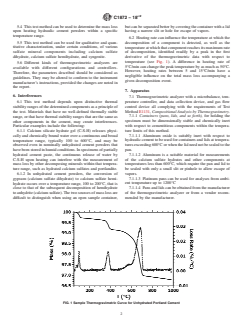
6.2 Heating rate can influence the temperature at which the
5.5 This test method can be used for qualitative and quan- decomposition of a component is detected, as well as the
titative characterization, under certain conditions, of various temperatureatwhichthatcomponentreachesitsmaximumrate
sulfate mineral components including calcium sulfate of decomposition, identified readily by a peak in the first
dihydrate, calcium sulfate hemihydrate, and syngenite. derivative of the thermogravimetric data with respect to
temperature (see Fig. 1). A difference in heating rate of
5.6 Different kinds of thermogravimetric analyzers are
5°C/min can change the peak temperature by as much as 50°C.
available with different configurations and controllers.
However, heating rates between 5 and 15°C/min have a
Therefore, the parameters described should be considered as
negligible influence on the total mass loss accompanying a
guidelines. They may be altered to conform to the instrument
given decomposition event.
manufacturer’s instructions, provided the changes are noted in
the report.
7. Apparatus
6. Interferences
7.1 Thermogravimetric analyzer with a microbalance, tem-
perature controller, and data collection device, and gas flow
6.1 This test method depends upon distinctive thermal
control device all complying with the requirements of Test
stability ranges of the determined components as a principle of
Method E1131, Compositional Analysis by Thermogravimetry.
the test. Materials that have no well-defined thermally stable
7.1.1 Containers (pans, lids, and so forth), for holding the
range, or that have thermal stability ranges that are the same as
specimen must be dimensionally stable and chemically inert
other components in the cement, may create interferences.
with respect to cementitious components within the tempera-
Particular examples include the following:
ture limits of this method.
6.1.1 Calcium silicate hydrate gel (C-S-H) releases physi-
7.1.1.1 Aluminum oxide is suitably inert with respect to
cally and chemically bound water over a continuous and broad
temperature range, typically 100 to 600°C, and may be hydraulic cement to be used for containers and lids at tempera-
turesexceeding600°Corwhenthelidneednotbesealedtothe
observed even in nominally unhydrated cement powders that
pan.
havebeenstoredinhumidconditions.Inspecimensofpartially
7.1.1.2 Aluminum is a suitable material for measurements
hydrated cement paste, the continuous release of water by
C-S-H upon heating can interfere with the measurement of of the calcium sulfate hydrates and other components at
temperatures less than 600°C, which require the pan and lid to
mass loss by other decomposing minerals within that tempera-
ture range, such as hydrated calcium sulfates and portlandite. be sealed with only a small slit or pinhole to allow escape of
6.1.2 In unhydrated cement powders, the conversion of vapors.
gypsum (calcium sulfate dihydrate) to calcium sulfate hemi- 7.1.1.3 Platinum pans can be used for analyses from ambi-
hydrate occurs over a temperature range, 100 to 200°C, that is ent temperature up to 1200°C
close to that of the subsequent decomposition of hemihydrate 7.1.1.4 Pans and lids can be obtained from the manufacturer
toanhydrite(calciumsulfate).Thetwosourcesofmasslossare of the thermogravimetric analyzer or from a vendor recom-
difficult to distinguish when using an open sample container, mended by the manufacturer.
FIG. 1 Sample Thermogravimetric Curve for Unhydrated Portland Cement
´2
C1872 − 18
8. Reagents and Materials 11.8 Initiate the user specified temperature program and
collect the data of mass and mass change versus time and
8.1 An inert compressed gas is required for this method.
temperature.Table1providestypicalmeasurementparameters.
High-purity nitrogen gas (99.99 % N ) is sufficient. High-
Consult the manufacturer’s instructions to determine optimum
purity argon or helium are also acceptable.
parameters for a specific thermogravimetric analyzer.
11.8.1 The mass loss profile shall be expressed in absolute
9. Sampling, Test Specimens, and Test Units
mass units of milligrams or grams. Expanded scale operation
9.1 Cement powders are normally analyzed as soon as
may be useful over selected temperature ranges.
possible after being received because they will tend to absorb
NOTE 2—Some instrument software may default to a normalized mass
moisture and react with carbon dioxide over time. Measuring
percentage scale based on the original sample mass. Absolute mass loss
an as-received sample provides a baseline against which
profiles can be recovered from a percentage scale if the original mass is
subsequent measurements can be compared to assess the
known.
degree of aging.
11.8.2 If only one or two components of the compositional
9.2 Typical sample masses will depend on the instrument
analysis are desired, specific, more limited temperature ranges
being used and on the specific minerals of interest. Depending
may be used. Similarly, several heating rates may be used
on the instrument being used, measurement of calcium
during analysis in those regions of greater or lesser interest.
hydroxide, syngenite, and calcium carbonate typically require
11.9 The analysis is complete when a state of constant mass
about 50 mg of cement powder, while determination of cal-
is obtained at the maximum temperature of interest.
cium sulfate hydrate content in cement often require about
100 mg of powder. Refer to the manufacturer’s instructions for 11.10 Calculate and report the sample composition (see
guidance on the optimum mass of sample. Sections 12 and 13).
10. Calibration
12. Calculation and Interpretation of Results
10.1 Calibrate the mass signal from the apparatus according
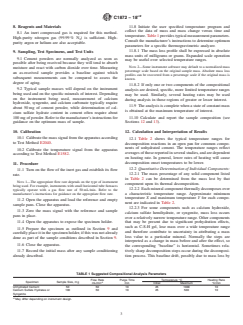
12.1 Table 2 shows the typical temperature ranges for
to Test Method E2040.
decomposition reactions in an open pan for common compo-
nents of unhydrated cement. The temperature ranges reflect
10.2 Calibrate the temperature signal from the apparatus
averagesofthosereportedinseveralstudies,andaredependent
according to Test Method E1582.
on heating rate. In general, lower rates of heating will cause
decomposition onset temperatures to be lower.
11. Procedure
12.2 Quantitative Determination of Individual Components:
11.1 Turn on the flow of the inert gas and establish its flow
12.2.1 The mass percentage of any solid component listed
rate.
in Table 2 can be determined from the mass lost by that
NOTE 1—The appropriate flow rate depends on the type of instrument
component upon its thermal decomposition.
being used. For example, instruments with small horizontal tube furnaces
12.2.2 Each mineral component thermally decomposes over
typically operate with a gas flow rate of 50 mL⁄min. Refer to the
a characteristic temperature range. Approximate minimum
manufacturer’s instructions for guidance on the appropriate flow rate.
temperature X and maximum temperature Y for each compo-
11.2 Open the apparatus and load the reference and empty
nent are indicated in Table 2.
sample pans. Close the apparatus.
12.2.3 For some components such as calcium hydroxide,
11.3 Zero the mass signal with the reference and sample
calcium sulfate hemihydrate, or syngenite, mass loss occurs
pans in place.
over a relatively narrow temperature range. Other components
11.4 Open the apparatus to expose the specimen holder.
that may be present due to significant prehydration effects,
such as C-S-H gel, lose mass over a wide temperature range
11.5 Prepare the specimen as outlined in Section 9 and
and therefore contribute to uncertainty in attributing a mass
carefully place it in the specimen holder, if this was not already
loss value to a particular mineral. Normally the steps are
done as part of the sample conditions described in Section 9.
interpreted as a change in mass before and after the effect, so
11.6 Close the apparatus.
the corresponding “baseline” is horizontal. Sometimes rela-
11.7 Record the initial mass after any sample conditioning tively sharp decomposition steps occur during the decomposi-
already described. tion process. This baseline drift, possibly due to mass loss by
TABLE 1 Suggested Compositional Analysis Parameters
Flow Rate Purge Time Temperature °C Heating Rate
Specimen Sample Size, mg
A
mL/min min Initial Maximum °C/min
Unhydrated Cement 50 50 10 25 1000 10
Calcium Sulfate Hydrates or 100 50 10 25 500 10
Syngenite
A
May differ depending on instrument design.
´2
C1872 − 18
TABLE 2 Mass and Mass Loss Per Mole of Pure, Stoichiometric Cementitious Components, With Typical Decomposition Temperature
Ranges
Temperature °C
A A
Component M g/mol C g/mol
Min (X) Max (Y)
CaSO · 0.5 H O (Bassanite) 145.1 9 90 200
4 2
CaSO ·2H O (Gypsum) 172.1 27 100 200
4 2
Mg(OH) (Brucite) 58.3 18 230 330
K Ca(SO ) ·H O (Syngenite) 328.4 18 250 300
2 4 2 2
Ca(OH) (Portlandite) 74.1 18 380 600
MgCO (Magnesite) 84.3 44 550 800
CaCO (Calcite) 100.1 44 600 1000
Ca (SiO ) CO (Spurrite) 444.6 44 700 850
5 4 2 3
A
Values of M and C assume pure mineral components.
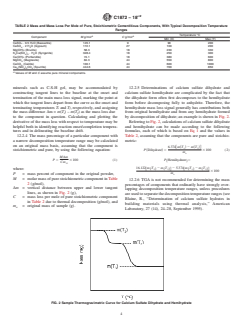
minerals such as C-S-H gel, may be accommodated by 12.2.5 Determinations of calcium sulfate dihydrate and
constructing tangent lines to the baseline at the onset and calcium sulfate hemihydrate are complicated by the fact that
termination of the main mass loss signal, marking the point at the dihydrate form often first decomposes to the hemihydrate
which the tangent lines depart from the curve as the onset and form before decomposing fully to anhydrite. Therefore, the
terminating temperatures T and T, respectively, and assigning hemihydrate mass loss signal generally has contributions both
i f
the mass difference ∆m=
...