

ASTM C1916-21
(Specification)Standard Specification for Flexible Protective Jackets Made of Modified Asphalt/Butyl Rubber for Use over Thermal Insulation
General Information
- Abstract
SCOPE
1.1 This specification addresses flexible protective jackets, made of a modified asphalt or butyl rubber sealing compound, for use over thermal insulation. The sealing compound is covered with an outer surface material. Typical applications are insulated ducts, pipe, and equipment. These materials shall be used only for outdoor or direct burial applications.
1.2 The jacket materials covered by this specification have an allowed exposure temperature range, after installation, from –25°F to 284°F (–32°C to 140°C).
1.3 This specification does not address installation methods of this jacketing material.
1.4 The values stated in inch-pound units are to be regarded as standard. The values given in parentheses are mathematical conversions to SI units that are provided for information only and are not considered standard.
1.5 This standard does not purport to address all of the safety concerns, if any, associated with its use. It is the responsibility of the user of this standard to establish appropriate safety, health, and environmental practices and determine the applicability of regulatory limitations prior to use.
1.6 This international standard was developed in accordance with internationally recognized principles on standardization established in the Decision on Principles for the Development of International Standards, Guides and Recommendations issued by the World Trade Organization Technical Barriers to Trade (TBT) Committee.
- Status
- Published
- Publication Date
- 31-Aug-2021
- Technical Committee
- C16 - Thermal Insulation
- Drafting Committee
- C16.40 - Insulation Systems

Overview
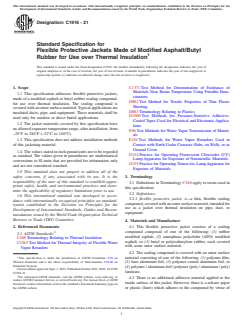
ASTM C1916-21 is the internationally recognized standard specification for flexible protective jackets made of modified asphalt or butyl rubber, covered with an outer surface material. These jackets are designed specifically for use over thermal insulation on pipes, ducts, and equipment. The specification outlines requirements for jackets intended for outdoor and direct burial applications, with an allowed exposure temperature range after installation from –25°F to 284°F (–32°C to 140°C). ASTM C1916-21 ensures the performance and durability of flexible jacketing used to safeguard insulation in demanding environmental conditions.
Key Topics
- Material Composition: Covers jackets made from rubber-modified asphalt, amorphous polyolefin (APO) modified asphalt, or butyl/polyisobutylene rubber.
- Outer Surface Material: Includes options such as polymer film, bare aluminum foil, polymer coated aluminum foil, or polymer/aluminum/polymer laminates.
- Classification: Jackets are classified by sealing method (self-sealing or heat-activated), outer surface material (four grades), sealing compound (three classes), and minimum thickness.
- Performance Requirements: Physical and performance characteristics include water vapor permeance, UV stability, tensile strength, puncture resistance, elongation, lap adhesion strength, and surface emittance.
- Quality Assurance: Specification provides for inspection, sampling, and marking for product identification and conformance.
- Testing Methods: Reference to relevant ASTM test methods, including tests for exposure, stability, strength, and insulation protection properties.
Applications
Flexible protective jackets according to ASTM C1916-21 are widely used in thermal insulation systems in industrial, commercial, and infrastructure sectors. Key practical applications include:
- Insulated Piping and Ducts: Provides an effective weather-resistant barrier to prevent moisture intrusion and mechanical damage.
- Outdoor Insulation Protection: Shields insulation from UV exposure, environmental contaminants, and physical impacts in exterior scenarios.
- Direct Burial: Offers durable protection of buried insulated pipes and equipment, resisting soil chemicals and ground movement.
- Mechanical Equipment: Suitable for use on insulated tanks, vessels, and process equipment subjected to temperature fluctuations and outdoor exposure.
- Retrofit and Repair: Ideal for both new installations and the repair or replacement of jacketing in existing insulation systems.
By specifying jackets that meet ASTM C1916-21, users ensure that their thermal insulation systems maintain performance integrity and extended service life in harsh conditions.
Related Standards
ASTM C1916-21 references and is closely linked to several other ASTM standards critical to insulation and protective jacketing:
- ASTM C168: Terminology Relating to Thermal Insulation
- ASTM C1263: Test Method for Thermal Integrity of Flexible Water Vapor Retarders
- ASTM C1371: Test Method for Determination of Emittance of Materials Near Room Temperature Using Portable Emissometers
- ASTM D882: Test Method for Tensile Properties of Thin Plastic Sheeting
- ASTM D1000: Test Methods for Pressure-Sensitive Adhesive-Coated Tapes for Electrical and Electronic Applications
- ASTM E96: Test Methods for Water Vapor Transmission of Materials
- ASTM E154: Test Methods for Water Vapor Retarders Used in Contact with Earth Under Concrete Slabs, on Walls, or as Ground Cover
- ASTM G154/G155: Practices for Operating Fluorescent UV and Xenon Arc Lamp Apparatus for Exposure of Nonmetallic Materials
These related standards support rigorous material qualification, installation, and system integrity for flexible jacketing in insulation applications. By adhering to ASTM C1916-21 and associated references, specifiers and installers achieve reliable, long-term protection for insulated systems exposed to challenging environments.
Keywords: ASTM C1916-21, flexible protective jackets, modified asphalt, butyl rubber, thermal insulation, outdoor insulation protection, direct burial, UV stable, composite membrane, sealing compound.
Relations
- Effective Date
- 15-Apr-2024
- Effective Date
- 01-Feb-2024
- Effective Date
- 01-Nov-2023
- Effective Date
- 01-Jan-2020
- Effective Date
- 01-Aug-2019
- Effective Date
- 15-Apr-2019
- Effective Date
- 01-Feb-2019
- Effective Date
- 01-Dec-2018
- Effective Date
- 01-Nov-2018
- Effective Date
- 15-Apr-2018
- Effective Date
- 15-Aug-2017
- Effective Date
- 01-Jul-2017
- Effective Date
- 01-Jun-2017
- Effective Date
- 15-Oct-2015
- Effective Date
- 01-Jun-2015
Get Certified
Connect with accredited certification bodies for this standard

DIBt (Deutsches Institut für Bautechnik)
German Institute for Building Technology.
DIN CERTCO
DIN Group product certification.

Aboma Certification B.V.
Specialized in construction, metal, and transport sectors.
Sponsored listings
Frequently Asked Questions
ASTM C1916-21 is a technical specification published by ASTM International. Its full title is "Standard Specification for Flexible Protective Jackets Made of Modified Asphalt/Butyl Rubber for Use over Thermal Insulation". This standard covers: SCOPE 1.1 This specification addresses flexible protective jackets, made of a modified asphalt or butyl rubber sealing compound, for use over thermal insulation. The sealing compound is covered with an outer surface material. Typical applications are insulated ducts, pipe, and equipment. These materials shall be used only for outdoor or direct burial applications. 1.2 The jacket materials covered by this specification have an allowed exposure temperature range, after installation, from –25°F to 284°F (–32°C to 140°C). 1.3 This specification does not address installation methods of this jacketing material. 1.4 The values stated in inch-pound units are to be regarded as standard. The values given in parentheses are mathematical conversions to SI units that are provided for information only and are not considered standard. 1.5 This standard does not purport to address all of the safety concerns, if any, associated with its use. It is the responsibility of the user of this standard to establish appropriate safety, health, and environmental practices and determine the applicability of regulatory limitations prior to use. 1.6 This international standard was developed in accordance with internationally recognized principles on standardization established in the Decision on Principles for the Development of International Standards, Guides and Recommendations issued by the World Trade Organization Technical Barriers to Trade (TBT) Committee.
SCOPE 1.1 This specification addresses flexible protective jackets, made of a modified asphalt or butyl rubber sealing compound, for use over thermal insulation. The sealing compound is covered with an outer surface material. Typical applications are insulated ducts, pipe, and equipment. These materials shall be used only for outdoor or direct burial applications. 1.2 The jacket materials covered by this specification have an allowed exposure temperature range, after installation, from –25°F to 284°F (–32°C to 140°C). 1.3 This specification does not address installation methods of this jacketing material. 1.4 The values stated in inch-pound units are to be regarded as standard. The values given in parentheses are mathematical conversions to SI units that are provided for information only and are not considered standard. 1.5 This standard does not purport to address all of the safety concerns, if any, associated with its use. It is the responsibility of the user of this standard to establish appropriate safety, health, and environmental practices and determine the applicability of regulatory limitations prior to use. 1.6 This international standard was developed in accordance with internationally recognized principles on standardization established in the Decision on Principles for the Development of International Standards, Guides and Recommendations issued by the World Trade Organization Technical Barriers to Trade (TBT) Committee.
ASTM C1916-21 is classified under the following ICS (International Classification for Standards) categories: 91.100.60 - Thermal and sound insulating materials. The ICS classification helps identify the subject area and facilitates finding related standards.
ASTM C1916-21 has the following relationships with other standards: It is inter standard links to ASTM C168-24, ASTM D883-24, ASTM D883-23, ASTM D883-20, ASTM D883-19c, ASTM D883-19a, ASTM D883-19, ASTM D883-18a, ASTM D883-18, ASTM C168-18, ASTM D883-17, ASTM D1000-17, ASTM C168-17, ASTM C168-15a, ASTM C168-15. Understanding these relationships helps ensure you are using the most current and applicable version of the standard.
ASTM C1916-21 is available in PDF format for immediate download after purchase. The document can be added to your cart and obtained through the secure checkout process. Digital delivery ensures instant access to the complete standard document.
Standards Content (Sample)
This international standard was developed in accordance with internationally recognized principles on standardization established in the Decision on Principles for the
Development of International Standards, Guides and Recommendations issued by the World Trade Organization Technical Barriers to Trade (TBT) Committee.
Designation:C1916 −21
Standard Specification for
Flexible Protective Jackets Made of Modified Asphalt/Butyl
Rubber for Use over Thermal Insulation
This standard is issued under the fixed designation C1916; the number immediately following the designation indicates the year of
original adoption or, in the case of revision, the year of last revision. A number in parentheses indicates the year of last reapproval. A
superscript epsilon (´) indicates an editorial change since the last revision or reapproval.
1. Scope C1371 Test Method for Determination of Emittance of
Materials Near Room Temperature Using Portable Emis-
1.1 This specification addresses flexible protective jackets,
someters
made of a modified asphalt or butyl rubber sealing compound,
D882 Test Method for Tensile Properties of Thin Plastic
for use over thermal insulation. The sealing compound is
Sheeting
coveredwithanoutersurfacematerial.Typicalapplicationsare
D883 Terminology Relating to Plastics
insulated ducts, pipe, and equipment. These materials shall be
D1000 Test Methods for Pressure-Sensitive Adhesive-
used only for outdoor or direct burial applications.
Coated Tapes Used for Electrical and Electronic Applica-
1.2 The jacket materials covered by this specification have
tions
an allowed exposure temperature range, after installation, from
E96 Test Methods for Water Vapor Transmission of Materi-
–25°F to 284°F (–32°C to 140°C).
als
E154 Test Methods for Water Vapor Retarders Used in
1.3 This specification does not address installation methods
of this jacketing material. Contact with Earth Under Concrete Slabs, on Walls, or as
Ground Cover
1.4 The values stated in inch-pound units are to be regarded
G154 Practice for Operating Fluorescent Ultraviolet (UV)
as standard. The values given in parentheses are mathematical
Lamp Apparatus for Exposure of Nonmetallic Materials
conversions to SI units that are provided for information only
G155 Practice for Operating XenonArc LampApparatus for
and are not considered standard.
Exposure of Materials
1.5 This standard does not purport to address all of the
3. Terminology
safety concerns, if any, associated with its use. It is the
responsibility of the user of this standard to establish appro-
3.1 Definitions in Terminology C168 apply to terms used in
priate safety, health, and environmental practices and deter-
this specification.
mine the applicability of regulatory limitations prior to use.
3.2 Definitions:
1.6 This international standard was developed in accor-
3.2.1 flexible protective jacket, n—a thin, flexible sealing
dance with internationally recognized principles on standard-
compound,coveredwithanoutersurfacematerial,intendedfor
ization established in the Decision on Principles for the
use as a jacket over thermal insulation on pipe, duct, or
Development of International Standards, Guides and Recom-
equipment.
mendations issued by the World Trade Organization Technical
Barriers to Trade (TBT) Committee.
4. Materials and Manufacture
2. Referenced Documents
4.1 This flexible protective jacket consists of a sealing
2 compound composed of one of the following: (1) rubber
2.1 ASTM Standards:
modified asphalt, (2) amorphous polyolefin (APO) modified
C168 Terminology Relating to Thermal Insulation
asphalt, or (3) butyl or polyisobutylene rubber, each covered
C1263 Test Method for Thermal Integrity of Flexible Water
with some outer surface material.
Vapor Retarders
4.2 The sealing compound is covered with an outer surface
material consisting of one of the following: (1) polymer film,
This specification is under the jurisdiction of ASTM Committee C16 on
Thermal Insulation and is the direct responsibility of Subcommittee C16.40 on
(2) bare aluminum foil, (3) polymer coated aluminum foil, or
Insulation Systems.
(4)polymer/aluminumfoil/polymer(poly/aluminum/poly)
Current edition approved Sept. 1, 2021. Published October 2021. DOI: 10.1520/
laminate.
C1916-21.
For referenced ASTM standards, visit the ASTM website, www.astm.org, or
4.3 There is no additional adhesive material applied to the
contact ASTM Customer Service at service@astm.org. For Annual Book of ASTM
inside surface of this jacket. However, there is a release paper
Standards volume information, refer to the standard’s Document Summary page on
the ASTM website. or plastic (liner) which adheres to the compound by virtue of
Copyright © ASTM International, 100 Barr Harbor Drive, PO Box C700, West Conshohocken, PA 19428-2959. United States
C1916−21
the tackiness of that material. The release paper or plastic film 5.1.3 Sealing Compound Material:
(liner) is a disposable material, normally removed during 5.1.3.1 Class A: Rubber modified asphalt compound
installation. It must first be removed for all performance tests. 5.1.3.2 Class B: Amorphous polyolefin (APO) modified
asphalt compound
5. Classification
5.1.3.3 Class C: Butyl or polyisobutylene (PIB) compound
5.1.4 Composite Material Thickness, minimum:
5.1 Classification of this jacketing is based on three factors
5.1.4.1 Thickness 1: 0.026 in. (0.66 mm)
that determine its Type, Grade, Class, and Material Thickness.
5.1.4.2 Thickness 2: 0.043 in. (1.1 mm)
Type differentiates the sealing method (Type I and II), Grade
5.1.4.3 Thickness 3: 0.066 in. (1.687 mm)
differentiates the outer surface material (Grade 1 through 4),
5.1.4.4 Thickness 4: 0.120 in. (3 mm)
and Class differentiates the sealing compound material (Class
A, B, or C).
6. Physical and Performance Characteristics
5.1.1 Sealing Method:
6.1 For Type I materials, Grade 2 and 3 materials only,
5.1.1.1 Type I: Self-Sealing
measure and report the total hemispherical emittance of the
5.1.1.2 Type II: Heat Activated (sometimes referred to as
outer surface. For other materials, there is no requirement to
“torch applied”)
measure and report outer surface emittance.
5.1.2 Outer Surface Material:
5.1.2.1 Grade 1: Polymer film only
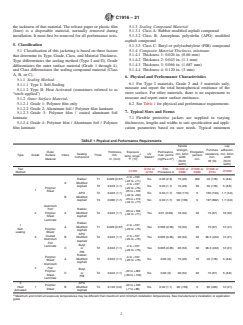
6.2 See Table 1 for physical and performance requirements.
5.1.2.2 Grade 2: Aluminum foil / Polymer film laminate
7. Typical Sizes and Forms
5.1.2.3 Grade 3: Polymer film / coated aluminum foil
laminate 7.1 Flexible protective jackets are supplied in varying
5.1.2.4 Grade 4: Polymer film / Aluminum foil / Polymer thicknesses, lengths and widths to suit specification and appli-
film laminate cation parameters based on user needs. Typical minimum
TABLE 1 Physical and Performance Requirements
Tensile Lap
strength, Puncture adhesion,
Outer Thickness, Permeance, Elongation,
Exposure
Sealing UV min. lbf/in. resistance, min. lbf/in.
A
Type Grade Surface Class Thick. min. max. perms percent
temp range
Compound Stable? width min. width
°F (°C)
Material in. (mm) (ng/Pa·s·m ) min.
(N/cm lbf (N) (N/cm
width) width)
Test G154 or E96, D1000 or D1000 or D1000 or
C1263 D1000
Method G155 Procedure A D882 D883 E154
-4 to +160
T1 0.026 (0.67) No 0.05 (2.9) 15 (26) 200 40 (178) 5 (8.8)
Rubber
(-20 to +71)
A Modified
-4 to +167
Asphalt
T2 0.043 (1.1) No 0.03 (1.7) 15 (26) 30 40 (178) 5 (8.8)
Polymer (-20 to +75)
Sheet -25 to +140
APO T2 0.043 (1.1) No 0.03 (1.7
...