

ASTM D226/D226M-17(2023)
(Specification)Standard Specification for Asphalt-Saturated Organic Felt Used in Roofing and Waterproofing
General Information
- Abstract
ABSTRACT
This specification covers asphalt-saturated organic felt used in roofing and waterproofing. Two types of asphalt-saturated felts are presented: type I - commonly called No. 15 asphalt felt, and type II - commonly called No. 30 asphalt felt. In the process of manufacture a single thickness of dry felt shall be saturated with an asphaltic saturant. The methods for the determination of openness of the perforations in saturated felts are presented in detail.
SCOPE
1.1 This specification covers asphalt-saturated organic felts, with or without perforations, intended to be used with asphalts conforming to the requirements of Specification D312/D312M in the construction of built-up roofs, and with asphalts conforming to the requirements of Specification D449/D449M in the construction of water proofing systems.
1.2 The values stated in either SI units or inch-pound units are to be regarded separately as standard. The values stated in each system may not be exact equivalents; therefore, each system shall be used independently of the other. Combining values from the two systems may result in non-conformance with the standard.
1.3 The following safety hazards caveat pertains only to the test method portion, Section 8, of this specification: This standard does not purport to address all of the safety concerns, if any, associated with its use. It is the responsibility of the user of this standard to establish appropriate safety, health, and environmental practices and determine the applicability of regulatory limitations prior to use.
1.4 This international standard was developed in accordance with internationally recognized principles on standardization established in the Decision on Principles for the Development of International Standards, Guides and Recommendations issued by the World Trade Organization Technical Barriers to Trade (TBT) Committee.
- Status
- Published
- Publication Date
- 31-Jan-2023
- Technical Committee
- D08 - Roofing and Waterproofing
- Drafting Committee
- D08.02 - Steep Roofing Products and Assemblies


Overview
ASTM D226/D226M-17(2023) is an internationally recognized standard issued by ASTM that specifies requirements for asphalt-saturated organic felt used in roofing and waterproofing applications. This standard covers both perforated and non-perforated organic felts, designed for use with asphalts conforming to ASTM D312/D312M for roofing and ASTM D449/D449M for waterproofing. Two main types of felts are included: Type I (No. 15 asphalt felt) and Type II (No. 30 asphalt felt), both widely used in the construction industry for built-up roofing systems and moisture barriers.
Key Topics
Materials and Types
- Type I: Commonly known as No. 15 asphalt felt, generally lighter and used as an underlayment.
- Type II: Known as No. 30 asphalt felt, offering higher strength and thickness for demanding applications.
- Manufactured by saturating a single thickness of organic felt with an asphaltic saturant, using primarily organic fibers.
Physical and Performance Requirements
- Specific minimum strength requirements are defined for breaking strength, pliability, moisture content, and mass.
- Felts must be free of visible defects and must show uniformity in saturation, ensuring reliable performance in roofing and waterproofing.
- Laying lines may be included for proper installation alignment, and splices or manufacturing joints are limited to maintain quality.
Unit Systems
- Specifications are provided in both SI (metric) and inch-pound (imperial) units, ensuring global applicability. Each measurement system must be used independently.
Perforated vs. Non-Perforated Felts
- Perforated felts are designed with regularly spaced holes to aid in venting moisture, particularly useful in certain waterproofing systems or hot-applied materials.
Applications
Asphalt-saturated organic felt specified by ASTM D226/D226M is used primarily in:
Built-up Roofing Systems
- Acts as a key component in multi-ply roofing, providing strength, flexibility, and a barrier to moisture.
- Compatible with hot-applied roofing asphalts per ASTM D312/D312M, ensuring secure adhesion and long-lasting protection.
Waterproofing Systems
- Used as a moisture barrier in walls, under concrete slabs, or other structural applications where water intrusion needs to be prevented.
- Suitable for use with bitumen and asphalt per ASTM D449/D449M for dampproofing and various below-grade applications.
Underlayment
- Serves as a secondary protective layer under shingles or other roofing materials, safeguarding the structure from leaks and environmental damage.
Related Standards
- ASTM D312/D312M - Specification for asphalt used in roofing, referenced for compatibility in manufactured systems.
- ASTM D449/D449M - Specification for asphalts used in waterproofing and dampproofing applications.
- ASTM D146/D146M - Test methods for evaluating bitumen-saturated felts, including mechanical strength and absorption.
- ASTM D1079 - Terminology relating to roofing and waterproofing, ensuring consistency across standards.
- ASTM D70/D70M - Test method for determining specific gravity and density of asphalt binders.
- ASTM D6136/D6136M - Test method for assessing the kerosine number of dry felt, used for quality control in felt manufacture.
Practical Value
By adhering to ASTM D226/D226M-17(2023), manufacturers, contractors, and specifiers ensure that asphalt-saturated organic felt materials meet internationally recognized requirements for strength, durability, and compatibility with standardized asphalts. This standard promotes safety, reliability, and longevity in roofing and waterproofing systems, offering proven methods for both product evaluation and quality assurance. Using compliant products helps mitigate the risk of water damage, structural failure, and maintenance costs in both residential and commercial construction projects.
For more information and to download the official ASTM D226/D226M-17(2023) standard, visit ASTM International.
Relations
- Effective Date
- 01-May-2020
- Effective Date
- 15-Dec-2018
- Effective Date
- 15-Dec-2018
- Effective Date
- 01-May-2016
- Effective Date
- 01-Feb-2016
- Effective Date
- 01-Feb-2015
- Effective Date
- 01-Mar-2013
- Effective Date
- 01-Mar-2013
- Effective Date
- 01-Jan-2013
- Effective Date
- 01-Sep-2010
- Effective Date
- 01-Jul-2009
- Effective Date
- 01-Feb-2008
- Effective Date
- 01-Jan-2008
- Effective Date
- 01-Jun-2007
- Effective Date
- 15-Jan-2007
Get Certified
Connect with accredited certification bodies for this standard

DIBt (Deutsches Institut für Bautechnik)
German Institute for Building Technology.
DIN CERTCO
DIN Group product certification.

Aboma Certification B.V.
Specialized in construction, metal, and transport sectors.
Sponsored listings
Frequently Asked Questions
ASTM D226/D226M-17(2023) is a technical specification published by ASTM International. Its full title is "Standard Specification for Asphalt-Saturated Organic Felt Used in Roofing and Waterproofing". This standard covers: ABSTRACT This specification covers asphalt-saturated organic felt used in roofing and waterproofing. Two types of asphalt-saturated felts are presented: type I - commonly called No. 15 asphalt felt, and type II - commonly called No. 30 asphalt felt. In the process of manufacture a single thickness of dry felt shall be saturated with an asphaltic saturant. The methods for the determination of openness of the perforations in saturated felts are presented in detail. SCOPE 1.1 This specification covers asphalt-saturated organic felts, with or without perforations, intended to be used with asphalts conforming to the requirements of Specification D312/D312M in the construction of built-up roofs, and with asphalts conforming to the requirements of Specification D449/D449M in the construction of water proofing systems. 1.2 The values stated in either SI units or inch-pound units are to be regarded separately as standard. The values stated in each system may not be exact equivalents; therefore, each system shall be used independently of the other. Combining values from the two systems may result in non-conformance with the standard. 1.3 The following safety hazards caveat pertains only to the test method portion, Section 8, of this specification: This standard does not purport to address all of the safety concerns, if any, associated with its use. It is the responsibility of the user of this standard to establish appropriate safety, health, and environmental practices and determine the applicability of regulatory limitations prior to use. 1.4 This international standard was developed in accordance with internationally recognized principles on standardization established in the Decision on Principles for the Development of International Standards, Guides and Recommendations issued by the World Trade Organization Technical Barriers to Trade (TBT) Committee.
ABSTRACT This specification covers asphalt-saturated organic felt used in roofing and waterproofing. Two types of asphalt-saturated felts are presented: type I - commonly called No. 15 asphalt felt, and type II - commonly called No. 30 asphalt felt. In the process of manufacture a single thickness of dry felt shall be saturated with an asphaltic saturant. The methods for the determination of openness of the perforations in saturated felts are presented in detail. SCOPE 1.1 This specification covers asphalt-saturated organic felts, with or without perforations, intended to be used with asphalts conforming to the requirements of Specification D312/D312M in the construction of built-up roofs, and with asphalts conforming to the requirements of Specification D449/D449M in the construction of water proofing systems. 1.2 The values stated in either SI units or inch-pound units are to be regarded separately as standard. The values stated in each system may not be exact equivalents; therefore, each system shall be used independently of the other. Combining values from the two systems may result in non-conformance with the standard. 1.3 The following safety hazards caveat pertains only to the test method portion, Section 8, of this specification: This standard does not purport to address all of the safety concerns, if any, associated with its use. It is the responsibility of the user of this standard to establish appropriate safety, health, and environmental practices and determine the applicability of regulatory limitations prior to use. 1.4 This international standard was developed in accordance with internationally recognized principles on standardization established in the Decision on Principles for the Development of International Standards, Guides and Recommendations issued by the World Trade Organization Technical Barriers to Trade (TBT) Committee.
ASTM D226/D226M-17(2023) is classified under the following ICS (International Classification for Standards) categories: 91.100.50 - Binders. Sealing materials. The ICS classification helps identify the subject area and facilitates finding related standards.
ASTM D226/D226M-17(2023) has the following relationships with other standards: It is inter standard links to ASTM D1079-20, ASTM D1079-18e1, ASTM D1079-18, ASTM D312/D312M-16, ASTM D1079-16, ASTM D312/D312M-15, ASTM D1079-13e1, ASTM D1079-13, ASTM D6136/D6136M-97(2013)e1, ASTM D1079-10, ASTM D1079-09, ASTM D1079-08a, ASTM D1079-08, ASTM D1079-07a, ASTM D1079-07. Understanding these relationships helps ensure you are using the most current and applicable version of the standard.
ASTM D226/D226M-17(2023) is available in PDF format for immediate download after purchase. The document can be added to your cart and obtained through the secure checkout process. Digital delivery ensures instant access to the complete standard document.
Standards Content (Sample)
This international standard was developed in accordance with internationally recognized principles on standardization established in the Decision on Principles for the
Development of International Standards, Guides and Recommendations issued by the World Trade Organization Technical Barriers to Trade (TBT) Committee.
Designation: D226/D226M − 17 (Reapproved 2023)
Standard Specification for
Asphalt-Saturated Organic Felt Used in Roofing and
Waterproofing
This standard is issued under the fixed designation D226/D226M; the number immediately following the designation indicates the year
of original adoption or, in the case of revision, the year of last revision. A number in parentheses indicates the year of last reapproval.
A superscript epsilon (´) indicates an editorial change since the last revision or reapproval.
This standard has been approved for use by agencies of the U.S. Department of Defense.
1. Scope D146/D146M Test Methods for Sampling and Testing
Bitumen-Saturated Felts and Woven Fabrics for Roofing
1.1 This specification covers asphalt-saturated organic felts,
and Waterproofing
with or without perforations, intended to be used with asphalts
D312/D312M Specification for Asphalt Used in Roofing
conforming to the requirements of Specification D312/D312M
D449/D449M Specification for Asphalt Used in Dampproof-
in the construction of built-up roofs, and with asphalts con-
ing and Waterproofing
forming to the requirements of Specification D449/D449M in
D1079 Terminology Relating to Roofing and Waterproofing
the construction of water proofing systems.
D6136/D6136M Test Method for Kerosine Number of Un-
1.2 The values stated in either SI units or inch-pound units
saturated (Dry) Felt by Vacuum Method
are to be regarded separately as standard. The values stated in
each system may not be exact equivalents; therefore, each
3. Terminology
system shall be used independently of the other. Combining
3.1 Definitions—For definitions of terms used in this
values from the two systems may result in non-conformance
specification, refer to Terminology D1079.
with the standard.
1.3 The following safety hazards caveat pertains only to the
4. Classification
test method portion, Section 8, of this specification: This
4.1 Asphalt-saturated felts covered by this specification are
standard does not purport to address all of the safety concerns,
of two types:
if any, associated with its use. It is the responsibility of the user
4.1.1 Type I—Commonly called No. 15 asphalt felt.
of this standard to establish appropriate safety, health, and
4.1.2 Type II—Commonly called No. 30 asphalt felt.
environmental practices and determine the applicability of
regulatory limitations prior to use.
5. Materials and Manufacture
1.4 This international standard was developed in accor-
dance with internationally recognized principles on standard-
5.1 In the process of manufacture a single thickness of dry
ization established in the Decision on Principles for the
felt shall be saturated with an asphaltic saturant.
Development of International Standards, Guides and Recom-
5.2 The felt shall be produced principally from organic
mendations issued by the World Trade Organization Technical
fibers. The surface of the felt shall be uniform and relatively
Barriers to Trade (TBT) Committee.
smooth. Upon splitting or tearing on the bias, the felt shall
appear reasonably free of lumps or particles of foreign sub-
2. Referenced Documents
stances.
2.1 ASTM Standards:
D70/D70M Test Method for Specific Gravity and Density of
6. Physical Requirements
Semi-Solid Asphalt Binder (Pycnometer Method)
6.1 The material shall conform to the physical requirements
prescribed in Table 1 and the dimensions and masses pre-
This specification is under the jurisdiction of ASTM Committee D08 on
scribed in Table 2.
Roofing and Waterproofing and is the direct responsibility of Subcommittee D08.02
on Steep Roofing Products and Assemblies.
6.2 The finished product shall not crack nor be so sticky as
Current edition approved Feb. 1, 2023. Published February 2023. Originally
to cause tearing or other damage upon being unrolled at
approved in 1925. Last previous edition approved in 2017 as D226/D226M – 17.
temperatures between 10 °C and 60 °C [50 °F and 140 °F].
DOI: 10.1520/D0226_D0226M-17R23.
For referenced ASTM standards, visit the ASTM website, www.astm.org, or
6.3 Perforated felts shall conform to the same requirements
contact ASTM Customer Service at service@astm.org. For Annual Book of ASTM
as the plain type but shall also have uniformly spaced perfo-
Standards volume information, refer to the standard’s Document Summary page on
the ASTM website. rations.
Copyright © ASTM International, 100 Barr Harbor Drive, PO Box C700, West Conshohocken, PA 19428-2959. United States
D226/D226M − 17 (2023)
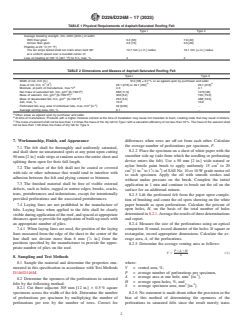
TABLE 1 Physical Requirements of Asphalt-Saturated Roofing Felt
Type I Type II
Average breaking strength, min, kN/m [lbf/in.] of width:
With fiber grain 5.3 [30] 7.0 [40]
Across fiber grain 2.6 [15] 3.5 [20]
Pliability at 25 °C [77 °F]
1 3
The ten strips tested shall not crack when bent 90° 12.7 mm [ ⁄2 in.] radius 19.1 mm [ ⁄4 in.] radius
at a uniform speed over a rounded corner of:
Loss on heating at 105 °C [221 °F] for 5 h, max, % 4 4
TABLE 2 Dimensions and Masses of Asphalt-Saturated Roofing Felt
Type I Type II
Width of roll, mm [in.] 914 [36] ± 0.7 % or as agreed upon by purchaser and seller
2 2 A A
Area of roll, min, m [ft ] 20.1 [216] or 40.1 [432] 20.1 [216]
B
Moisture, at point of manufacture, max % 4.3 4.1
2 2
Net mass of saturated felt, min, g/m [lb ⁄100 ft ] 560 [11.5] 1270 [26]
2 2 C
Mass of saturant, min, g/m [lb ⁄100 ft ] 303 [6.2] 732 [15.0]
2 2
Mass of desaturated felt, min, g/m [lb ⁄100 ft ] 254 [5.2] 488 [10.0]
Ash, max, % 10.0 10.0
2 2
Perforated felt, avg, area of individual hole, max, mm [in. ] 32 [0.05] .
Average venting area, min, % 0.1 .
A
Other areas as agreed upon by purchaser and seller.
B
At time of manufacture. Products with a higher moisture content at the time of installation may cause hot materials to foam, creating voids that may result in blisters.
C
The mass of saturant shall not be less than 1.2 times the mass of the dry felt for Type I with a saturation efficiency of not less than 70 %. The mass of the saturant shall
not be less than 1.50 times the mass of dry felt for Type II.
7. Workmanship, Finish, and Appearance differences when rows are off-set from each other. Calculate
the average number of perforations per specimen, P.
7.1 The felt shall be thoroughly and uniformly saturated,
8.2.2 Place the specimen on a sheet of white paper with the
and shall show no unsaturated spots at any point upon cutting
smoother side up (side from which the needling or perforating
50 mm [2 in.] wide strips at r
...