

ASTM D4828-94(2020)
(Test Method)Standard Test Methods for Practical Washability of Organic Coatings
General Information
- Abstract
SIGNIFICANCE AND USE
4.1 Interior architectural paints are subjected in use to soiling by dirt or other stains. This test method provides a way to assess relative ease of soil or stain removal from a paint film using materials common to households. This test method includes a way to evaluate the film for washability properties and changes in appearance. Thus, a formulator may evaluate the effects of composition on the washability properties of a paint. Users may also compare the ease of soil removal from different paints that are tested, preferably at the same time.
SCOPE
1.1 These test methods cover the determination of the relative ease of removal of common soil and stains from interior coatings by manual or mechanical washing with a sponge and a liquid or powder cleanser.
1.2 The values stated in SI units are to be regarded as the standard. The values given in parentheses are for information only.
1.3 This standard does not purport to address all of the safety concerns, if any, associated with its use. It is the responsibility of the user of this standard to establish appropriate safety, health, and environmental practices and determine the applicability of regulatory limitations prior to use.
1.4 This international standard was developed in accordance with internationally recognized principles on standardization established in the Decision on Principles for the Development of International Standards, Guides and Recommendations issued by the World Trade Organization Technical Barriers to Trade (TBT) Committee.
- Status
- Published
- Publication Date
- 30-Nov-2020
- Technical Committee
- D01 - Paint and Related Coatings, Materials, and Applications
- Drafting Committee
- D01.42 - Architectural Coatings
Overview
ASTM D4828-94(2020) - Standard Test Methods for Practical Washability of Organic Coatings sets out procedures to assess the ease of removal of common soils and stains from interior architectural coatings, including paints. This standard provides a reliable and practical method for evaluating the washability properties of organic coatings and any resulting changes in appearance, using materials and techniques commonly found in household environments. It serves both paint formulators and end users by delivering consistent, comparative data on stain resistance and cleansability.
Key Topics
- Washability Testing: Measures how readily stains and dirt can be removed from painted or coated surfaces using either manual or mechanical washing, typically with a sponge and common liquid or powder cleansers.
- Assessment of Appearance: Evaluates not just the removal of stains, but also changes in gloss, color, and surface erosion after washing, providing a holistic view of coating durability.
- Standardized Procedures: Ensures repeatable and reliable results through detailed specifications on preparation, application of stains, washing methods, and criteria for evaluating results.
- Household Relevance: Uses soils and stains typical of residential environments (such as pencil, crayon, lipstick, and markers), and cleaning agents commonly available to consumers.
- Test Conditions: Specifies environmental controls and consistent washing cycles (up to 100 cycles), making cross-comparisons between different products valid and meaningful.
Applications
ASTM D4828-94(2020) practical washability test methods are widely used throughout the paint and coatings industry, including:
- Product Development: Paint manufacturers and formulators utilize this standard to test new formulations, optimize compositions, and improve the stain resistance and cleanability of their interior coatings.
- Quality Assurance: Evaluates batch-to-batch consistency and ensures that paints meet minimum washability performance standards before reaching the market.
- Comparative Product Testing: Provides a basis for comparing the performance of different interior paints under identical conditions, assisting both professionals and consumers in making informed choices.
- Specification and Procurement: Architects, builders, and facility managers use the data from this test to specify coatings that meet required durability and maintenance criteria for residential, commercial, and institutional spaces.
- Regulatory Compliance and Marketing: Demonstrates compliance with performance claims related to cleansability and stain resistance, supporting labeling and product certification.
Related Standards
For comprehensive evaluation of coatings, ASTM D4828-94(2020) references and complements several other standards:
- ASTM D3450 - Test Method for Washability Properties of Interior Architectural Coatings: Details related procedures for evaluating the abrasion resistance of painted surfaces.
- ASTM D1193 - Specification for Reagent Water: Defines the purity of water required for testing and cleaning operations within the method.
- ASTM D3924 - Specification for Standard Environment for Conditioning and Testing Paint, Varnish, Lacquer, and Related Materials: Provides environmental controls to ensure consistency in test results.
- Other Relevant Standards: Consideration of additional ASTM or ISO standards concerning paint performance and durability testing may further enhance product evaluation and comparison.
By following ASTM D4828-94(2020), users gain a practical and internationally recognized approach to examining the durability and maintenance attributes of architectural coatings, supporting higher quality in products and greater satisfaction in end-use performance. These methods are essential tools for any organization concerned with the manufacture, selection, or implementation of interior paints and finishes in environments requiring regular cleaning and stain removal.
Keywords: washability, stain resistance, cleansability, paint testing, organic coatings, ASTM D4828, interior coatings, architectural paints, wet abrasion resistance, household stains.
Relations
- Effective Date
- 01-Apr-2016
- Effective Date
- 01-Jun-2011
- Effective Date
- 01-Jun-2010
- Effective Date
- 01-Jun-2010
- Effective Date
- 01-Mar-2006
- Effective Date
- 15-May-2005
- Effective Date
- 01-Feb-2005
- Refers
ASTM D3450-00 - Standard Test Method for Washability Properties of Interior Architectural Coatings - Effective Date
- 10-Mar-2000
- Effective Date
- 10-Feb-1999
- Effective Date
- 10-Feb-1999
- Effective Date
- 01-Jan-1996
Get Certified
Connect with accredited certification bodies for this standard

DVS-ZERT GmbH
German welding certification society.
CARES (UK Certification Authority for Reinforcing Steels)
UK certification for reinforcing steels and construction.
EWF/IIW (European/International Welding Federation)
International welding personnel certification.
Sponsored listings
Frequently Asked Questions
ASTM D4828-94(2020) is a standard published by ASTM International. Its full title is "Standard Test Methods for Practical Washability of Organic Coatings". This standard covers: SIGNIFICANCE AND USE 4.1 Interior architectural paints are subjected in use to soiling by dirt or other stains. This test method provides a way to assess relative ease of soil or stain removal from a paint film using materials common to households. This test method includes a way to evaluate the film for washability properties and changes in appearance. Thus, a formulator may evaluate the effects of composition on the washability properties of a paint. Users may also compare the ease of soil removal from different paints that are tested, preferably at the same time. SCOPE 1.1 These test methods cover the determination of the relative ease of removal of common soil and stains from interior coatings by manual or mechanical washing with a sponge and a liquid or powder cleanser. 1.2 The values stated in SI units are to be regarded as the standard. The values given in parentheses are for information only. 1.3 This standard does not purport to address all of the safety concerns, if any, associated with its use. It is the responsibility of the user of this standard to establish appropriate safety, health, and environmental practices and determine the applicability of regulatory limitations prior to use. 1.4 This international standard was developed in accordance with internationally recognized principles on standardization established in the Decision on Principles for the Development of International Standards, Guides and Recommendations issued by the World Trade Organization Technical Barriers to Trade (TBT) Committee.
SIGNIFICANCE AND USE 4.1 Interior architectural paints are subjected in use to soiling by dirt or other stains. This test method provides a way to assess relative ease of soil or stain removal from a paint film using materials common to households. This test method includes a way to evaluate the film for washability properties and changes in appearance. Thus, a formulator may evaluate the effects of composition on the washability properties of a paint. Users may also compare the ease of soil removal from different paints that are tested, preferably at the same time. SCOPE 1.1 These test methods cover the determination of the relative ease of removal of common soil and stains from interior coatings by manual or mechanical washing with a sponge and a liquid or powder cleanser. 1.2 The values stated in SI units are to be regarded as the standard. The values given in parentheses are for information only. 1.3 This standard does not purport to address all of the safety concerns, if any, associated with its use. It is the responsibility of the user of this standard to establish appropriate safety, health, and environmental practices and determine the applicability of regulatory limitations prior to use. 1.4 This international standard was developed in accordance with internationally recognized principles on standardization established in the Decision on Principles for the Development of International Standards, Guides and Recommendations issued by the World Trade Organization Technical Barriers to Trade (TBT) Committee.
ASTM D4828-94(2020) is classified under the following ICS (International Classification for Standards) categories: 25.220.60 - Organic coatings. The ICS classification helps identify the subject area and facilitates finding related standards.
ASTM D4828-94(2020) has the following relationships with other standards: It is inter standard links to ASTM D3924-16, ASTM D3924-80(2011), ASTM D3450-00(2010)e1, ASTM D3450-00(2010), ASTM D1193-06, ASTM D3450-00(2005), ASTM D3924-80(2005), ASTM D3450-00, ASTM D1193-99, ASTM D1193-99e1, ASTM D3924-80(1996). Understanding these relationships helps ensure you are using the most current and applicable version of the standard.
ASTM D4828-94(2020) is available in PDF format for immediate download after purchase. The document can be added to your cart and obtained through the secure checkout process. Digital delivery ensures instant access to the complete standard document.
Standards Content (Sample)
This international standard was developed in accordance with internationally recognized principles on standardization established in the Decision on Principles for the
Development of International Standards, Guides and Recommendations issued by the World Trade Organization Technical Barriers to Trade (TBT) Committee.
Designation: D4828 − 94 (Reapproved 2020)
Standard Test Methods for
Practical Washability of Organic Coatings
This standard is issued under the fixed designation D4828; the number immediately following the designation indicates the year of
original adoption or, in the case of revision, the year of last revision. A number in parentheses indicates the year of last reapproval. A
superscript epsilon (´) indicates an editorial change since the last revision or reapproval.
1. Scope up to 100 cycles using a sponge and a liquid or powder
cleanser.Afterrinsinganddrying,thepanelisevaluatedforthe
1.1 These test methods cover the determination of the
degree of soil or stain removal, erosion, and any change in
relative ease of removal of common soil and stains from
gloss/sheen or color between the washed and unwashed area.
interior coatings by manual or mechanical washing with a
sponge and a liquid or powder cleanser.
4. Significance and Use
1.2 The values stated in SI units are to be regarded as the
4.1 Interior architectural paints are subjected in use to
standard. The values given in parentheses are for information
soiling by dirt or other stains. This test method provides a way
only.
to assess relative ease of soil or stain removal from a paint film
1.3 This standard does not purport to address all of the
using materials common to households. This test method
safety concerns, if any, associated with its use. It is the
includes a way to evaluate the film for washability properties
responsibility of the user of this standard to establish appro-
and changes in appearance. Thus, a formulator may evaluate
priate safety, health, and environmental practices and deter-
the effects of composition on the washability properties of a
mine the applicability of regulatory limitations prior to use.
paint. Users may also compare the ease of soil removal from
1.4 This international standard was developed in accor-
different paints that are tested, preferably at the same time.
dance with internationally recognized principles on standard-
ization established in the Decision on Principles for the
5. Apparatus
Development of International Standards, Guides and Recom-
5.1 Sponge and Holder.
mendations issued by the World Trade Organization Technical
5.2 Soil and Stain Applicator (see Fig. 1).
Barriers to Trade (TBT) Committee.
5.3 Weight, 100 g.
2. Referenced Documents
5.4 Balance, weighing accurately to 0.1 g.
2.1 ASTM Standards:
5.5 Wet Film Applicator, capable of applying a wet film of
D1193 Specification for Reagent Water
0.9 mm (3.5 mil) thick by 150 mm (6 in.) film width.
D3450 Test Method for Washability Properties of Interior
1 1
Architectural Coatings
5.6 GlassPlate, 455 by 165 mm by 6.3 mm (17 ⁄2 by 6 ⁄2 by
D3924 Specification for Standard Environment for Condi-
⁄4 in.).
tioning and Testing Paint, Varnish, Lacquer, and Related
5.7 Washability Machine.
Materials
5.8 Black Plastic Panels.
3. Summary of Test Method
5.9 Masking Tape.
3.1 The test material is applied to a plastic panel and
5.10 Straightedge,approximately430mm(17in.)inlength.
allowed to dry for 7 days or as mutually agreed. Soilants or
5.11 Cotton Tipped Swabs.
stains, or both, are applied to the film. The film is washed for
5.12 Medicine Droppers.
5.13 Suction Plate, for drawdowns.
These test methods are under the jurisdiction of ASTM Committee D01 on
Paint and Related Coatings, Materials, and Applications and are the direct
6. Reagents and Materials
responsibility of Subcommittee D01.42 on Architectural Coatings.
Current edition approved Dec. 1, 2020. Published December 2020. Originally
6.1 Purity of Water—Unless otherwise indicated, references
approved in 1988. Last previous edition approved in 2016 as D4828 – 94 (2016).
to water shall be understood to mean reagent water as defined
DOI: 10.1520/D4828-94R20.
For referenced ASTM standards, visit the ASTM website, www.astm.org, or by Type IV of Specification D1193.
contact ASTM Customer Service at service@astm.org. For Annual Book of ASTM
6.2 Soil and Staining Medium—Examples found acceptable
Standards volume information, refer to the standard’s Document Summary page on
the ASTM website. for use with this test method include, but are not limited to
Copyright ©ASTM International, 100 Barr Harbor Drive, PO Box C700, West Conshohocken, PA19428-2959. United States
D4828 − 94 (2020)
FIG. 1 Solid Soil and Stain Application
pencil, crayon, mercurochrome, ball-point pen, waterborne 8.2 Stir the material thoroughly and strain, if necessary, to
felt-tip markers, lipstick and mineral-oil-borne soilant as out- remove all skins and particles. Draw down the coating on the
lined in Test Method D3450. panel.Apply the coating in 3 to 4 s from end to end to prevent
pin holes or holidays in the film. Prepare enough panels with
6.3 Cleaning Media—Examples found acceptable for use
each paint for all the projected tests. Air dry all panels in a
with this test method include, but are not limited to, commer-
horizontal position for 7 days in a room maintained at 23 6
cial liquid cleansers, laboratory-standardized liquid cleaners as
2°C (73 6 3.5°F) and 50 6 5 % relative humidity as described
outlined in Test Method D3450, and powder cleansers. Powder
in Specification D3924, or under conditions specifically appli-
cleansers containing chlorine may affect the color of the
cable to the material under test.
washed portion of the test panel.
NOTE 2—If desired, an extra panel of each paint may be prepared to
7. Preparation of Apparatus
serve as its unwashed control.
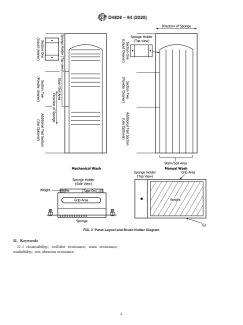
7.1 Washability Machine—Level the apparatus before use
8.3 Application of Soilants and Stains:
and operate at 37 6 1 cpm. (A cycle consists of a complete
8.3.1 Atthecompletionofthedryingperiod,tapethecoated
forward and reverse stroke.)
panel to the glass plate, as directed in 8.1, to ensure uniform
7.2 SpongeandHolder—Add sufficient weight to the holder application of the soilants and stains. Apply the selected
in the form of metal sheets or other flat weights to give a
soilants or stains, or both, to the coating film in straight pairs
combined weight of 1000 g, including the dry sponge. of lines parallel to the length of the panel for the manual
method of cleaning, or perpendicular to the length of the panel
NOTE 1—Check the compression of the damp sponge under the 1000-g
for the mechanical method of cleaning.
weight to ensure that the holder does not drag along the panel and tear the
film.
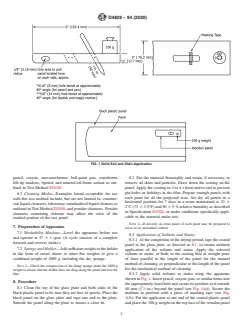
8.3.2 Apply solid soilants or stains using the apparatus
showninFig.1.Insertpencil,crayon,pen,orsimilaritemsinto
8. Procedure
theappropriatelysizedholeandsecureitspositionsoitextends
8.1 Clean the top of the glass plate and both sides of the 40 mm (1 ⁄2 in.) beyond the panel (see Fig. 1(a)). Secure the
black plastic panel to be sure they are free of specks. Place the medium in position with a piece of masking tape (see Fig.
black panel on the glass plate and tape one end to the plate. 1(b)). Put the applicator at one end of the coated plastic panel
Smooth the panel along the plate to ensure a close fit. and place the 100-g weight on the top face of the wooden panel
...