

ASTM D6767-21
(Test Method)Standard Test Method for Pore Size Characteristics of Geotextiles by Capillary Flow Test
General Information
- Abstract
SIGNIFICANCE AND USE
5.1 This test method may be used to:
5.1.1 Determine the pore size distribution of a geotextile,
5.1.2 Determine the maximum pore size of a geotextile,
5.1.3 Determine the mean flow pore size of a geotextile,
5.1.4 Determine the effect of processes such as calendaring or needle punching upon the pore size distribution,
5.1.5 Determine the effect of compression upon the pore size distribution of a geotextile, if the test equipment allows, and
5.1.6 Determine the gas flow rate of a geotextile, and thereby its gas flow capability.
5.2 The pore size distribution test may also be used for research, material development, or to assess clogging on field-retrieved samples.
SCOPE
1.1 This test method covers the determination of the pore size distribution of geotextile filters with pore sizes ranging from 1 to 1000 μm.
Note 1: The accuracy of this procedure has been verified up to a maximum pore size of 500 μm. Above this value, accuracy has been found to be equipment dependent and should be verified by the user through checks on materials with known opening sizes.
1.2 The test method measures the entire pore size distribution in terms of a surface analysis of specified pore sizes in a geotextile, defined in terms of the limiting diameters.
1.3 The values stated in SI units are to be regarded as standard. No other units of measurement are included in this standard.
1.4 This standard does not purport to address all of the safety concerns, if any, associated with its use. It is the responsibility of the user of this standard to establish appropriate safety, health, and environmental practices and determine the applicability of regulatory limitations prior to use.
1.5 This international standard was developed in accordance with internationally recognized principles on standardization established in the Decision on Principles for the Development of International Standards, Guides and Recommendations issued by the World Trade Organization Technical Barriers to Trade (TBT) Committee.
- Status
- Published
- Publication Date
- 30-Apr-2021
- Technical Committee
- D35 - Geosynthetics
- Drafting Committee
- D35.03 - Permeability and Filtration
Buy Documents
ASTM D6767-21 - Standard Test Method for Pore Size Characteristics of Geotextiles by Capillary Flow Test
REDLINE ASTM D6767-21 - Standard Test Method for Pore Size Characteristics of Geotextiles by Capillary Flow Test
Overview
ASTM D6767-21: Standard Test Method for Pore Size Characteristics of Geotextiles by Capillary Flow Test provides a comprehensive procedure for determining the pore size distribution, maximum and mean pore sizes, and gas flow capabilities of geotextile filters. Geotextiles are widely used in civil engineering, construction, and environmental applications for filtration, separation, and drainage. Accurately characterizing the pore structure is essential for ensuring long-term performance, as it directly impacts filter efficiency and resistance to clogging.
This standard outlines a precise laboratory method to measure the full range of pore sizes (1 to 1000 μm) present within geotextile materials using a capillary flow or porometry technique. The results are important for quality control, material development, specification conformance, and research applications.
Key Topics
- Pore Size Distribution Analysis
The method delivers a full surface analysis of geotextile pore sizes, defined by their limiting diameters. - Maximum and Mean Pore Size Determination
Testing identifies both the largest pores (bubble point) and the mean flow pore size, which are critical for assessing geotextile filtration capabilities. - Effect of Manufacturing Processes
The standard can evaluate changes in pore distribution resulting from manufacturing methods such as calendaring or needle punching, as well as from compression. - Gas Flow Rate Measurement
The test also determines the gas flow rate through geotextile samples, which is related to their permeability and filtration behavior. - Evaluation of Clogging
Results can be used to assess clogging in geotextiles retrieved from field installations, aiding durability studies. - Research and Material Development
Useful for comparing different material types, validating new products, and informing product improvement.
Applications
- Quality Control in Manufacturing
Routine testing ensures that geotextile products meet design specifications and perform as intended in filtration or drainage systems. - Product Development and Performance Verification
Allows product engineers to tailor geotextile pore structures to specific filtration or separation requirements. - Project Design and Specification Compliance
Objective assessment of pore size distributions supports the selection of appropriate geotextiles for civil engineering projects, such as roadways, embankments, retaining structures, and landfill liners. - Clogging Assessment
Laboratory evaluation of field-retrieved samples helps diagnose performance loss due to clogging, informing maintenance or replacement strategies. - Research and Innovation
Enables academic and industrial research into the relationship between geotextile structure and filtration performance.
Related Standards
- ASTM D4354 - Practice for Sampling of Geosynthetics and Rolled Erosion Control Products for Testing
- ASTM D4439 - Terminology for Geosynthetics
- ASTM D1193 - Specification for Reagent Water
- ASTM D1129 - Terminology Relating to Water
Other international or national standards for geotextile testing and characterization may also complement ASTM D6767-21, helping to ensure global compatibility and regulatory compliance.
Adhering to ASTM D6767-21 enables manufacturers, engineers, and researchers to accurately measure geotextile pore size attributes, support product innovation, and assure long-term reliability in filtration and drainage applications. Utilizing this standardized method supports high-quality geotextile deployment in both routine and critical infrastructure projects.
Relations
- Effective Date
- 01-Feb-2024
- Effective Date
- 01-May-2020
- Effective Date
- 01-May-2020
- Effective Date
- 15-Apr-2018
- Effective Date
- 01-Aug-2017
- Effective Date
- 01-Sep-2015
- Effective Date
- 01-Jul-2015
- Effective Date
- 01-Mar-2014
- Effective Date
- 01-Jul-2012
- Effective Date
- 01-Oct-2011
- Effective Date
- 01-Mar-2010
- Effective Date
- 15-Jan-2009
- Effective Date
- 01-Sep-2006
- Effective Date
- 01-Sep-2006
- Effective Date
- 01-Mar-2006
Buy Documents
ASTM D6767-21 - Standard Test Method for Pore Size Characteristics of Geotextiles by Capillary Flow Test
REDLINE ASTM D6767-21 - Standard Test Method for Pore Size Characteristics of Geotextiles by Capillary Flow Test
Get Certified
Connect with accredited certification bodies for this standard

Control Union Certifications
Global certification for agriculture and sustainability.

Hohenstein Institut
Textile testing and certification.

Bureau Veritas Bangladesh
Bureau Veritas certification services in Bangladesh.
Sponsored listings
Frequently Asked Questions
ASTM D6767-21 is a standard published by ASTM International. Its full title is "Standard Test Method for Pore Size Characteristics of Geotextiles by Capillary Flow Test". This standard covers: SIGNIFICANCE AND USE 5.1 This test method may be used to: 5.1.1 Determine the pore size distribution of a geotextile, 5.1.2 Determine the maximum pore size of a geotextile, 5.1.3 Determine the mean flow pore size of a geotextile, 5.1.4 Determine the effect of processes such as calendaring or needle punching upon the pore size distribution, 5.1.5 Determine the effect of compression upon the pore size distribution of a geotextile, if the test equipment allows, and 5.1.6 Determine the gas flow rate of a geotextile, and thereby its gas flow capability. 5.2 The pore size distribution test may also be used for research, material development, or to assess clogging on field-retrieved samples. SCOPE 1.1 This test method covers the determination of the pore size distribution of geotextile filters with pore sizes ranging from 1 to 1000 μm. Note 1: The accuracy of this procedure has been verified up to a maximum pore size of 500 μm. Above this value, accuracy has been found to be equipment dependent and should be verified by the user through checks on materials with known opening sizes. 1.2 The test method measures the entire pore size distribution in terms of a surface analysis of specified pore sizes in a geotextile, defined in terms of the limiting diameters. 1.3 The values stated in SI units are to be regarded as standard. No other units of measurement are included in this standard. 1.4 This standard does not purport to address all of the safety concerns, if any, associated with its use. It is the responsibility of the user of this standard to establish appropriate safety, health, and environmental practices and determine the applicability of regulatory limitations prior to use. 1.5 This international standard was developed in accordance with internationally recognized principles on standardization established in the Decision on Principles for the Development of International Standards, Guides and Recommendations issued by the World Trade Organization Technical Barriers to Trade (TBT) Committee.
SIGNIFICANCE AND USE 5.1 This test method may be used to: 5.1.1 Determine the pore size distribution of a geotextile, 5.1.2 Determine the maximum pore size of a geotextile, 5.1.3 Determine the mean flow pore size of a geotextile, 5.1.4 Determine the effect of processes such as calendaring or needle punching upon the pore size distribution, 5.1.5 Determine the effect of compression upon the pore size distribution of a geotextile, if the test equipment allows, and 5.1.6 Determine the gas flow rate of a geotextile, and thereby its gas flow capability. 5.2 The pore size distribution test may also be used for research, material development, or to assess clogging on field-retrieved samples. SCOPE 1.1 This test method covers the determination of the pore size distribution of geotextile filters with pore sizes ranging from 1 to 1000 μm. Note 1: The accuracy of this procedure has been verified up to a maximum pore size of 500 μm. Above this value, accuracy has been found to be equipment dependent and should be verified by the user through checks on materials with known opening sizes. 1.2 The test method measures the entire pore size distribution in terms of a surface analysis of specified pore sizes in a geotextile, defined in terms of the limiting diameters. 1.3 The values stated in SI units are to be regarded as standard. No other units of measurement are included in this standard. 1.4 This standard does not purport to address all of the safety concerns, if any, associated with its use. It is the responsibility of the user of this standard to establish appropriate safety, health, and environmental practices and determine the applicability of regulatory limitations prior to use. 1.5 This international standard was developed in accordance with internationally recognized principles on standardization established in the Decision on Principles for the Development of International Standards, Guides and Recommendations issued by the World Trade Organization Technical Barriers to Trade (TBT) Committee.
ASTM D6767-21 is classified under the following ICS (International Classification for Standards) categories: 59.080.70 - Geotextiles. The ICS classification helps identify the subject area and facilitates finding related standards.
ASTM D6767-21 has the following relationships with other standards: It is inter standard links to ASTM D4439-24, ASTM D1129-13(2020)e2, ASTM D4354-12(2020), ASTM D4439-18, ASTM D4439-17, ASTM D4439-15a, ASTM D4439-15, ASTM D4439-14, ASTM D4354-12, ASTM D4439-11, ASTM D1129-10, ASTM D4354-99(2009), ASTM D1129-06a, ASTM D1129-06ae1, ASTM D1193-06. Understanding these relationships helps ensure you are using the most current and applicable version of the standard.
ASTM D6767-21 is available in PDF format for immediate download after purchase. The document can be added to your cart and obtained through the secure checkout process. Digital delivery ensures instant access to the complete standard document.
Standards Content (Sample)
This international standard was developed in accordance with internationally recognized principles on standardization established in the Decision on Principles for the
Development of International Standards, Guides and Recommendations issued by the World Trade Organization Technical Barriers to Trade (TBT) Committee.
Designation: D6767 − 21
Standard Test Method for
Pore Size Characteristics of Geotextiles by Capillary Flow
Test
This standard is issued under the fixed designation D6767; the number immediately following the designation indicates the year of
original adoption or, in the case of revision, the year of last revision. A number in parentheses indicates the year of last reapproval. A
superscript epsilon (´) indicates an editorial change since the last revision or reapproval.
1. Scope D4439 Terminology for Geosynthetics
1.1 This test method covers the determination of the pore
3. Terminology
size distribution of geotextile filters with pore sizes ranging
3.1 Definitions—For definitions of other terms used in this
from 1 to 1000 µm.
test method, refer to Terminologies D4439 and D1129.
NOTE 1—The accuracy of this procedure has been verified up to a
3.2 Definitions of Terms Specific to This Standard:
maximumporesizeof500µm.Abovethisvalue,accuracyhasbeenfound
3.2.1 bubble point pore size (O ), n—the largest effective
to be equipment dependent and should be verified by the user through 98
checks on materials with known opening sizes.
pore diameter detected by the sudden increase of flow rate at
the beginning of the wet test.
1.2 The test method measures the entire pore size distribu-
tion in terms of a surface analysis of specified pore sizes in a 3.2.2 pore constriction (O), n—diameter of a circle having
geotextile, defined in terms of the limiting diameters. the same area as the smallest section of a given pore.
3.2.3 pore size (O), n—capillary equivalent pore diameter
1.3 The values stated in SI units are to be regarded as
i
for which the percent of total pore diameters i in a given
standard. No other units of measurement are included in this
geotextilebasedonthesurfaceoccupiedbytheporesissmaller
standard.
than or equal to that diameter.
1.4 This standard does not purport to address all of the
3.2.4 pore size distribution (PSD), n—percent cumulative
safety concerns, if any, associated with its use. It is the
distribution of the complete range of pore sizes with in a given
responsibility of the user of this standard to establish appro-
geotextile based on the surface occupied by the pores.
priate safety, health, and environmental practices and deter-
mine the applicability of regulatory limitations prior to use.
3.2.5 wetting fluid, n—fluid used to wet the geotextile test
1.5 This international standard was developed in accor-
specimen for the capillary porometry portion of the test
dance with internationally recognized principles on standard-
method, that is, the “wet” test. The verb “wet” is intended to
ization established in the Decision on Principles for the
mean to completely saturate the geotextile specimen with the
Development of International Standards, Guides and Recom-
wetting fluid thoroughly such that the entire thickness of the
mendations issued by the World Trade Organization Technical
specimen contains fluid with no entrained air bubbles.
Barriers to Trade (TBT) Committee.
4. Summary of Test Method
2. Referenced Documents
4.1 Geotextile filters have discrete pores from one side to
2.1 ASTM Standards: theotherofthegeotextile.Thebubblepointtestisbasedonthe
D1129 Terminology Relating to Water principle that a wetting fluid is held in these continuous pores
D1193 Specification for Reagent Water by capillary attraction and surface tension, and the minimum
D4354 Practice for Sampling of Geosynthetics and Rolled pressure required to force fluid from these pores is a function
Erosion Control Products (RECPs) for Testing of pore diameter.
4.2 Afluid-wet geotextile will pass air when the applied air
pressure exceeds the capillary attraction of the fluid in the pore
This test method is under the jurisdiction of ASTM Committee D35 on
constriction. Smaller pore constrictions will exhibit similar
Geosynthetics and is the direct responsibility of Subcommittee D35.03 on Perme-
ability and Filtration.
behavior at higher pressures. The relationship between pore
Current edition approved May 1, 2021. Published May 2021. Originally
size and pressure has been established for the wetting fluid.
approved in 2002. Last previous edition approved in 2020 as D6767 – 20a. DOI:
10.1520/D6767-21.
4.3 By comparing the gas flow rates of both a wet and dry
For referenced ASTM standards, visit the ASTM website, www.astm.org, or
test at the same pressures, the percentage of the flow passing
contact ASTM Customer Service at service@astm.org. For Annual Book of ASTM
through the filter pores larger than or equal to the specified size
Standards volume information, refer to the standard’s Document Summary page on
the ASTM website. may be calculated from the pressure-size relationship. By
Copyright © ASTM International, 100 Barr Harbor Drive, PO Box C700, West Conshohocken, PA 19428-2959. United States
D6767 − 21
increasing pressure in small steps, it is possible to determine and holding it for a period of 1 min. The flow rate measured
the flow contribution of very small pore size increments by during this period must be zero.
difference.
6.4 Metal Punch, used to cut a suitable size geotextile from
the test sheet to fit the test filter holder.
5. Significance and Use
6.5 Flow Rate Measurement Sensors—The porometer
5.1 This test method may be used to:
should be equipped with sensors to measure the flow rate that
5.1.1 Determine the pore size distribution of a geotextile,
are high enough to derive the desired pore size distribution.
5.1.2 Determine the maximum pore size of a geotextile,
The maximum flow rate measurement required will depend on
5.1.3 Determine the mean flow pore size of a geotextile,
the opening diameter and the dry air flow that corresponds to
5.1.4 Determine the effect of processes such as calendaring
the smallest opening that can be determined with this method
or needle punching upon the pore size distribution,
on the geotextile type under test.The minimumsensitivity,that
5.1.5 Determine the effect of compression upon the pore
is, the detection threshold, is dictated by the flow rate that
size distribution of a geotextile, if the test equipment allows,
corresponds to the onset of flow at the bubble point. For some
and
geotextiles, this value may be as low as 0.1 L/min.
5.1.6 Determine the gas flow rate of a geotextile, and
6.5.1 A series of floating ball-type flow meters placed in a
thereby its gas flow capability.
parallel arrangement to cover the ranges of flow rates is
5.2 The pore size distribution test may also be used for
acceptable, provided the minimum and maximum flow rate
research, material development, or to assess clogging on
measurements can be obtained with an accuracy of 5 % or less
field-retrieved samples.
of the measured value.
6.5.2 Digital flow meters are preferred for measurement of
6. Apparatus
flow rates. Two or more digital flow meters of different
6.1 Clean Gas Pressure Source, with regulation (filtered
capacities and sensitivities may be necessary to cover both the
air).
minimum detection value and the maximum dry specimen
6.2 Pressure Sensor—Pressure measurements may be ob-
value. The accuracy of digital flow meters shall be at least
tained with a digital pressure transducer, a U-tube manometer,
60.5 lpm or 62 % of the measured value, whichever is larger.
or an inclined manometer covering the necessary pressure
6.6 In-Line Fluid Trap, for porometers which have the flow
range for the pore sizes under study and the wetting fluid used.
rate sensors downstream from the test specimen to protect the
Thepressuresensorsensitivityshallbedictatedbytherangeof
flow meters from being contaminated by the exhausted fluid.
pressures associated with the openings sizes. Pressure mea-
surements must be accurate to 65 Pa to 1000 Pa, and 61%
6.7 Appropriate Fittings, Hose, Connectors, Piping, to as-
above 1000 Pa. semble apparatus.
6.2.1 Pressure sensor(s) must be installed immediately up-
6.8 Balance, with a precision of 0.001 g.
stream (for example, within 5 mm) of the sample holder.
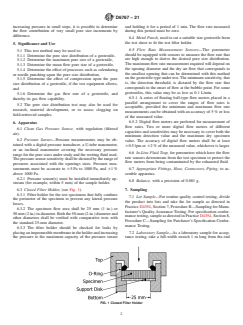
6.3 Closed Filter Holder, (see Fig. 1).
7. Sampling
6.3.1 Filter holder for the test specimens that fully confines
7.1 Lot Sample—For routine quality control testing, divide
the perimeter of the specimen to prevent any lateral pressure
the product into lots and take the lot sample as directed in
losses.
Practice D4354, Section 7, Procedure B—Sampling for Manu-
6.3.2 The specimen flow area shall be 25 mm (1 in.) or
facturer’s QualityAssurance Testing. For specification confor-
50 mm(2in.)indiameter.Boththe50-mm(2-in.)diameterand
mancetesting,sampleasdirectedinPracticeD4354,Section8,
other diameters shall be verified with comparative tests with
Procedure C—Sampling for Purchaser’s Specification Confor-
the standard 25-mm diameter.
mance Testing.
6.3.3 The filter holder should be checked for leaks by
placinganimpermeablemembraneintheholderandincreasing 7.2 Laboratory Sample—As a laboratory sample for accep-
the pressure to the maximum capacity of the pressure sensor tance testing, take a full-width swatch 1 m long from the end
FIG. 1 Closed Filter Holder
D6767 − 21
of each roll of fabric in the lot sample, after first discarding a 10.2.2 The pressure shall then be increased at a constant
minimu
...
This document is not an ASTM standard and is intended only to provide the user of an ASTM standard an indication of what changes have been made to the previous version. Because
it may not be technically possible to adequately depict all changes accurately, ASTM recommends that users consult prior editions as appropriate. In all cases only the current version
of the standard as published by ASTM is to be considered the official document.
Designation: D6767 − 20a D6767 − 21
Standard Test Method for
Pore Size Characteristics of Geotextiles by Capillary Flow
Test
This standard is issued under the fixed designation D6767; the number immediately following the designation indicates the year of
original adoption or, in the case of revision, the year of last revision. A number in parentheses indicates the year of last reapproval. A
superscript epsilon (´) indicates an editorial change since the last revision or reapproval.
1. Scope
1.1 This test method covers the determination of the pore size distribution of geotextile filters with pore sizes ranging from 1 to
1000 μm.
NOTE 1—The accuracy of this procedure has been verified up to a maximum pore size of 500 μm. Above this value, accuracy has been found to be
equipment dependent and should be verified by the user through checks on materials with known opening sizes.
1.2 The test method measures the entire pore size distribution in terms of a surface analysis of specified pore sizes in a geotextile,
defined in terms of the limiting diameters.
1.3 The values stated in SI units are to be regarded as standard. No other units of measurement are included in this standard.
1.4 This standard does not purport to address all of the safety concerns, if any, associated with its use. It is the responsibility
of the user of this standard to establish appropriate safety, health, and environmental practices and determine the applicability of
regulatory limitations prior to use.
1.5 This international standard was developed in accordance with internationally recognized principles on standardization
established in the Decision on Principles for the Development of International Standards, Guides and Recommendations issued
by the World Trade Organization Technical Barriers to Trade (TBT) Committee.
2. Referenced Documents
2.1 ASTM Standards:
D1129 Terminology Relating to Water
D1193 Specification for Reagent Water
D4354 Practice for Sampling of Geosynthetics and Rolled Erosion Control Products (RECPs) for Testing
D4439 Terminology for Geosynthetics
3. Terminology
3.1 Definitions—For definitions of other terms used in this test method, refer to Terminologies D4439 and D1129.
3.2 Definitions of Terms Specific to This Standard:
This test method is under the jurisdiction of ASTM Committee D35 on Geosynthetics and is the direct responsibility of Subcommittee D35.03 on Permeability and
Filtration.
Current edition approved Dec. 1, 2020May 1, 2021. Published December 2020May 2021. Originally approved in 2002. Last previous edition approved in 2020 as
D6767 – 20.D6767 – 20a. DOI: 10.1520/D6767-20A.10.1520/D6767-21.
For referenced ASTM standards, visit the ASTM website, www.astm.org, or contact ASTM Customer Service at service@astm.org. For Annual Book of ASTM Standards
volume information, refer to the standard’s Document Summary page on the ASTM website.
Copyright © ASTM International, 100 Barr Harbor Drive, PO Box C700, West Conshohocken, PA 19428-2959. United States
D6767 − 21
3.2.1 bubble point pore size (O ), n—the largest effective pore diameter detected by the sudden increase of flow rate at the
beginning of the wet test.
3.2.2 pore constriction (O), n—diameter of a circle having the same area as the smallest section of a given pore.
3.2.3 pore size (O ), n—capillary equivalent pore diameter for which the percent of total pore diameters i in a given geotextile
i
based on the surface occupied by the pores is smaller than or equal to that diameter.
3.2.4 pore size distribution (PSD), n—percent cumulative distribution of the complete range of pore sizes with in a given
geotextile based on the surface occupied by the pores.
3.2.5 wetting fluid, n—fluid used to wet the geotextile test specimen for the capillary porometry portion of the test method, that
is, the “wet” test. The verb “wet” is intended to mean to completely saturate the geotextile specimen with the wetting fluid
thoroughly such that the entire thickness of the specimen contains fluid with no entrained air bubbles.
4. Summary of Test Method
4.1 Geotextile filters have discrete pores from one side to the other of the geotextile. The bubble point test is based on the principle
that a wetting fluid is held in these continuous pores by capillary attraction and surface tension, and the minimum pressure required
to force fluid from these pores is a function of pore diameter.
4.2 A fluid-wet geotextile will pass air when the applied air pressure exceeds the capillary attraction of the fluid in the pore
constriction. Smaller pore constrictions will exhibit similar behavior at higher pressures. The relationship between pore size and
pressure has been established for the wetting fluid.
4.3 By comparing the gas flow rates of both a wet and dry test at the same pressures, the percentage of the flow passing through
the filter pores larger than or equal to the specified size may be calculated from the pressure-size relationship. By increasing
pressure in small steps, it is possible to determine the flow contribution of very small pore size increments by difference.
5. Significance and Use
5.1 This test method may be used to:
5.1.1 Determine the pore size distribution of a geotextile,
5.1.2 Determine the maximum pore size of a geotextile,
5.1.3 Determine the mean flow pore size of a geotextile,
5.1.4 Determine the effect of processes such as calendaring or needle punching upon the pore size distribution,
5.1.5 Determine the effect of compression upon the pore size distribution of a geotextile, if the test equipment allows, and
5.1.6 Determine the gas flow rate of a geotextile, and thereby its gas flow capability.
5.2 The pore size distribution test may also be used for research, material development, or to assess clogging on field-retrieved
samples.
6. Apparatus
6.1 Clean Gas Pressure Source, with regulation (filtered air).
6.2 Pressure Sensor—Pressure measurements may be obtained with a digital pressure transducer, a U-tube manometer, or an
inclined manometer covering the necessary pressure range for the pore sizes under study and the wetting fluid used. The pressure
D6767 − 21
sensor sensitivity shall be dictated by the range of pressures associated with the openings sizes. The bubble point pressure should
be measured with an accuracy of 61 % or 65 Pa, whichever is larger.Pressure measurements must be accurate to 65 Pa to
1000 Pa, and 61 % above 1000 Pa.
6.2.1 Pressure sensor(s) must be installed immediately upstream (for example, within 5 mm) of the sample holder.
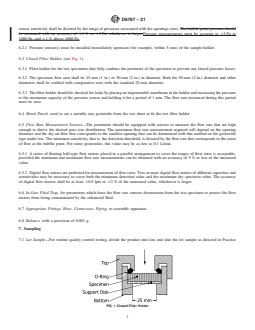
6.3 Closed Filter Holder, (see Fig. 1).
6.3.1 Filter holder for the test specimens that fully confines the perimeter of the specimen to prevent any lateral pressure losses.
6.3.2 The specimen flow area shall be 25 mm (1 in.) or 50 mm (2 in.) in diameter. Both the 50-mm (2-in.) diameter and other
diameters shall be verified with comparative tests with the standard 25-mm diameter.
6.3.3 The filter holder should be checked for leaks by placing an impermeable membrane in the holder and increasing the pressure
to the maximum capacity of the pressure sensor and holding it for a period of 1 min. The flow rate measured during this period
must be zero.
6.4 Metal Punch, used to cut a suitable size geotextile from the test sheet to fit the test filter holder.
6.5 Flow Rate Measurement Sensors—The porometer should be equipped with sensors to measure the flow rate that are high
enough to derive the desired pore size distribution. The maximum flow rate measurement required will depend on the opening
diameter and the dry air flow that corresponds to the smallest opening that can be determined with this method on the geotextile
type under test. The minimum sensitivity, that is, the detection threshold, is dictated by the flow rate that corresponds to the onset
of flow at the bubble point. For some geotextiles, this value may be as low as 0.1 L/min.
6.5.1 A series of floating ball-type flow meters placed in a parallel arrangement to cover the ranges of flow rates is acceptable,
provided the minimum and maximum flow rate measurements can be obtained with an accuracy of 5 % or less of the measured
value.
6.5.2 Digital flow meters are preferred for measurement of flow rates. Two or more digital flow meters of different capacities and
sensitivities may be necessary to cover both the minimum detection value and the maximum dry specimen value. The accuracy
of digital flow meters shall be at least 60.5 lpm or 62 % of the measured value, whichever is larger.
6.6 In-Line Fluid Trap, for porometers which have the flow rate sensors downstream from the test specimen to protect the flow
meters from being contaminated by the exhausted fluid.
6.7 Appropriate Fittings, Hose, Connectors, Piping, to assemble apparatus.
6.8 Balance, with a precision of 0.001 g.
7. Sampling
7.1 Lot Sample—For routine quality control testing, divide the product into lots and take the lot sample as directed in Practice
FIG. 1 Closed Filter Holder
D6767 − 21
D4354, Section 7, Procedure B—Sampling for Manufacturer’s Quality Assurance Testing. For specification conformance testing,
sample as directed in Practice D4354, Section 8, Procedure C—Sampling for Purchaser’s Specification Conformance Testing.
7.2 Laboratory Sample—As a laboratory sample for acceptance testing, take a full-width swatch 1 m long from t
...