

ASTM D2001-07(2017)
(Test Method)Standard Test Method for Depentanization of Gasoline and Naphthas
General Information
- Abstract
SIGNIFICANCE AND USE
4.1 The presence of pentane and lighter hydrocarbons in gasolines, naphthas, and similar petroleum distillates interferes in Test Method D2789. Pentane and lighter hydrocarbons are separated by this test method so that the depentanized residue can be analyzed and so the pentane and lighter hydrocarbons can be analyzed by other methods, if desired.
4.2 Under the conditions specified in the test method some C5 and lighter hydrocarbons remain in the bottoms, and some C6 and heavier hydrocarbons carry over to the overhead. Expressed as volume percent of charge, the amounts are typically 2 % or less, which is considered adequate for the purpose designated under Scope. It should be recognized, however, that when expressed as volume percent of overhead or of bottoms the percentages can be higher, making this test method unsuitable for any purposes not designated under Scope.
SCOPE
1.1 This test method covers the removal of pentanes and lighter hydrocarbons from gasolines, naphthas, and similar petroleum distillates to prepare samples suitable for the determination of hydrocarbon types in accordance with Test Method D2789. In addition, this test method determines the volume percent of bottoms remaining after depentanization.
1.2 The values stated in SI units are to be regarded as standard. The values given in parentheses are for information only.
1.3 This standard does not purport to address all of the safety concerns, if any, associated with its use. It is the responsibility of the user of this standard to establish appropriate safety, health, and environmental practices and determine the applicability of regulatory limitations prior to use.
1.4 This international standard was developed in accordance with internationally recognized principles on standardization established in the Decision on Principles for the Development of International Standards, Guides and Recommendations issued by the World Trade Organization Technical Barriers to Trade (TBT) Committee.
- Status
- Published
- Publication Date
- 30-Nov-2017
- Technical Committee
- D02 - Petroleum Products, Liquid Fuels, and Lubricants
- Drafting Committee
- D02.04.0C - Liquid Chromatography


Overview
ASTM D2001-07(2017), the Standard Test Method for Depentanization of Gasoline and Naphthas, is issued by ASTM International. This standard specifies a method for the removal of pentanes and lighter hydrocarbons from gasolines, naphthas, and similar petroleum distillates. The depentanization process enables the preparation of samples suitable for further hydrocarbon type determination, notably in support of ASTM D2789. This ensures more accurate analysis by eliminating the interference from pentane and lighter components. The standard also provides a procedure for determining the volume percent of bottoms remaining after depentanization.
Key Topics
- Purpose of Depentanization: Removes pentanes (C5) and lighter hydrocarbons that interfere with specific analytical methods, such as hydrocarbon type analysis by mass spectrometry.
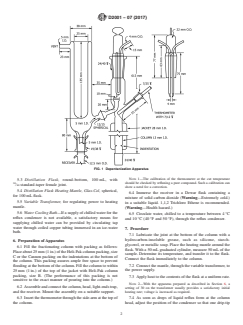
- Sample Preparation: Outlines the necessary apparatus and step-by-step procedures to separate light ends and measure the remaining heavier fraction.
- Measurement Accuracy: Specifies temperature control, use of calibrated apparatus, and proper correction for volume measurements to ensure result reliability.
- Limitations: Some overlap between lighter and heavier hydrocarbon fractions is possible, but is generally limited to 2% or less of the sample charge, which is considered acceptable for the intended use.
- Safety and Compliance: Users are responsible for addressing safety, health, and environmental considerations, as well as regulatory requirements when implementing this standard.
Applications
ASTM D2001-07(2017) is widely used in:
- Petroleum Laboratories: Facilitates the preparation of distillate samples for hydrocarbon type determination, especially in research, quality control, and fuel certification contexts.
- Refineries and Blending Plants: Enables precise analysis of gasoline and naphtha components to optimize blends, improve process control, and meet regulatory specifications.
- Analytical Chemistry: Assists in removing analytical interferences in downstream tests, such as ASTM D2789 (hydrocarbon type analysis), thus increasing the specificity and accuracy of results.
- Regulatory Compliance: Supports adherence to national and international standards for the characterization of petroleum products, crucial for trade, safety, and environmental reporting.
Related Standards
For integrated petroleum analysis and compliance, consider these related ASTM standards:
- ASTM D1250 - Guide for Use of the Petroleum Measurement Tables: Essential for volume corrections based on temperature.
- ASTM D2789 - Test Method for Hydrocarbon Types in Low Olefinic Gasoline by Mass Spectrometry: Complementary method for which depentanized samples are prepared.
- Additional relevant documents may be obtained from the ASTM International website or referenced directly within the standard.
Practical Value
Implementing ASTM D2001-07(2017) ensures that gasoline and naphtha samples are free of pentane and lighter hydrocarbons prior to advanced hydrocarbon type analysis. This leads to:
- Improved Analytical Accuracy: By minimizing interference, laboratories can report hydrocarbon types with greater confidence.
- Operational Consistency: Standardized methodology enables reproducible results across different labs and operators, supporting quality assurance.
- Regulatory Readiness: Helps organizations demonstrate compliance with international standards and guidelines set by trade and regulatory bodies.
Proper use of this standard directly contributes to better petroleum product management, enhanced analytical outcomes, and strengthened industry confidence in reported results.
Keywords: ASTM D2001, depentanization, gasoline analysis, naphtha analysis, hydrocarbon separation, petroleum standard, petroleum distillates, light hydrocarbons removal.
Relations
- Effective Date
- 01-Dec-2017
- Effective Date
- 01-May-2019
- Effective Date
- 01-May-2011
- Effective Date
- 01-May-2007
- Effective Date
- 01-May-2005
- Effective Date
- 01-May-2004
- Effective Date
- 10-Dec-2002
- Effective Date
- 01-Jan-2000
- Effective Date
- 01-Jan-1997
- Effective Date
- 01-Dec-2017
Get Certified
Connect with accredited certification bodies for this standard

Element Materials Technology
Materials testing and product certification.

ABS Group Brazil
ABS Group certification services in Brazil.

ABS Quality Evaluations Inc.
American Bureau of Shipping quality certification.
Sponsored listings
Frequently Asked Questions
ASTM D2001-07(2017) is a standard published by ASTM International. Its full title is "Standard Test Method for Depentanization of Gasoline and Naphthas". This standard covers: SIGNIFICANCE AND USE 4.1 The presence of pentane and lighter hydrocarbons in gasolines, naphthas, and similar petroleum distillates interferes in Test Method D2789. Pentane and lighter hydrocarbons are separated by this test method so that the depentanized residue can be analyzed and so the pentane and lighter hydrocarbons can be analyzed by other methods, if desired. 4.2 Under the conditions specified in the test method some C5 and lighter hydrocarbons remain in the bottoms, and some C6 and heavier hydrocarbons carry over to the overhead. Expressed as volume percent of charge, the amounts are typically 2 % or less, which is considered adequate for the purpose designated under Scope. It should be recognized, however, that when expressed as volume percent of overhead or of bottoms the percentages can be higher, making this test method unsuitable for any purposes not designated under Scope. SCOPE 1.1 This test method covers the removal of pentanes and lighter hydrocarbons from gasolines, naphthas, and similar petroleum distillates to prepare samples suitable for the determination of hydrocarbon types in accordance with Test Method D2789. In addition, this test method determines the volume percent of bottoms remaining after depentanization. 1.2 The values stated in SI units are to be regarded as standard. The values given in parentheses are for information only. 1.3 This standard does not purport to address all of the safety concerns, if any, associated with its use. It is the responsibility of the user of this standard to establish appropriate safety, health, and environmental practices and determine the applicability of regulatory limitations prior to use. 1.4 This international standard was developed in accordance with internationally recognized principles on standardization established in the Decision on Principles for the Development of International Standards, Guides and Recommendations issued by the World Trade Organization Technical Barriers to Trade (TBT) Committee.
SIGNIFICANCE AND USE 4.1 The presence of pentane and lighter hydrocarbons in gasolines, naphthas, and similar petroleum distillates interferes in Test Method D2789. Pentane and lighter hydrocarbons are separated by this test method so that the depentanized residue can be analyzed and so the pentane and lighter hydrocarbons can be analyzed by other methods, if desired. 4.2 Under the conditions specified in the test method some C5 and lighter hydrocarbons remain in the bottoms, and some C6 and heavier hydrocarbons carry over to the overhead. Expressed as volume percent of charge, the amounts are typically 2 % or less, which is considered adequate for the purpose designated under Scope. It should be recognized, however, that when expressed as volume percent of overhead or of bottoms the percentages can be higher, making this test method unsuitable for any purposes not designated under Scope. SCOPE 1.1 This test method covers the removal of pentanes and lighter hydrocarbons from gasolines, naphthas, and similar petroleum distillates to prepare samples suitable for the determination of hydrocarbon types in accordance with Test Method D2789. In addition, this test method determines the volume percent of bottoms remaining after depentanization. 1.2 The values stated in SI units are to be regarded as standard. The values given in parentheses are for information only. 1.3 This standard does not purport to address all of the safety concerns, if any, associated with its use. It is the responsibility of the user of this standard to establish appropriate safety, health, and environmental practices and determine the applicability of regulatory limitations prior to use. 1.4 This international standard was developed in accordance with internationally recognized principles on standardization established in the Decision on Principles for the Development of International Standards, Guides and Recommendations issued by the World Trade Organization Technical Barriers to Trade (TBT) Committee.
ASTM D2001-07(2017) is classified under the following ICS (International Classification for Standards) categories: 75.160.20 - Liquid fuels. The ICS classification helps identify the subject area and facilitates finding related standards.
ASTM D2001-07(2017) has the following relationships with other standards: It is inter standard links to ASTM D2001-07(2012), ASTM D1250-19e1, ASTM D2789-95(2011), ASTM D1250-07, ASTM D2789-95(2005), ASTM D1250-04, ASTM D1250-80(2002), ASTM D2789-95(2000)e1, ASTM D1250-80(1997)e1, ASTM D2427-06(2019). Understanding these relationships helps ensure you are using the most current and applicable version of the standard.
ASTM D2001-07(2017) is available in PDF format for immediate download after purchase. The document can be added to your cart and obtained through the secure checkout process. Digital delivery ensures instant access to the complete standard document.
Standards Content (Sample)
This international standard was developed in accordance with internationally recognized principles on standardization established in the Decision on Principles for the
Development of International Standards, Guides and Recommendations issued by the World Trade Organization Technical Barriers to Trade (TBT) Committee.
Designation: D2001 − 07 (Reapproved 2017)
Standard Test Method for
Depentanization of Gasoline and Naphthas
This standard is issued under the fixed designation D2001; the number immediately following the designation indicates the year of
original adoption or, in the case of revision, the year of last revision. A number in parentheses indicates the year of last reapproval. A
superscript epsilon (´) indicates an editorial change since the last revision or reapproval.
1. Scope 4. Significance and Use
1.1 This test method covers the removal of pentanes and 4.1 The presence of pentane and lighter hydrocarbons in
lighter hydrocarbons from gasolines, naphthas, and similar gasolines, naphthas, and similar petroleum distillates interferes
petroleum distillates to prepare samples suitable for the deter- in Test Method D2789. Pentane and lighter hydrocarbons are
minationofhydrocarbontypesinaccordancewithTestMethod separated by this test method so that the depentanized residue
D2789. In addition, this test method determines the volume can be analyzed and so the pentane and lighter hydrocarbons
percent of bottoms remaining after depentanization. can be analyzed by other methods, if desired.
1.2 The values stated in SI units are to be regarded as 4.2 Under the conditions specified in the test method some
standard. The values given in parentheses are for information C and lighter hydrocarbons remain in the bottoms, and some
only. C and heavier hydrocarbons carry over to the overhead.
Expressed as volume percent of charge, the amounts are
1.3 This standard does not purport to address all of the
typically 2 % or less, which is considered adequate for the
safety concerns, if any, associated with its use. It is the
purpose designated under Scope. It should be recognized,
responsibility of the user of this standard to establish appro-
however, that when expressed as volume percent of overhead
priate safety, health, and environmental practices and deter-
or of bottoms the percentages can be higher, making this test
mine the applicability of regulatory limitations prior to use.
method unsuitable for any purposes not designated under
1.4 This international standard was developed in accor-
Scope.
dance with internationally recognized principles on standard-
ization established in the Decision on Principles for the
5. Apparatus
Development of International Standards, Guides and Recom-
mendations issued by the World Trade Organization Technical
5.1 Depentanization Apparatus, as shown in Fig. 1, consist-
Barriers to Trade (TBT) Committee. ing of the following parts:
5.1.1 Distillation Column,
2. Referenced Documents
5.1.2 Reflux Condenser Head,
5.1.3 Light-Ends Trap,
2.1 ASTM Standards:
5.1.4 Receiver, graduated, 12.5 mL, and
D1250 Guide for Use of the Petroleum Measurement Tables
3,4
5.1.5 Thermometer, 10 °C to 79 °C (50 °F to 175 °F).
D2789 Test Method for Hydrocarbon Types in Low Olefinic
Gasoline by Mass Spectrometry
5.2 Column Packing—Two types are required:
4,5
5.2.1 Heli-Pak Column Packing, 1.27 mm by 2.54 mm
3. Summary of Test Method
by 2.54 mm (Size B, 0.050 in. by 0.100 in. by 0.100 in.).
4,5
5.2.2 Heli-Pak Column Packing, Size C, 4.4 m by 4.4 m
3.1 A 50 mL sample is distilled into an overhead (C and
lighter) fraction and a bottoms (C and heavier) fraction. The (0.090 in. by 0.175 in. by 0.175 in.), or Cannon Protruded
4,6
Metal Packing, 4.0 mm by 4.0 mm (0.16 in. by 0.16 in.).
volume of bottoms is measured and the volume percent, based
on the charge, is calculated.
The sole source of supply of the apparatus known to the committee at this time
This test method is under the jurisdiction of ASTM Committee D02 on is Thermometer No. ME510-1 available from Metro Scientific Inc., 11 Willow Park
Petroleum Products, Liquid Fuels, and Lubricants and is the direct responsibility of Center, East Farmingdale, NY 11735.
Subcommittee D02.04.0C on Liquid Chromatography. If you are aware of alternative suppliers, please provide this information to
Current edition approved Dec. 1, 2017. Published December 2017. Originally ASTM International Headquarters. Your comments will receive careful consider-
approved in 1962. Last previous edition approved in 2012 as D2001 – 07 (2012). ation at a meeting of the responsible technical committee, which you may attend.
DOI: 10.1520/D2001-07R17. The sole source of supply of the apparatus known to the committee at this time
For referenced ASTM standards, visit the ASTM website, www.astm.org, or is Reliance Glass Works Inc., Gateway Rd., PO Box 825, Bensenville, IL 60106.
contact ASTM Customer Service at service@astm.org. For Annual Book of ASTM The sole source of supply of the apparatus known to the committee at this time
Standards volume information, refer to the standard’s Document Summary page on is Cannon protruded metal packing available from Scientific Development Co., Box
the ASTM website. 795, State College, PA.
Copyright © ASTM International, 100 Barr Harbor Drive, PO Box C700, West Conshohocken, PA 19428-2959. United States
D2001 − 07 (2017)
FIG. 1 Depentanization Apparatus
NOTE 1—The calibration of the thermometer at the cut temperature
5.3 Distillation Flask, round-bottom, 100 mL, with
24 should be checked by refluxing a pure compound. Such a calibration can
⁄40 standard-taper female joint.
show a need for a correction.
5.4 Distillation Flask Heating Mantle, Glas-Col, spherical,
6.4 Immerse the receiver in a Dewar flask containing a
for 100 mL flask.
mixture of solid carbon dioxide (Warning—Extremely cold.)
5.5 Variable Transformer, for regulating power to heating
in a suitable liquid. 1,1,2 Trichloro Ethene is recommended.
mantle.
(Warning—Health hazard.)
5.6 Water Cooling Bath—If a supply of
...