

ASTM D4625-21
(Test Method)Standard Test Method for Middle Distillate Fuel Storage Stability at 43 °C (110 °F)
General Information
- Abstract
SIGNIFICANCE AND USE
5.1 Fuel oxidation and other degradative reactions leading to formation of sediment (and color) are mildly accelerated by the test conditions compared with typical storage conditions. Test results have been shown to predict storage stability more reliably than other more accelerated tests. See Appendix X1 for information on the correlation of test results with actual field storage.
5.2 Because the storage periods are long (4 weeks to 24 weeks), the test method is not suitable for quality control testing, but does provide a tool for research on storage properties of fuels.
5.3 Because environmental effects and the materials and nature of tank construction affect storage stability, the results obtained by this test are not necessarily the same as those obtained during storage in a specific field storage situation.
SCOPE
1.1 This test method covers a method for evaluating the inherent storage stability of distillate fuels having flash points above 38 °C (100 °F), by Test Methods D93, and 90 % distilled points below 340 °C (644 °F), by Test Method D86.
Note 1: ASTM specification fuels falling within the scope of this test method are Specification D396, Grade Nos. 1 and 2; Specification D975, Grades 1-D and 2-D; and Specification D2880, Grades 1-GT and 2-GT.
1.2 This test method is not suitable for quality control testing but, rather it is intended for research use to shorten storage time relative to that required at ambient storage temperatures.
1.3 Appendix X1 presents additional information about storage stability and the correlation of Test Method D4625 results with sediment formation in actual field storage.
1.4 The values given in SI units are to be regarded as the standard.
1.4.1 Exception—The values in parentheses are for information only.
1.5 This standard does not purport to address all of the safety concerns, if any, associated with its use. It is the responsibility of the user of this standard to establish appropriate safety, health, and environmental practices and determine the applicability of regulatory limitations prior to use.
1.6 This international standard was developed in accordance with internationally recognized principles on standardization established in the Decision on Principles for the Development of International Standards, Guides and Recommendations issued by the World Trade Organization Technical Barriers to Trade (TBT) Committee.
- Status
- Published
- Publication Date
- 30-Sep-2021
- Technical Committee
- D02 - Petroleum Products, Liquid Fuels, and Lubricants
- Drafting Committee
- D02.14 - Stability, Cleanliness and Compatibility of Liquid Fuels
Buy Documents
ASTM D4625-21 - Standard Test Method for Middle Distillate Fuel Storage Stability at 43 °C (110 °F)
REDLINE ASTM D4625-21 - Standard Test Method for Middle Distillate Fuel Storage Stability at 43 °C (110 °F)
Overview
ASTM D4625-21 is the Standard Test Method for Middle Distillate Fuel Storage Stability at 43 °C (110 °F), developed by ASTM International. This standard outlines procedures for assessing the inherent storage stability of middle distillate fuels-including diesel and gas turbine fuels-by simulating long-term storage conditions at an elevated temperature. The test predicts fuel reactions such as sediment and color formation over time, providing important research data on fuel durability in storage.
This method is applicable to fuels with flash points above 38 °C (100 °F) and 90% distilled points below 340 °C (644 °F). It covers ASTM Specification D396 (Fuel Oils), D975 (Diesel Fuel), and D2880 (Gas Turbine Fuel Oils) within specified grades.
Key Topics
- Assessment of Storage Stability: Simulates storage at 43 °C to mildly accelerate oxidation and degradation reactions in fuel, resulting in formation of sediment and color changes.
- Measurement of Insolubles: Distinguishes between filterable insolubles (removable by filtration) and adherent insolubles (gums adhering to container walls), with total insolubles considered an indicator of storage stability.
- Applicability and Limitations:
- Intended for use in research, not routine quality control.
- Suitable for evaluating inherent fuel stability, but field results may differ due to variables like tank construction and local environmental effects.
- Test Procedure: Involves storing filtered fuel samples in borosilicate glass containers at 43 °C for periods from 4 to 24 weeks and determining the insolubles formed.
- Correlation with Real Storage: Results at 43 °C are correlated with actual field storage; typically, a week at 43 °C approximates a month at ambient temperature, but this relationship varies with fuel composition.
Applications
- Research on Fuel Storage Stability: Used by fuel manufacturers, researchers, and standards organizations to study and compare the storage behavior of middle distillate fuels under controlled conditions.
- Predictive Testing: Offers more reliable long-term storage stability prediction than more aggressively accelerated tests, aiding in fuel formulation and additive evaluation.
- Support for Specification Development: Informs updates to fuel specifications by quantifying how fuels age and degrade during extended storage.
- Evaluation of Refined Products: Helps refineries and suppliers assess new fuel blends or alternative feedstocks for stable storage characteristics.
- Regulatory and Defense Usage: Recognized by agencies such as the U.S. Department of Defense for fuel qualification and procurement.
Related Standards
- ASTM D86: Test Method for Distillation of Petroleum Products and Liquid Fuels at Atmospheric Pressure
- ASTM D93: Test Methods for Flash Point by Pensky-Martens Closed Cup Tester
- ASTM D396: Specification for Fuel Oils (Grades 1 and 2)
- ASTM D975: Specification for Diesel Fuel Oils (Grades 1-D and 2-D)
- ASTM D2880: Specification for Gas Turbine Fuel Oils (Grades 1-GT and 2-GT)
- ASTM D381: Test Method for Gum Content in Fuels by Jet Evaporation
- ASTM D4057 & D4177: Practices for Manual and Automatic Sampling of Petroleum Products
- ASTM D4175: Terminology Relating to Petroleum Products, Liquid Fuels, and Lubricants
- ASTM D1193: Specification for Reagent Water
Summary
ASTM D4625-21 is an internationally recognized method vital for evaluating the storage stability of middle distillate fuels. By moderately accelerating aging at 43 °C, this standard provides a practical approach for predicting long-term fuel behavior, supporting research, product development, and specification work in the petroleum industry. Its relevance spans fuel producers, regulatory agencies, and research institutions involved in the development and safe storage of diesel, heating oils, and gas turbine fuels.
Relations
- Effective Date
- 15-Dec-2023
- Refers
ASTM D4175-23a - Standard Terminology Relating to Petroleum Products, Liquid Fuels, and Lubricants - Effective Date
- 15-Dec-2023
- Effective Date
- 01-Dec-2023
- Effective Date
- 01-Dec-2023
- Refers
ASTM D4175-23e1 - Standard Terminology Relating to Petroleum Products, Liquid Fuels, and Lubricants - Effective Date
- 01-Jul-2023
- Effective Date
- 01-Aug-2020
- Effective Date
- 15-Dec-2019
- Effective Date
- 01-May-2019
- Effective Date
- 01-Feb-2019
- Effective Date
- 01-Dec-2018
- Effective Date
- 01-Oct-2018
- Effective Date
- 01-Oct-2018
- Effective Date
- 01-May-2018
- Effective Date
- 01-May-2018
- Effective Date
- 15-Dec-2017
Buy Documents
ASTM D4625-21 - Standard Test Method for Middle Distillate Fuel Storage Stability at 43 °C (110 °F)
REDLINE ASTM D4625-21 - Standard Test Method for Middle Distillate Fuel Storage Stability at 43 °C (110 °F)
Get Certified
Connect with accredited certification bodies for this standard

Element Materials Technology
Materials testing and product certification.

ABS Group Brazil
ABS Group certification services in Brazil.

ABS Quality Evaluations Inc.
American Bureau of Shipping quality certification.
Sponsored listings
Frequently Asked Questions
ASTM D4625-21 is a standard published by ASTM International. Its full title is "Standard Test Method for Middle Distillate Fuel Storage Stability at 43 °C (110 °F)". This standard covers: SIGNIFICANCE AND USE 5.1 Fuel oxidation and other degradative reactions leading to formation of sediment (and color) are mildly accelerated by the test conditions compared with typical storage conditions. Test results have been shown to predict storage stability more reliably than other more accelerated tests. See Appendix X1 for information on the correlation of test results with actual field storage. 5.2 Because the storage periods are long (4 weeks to 24 weeks), the test method is not suitable for quality control testing, but does provide a tool for research on storage properties of fuels. 5.3 Because environmental effects and the materials and nature of tank construction affect storage stability, the results obtained by this test are not necessarily the same as those obtained during storage in a specific field storage situation. SCOPE 1.1 This test method covers a method for evaluating the inherent storage stability of distillate fuels having flash points above 38 °C (100 °F), by Test Methods D93, and 90 % distilled points below 340 °C (644 °F), by Test Method D86. Note 1: ASTM specification fuels falling within the scope of this test method are Specification D396, Grade Nos. 1 and 2; Specification D975, Grades 1-D and 2-D; and Specification D2880, Grades 1-GT and 2-GT. 1.2 This test method is not suitable for quality control testing but, rather it is intended for research use to shorten storage time relative to that required at ambient storage temperatures. 1.3 Appendix X1 presents additional information about storage stability and the correlation of Test Method D4625 results with sediment formation in actual field storage. 1.4 The values given in SI units are to be regarded as the standard. 1.4.1 Exception—The values in parentheses are for information only. 1.5 This standard does not purport to address all of the safety concerns, if any, associated with its use. It is the responsibility of the user of this standard to establish appropriate safety, health, and environmental practices and determine the applicability of regulatory limitations prior to use. 1.6 This international standard was developed in accordance with internationally recognized principles on standardization established in the Decision on Principles for the Development of International Standards, Guides and Recommendations issued by the World Trade Organization Technical Barriers to Trade (TBT) Committee.
SIGNIFICANCE AND USE 5.1 Fuel oxidation and other degradative reactions leading to formation of sediment (and color) are mildly accelerated by the test conditions compared with typical storage conditions. Test results have been shown to predict storage stability more reliably than other more accelerated tests. See Appendix X1 for information on the correlation of test results with actual field storage. 5.2 Because the storage periods are long (4 weeks to 24 weeks), the test method is not suitable for quality control testing, but does provide a tool for research on storage properties of fuels. 5.3 Because environmental effects and the materials and nature of tank construction affect storage stability, the results obtained by this test are not necessarily the same as those obtained during storage in a specific field storage situation. SCOPE 1.1 This test method covers a method for evaluating the inherent storage stability of distillate fuels having flash points above 38 °C (100 °F), by Test Methods D93, and 90 % distilled points below 340 °C (644 °F), by Test Method D86. Note 1: ASTM specification fuels falling within the scope of this test method are Specification D396, Grade Nos. 1 and 2; Specification D975, Grades 1-D and 2-D; and Specification D2880, Grades 1-GT and 2-GT. 1.2 This test method is not suitable for quality control testing but, rather it is intended for research use to shorten storage time relative to that required at ambient storage temperatures. 1.3 Appendix X1 presents additional information about storage stability and the correlation of Test Method D4625 results with sediment formation in actual field storage. 1.4 The values given in SI units are to be regarded as the standard. 1.4.1 Exception—The values in parentheses are for information only. 1.5 This standard does not purport to address all of the safety concerns, if any, associated with its use. It is the responsibility of the user of this standard to establish appropriate safety, health, and environmental practices and determine the applicability of regulatory limitations prior to use. 1.6 This international standard was developed in accordance with internationally recognized principles on standardization established in the Decision on Principles for the Development of International Standards, Guides and Recommendations issued by the World Trade Organization Technical Barriers to Trade (TBT) Committee.
ASTM D4625-21 is classified under the following ICS (International Classification for Standards) categories: 75.080 - Petroleum products in general. The ICS classification helps identify the subject area and facilitates finding related standards.
ASTM D4625-21 has the following relationships with other standards: It is inter standard links to ASTM D975-23a, ASTM D4175-23a, ASTM D86-23a, ASTM D86-23ae1, ASTM D4175-23e1, ASTM D93-20, ASTM D396-19a, ASTM D396-19, ASTM D975-19, ASTM D975-18a, ASTM D2880-18a, ASTM D396-18a, ASTM D2880-18, ASTM D396-18, ASTM D975-17a. Understanding these relationships helps ensure you are using the most current and applicable version of the standard.
ASTM D4625-21 is available in PDF format for immediate download after purchase. The document can be added to your cart and obtained through the secure checkout process. Digital delivery ensures instant access to the complete standard document.
Standards Content (Sample)
This international standard was developed in accordance with internationally recognized principles on standardization established in the Decision on Principles for the
Development of International Standards, Guides and Recommendations issued by the World Trade Organization Technical Barriers to Trade (TBT) Committee.
Designation: D4625 − 21
Standard Test Method for
Middle Distillate Fuel Storage Stability at 43 °C (110 °F)
This standard is issued under the fixed designation D4625; the number immediately following the designation indicates the year of
original adoption or, in the case of revision, the year of last revision. A number in parentheses indicates the year of last reapproval. A
superscript epsilon (´) indicates an editorial change since the last revision or reapproval.
This standard has been approved for use by agencies of the U.S. Department of Defense.
1. Scope* 2. Referenced Documents
2.1 ASTM Standards:
1.1 This test method covers a method for evaluating the
D86 Test Method for Distillation of Petroleum Products and
inherent storage stability of distillate fuels having flash points
Liquid Fuels at Atmospheric Pressure
above38 °C(100 °F),byTestMethodsD93,and90 %distilled
points below 340 °C (644 °F), by Test Method D86. D93 Test Methods for Flash Point by Pensky-Martens
Closed Cup Tester
NOTE 1—ASTM specification fuels falling within the scope of this test
D381 Test Method for Gum Content in Fuels by Jet Evapo-
method are Specification D396, Grade Nos. 1 and 2; Specification D975,
ration
Grades 1-D and 2-D; and Specification D2880, Grades 1-GT and 2-GT.
D396 Specification for Fuel Oils
1.2 This test method is not suitable for quality control
D975 Specification for Diesel Fuel
testing but, rather it is intended for research use to shorten
D1193 Specification for Reagent Water
storage time relative to that required at ambient storage
D2880 Specification for Gas Turbine Fuel Oils
temperatures.
D4057 Practice for Manual Sampling of Petroleum and
1.3 Appendix X1 presents additional information about
Petroleum Products
storage stability and the correlation of Test Method D4625
D4175 Terminology Relating to Petroleum Products, Liquid
results with sediment formation in actual field storage.
Fuels, and Lubricants
D4177 Practice for Automatic Sampling of Petroleum and
1.4 The values given in SI units are to be regarded as the
Petroleum Products
standard.
1.4.1 Exception—Thevaluesinparenthesesareforinforma-
3. Terminology
tion only.
3.1 Definitions:
1.5 This standard does not purport to address all of the
3.1.1 For definitions of terms used in this test method, refer
safety concerns, if any, associated with its use. It is the
to Terminology D4175.
responsibility of the user of this standard to establish appro-
3.2 Definitions of Terms Specific to This Standard:
priate safety, health, and environmental practices and deter-
3.2.1 adherent insolubles, n—gums formed during storage
mine the applicability of regulatory limitations prior to use.
that remain tightly attached to the walls of the vessel after fuel
1.6 This international standard was developed in accor-
has been flushed from the container.
dance with internationally recognized principles on standard-
3.2.2 filterable insolubles, n—solids formed during storage
ization established in the Decision on Principles for the
that can be removed from the fuel by filtration.
Development of International Standards, Guides and Recom-
mendations issued by the World Trade Organization Technical 3.2.3 inherent storage stability, n—of middle distillate
Barriers to Trade (TBT) Committee. fuel—the resistance of the fuel to change during storage in
contact with air, but in the absence of other environmental
factors such as water, or reactive metals and dirt.
This test method is under the jurisdiction of ASTM Committee D02 on
Petroleum Products, Liquid Fuels, and Lubricantsand is the direct responsibility of
Subcommittee D02.14 on Stability, Cleanliness and Compatibility of Liquid Fuels. For referenced ASTM standards, visit the ASTM website, www.astm.org, or
Current edition approved Oct. 1, 2021. Published November 2021. Originally contact ASTM Customer Service at service@astm.org. For Annual Book of ASTM
ɛ1
approved in 1986. Last previous edition approved in 2016 as D4625 – 16 . DOI: Standards volume information, refer to the standard’s Document Summary page on
10.1520/D4625-21. the ASTM website.
*A Summary of Changes section appears at the end of this standard
Copyright © ASTM International, 100 Barr Harbor Drive, PO Box C700, West Conshohocken, PA 19428-2959. United States
D4625 − 21
or cover, preferably with a polytetrafluoroethylene (PTFE)
insert and a hole for a borosilicate glass vent.
6.2 Storage Oven, large enough to contain all of the sample
bottles. The oven shall be thermostatically controlled to main-
tain a temperature of 43 °C 61°C(110°F 6 2 °F). It shall be
as dark as possible to prevent degradation due to photolytic
reactions and shall also be explosion proof.
6.3 Filter Drying Oven, shall be capable of safely evapo-
rating the solvent at 90 °C 6 5 °C for the drying of filters.
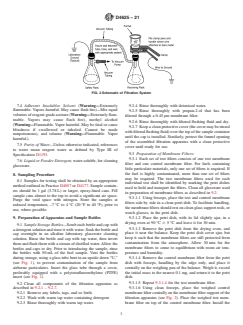
6.4 Filtration System—Arrange the following components
as shown in Fig. 2.
6.4.1 Funnel and Funnel Base, with filter support for a
47 mm diameter membrane and a locking ring or spring action
clip.
6.4.2 Ground/Bond Wire, 0.912 mm to 2.59 mm (No. 10 to
No. 19) bare-stranded, flexible stainless steel or copper in-
stalled in the flasks and grounded as shown in Fig. 2.
6.4.3 Receiving Flask, 1.5 L, or larger, borosilicate glass
vacuum filter flask, into which the filtration apparatus fits,
equipped with a sidearm to connect to the safety flask.
FIG. 1 Sample Storage Container
6.4.4 Safety Flask, 1.5 L, or larger, borosilicate glass
vacuum filter flask equipped with a sidearm to connect the
vacuum system. A fuel and solvent resistant rubber hose,
3.2.4 total insolubles, n—thearithmeticsumofthefilterable
through which the grounding wire passes, shall connect the
insolubles plus the adherent insolubles.
sidearm of the receiving flask to the tube passing through the
rubber stopper in the top of the safety flask.
4. Summary of Test Method
6.4.5 Vacuum System, either a water-aspirated, or a
4.1 Four-hundred(400)mLvolumesoffilteredfuelareaged
mechanical, vacuum pump may be used if capable of produc-
by storage in borosilicate glass containers at 43 °C (110 °F) for
ingavacuumof80 kPato100 kPabelowatmosphericpressure
periods of 4, 8, 12, 18, and 24 weeks. If desired, perform
when measured at the receiving flask.
zero-week analyses on the same day as the other samples are
placedinstorage.Zero-weekdataareusedtoprovidebasedata
7. Reagents and Materials
and ensure satisfactory technique. After aging for a selected
7.1 Purity of Reagents—Reagent grade chemicals shall be
time period, a sample is removed from storage, cooled to room
used in all tests. Unless otherwise indicated, it is intended that
temperature, and analyzed for filterable insolubles and for
all reagents conform to the specifications of the Committee on
adherent insolubles.
Analytical Reagents of the American Chemical Society where
5. Significance and Use
such specifications are available. Other grades may be used,
provided it is first ascertained that the reagent is of sufficiently
5.1 Fuel oxidation and other degradative reactions leading
high purity to permit its use without lessening the accuracy of
to formation of sediment (and color) are mildly accelerated by
the determination.
the test conditions compared with typical storage conditions.
Test results have been shown to predict storage stability more
7.2 Nylon Test and Control Membrane Filters—plain,
reliablythanothermoreacceleratedtests.SeeAppendixX1for
47 mm diameter, nominal pore size 0.8 µm. (Membrane filters
information on the correlation of test results with actual field
with a grid imprinted on their surface may be used as control
storage.
membrane filters for identification.)
5.2 Because the storage periods are long (4 weeks to
7.3 Hydrocarbon Solvent, 2,2,4-trimethylpentane (iso-
24 weeks), the test method is not suitable for quality control
octane)—ASTM knock test reference fuel grade or equivalent,
testing, but does provide a tool for research on storage
prefiltered through two glass-fiber or nylon membrane filters,
properties of fuels.
nominal pore size 0.8 µm. (Warning—Extremely flammable.
Harmful if inhaled. Vapors may cause flash fire.)
5.3 Because environmental effects and the materials and
nature of tank construction affect storage stability, the results
obtained by this test are not necessarily the same as those
obtained during storage in a specific field storage situation.
ACS Reagent Chemicals, Specifications and Procedures for Reagents and
Standard-Grade Reference Materials, American Chemical Society, Washington,
6. Apparatus DC. For suggestions on the testing of reagents not listed by theAmerican Chemical
Society, see Analar Standards for Laboratory Chemicals, BDH Ltd., Poole, Dorset,
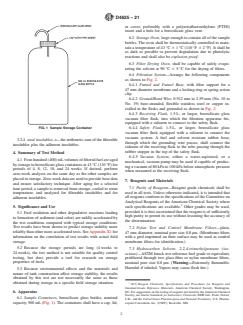
6.1 Sample Containers, borosilicate glass bottles, nominal
U.K., and the United States Pharmacopeia and National Formulary, U.S. Pharma-
capacity 500 mL (Fig. 1). The containers shall have a cap, lid, copeial Convention, Inc. (USPC), Rockville, MD.
D4625 − 21
FIG. 2 Schematic of Filtration System
7.4 Adherent Insolubles Solvent (Warning—Extremely 9.2.4 Rinse thoroughly with deionized water.
flammable. Vapors harmful. May cause flash fire)—Mix equal
9.2.5 Rinse thoroughly with propan-2-ol that has been
volumesofreagentgradeacetone(Warning—Extremelyflam-
filtered through a 0.45 µm membrane filter.
mable. Vapors may cause flash fire), methyl alcohol
9.2.6 Rinse thoroughly with filtered flushing fluid and dry.
(Warning—Flammable. Vapor harmful. May be fatal or cause
9.2.7 Keepacleanprotectivecover(thecovermayberinsed
blindness if swallowed or inhaled. Cannot be made
withfilteredflushingfluid)overthetopofthesamplecontainer
nonpoisonous), and toluene (Warning—Flammable. Vapor
until the cap is installed. Similarly, protect the funnel opening
harmful.).
of the assembled filtration apparatus with a clean protective
7.5 Purity of Water—Unless otherwise indicated, references
cover until ready for use.
to water mean reagent water as defined by Type III of
9.3 Preparation of Membrane Filters:
Specification D1193.
9.3.1 Each set of test filters consists of one test membrane
7.6 Liquid or Powder Detergent, water-soluble, for cleaning
filter and one control membrane filter. For fuels containing
glassware.
little particulate materials, only one set of filters is required. If
the fuel is highly contaminated, more than one set of filters
8. Sampling Procedure
may be required. The two membrane filters used for each
8.1 Samples for testing shall be obtained by an appropriate
individual test shall be identified by marking the petri dishes
method outlined in Practice D4057 or D4177. Sample contain-
used to hold and transport the filters. Clean all glassware used
ers should be 1 gal (3.78 L) or larger, epoxy-lined cans. Fill
in preparation of membrane filters as described in 9.2.
sample cans almost to the top to avoid a significant air space.
9.3.1.1 Using forceps, place the test and control membrane
Purge the void space with nitrogen. Store the samples at
filters side by side in a clean petri dish. To facilitate handling,
reduced temperature, –7 °C to 4 °C (20 °F to 40 °F), prior to
the membrane filters should rest on clean glass support rods, or
use, where possible.
watch glasses, in the petri dish.
9. Preparation of Apparatus and Sample Bottles 9.3.1.2 Place the petri dish, with its lid slightly ajar, in a
drying oven at 90 °C 6 5 °C and leave it for 30 min.
9.1 Sample Storage Bottles—Scrub each bottle and cap with
9.3.1.3 Remove the petri dish from the drying oven, and
a detergent solution and rinse it with water. Soak the bottle and
place it near the balance. Keep the petri dish cover ajar, but
cap overnight in an alkaline laboratory glassware cleaning
keep it such that the membrane filters are still protected from
solution. Rinse the bottle and cap with tap water, then invert
contamination from the atmosphere. Allow 30 min for the
them and flush them with a stream of distilled water.Allow the
membrane filters to come to equilibrium with room air tem-
bottles and caps to dry. Prior to introducing the sample, rinse
perature and humidity.
the bottles with 50 mL of the fuel sample. Vent the bottles
during storage, using a glass tube bent in an upside down “U,” 9.3.1.4 Remove the control membrane filter from the petri
(see Fig. 1), to prevent contamination of the sample from dish with forceps, handling by the edge only, and place it
airborne particulates. Insert the glass tube through a cover, centrally on the weighing pan of the balance.
...
This document is not an ASTM standard and is intended only to provide the user of an ASTM standard an indication of what changes have been made to the previous version. Because
it may not be technically possible to adequately depict all changes accurately, ASTM recommends that users consult prior editions as appropriate. In all cases only the current version
of the standard as published by ASTM is to be considered the official document.
´1
Designation: D4625 − 16 D4625 − 21
Standard Test Method for
Middle Distillate Fuel Storage Stability at 43 °C (110 °F)
This standard is issued under the fixed designation D4625; the number immediately following the designation indicates the year of
original adoption or, in the case of revision, the year of last revision. A number in parentheses indicates the year of last reapproval. A
superscript epsilon (´) indicates an editorial change since the last revision or reapproval.
This standard has been approved for use by agencies of the U.S. Department of Defense.
ε NOTE—The IP designation was removed and footnote 1 was revised editorially in February 2018.
1. Scope*
1.1 This test method covers a method for evaluating the inherent storage stability of distillate fuels having flash points above 38 °C
(100 °F), by Test Methods D93, and 90 % distilled points below 340 °C (644 °F), by Test Method D86.
NOTE 1—ASTM specification fuels falling within the scope of this test method are Specification D396, Grade Nos. 1 and 2; Specification D975, Grades
1-D and 2-D; and Specification D2880, Grades 1-GT and 2-GT.
1.2 This test method is not suitable for quality control testing but, rather it is intended for research use to shorten storage time
relative to that required at ambient storage temperatures.
1.3 Appendix X1 presents additional information about storage stability and the correlation of Test Method D4625 results with
sediment formation in actual field storage.
1.4 The values given in SI units are to be regarded as the standard.
1.4.1 Exception—The values in parentheses are for information only.
1.5 This standard does not purport to address all of the safety concerns, if any, associated with its use. It is the responsibility
of the user of this standard to establish appropriate safety, health, and environmental practices and determine the applicability of
regulatory limitations prior to use.
1.6 This international standard was developed in accordance with internationally recognized principles on standardization
established in the Decision on Principles for the Development of International Standards, Guides and Recommendations issued
by the World Trade Organization Technical Barriers to Trade (TBT) Committee.
2. Referenced Documents
2.1 ASTM Standards:
D86 Test Method for Distillation of Petroleum Products and Liquid Fuels at Atmospheric Pressure
D93 Test Methods for Flash Point by Pensky-Martens Closed Cup Tester
This test method is under the jurisdiction of ASTM Committee D02 on Petroleum Products, Liquid Fuels, and Lubricantsand is the direct responsibility of Subcommittee
D02.14 on on Stability, Cleanliness and Compatibility of Liquid Fuels.
Current edition approved Dec. 1, 2016Oct. 1, 2021. Published January 2017November 2021. Originally approved in 1986. Last previous edition approved in 20142016
ɛ1
as D4625 – 14.D4625 – 16 . DOI: 10.1520/D4625-16E01.10.1520/D4625-21.
For referenced ASTM standards, visit the ASTM website, www.astm.org, or contact ASTM Customer Service at service@astm.org. For Annual Book of ASTM Standards
volume information, refer to the standard’s Document Summary page on the ASTM website.
*A Summary of Changes section appears at the end of this standard
Copyright © ASTM International, 100 Barr Harbor Drive, PO Box C700, West Conshohocken, PA 19428-2959. United States
D4625 − 21
D381 Test Method for Gum Content in Fuels by Jet Evaporation
D396 Specification for Fuel Oils
D975 Specification for Diesel Fuel
D1193 Specification for Reagent Water
D2880 Specification for Gas Turbine Fuel Oils
D4057 Practice for Manual Sampling of Petroleum and Petroleum Products
D4175 Terminology Relating to Petroleum Products, Liquid Fuels, and Lubricants
D4177 Practice for Automatic Sampling of Petroleum and Petroleum Products
3. Terminology
3.1 Definitions:
3.1.1 For definitions of terms used in this test method, refer to Terminology D4175.
3.2 Definitions of Terms Specific to This Standard:
3.2.1 adherent insolubles, n—gums formed during storage that remain tightly attached to the walls of the vessel after fuel has been
flushed from the container.
3.2.2 filterable insolubles, n—solids formed during storage that can be removed from the fuel by filtration.
3.2.3 inherent storage stability, n—of middle distillate fuel—the resistance of the fuel to change during storage in contact with air,
but in the absence of other environmental factors such as water, or reactive metals and dirt.
3.2.4 total insolubles, n—the arithmetic sum of the filterable insolubles plus the adherent insolubles.
4. Summary of Test Method
4.1 Four-hundred (400) mL volumes of filtered fuel are aged by storage in borosilicate glass containers at 43 °C (110 °F) for
periods of 4, 8, 12, 18, and 24 weeks. If desired, perform zero-week analyses on the same day as the other samples are placed in
storage. Zero-week data are used to provide base data and ensure satisfactory technique. After aging for a selected time period,
a sample is removed from storage, cooled to room temperature, and analyzed for filterable insolubles and for adherent insolubles.
5. Significance and Use
5.1 Fuel oxidation and other degradative reactions leading to formation of sediment (and color) are mildly accelerated by the test
conditions compared with typical storage conditions. Test results have been shown to predict storage stability more reliably than
other more accelerated tests. See Appendix X1 for information on the correlation of test results with actual field storage.
5.2 Because the storage periods are long (4 weeks to 24 weeks), the test method is not suitable for quality control testing, but does
provide a tool for research on storage properties of fuels.
5.3 Because environmental effects and the materials and nature of tank construction affect storage stability, the results obtained
by this test are not necessarily the same as those obtained during storage in a specific field storage situation.
6. Apparatus
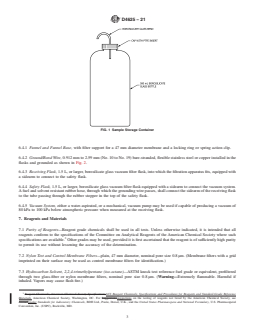
6.1 Sample Containers, borosilicate glass bottles, nominal capacity 500 mL (Fig. 1). The containers shall have a cap, lid, or cover,
preferably with a polytetrafluoroethylene (PTFE) insert and a hole for a borosilicate glass vent.
6.2 Storage Oven, large enough to contain all of the sample bottles. The oven shall be thermostatically controlled to maintain a
temperature of 43 °C 6 1 °C (110 °F 6 2 °F). It shall be as dark as possible to prevent degradation due to photolytic reactions
and shall also be explosion proof.
6.3 Filter Drying Oven, shall be capable of safely evaporating the solvent at 90 °C 6 5 °C for the drying of filters.
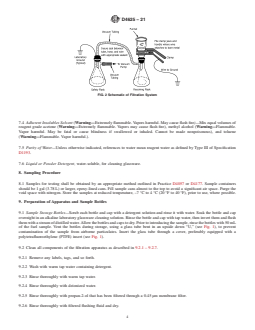
6.4 Filtration System—Arrange the following components as shown in Fig. 2.
D4625 − 21
FIG. 1 Sample Storage Container
6.4.1 Funnel and Funnel Base, with filter support for a 47 mm diameter membrane and a locking ring or spring action clip.
6.4.2 Ground/Bond Wire, 0.912 mm to 2.59 mm (No. 10 to No. 19) bare-stranded, flexible stainless steel or copper installed in the
flasks and grounded as shown in Fig. 2.
6.4.3 Receiving Flask, 1.5 L, or larger, borosilicate glass vacuum filter flask, into which the filtration apparatus fits, equipped with
a sidearm to connect to the safety flask.
6.4.4 Safety Flask, 1.5 L, or larger, borosilicate glass vacuum filter flask equipped with a sidearm to connect the vacuum system.
A fuel and solvent resistant rubber hose, through which the grounding wire passes, shall connect the sidearm of the receiving flask
to the tube passing through the rubber stopper in the top of the safety flask.
6.4.5 Vacuum System, either a water-aspirated, or a mechanical, vacuum pump may be used if capable of producing a vacuum of
80 kPa to 100 kPa below atmospheric pressure when measured at the receiving flask.
7. Reagents and Materials
7.1 Purity of Reagents—Reagent grade chemicals shall be used in all tests. Unless otherwise indicated, it is intended that all
reagents conform to the specifications of the Committee on Analytical Reagents of the American Chemical Society where such
specifications are available. Other grades may be used, provided it is first ascertained that the reagent is of sufficiently high purity
to permit its use without lessening the accuracy of the determination.
7.2 Nylon Test and Control Membrane Filters—plain, 47 mm diameter, nominal pore size 0.8 μm. (Membrane filters with a grid
imprinted on their surface may be used as control membrane filters for identification.)
7.3 Hydrocarbon Solvent, 2,2,4-trimethylpentane (iso-octane)—ASTM knock test reference fuel grade or equivalent, prefiltered
through two glass-fiber or nylon membrane filters, nominal pore size 0.8 μm. (Warning—Extremely flammable. Harmful if
inhaled. Vapors may cause flash fire.)
Reagent Chemicals, American Chemical Society Specifications,ACS Reagent Chemicals, Specifications and Procedures for Reagents and Standard-Grade Reference
Materials, American Chemical Society, Washington, DC. For Suggestionssuggestions on the testing of reagents not listed by the American Chemical Society, see
AnnualAnalar Standards for Laboratory Chemicals, BDH Ltd., Poole, Dorset, U.K., and the United States Pharmacopeia and National Formulary, U.S. Pharmacopeial
Convention, Inc. (USPC), Rockville, MD.
D4625 − 21
FIG. 2 Schematic of Filtration System
7.4 Adherent Insolubles Solvent (Warning—Extremely flammable. Vapors harmful. May cause flash fire)—Mix equal volumes of
reagent grade acetone (Warning—Extremely flammable. Vapors may cause flash fire), methyl alcohol (Warning—Flammable.
Vapor harmful. May be fatal or cause blindness if swallowed or inhaled. Cannot be made nonpoisonous), and toluene
(Warning—Flammable. Vapor harmful.).
7.5 Purity of Water—Unless otherwise indicated, references to water mean reagent water as defined by Type III of Specification
D1193.
7.6 Liquid or Powder Detergent, water-soluble, for cleaning glassware.
8. Sampling Procedure
8.1 Samples for testing shall be obtained by an appropriate method outlined in Practice D4057 or D4177. Sample containers
should be 1 gal (3.78 L) or larger, epoxy-lined cans. Fill sample cans almost to the top to avoid a significant air space. Purge the
void space with nitrogen. Store the samples at reduced temperature, –7 °C to 4 °C (20 °F to 40 °F), prior to use, where possible.
9. Preparation of Apparatus and Sample Bottles
9.1 Sample Storage Bottles—Scrub each bottle and cap with a detergent solution and rinse it with water. Soak the bottle and cap
overnight in an alkaline laboratory glassware cleaning solution. Rinse the bottle and cap with tap water, then invert them and flush
them with a stream of distilled water. Allow the bottles and caps to dry. Prior to introducing the sample, rinse the bottles with 50 mL
of the fuel sample. Vent the bottles during storage, using a glass tube bent in an upside down “U,” (see Fig. 1), to prevent
contamination of the sample from airborne particulates. Insert the glass tube through a cover, preferably equipped with a
polytetrafluoroethylene (PTFE) insert (see Fig. 1).
9.2 Clean all components of the filtration apparatus as described in 9.2.1 – 9.2.7.
9.2.1 Remove any labels, tags, and so forth.
9.2.2 Wash with warm tap water containing detergent.
9.2.3 Rinse thoroughly with warm tap water.
9.2.4 Rinse thoroughly with deionized water.
9.2.5 Rinse thoroughly with propan-2-ol that has been filtered through a 0.45 μm membrane filter.
9.2.6 Rinse thoroughly with filtered flushing fluid and dry.
D4625 − 21
9.2.7 Keep a clean protective cover (the cover may be rinsed with filtered flushing fluid) over the top of the sample container until
the cap is installed. Similarly, protect the funnel opening of the assembled filtration apparatus with a clean protective cover until
ready for use.
9.3 Preparation of Membrane Filters:
9.3.1 Each set of test filters consists of one test membrane filter and one control membrane filter. For fuels containing little
particulate materials, only one set of filters is required. If the fuel is highly contaminated, more than one set of filters may be
required. The two membrane filters used for each individual test shall be identified by marking the petri dishes used to hold and
transport the filters. Clean all glassware used in preparation of membrane filters as described in 9.2.
9.3.1.1 Using forceps, place the test and control membrane filters side by side in a clean petri dish. To facilitate handling, the
membrane filters should rest on clean glass support rods, or watch glasses, in the petri dish.
9.3.1.2 Place the petri dish, with its lid slightly ajar, in a drying oven at 90 °C 6 5 °C and leave it for 30 min.
9.3.1.3 Remove the petri dish from the drying oven, and place it near the balance. Keep the petri dish cover ajar, but keep it such
that th
...