

ASTM F2979-20
(Guide)Standard Guide for Characterization of Wear from the Articulating Surfaces in Retrieved Metal-on-Metal and other Hard-on-Hard Hip Prostheses
General Information
- Abstract
SCOPE
1.1 This standard guide provides options and a compendium of information for measuring the bearing surface and estimating the in-vivo wear of explanted Metal-on-Metal (MoM) and other “hard” (for example, ceramic) hip components. The guide covers the measurement of acetabular cups and femoral heads using a dimensional change method and is applicable to all prosthetic hip types, including stemmed (modular) and resurfacing hip systems.
1.2 The methods specified in this guide are not applicable for measuring the in-vivo wear from non-articulating surfaces, for example modular connections (at the stem/neck, neck/head, or cup liner/shell interface) or at the acetabular cup rim.
1.3 The parameters (wear depth and volumetric wear) evaluated and reported in this guide are estimated from the assumed as-manufactured shape of the components. The wear volume is calculated using a numerical integration method and the wear depth is the difference between the assumed as-manufactured shape and the measured surface.
1.4 This guide covers the measurement of the depth of wear and the volumetric wear using a Coordinate Measuring Machine (CMM) and the depth of wear using an Roundness Machine. Other metrology measurement equipment may be used to measure the wear depth or volume if the resolution and accuracy of the measurements are comparable with the instruments detailed in this standard. The measurement and analysis protocols should be based on those described in this standard.
1.5 This guide is applicable to hip joints which are nominally spherical at the time of manufacture. Form deviations resulting from manufacturing or deformation may occur and may necessitate the use of a non-spherical surface to represent the unworn surface of the component. Hip joints designed with asymmetry are considered beyond the scope of this guide, although the principles and techniques may be applicable to the characterization of wear from the articulating surfaces.
1.6 This guide is intended as an extension to Practice F561 as a Stage II nondestructive test.
1.7 This standard may involve hazardous materials, operations, and equipment. As a precautionary measure, explanted devices should be sterilized or disinfected by an appropriate means that does not adversely affect the implant or the associated tissue that may be the subject of subsequent analysis. A detailed discussion of precautions to be used in handling human tissues can be found in ISO 12891-1. This standard does not purport to address all of the safety concerns, if any, associated with its use. It is the responsibility of the user of this standard to establish appropriate safety, health, and environmental practices and determine the applicability of regulatory limitations prior to use.
1.8 This international standard was developed in accordance with internationally recognized principles on standardization established in the Decision on Principles for the Development of International Standards, Guides and Recommendations issued by the World Trade Organization Technical Barriers to Trade (TBT) Committee.
- Status
- Published
- Publication Date
- 14-Dec-2020
- Technical Committee
- F04 - Medical and Surgical Materials and Devices
- Drafting Committee
- F04.22 - Arthroplasty
Buy Documents
ASTM F2979-20 - Standard Guide for Characterization of Wear from the Articulating Surfaces in Retrieved Metal-on-Metal and other Hard-on-Hard Hip Prostheses
REDLINE ASTM F2979-20 - Standard Guide for Characterization of Wear from the Articulating Surfaces in Retrieved Metal-on-Metal and other Hard-on-Hard Hip Prostheses
Overview
ASTM F2979-20 is the Standard Guide for Characterization of Wear from the Articulating Surfaces in Retrieved Metal-on-Metal (MoM) and other Hard-on-Hard Hip Prostheses. Developed by ASTM International, this guide provides recommended options and methods for accurately measuring the bearing surfaces and estimating the in-vivo wear of explanted hard hip components, including both metal-on-metal and ceramic-on-ceramic hip prosthetics. The standard details dimensional change methodologies for both acetabular cups and femoral heads, supporting assessment across varying hip prosthesis designs such as modular, stemmed, and resurfacing systems.
Key Topics
- Wear Characterization Methods: Focuses on measurement of hip joint wear using both Coordinate Measuring Machines (CMM) and Roundness Machines.
- Measurement Parameters: Provides guidance on assessing wear depth and volumetric wear based on the difference between the manufactured shape and the current surface of the explanted device.
- Scope Limitations: The guide is specifically intended for articulating surfaces. It does not cover non-articulating zones such as modular connections or cup rims.
- Data Analysis: Describes approaches for fitting assumed unworn shapes, calculating root mean square error, and interpreting wear maps to separate true wear from manufacturing form deviations.
- Reporting Standards: Recommends thorough documentation of measurement equipment, calibration, measurement results, and graphical representations of wear patterns.
- Precision and Validation: Discusses the repeatability and reproducibility of the methods through interlaboratory studies, emphasizing the importance of validated and precise measurement protocols.
Applications
The ASTM F2979-20 standard is highly valuable in applications related to:
- Hip Implant Retrieval Analysis: Used by research laboratories, clinicians, and regulatory bodies to evaluate the wear performance of explanted hip prostheses and identify patterns related to implant longevity and design improvements.
- Implant Design Optimization: Helps manufacturers and designers understand clinical wear performance, supporting the development of more durable hip implants with optimized articulating surfaces.
- Quality Assurance: Ensures consistency and comparability in post-market surveillance and failure analysis by providing clear measurement and reporting guidance.
- Regulatory Submissions: Assists medical device companies in meeting important regulatory and compliance requirements for evidence of wear performance in metal-on-metal and hard-on-hard hip replacements.
- Comparison of Hip Systems: Facilitates the comparison of different hip joint prosthesis systems under standardized wear measurement methods, supporting objective evaluation of product safety and efficacy.
Related Standards
ASTM F2979-20 references and complements several other industry and international standards:
- ASTM F561: Practice for Retrieval and Analysis of Medical Devices, and Associated Tissues and Fluids - outlines general procedures for explant analysis.
- ASTM F2033: Specification for Total Hip Joint Prosthesis and Hip Endoprosthesis Bearing Surfaces Made of Metallic, Ceramic, and Polymeric Materials.
- ASTM E177 and E691: Practices for use of terms like precision and bias, and guidelines for interlaboratory studies.
- ISO 12181-1: Geometrical product specifications - focuses on roundness, vocabulary, and parameters.
- ISO 12891-1: Safety recommendations for handling and sterilizing retrieved implants and tissues - crucial for biosafety during analysis.
Practical Value
By following ASTM F2979-20, stakeholders in the orthopedic device industry can ensure objective, repeatable, and valid measurements of wear in retrieved hip joints. This supports reliable data for post-market surveillance, assists in identifying failure modes, and contributes to ongoing improvements in implant safety and longevity. The standard is an essential resource for biomedical engineers, orthopedic surgeons, device manufacturers, and regulatory professionals engaged in hip prosthesis analysis and quality assurance.
Relations
- Effective Date
- 01-Jan-2019
- Effective Date
- 01-May-2014
- Effective Date
- 01-Sep-2013
- Effective Date
- 01-May-2013
- Effective Date
- 01-May-2013
- Effective Date
- 01-Nov-2011
- Effective Date
- 01-Oct-2010
- Effective Date
- 01-Sep-2010
- Effective Date
- 01-Oct-2008
- Effective Date
- 01-Oct-2008
- Refers
ASTM E177-06b - Standard Practice for Use of the Terms Precision and Bias in ASTM Test Methods - Effective Date
- 15-Nov-2006
- Refers
ASTM E177-06a - Standard Practice for Use of the Terms Precision and Bias in ASTM Test Methods - Effective Date
- 01-Nov-2006
- Effective Date
- 01-Nov-2005
- Effective Date
- 01-Oct-2005
- Effective Date
- 01-Jun-2005
Buy Documents
ASTM F2979-20 - Standard Guide for Characterization of Wear from the Articulating Surfaces in Retrieved Metal-on-Metal and other Hard-on-Hard Hip Prostheses
REDLINE ASTM F2979-20 - Standard Guide for Characterization of Wear from the Articulating Surfaces in Retrieved Metal-on-Metal and other Hard-on-Hard Hip Prostheses
Get Certified
Connect with accredited certification bodies for this standard

BSI Group
BSI (British Standards Institution) is the business standards company that helps organizations make excellence a habit.

TÜV Rheinland
TÜV Rheinland is a leading international provider of technical services.

TÜV SÜD
TÜV SÜD is a trusted partner of choice for safety, security and sustainability solutions.
Sponsored listings
Frequently Asked Questions
ASTM F2979-20 is a guide published by ASTM International. Its full title is "Standard Guide for Characterization of Wear from the Articulating Surfaces in Retrieved Metal-on-Metal and other Hard-on-Hard Hip Prostheses". This standard covers: SCOPE 1.1 This standard guide provides options and a compendium of information for measuring the bearing surface and estimating the in-vivo wear of explanted Metal-on-Metal (MoM) and other “hard” (for example, ceramic) hip components. The guide covers the measurement of acetabular cups and femoral heads using a dimensional change method and is applicable to all prosthetic hip types, including stemmed (modular) and resurfacing hip systems. 1.2 The methods specified in this guide are not applicable for measuring the in-vivo wear from non-articulating surfaces, for example modular connections (at the stem/neck, neck/head, or cup liner/shell interface) or at the acetabular cup rim. 1.3 The parameters (wear depth and volumetric wear) evaluated and reported in this guide are estimated from the assumed as-manufactured shape of the components. The wear volume is calculated using a numerical integration method and the wear depth is the difference between the assumed as-manufactured shape and the measured surface. 1.4 This guide covers the measurement of the depth of wear and the volumetric wear using a Coordinate Measuring Machine (CMM) and the depth of wear using an Roundness Machine. Other metrology measurement equipment may be used to measure the wear depth or volume if the resolution and accuracy of the measurements are comparable with the instruments detailed in this standard. The measurement and analysis protocols should be based on those described in this standard. 1.5 This guide is applicable to hip joints which are nominally spherical at the time of manufacture. Form deviations resulting from manufacturing or deformation may occur and may necessitate the use of a non-spherical surface to represent the unworn surface of the component. Hip joints designed with asymmetry are considered beyond the scope of this guide, although the principles and techniques may be applicable to the characterization of wear from the articulating surfaces. 1.6 This guide is intended as an extension to Practice F561 as a Stage II nondestructive test. 1.7 This standard may involve hazardous materials, operations, and equipment. As a precautionary measure, explanted devices should be sterilized or disinfected by an appropriate means that does not adversely affect the implant or the associated tissue that may be the subject of subsequent analysis. A detailed discussion of precautions to be used in handling human tissues can be found in ISO 12891-1. This standard does not purport to address all of the safety concerns, if any, associated with its use. It is the responsibility of the user of this standard to establish appropriate safety, health, and environmental practices and determine the applicability of regulatory limitations prior to use. 1.8 This international standard was developed in accordance with internationally recognized principles on standardization established in the Decision on Principles for the Development of International Standards, Guides and Recommendations issued by the World Trade Organization Technical Barriers to Trade (TBT) Committee.
SCOPE 1.1 This standard guide provides options and a compendium of information for measuring the bearing surface and estimating the in-vivo wear of explanted Metal-on-Metal (MoM) and other “hard” (for example, ceramic) hip components. The guide covers the measurement of acetabular cups and femoral heads using a dimensional change method and is applicable to all prosthetic hip types, including stemmed (modular) and resurfacing hip systems. 1.2 The methods specified in this guide are not applicable for measuring the in-vivo wear from non-articulating surfaces, for example modular connections (at the stem/neck, neck/head, or cup liner/shell interface) or at the acetabular cup rim. 1.3 The parameters (wear depth and volumetric wear) evaluated and reported in this guide are estimated from the assumed as-manufactured shape of the components. The wear volume is calculated using a numerical integration method and the wear depth is the difference between the assumed as-manufactured shape and the measured surface. 1.4 This guide covers the measurement of the depth of wear and the volumetric wear using a Coordinate Measuring Machine (CMM) and the depth of wear using an Roundness Machine. Other metrology measurement equipment may be used to measure the wear depth or volume if the resolution and accuracy of the measurements are comparable with the instruments detailed in this standard. The measurement and analysis protocols should be based on those described in this standard. 1.5 This guide is applicable to hip joints which are nominally spherical at the time of manufacture. Form deviations resulting from manufacturing or deformation may occur and may necessitate the use of a non-spherical surface to represent the unworn surface of the component. Hip joints designed with asymmetry are considered beyond the scope of this guide, although the principles and techniques may be applicable to the characterization of wear from the articulating surfaces. 1.6 This guide is intended as an extension to Practice F561 as a Stage II nondestructive test. 1.7 This standard may involve hazardous materials, operations, and equipment. As a precautionary measure, explanted devices should be sterilized or disinfected by an appropriate means that does not adversely affect the implant or the associated tissue that may be the subject of subsequent analysis. A detailed discussion of precautions to be used in handling human tissues can be found in ISO 12891-1. This standard does not purport to address all of the safety concerns, if any, associated with its use. It is the responsibility of the user of this standard to establish appropriate safety, health, and environmental practices and determine the applicability of regulatory limitations prior to use. 1.8 This international standard was developed in accordance with internationally recognized principles on standardization established in the Decision on Principles for the Development of International Standards, Guides and Recommendations issued by the World Trade Organization Technical Barriers to Trade (TBT) Committee.
ASTM F2979-20 is classified under the following ICS (International Classification for Standards) categories: 11.040.40 - Implants for surgery, prosthetics and orthotics. The ICS classification helps identify the subject area and facilitates finding related standards.
ASTM F2979-20 has the following relationships with other standards: It is inter standard links to ASTM F561-19, ASTM E177-14, ASTM F561-13, ASTM E691-13, ASTM E177-13, ASTM E691-11, ASTM E177-10, ASTM F561-05a(2010), ASTM E177-08, ASTM E691-08, ASTM E177-06b, ASTM E177-06a, ASTM E691-05, ASTM F561-05a, ASTM F2033-05. Understanding these relationships helps ensure you are using the most current and applicable version of the standard.
ASTM F2979-20 is available in PDF format for immediate download after purchase. The document can be added to your cart and obtained through the secure checkout process. Digital delivery ensures instant access to the complete standard document.
Standards Content (Sample)
This international standard was developed in accordance with internationally recognized principles on standardization established in the Decision on Principles for the
Development of International Standards, Guides and Recommendations issued by the World Trade Organization Technical Barriers to Trade (TBT) Committee.
Designation: F2979 − 20
Standard Guide for
Characterization of Wear from the Articulating Surfaces in
Retrieved Metal-on-Metal and other Hard-on-Hard Hip
Prostheses
This standard is issued under the fixed designation F2979; the number immediately following the designation indicates the year of
original adoption or, in the case of revision, the year of last revision. A number in parentheses indicates the year of last reapproval. A
superscript epsilon (´) indicates an editorial change since the last revision or reapproval.
1. Scope althoughtheprinciplesandtechniquesmaybeapplicabletothe
characterization of wear from the articulating surfaces.
1.1 Thisstandardguideprovidesoptionsandacompendium
of information for measuring the bearing surface and estimat-
1.6 This guide is intended as an extension to Practice F561
ing the in-vivo wear of explanted Metal-on-Metal (MoM) and
as a Stage II nondestructive test.
other “hard” (for example, ceramic) hip components. The
1.7 This standard may involve hazardous materials,
guide covers the measurement of acetabular cups and femoral
operations, and equipment. As a precautionary measure, ex-
heads using a dimensional change method and is applicable to
planted devices should be sterilized or disinfected by an
all prosthetic hip types, including stemmed (modular) and
appropriate means that does not adversely affect the implant or
resurfacing hip systems.
the associated tissue that may be the subject of subsequent
1.2 The methods specified in this guide are not applicable
analysis. A detailed discussion of precautions to be used in
for measuring the in-vivo wear from non-articulating surfaces,
handling human tissues can be found in ISO 12891-1. This
forexamplemodularconnections(atthestem/neck,neck/head,
standard does not purport to address all of the safety concerns,
or cup liner/shell interface) or at the acetabular cup rim.
if any, associated with its use. It is the responsibility of the user
1.3 The parameters (wear depth and volumetric wear) of this standard to establish appropriate safety, health, and
evaluated and reported in this guide are estimated from the environmental practices and determine the applicability of
assumed as-manufactured shape of the components. The wear regulatory limitations prior to use.
volume is calculated using a numerical integration method and
1.8 This international standard was developed in accor-
the wear depth is the difference between the assumed as-
dance with internationally recognized principles on standard-
manufactured shape and the measured surface.
ization established in the Decision on Principles for the
Development of International Standards, Guides and Recom-
1.4 This guide covers the measurement of the depth of wear
mendations issued by the World Trade Organization Technical
and the volumetric wear using a Coordinate Measuring Ma-
Barriers to Trade (TBT) Committee.
chine (CMM) and the depth of wear using an Roundness
Machine. Other metrology measurement equipment may be
2. Referenced Documents
used to measure the wear depth or volume if the resolution and
accuracy of the measurements are comparable with the instru-
2.1 ASTM Standards:
ments detailed in this standard. The measurement and analysis
E177 Practice for Use of the Terms Precision and Bias in
protocols should be based on those described in this standard.
ASTM Test Methods
1.5 This guide is applicable to hip joints which are nomi- E691 Practice for Conducting an Interlaboratory Study to
nally spherical at the time of manufacture. Form deviations
Determine the Precision of a Test Method
resulting from manufacturing or deformation may occur and F561 Practice for Retrieval and Analysis of Medical
may necessitate the use of a non-spherical surface to represent
Devices, and Associated Tissues and Fluids
the unworn surface of the component. Hip joints designed with F2033 Specification for Total Hip Joint Prosthesis and Hip
asymmetry are considered beyond the scope of this guide,
Endoprosthesis Bearing Surfaces Made of Metallic,
Ceramic, and Polymeric Materials
This guide is under the jurisdiction of ASTM Committee F04 on Medical and
Surgical Materials and Devices and is the direct responsibility of Subcommittee
F04.22 on Arthroplasty. For referenced ASTM standards, visit the ASTM website, www.astm.org, or
Current edition approved Dec. 15, 2020. Published January 2021. Originally contact ASTM Customer Service at service@astm.org. For Annual Book of ASTM
approved in 2014. Last previous edition approved in 2014 as F2979 – 14. DOI: Standards volume information, refer to the standard’s Document Summary page on
10.1520/F2979-20. the ASTM website.
Copyright © ASTM International, 100 Barr Harbor Drive, PO Box C700, West Conshohocken, PA 19428-2959. United States
F2979 − 20
2.2 ISO Standard: 3.1.5 maximum inscribed reference circle—largest possible
ISO 12181-1-2011 Part 1—Geometrical Product Specifica- circle that can be fitted within the roundness profile. ISO
tions Roundness, Vocabulary and Parameters of Round- 12181-1-2011
ness
3.1.6 minimum circumscribed reference circle—smallest
possible circle that can be fitted around the roundness profile.
3. Terminology
ISO 12181-1-2011
3.1 Definitions of Terms Specific to This Standard:
3.1.7 pole of articulating surface—the pole of an articulat-
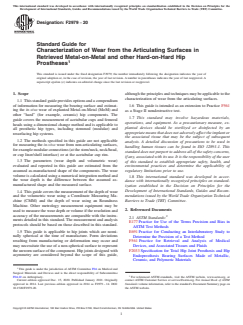
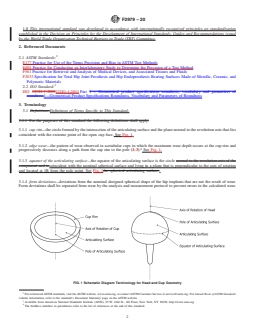
3.1.1 cup rim—the circle formed by the intersection of the
ing surface is defined by a point at the intercept of the
articulating surface and the plane normal to the revolution axis
revolution axis of the component and the spherical articulation
thatliescoincidentwiththeextremepointoftheopencupface.
surface. See Fig. 1.
See Fig. 1.
3.1.8 root mean square error—the statistical measure of the
3.1.2 edge wear—the pattern of wear observed in acetabular
magnitude of the variation between the assumed manufactured
cups in which the maximum wear depth occurs at the cup rim
component shape fitted to the unworn regions and the mea-
andprogressivelydeceasesalongapathfromthecuprimtothe
sured data points in the unworn regions.
pole (1-3). See Fig. 1.
RMS Error 5 1⁄ n Σ x 2 (1)
~ !
n
3.1.3 equator of the articulating surface—the equator of the
articulating surface is the circle coincident with the nominal
where:
spherical surface and lying in a plane that is perpendicular to
x = the deviation between the assumed shape and each
the axis of rotation and located at 1R from the pole point. See
measured data point for n data points.
Fig. 1.
3.1.9 volumetric wear—the volume of material removed
3.1.4 form deviations—deviations from the nominal de-
from the articulating surface as a result of in-vivo wear.
signedsphericalshapeofthehipimplantsthatarenottheresult
3.1.10 wear—deviations from the as-manufactured shape
of wear. Form deviations shall be separated from wear by the
due to loss of material from the articulating surfaces of the
analysis and measurement protocol to prevent errors in the
components through abrasive, adhesive, or fatigue wear
calculated wear. Form deviations may result from manufactur-
mechanisms, or by corrosion, or any combination of these
ing tolerances or deformation during implantation or revision
mechanisms.
procedures.Typically, hip implants are symmetrical around the
3.1.11 wear depth—the maximum penetration normal to the
revolution axis.
articulating surface due to in-vivo wear.
3.1.12 wear rate—the volumetric wear rate (mm /year) or
the penetration wear rate (mm/year) is calculated by dividing
Available fromAmerican National Standards Institute (ANSI), 25 W. 43rd St.,
the wear volume or maximum wear depth by the time
4th Floor, New York, NY 10036, http://www.ansi.org.
The boldface numbers in parentheses refer to the list of references at the end of implanted in years. The wear rate is an average of the wear
this standard.
FIG. 1 Schematic Diagram Terminology for Head and Cup Geometry
F2979 − 20
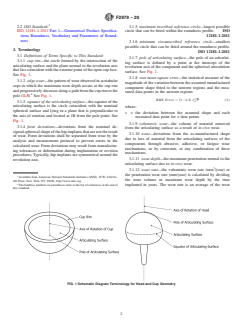
over the life of the component. The wear rate of hip joints may 5.1.2 Measure data points from the bearing surface so that
change over the life of component with an initial “running in” the maximum spacing between the data points along lines of
or “bedding-in” wear rate and the subsequent lower “steady
latitude or longitude is not greater than 0.5 mm (5) as shown in
state” wear rate (4).
Fig. 2. The mesh may be applied and profiles measured in a
latitudinal or longitudinal pattern, or a combination to give the
4. Measurement Preparation
optimum point spacing over the component. The distance
4.1 All components shall be cleaned in accordance with the between the measured data points and the cup rim shall not be
procedure detailed in Practice F561. Ensure that there are no greater than 1 mm.
deposits on the articulating surface of the components that
NOTE 3—The 0.5 mm mesh spacing is based on minimizing the errors
might interfere with or induce errors in the measurements.
of calculating the wear volume when using a simple linear “triangulation”
4.2 The temperature of the analysis laboratory shall be
integration method to calculate the wear volume (5). A larger point
spacing may be used if a sensitivity analysis is carried out to investigate
maintained at 20 °C 6 2 °C and other environmental param-
the effect of mesh spacing on the wear depth and volume, and the values
eters within specified range for measurement machine. The
can be shown to converge.
components shall be maintained at the temperature of the
analysis laboratory for at least 24 h before the measurement to
5.2 Measurement of Femoral Head:
ensure dimensional stability.
5.2.1 Align the origin of the CMM coordinate system with
4.3 Apparatus—3D coordinate measuring machine with a
the center of the unworn regions of the articulating surface of
maximum permissible error of 2 µm over the largest dimension
the component, with the revolution axis of the head perpen-
of the component, or a computer numerical control (CNC)
dicular to the coordinate system horizontal plane. Nondestruc-
controlled roundness machine with automated centering and
tively mark the retrieved component, or identify a landmark
leveling. The maximum runout of the air-bearing spindle shall
feature to provide an angular reference around the axis of
be 620 nm, and the minimum gauge resolution shall be 630
rotational symmetry.
nm.
NOTE 1—When centering and leveling to align the component coordi- NOTE 4—The components must be firmly held for the measurement to
nate system with the machine coordinate system, care must be taken to prevent movement, but care must be taken not to distort the bearing
reference from unworn regions of the component.
surface or damage the component.
NOTE 2—Measuring machines with a larger error may be used if the
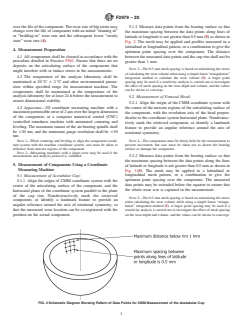
5.2.2 Measure data points from the bearing surface so that
measurement and analysis protocol is validated.
the maximum spacing between the data points along the lines
5. Measurement of Components Using a Coordinate
of latitude or longitude is not greater than 0.5 mm as shown in
Measuring Machine
Fig. 3 (5). The mesh may be applied in a latitudinal or
longitudinal mesh pattern, or a combination to give the
5.1 Measurement of Acetabular Cup:
optimum point spacing over the component. The measured
5.1.1 Align the origin of CMM coordinate system with the
data points may be extended below the equator to ensure that
center of the articulating surface of the component, and the
the whole wear scar is captured in the measurement.
horizontal plane of the coordinate system parallel to the plane
of the cup rim. Nondestructively mark the retrieved
NOTE 5—The 0.5 mm mesh spacing is based on minimizing the errors
component, or identify a landmark feature to provide an
when calculating the wear volume while using a simple linear “triangu-
angular reference around the axis of rotational symmetry, so
lation” integration method (5). A larger point spacing may be used if a
that the measured wear location can be co-registered with the
sensitivity analysis is carried out to investigate the effect of mesh spacing
position on the actual component. on the wear depth and volume, and the values can be shown to converge.
FIG. 2 Schematic Diagram Showing Pattern of Data Points for CMM Measurement of the Acetabular Cup
F2979 − 20
FIG. 3 Schematic Diagram Showing Pattern of Data Points for CMM Measurement of the Femoral Head
6. Analysis of CMM Measurements deviations are not axisymmetric. As-manufactured acetabular
cups are also often axisymmetric due to the manufacturing
6.1 Fit the assumed unworn shape of the component.
process;however,explantedcomponentsmaybepinchedatthe
Published studies have used ellipsoids, spheres, or nurbs
rim giving an oval shape. Care must be taken excluding this
profiles (6-13) to represent the unworn (but possible deformed)
ovality from wear.
shape of the hip component. The assumed unworn shape
should be fitted to the measured data points in the unworn
6.3 Check the fit of the assumed unworn shape by calculat-
regions, excluding the data points that are within the worn ing the Root Mean Square (RMS) error between the assumed
region and/or surface deposits. Several of the published meth-
unworn shape and the measured data points in the unworn
ods use a two-stage or an iterative process to fit the surface and region of the hip component (9). If the calculated RMS error
exclude worn regions from the surface fit (6-13).
exceeds 2 µm, the wear maps must be inspected to ensure the
assumed unworn shape is a good fit.
NOTE 6—Specification F2033 specifies that the maximum departure
from roundness for metallic components shall not be greater than 5 µm for
NOTE 8—Care must be taken when using the RMS error to check the fit
the acetabular component and 5 µm for the femoral component using a
of the assumed unworn shape as the RMS error will typically decrease as
least squares or Minimum Zone Centre Method. Due to these deviations,
morepointsareexcludedfromthefit.However,inthecaseofcomponents
and possible deformation during implantation or revision procedures,
with a form deviation removing data points in unworn regions will reduce
fitting a sphere to the unworn data points might result in significant errors
the RMS error, but as the proportion of the unworn surface used to fit the
in the calculated wear values. In some cases, ellipsoids and other shapes
surfacedecreases,thequalityofthefitmaydecrease.TheRMSerrormust
have been shown to better represent the unworn shape of MoM hip
be used in conjunction with the wear maps to ensure that data points in
components than a simple sphere (10).
unworn regions are not unnecessarily excluded.
NOTE 7—The measurements of acetabular cups will often include the
transition between the bearing surface and cup rim, which is typically 6.4 The wear map should be visually co-registered with the
filleted during manufacture. This filleted region should be excluded from
explanted component to ensure that the wear map is consistent
the analysis; however, care must be taken not to exclude data points
with the visual evidence of wear and damage on the compo-
measured on the bearing surface.
nent.Forexample,sometimestheremaybeachangeinsurface
6.2 Visually check the fit of the assumed unworn shape by
appearance in the worn region, the edge of the wear scar may
looking at a graphical illustration of the deviations from the
be visible in the protein deposits, or in the case of edge worn
assumed unworn shape in the unworn regions of the compo-
cups the wear may be visible at the transition between bearing
nent.Thecolorscaleshouldbesettooptimizethesedeviations,
surface and cup rim.
not the appearance of the worn regions. Typically, a scale of
6.5 If the whole wear area is not wholly captured within the
610 µm allows the visualization of form deviations. Normally,
measurement region and extends below the equator of the
the assumed unworn shape should match the measured unworn
head, then the measurement shall be repeated to include the
regions on the surface of the component, with the only
whole area of the wear area.
substantial deviations being attributed to form and not a poor
fit. In the case of femoral heads, the components are often 6.6 The maximum depth of wear shall be taken as the
axisymmetric due to the manufacturing process; thus, the form maximum deviation between a point on the measured worn
deviations will typically appear axisymmetric around the pole surface and a point on the assumed unworn articular surface
with wear appearing as a more localized deviation. Wear along a line normal to the assumed unworn articular surface.
F2979 − 20
NOTE 9—The stylus will mechanically filter scratches and other short
wear depth or wear volume by the time implanted to give the
wavelength surface roughness features and, due to the point spacing, short
wear rate (µm/year) and the volumetric wear rate (mm /year)
wavelength surface roughness features may not be measured. However,
for the head and cup.
the depth of scratches will typically be small compared to the measured
maximumweardepth.Carmignatoetal. (14)evaluatedthecontributionof
surface roughness on the estimation of wear volume and concluded that it 7. Measurement and Analysis of Components Using a
“hardly reaches 0.5 mm when the roughness Ra of the worn areas is not
Roundness Machine
greater than 0.3 µm.”
7.1 Measurement of Acetabular Cup:
6.7 Use a numerical method to calculate the wear volume
7.1.1 Cup Circumferential Measurement:
over the worn regions of the component by calculating the
7.1.1.1 Calibrate the radial position of the roundness ma-
volume between the assumed unworn shape of the component
chine radial arm so that the machine gives absolute measure-
and the worn region.
ment values.
NOTE 10—Differences in algorithms used to calculate the wear volume
7.1.1.2 Alignthecuprevolutionaxiswiththespindleaxisof
mayresultinvariationsinthewearvolumes.Scratching,indentations,and
deformation attributed to the explantation process and/or handling after
rotation of the roundness machine and the cup rim plane
explantation should not be included in the wear depth and volume
perpendicular to the spindle axis of rotation using automatic
estimates.
centeringandle
...
This document is not an ASTM standard and is intended only to provide the user of an ASTM standard an indication of what changes have been made to the previous version. Because
it may not be technically possible to adequately depict all changes accurately, ASTM recommends that users consult prior editions as appropriate. In all cases only the current version
of the standard as published by ASTM is to be considered the official document.
Designation: F2979 − 14 F2979 − 20
Standard Guide for
Characterization of Wear from the Articulating Surfaces in
Retrieved Metal-on-Metal and other Hard-on-Hard Hip
Prostheses
This standard is issued under the fixed designation F2979; the number immediately following the designation indicates the year of
original adoption or, in the case of revision, the year of last revision. A number in parentheses indicates the year of last reapproval. A
superscript epsilon (´) indicates an editorial change since the last revision or reapproval.
1. Scope
1.1 This guide specifies a method to measure the standard guide provides options and a compendium of information for measuring
the bearing surface and estimating the in-vivo wear of explanted Metal-on-Metal (MoM) and other “hard” (e.g., (for example,
ceramic) hip components. The guide covers the measurement of acetabular cups and femoral heads using a dimensional change
method and is applicable to all prosthetic hip types, including stemmed (modular) and resurfacing hip systems.
1.2 The methods specified in this guide are not applicable for measuring the in-vivo wear from non-articulating surfaces, for
example modular connections (at the stem/neck, neck/headneck/head, or cup liner/shell interface) or at the acetabular cup rim.
1.3 The parameters (wear depth and volumetric wear) evaluated and reported in this guide are estimated from the assumed
as-manufactured shape of the components. The wear volume is calculated using a numerical integration method and the wear depth
is the difference between the assumed as-manufactured shape and the measured surface.
1.4 This guide covers the measurement of the depth of wear and the volumetric wear using a Coordinate Measuring Machine
(CMM) and the depth of wear using an Roundness Machine. Other metrology measurement equipment may be used to measure
the wear depth or volume if the resolution and accuracy of the measurements are comparable with the instruments detailed in this
standard. The measurement and analysis protocols should be based on those described in this standard.
1.5 This guide is applicable to hip joints which are nominally spherical at the time of manufacture. Form deviations resulting from
manufacturing or deformation may occur and may necessitate the use of a non-spherical surface to represent the unworn surface
of the component. Hip joints designed with asymmetry are considered beyond the scope of this guide, although the principles and
techniques may be applicable to the characterization of wear from the articulating surfaces.
1.6 This guide is intended as an extension to ASTMPractice F561 as a Stage II nondestructive test.
1.7 This standard may involve hazardous materials, operations, and equipment. As a precautionary measure, explanted devices
should be sterilized or disinfected by an appropriate means that does not adversely affect the implant or the associated tissue that
may be the subject of subsequent analysis. A detailed discussion of precautions to be used in handling human tissues can be found
in ISO 12891-1. This standard does not purport to address all of the safety concerns, if any, associated with its use. It is the
responsibility of the user of this standard to establish appropriate safety safety, health, and healthenvironmental practices and
determine the applicability of regulatory limitations prior to use.
This test method guide is under the jurisdiction of ASTM Committee F04 on Medical and Surgical Materials and Devices and is the direct responsibility of Subcommittee
F04.22 on Arthroplasty.
Current edition approved Feb. 1, 2014Dec. 15, 2020. Published April 2014January 2021. Originally approved in 2014. Last previous edition approved in 2014 as
F2979 – 14. DOI: 10.1520/F2979-14.10.1520/F2979-20.
Copyright © ASTM International, 100 Barr Harbor Drive, PO Box C700, West Conshohocken, PA 19428-2959. United States
F2979 − 20
1.8 This international standard was developed in accordance with internationally recognized principles on standardization
established in the Decision on Principles for the Development of International Standards, Guides and Recommendations issued
by the World Trade Organization Technical Barriers to Trade (TBT) Committee.
2. Referenced Documents
2.1 ASTM Standards:
E177 Practice for Use of the Terms Precision and Bias in ASTM Test Methods
E691 Practice for Conducting an Interlaboratory Study to Determine the Precision of a Test Method
F561 Practice for Retrieval and Analysis of Medical Devices, and Associated Tissues and Fluids
F2033 Specification for Total Hip Joint Prosthesis and Hip Endoprosthesis Bearing Surfaces Made of Metallic, Ceramic, and
Polymeric Materials
2.2 ISO Standard:
ISO 12181-1-200312181-1-2011 Part 1 – Geometrical product specifications roundness, vocabulary and parameters of
roundness1—Geometrical Product Specifications Roundness, Vocabulary and Parameters of Roundness
3. Terminology
3.1 Definitions:Definitions of Terms Specific to This Standard:
3.1.1 For the purposes of this standard the following definitions shall apply.
3.1.1 cup rim—the circle formed by the intersection of the articulating surface and the plane normal to the revolution axis that lies
coincident with the extreme point of the open cup face. See Fig. 1.
3.1.2 edge wear—the pattern of wear observed in acetabular cups in which the maximum wear depth occurs at the cup rim and
progressively deceases along a path from the cup rim to the pole (1-3). See Fig. 1.
3.1.3 equator of the articulating surface—the equator of the articulating surface is the circle normal to the revolution axis of the
component and tocoincident with the nominal spherical surface and lying in a plane that is perpendicular to the axis of rotation
and located at 1R from the pole point. See Fig. 1the spherical articulating surface.
3.1.4 form deviations—deviations from the nominal designed spherical shape of the hip implants that are not the result of wear.
Form deviations shall be separated from wear by the analysis and measurement protocol to prevent errors in the calculated wear.
FIG. 1 Schematic Diagram Terminology for Head and Cup Geometry
For referenced ASTM standards, visit the ASTM website, www.astm.org, or contact ASTM Customer Service at service@astm.org. For Annual Book of ASTM Standards
volume information, refer to the standard’s Document Summary page on the ASTM website.
Available from American National Standards Institute (ANSI), 25 W. 43rd St., 4th Floor, New York, NY 10036, http://www.ansi.org.
The boldface numbers in parentheses refer to the list of references at the end of this standard.
F2979 − 20
Form deviations may result from manufacturing tolerances or deformation during implantation or revision procedures. Typically,
hip implants are symmetrical around the revolution axis.
3.1.5 maximum inscribed reference circle—the reference circle of maximum radius that is totally enclosed by the measuredlargest
possible circle that can be fitted within the roundness profile. ISO 12181-1-200312181-1-2011
3.1.6 minimum circumscribed arc—reference circle—the reference arc of the minimum radius that totally encloses the
measuredsmallest possible circle that can be fitted around the roundness profile. ISO 12181-1-200312181-1-2011
3.1.7 pole of articulating surface—the pole of an articulating surface is defined by a point at the intercept of the revolution axis
of the component and the spherical articulation surface. See Fig. 1.
3.1.8 root mean square error—the statistical measure of the magnitude of the variation between the assumed manufactured
component shape fitted to the unworn regions and the measured data points in the unworn regions.
RMS Error 5 ~1 ⁄ n Σ x ! (1)
n
where:
x = the deviation between the assumed shape and each measured data point for n data points.
3.1.9 volumetric wear—the volume of material removed from the articulating surface as a result of in-vivo wear.
3.1.10 wear—deviations from the as-manufactured shape due to loss of material from the articulating surfaces of the components
through abrasive, adhesive, or fatigue wear mechanisms, or by corrosion, or any combination of these mechanisms.
3.1.11 wear depth—the maximum penetration normal to the articulating surface due to in-vivo wear.
3.1.12 wear rate—the volumetric wear rate (mm /year) or the penetration wear rate (mm/year) is calculated by dividing the wear
volume or maximum wear depth by the time implanted in years. The wear rate is an average of the wear over the life of the
component. The wear rate of hip joints may change over the life of component with an initial “running in” or “bedding-in” wear
rate and the subsequent lower “steady state” wear rate (4).
4. Measurement Preparation
4.1 All components shall be cleaned in accordance with the procedure detailed in ASTMPractice F561. Ensure that there are no
deposits on the articulating surface of the components that might interfere with or induce errors in the measurements.
4.2 The temperature of the analysis laboratory shall be maintained at 20°C 6 2°C. 20 °C 6 2 °C and other environmental
parameters within specified range for measurement machine. The components shall be maintained at the temperature of the
analysis laboratory for at least 24 hoursh before the measurement to ensure dimensional stability.
4.3 Apparatus—3D Coordinatecoordinate measuring machine with a maximum permissible error of 2 μm over the largest
dimension of the component, or a computer numerical control (CNC) controlled Roundness Machineroundness machine with
automated centering and leveling. The maximum runout of the air-bearing spindle shall be 6 20 620 nm, and the minimum gauge
resolution shall be 6 30 630 nm.
NOTE 1—When centering and leveling to align the component coordinate system with the machine coordinate system, care must be taken to reference
from unworn regions of the component.
NOTE 2—Measuring machines with a larger error may be used if the measurement and analysis protocol is validated.
5. Measurement of Components Using a Coordinate Measuring Machine
5.1 Measurement of Acetabular Cup:
5.1.1 Align the origin of CMM coordinate system with the center of the articulating surface of the component, and the horizontal
F2979 − 20
plane of the coordinate system parallel to the plane of the cup rim. Nondestructively mark the retrieved component, or identify
a landmark feature to provide an angular reference around the axis of rotational symmetry, so that the measured wear location can
be co-registered with the position on the actual component.
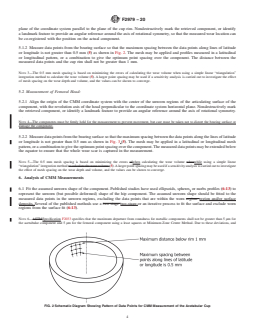
5.1.2 Measure data points from the bearing surface so that the maximum spacing between the data points along lines of latitude
or longitude is not greater than 0.5 mm (5) as shown in Fig. 2. The mesh may be applied and profiles measured in a latitudinal
or longitudinal pattern, or a combination to give the optimum point spacing over the component. The distance between the
measured data points and the cup rim shall not be greater than 1 mm.
NOTE 3—The 0.5 mm mesh spacing is based on minimizing the errors of calculating the wear volume when using a simple linear “triangulation”
integration method to calculate the wear volume (5). A larger point spacing may be used if a sensitivity analysis is carried out to investigate the effect
of mesh spacing on the wear depth and volume, and the values can be shown to converge.
5.2 Measurement of Femoral Head:
5.2.1 Align the origin of the CMM coordinate system with the center of the unworn regions of the articulating surface of the
component, with the revolution axis of the head perpendicular to the coordinate system horizontal plane. Nondestructively mark
the retrieved component, or identify a landmark feature to provide an angular reference around the axis of rotational symmetry.
NOTE 4—The components must be firmly held for the measurement to prevent movement, but care must be taken not to distort the bearing surface or
damage the component.
5.2.2 Measure data points from the bearing surface so that the maximum spacing between the data points along the lines of latitude
or longitude is not greater than 0.5 mm as shown in Fig. 3 (5). The mesh may be applied in a latitudinal or longitudinal mesh
pattern, or a combination to give the optimum point spacing over the component. The measured data points may be extended below
the equator to ensure that the whole wear scar is captured in the measurement.
NOTE 5—The 0.5 mm mesh spacing is based on minimizing the errors ofwhen calculating the wear volume whenwhile using a simple linear
“triangulation” integration method to calculate the wear volume (5). A larger point spacing may be used if a sensitivity analysis is carried out to investigate
the effect of mesh spacing on the wear depth and volume, and the values can be shown to converge.
6. Analysis of CMM Measurements
6.1 Fit the assumed unworn shape of the component. Published studies have used ellipsoids, spheres, or nurbs profiles (6-13) to
represent the unworn (but possible deformed) shape of the hip component. The assumed unworn shape should be fitted to the
measured data points in the unworn regions, excluding the data points that are within the worn region. region and/or surface
deposits. Several of the published methods use a two stage two-stage or an iterative process to fit the surface and exclude worn
regions from the surface fit (6-13).
NOTE 6—ASTMSpecification F2033 specifies that the maximum departure from roundness for metallic components shall not be greater than 5 μm for
the acetabular component and 5 μm for the femoral component using a least squares or Minimum Zone Centre Method. Due to these deviations, and
FIG. 2 Schematic Diagram Showing Pattern of Data Points for CMM Measurement of the Acetabular Cup
F2979 − 20
FIG. 3 Schematic Diagram Showing Pattern of Data Points for CMM Measurement of the Femoral Head
possible deformation during implantation or revision procedures, fitting a sphere to the unworn data points might result in significant errors in the
calculated wear values. In some cases, ellipsoids and other shapes have been shown to better represent the unworn shape of MoM hip components than
a simple sphere (10).
NOTE 7—The measurements of acetabular cups will often include the transition between the bearing surface and cup rim, which is typically filleted during
manufacture. This filleted region should be excluded from the analysis; however, care must be taken not to exclude data points measured on the bearing
surface.
6.2 Visually check the fit of the assumed unworn shape by looking at a graphical illustration of the deviations from the assumed
unworn shape in the unworn regions of the component. The color scale should be set to optimize these deviations, not the
appearance of the worn regions. Typically, a scale of 610 μm allows the visualization of form deviations. Normally, the assumed
unworn shape should match the measured unworn regions on the surface of the component, with the only substantial deviations
being attributed to form and not a poor fit. In the case of femoral heads, the components are often axisymmetric due to the
manufacturing process; thus, the form deviations will typically appear axisymmetric around the pole with wear appearing as a more
localized deviation. Wear deviations are not axisymmetric. As-manufactured acetabular cups are also often axisymmetric due to
the manufacturing process; however, explanted components may be pinched at the rim giving an oval shape. Care must be taken
excluding this ovality from wear.
6.3 Check the fit of the assumed unworn shape by calculating the Root Mean Square (RMS) error between the assumed unworn
shape and the measured data points in the unworn region of the hip component (9). If the calculated RMS error exceeds 2 μm, the
fit and the assumed shape shall be modified to reduce the error.wear maps must be inspected to ensure the assumed unworn shape
is a good fit.
NOTE 8—Care must be taken when using the RMS error to check the fit of the assumed unworn shape as the RMS error will typically decrease as more
points are excluded from the fit. However, in the case of components with a form deviation removing data points in unworn regions will reduce the RMS
error, but as the proportion of the unworn surface used to fit the surface decreases, the quality of the fit may decrease. The RMS error must be used in
conjunction with the wear maps to ensure that data points in unworn regions are not unnecessarily excluded.
6.4 Visually check the fit of the assumed unworn shape by looking at a graphical illustration of the deviations from the assumed
unworn shape in the unworn regions of the component. The color scale should be set to optimize these deviations, not the
appearance of the worn regions.The wear map should be visually co-registered with the explanted component to ensure that the
wear map is consistent with the visual evidence of wear and damage on the component. For example, sometimes there may be a
change in surface appearance in the worn region, the edge of the wear scar may be visible in the protein deposits, or in the case
of edge worn cups the wear may be visible at the transition between bearing surface and cup rim.
F2979 − 20
6.5 If the whole wear area is not wholly captured within the measurement region and extends below the equator of the head, then
the measurement shall be repeated to include the whole area of the wear area.
6.6 The maximum depth of wear shall be taken as the maximum deviation between a point on the measured worn surface and a
point on the assumed unworn articular surface along a line normal to the assumed unworn articular surface.
NOTE 9—The stylus will mechanically filter scratches and other short wavelength surface roughness features and, due to the point spacing, short
wavelength surface roughness features may not be measured. However, the depth of scratches will typically be small compared to the measured maximum
wear depth. Carmignato et al. (14) evaluated the contribution of surface roughness on the estimation of wear volume and concluded that it “hardly reaches
0.5 mm when the roughness Ra of the worn areas is not greater than 0.3 μm.”
6.7 Use a numerical method to calculate the wear volume over the worn regions of the component by calculating the volume
between the assumed unworn shape of the component and the worn region.
NOTE 10—Differences in algorithms used to calculate the wear volume may result in variations in the wear volumes. Scratching, indentations, and
deformation attributed to the explantation process and/or handling after explantation should not be included in the wear depth and volume estimates.
6.8 In cases of components with form deviations but with little or no wear, the algorithm may calculate a “wear” volume. Based
on inspection of the wear maps and the components, if it is clear that the measured deviations are not caused by material loss, then
a zero wear value may be reported with an explanatory note in the report.
6.9 The measurement method and analysis algorithm used should be described in detail in the report and suitably validated.
Suitable validation methods may include the measurement of a reference sphere (1415), calculation of the wear from “ideal”
datasets with mathematically generated wear scars, comparison of gravimetric and calculated dimensional wear for simulator
(components tested in a hip simulator) and artificially (components with material removed to represent a wear scar) worn
components (10, 11, 1415).
NOTE 11—A validation using ideal wear scars and artefacts may not fully represent the technical difficulties of measuring clinically retrieved components
and not include all sources of uncertainty.
6.10 If the time implanted is known (whole years and decimal fraction), the calculate the wear rate by dividing the wear depth
or wear volume by the time implanted to give the wear rate (μm/year) and the volumetric wear rate (mm /year) for the head and
cup.
7. Measurement and Analysis of Components Using a Roundness Machine
7.1 Measurement of Acetabular CupCup:
7.1.1 Cup Circumferential Measurement:
7.1.1.1 Calibrate the radial position of the roundness machine radial arm so that the machine gives absolute measurement values.
7.1.1.2 Align th
...