

ASTM D2878-21
(Test Method)Standard Test Method for Estimating Apparent Vapor Pressures and Molecular Weights of Lubricating Oils
General Information
- Abstract
SIGNIFICANCE AND USE
5.1 The vapor pressure of a substance as determined by measurement of evaporation reflects a property of the bulk sample. Little weight is given by the procedure to the presence of low concentrations of volatile impurities.
5.2 Vapor pressure, per se, is a thermodynamic property that is dependent only upon composition and temperature for stable systems. In the present method, composition changes occur during the course of the test so that the contribution of minor amounts of volatile impurities is minimized.
SCOPE
1.1 This test method covers a calculation procedure for converting data obtained by Test Method D972 to apparent vapor pressures and molecular weights. It has been demonstrated to be applicable to petroleum-based and synthetic ester lubricating oils,2 at temperatures of 395 K to 535 K (250 °F to 500 °F). However, its applicability to lubricating greases has not been established.
Note 1: Most lubricants boil over a fairly wide temperature range, a fact recognized in discussion of their vapor pressures. For example, the apparent vapor pressure over the range 0 % to 0.1 % evaporated may be as much as 100 times that over the range 4.9 % to 5.0 % evaporated.
1.2 The values stated in SI units are to be regarded as the standard. In cases in which materials, products, or equipment are available in inch-pound units only, SI units are omitted.
1.3 WARNING—Mercury has been designated by many regulatory agencies as a hazardous substance that can cause serious medical issues. Mercury, or its vapor, has been demonstrated to be hazardous to health and corrosive to materials. Use caution when handling mercury and mercury-containing products. See the applicable product Safety Data Sheet (SDS) for additional information. The potential exists that selling mercury or mercury-containing products, or both, is prohibited by local or national law. Users must determine legality of sales in their location.
1.4 This standard does not purport to address all of the safety concerns, if any, associated with its use. It is the responsibility of the user of this standard to establish appropriate safety, health, and environmental practices and determine the applicability or regulatory limitations prior to use. For specific warning statements, see 6.2, 7.1, 8.2, and Annex A2.
1.5 This international standard was developed in accordance with internationally recognized principles on standardization established in the Decision on Principles for the Development of International Standards, Guides and Recommendations issued by the World Trade Organization Technical Barriers to Trade (TBT) Committee.
- Status
- Published
- Publication Date
- 30-Nov-2021
- Technical Committee
- D02 - Petroleum Products, Liquid Fuels, and Lubricants
Buy Documents
ASTM D2878-21 - Standard Test Method for Estimating Apparent Vapor Pressures and Molecular Weights of Lubricating Oils
REDLINE ASTM D2878-21 - Standard Test Method for Estimating Apparent Vapor Pressures and Molecular Weights of Lubricating Oils
Overview
ASTM D2878-21 is the standard test method published by ASTM International for estimating the apparent vapor pressure and molecular weights of lubricating oils. This test method provides a calculation procedure that converts evaporation loss data, primarily collected per ASTM D972, into information about the vapor pressure and molecular weight of petroleum-based and synthetic ester lubricating oils at temperatures ranging from 395 K to 535 K (250 °F to 500 °F). The test is widely referenced in the lubrication industry because it offers a consistent way to assess the volatility and thermodynamic characteristics of lubricating oils, especially under high-temperature conditions. The procedure is not validated for lubricating greases.
Key Topics
- Vapor Pressure Measurement
- Measures the apparent vapor pressure by analyzing evaporation rates, which relate to the oil's volatility.
- Method minimizes the influence of low concentrations of volatile impurities, focusing on the bulk sample's properties.
- Molecular Weight Estimation
- Utilizes data from evaporation loss tests to estimate molecular weight, supporting oil formulation and quality assurance.
- Apparatus and Calibration
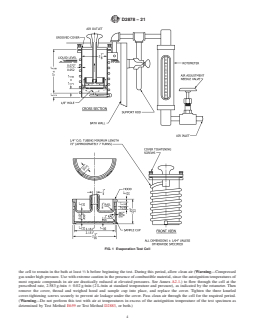
- Describes use of standardized equipment, including a calibrated evaporation cell, oil bath, temperature devices, and an air supply system.
- Calibration and testing utilize m-terphenyl as a reference substance under specified conditions.
- Temperature Range
- Applicable for tests performed between 395 K and 535 K (250 °F to 500 °F), a temperature range relevant for high-performance lubricants.
- Calculation Procedure
- Defines equations and interpolations needed to determine vapor pressure and molecular weight based on loss data.
- Precision and Reporting
- Provides guidance on repeatability, reproducibility, and standardized reporting, ensuring reliability and comparability of results.
- Safety Considerations
- Issues cautions regarding the use of hazardous materials such as mercury and compressed gases, with references to applicable safety data sheets.
Applications
The ASTM D2878-21 test method supports a variety of practical uses in the lubricants and oil industry, including:
- Product Development and Formulation
- Assists manufacturers in evaluating and tuning the volatility and stability of new oil formulations, critical for advanced engine and industrial lubricants.
- Quality Control
- Used routinely by laboratories to monitor batch consistency and specification compliance during production.
- Performance Benchmarking
- Provides data vital for comparing lubricating oils’ volatility characteristics, especially in environments exposed to elevated temperatures.
- Regulatory Compliance
- Supplies required data for meeting industry and government standards related to lubricant emissions and environmental impact.
- Research and Technical Support
- Facilitates research on oil degradation, evaporation rates, and helps predict oil consumption in service.
Related Standards
- ASTM D972: Test Method for Evaporation Loss of Lubricating Greases and Oils
- Source of the primary data for calculations under ASTM D2878.
- ASTM D92: Test Method for Flash and Fire Points by Cleveland Open Cup Tester
- Often used in conjunction with D2878 for safety and performance assessments.
- ASTM D2503: Test Method for Relative Molecular Mass (Molecular Weight) of Hydrocarbons
- Provides molecular weight values that can enhance the accuracy of D2878 results.
- ASTM D2595: Test Method for Evaporation Loss of Lubricating Greases Over a Wide-Temperature Range
- ASTM D4175: Terminology Relating to Petroleum Products, Liquid Fuels, and Lubricants
- ASTM E659: Test Method for Autoignition Temperature of Chemicals
Implementing ASTM D2878-21 ensures standardized evaluation of lubricating oils’ vapor pressure and molecular weight, underpinning product reliability, safety, and regulatory compliance in numerous industrial applications.
Relations
- Refers
ASTM D4175-23a - Standard Terminology Relating to Petroleum Products, Liquid Fuels, and Lubricants - Effective Date
- 15-Dec-2023
- Effective Date
- 01-Nov-2023
- Refers
ASTM D4175-23e1 - Standard Terminology Relating to Petroleum Products, Liquid Fuels, and Lubricants - Effective Date
- 01-Jul-2023
- Effective Date
- 01-Nov-2017
- Effective Date
- 01-Dec-2016
- Effective Date
- 01-May-2016
- Effective Date
- 01-Nov-2015
- Effective Date
- 01-Mar-2015
- Effective Date
- 01-Jan-2015
- Effective Date
- 01-May-2014
- Effective Date
- 01-Feb-2014
- Effective Date
- 01-Nov-2013
- Effective Date
- 15-Oct-2013
- Effective Date
- 01-Oct-2013
- Effective Date
- 01-May-2013
Buy Documents
ASTM D2878-21 - Standard Test Method for Estimating Apparent Vapor Pressures and Molecular Weights of Lubricating Oils
REDLINE ASTM D2878-21 - Standard Test Method for Estimating Apparent Vapor Pressures and Molecular Weights of Lubricating Oils
Get Certified
Connect with accredited certification bodies for this standard

Element Materials Technology
Materials testing and product certification.

ABS Group Brazil
ABS Group certification services in Brazil.

ABS Quality Evaluations Inc.
American Bureau of Shipping quality certification.
Sponsored listings
Frequently Asked Questions
ASTM D2878-21 is a standard published by ASTM International. Its full title is "Standard Test Method for Estimating Apparent Vapor Pressures and Molecular Weights of Lubricating Oils". This standard covers: SIGNIFICANCE AND USE 5.1 The vapor pressure of a substance as determined by measurement of evaporation reflects a property of the bulk sample. Little weight is given by the procedure to the presence of low concentrations of volatile impurities. 5.2 Vapor pressure, per se, is a thermodynamic property that is dependent only upon composition and temperature for stable systems. In the present method, composition changes occur during the course of the test so that the contribution of minor amounts of volatile impurities is minimized. SCOPE 1.1 This test method covers a calculation procedure for converting data obtained by Test Method D972 to apparent vapor pressures and molecular weights. It has been demonstrated to be applicable to petroleum-based and synthetic ester lubricating oils,2 at temperatures of 395 K to 535 K (250 °F to 500 °F). However, its applicability to lubricating greases has not been established. Note 1: Most lubricants boil over a fairly wide temperature range, a fact recognized in discussion of their vapor pressures. For example, the apparent vapor pressure over the range 0 % to 0.1 % evaporated may be as much as 100 times that over the range 4.9 % to 5.0 % evaporated. 1.2 The values stated in SI units are to be regarded as the standard. In cases in which materials, products, or equipment are available in inch-pound units only, SI units are omitted. 1.3 WARNING—Mercury has been designated by many regulatory agencies as a hazardous substance that can cause serious medical issues. Mercury, or its vapor, has been demonstrated to be hazardous to health and corrosive to materials. Use caution when handling mercury and mercury-containing products. See the applicable product Safety Data Sheet (SDS) for additional information. The potential exists that selling mercury or mercury-containing products, or both, is prohibited by local or national law. Users must determine legality of sales in their location. 1.4 This standard does not purport to address all of the safety concerns, if any, associated with its use. It is the responsibility of the user of this standard to establish appropriate safety, health, and environmental practices and determine the applicability or regulatory limitations prior to use. For specific warning statements, see 6.2, 7.1, 8.2, and Annex A2. 1.5 This international standard was developed in accordance with internationally recognized principles on standardization established in the Decision on Principles for the Development of International Standards, Guides and Recommendations issued by the World Trade Organization Technical Barriers to Trade (TBT) Committee.
SIGNIFICANCE AND USE 5.1 The vapor pressure of a substance as determined by measurement of evaporation reflects a property of the bulk sample. Little weight is given by the procedure to the presence of low concentrations of volatile impurities. 5.2 Vapor pressure, per se, is a thermodynamic property that is dependent only upon composition and temperature for stable systems. In the present method, composition changes occur during the course of the test so that the contribution of minor amounts of volatile impurities is minimized. SCOPE 1.1 This test method covers a calculation procedure for converting data obtained by Test Method D972 to apparent vapor pressures and molecular weights. It has been demonstrated to be applicable to petroleum-based and synthetic ester lubricating oils,2 at temperatures of 395 K to 535 K (250 °F to 500 °F). However, its applicability to lubricating greases has not been established. Note 1: Most lubricants boil over a fairly wide temperature range, a fact recognized in discussion of their vapor pressures. For example, the apparent vapor pressure over the range 0 % to 0.1 % evaporated may be as much as 100 times that over the range 4.9 % to 5.0 % evaporated. 1.2 The values stated in SI units are to be regarded as the standard. In cases in which materials, products, or equipment are available in inch-pound units only, SI units are omitted. 1.3 WARNING—Mercury has been designated by many regulatory agencies as a hazardous substance that can cause serious medical issues. Mercury, or its vapor, has been demonstrated to be hazardous to health and corrosive to materials. Use caution when handling mercury and mercury-containing products. See the applicable product Safety Data Sheet (SDS) for additional information. The potential exists that selling mercury or mercury-containing products, or both, is prohibited by local or national law. Users must determine legality of sales in their location. 1.4 This standard does not purport to address all of the safety concerns, if any, associated with its use. It is the responsibility of the user of this standard to establish appropriate safety, health, and environmental practices and determine the applicability or regulatory limitations prior to use. For specific warning statements, see 6.2, 7.1, 8.2, and Annex A2. 1.5 This international standard was developed in accordance with internationally recognized principles on standardization established in the Decision on Principles for the Development of International Standards, Guides and Recommendations issued by the World Trade Organization Technical Barriers to Trade (TBT) Committee.
ASTM D2878-21 is classified under the following ICS (International Classification for Standards) categories: 75.100 - Lubricants, industrial oils and related products. The ICS classification helps identify the subject area and facilitates finding related standards.
ASTM D2878-21 has the following relationships with other standards: It is inter standard links to ASTM D4175-23a, ASTM A240/A240M-23a, ASTM D4175-23e1, ASTM A240/A240M-17, ASTM A240/A240M-16a, ASTM A240/A240M-16, ASTM A240/A240M-15b, ASTM A240/A240M-15a, ASTM A240/A240M-15, ASTM A240/A240M-14, ASTM E659-14, ASTM A240/A240M-13c, ASTM E659-13, ASTM A240/A240M-13b, ASTM A240/A240M-13a. Understanding these relationships helps ensure you are using the most current and applicable version of the standard.
ASTM D2878-21 is available in PDF format for immediate download after purchase. The document can be added to your cart and obtained through the secure checkout process. Digital delivery ensures instant access to the complete standard document.
Standards Content (Sample)
This international standard was developed in accordance with internationally recognized principles on standardization established in the Decision on Principles for the
Development of International Standards, Guides and Recommendations issued by the World Trade Organization Technical Barriers to Trade (TBT) Committee.
Designation: D2878 − 21
Standard Test Method for
Estimating Apparent Vapor Pressures and Molecular
Weights of Lubricating Oils
This standard is issued under the fixed designation D2878; the number immediately following the designation indicates the year of
original adoption or, in the case of revision, the year of last revision. A number in parentheses indicates the year of last reapproval. A
superscript epsilon (´) indicates an editorial change since the last revision or reapproval.
1. Scope* 1.5 This international standard was developed in accor-
dance with internationally recognized principles on standard-
1.1 This test method covers a calculation procedure for
ization established in the Decision on Principles for the
converting data obtained by Test Method D972 to apparent
Development of International Standards, Guides and Recom-
vapor pressures and molecular weights. It has been demon-
mendations issued by the World Trade Organization Technical
strated to be applicable to petroleum-based and synthetic ester
2 Barriers to Trade (TBT) Committee.
lubricating oils, at temperatures of 395 K to 535 K (250 °F to
500 °F). However, its applicability to lubricating greases has
2. Referenced Documents
not been established.
2.1 ASTM Standards:
NOTE 1—Most lubricants boil over a fairly wide temperature range, a
A240/A240M Specification for Chromium and Chromium-
fact recognized in discussion of their vapor pressures. For example, the
Nickel Stainless Steel Plate, Sheet, and Strip for Pressure
apparent vapor pressure over the range 0 % to 0.1 % evaporated may be
as much as 100 times that over the range 4.9 % to 5.0 % evaporated.
Vessels and for General Applications
D92 Test Method for Flash and Fire Points by Cleveland
1.2 The values stated in SI units are to be regarded as the
Open Cup Tester
standard. In cases in which materials, products, or equipment
D972 Test Method for Evaporation Loss of Lubricating
are available in inch-pound units only, SI units are omitted.
Greases and Oils
1.3 WARNING—Mercury has been designated by many
D2503 TestMethodforRelativeMolecularMass(Molecular
regulatory agencies as a hazardous substance that can cause
Weight) of Hydrocarbons by Thermoelectric Measure-
serious medical issues. Mercury, or its vapor, has been dem-
ment of Vapor Pressure
onstrated to be hazardous to health and corrosive to materials.
D2595 Test Method for Evaporation Loss of Lubricating
Use caution when handling mercury and mercury-containing
Greases Over Wide-Temperature Range
products. See the applicable product Safety Data Sheet (SDS)
D2883 Test Method for Reaction Threshold Temperature of
for additional information. The potential exists that selling
Liquid and Solid Materials (Withdrawn 2016)
mercury or mercury-containing products, or both, is prohibited
D4175 Terminology Relating to Petroleum Products, Liquid
by local or national law. Users must determine legality of sales
Fuels, and Lubricants
in their location.
E659 Test Method for Autoignition Temperature of Chemi-
1.4 This standard does not purport to address all of the
cals
safety concerns, if any, associated with its use. It is the
responsibility of the user of this standard to establish appro-
3. Terminology
priate safety, health, and environmental practices and deter-
3.1 Definitions of Terms Specific to This Standard:
mine the applicability or regulatory limitations prior to use.
3.1.1 For definitions of terms used in this test method, refer
For specific warning statements, see 6.2, 7.1, 8.2, and Annex
to Terminology D4175.
A2.
3.1.2 apparent vapor pressure (p), n—the time-averaged
value of the vapor pressure from the start to the end of the
1 evaporation test.
This test method is under the jurisdiction of Committee D02 on Petroleum
Products, Liquid Fuels, and Lubricants and is the direct responsibility of Subcom-
mittee D02.L0.07 on Engineering Sciences of High Performance Fluids and Solids
(Formally D02.1100).
Current edition approved Dec. 1, 2021. Published February 2022. Originally For referenced ASTM standards, visit the ASTM website, www.astm.org, or
approved in 1970. Last previous edition approved in 2016 as D2878 – 10 (2016). contact ASTM Customer Service at service@astm.org. For Annual Book of ASTM
DOI: 10.1520/D2878-21. Standards volume information, refer to the standard’s Document Summary page on
Coburn, J. F., “Lubricant Vapor Pressure Derived from Evaporation Loss,” the ASTM website.
Transactions, American Society of Lubricating Engineers, ASLTA, Vol 12 , 1969, The last approved version of this historical standard is referenced on
pp.129–134. www.astm.org.
*A Summary of Changes section appears at the end of this standard
Copyright © ASTM International, 100 Barr Harbor Drive, PO Box C700, West Conshohocken, PA 19428-2959. United States
D2878 − 21
3.1.2.1 Discussion—While this may include some effects of reduced at elevated pressures. See Annex A2.1.). A 410 mm
differences in nonideality of the vapor, heat of vaporization, (16 in.) length of 1 in. diameter pipe packed with glass wool
surface tension, and viscosity between the m-terphenyl and the has been found satisfactory for filtering the air.
lubricating oil, these factors have been demonstrated to be
6.3 Oil Bath, as described in Annex A1.
negligible. Unless stated, this average shall cover the range
NOTE 2—Other constant-temperature baths may be used if the exit air
0%to5% 61%.
passing over the grease sample is at the test temperature (60.5 K (1 °F)).
3.1.3 cell constant (k), n—the ratio of the amount of
6.4 Temperature Measuring Devices—Resistance
m-terphenylorlubricatingoilcarriedoffperunitvolumeofgas
thermometers, thermocouples, or liquid-in-glass thermometers
to that predicted by Dalton’s law.
calibrated to accuracy within 60.5 ºC (61.0 ºF) may be used.
k 5 22.41 PW/VpM (1)
The use of mercury-in-glass thermometers of equal accuracy is
permitted, although it is discouraged.
where:
k = call constant 6.5 Flowmeter —A rotameter calibrated to deliver air at a
P = ambient atmospheric pressure, torr rate of 2.583 g⁄min 6 0.02 g⁄min between 289 K and 302 K
W = mass of lubricant evaporated, g
(60 °F and 85 °F) (2 L⁄min at standard temperature and pres-
V = volume of gas passed through all litres at 273 K and
sure). It shall be furnished with a needle valve and mounted as
101.3 kPa (760 torr)
shown in Fig. 1.
p = apparent vapor pressure, torr
6.6 Oil Sample Cup, as described in Fig. 1 and A1.1.2.
M = mole average molecular weight of lubricant vapor,
g/mole
7. Calibration of Equipment
T = test temperature, K
7.1 ItisassumedthatequipmentconformingtoTestMethod
Ithasbeenempiricallydeterminedthatfor m-terphenylinair
D972 in design and installation needs no calibration. If
k 5 0.1266 2 12.60/ T 2 273 (2)
~ !
questions arise, carry out the procedure using m-terphenyl
(Warning—Harmful or fatal if swallowed. See A2.2.) of good
and that the cell constant is independent of the composi-
commercial quality. The following two points shall be deter-
tion of the lubricant.
mined:
3.1.4 Test Method D972 is normally run with air, which
Temperature Evaporation to Conform
may cause changes in easily oxidized fluids. In such cases, use
K °F Time, h to Eq 2,g
of common reactive gas nitrogen and recalibration to obtain a
395 250 22 0.267 ± 0.027
slightly different cell constant (k') is mandatory.
420 300 6.5 0.503 ± 0.050
If the data do not fall within the above ranges, check flow
4. Summary of Test Method
rate and temperature. If these are correct, prepare a substitute
4.1 The test is run at the selected temperature for a sufficient
equation for k' similar to Eq 2 and use it in Section 10. When
time to give the selected amount of evaporation, which is 5 %
use of nonreactive gas is required, this calibration is necessary
6 1 % unless otherwise specified. This evaporation rate is
as standard cell constants are not valid for gases other than air.
compared with a standard value for pure m-terphenyl to yield
7.2 If the apparatus specified in Test Method D2595 is to be
the apparent vapor pressure and molecular weight of the
used, it shall be calibrated as described in 7.1.
lubricating oil as defined in Section 3.
8. Procedure
5. Significance and Use
8.1 Weigh the clean test specimen cup and hood to the
5.1 The vapor pressure of a substance as determined by
nearest 1 mg. Transfer, by means of a pipet, 10.00 g 6 0.05 g
measurement of evaporation reflects a property of the bulk
of test specimen to the cup.Assemble the cup and hood, being
sample. Little weight is given by the procedure to the presence
careful not to splash oil on the underside of the hood. Weigh
of low concentrations of volatile impurities.
the assembly and record the net test specimen weight to the
5.2 Vaporpressure, per se,isathermodynamicpropertythat
nearest 1 mg.
is dependent only upon composition and temperature for stable
8.2 With cover in place, but without the hood and test
systems. In the present method, composition changes occur
specimen cup attached, allow the evaporation cell to acquire
during the course of the test so that the contribution of minor
the temperature of the bath (controlled to 60.5 K (61 °F)) at
amounts of volatile impurities is minimized.
which the test is to be made by immersing the cell in it, as
shown in Fig. 1. Allow the cell to remain in the bath at least
6. Apparatus
⁄2 h before beginning the test. During this period, allow clean
6.1 Evaporation Cell, as described in Annex A1.
6.2 Air Supply System, capable of supplying to the cell the
The sole source of supply of the apparatus known to the committee at this time
required flow of air free of entrained particles (Warning—
is Flowrater meter, Fisher and Porter Co., Hatboro, PA. If you are aware of
Compressedgasunderhighpressure.Usewithextremecaution
alternative suppliers, please provide this information to ASTM International
in the presence of combustible material, since the autoignition
Headquarters.Your comments will receive careful consideration at a meeting of the
temperatures of most organic compounds in air are drastically responsible technical committee, which you may attend.
D2878 − 21
FIG. 1 Evaporation Test Cell
air (Warning—Compressed gas under high pressure. Use with weighedhoodandsamplecupintoplace,andreplacethecover.
extreme caution in the presence of combustible material, since Tighten the three knurled cover-tightening screws securely to
theautoignitiontemperaturesofmostorganiccompoundsinair prevent air leakage under the cover. Pass clean air through the
are drastically reduced at elevated pressures. SeeAnnex A2.1.) cell for the required period. (Warning—Do not perform this
to flow through the cell at the prescribed rate, 2.583 g⁄min 6 test with air at temperatures in excess of the autoignition
0.02 g⁄min (2 L⁄min at standard temperature and pressure), as temperature of the test specimen as determined byTest Method
indicated by the rotameter. Then remove the cover, thread and E659
...
This document is not an ASTM standard and is intended only to provide the user of an ASTM standard an indication of what changes have been made to the previous version. Because
it may not be technically possible to adequately depict all changes accurately, ASTM recommends that users consult prior editions as appropriate. In all cases only the current version
of the standard as published by ASTM is to be considered the official document.
Designation: D2878 − 10 (Reapproved 2016) D2878 − 21
Standard Test Method for
Estimating Apparent Vapor Pressures and Molecular
Weights of Lubricating Oils
This standard is issued under the fixed designation D2878; the number immediately following the designation indicates the year of
original adoption or, in the case of revision, the year of last revision. A number in parentheses indicates the year of last reapproval. A
superscript epsilon (´) indicates an editorial change since the last revision or reapproval.
1. Scope Scope*
1.1 This test method covers a calculation procedure for converting data obtained by Test Method D972 to apparent vapor pressures
and molecular weights. It has been demonstrated to be applicable to petroleum-based and synthetic ester lubricating oils, at
temperatures of 395 K to 535 K (250 °F to 500 °F). However, its applicability to lubricating greases has not been established.
NOTE 1—Most lubricants boil over a fairly wide temperature range, a fact recognized in discussion of their vapor pressures. For example, the apparent
vapor pressure over the range 0 % to 0.1 % evaporated may be as much as 100 times that over the range 4.9 % to 5.0 % evaporated.
1.2 The values stated in SI units are to be regarded as the standard. In cases in which materials, products, or equipment are
available in inch-pound units only, SI units are omitted.
1.3 WARNING—Mercury has been designated by many regulatory agencies as a hazardous materialsubstance that can cause
central nervous system, kidney and liver damage. serious medical issues. Mercury, or its vapor, may has been demonstrated to be
hazardous to health and corrosive to materials. Caution should be taken Use caution when handling mercury and mercury
containing mercury-containing products. See the applicable product Material Safety Data Sheet (MSDS) for details and EPA’s
website—http://www.epa.gov/mercury/faq.htm—for additional information. Users should be aware (SDS) for additional informa-
tion. The potential exists that selling mercury or mercury containing products into your state or country may be prohibited by
law.mercury-containing products, or both, is prohibited by local or national law. Users must determine legality of sales in their
location.
1.4 This standard does not purport to address all of the safety concerns, if any, associated with its use. It is the responsibility
of the user of this standard to establish appropriate safety safety, health, and healthenvironmental practices and determine the
applicability or regulatory limitations prior to use. For specific warning statements, see 6.2, 7.1, 8.2, and Annex A2.
1.5 This international standard was developed in accordance with internationally recognized principles on standardization
established in the Decision on Principles for the Development of International Standards, Guides and Recommendations issued
by the World Trade Organization Technical Barriers to Trade (TBT) Committee.
2. Referenced Documents
2.1 ASTM Standards:
This test method is under the jurisdiction of Committee D02 on Petroleum Products, Liquid Fuels, and Lubricants and is the direct responsibility of Subcommittee
D02.L0.07 on Engineering Sciences of High Performance Fluids and Solids (Formally D02.1100).
Current edition approved Jan. 1, 2016Dec. 1, 2021. Published February 2016February 2022. Originally approved in 1970. Last previous edition approved in 20102016
as D2878 – 10.D2878 – 10 (2016). DOI: 10.1520/D2878-10R16.10.1520/D2878-21.
Coburn, J. F., “Lubricant Vapor Pressure Derived from Evaporation Loss,” Transactions, American Society of Lubricating Engineers, ASLTA, Vol 12 , 1969, pp. 129–134.
For referenced ASTM standards, visit the ASTM website, www.astm.org, or contact ASTM Customer Service at service@astm.org. For Annual Book of ASTM Standards
volume information, refer to the standard’s Document Summary page on the ASTM website.
*A Summary of Changes section appears at the end of this standard
Copyright © ASTM International, 100 Barr Harbor Drive, PO Box C700, West Conshohocken, PA 19428-2959. United States
D2878 − 21
A240/A240M Specification for Chromium and Chromium-Nickel Stainless Steel Plate, Sheet, and Strip for Pressure Vessels and
for General Applications
D92 Test Method for Flash and Fire Points by Cleveland Open Cup Tester
D972 Test Method for Evaporation Loss of Lubricating Greases and Oils
D2503 Test Method for Relative Molecular Mass (Molecular Weight) of Hydrocarbons by Thermoelectric Measurement of
Vapor Pressure
D2595 Test Method for Evaporation Loss of Lubricating Greases Over Wide-Temperature Range
D2883 Test Method for Reaction Threshold Temperature of Liquid and Solid Materials (Withdrawn 2016)
D4175 Terminology Relating to Petroleum Products, Liquid Fuels, and Lubricants
E659 Test Method for Autoignition Temperature of Chemicals
3. Terminology
3.1 Definitions of Terms Specific to This Standard:
3.1.1 For definitions of terms used in this test method, refer to Terminology D4175.
3.1.2 apparent vapor pressure (p), n—the time-averaged value of the vapor pressure from the start to the end of the evaporation
test.
3.1.2.1 Discussion—
While this may include some effects of differences in nonideality of the vapor, heat of vaporization, surface tension, and viscosity
between the m-terphenyl and the lubricating oil, these factors have been demonstrated to be negligible. Unless stated, this average
shall cover the range 00 % to 55 % 6 1 %.
3.1.3 cell constant (k), n—the ratio of the amount of m-terphenyl or lubricating oil carried off per unit volume of gas to that
predicted by Dalton’s law.
k 5 22.41 PW/VpM (1)
where:
k = call constant
P = ambient atmospheric pressure, torr
W = mass of lubricant evaporated, g
V = volume of gas passed through all litres at 273 K and 101.3 kPa (760 torr)
p = apparent vapor pressure, torr
M = mole average molecular weight of lubricant vapor, g/mole
T = test temperature, K
It has been empirically determined that for m-terphenyl in air
k 5 0.1266 2 12.60/~ T 2 273! (2)
and that the cell constant is independent of the composition of the lubricant.
3.1.4 Test Method D972 is normally run with air, which may cause changes in easily oxidized fluids. In such cases, use of common
reactive gas nitrogen and recalibration to obtain a slightly different cell constant (k') is mandatory.
4. Summary of Test Method
4.1 The test is run at the selected temperature for a sufficient time to give the selected amount of evaporation, which is 5 % 6
1 % unless otherwise specified. This evaporation rate is compared with a standard value for pure m-terphenyl to yield the apparent
vapor pressure and molecular weight of the lubricating oil as defined in Section 3.
5. Significance and Use
5.1 The vapor pressure of a substance as determined by measurement of evaporation reflects a property of the bulk sample. Little
weight is given by the procedure to the presence of low concentrations of volatile impurities.
The last approved version of this historical standard is referenced on www.astm.org.
D2878 − 21
5.2 Vapor pressure, per se, is a thermodynamic property that is dependent only upon composition and temperature for stable
systems. In the present method, composition changes occur during the course of the test so that the contribution of minor amounts
of volatile impurities is minimized.
6. Apparatus
6.1 Evaporation Cell, as described in Annex A1.
6.2 Air Supply System, capable of supplying to the cell the required flow of air free of entrained particles (Warning—Compressed
gas under high pressure. Use with extreme caution in the presence of combustible material, since the autoignition temperatures of
most organic compounds in air are drastically reduced at elevated pressures. See Annex A2.1.). A 410 mm (16 in.) length of 1 in.
diameter pipe packed with glass wool has been found satisfactory for filtering the air.
6.3 Oil Bath, as described in Annex A1.
NOTE 2—Other constant-temperature baths may be used if the exit air passing over the grease sample is at the test temperature (60.5 K (1 °F)).
6.4 Temperature Measuring Devices—Resistance thermometers, thermocouples, or liquid-in-glass thermometers calibrated to
accuracy within 60.5 ºC (61.0 ºF) may be used. The use of mercury-in-glass thermometers of equal accuracy is permitted,
although it is discouraged.
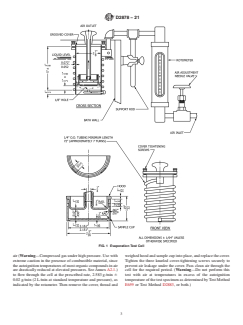
6.5 Flowmeter —A rotameter calibrated to deliver air at a rate of 2.583 g ⁄min 6 0.02 g ⁄min between 289 K and 302 K (60 °F and
85 °F) (2 L ⁄min at standard temperature and pressure). It shall be furnished with a needle valve and mounted as shown in Fig. 1.
6.6 Oil Sample Cup, as described in Fig. 1 and A1.1.2.
7. Calibration of Equipment
7.1 It is assumed that equipment conforming to Test Method D972 in design and installation needs no calibration. If questions
arise, carry out the procedure using m-terphenyl (Warning—Harmful or fatal if swallowed. See A2.2.) of good commercial quality.
The following two points shall be determined:
Temperature Evaporation to Conform
K °F Time, h to Eq 2, g
395 250 22 0.267 ± 0.027
420 300 6.5 0.503 ± 0.050
If the data do not fall within the above ranges, check flow rate and temperature. If these are correct, prepare a substitute equation
for k' similar to Eq 2 and use it in Section 10. When use of nonreactive gas is required, this calibration is necessary as standard
cell constants are not valid for gases other than air.
7.2 If the apparatus specified in Test Method D2595 is to be used, it shall be calibrated as described in 7.1.
8. Procedure
8.1 Weigh the clean test specimen cup and hood to the nearest 1 mg. Transfer, by means of a pipet, 10.00 g 6 0.05 g of test
specimen to the cup. Assemble the cup and hood, being careful not to splash oil on the underside of the hood. Weigh the assembly
and record the net test specimen weight to the nearest 1 mg.
8.2 With cover in place, but without the hood and test specimen cup attached, allow the evaporation cell to acquire the temperature
of the bath (controlled to 60.5 K (61 °F)) at which the test is to be made by immersing the cell in it, as shown in Fig. 1. Allow
The sole source of supply of the apparatus known to the committee at this time is Flowrater meter, Fisher and Porter Co., Hatboro, PA. If you are aware of alternative
suppliers, please provide this information to ASTM International Headquarters. Your comments will receive careful consideration at a meeting of the responsible technical
committee, which you may attend.
D2878 − 21
FIG. 1 Evaporation Test Cell
the cell to remain in the bath at least ⁄2 h before beginning the test. During this period, allow clean air (Warning—Compressed
gas under high pressure. Use with extreme caution in the presence of combustible material, since the autoignition temperatures of
most organic compounds in air are drastically reduced at elevated pressures. See Annex A2.1.) to flow through the cell at the
prescribed rate, 2.583 g ⁄min 6 0.02 g ⁄min (2 L ⁄min at standard temperature and pressure), as indicated by the rotameter. Then
remove the cover, thread and weighed hood and sample cup into place, and replace the cover. Tighten the three knurled
cover-tightening screws securely to prevent air leakage under the cover. Pas
...