


ASTM D3174-12(2018)
(Test Method)Standard Test Method for Ash in the Analysis Sample of Coal and Coke from Coal
Standard Test Method for Ash in the Analysis Sample of Coal and Coke from Coal
SIGNIFICANCE AND USE
5.1 Ash, as determined by this test method, is the residue remaining after burning the coal and coke. Ash obtained differs in composition from the inorganic constituents present in the original coal. Incineration causes an expulsion of all water, the loss of carbon dioxide from carbonates, the conversion of iron pyrites into ferric oxide, and other chemical reactions. Ash, as determined by this test method, will differ in amount from ash produced in furnace operations and other firing systems because incineration conditions influence the chemistry and amount of the ash. References for correcting ash results determined by this test method to a mineral-matter-free basis are listed in Classification D388, Section 9.
SCOPE
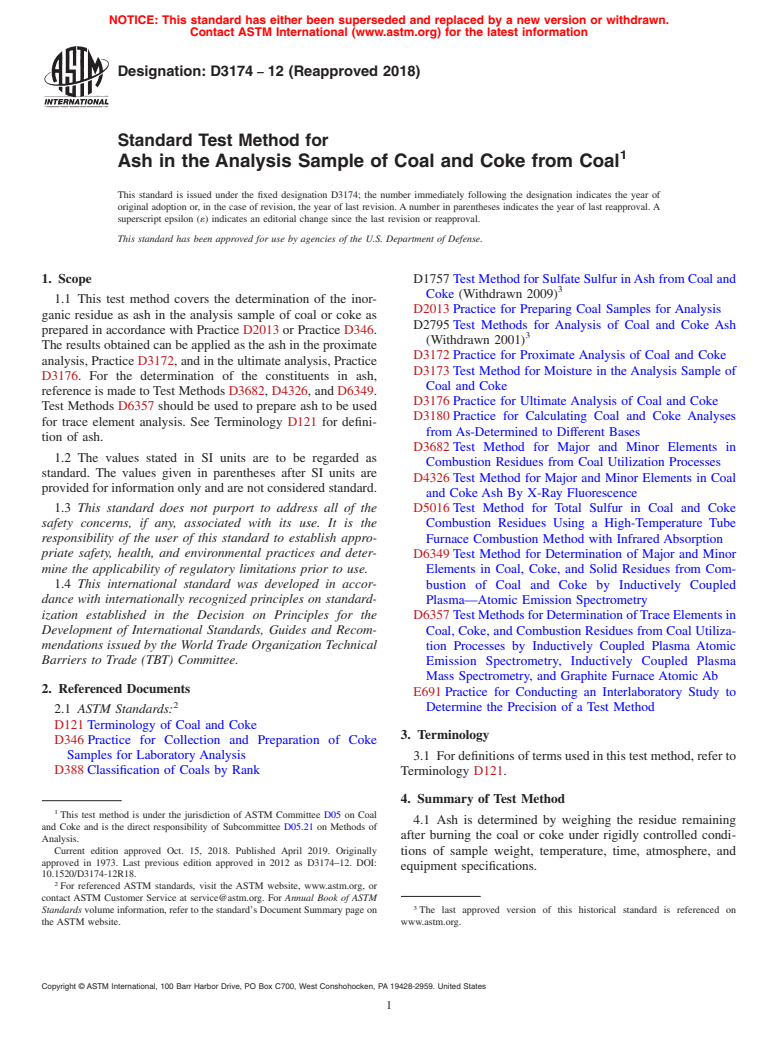
1.1 This test method covers the determination of the inorganic residue as ash in the analysis sample of coal or coke as prepared in accordance with Practice D2013 or Practice D346. The results obtained can be applied as the ash in the proximate analysis, Practice D3172, and in the ultimate analysis, Practice D3176. For the determination of the constituents in ash, reference is made to Test Methods D3682, D4326, and D6349. Test Methods D6357 should be used to prepare ash to be used for trace element analysis. See Terminology D121 for definition of ash.
1.2 The values stated in SI units are to be regarded as standard. The values given in parentheses after SI units are provided for information only and are not considered standard.
1.3 This standard does not purport to address all of the safety concerns, if any, associated with its use. It is the responsibility of the user of this standard to establish appropriate safety, health, and environmental practices and determine the applicability of regulatory limitations prior to use.
1.4 This international standard was developed in accordance with internationally recognized principles on standardization established in the Decision on Principles for the Development of International Standards, Guides and Recommendations issued by the World Trade Organization Technical Barriers to Trade (TBT) Committee.
General Information
Buy Standard
Standards Content (Sample)
NOTICE: This standard has either been superseded and replaced by a new version or withdrawn.
Contact ASTM International (www.astm.org) for the latest information
Designation: D3174 − 12 (Reapproved 2018)
Standard Test Method for
Ash in the Analysis Sample of Coal and Coke from Coal
This standard is issued under the fixed designation D3174; the number immediately following the designation indicates the year of
original adoption or, in the case of revision, the year of last revision. A number in parentheses indicates the year of last reapproval. A
superscript epsilon (´) indicates an editorial change since the last revision or reapproval.
This standard has been approved for use by agencies of the U.S. Department of Defense.
1. Scope D1757 Test Method for Sulfate Sulfur inAsh from Coal and
Coke (Withdrawn 2009)
1.1 This test method covers the determination of the inor-
D2013 Practice for Preparing Coal Samples for Analysis
ganic residue as ash in the analysis sample of coal or coke as
D2795 Test Methods for Analysis of Coal and Coke Ash
prepared in accordance with Practice D2013 or Practice D346.
(Withdrawn 2001)
The results obtained can be applied as the ash in the proximate
D3172 Practice for Proximate Analysis of Coal and Coke
analysis, Practice D3172, and in the ultimate analysis, Practice
D3173 Test Method for Moisture in the Analysis Sample of
D3176. For the determination of the constituents in ash,
Coal and Coke
reference is made to Test Methods D3682, D4326, and D6349.
D3176 Practice for Ultimate Analysis of Coal and Coke
Test Methods D6357 should be used to prepare ash to be used
D3180 Practice for Calculating Coal and Coke Analyses
for trace element analysis. See Terminology D121 for defini-
from As-Determined to Different Bases
tion of ash.
D3682 Test Method for Major and Minor Elements in
1.2 The values stated in SI units are to be regarded as
Combustion Residues from Coal Utilization Processes
standard. The values given in parentheses after SI units are
D4326 Test Method for Major and Minor Elements in Coal
provided for information only and are not considered standard.
and Coke Ash By X-Ray Fluorescence
1.3 This standard does not purport to address all of the D5016 Test Method for Total Sulfur in Coal and Coke
safety concerns, if any, associated with its use. It is the
Combustion Residues Using a High-Temperature Tube
responsibility of the user of this standard to establish appro- Furnace Combustion Method with Infrared Absorption
priate safety, health, and environmental practices and deter-
D6349 Test Method for Determination of Major and Minor
mine the applicability of regulatory limitations prior to use. Elements in Coal, Coke, and Solid Residues from Com-
1.4 This international standard was developed in accor-
bustion of Coal and Coke by Inductively Coupled
dance with internationally recognized principles on standard-
Plasma—Atomic Emission Spectrometry
ization established in the Decision on Principles for the D6357 TestMethodsforDeterminationofTraceElementsin
Development of International Standards, Guides and Recom-
Coal, Coke, and Combustion Residues from Coal Utiliza-
mendations issued by the World Trade Organization Technical tion Processes by Inductively Coupled Plasma Atomic
Barriers to Trade (TBT) Committee.
Emission Spectrometry, Inductively Coupled Plasma
Mass Spectrometry, and Graphite Furnace Atomic Ab
2. Referenced Documents
E691 Practice for Conducting an Interlaboratory Study to
Determine the Precision of a Test Method
2.1 ASTM Standards:
D121 Terminology of Coal and Coke
3. Terminology
D346 Practice for Collection and Preparation of Coke
Samples for Laboratory Analysis 3.1 For definitions of terms used in this test method, refer to
D388 Classification of Coals by Rank Terminology D121.
4. Summary of Test Method
This test method is under the jurisdiction of ASTM Committee D05 on Coal
4.1 Ash is determined by weighing the residue remaining
and Coke and is the direct responsibility of Subcommittee D05.21 on Methods of
after burning the coal or coke under rigidly controlled condi-
Analysis.
Current edition approved Oct. 15, 2018. Published April 2019. Originally
tions of sample weight, temperature, time, atmosphere, and
approved in 1973. Last previous edition approved in 2012 as D3174–12. DOI:
equipment specifications.
10.1520/D3174-12R18.
For referenced ASTM standards, visit the ASTM website, www.astm.org, or
contact ASTM Customer Service at service@astm.org. For Annual Book of ASTM
Standards volume information, refer to the standard’s Document Summary page on The last approved version of this historical standard is referenced on
the ASTM website. www.astm.org.
Copyright © ASTM International, 100 Barr Harbor Drive, PO Box C700, West Conshohocken, PA 19428-2959. United States
D3174 − 12 (2018)
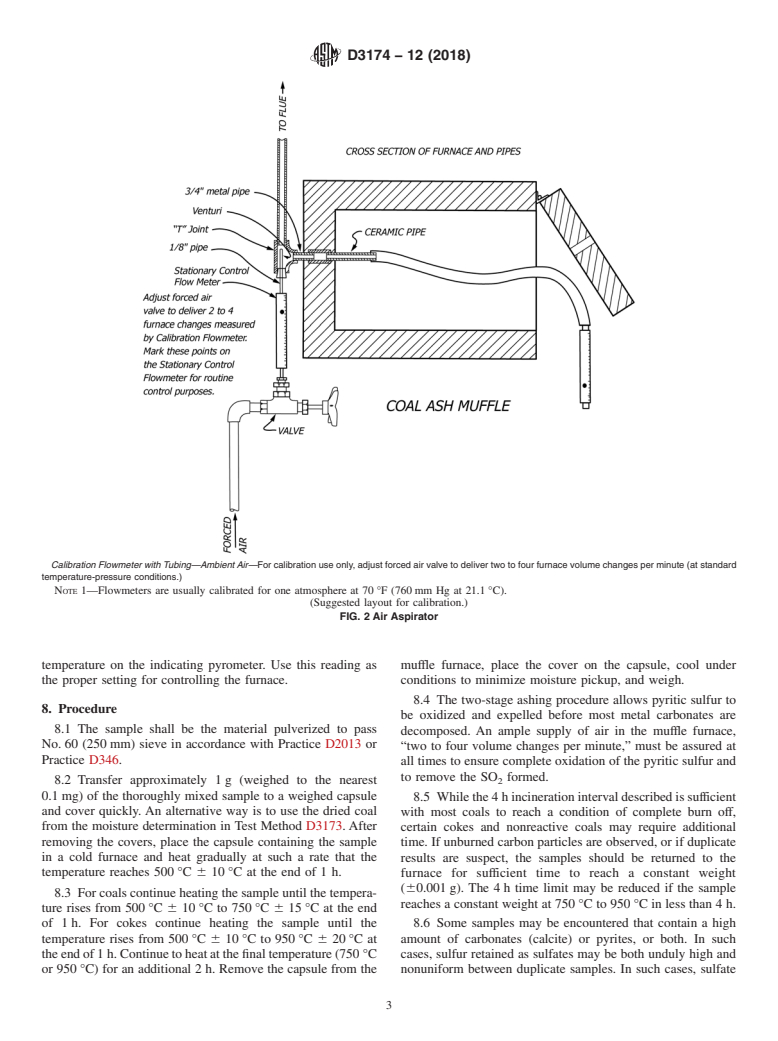
(Suggested method for inducing regulated air flow through ashing furnace.)
FIG. 1 Air Aspirator
5. Significance and Use shall be located and arranged to distribute the air uniformly
throughoutthefurnaceareawithoutthepossibilityofsweeping
5.1 Ash, as determined by this test method, is the residue
solid particles from the capsules. The temperature over the
remaining after burning the coal and coke.Ash obtained differs
entire working area of the furnace floor shall be maintained
in composition from the inorganic constituents present in the
within the specified temperature limits.
original coal. Incineration causes an expulsion of all water, the
loss of carbon dioxide from carbonates, the conversion of iron 6.2 Porcelain Capsules, about 22 mm ( ⁄8 in.) in depth, and
pyrites into ferric oxide, and other chemical reactions. Ash, as 44 mm (1 ⁄4 in.) in diameter, or similar shallow dishes or
determined by this test method, will differ in amount from ash platinum crucibles.
produced in furnace operations and other firing systems be-
6.3 Balance, sensitive to 0.1 mg.
cause incineration conditions influence the chemistry and
6.4 Crucible Cover, aluminum, porcelain, or similar covers.
amount of the ash. References for correcting ash results
determined by this test method to a mineral-matter-free basis
7. Temperature Calibration
are listed in Classification D388, Section 9.
7.1 Place a preignited capsule with1gof sand at the center
6. Apparatus
of the working area of the furnace, and by the use of a
6.1 Electric Muffle Furnace for Coal or Coke—For deter- potentiometer and thermocouple or other suitable temperature
mination of ash of coal and coke, the furnace shall have an measuring device, measure the temperature of the sand in the
adequate air circulation and be capable of having its tempera- crucible. The crucible and sand should be at temperature
ture regulated at 500 °C, 750 °C, and 950 °C.The furnace shall equilibrium with the furnace. There should be two to four air
be equipped with a temperature indicator and means of changes per minute moving throughout the furnace (the air
controlling the temperature within prescribed limits. Means flow may be measured by using a wet-test meter or equivalent
shall be provided for maintaining air flow at a rate of two to calibrated at standard conditions for air connected to the
four changes per minute (see Fig. 1 and Fig. 2). Combustion ceramic-pipe exhaust).Adjust the furnace temperature until the
gases shall be vented from laboratory. Inlet and outlet ports potentiometerreads750 °C 610 °Candthenadjustorreadthe
D3174 − 12 (2018)
Calibration Flowmeter with Tubing—Ambient Air—For calibration use only, adjust forced air valve to deliver two to four furnace volume changes per minute (at standard
temperature-pressure conditions.)
NOTE 1—Flowmeters are usually calibrated for one atmosphere at 70 °F (760 mm Hg at 21.1 °C).
(Suggested layout for calibration.)
FIG. 2 Air Aspirator
temperature on the indicating pyrometer. Use this reading as muffle furnace, place the cover on the capsule, cool under
the proper setting for controlling the furnace. conditions to minimize moisture pickup, and weigh.
8.4 The two-stage ashing procedure allows pyritic sulfur to
8. Procedure
be oxidized and expelled before most metal carbonates are
8.1 The sample shall be the material pulverized to pass
decomposed. An ample supply of air in the muffle furnace,
No. 60 (250 mm) sieve in accordance with Practice D2013 or
“two to four volume changes per minute,” must be assured at
Practice D346.
all times to ensure complete oxidation of the pyritic sulfur and
to remove the SO formed.
8.2 Transfer approximately 1 g (weighed to the nearest 2
0.1 mg) of the thoroughly mixed sample to a weighed capsule
8.5 Whilethe4 hincinerationintervaldescribedissufficient
and cover quickly. An alternative way is to use the dried coal
with most coals to reach a condition of complete burn off,
from the moisture determination in Test Method D3173. After certain cokes and nonreactive coals may require additional
removing the covers, place the capsule containing the sample
time. If unburned carbon particles are observed, or if duplicate
in a cold furnace and heat gradually at such a rate that the results are suspect, the samples should be returned to the
temperature reaches 500 °C 6 10 °C at the end of 1 h.
furnace for sufficient time to reach a constant weight
(60.001 g). The 4 h time limit may be reduced if the sample
8.3 For coals continue heating the sample until the tempera-
reaches a constant weight at 750 °C to 950 °C in less than 4 h.
ture rises from 500 °C 6 10 °C to 750 °C 6 15 °C at the end
of 1 h. For cokes continue heating the sample until the 8.6 Some samples may be encountered tha
...
This document is not an ASTM standard and is intended only to provide the user of an ASTM standard an indication of what changes have been made to the previous version. Because
it may not be technically possible to adequately depict all changes accurately, ASTM recommends that users consult prior editions as appropriate. In all cases only the current version
of the standard as published by ASTM is to be considered the official document.
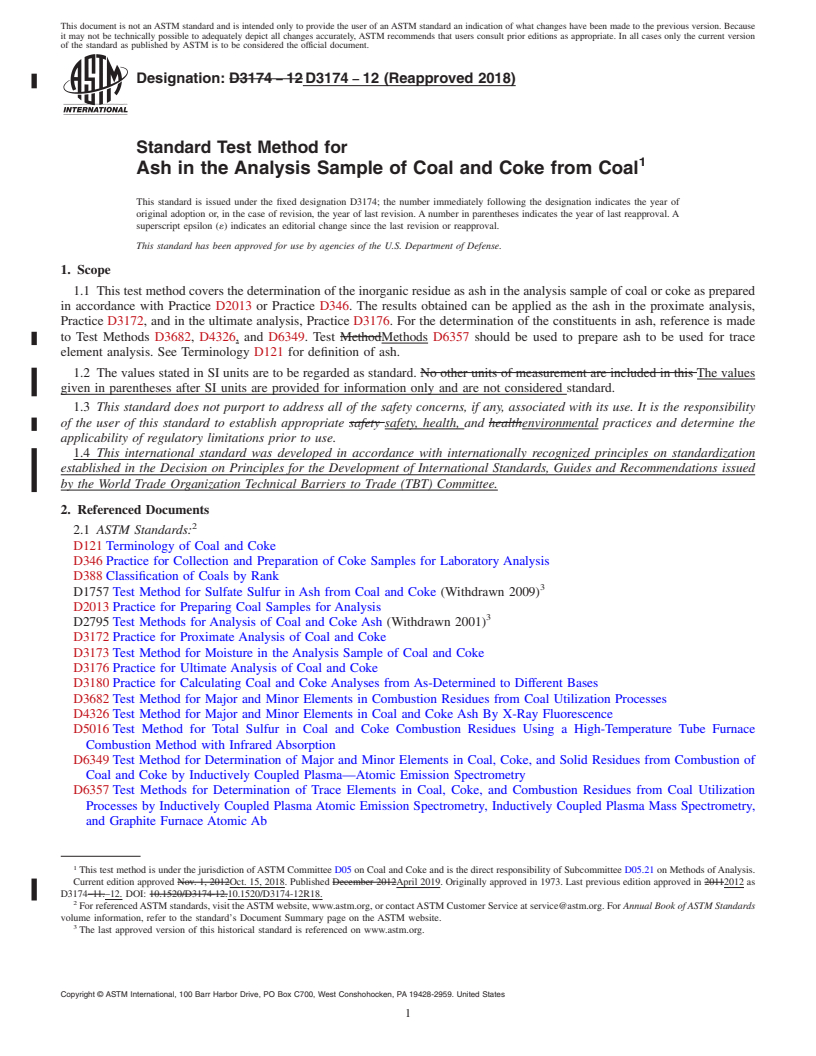
Designation: D3174 − 12 D3174 − 12 (Reapproved 2018)
Standard Test Method for
Ash in the Analysis Sample of Coal and Coke from Coal
This standard is issued under the fixed designation D3174; the number immediately following the designation indicates the year of
original adoption or, in the case of revision, the year of last revision. A number in parentheses indicates the year of last reapproval. A
superscript epsilon (´) indicates an editorial change since the last revision or reapproval.
This standard has been approved for use by agencies of the U.S. Department of Defense.
1. Scope
1.1 This test method covers the determination of the inorganic residue as ash in the analysis sample of coal or coke as prepared
in accordance with Practice D2013 or Practice D346. The results obtained can be applied as the ash in the proximate analysis,
Practice D3172, and in the ultimate analysis, Practice D3176. For the determination of the constituents in ash, reference is made
to Test Methods D3682, D4326, and D6349. Test MethodMethods D6357 should be used to prepare ash to be used for trace
element analysis. See Terminology D121 for definition of ash.
1.2 The values stated in SI units are to be regarded as standard. No other units of measurement are included in this The values
given in parentheses after SI units are provided for information only and are not considered standard.
1.3 This standard does not purport to address all of the safety concerns, if any, associated with its use. It is the responsibility
of the user of this standard to establish appropriate safety safety, health, and healthenvironmental practices and determine the
applicability of regulatory limitations prior to use.
1.4 This international standard was developed in accordance with internationally recognized principles on standardization
established in the Decision on Principles for the Development of International Standards, Guides and Recommendations issued
by the World Trade Organization Technical Barriers to Trade (TBT) Committee.
2. Referenced Documents
2.1 ASTM Standards:
D121 Terminology of Coal and Coke
D346 Practice for Collection and Preparation of Coke Samples for Laboratory Analysis
D388 Classification of Coals by Rank
D1757 Test Method for Sulfate Sulfur in Ash from Coal and Coke (Withdrawn 2009)
D2013 Practice for Preparing Coal Samples for Analysis
D2795 Test Methods for Analysis of Coal and Coke Ash (Withdrawn 2001)
D3172 Practice for Proximate Analysis of Coal and Coke
D3173 Test Method for Moisture in the Analysis Sample of Coal and Coke
D3176 Practice for Ultimate Analysis of Coal and Coke
D3180 Practice for Calculating Coal and Coke Analyses from As-Determined to Different Bases
D3682 Test Method for Major and Minor Elements in Combustion Residues from Coal Utilization Processes
D4326 Test Method for Major and Minor Elements in Coal and Coke Ash By X-Ray Fluorescence
D5016 Test Method for Total Sulfur in Coal and Coke Combustion Residues Using a High-Temperature Tube Furnace
Combustion Method with Infrared Absorption
D6349 Test Method for Determination of Major and Minor Elements in Coal, Coke, and Solid Residues from Combustion of
Coal and Coke by Inductively Coupled Plasma—Atomic Emission Spectrometry
D6357 Test Methods for Determination of Trace Elements in Coal, Coke, and Combustion Residues from Coal Utilization
Processes by Inductively Coupled Plasma Atomic Emission Spectrometry, Inductively Coupled Plasma Mass Spectrometry,
and Graphite Furnace Atomic Ab
This test method is under the jurisdiction of ASTM Committee D05 on Coal and Coke and is the direct responsibility of Subcommittee D05.21 on Methods of Analysis.
Current edition approved Nov. 1, 2012Oct. 15, 2018. Published December 2012April 2019. Originally approved in 1973. Last previous edition approved in 20112012 as
D3174–11.–12. DOI: 10.1520/D3174-12.10.1520/D3174-12R18.
For referenced ASTM standards, visit the ASTM website, www.astm.org, or contact ASTM Customer Service at service@astm.org. For Annual Book of ASTM Standards
volume information, refer to the standard’s Document Summary page on the ASTM website.
The last approved version of this historical standard is referenced on www.astm.org.
Copyright © ASTM International, 100 Barr Harbor Drive, PO Box C700, West Conshohocken, PA 19428-2959. United States
D3174 − 12 (2018)
(Suggested method for inducing regulated air flow through ashing furnace.)
FIG. 1 Air Aspirator
E691 Practice for Conducting an Interlaboratory Study to Determine the Precision of a Test Method
3. Terminology
3.1 For definitions of terms used in this test method, refer to Terminology D121.
4. Summary of Test Method
4.1 Ash is determined by weighing the residue remaining after burning the coal or coke under rigidly controlled conditions of
sample weight, temperature, time, atmosphere, and equipment specifications.
5. Significance and Use
5.1 Ash, as determined by this test method, is the residue remaining after burning the coal and coke. Ash obtained differs in
composition from the inorganic constituents present in the original coal. Incineration causes an expulsion of all water, the loss of
carbon dioxide from carbonates, the conversion of iron pyrites into ferric oxide, and other chemical reactions. Ash, as determined
by this test method, will differ in amount from ash produced in furnace operations and other firing systems because incineration
conditions influence the chemistry and amount of the ash. References for correcting ash results determined by this test method to
a mineral-matter-free basis are listed in Classification D388, Section 9.9.
6. Apparatus
6.1 Electric Muffle Furnace for Coal or Coke—For determination of ash of coal and coke, the furnace shall have an adequate
air circulation and be capable of having its temperature regulated at 500°C, 750°C,500 °C, 750 °C, and 950°C.950 °C. The furnace
shall be equipped with a temperature indicator and means of controlling the temperature within prescribed limits. Means shall be
provided for maintaining air flow at a rate of two to four changes per minute (see Fig. 1 and Fig. 2). Combustion gases shall be
vented from laboratory. Inlet and outlet ports shall be located and arranged to distribute the air uniformly throughout the furnace
D3174 − 12 (2018)
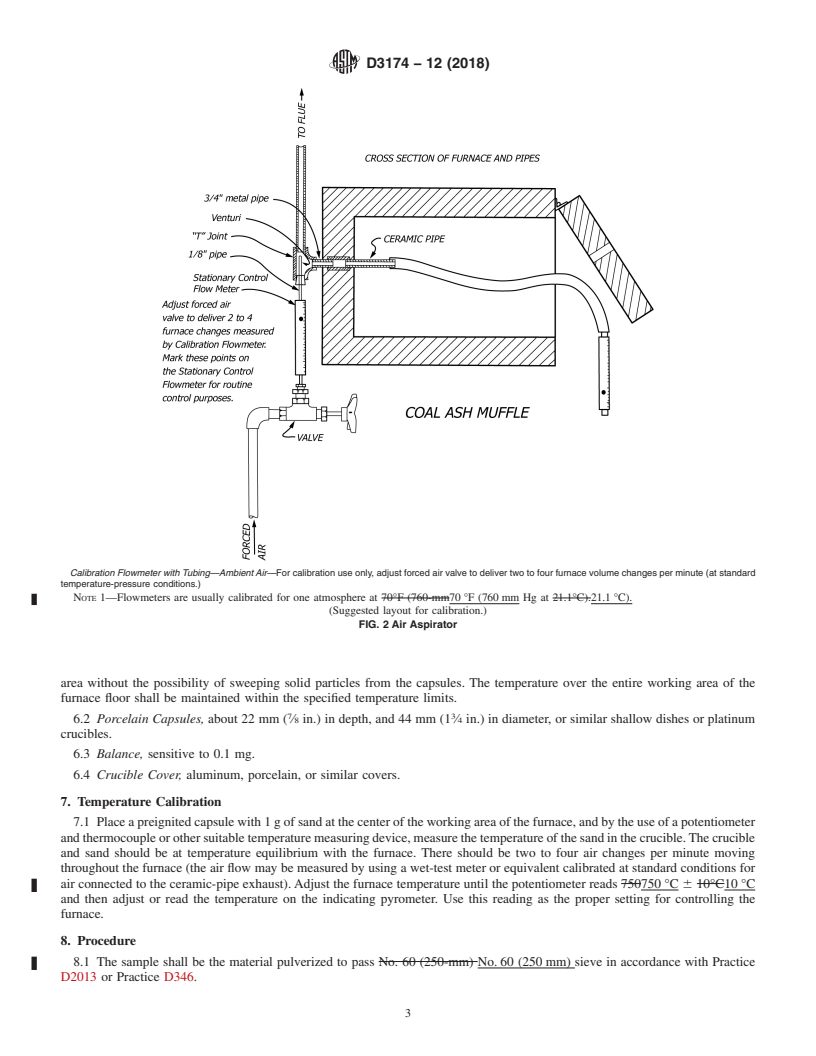
Calibration Flowmeter with Tubing—Ambient Air—For calibration use only, adjust forced air valve to deliver two to four furnace volume changes per minute (at standard
temperature-pressure conditions.)
NOTE 1—Flowmeters are usually calibrated for one atmosphere at 70°F (760-mm70 °F (760 mm Hg at 21.1°C).21.1 °C).
(Suggested layout for calibration.)
FIG. 2 Air Aspirator
area without the possibility of sweeping solid particles from the capsules. The temperature over the entire working area of the
furnace floor shall be maintained within the specified temperature limits.
7 3
6.2 Porcelain Capsules, about 22 mm ( ⁄8 in.) in depth, and 44 mm (1 ⁄4 in.) in diameter, or similar shallow dishes or platinum
crucibles.
6.3 Balance, sensitive to 0.1 mg.
6.4 Crucible Cover, aluminum, porcelain, or similar covers.
7. Temperature Calibration
7.1 Place a preignited capsule with 1 g of sand at the center of the working area of the furnace, and by the use of a potentiometer
and thermocouple or other suitable temperature measuring device, measure the temperature of the sand in the crucible. The crucible
and sand should be at temperature equilibrium with the furnace. There should be two to four air changes per minute moving
throughout the furnace (the air flow may be measured by using a wet-test meter or equivalent calibrated at standard conditions for
air connected to the ceramic-pipe exhaust). Adjust the furnace temperature until the potentiometer reads 750750 °C 6 10°C10 °C
and then adjust or read the temperature on the indicating pyrometer. Use this reading as the proper setting for controlling the
furnace.
8. Procedure
8.1 The sample shall be the material pulverized to pass No. 60 (250-mm) No. 60 (250 mm) sieve in accordance with Practice
D2013 or Practice D346.
D3174 − 12 (2018)
TABLE 1 Determination of Ash in the Analysis Sample of Coal
and Coke
Range Repeatability Reproducibility
Limit, Limit,
r R
Coal 2.68 to 0.22 0.32
17.86 %
Coke 5.73 to 0.10 0.20
11.75 %
8.2 Transfer approximately 1 g 1 g (weighed to the nearest 0.1 mg) 0.1 mg) of the thoroughly mixed sample to a weighed
capsule and cover quickly. An alternative way is to use the dried coal from the moisture determination in Test Method D3173. After
removing the covers, place the capsule containing the sample in a cold furnace and heat gradually at such a rate that the temperature
reaches 500500 °C 6 10°C10 °C at the end of 1 h.
8.3 For coals continue heating the sample until the temperature rises from 500500 °C 6 10°C10 °C to 750750 °C 6 15°C15 °C
at the end of 1 hour. 1 h. For cokes continue heating the sample until the temperature rises from 500500 °C 6 10°C10 °C to
950950 °C 6 20°C20 °C at the end of 1 hour. 1 h. Continue to heat at the final temperature (750°C(750 °C or 950°C)950 °C) for
an additional 2 h. Remove the capsule from the muffle furnace, place the cover on the capsule, cool under conditions to minimize
moisture pickup, and weigh.
8.4 The two-stage ashing procedure allows pyritic sulfur to be oxidized and expelled before most metal carbonates are
decomposed. An ample supply of air in the muffle furnace, “two to four volume changes per minute,” must be assured at all ti
...
Questions, Comments and Discussion
Ask us and Technical Secretary will try to provide an answer. You can facilitate discussion about the standard in here.