

ASTM D2711-22
(Test Method)Standard Test Method for Demulsibility Characteristics of Lubricating Oils
General Information
- Abstract
SIGNIFICANCE AND USE
5.1 This test provides a guide for determining the demulsibility characteristic of lubricating oils that are prone to water contamination and may encounter the turbulence of pumping and circulation capable of producing water-in-oil emulsions.
SCOPE
1.1 This test method covers the measurement of the ability of oil and water to separate from each other. It is intended for use in testing medium and high-viscosity lubricating oils.
1.2 The values stated in SI units are to be regarded as standard. No other units of measurement are included in this standard.
1.3 This standard does not purport to address all of the safety concerns, if any, associated with its use. It is the responsibility of the user of this standard to establish appropriate safety, health, and environmental practices and determine the applicability of regulatory limitations prior to use.
1.4 This international standard was developed in accordance with internationally recognized principles on standardization established in the Decision on Principles for the Development of International Standards, Guides and Recommendations issued by the World Trade Organization Technical Barriers to Trade (TBT) Committee.
- Status
- Published
- Publication Date
- 31-Oct-2022
- Technical Committee
- D02 - Petroleum Products, Liquid Fuels, and Lubricants
- Drafting Committee
- D02.L0.01 - Metal Removal Fluids and Lubricants
Overview
ASTM D2711-22, "Standard Test Method for Demulsibility Characteristics of Lubricating Oils," specifies a laboratory procedure for measuring the ability of oil and water to separate after being mixed under controlled conditions. This method is crucial for evaluating the demulsibility-or water-separation characteristics-of medium and high-viscosity lubricating oils that may be exposed to water contamination and agitation during use. The standard helps manufacturers, formulators, and users determine how well oils resist forming stable water-in-oil emulsions, which can negatively impact lubrication, equipment life, and performance.
Keywords: demulsibility, lubricating oil, water contamination, ASTM D2711, oil-water separation, viscosity, emulsion
Key Topics
- Demulsibility Definition: The ability of a mixture, typically oil and water, to separate into its original components after agitation.
- Applicability: Focus on medium and high-viscosity lubricating oils, including products with and without extreme-pressure (EP) additives.
- Test Method: Detailed laboratory procedure involving heating, mixing, and settling oil-water mixtures, followed by measurement of separated phases.
- Measurement Units: All results are reported in SI units to ensure consistency and comparability.
- Precision and Repeatability: The standard outlines clear guidelines and limits for repeatability and reproducibility of test results.
- Safety Considerations: Users must establish appropriate safety, health, and environmental practices before conducting the test.
Applications
This ASTM D2711 test method is widely utilized in industries such as:
- Industrial Lubricant Manufacturing: Quality control during the development of hydraulic oils, gear oils, and other lubricants used in environments with potential water ingress.
- Used Oil Analysis: Assessing oil condition in maintenance programs to determine the extent of water contamination and the need for oil replacement.
- Formulation Testing: Comparing different lubricant formulations for their ability to quickly release water, an important parameter for ensuring optimal lubrication and minimizing equipment wear.
- Equipment Protection: Ensuring lubricants meet demulsibility requirements to avoid problems such as bearing corrosion, sludge formation, and reduced machine performance.
- Regulatory Compliance: Demonstrating conformity to industry standards for lubricating oil performance in water separation.
This method supports operational reliability by helping select lubricants that prevent the formation of harmful oil-water emulsions, reducing maintenance costs and downtime.
Related Standards
For comprehensive oil analysis and quality testing, ASTM D2711-22 is often used alongside these key ASTM standards:
- ASTM D1193: Specification for Reagent Water - ensures the purity and consistency of water used in testing.
- ASTM D1796: Test Method for Water and Sediment in Fuel Oils by the Centrifuge Method - relevant for determination of water in oil samples.
- ASTM D4175: Terminology Relating to Petroleum Products, Liquid Fuels, and Lubricants - provides industry-accepted definitions for terms such as "demulsibility".
By integrating ASTM D2711-22 with related standards, laboratories and industry professionals gain a holistic approach to lubricating oil quality assessment, enhancing confidence in product specifications and operational performance.
In summary: ASTM D2711-22 provides a robust, standardized approach for testing the demulsibility of lubricating oils, supporting decision-making in lubricant formulation, quality control, and maintenance programs where water contamination control is critical.
Relations
- Refers
ASTM D4175-23a - Standard Terminology Relating to Petroleum Products, Liquid Fuels, and Lubricants - Effective Date
- 15-Dec-2023
- Refers
ASTM D4175-23e1 - Standard Terminology Relating to Petroleum Products, Liquid Fuels, and Lubricants - Effective Date
- 01-Jul-2023
- Effective Date
- 15-Apr-2009
- Effective Date
- 01-Mar-2006
- Effective Date
- 01-Dec-2004
- Effective Date
- 10-Dec-2002
- Effective Date
- 10-Feb-1999
- Effective Date
- 10-Feb-1999
- Effective Date
- 10-Jan-1997
- Effective Date
- 01-Jan-1997
Get Certified
Connect with accredited certification bodies for this standard

Element Materials Technology
Materials testing and product certification.

ABS Group Brazil
ABS Group certification services in Brazil.

ABS Quality Evaluations Inc.
American Bureau of Shipping quality certification.
Sponsored listings
Frequently Asked Questions
ASTM D2711-22 is a standard published by ASTM International. Its full title is "Standard Test Method for Demulsibility Characteristics of Lubricating Oils". This standard covers: SIGNIFICANCE AND USE 5.1 This test provides a guide for determining the demulsibility characteristic of lubricating oils that are prone to water contamination and may encounter the turbulence of pumping and circulation capable of producing water-in-oil emulsions. SCOPE 1.1 This test method covers the measurement of the ability of oil and water to separate from each other. It is intended for use in testing medium and high-viscosity lubricating oils. 1.2 The values stated in SI units are to be regarded as standard. No other units of measurement are included in this standard. 1.3 This standard does not purport to address all of the safety concerns, if any, associated with its use. It is the responsibility of the user of this standard to establish appropriate safety, health, and environmental practices and determine the applicability of regulatory limitations prior to use. 1.4 This international standard was developed in accordance with internationally recognized principles on standardization established in the Decision on Principles for the Development of International Standards, Guides and Recommendations issued by the World Trade Organization Technical Barriers to Trade (TBT) Committee.
SIGNIFICANCE AND USE 5.1 This test provides a guide for determining the demulsibility characteristic of lubricating oils that are prone to water contamination and may encounter the turbulence of pumping and circulation capable of producing water-in-oil emulsions. SCOPE 1.1 This test method covers the measurement of the ability of oil and water to separate from each other. It is intended for use in testing medium and high-viscosity lubricating oils. 1.2 The values stated in SI units are to be regarded as standard. No other units of measurement are included in this standard. 1.3 This standard does not purport to address all of the safety concerns, if any, associated with its use. It is the responsibility of the user of this standard to establish appropriate safety, health, and environmental practices and determine the applicability of regulatory limitations prior to use. 1.4 This international standard was developed in accordance with internationally recognized principles on standardization established in the Decision on Principles for the Development of International Standards, Guides and Recommendations issued by the World Trade Organization Technical Barriers to Trade (TBT) Committee.
ASTM D2711-22 is classified under the following ICS (International Classification for Standards) categories: 75.100 - Lubricants, industrial oils and related products. The ICS classification helps identify the subject area and facilitates finding related standards.
ASTM D2711-22 has the following relationships with other standards: It is inter standard links to ASTM D4175-23a, ASTM D4175-23e1, ASTM D1796-04(2009), ASTM D1193-06, ASTM D1796-04, ASTM D1796-97(2002), ASTM D1193-99e1, ASTM D1193-99, ASTM D1796-97e1, ASTM D1796-97. Understanding these relationships helps ensure you are using the most current and applicable version of the standard.
ASTM D2711-22 is available in PDF format for immediate download after purchase. The document can be added to your cart and obtained through the secure checkout process. Digital delivery ensures instant access to the complete standard document.
Standards Content (Sample)
This international standard was developed in accordance with internationally recognized principles on standardization established in the Decision on Principles for the
Development of International Standards, Guides and Recommendations issued by the World Trade Organization Technical Barriers to Trade (TBT) Committee.
Designation: D2711 − 22
Standard Test Method for
Demulsibility Characteristics of Lubricating Oils
This standard is issued under the fixed designation D2711; the number immediately following the designation indicates the year of
original adoption or, in the case of revision, the year of last revision. A number in parentheses indicates the year of last reapproval. A
superscript epsilon (´) indicates an editorial change since the last revision or reapproval.
1. Scope* separate into its components after the mixture has been
vigorously agitated. D4175
1.1 This test method covers the measurement of the ability
of oil and water to separate from each other. It is intended for
4. Summary of Test Method
use in testing medium and high-viscosity lubricating oils.
4.1 For Oils That Do Not Contain Extreme Pressure (EP)
1.2 The values stated in SI units are to be regarded as
Additives—A 405 mL sample of the oil and 45 mL of distilled
standard. No other units of measurement are included in this
water are stirred together for 5 min at 82 °C in a special
standard.
graduated separatory funnel.After a 5 h settling period follow-
1.3 This standard does not purport to address all of the
ing the stirring, a percentage of the water in the oil and the
safety concerns, if any, associated with its use. It is the
volumes of water and emulsion separating from the oil are
responsibility of the user of this standard to establish appro-
measured and recorded.
priate safety, health, and environmental practices and deter-
4.2 For Oils That Contain Extreme Pressure (EP)
mine the applicability of regulatory limitations prior to use.
Additives—A 360 mL sample of the oil and 90 mL of distilled
1.4 This international standard was developed in accor-
water are stirred together for 5 min at 82 °C in a special
dance with internationally recognized principles on standard-
graduated separatory funnel.After a 5 h settling period follow-
ization established in the Decision on Principles for the
ing the stirring, percentage of water in the oil and the volumes
Development of International Standards, Guides and Recom-
ofwaterandemulsionseparatingfromtheoilaremeasuredand
mendations issued by the World Trade Organization Technical
recorded.
Barriers to Trade (TBT) Committee.
5. Significance and Use
2. Referenced Documents
5.1 This test provides a guide for determining the demulsi-
2.1 ASTM Standards:
bility characteristic of lubricating oils that are prone to water
D1193 Specification for Reagent Water
contamination and may encounter the turbulence of pumping
D1796 Test Method for Water and Sediment in Fuel Oils by
and circulation capable of producing water-in-oil emulsions.
the Centrifuge Method (Laboratory Procedure)
D4175 Terminology Relating to Petroleum Products, Liquid
6. Apparatus
Fuels, and Lubricants
6.1 Stirrer, constructed from parts shown in Figs. 1-3.
3. Terminology
NOTE 1—An air pressure driven motor is suggested to avoid any
potential electrical sparking hazard.
3.1 Definitions:
3.1.1 For definitions of terms used in this test method, refer 6.2 Special Graduated Separatory Funnel, as shown in Fig.
to Terminology D4175.
4.
3.1.2 demulsibility, n—in petroleum products, the ability of
6.3 Heating Bath, sufficiently large and deep to permit the
a mixture of liquids (usually hydrocarbons and water) to
immersion of at least two test separatory funnels in the bath
liquid up to their 500 mL graduation mark. The bath shall be
capable of maintaining a temperature of 82 °C 6 1 °C and
This test method is under the jurisdiction of ASTM Committee D02 on
shall be so equipped to hold the separatory funnels securely in
Petroleum Products, Liquid Fuels, and Lubricants and is the direct responsibility of
Subcommittee D02.L0.01 on Metal Removal Fluids and Lubricants. a position so that the vertical axis of the stirrer corresponds to
Current edition approved Nov. 1, 2022. Published November 2022. Originally
thecenterlineoftheseparatoryfunnelduringthemixingofthe
approved in 1968. Last previous edition approved in 2017 as D2711 – 17. DOI:
oil and water.
10.1520/D2711-22.
For referenced ASTM standards, visit the ASTM website, www.astm.org, or
NOTE 2—The use of silicone oil as a bath medium is discouraged, since
contact ASTM Customer Service at service@astm.org. For Annual Book of ASTM
any contamination into the oil/water mixture may cause erroneous results.
Standards volume information, refer to the standard’s Document Summary page on
the ASTM website. 6.4 Centrifuge, as described in Test Method D1796.
*A Summary of Changes section appears at the end of this standard
Copyright © ASTM International, 100 Barr Harbor Drive, PO Box C700, West Conshohocken, PA 19428-2959. United States
D2711 − 22
FIG. 1 Stirrer
6.5 Centrifuge Tubes, long-form, 195 mm to 203 mm as sparking hazard, ensure that the motor is detached from any
described in Fig. 1 of Test Method D1796. electrical source during the cleaning procedure.)
9. Procedure A for Oils That Do Not Contain EP
7. Materials
Additives
7.1 Cleaning Solvent—Any suitable solvent capable of
9.1 Heat the bath liquid to 82 °C 6 1 °C and maintain this
cleaning and effectively removing any oil or fluid from the
temperature throughout the test.
stirrer and graduated cylinder. 1,1,1-Trichloroethane has been
9.2 Measure the oil under test, at room temperature, directly
found suitable for use in this test method. (Warning—1,1,
into the separatory funnel to a volume of 405 mL 6 5 mL.
1–Trichloroethane, Harmful if inhaled or swallowed. Eye
Place the separatory funnel and oil in the constant-temperature
irritant. High concentration can cause unconsciousness or
bath and bring it to a temperature of 82 °C. Add 45 mL 6
death.)
0.5 mLof distilled water, measured at room temperature, to the
NOTE 3—In cases in which the use of 1,1,1 trichloroethane is
oil. Immerse the stirrer in the oil and position it carefully as
unacceptable, some laboratories are using heptane or mineral spirits as
follows: lower the stirrer until it touches the bottom of the
alternative solvents. The effect on the precision of this test method when
funnel, then raise it approximately 25 mm. Ensure that the
using an alternate solvent has not been determined.
vertical axis of the stirrer corresponds with the vertical center
7.2 Water—Type II reagent grade water conforming to
line of the funnel. Slowly bring the stirrer motor to a speed of
Specification D1193.
4500 r⁄min 6 500 r⁄min within 25 s to 30 s, and operate for a
total of 5 min, including the start-up time. Then withdraw the
8. Preparation of Apparatus
stirrer from the oil-water mixture but not entirely out of the
8.1 Clean the graduated separatory funnel by removing any
separatory funnel. Allow the stirrer to drain for 5 min, then
film of oil with cleaning solvent followed by a wash first with
remove from the separatory funnel and clean.
acetone (Warning—Extremely flammable vapors may cause
NOTE 4—It is critical that silcone grease not be used on the stopcock.
flash fires. Use of a sparkless motor recommended) and then
Use either PTFE (polytetrafluoroethlyene) stopcocks, or use the test oil or
with tap water. Rinse thoroughly with tap water and then with
other non-silicone containing material as the lubricant for the stopcock.
reagent grade water.
NOTE 5—Starting the stirrer any more quickly than suggested may
cause erroneous results.
8.2 Clean the stirrer by appropriate means, using the clean-
ing solvent (7.1). Allow the stirrer to air dry completely prior 9.3 Five hours after stirring has stopped, withdraw a 50 mL
to use in the test. (Warning—To minimize any potential sample from the center of the funnel and approximately 50 mm
D2711 − 22
NOTE 1—All dimensions are in millimetres.
FIG. 2 Detailed Construction of Stirrer, Part 1
NOTE 1—All dimensions are in millimetres.
FIG. 3 Detailed Construction of Stirrer, Part 2
below the surface of the oil-water mixture, using a 50 mL from the oil-water mixture into a 50 mL graduated cylinder.
pipet. Discharge the contents of the pipet into a centrifuge tube Allow this water to reach room temperature, measure, and
and determine the water present in the sample using Test record the volume.
Method D1796. Record the volume of water in the centrifuge
9.5 After removing the free water from the separatory
tube.
funnel, reduce the volume of the fluid remaining to 100 mLby
9.4 With minimum delay, remove the separatory funnel carefully siphoning the fluid off the top (end of siphon should
from the bath and draw off any free water that has separated not be more than 20 mm below the surface of the fluid at any
D2711 − 22
NOTE 1—Stopcock placed as close to tube body as possible.
FIG. 4 Graduated Separatory Funnel
D2711 − 22
time) down to the 100 mL graduation mark on the separatory the two sets of results obtained is outside the repeatability
funnel. Drain the remaining 100 mL of fluid (oil, water, and limits of Procedure B, discard them and obtain two additional
emulsion) directly into a centrifuge tube.
sets of results.
9.6 Centrifuge the tube and its contents for a period of
NOTE 7—The stirring motor may slow down when testing high-
10 min to 15 min at a relative centrifugal force of 700. Record
viscosity or emulsion-forming oils. Check speed frequently during the
the volume of water and emulsion separated by centrifuging.
5 min stirring period and adjust as necessary. PID motor controller with
feedback recommended.
9.7 Perform a minimum of two determinations on each oil
samplebyrepeatingprocedure9.1–9.6.Ifthedifferenceinthe
11. Calculati
...
This document is not an ASTM standard and is intended only to provide the user of an ASTM standard an indication of what changes have been made to the previous version. Because
it may not be technically possible to adequately depict all changes accurately, ASTM recommends that users consult prior editions as appropriate. In all cases only the current version
of the standard as published by ASTM is to be considered the official document.
Designation: D2711 − 17 D2711 − 22
Standard Test Method for
Demulsibility Characteristics of Lubricating Oils
This standard is issued under the fixed designation D2711; the number immediately following the designation indicates the year of
original adoption or, in the case of revision, the year of last revision. A number in parentheses indicates the year of last reapproval. A
superscript epsilon (´) indicates an editorial change since the last revision or reapproval.
1. Scope*
1.1 This test method covers the measurement of the ability of oil and water to separate from each other. It is intended for use in
testing medium and high-viscosity lubricating oils.
1.2 The values stated in SI units are to be regarded as standard. No other units of measurement are included in this standard.
1.3 This standard does not purport to address all of the safety concerns, if any, associated with its use. It is the responsibility
of the user of this standard to establish appropriate safety safety, health, and healthenvironmental practices and determine the
applicability of regulatory limitations prior to use.
1.4 This international standard was developed in accordance with internationally recognized principles on standardization
established in the Decision on Principles for the Development of International Standards, Guides and Recommendations issued
by the World Trade Organization Technical Barriers to Trade (TBT) Committee.
2. Referenced Documents
2.1 ASTM Standards:
D1193 Specification for Reagent Water
D1796 Test Method for Water and Sediment in Fuel Oils by the Centrifuge Method (Laboratory Procedure)
D4175 Terminology Relating to Petroleum Products, Liquid Fuels, and Lubricants
3. Terminology
3.1 Definitions:
3.1.1 For definitions of terms used in this test method, refer to Terminology D4175.
3.1.2 demulsibility, n—in petroleum products, the ability of a mixture of liquids (usually hydrocarbons and water) to separate into
its components after the mixture has been vigorously agitated. D4175
4. Summary of Test Method
4.1 For Oils That Do Not Contain Extreme Pressure (EP) Additives—A 405 mL sample of the oil and 45 mL of distilled water
are stirred together for 5 min at 82 °C in a special graduated separatory funnel. After a 5 h settling period following the stirring,
a percentage of the water in the oil and the volumes of water and emulsion separating from the oil are measured and recorded.
This test method is under the jurisdiction of ASTM Committee D02 on Petroleum Products, Liquid Fuels, and Lubricants and is the direct responsibility of Subcommittee
D02.L0.01 on Metal Removal Fluids and Lubricants.
Current edition approved June 1, 2017Nov. 1, 2022. Published June 2017November 2022. Originally approved in 1968. Last previous edition approved in 20112017 as
D2711 – 11.D2711 – 17. DOI: 10.1520/D2711-17.10.1520/D2711-22.
For referenced ASTM standards, visit the ASTM website, www.astm.org, or contact ASTM Customer Service at service@astm.org. For Annual Book of ASTM Standards
volume information, refer to the standard’s Document Summary page on the ASTM website.
*A Summary of Changes section appears at the end of this standard
Copyright © ASTM International, 100 Barr Harbor Drive, PO Box C700, West Conshohocken, PA 19428-2959. United States
D2711 − 22
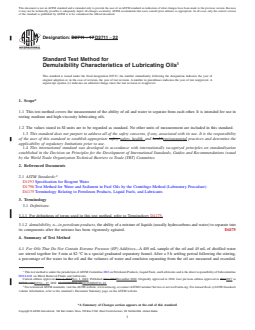
FIG. 1 Stirrer
4.2 For Oils That Contain Extreme Pressure (EP) Additives—A 360 mL sample of the oil and 90 mL of distilled water are stirred
together for 5 min at 82 °C in a special graduated separatory funnel. After a 5 h settling period following the stirring, percentage
of water in the oil and the volumes of water and emulsion separating from the oil are measured and recorded.
5. Significance and Use
5.1 This test provides a guide for determining the demulsibility characteristic of lubricating oils that are prone to water
contamination and may encounter the turbulence of pumping and circulation capable of producing water-in-oil emulsions.
6. Apparatus
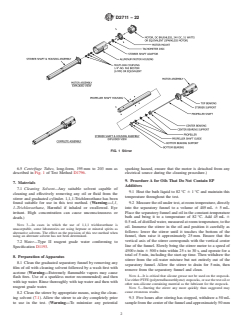
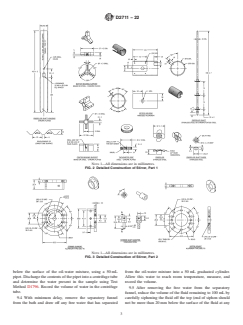
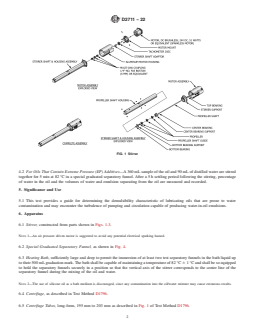
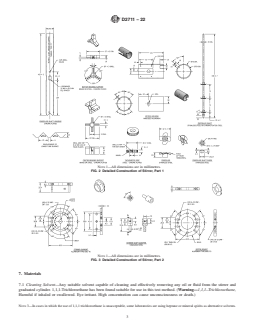
6.1 Stirrer, constructed from parts shown in Figs. 1-3.
NOTE 1—An air pressure driven motor is suggested to avoid any potential electrical sparking hazard.
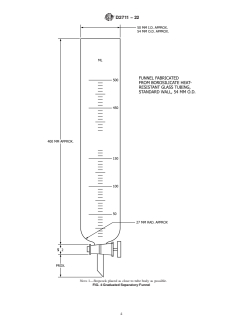
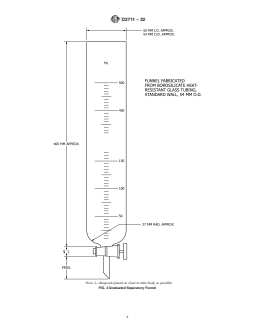
6.2 Special Graduated Separatory Funnel, as shown in Fig. 4.
6.3 Heating Bath, sufficiently large and deep to permit the immersion of at least two test separatory funnels in the bath liquid up
to their 500 mL graduation mark. The bath shall be capable of maintaining a temperature of 82 °C 6 1 °C and shall be so equipped
to hold the separatory funnels securely in a position so that the vertical axis of the stirrer corresponds to the center line of the
separatory funnel during the mixing of the oil and water.
NOTE 2—The use of silicone oil as a bath medium is discouraged, since any contamination into the oil/water mixture may cause erroneous results.
6.4 Centrifuge, as described in Test Method D1796.
6.5 Centrifuge Tubes, long-form, 195 mm to 203 mm as described in Fig. 1 of Test Method D1796.
D2711 − 22
NOTE 1—All dimensions are in millimetres.
FIG. 2 Detailed Construction of Stirrer, Part 1
NOTE 1—All dimensions are in millimetres.
FIG. 3 Detailed Construction of Stirrer, Part 2
7. Materials
7.1 Cleaning Solvent—Any suitable solvent capable of cleaning and effectively removing any oil or fluid from the stirrer and
graduated cylinder. 1,1,1-Trichloroethane has been found suitable for use in this test method. (Warning—1,1,1–Trichloroethane,
Harmful if inhaled or swallowed. Eye irritant. High concentration can cause unconsciousness or death.)
NOTE 3—In cases in which the use of 1,1,1 trichloroethane is unacceptable, some laboratories are using heptane or mineral spirits as alternative solvents.
D2711 − 22
NOTE 1—Stopcock placed as close to tube body as possible.
FIG. 4 Graduated Separatory Funnel
D2711 − 22
The effect on the precision of this test method when using an alternate solvent has not been determined.
7.2 Water—Type II reagent grade water conforming to Specification D1193.
8. Preparation of Apparatus
8.1 Clean the graduated separatory funnel by removing any film of oil with cleaning solvent followed by a wash first with acetone
(Warning—Extremely flammable vapors may cause flash fires. Use of a sparkless motor recommended) and then with tap water.
Rinse thoroughly with tap water and then with reagent grade water.
8.2 Clean the stirrer by appropriate means, using the cleaning solvent (7.1). Allow the stirrer to air dry completely prior to use
in the test. (Warning—To minimize any potential sparking hazard, ensure that the motor is detached from any electrical source
during the cleaning procedure.)
9. Procedure A for Oils That Do Not Contain EP Additives
9.1 Heat the bath liquid to 82 °C 6 1 °C and maintain this temperature throughout the test.
9.2 Measure the oil under test, at room temperature, directly into the separatory funnel to a volume of 405 mL 6 5 mL. Place the
separatory funnel and oil in the constant-temperature bath and bring it to a temperature of 82 °C. Add 45 mL 6 0.5 mL of distilled
water, measured at room temperature, to the oil. Immerse the stirrer in the oil and position it carefully as follows: lower the stirrer
until it touches the bottom of the funnel, then raise it approximately 25 mm. Ensure that the vertical axis of the stirrer corresponds
with the vertical center line of the funnel. Slowly bring the stirrer motor to a speed of 4500 r ⁄min 6 500 r ⁄min within 25 s to 30 s,
and operate for a total of 5 min, including the start-up time. Then withdraw the stirrer from the oil-water mixture but not entirely
out of the separatory funnel. Allow the stirrer to drain for 5 min, then remove from the separatory funnel and clean.
NOTE 4—It is critical that silcone grease not be used on the stopcock. Use either PTFE (polytetrafluoroethlyene) stopcocks, or use the test oil or other
non-silicone containing material as the lubricant for the stopcock.
NOTE 5—Starting the stirrer any more quickly than suggested may cause erroneous results.
9.3 Five hours after stirring has stopped, withdraw a 50 mL sample from the center of the funnel and approximately 50 mm below
the surface of the oil-water mixture, using a 50 mL pipet. Discharge the contents of the pipet into a centrifuge tube and determine
the water present in the sample using Test Method D1796. Record the volume of water in the centrifuge tube.
9.4 With minimum delay, remove the separatory funnel from the bath and draw off any free water that has separated from the
oil-water mixture into a 50 mL graduated cylinder. Allow this water to reach room temperature, measure, and record the volume.
9.5 After removing the free water from the separatory funnel, reduce the volume of the fluid remaining to 100 mL by carefully
siphoning the fluid off the top (end of siphon should not be more than 20 mm below the surface of the fluid at any time) down
to the 100 mL graduation mark on the separatory funnel. Drain the remaining 100 mL of fluid (oil, water, and emulsion) directly
into a centrifuge tube.
9.6 Centrifuge the tube and its contents for a period of 10 min to 15 min at a relative centrifugal force of 700. Record the volume
of water and emulsion separated by centrifuging.
9.7 Perform a minimum of two determinations on each oil sample by repeating procedure 9.1 – 9.6. If the difference in the two
sets of results obtained is outside the repeatability limits of Procedure A, discard them and obtain two additional sets of results.
10. Procedure B for Oils That Contain EP Additives
10.1 Heat the bath liquid to 82 °C 6 1 °C and maintain this temperature throughout the test.
10.2 Measure the oil under test, at room temperature, directly into the separatory funnel to a volume of 360 mL 6 5 mL. Place
the separatory funnel and oil in a const
...