

ASTM D7540-09(2019)
(Practice)Standard Practice for Dispersion of Chromatic Pigments with a Mechanical Muller
General Information
- Abstract
SIGNIFICANCE AND USE
5.1 The results obtained with a mechanical muller do not necessarily correlate directly with an industrial situation where different dispersing conditions exist. However, dispersion with a mechanical muller is a quick and inexpensive way to prepare specimens for testing the color and strength of a pigment for routine quality control.
5.2 By following the procedure described in Appendix X1, the conditions for achieving the maximum practical degree of dispersion with a mechanical muller may be determined. Any color and strength tests done with the dispersions should be carried out under these conditions.
SCOPE
1.1 This practice is intended to be used to disperse a chromatic pigment for subsequent testing.
1.2 This practice does not apply to white pigments.
Note 1: The dispersion portion of Test Method D3022 is similar to this practice, but it utilizes a miniature sandmill rather than a mechanical muller, to disperse the chromatic pigment.
Note 2: The dispersion portions of Test Methods D332 and D2745 are similar to this practice, but they are intended for use with white pigments, rather than chromatic pigments.
1.3 The values stated in SI units are to be regarded as the standard. The values given in parentheses are for information only.
1.4 This standard does not purport to address all of the safety concerns, if any, associated with its use. It is the responsibility of the user of this standard to establish appropriate safety, health, and environmental practices and determine the applicability of regulatory limitations prior to use. Specific hazard statements are given in Section 8.
1.5 This international standard was developed in accordance with internationally recognized principles on standardization established in the Decision on Principles for the Development of International Standards, Guides and Recommendations issued by the World Trade Organization Technical Barriers to Trade (TBT) Committee.
- Status
- Published
- Publication Date
- 31-Mar-2019
- Technical Committee
- D01 - Paint and Related Coatings, Materials, and Applications
- Drafting Committee
- D01.24 - Physical Properties of Liquid Paints & Paint Materials


Overview
ASTM D7540-09(2019): Standard Practice for Dispersion of Chromatic Pigments with a Mechanical Muller provides a standardized procedure for dispersing chromatic pigments using a mechanical muller. Developed by ASTM International, this standard ensures consistency and reliability when preparing pigment samples for color and strength testing in quality control settings. This method is widely recognized for its efficiency, cost-effectiveness, and its role in routine laboratory testing of chromatic pigments, excluding white pigments.
Mechanical mulling offers a quick and uniform means to prepare pigment dispersions under controlled conditions, enabling accurate evaluation of pigment properties. The practice outlines the use of specific apparatus, procedural steps, safety considerations, and the establishment of optimal dispersing conditions tailored to each pigment and vehicle combination.
Key Topics
Scope
- Applies to the dispersion of chromatic pigments (not white pigments) for subsequent testing.
- Describes laboratory procedures, not meant to replace or directly simulate industrial dispersing conditions.
- Specifies use of SI units as the standard measurement system.
Significance and Use
- Offers a practical approach for laboratories to prepare pigment samples for routine quality control.
- Enables color and strength tests once dispersion conditions are optimized.
- Provides a basis for reproducible comparison of pigment qualities between batches or suppliers.
Apparatus and Procedure
- Requires a mechanical muller with ground-glass plates, precision balances, spatulas, and nonabsorbent slabs.
- Conditions such as force applied, number of muller revolutions, and mass of pigment and vehicle are crucial for optimal dispersion.
- Appendix guidance helps users determine maximum practical tinting strength for different pigment types and vehicles.
Safety Considerations
- Highlights the potential toxicity and hazards associated with handling pigments and paint vehicles.
- Mandates adherence to proper safety, health, and environmental procedures.
Applications
The ASTM D7540-09(2019) standard is primarily used in industries and laboratories involved in the formulation, manufacture, and quality control of paints, coatings, inks, and other pigmented products. Typical applications include:
Quality Control:
- Fast, reproducible preparation of pigment dispersions for evaluation.
- Consistent measurement of pigment color, tinting strength, and performance between batches.
Product Development:
- Provides a means to compare new pigment formulations under controlled conditions.
- Supports development and optimization of pigment-vehicle combinations for desired properties.
Supplier Evaluation:
- Enables reliable comparison of pigments from different manufacturers.
- Standardizes testing for purchasing and acceptance criteria.
Regulatory Compliance:
- Assists in meeting international testing and quality documentation requirements, aligning with WTO TBT Committee principles.
Related Standards
For organizations and professionals working with pigment dispersion and evaluation, the following ASTM standards are closely related:
- ASTM D3022: Color and Strength of Color Pigments by Use of a Miniature Sandmill (applies to chromatic pigments, using different apparatus).
- ASTM D332: Relative Tinting Strength of White Pigments by Visual Observation (specific to white pigments).
- ASTM D2745: Relative Tinting Strength of White Pigments by Reflectance Measurements (specific to white pigments).
- ASTM E284: Terminology of Appearance.
Utilizing ASTM D7540-09(2019) enhances consistency in pigment quality testing, supporting efficient quality assurance and product development for chromatic pigment applications.
Relations
- Effective Date
- 01-Apr-2019
- Effective Date
- 01-Jun-2020
- Effective Date
- 01-Dec-2015
- Effective Date
- 01-Nov-2013
- Effective Date
- 01-Jun-2013
- Effective Date
- 01-Jan-2013
- Effective Date
- 01-Jul-2012
- Effective Date
- 01-Jun-2011
- Effective Date
- 01-Feb-2011
- Effective Date
- 01-Jun-2009
- Effective Date
- 01-Jan-2009
- Effective Date
- 01-Aug-2008
- Effective Date
- 01-Feb-2008
- Effective Date
- 15-Jul-2007
- Effective Date
- 01-Dec-2006
Frequently Asked Questions
ASTM D7540-09(2019) is a standard published by ASTM International. Its full title is "Standard Practice for Dispersion of Chromatic Pigments with a Mechanical Muller". This standard covers: SIGNIFICANCE AND USE 5.1 The results obtained with a mechanical muller do not necessarily correlate directly with an industrial situation where different dispersing conditions exist. However, dispersion with a mechanical muller is a quick and inexpensive way to prepare specimens for testing the color and strength of a pigment for routine quality control. 5.2 By following the procedure described in Appendix X1, the conditions for achieving the maximum practical degree of dispersion with a mechanical muller may be determined. Any color and strength tests done with the dispersions should be carried out under these conditions. SCOPE 1.1 This practice is intended to be used to disperse a chromatic pigment for subsequent testing. 1.2 This practice does not apply to white pigments. Note 1: The dispersion portion of Test Method D3022 is similar to this practice, but it utilizes a miniature sandmill rather than a mechanical muller, to disperse the chromatic pigment. Note 2: The dispersion portions of Test Methods D332 and D2745 are similar to this practice, but they are intended for use with white pigments, rather than chromatic pigments. 1.3 The values stated in SI units are to be regarded as the standard. The values given in parentheses are for information only. 1.4 This standard does not purport to address all of the safety concerns, if any, associated with its use. It is the responsibility of the user of this standard to establish appropriate safety, health, and environmental practices and determine the applicability of regulatory limitations prior to use. Specific hazard statements are given in Section 8. 1.5 This international standard was developed in accordance with internationally recognized principles on standardization established in the Decision on Principles for the Development of International Standards, Guides and Recommendations issued by the World Trade Organization Technical Barriers to Trade (TBT) Committee.
SIGNIFICANCE AND USE 5.1 The results obtained with a mechanical muller do not necessarily correlate directly with an industrial situation where different dispersing conditions exist. However, dispersion with a mechanical muller is a quick and inexpensive way to prepare specimens for testing the color and strength of a pigment for routine quality control. 5.2 By following the procedure described in Appendix X1, the conditions for achieving the maximum practical degree of dispersion with a mechanical muller may be determined. Any color and strength tests done with the dispersions should be carried out under these conditions. SCOPE 1.1 This practice is intended to be used to disperse a chromatic pigment for subsequent testing. 1.2 This practice does not apply to white pigments. Note 1: The dispersion portion of Test Method D3022 is similar to this practice, but it utilizes a miniature sandmill rather than a mechanical muller, to disperse the chromatic pigment. Note 2: The dispersion portions of Test Methods D332 and D2745 are similar to this practice, but they are intended for use with white pigments, rather than chromatic pigments. 1.3 The values stated in SI units are to be regarded as the standard. The values given in parentheses are for information only. 1.4 This standard does not purport to address all of the safety concerns, if any, associated with its use. It is the responsibility of the user of this standard to establish appropriate safety, health, and environmental practices and determine the applicability of regulatory limitations prior to use. Specific hazard statements are given in Section 8. 1.5 This international standard was developed in accordance with internationally recognized principles on standardization established in the Decision on Principles for the Development of International Standards, Guides and Recommendations issued by the World Trade Organization Technical Barriers to Trade (TBT) Committee.
ASTM D7540-09(2019) is classified under the following ICS (International Classification for Standards) categories: 87.060.10 - Pigments and extenders. The ICS classification helps identify the subject area and facilitates finding related standards.
ASTM D7540-09(2019) has the following relationships with other standards: It is inter standard links to ASTM D7540-09(2013), ASTM D332-87(2020), ASTM D332-87(2015), ASTM E284-13b, ASTM E284-13a, ASTM E284-13, ASTM E284-12, ASTM D3022-84(2011), ASTM D332-87(2011), ASTM E284-09a, ASTM E284-09, ASTM E284-08, ASTM D2745-00(2008), ASTM E284-07, ASTM E284-06b. Understanding these relationships helps ensure you are using the most current and applicable version of the standard.
ASTM D7540-09(2019) is available in PDF format for immediate download after purchase. The document can be added to your cart and obtained through the secure checkout process. Digital delivery ensures instant access to the complete standard document.
Standards Content (Sample)
This international standard was developed in accordance with internationally recognized principles on standardization established in the Decision on Principles for the
Development of International Standards, Guides and Recommendations issued by the World Trade Organization Technical Barriers to Trade (TBT) Committee.
Designation: D7540 − 09 (Reapproved 2019)
Standard Practice for
Dispersion of Chromatic Pigments with a Mechanical
Muller
This standard is issued under the fixed designation D7540; the number immediately following the designation indicates the year of
original adoption or, in the case of revision, the year of last revision. A number in parentheses indicates the year of last reapproval. A
superscript epsilon (´) indicates an editorial change since the last revision or reapproval.
1. Scope D3022 Test Method for Color and Strength of Color Pig-
ments by Use of a Miniature Sandmill
1.1 This practice is intended to be used to disperse a
E284 Terminology of Appearance
chromatic pigment for subsequent testing.
1.2 This practice does not apply to white pigments.
3. Terminology
NOTE1—ThedispersionportionofTestMethodD3022issimilartothis
3.1 Definitions—Definitions of appearance terms used in
practice, but it utilizes a miniature sandmill rather than a mechanical
this practice may be found in Terminology E284.
muller, to disperse the chromatic pigment.
NOTE 2—The dispersion portions ofTest Methods D332 and D2745 are
similar to this practice, but they are intended for use with white pigments,
4. Summary of Practice
rather than chromatic pigments.
4.1 Pigments are dispersed in a suitable vehicle with a
1.3 The values stated in SI units are to be regarded as the
mechanical muller. Test and standard pigments are treated
standard. The values given in parentheses are for information
identically. Opaque drawdowns may be made from the disper-
only.
sions and compared for color and strength differences either
1.4 This standard does not purport to address all of the
visually or instrumentally.
safety concerns, if any, associated with its use. It is the
responsibility of the user of this standard to establish appro-
5. Significance and Use
priate safety, health, and environmental practices and deter-
5.1 The results obtained with a mechanical muller do not
mine the applicability of regulatory limitations prior to use.
necessarily correlate directly with an industrial situation where
Specific hazard statements are given in Section 8.
different dispersing conditions exist. However, dispersion with
1.5 This international standard was developed in accor-
a mechanical muller is a quick and inexpensive way to prepare
dance with internationally recognized principles on standard-
specimens for testing the color and strength of a pigment for
ization established in the Decision on Principles for the
routine quality control.
Development of International Standards, Guides and Recom-
5.2 By following the procedure described in Appendix X1,
mendations issued by the World Trade Organization Technical
the conditions for achieving the maximum practical degree of
Barriers to Trade (TBT) Committee.
dispersion with a mechanical muller may be determined. Any
color and strength tests done with the dispersions should be
2. Referenced Documents
carried out under these conditions.
2.1 ASTM Standards:
D332 Test Method for Relative Tinting Strength of White
6. Apparatus
Pigments by Visual Observation
6.1 Balances—(1) A balance sensitive to 10 mg, and (2)an
D2745 Test Method for Relative Tinting Strength of White
analytical balance sensitive to 1.0 mg.
Pigments by Reflectance Measurements
6.2 Muller, Mechanical, equipped with ground-glass plates
to which a variable but known force may be added in 220-N
(50-lbf) increments. The driven glass plate shall have a speed
This practice is under the jurisdiction of ASTM Committee D01 on Paint and
ofrotationofbetween70and120r/minandtheapparatusshall
Related Coatings, Materials, and Applications and is the direct responsibility of
Subcommittee D01.24 on Physical Properties of Liquid Paints & Paint Materials.
have an arrangement for pre-setting the number of revolutions
Current edition approved April 1, 2019. Published April 2019. Originally
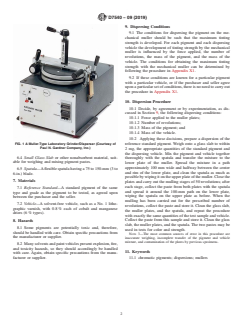
in multiples of 50. See Fig. 1 for an example of such a device.
approved in 2009. Last previous edition approved in 2013 as D7540 – 09 (2013).
DOI: 10.1520/D7540-09R19.
6.3 Rubbing Surfaces—The rubbing surfaces of the ground-
For referenced ASTM standards, visit the ASTM website, www.astm.org, or
glass plates shall be kept sharp by removing them from the
contact ASTM Customer Service at service@astm.org. For Annual Book of ASTM
muller and grinding them face-to-face with No. 303 optical
Standards volume information, refer to the standard’s Document Summary page on
the ASTM website. emery, or its equivalent, and water.
Copyright © ASTM International, 100 Barr Harbor Drive, PO Box C700, West Conshohocken, PA 19428-2959. United States
D7540 − 09 (2019)
9. Dispersing Conditions
9.1 The conditions for dispersing the pigment on the me-
chanical muller should be such that the maximum tinting
strength is developed. For each pigment and each dispersing
vehicle the development of tinting strength by the mechanical
muller is influenced by the force applied, the number of
revolutions, the mass of the pigment, and the mass of the
vehicle. The conditions for obtaining the maximum tinting
strength with the mechanical muller can be determined by
following the procedure in Appendix X1.
9.2 If these conditions are known for a particular pigment
with a particular vehicle, or if the purchaser and seller agree
upon a particular set of conditions, there is no need to carry out
the procedure in Appendix X1.
10. Dispersion Procedure
10.1 Decide, by agreement or by experimentation, as dis-
cussed in Section 9, the following dispersing conditions:
10.1.1 Force applied to the muller plates;
10.1.2 Number of revolutions;
10.1.3 Mass of the pigment; and
10.1.4 Mass of the vehicle.
10.2 Applying these decisions, prepare a dispersion of the
FIG. 1 A Muller-Type Laboratory Grinder/Disperser (Courtesy of reference standard pigment. Weigh onto a glass slab to within
Paul N. Gardner Company, Inc.)
2 mg, the appropriate quantities of the standard pigment and
the dispersing vehicle. Mix the pigment and vehicle together
6.4 Small Glass Slab or other nonabsorbent material, suit-
thoroughly with the spatula and transfer the mixture to the
ab
...