


ASTM D4846-96(2016)
(Test Method)Standard Test Method for Resistance to Unsnapping of Snap Fasteners
Standard Test Method for Resistance to Unsnapping of Snap Fasteners
SIGNIFICANCE AND USE
5.1 This test method may be used for acceptance testing of commercial shipments of snap fasteners, but caution is advised since information on between laboratory precision is incomplete. Comparative tests as directed in 5.1.1 are advisable.
5.1.1 In case of a dispute arising from differences in reported test results when using Test Method D4846 for acceptance testing of commercial shipments, the purchaser and seller should conduct comparative tests to determine if there is statistical bias between their laboratories. Competent statistical assistance is recommended for the investigation of bias. As a minimum, the two parties should take a group of test specimens that are as homogeneous as possible and that are from a lot of material of the type in question. The test specimens then should be assigned randomly in equal numbers to each laboratory for testing. The average results from the two laboratories should be compared using Student's t-test for unpaired data and an acceptable probability level chosen by the two parties before testing is begun. If a bias is found, either its cause must be found and corrected or the purchaser and seller must agree to interpret future test results in the light of the known bias.
SCOPE
1.1 This test method covers the determination of the force required to disengage snap fasteners by a pull perpendicular to and parallel with the plane of the snap fastener.
1.2 This test method requires attachment of snaps to specimens using specifications provided by the producers of the snaps.
1.3 This test method is used to establish correlation to wear conditions and for comparing different brands and types of snap fasteners.
1.4 The values stated in SI units are to be regarded as the standard. The values stated in the parentheses are for information only.
1.5 This standard does not purport to address all of the safety concerns, if any, associated with its use. It is the responsibility of the user of this standard to establish appropriate safety and health practices and determine the applicability of regulatory limitations prior to use.
General Information
Buy Standard
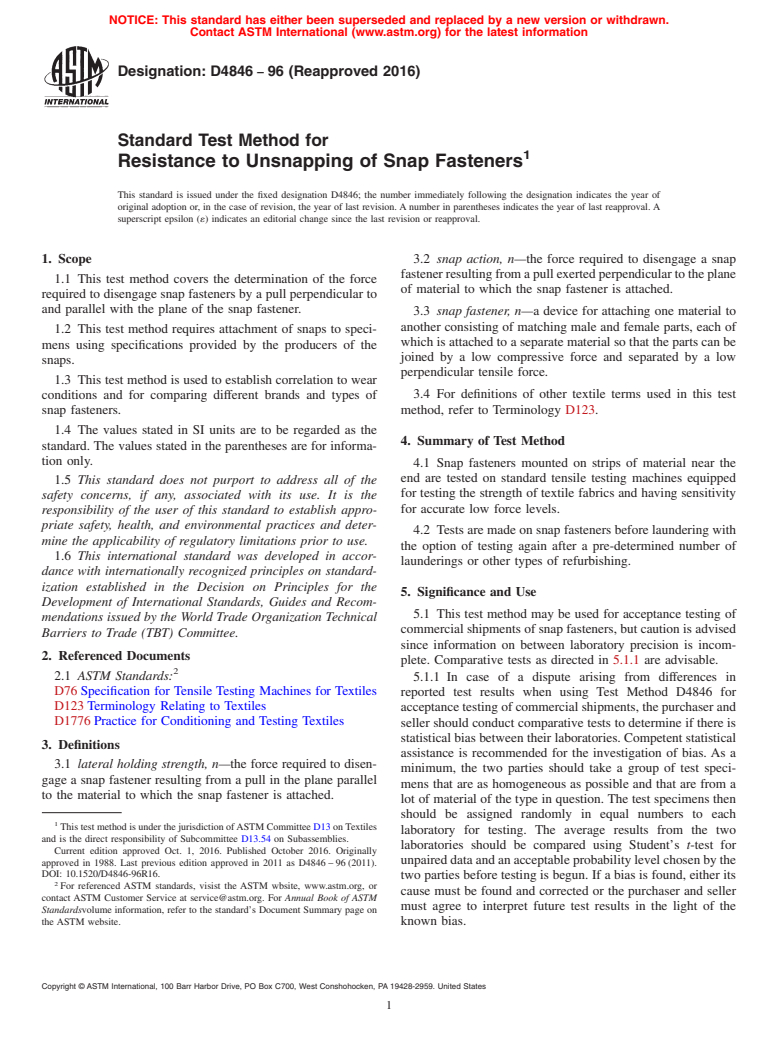
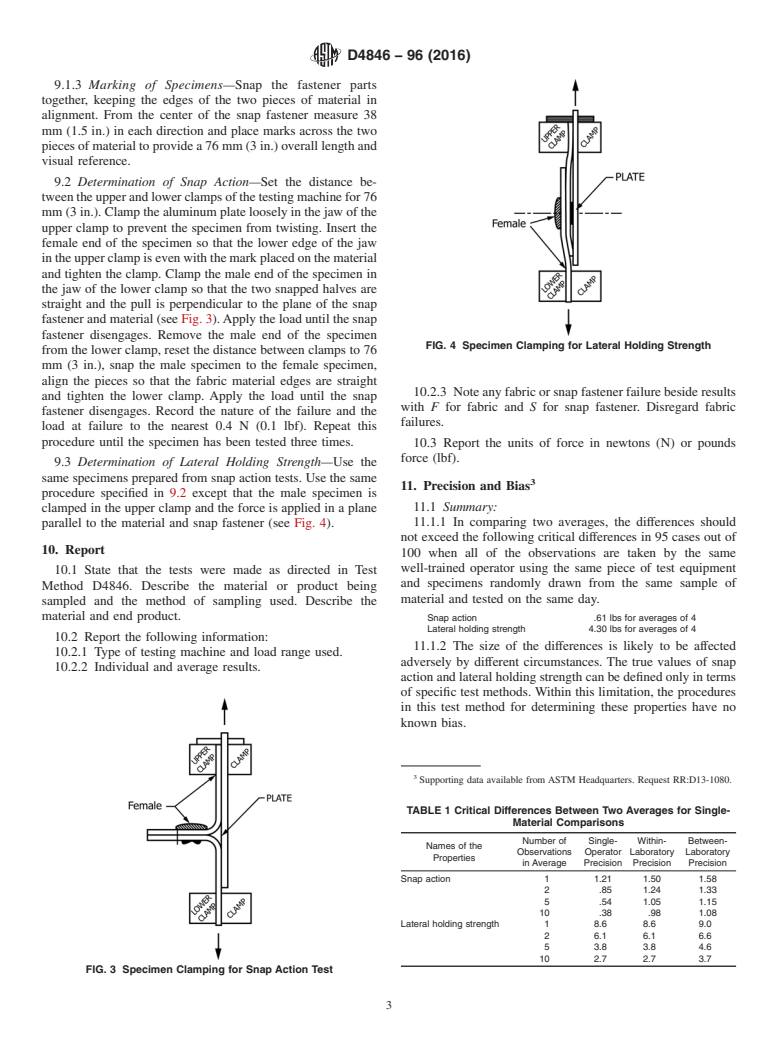
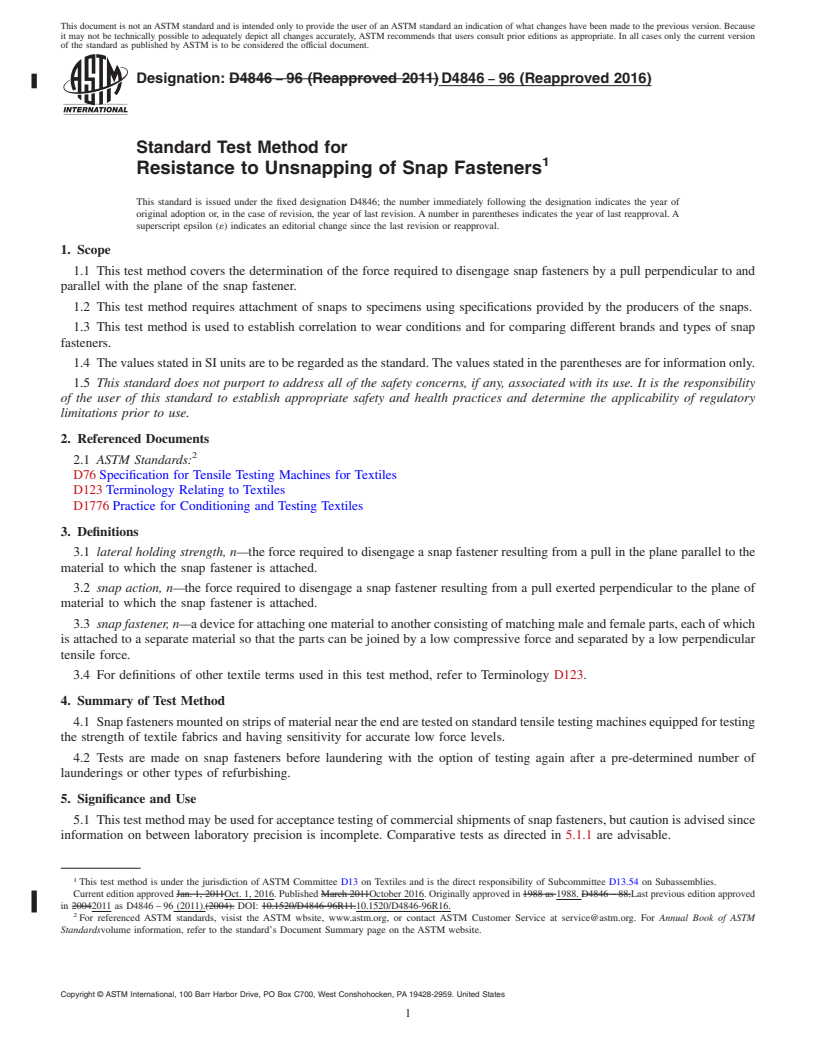
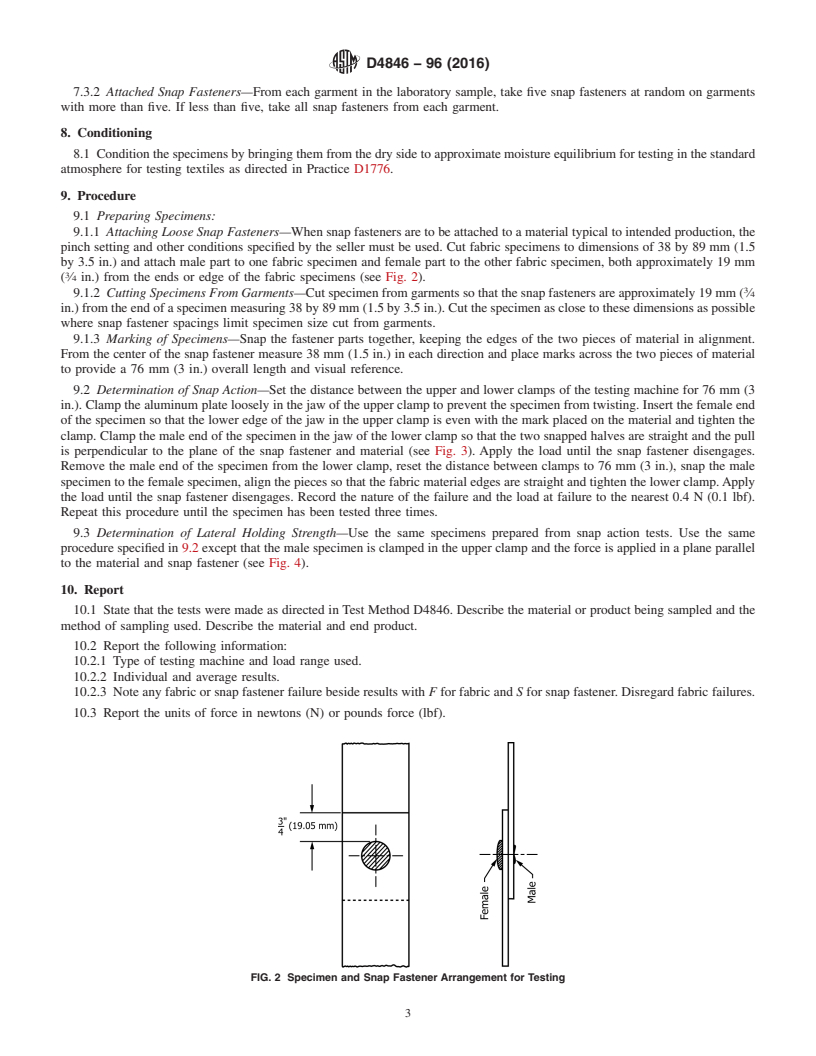
Standards Content (Sample)
NOTICE: This standard has either been superseded and replaced by a new version or withdrawn.
Contact ASTM International (www.astm.org) for the latest information
Designation: D4846 − 96 (Reapproved 2016)
Standard Test Method for
Resistance to Unsnapping of Snap Fasteners
This standard is issued under the fixed designation D4846; the number immediately following the designation indicates the year of
original adoption or, in the case of revision, the year of last revision. A number in parentheses indicates the year of last reapproval. A
superscript epsilon (´) indicates an editorial change since the last revision or reapproval.
1. Scope 3.2 snap action, n—the force required to disengage a snap
fastenerresultingfromapullexertedperpendiculartotheplane
1.1 This test method covers the determination of the force
of material to which the snap fastener is attached.
required to disengage snap fasteners by a pull perpendicular to
and parallel with the plane of the snap fastener.
3.3 snap fastener, n—a device for attaching one material to
another consisting of matching male and female parts, each of
1.2 This test method requires attachment of snaps to speci-
which is attached to a separate material so that the parts can be
mens using specifications provided by the producers of the
joined by a low compressive force and separated by a low
snaps.
perpendicular tensile force.
1.3 This test method is used to establish correlation to wear
conditions and for comparing different brands and types of 3.4 For definitions of other textile terms used in this test
method, refer to Terminology D123.
snap fasteners.
1.4 The values stated in SI units are to be regarded as the
4. Summary of Test Method
standard. The values stated in the parentheses are for informa-
tion only.
4.1 Snap fasteners mounted on strips of material near the
end are tested on standard tensile testing machines equipped
1.5 This standard does not purport to address all of the
for testing the strength of textile fabrics and having sensitivity
safety concerns, if any, associated with its use. It is the
for accurate low force levels.
responsibility of the user of this standard to establish appro-
priate safety, health, and environmental practices and deter-
4.2 Tests are made on snap fasteners before laundering with
mine the applicability of regulatory limitations prior to use.
the option of testing again after a pre-determined number of
1.6 This international standard was developed in accor-
launderings or other types of refurbishing.
dance with internationally recognized principles on standard-
ization established in the Decision on Principles for the
5. Significance and Use
Development of International Standards, Guides and Recom-
5.1 This test method may be used for acceptance testing of
mendations issued by the World Trade Organization Technical
commercial shipments of snap fasteners, but caution is advised
Barriers to Trade (TBT) Committee.
since information on between laboratory precision is incom-
2. Referenced Documents
plete. Comparative tests as directed in 5.1.1 are advisable.
2.1 ASTM Standards:
5.1.1 In case of a dispute arising from differences in
D76 Specification for Tensile Testing Machines for Textiles
reported test results when using Test Method D4846 for
D123 Terminology Relating to Textiles
acceptance testing of commercial shipments, the purchaser and
D1776 Practice for Conditioning and Testing Textiles
seller should conduct comparative tests to determine if there is
statistical bias between their laboratories. Competent statistical
3. Definitions
assistance is recommended for the investigation of bias. As a
3.1 lateral holding strength, n—the force required to disen-
minimum, the two parties should take a group of test speci-
gage a snap fastener resulting from a pull in the plane parallel
mens that are as homogeneous as possible and that are from a
to the material to which the snap fastener is attached.
lot of material of the type in question. The test specimens then
should be assigned randomly in equal numbers to each
This test method is under the jurisdiction ofASTM Committee D13 on Textiles
laboratory for testing. The average results from the two
and is the direct responsibility of Subcommittee D13.54 on Subassemblies.
laboratories should be compared using Student’s t-test for
Current edition approved Oct. 1, 2016. Published October 2016. Originally
unpaired data and an acceptable probability level chosen by the
approved in 1988. Last previous edition approved in 2011 as D4846 – 96 (2011).
DOI: 10.1520/D4846-96R16.
two parties before testing is begun. If a bias is found, either its
For referenced ASTM standards, visist the ASTM wbsite, www.astm.org, or
cause must be found and corrected or the purchaser and seller
contact ASTM Customer Service at service@astm.org. For Annual Book of ASTM
must agree to interpret future test results in the light of the
Standardsvolume information, refer to the standard’s Document Summary page on
the ASTM website. known bias.
Copyright © ASTM International, 100 Barr Harbor Drive, PO Box C700, West Conshohocken, PA 19428-2959. United States
D4846 − 96 (2016)
6. Apparatus 7.2.1 Unattached Snap Fasteners—Take one box or card of
unattached snap fasteners at random from each shipping carton
6.1 Tensile Testing Machine—A constant rate of extension
in the lot sample. If the male and female parts are packed
(CRE) type or constant rate of traverse (CRT) type testing
separately, take one box of each from each shipping carton in
machine conforming to Specification D76 with a rate of
the lot sample.
traverse of 305 mm (12 in.)/min, or a rate agreed upon between
7.2.2 Attached Snap Fasteners—Take one garment from
purchaser and seller, and a scale which will produce accurate
each shipping carton in the lot sample.
results at very low force levels. There may be no overall
correlationbetweentheresultsobtainedwiththeCREandCRT 7.3 Test Specimens:
tensile testing machines. In the case of controversy, however, 7.3.1 Unattached Snap Fasteners—From each box or card
the CRE method shall prevail. in the laboratory sample, take five snap fasteners at random. If
the male and female parts are packed separately, for each pair
6.2 Jaws—The back jaws of the clamps on the tensile
of boxes from a shipping carton in the lot sample, take five
testing machine should be at least the same width as the front
male parts at random and match them with five female parts
jaws. The front jaws must be 25.4 mm (1 in.) wide.
taken at random.
6.3 Aluminum Plate—A plate is required measuring 50 by
7.3.2 Attached Snap Fasteners—From each garment in the
100by4mm(2by4by ⁄8 in.) with dowel pins inserted (see
laboratory sample, take five snap fasteners at random on
Fig. 1).
garments with more than five. If less than five, take all snap
fasteners from each garment.
6.4 Attaching Machine—A hand operated, foot operated, or
automatic machine for attaching snap fastener parts conform-
8. Conditioning
ing to specifications of seller.
8.1 Condition the specimens by bringing them from the dry
7. Sampling side to approximate moisture equilibrium for testing in the
standard atmosphere for testing textiles as directed in Practice
7.1 LotSample—Asalotsampleforacceptancetesting,take
D1776.
at random the number of shipping cartons of snap fasteners or
shipping cartons of garments directed in an applicable material
9. Procedure
specification or other agreement between the purchaser and the
9.1 Preparing Specimens:
seller. Consider shipping cartons of snap fasteners or shipping
9.1.1 Attaching Loose Snap Fasteners—When snap fasten-
cartons of garments to be the primary sampling units.
ers are to be attached to a material typical to intended
NOTE 1—An adequate specification or other agreement between the
production, the pinch setting and other conditions specified by
purchaser and the seller requires taking into account the variability
the seller must be used. Cut fabric specimens to dimensions of
be
...
This document is not an ASTM standard and is intended only to provide the user of an ASTM standard an indication of what changes have been made to the previous version. Because
it may not be technically possible to adequately depict all changes accurately, ASTM recommends that users consult prior editions as appropriate. In all cases only the current version
of the standard as published by ASTM is to be considered the official document.
Designation: D4846 − 96 (Reapproved 2011) D4846 − 96 (Reapproved 2016)
Standard Test Method for
Resistance to Unsnapping of Snap Fasteners
This standard is issued under the fixed designation D4846; the number immediately following the designation indicates the year of
original adoption or, in the case of revision, the year of last revision. A number in parentheses indicates the year of last reapproval. A
superscript epsilon (´) indicates an editorial change since the last revision or reapproval.
1. Scope
1.1 This test method covers the determination of the force required to disengage snap fasteners by a pull perpendicular to and
parallel with the plane of the snap fastener.
1.2 This test method requires attachment of snaps to specimens using specifications provided by the producers of the snaps.
1.3 This test method is used to establish correlation to wear conditions and for comparing different brands and types of snap
fasteners.
1.4 The values stated in SI units are to be regarded as the standard. The values stated in the parentheses are for information only.
1.5 This standard does not purport to address all of the safety concerns, if any, associated with its use. It is the responsibility
of the user of this standard to establish appropriate safety and health practices and determine the applicability of regulatory
limitations prior to use.
2. Referenced Documents
2.1 ASTM Standards:
D76 Specification for Tensile Testing Machines for Textiles
D123 Terminology Relating to Textiles
D1776 Practice for Conditioning and Testing Textiles
3. Definitions
3.1 lateral holding strength, n—the force required to disengage a snap fastener resulting from a pull in the plane parallel to the
material to which the snap fastener is attached.
3.2 snap action, n—the force required to disengage a snap fastener resulting from a pull exerted perpendicular to the plane of
material to which the snap fastener is attached.
3.3 snap fastener, n—a device for attaching one material to another consisting of matching male and female parts, each of which
is attached to a separate material so that the parts can be joined by a low compressive force and separated by a low perpendicular
tensile force.
3.4 For definitions of other textile terms used in this test method, refer to Terminology D123.
4. Summary of Test Method
4.1 Snap fasteners mounted on strips of material near the end are tested on standard tensile testing machines equipped for testing
the strength of textile fabrics and having sensitivity for accurate low force levels.
4.2 Tests are made on snap fasteners before laundering with the option of testing again after a pre-determined number of
launderings or other types of refurbishing.
5. Significance and Use
5.1 This test method may be used for acceptance testing of commercial shipments of snap fasteners, but caution is advised since
information on between laboratory precision is incomplete. Comparative tests as directed in 5.1.1 are advisable.
This test method is under the jurisdiction of ASTM Committee D13 on Textiles and is the direct responsibility of Subcommittee D13.54 on Subassemblies.
Current edition approved Jan. 1, 2011Oct. 1, 2016. Published March 2011October 2016. Originally approved in 1988 as 1988. D4846 – 88.Last previous edition approved
in 20042011 as D4846 – 96 (2011).(2004). DOI: 10.1520/D4846-96R11.10.1520/D4846-96R16.
For referenced ASTM standards, visist the ASTM wbsite, www.astm.org, or contact ASTM Customer Service at service@astm.org. For Annual Book of ASTM
Standardsvolume information, refer to the standard’s Document Summary page on the ASTM website.
Copyright © ASTM International, 100 Barr Harbor Drive, PO Box C700, West Conshohocken, PA 19428-2959. United States
D4846 − 96 (2016)
5.1.1 In case of a dispute arising from differences in reported test results when using Test Method D4846 for acceptance testing
of commercial shipments, the purchaser and seller should conduct comparative tests to determine if there is statistical bias between
their laboratories. Competent statistical assistance is recommended for the investigation of bias. As a minimum, the two parties
should take a group of test specimens that are as homogeneous as possible and that are from a lot of material of the type in question.
The test specimens then should be assigned randomly in equal numbers to each laboratory for testing. The average results from
the two laboratories should be compared using Student’s t-test for unpaired data and an acceptable probability level chosen by the
two parties before testing is begun. If a bias is found, either its cause must be found and corrected or the purchaser and seller must
agree to interpret future test results in the light of the known bias.
6. Apparatus
6.1 Tensile Testing Machine—A constant rate of extension (CRE) type or constant rate of traverse (CRT) type testing machine
conforming to Specification D76 with a rate of traverse of 305 mm (12 in.)/min, or a rate agreed upon between purchaser and seller,
and a scale which will produce accurate results at very low force levels. There may be no overall correlation between the results
obtained with the CRE and CRT tensile testing machines. In the case of controversy, however, the CRE method shall prevail.
6.2 Jaws—The back jaws of the clamps on the tensile testing machine should be at least the same width as the front jaws. The
front jaws must be 25.4 mm (1 in.) wide.
6.3 Aluminum Plate—A plate is required measuring 50 by 100 by 4 mm (2 by 4 by ⁄8 in.) with dowel pins inserted (see Fig.
1).
6.4 Attaching Machine—A hand operated, foot operated, or automatic machine for attaching snap fastener parts conforming to
specifications of seller.
7. Sampling
7.1 Lot Sample—As a lot sample for acceptance testing, take at random the number of shipping cartons of snap fasteners or
shipping cartons of garments directed in an applicable material specification or other agreement between the purchaser and the
seller. Consider shipping cartons of snap fasteners or shipping cartons of garments to be the primary sampling units.
NOTE 1—An adequate specification or other agreement between the purchaser and the seller requires taking into account the variability between
shipping cartons, units within a shipping carton, and between specimens from a unit within a shipping carton, to provide a sampling plan with a
meaningful producer’s risk, consumer’s risk, acceptable quality level, and limiting quality level.
7.2 Laboratory Sample—As a laboratory sample for acceptance testing, proceed as follows:
7.2.1 Unattached Snap Fasteners—Take one box or card of unattached snap fasteners at random from each shipping carton in
the lot sample. If the male and female parts are packed separately, take one box of each from each shipping carton in the lot sample.
7.2.2 Attached Snap Fasteners—Take one garment from each shipping carton in the lot sample.
7.3 Test Specimens:
7.3.1 Unattached Snap Fasteners—From each box or card in the laboratory sample, take five snap fasteners at random. If the
male and female parts are packed separately, for each pair of boxes from a shipping carton in the lot sample, take five male parts
at random and match them with five female parts taken at random.
FIG. 1 Aluminum Plate
D4846 − 96 (2016)
7.3.2 Attached Snap Fasteners—From each garment in the laboratory sample, take five snap fasteners at random on garments
with more than five. If less than five, take all snap fasteners from each garment.
8. Conditioning
8.1 Condition the specimens by bringing them from the dry side to approximate
...
Questions, Comments and Discussion
Ask us and Technical Secretary will try to provide an answer. You can facilitate discussion about the standard in here.