

ASTM D1662-19
(Test Method)Standard Test Method for Active Sulfur in Cutting Oils
General Information
- Abstract
SIGNIFICANCE AND USE
5.1 This test method measures the quantity of sulfur available to react with metallic surfaces to form solid lubricating aids at the temperature of the test. Rates of reaction are metal type, temperature, and time dependent.
SCOPE
1.1 This test method covers the determination of active sulfur in cutting oils. This test method applies to sulfur reactive with copper powder at a temperature of 150 °C (302 °F) in cutting fluids containing both natural and added sulfur.
Note 1: It has not been established by ASTM Subcommittee D02.L0 as to how the active sulfur content thus determined may relate to field performance of the cutting fluid.
1.2 The values stated in SI units are to be regarded as the standard. The values given in parentheses are for information only.
1.3 This standard does not purport to address all of the safety concerns, if any, associated with its use. It is the responsibility of the user of this standard to establish appropriate safety, health, and environmental practices and determine the applicability of regulatory limitations prior to use.
1.4 This international standard was developed in accordance with internationally recognized principles on standardization established in the Decision on Principles for the Development of International Standards, Guides and Recommendations issued by the World Trade Organization Technical Barriers to Trade (TBT) Committee.
- Status
- Published
- Publication Date
- 31-Oct-2019
- Technical Committee
- D02 - Petroleum Products, Liquid Fuels, and Lubricants
- Drafting Committee
- D02.L0.01 - Metal Removal Fluids and Lubricants




Overview
ASTM D1662-19: Standard Test Method for Active Sulfur in Cutting Oils establishes uniform procedures to determine the presence of active sulfur in metalworking fluids. Active sulfur in cutting oils is significant due to its reactivity with metallic surfaces, particularly under elevated temperatures. This standard applies to both naturally occurring and added sulfur that can react with copper powder at 150 °C (302 °F), providing a quantitative method for assessing active sulfur content in cutting oils used for metal removal operations.
Accurate determination of active sulfur is essential for quality control, troubleshooting, and formulation of cutting fluids. The method recognizes the effect of factors such as metal type, temperature, and reaction time on sulfur reactivity, helping manufacturers and end users evaluate the lubricating potential and protective qualities of oils.
Key Topics
- Active Sulfur Definition: Refers to sulfur in a cutting fluid capable of reacting with metallic copper under specified conditions.
- Test Procedure: Involves reacting a defined amount of cutting oil with copper powder at 150 °C, then measuring the sulfur content before and after the reaction.
- Applicability: Suitable for cutting fluid formulations containing both natural and added sulfur.
- Sample Preparation: May require diluting high-sulfur content oils to improve measurement accuracy.
- Measurement: The active sulfur is calculated as the difference between untreated and copper-treated samples’ sulfur content.
- Repeatability and Reproducibility: The standard outlines acceptable ranges for test comparison both within and between laboratories to ensure consistent results.
- Suitability: While the test quantifies reactive sulfur, its correlation to actual cutting performance in the field is not established within this method.
- Safety and Compliance: Users are responsible for employing appropriate safety, health, and environmental controls when executing this method.
Applications
ASTM D1662-19 is primarily used by:
- Cutting Oil Manufacturers: To ensure formulations contain the appropriate levels of active sulfur to deliver the intended lubricity and protective effects during metalworking.
- Quality Control Laboratories: For verifying batch-to-batch consistency of active sulfur concentration.
- End-Users & Industrial Operations: To assess suitability of cutting fluids for specific machining tasks, especially where a certain reactivity with metal surfaces is desired to enhance lubrication and reduce wear.
- Research and Development: In evaluating new additives or formulations for enhanced metalworking performance.
Determining active sulfur content helps optimize cutting fluid selection for demanding machining processes, ensures safe operation by minimizing unexpected corrosion or reactivity, and supports regulatory compliance concerning sulfur additives.
Related Standards
- ASTM D130: Test Method for Corrosiveness to Copper from Petroleum Products by the Copper Strip Test
- ASTM D129 (historical relevance): Was formerly used for sulfur determination in this context, but any suitable sulfur analysis method may now be used.
- ISO and Other ASTM Metalworking Fluid Standards: These may provide complementary guidance on physical and chemical testing for lubricants and metal removal fluids.
By following ASTM D1662-19, manufacturers and users of cutting oils can reliably quantify active sulfur, facilitating informed decisions on fluid selection and quality assurance in metal removal operations.
Relations
- Effective Date
- 01-Nov-2019
- Effective Date
- 01-Nov-2010
- Effective Date
- 01-May-2004
- Effective Date
- 01-May-2004
- Effective Date
- 10-Aug-2000
Get Certified
Connect with accredited certification bodies for this standard

Element Materials Technology
Materials testing and product certification.

ABS Group Brazil
ABS Group certification services in Brazil.

ABS Quality Evaluations Inc.
American Bureau of Shipping quality certification.
Sponsored listings
Frequently Asked Questions
ASTM D1662-19 is a standard published by ASTM International. Its full title is "Standard Test Method for Active Sulfur in Cutting Oils". This standard covers: SIGNIFICANCE AND USE 5.1 This test method measures the quantity of sulfur available to react with metallic surfaces to form solid lubricating aids at the temperature of the test. Rates of reaction are metal type, temperature, and time dependent. SCOPE 1.1 This test method covers the determination of active sulfur in cutting oils. This test method applies to sulfur reactive with copper powder at a temperature of 150 °C (302 °F) in cutting fluids containing both natural and added sulfur. Note 1: It has not been established by ASTM Subcommittee D02.L0 as to how the active sulfur content thus determined may relate to field performance of the cutting fluid. 1.2 The values stated in SI units are to be regarded as the standard. The values given in parentheses are for information only. 1.3 This standard does not purport to address all of the safety concerns, if any, associated with its use. It is the responsibility of the user of this standard to establish appropriate safety, health, and environmental practices and determine the applicability of regulatory limitations prior to use. 1.4 This international standard was developed in accordance with internationally recognized principles on standardization established in the Decision on Principles for the Development of International Standards, Guides and Recommendations issued by the World Trade Organization Technical Barriers to Trade (TBT) Committee.
SIGNIFICANCE AND USE 5.1 This test method measures the quantity of sulfur available to react with metallic surfaces to form solid lubricating aids at the temperature of the test. Rates of reaction are metal type, temperature, and time dependent. SCOPE 1.1 This test method covers the determination of active sulfur in cutting oils. This test method applies to sulfur reactive with copper powder at a temperature of 150 °C (302 °F) in cutting fluids containing both natural and added sulfur. Note 1: It has not been established by ASTM Subcommittee D02.L0 as to how the active sulfur content thus determined may relate to field performance of the cutting fluid. 1.2 The values stated in SI units are to be regarded as the standard. The values given in parentheses are for information only. 1.3 This standard does not purport to address all of the safety concerns, if any, associated with its use. It is the responsibility of the user of this standard to establish appropriate safety, health, and environmental practices and determine the applicability of regulatory limitations prior to use. 1.4 This international standard was developed in accordance with internationally recognized principles on standardization established in the Decision on Principles for the Development of International Standards, Guides and Recommendations issued by the World Trade Organization Technical Barriers to Trade (TBT) Committee.
ASTM D1662-19 is classified under the following ICS (International Classification for Standards) categories: 75.100 - Lubricants, industrial oils and related products. The ICS classification helps identify the subject area and facilitates finding related standards.
ASTM D1662-19 has the following relationships with other standards: It is inter standard links to ASTM D1662-08(2014), ASTM D130-10, ASTM D130-04e1, ASTM D130-04, ASTM D130-94(2000)e1. Understanding these relationships helps ensure you are using the most current and applicable version of the standard.
ASTM D1662-19 is available in PDF format for immediate download after purchase. The document can be added to your cart and obtained through the secure checkout process. Digital delivery ensures instant access to the complete standard document.
Standards Content (Sample)
This international standard was developed in accordance with internationally recognized principles on standardization established in the Decision on Principles for the
Development of International Standards, Guides and Recommendations issued by the World Trade Organization Technical Barriers to Trade (TBT) Committee.
Designation: D1662 − 19
Standard Test Method for
Active Sulfur in Cutting Oils
This standard is issued under the fixed designation D1662; the number immediately following the designation indicates the year of
original adoption or, in the case of revision, the year of last revision. A number in parentheses indicates the year of last reapproval. A
superscript epsilon (´) indicates an editorial change since the last revision or reapproval.
1. Scope* 4. Summary of Test Method
1.1 This test method covers the determination of active 4.1 Aportion of the sample is treated with copper powder at
sulfur in cutting oils.This test method applies to sulfur reactive 150 °C (302 °F). The copper powder is filtered from the
with copper powder at a temperature of 150 °C (302 °F) in mixture. Active sulfur is expressed as the difference between
cutting fluids containing both natural and added sulfur. the sulfur contents of the sample, as determined before and
after treatment with copper.
NOTE 1—It has not been established by ASTM Subcommittee D02.L0
as to how the active sulfur content thus determined may relate to field
5. Significance and Use
performance of the cutting fluid.
5.1 This test method measures the quantity of sulfur avail-
1.2 The values stated in SI units are to be regarded as the
standard. The values given in parentheses are for information able to react with metallic surfaces to form solid lubricating
aids at the temperature of the test. Rates of reaction are metal
only.
type, temperature, and time dependent.
1.3 This standard does not purport to address all of the
safety concerns, if any, associated with its use. It is the
6. Apparatus
responsibility of the user of this standard to establish appro-
priate safety, health, and environmental practices and deter- 6.1 Filter Paper, 2.5 µm retention size.
mine the applicability of regulatory limitations prior to use.
6.2 Stirrer, constructed of glass in the form of an inverted T.
1.4 This international standard was developed in accor-
A flat blade, approximate length 25 mm, height 6 mm, thick-
dance with internationally recognized principles on standard-
ness 1 mm, shall be attached to a glass rod 6 mm in diameter,
ization established in the Decision on Principles for the
insuchawaythatthebladeissymmetricalwiththerodandhas
Development of International Standards, Guides and Recom-
its flat surface in the vertical plane. Alternatively, a glass-
mendations issued by the World Trade Organization Technical
coated magnetic stirring bar 9.5 mm by 34.9 mm 6 2mm
Barriers to Trade (TBT) Committee.
3 3
( ⁄8 in. by 1 ⁄8 in.) can be used.
2. Referenced Documents
6.3 Stirring Apparatus, electric motor capable of maintain-
ingaspeedof500 r⁄min 625 r⁄min.Alternatively,whenusing
2.1 ASTM Standards:
theglass-coatedstirringbar,acombinationmagneticstirrer-hot
D130 Test Method for Corrosiveness to Copper from Petro-
plate is required.
leum Products by Copper Strip Test
6.4 Hot Plate, electric, or other convenient heat source
3. Terminology
capable of maintaining the sample at a temperature of 150 °C
3.1 Definitions of Terms Specific to This Standard:
6 2 °C (302 °F 6 5 °F).
3.1.1 active sulfur—sulfur in a cutting fluid that will react
6.5 Beaker, 200 mL, tall-form of heat-resistant glass, with a
with metallic copper at a temperature of 150 °C (302 °F) under
pour-out spout.
the prescribed conditions.
7. Materials
This test method is under the jurisdiction of ASTM Committee D02 on
Petroleum Products, Liquid Fuels, and Lubricants and is the direct responsibility of
7.1 Diluent, sulfur-free white oil, methyl lardate or dialky-
Subcommittee D02.L0.01 on Metal Removal Fluids and Lubricants.
lbenzene.
Current edition approved Nov. 1, 2019. Published February 2020. Originally
approved in 1959. Last previous edition approved in 2014 as D1662 – 08 (2014).
7.2 Copper Powder, >99 %, <75 µm (200 mesh).
DOI: 10.1520/D1662-19.
This test method was prepared under the joint sponsorship of the American
8. Procedure
Society of Lubrication Engineers (ASLE) and accepted by ASLE in January 1969.
For referenced ASTM standards, visit the ASTM website, www.astm.org, or
8.1 Determine the sulfur concentration of the sample to be
contact ASTM Customer Service at service@astm.org. For Annual Book of ASTM
tested using any accepted method that has precision of
Standards volume information, refer to the standard’s Document Summary page on
the ASTM website. 60.15 % for sulfur.
*A Summary of Changes section appears at the end of this standard
Copyright © ASTM International, 100 Barr Harbor Drive, PO Box C700, West Conshohocken, PA 19428-2959. United States
D1662 − 19
TABLE 1 Active Sulfur (%)
Average Repeatability Reproducibility Repeatability Reproducibility
Standard Deviation Standard Deviation Limit Limit
Materials Xbar Sr SR r R
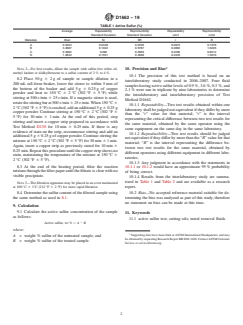
A 0.9454 0.0348 0.0706 0.0974 0.1976
B 3.3687 0.1022 0.5787 0.2862 1.6205
C 0.3902 0.082 0.2969 0.2296 0.8312
D 1.9643 0.1551 0.4668 0.4343 1.3070
NOTE 2—For best results, dilute the sample with sulfur-free white oil,
10. Precision and Bias
methyl lardate or dialkylbenzene to a sulfur content of 2 % to 4 %.
10.1
...
This document is not an ASTM standard and is intended only to provide the user of an ASTM standard an indication of what changes have been made to the previous version. Because
it may not be technically possible to adequately depict all changes accurately, ASTM recommends that users consult prior editions as appropriate. In all cases only the current version
of the standard as published by ASTM is to be considered the official document.
Designation: D1662 − 08 (Reapproved 2014) D1662 − 19
Standard Test Method for
Active Sulfur in Cutting Oils
This standard is issued under the fixed designation D1662; the number immediately following the designation indicates the year of
original adoption or, in the case of revision, the year of last revision. A number in parentheses indicates the year of last reapproval. A
superscript epsilon (´) indicates an editorial change since the last revision or reapproval.
1. Scope*
1.1 This test method covers the determination of active sulfur in cutting oils. This test method applies to sulfur reactive with
copper powder at a temperature of 150°C (302°F)150 °C (302 °F) in cutting fluids containing both natural and added sulfur.
NOTE 1—It has not been established by ASTM Subcommittee D02.L0 as to how the active sulfur content thus determined may relate to field
performance of the cutting fluid.
1.2 The values stated in SI units are to be regarded as the standard. The values given in parentheses are for information only.
1.3 This standard does not purport to address all of the safety concerns, if any, associated with its use. It is the responsibility
of the user of this standard to establish appropriate safety safety, health, and healthenvironmental practices and determine the
applicability of regulatory limitations prior to use.
1.4 This international standard was developed in accordance with internationally recognized principles on standardization
established in the Decision on Principles for the Development of International Standards, Guides and Recommendations issued
by the World Trade Organization Technical Barriers to Trade (TBT) Committee.
2. Referenced Documents
2.1 ASTM Standards:
D130 Test Method for Corrosiveness to Copper from Petroleum Products by Copper Strip Test
3. Terminology
3.1 Definitions of Terms Specific to This Standard:
3.1.1 active sulfur—sulfur in a cutting fluid that will react with metallic copper at a temperature of 150°C (302°F)150 °C
(302 °F) under the prescribed conditions.
4. Summary of Test Method
4.1 A portion of the sample is treated with copper powder at 150°C (302°F).150 °C (302 °F). The copper powder is filtered from
the mixture. Active sulfur is expressed as the difference between the sulfur contents of the sample, as determined before and after
treatment with copper.
5. Significance and Use
5.1 This test method measures the quantity of sulfur available to react with metallic surfaces to form solid lubricating aids at
the temperature of the test. Rates of reaction are metal type, temperature, and time dependent.
6. Apparatus
6.1 Filter Paper, 2.5 μm 2.5 μm retention size.
6.2 Stirrer, constructed of glass in the form of an inverted T. A flat blade, approximate length 25 mm, height 6 mm, thickness
1 mm, 25 mm, height 6 mm, thickness 1 mm, shall be attached to a glass rod 6 mm 6 mm in diameter, in such a way that the blade
This test method is under the jurisdiction of ASTM Committee D02 on Petroleum Products, Liquid Fuels, and Lubricants and is the direct responsibility of Subcommittee
D02.L0.01 on Metal Removal Fluids and Lubricants.
Current edition approved Jan. 1, 2014Nov. 1, 2019. Published February 2014February 2020. Originally approved in 1959. Last previous edition approved in 20082014
as D1662D1662 – 08 (2014).–08. DOI: 10.1520/D1662-08R14.10.1520/D1662-19.
This test method was prepared under the joint sponsorship of the American Society of Lubrication Engineers (ASLE) and accepted by ASLE in January 1969.
For referenced ASTM standards, visit the ASTM website, www.astm.org, or contact ASTM Customer Service at service@astm.org. For Annual Book of ASTM Standards
volume information, refer to the standard’s Document Summary page on the ASTM website.
*A Summary of Changes section appears at the end of this standard
Copyright © ASTM International, 100 Barr Harbor Drive, PO Box C700, West Conshohocken, PA 19428-2959. United States
D1662 − 19
is symmetrical with the rod and has its flat surface in the vertical plane. Alternatively, a glass-coated magnetic stirring bar
3 3
9.59.5 mm by 34.934.9 mm 6 2 mm 2 mm ( ⁄8 in. by 1 ⁄8 in.) in.) can be used.
6.3 Stirring Apparatus, electric motor capable of maintaining a speed of 500500 r ⁄min 6 2525 r rpm. ⁄min. Alternatively, when
using the glass-coated stirring bar, a combination magnetic stirrer-hot plate is required.
6.4 Hot Plate, electric, or other convenient heat source capable of maintaining the sample at a temperature of 150150 °C 6 2°C
(3022 °C (302 °F 6 5°F).5 °F).
6.5 Beaker, 200-mL,200 mL, tall-form of heat-resistant glass, with a pour-out spout.
7. Materials
7.1 Diluent, sulfur-free white oil, methyl lardate or dialkylbenzene.
7.2 Copper Powder, >99 %, <75 μm <75 μm (200 mesh).
8. Procedure
8.1 Determine the sulfur concentration of the sample to be tested using any accepted method that has precision of 60.15 % for
sulfur.
NOTE 2—For best results, dilute the sample with sulfur-free white oil, methyl lardate or dialkylbenzene to a sulfur content of 22 % to 4 %.
8.2 Place 5050 g 6 2 g 2 g of sample or sample dilution in a 200-mL200 mL tall-form beaker, lower the stirrer to within 5 mm
5 mm of the bottom of the beaker and add 55 g 6 0.25 g 0.25 g of copper powder and heat to 150150 °C 6 2°C (3022 °C (302 °F
6 5°F)5 °F) while stirring at 500500 r ⁄min 6 2525 r rpm. ⁄min. If a magnetic stirrer is used, rotate the stirring bar at 500500 r ⁄min
6 2525 r rpm. ⁄min. When 150150 °C 6 2°C (3022 °C (302 °F 6 5°F)5 °F) is reached, add an additional 55 g 6 0.25 g 0.25 g
copper powder. Continue stirring at 150150 °C 6 2°C (3022 °C (302 °F 6 5°F)5 °F) for 3030 min 6 1 min. 1 min. At the end of
this period, stop stirring and insert a copper strip prepared in accordance with Test Method D130 for 1010 min 6 0.25 min.
...