

ASTM G175-13(2021)
(Test Method)Standard Test Method for Evaluating the Ignition Sensitivity and Fault Tolerance of Oxygen Pressure Regulators Used for Medical and Emergency Applications
General Information
- Abstract
SIGNIFICANCE AND USE
4.1 This test method comprises two phases and is used to evaluate the ignition sensitivity and fault tolerance of oxygen pressure regulators used for medical and emergency applications.
4.2 Phase 1: Oxygen Pressure Shock Test—The objective of this test phase is to determine whether the heat or temperature from oxygen pressure shocks will result in burnout or visible heat damage to the internal parts of the pressure regulator.
4.2.1 The criteria for a valid test are specified in ISO 10524–1, Section 6.6 for oxygen pressure regulators and ISO 10524–3, Section 6.6 for oxygen VIPRs.
4.2.2 The pass/fail criteria for a pressure regulator are specified in ISO 10524–1, Section 6.6 for oxygen pressure regulators and ISO 10524–3, Section 6.6 for oxygen VIPRs.
4.3 Phase 2: Promoted Ignition Test—
4.3.1 Oxygen Pressure Regulator—The objective of this test phase is to determine if an ignition event upstream of the pressure regulator inlet filter will result in sustained combustion and burnout of the pressure regulator.
4.3.1.1 The criterion for a valid test is either, (1) failure of the pressure regulator, as defined in 4.3.1.2, or (2) if the pressure regulator does not fail, consumption of at least 90 % of the ignition pill as determined by visual inspection or mass determination.
4.3.1.2 Failure of the pressure regulator is defined as the breach of the pressurized regulator component (burnout), which may include the CGA 870 seal ring, and ejection of molten or burning metal or any parts, including the gauge, from the pressure regulator. See Appendix X6 Testing Pressure Regulators and VIPRs with Gauges. However, momentary (less than 1 s) ejection of flame through normal vent paths, with sparks that look similar to those from metal applied to a grinding wheel, is acceptable and does not constitute a failure.
4.3.2 Oxygen VIPR—The objective of this test is to determine if an ignition event upstream of the shut-off valve or within the shut-off valve will resu...
SCOPE
1.1 For the purpose of this standard, a pressure regulator, also called a pressure-reducing valve, is a device intended for medical or emergency purposes that is used to convert a medical or emergency gas pressure from a high, variable pressure to a lower, more constant working pressure [21 CFR 868.2700 (a)]. Some of these oxygen pressure regulators are a combination of a pressure regulator and cylinder valve. These devices are often referred to as valve integrated pressure regulators, or VIPRs.
1.2 This standard provides an evaluation tool for determining the ignition sensitivity and fault tolerance of oxygen pressure regulators and VIPRs used for medical and emergency applications. An ignition-sensitive pressure regulator or VIPR is defined as having a high probability of ignition as evaluated by rapid pressurization testing (Phase 1). A fault-tolerant pressure regulator or VIPR is defined as having a low consequence of ignition as evaluated by forced ignition testing (Phase 2).
Note 1: It is essential that a risk assessment be carried out on breathing gas systems, especially concerning toxic product formation due to ignition or decomposition of nonmetallic materials as weighed against the risk of flammability (refer to Guide G63 and ISO 15001.2). See Appendix X1 and Appendix X2 for details.
1.3 This standard applies only to:
1.3.1 Oxygen pressure regulators used for medical and emergency applications that are designed and fitted with CGA 540 inlet connections, CGA 870 pin-index adapters (CGA V-1), or EN ISO 407 pin-index adapters.
1.3.2 Oxygen VIPRs used for medical and emergency applications that are designed to be permanently fitted to a medical gas cylinder.
1.4 This standard is a test standard not a design standard; This test standard is not intended as a substitute for traditional design requirements for oxygen cylinder valves, pressure regulators and VIPRs. A well-designed pressure regulator or ...
- Status
- Published
- Publication Date
- 30-Nov-2021
- Drafting Committee
- G04.01 - Test Methods
Overview
ASTM G175-13(2021) is the Standard Test Method for Evaluating the Ignition Sensitivity and Fault Tolerance of Oxygen Pressure Regulators Used for Medical and Emergency Applications. Developed by ASTM International, this standard is vital for assessing the safety and reliability of devices that control the delivery of oxygen in healthcare and emergency environments. The document establishes a systematic method for evaluating how oxygen pressure regulators and valve-integrated pressure regulators (VIPRs) respond to ignition events, helping manufacturers, designers, and users minimize fire hazards and improve patient safety.
Key Topics
- Ignition Sensitivity and Fault Tolerance: This standard focuses on the likelihood of a regulator catching fire (ignition sensitivity) and its ability to withstand ignition events without catastrophic failure (fault tolerance).
- Two-Phase Testing Approach:
- Phase 1: Oxygen Pressure Shock Test
Evaluates whether pressure shocks in the regulator cause internal thermal damage or burnout. Criteria for this phase refer to ISO 10524-1 (pressure regulators) and ISO 10524-3 (VIPRs). - Phase 2: Promoted Ignition Test
Simulates severe ignition sources upstream of the inlet filter or shut-off valve to determine if the regulator sustains combustion or burnout.
- Phase 1: Oxygen Pressure Shock Test
- Risk Assessment: The standard underscores the necessity of risk assessment, especially concerning the formation of toxic by-products from nonmetallic material ignition versus the risk of flammability.
- Regulator Types: Covers only oxygen pressure regulators and VIPRs designed for medical and emergency use with specific inlet connections (CGA 540, CGA 870, EN ISO 407).
- Testing Not a Substitute for Design: This is a test standard, not a design specification. Design considerations must still align with traditional safety and material standards.
Applications
- Medical Oxygen Delivery: Essential in hospitals, clinics, ambulances, and home healthcare where oxygen regulation safety is critical for patient therapy.
- Emergency Medical Services (EMS): Assures that oxygen pressure regulators and VIPRs used by first responders are tested for ignition resistance and fail-safes in fire-prone scenarios.
- Procurement and Compliance: Provides a reliable method for buyers and facility managers to select and verify compliant oxygen delivery equipment.
- Device Manufacturing and Quality Control: Forms part of manufacturer protocols for developing, testing, and certifying medical and emergency oxygen regulators for regulatory compliance and international market access.
- Regulatory Support: Supports conformance with U.S. regulations (21 CFR 868.2700) and international safety requirements for medical gas devices.
Related Standards
ASTM G175-13(2021) explicitly references several critical standards and guides, including:
- ISO 10524-1: Pressure regulators for use with medical gases
- ISO 10524-3: VIPRs (Valve Integrated Pressure Regulators) for medical gases
- ISO 15001: Anaesthetic and respiratory equipment - Compatibility with oxygen
- ASTM G63, G88, G94, G128: Guides for evaluating materials and designing systems for oxygen-enriched environments
- ASTM G93: Guide for cleanliness levels and cleaning methods for oxygen service
- CGA (Compressed Gas Association) Standards: E-4, E-7, E-18, G-4, G-4.1, V-1, V-14 covering regulator design, valve and gasket performance, and cleaning
- USP24-NF19: Specifications for oxygen purity
- Federal Regulation 21 CFR 868.2700: U.S. requirements for pressure regulators
Practical Value
Implementing ASTM G175-13(2021) enhances device safety by verifying resistance to ignition events, ultimately protecting both users and patients. This standard enables stakeholders to confidently choose, test, and maintain oxygen delivery equipment that meets stringent medical and emergency application requirements, reducing the risk of fires, system failures, and associated health hazards. Adhering to this protocol supports compliance with regulatory and international standards, building trust across the global healthcare industry.
Relations
- Effective Date
- 01-Nov-2019
- Effective Date
- 01-Mar-2017
- Effective Date
- 01-May-2016
- Refers
ASTM D4066-13 - Standard Classification System for Nylon Injection and Extrusion Materials (PA) - Effective Date
- 01-Jul-2013
- Effective Date
- 01-Aug-2012
- Effective Date
- 01-Apr-2012
- Effective Date
- 01-Apr-2011
- Refers
ASTM D6779-10 - Standard Classification System for Polyamide Molding and Extrusion Materials (PA) - Effective Date
- 01-Jul-2010
- Refers
ASTM D6779-11 - Standard Classification System for Polyamide Molding and Extrusion Materials (PA) - Effective Date
- 01-Jul-2010
- Effective Date
- 01-Nov-2008
- Effective Date
- 15-Sep-2008
- Refers
ASTM G128-02(2008) - Standard Guide for Control of Hazards and Risks in Oxygen Enriched Systems - Effective Date
- 01-Sep-2008
- Refers
ASTM D6779-08a - Standard Classification System for Polyamide Molding and Extrusion Materials (PA) - Effective Date
- 01-Apr-2008
- Refers
ASTM D6779-08 - Standard Classification System for Polyamide Molding and Extrusion Materials (PA) - Effective Date
- 15-Jan-2008
- Refers
ASTM D6779-07a - Standard Classification System for Polyamide Molding and Extrusion Materials (PA) - Effective Date
- 15-Sep-2007
Get Certified
Connect with accredited certification bodies for this standard

BSI Group
BSI (British Standards Institution) is the business standards company that helps organizations make excellence a habit.

TÜV Rheinland
TÜV Rheinland is a leading international provider of technical services.

TÜV SÜD
TÜV SÜD is a trusted partner of choice for safety, security and sustainability solutions.
Sponsored listings
Frequently Asked Questions
ASTM G175-13(2021) is a standard published by ASTM International. Its full title is "Standard Test Method for Evaluating the Ignition Sensitivity and Fault Tolerance of Oxygen Pressure Regulators Used for Medical and Emergency Applications". This standard covers: SIGNIFICANCE AND USE 4.1 This test method comprises two phases and is used to evaluate the ignition sensitivity and fault tolerance of oxygen pressure regulators used for medical and emergency applications. 4.2 Phase 1: Oxygen Pressure Shock Test—The objective of this test phase is to determine whether the heat or temperature from oxygen pressure shocks will result in burnout or visible heat damage to the internal parts of the pressure regulator. 4.2.1 The criteria for a valid test are specified in ISO 10524–1, Section 6.6 for oxygen pressure regulators and ISO 10524–3, Section 6.6 for oxygen VIPRs. 4.2.2 The pass/fail criteria for a pressure regulator are specified in ISO 10524–1, Section 6.6 for oxygen pressure regulators and ISO 10524–3, Section 6.6 for oxygen VIPRs. 4.3 Phase 2: Promoted Ignition Test— 4.3.1 Oxygen Pressure Regulator—The objective of this test phase is to determine if an ignition event upstream of the pressure regulator inlet filter will result in sustained combustion and burnout of the pressure regulator. 4.3.1.1 The criterion for a valid test is either, (1) failure of the pressure regulator, as defined in 4.3.1.2, or (2) if the pressure regulator does not fail, consumption of at least 90 % of the ignition pill as determined by visual inspection or mass determination. 4.3.1.2 Failure of the pressure regulator is defined as the breach of the pressurized regulator component (burnout), which may include the CGA 870 seal ring, and ejection of molten or burning metal or any parts, including the gauge, from the pressure regulator. See Appendix X6 Testing Pressure Regulators and VIPRs with Gauges. However, momentary (less than 1 s) ejection of flame through normal vent paths, with sparks that look similar to those from metal applied to a grinding wheel, is acceptable and does not constitute a failure. 4.3.2 Oxygen VIPR—The objective of this test is to determine if an ignition event upstream of the shut-off valve or within the shut-off valve will resu... SCOPE 1.1 For the purpose of this standard, a pressure regulator, also called a pressure-reducing valve, is a device intended for medical or emergency purposes that is used to convert a medical or emergency gas pressure from a high, variable pressure to a lower, more constant working pressure [21 CFR 868.2700 (a)]. Some of these oxygen pressure regulators are a combination of a pressure regulator and cylinder valve. These devices are often referred to as valve integrated pressure regulators, or VIPRs. 1.2 This standard provides an evaluation tool for determining the ignition sensitivity and fault tolerance of oxygen pressure regulators and VIPRs used for medical and emergency applications. An ignition-sensitive pressure regulator or VIPR is defined as having a high probability of ignition as evaluated by rapid pressurization testing (Phase 1). A fault-tolerant pressure regulator or VIPR is defined as having a low consequence of ignition as evaluated by forced ignition testing (Phase 2). Note 1: It is essential that a risk assessment be carried out on breathing gas systems, especially concerning toxic product formation due to ignition or decomposition of nonmetallic materials as weighed against the risk of flammability (refer to Guide G63 and ISO 15001.2). See Appendix X1 and Appendix X2 for details. 1.3 This standard applies only to: 1.3.1 Oxygen pressure regulators used for medical and emergency applications that are designed and fitted with CGA 540 inlet connections, CGA 870 pin-index adapters (CGA V-1), or EN ISO 407 pin-index adapters. 1.3.2 Oxygen VIPRs used for medical and emergency applications that are designed to be permanently fitted to a medical gas cylinder. 1.4 This standard is a test standard not a design standard; This test standard is not intended as a substitute for traditional design requirements for oxygen cylinder valves, pressure regulators and VIPRs. A well-designed pressure regulator or ...
SIGNIFICANCE AND USE 4.1 This test method comprises two phases and is used to evaluate the ignition sensitivity and fault tolerance of oxygen pressure regulators used for medical and emergency applications. 4.2 Phase 1: Oxygen Pressure Shock Test—The objective of this test phase is to determine whether the heat or temperature from oxygen pressure shocks will result in burnout or visible heat damage to the internal parts of the pressure regulator. 4.2.1 The criteria for a valid test are specified in ISO 10524–1, Section 6.6 for oxygen pressure regulators and ISO 10524–3, Section 6.6 for oxygen VIPRs. 4.2.2 The pass/fail criteria for a pressure regulator are specified in ISO 10524–1, Section 6.6 for oxygen pressure regulators and ISO 10524–3, Section 6.6 for oxygen VIPRs. 4.3 Phase 2: Promoted Ignition Test— 4.3.1 Oxygen Pressure Regulator—The objective of this test phase is to determine if an ignition event upstream of the pressure regulator inlet filter will result in sustained combustion and burnout of the pressure regulator. 4.3.1.1 The criterion for a valid test is either, (1) failure of the pressure regulator, as defined in 4.3.1.2, or (2) if the pressure regulator does not fail, consumption of at least 90 % of the ignition pill as determined by visual inspection or mass determination. 4.3.1.2 Failure of the pressure regulator is defined as the breach of the pressurized regulator component (burnout), which may include the CGA 870 seal ring, and ejection of molten or burning metal or any parts, including the gauge, from the pressure regulator. See Appendix X6 Testing Pressure Regulators and VIPRs with Gauges. However, momentary (less than 1 s) ejection of flame through normal vent paths, with sparks that look similar to those from metal applied to a grinding wheel, is acceptable and does not constitute a failure. 4.3.2 Oxygen VIPR—The objective of this test is to determine if an ignition event upstream of the shut-off valve or within the shut-off valve will resu... SCOPE 1.1 For the purpose of this standard, a pressure regulator, also called a pressure-reducing valve, is a device intended for medical or emergency purposes that is used to convert a medical or emergency gas pressure from a high, variable pressure to a lower, more constant working pressure [21 CFR 868.2700 (a)]. Some of these oxygen pressure regulators are a combination of a pressure regulator and cylinder valve. These devices are often referred to as valve integrated pressure regulators, or VIPRs. 1.2 This standard provides an evaluation tool for determining the ignition sensitivity and fault tolerance of oxygen pressure regulators and VIPRs used for medical and emergency applications. An ignition-sensitive pressure regulator or VIPR is defined as having a high probability of ignition as evaluated by rapid pressurization testing (Phase 1). A fault-tolerant pressure regulator or VIPR is defined as having a low consequence of ignition as evaluated by forced ignition testing (Phase 2). Note 1: It is essential that a risk assessment be carried out on breathing gas systems, especially concerning toxic product formation due to ignition or decomposition of nonmetallic materials as weighed against the risk of flammability (refer to Guide G63 and ISO 15001.2). See Appendix X1 and Appendix X2 for details. 1.3 This standard applies only to: 1.3.1 Oxygen pressure regulators used for medical and emergency applications that are designed and fitted with CGA 540 inlet connections, CGA 870 pin-index adapters (CGA V-1), or EN ISO 407 pin-index adapters. 1.3.2 Oxygen VIPRs used for medical and emergency applications that are designed to be permanently fitted to a medical gas cylinder. 1.4 This standard is a test standard not a design standard; This test standard is not intended as a substitute for traditional design requirements for oxygen cylinder valves, pressure regulators and VIPRs. A well-designed pressure regulator or ...
ASTM G175-13(2021) is classified under the following ICS (International Classification for Standards) categories: 11.040.10 - Anaesthetic, respiratory and reanimation equipment. The ICS classification helps identify the subject area and facilitates finding related standards.
ASTM G175-13(2021) has the following relationships with other standards: It is inter standard links to ASTM D4066-13(2019), ASTM D6779-17, ASTM D6779-16, ASTM D4066-13, ASTM D6779-12a, ASTM D6779-12, ASTM G93-03(2011), ASTM D6779-10, ASTM D6779-11, ASTM D618-08, ASTM D4066-01a(2008), ASTM G128-02(2008), ASTM D6779-08a, ASTM D6779-08, ASTM D6779-07a. Understanding these relationships helps ensure you are using the most current and applicable version of the standard.
ASTM G175-13(2021) is available in PDF format for immediate download after purchase. The document can be added to your cart and obtained through the secure checkout process. Digital delivery ensures instant access to the complete standard document.
Standards Content (Sample)
This international standard was developed in accordance with internationally recognized principles on standardization established in the Decision on Principles for the
Development of International Standards, Guides and Recommendations issued by the World Trade Organization Technical Barriers to Trade (TBT) Committee.
Designation: G175 − 13 (Reapproved 2021)
Standard Test Method for
Evaluating the Ignition Sensitivity and Fault Tolerance of
Oxygen Pressure Regulators Used for Medical and
Emergency Applications
This standard is issued under the fixed designation G175; the number immediately following the designation indicates the year of
original adoption or, in the case of revision, the year of last revision.Anumber in parentheses indicates the year of last reapproval.A
superscript epsilon (´) indicates an editorial change since the last revision or reapproval.
1. Scope design requirements for oxygen cylinder valves, pressure
regulators and VIPRs. A well-designed pressure regulator or
1.1 For the purpose of this standard, a pressure regulator,
VIPR should consider the practices and materials in standards
also called a pressure-reducing valve, is a device intended for
suchasGuidesG63,G88,G94,andG128,PracticeG93,CGA
medical or emergency purposes that is used to convert a
E-18, CGA E-7, ISO 15001, ISO 10524-1 and ISO 10524-3.
medical or emergency gas pressure from a high, variable
pressure to a lower, more constant working pressure [21 CFR
NOTE 2—Medical applications include, but are not limited to, oxygen
868.2700 (a)]. Some of these oxygen pressure regulators are a
gasdeliveryinhospitalsandhomehealthcare,andemergencyapplications
combination of a pressure regulator and cylinder valve. These
including, but not limited to, oxygen gas delivery by emergency person-
devices are often referred to as valve integrated pressure
nel.
regulators, or VIPRs.
1.5 This standard is also intended to aid those responsible
1.2 This standard provides an evaluation tool for determin-
for purchasing or using oxygen pressure regulators and VIPRs
ing the ignition sensitivity and fault tolerance of oxygen
used for medical and emergency applications by ensuring that
pressureregulatorsandVIPRsusedformedicalandemergency
selected pressure regulators are tolerant of the ignition mecha-
applications. An ignition-sensitive pressure regulator or VIPR
nisms that are normally active in oxygen systems.
is defined as having a high probability of ignition as evaluated
by rapid pressurization testing (Phase 1). A fault-tolerant
1.6 This standard does not purport to address the ignition
pressure regulator or VIPR is defined as having a low conse-
sensitivity and fault tolerance of an oxygen regulator or VIPR
quence of ignition as evaluated by forced ignition testing
caused by contamination during field maintenance or use.
(Phase 2).
Pressure regulator and VIPR designers and manufacturers
should provide design safeguards to minimize the potential for
NOTE 1—It is essential that a risk assessment be carried out on
breathing gas systems, especially concerning toxic product formation due
contamination or its consequences (see Guide G88).
to ignition or decomposition of nonmetallic materials as weighed against
NOTE 3—Experience has shown that the use of bi-direction flow filters
the risk of flammability (refer to Guide G63 and ISO 15001.2). See
in components can lead to accumulation and re-release of contaminants
Appendix X1 and Appendix X2 for details.
(refer to Guide G88-05 Section 7.5.3.8 and EIGA Info 21/08).
1.3 This standard applies only to:
1.7 The values stated in inch-pound units are to be regarded
1.3.1 Oxygen pressure regulators used for medical and
as standard. The values given in parentheses are mathematical
emergency applications that are designed and fitted with CGA
conversions to SI units that are provided for information only
540inletconnections,CGA870pin-indexadapters(CGAV-1),
and are not considered standard.
or EN ISO 407 pin-index adapters.
1.3.2 Oxygen VIPRs used for medical and emergency
1.8 This standard does not purport to address all of the
applications that are designed to be permanently fitted to a
safety concerns, if any, associated with its use. It is the
medical gas cylinder.
responsibility of the user of this standard to establish appro-
1.4 This standard is a test standard not a design standard; priate safety, health, and environmental practices and deter-
Thisteststandardisnotintendedasasubstitutefortraditional mine the applicability of regulatory limitations prior to use.
1.9 This international standard was developed in accor-
dance with internationally recognized principles on standard-
This test method is under the jurisdiction of ASTM Committee G04 on
Compatibility and Sensitivity of Materials in Oxygen EnrichedAtmospheres and is ization established in the Decision on Principles for the
the direct responsibility of Subcommittee G04.01 on Test Methods.
Development of International Standards, Guides and Recom-
Current edition approved Dec. 1, 2021. Published December 2021. Originally
mendations issued by the World Trade Organization Technical
published as PS127–00. Last published in 2013 as G175–13. DOI: 10.1520/
G0175-13R21. Barriers to Trade (TBT) Committee.
Copyright © ASTM International, 100 Barr Harbor Drive, PO Box C700, West Conshohocken, PA 19428-2959. United States
G175 − 13 (2021)
2. Referenced Documents 2.6 ISO Standards:
ISO 10524-1Pressure regulators for use with medical gases
2.1 ASTM Standards:
—Part1:Pressureregulatorsandpressureregulatorswith
G63Guide for Evaluating Nonmetallic Materials for Oxy-
flow-metering devices
gen Service
ISO 10524-3Pressure regulators for use with medical gases
G88Guide for Designing Systems for Oxygen Service
— Part 3: Pressure regulators integrated with cylinder
G93GuideforCleanlinessLevelsandCleaningMethodsfor
valves
Materials and Equipment Used in Oxygen-Enriched En-
ISO 15001Anaesthetic and respiratory equipment – Com-
vironments
patibility with oxygen
G94Guide for Evaluating Metals for Oxygen Service
2.7 European Industrial Gas Association Documents:
G128Guide for Control of Hazards and Risks in Oxygen
EIGA Info 21/08Cylinder Valves—Design Considerations
Enriched Systems
D618Practice for Conditioning Plastics for Testing
3. Summary of Test Method
D4066Classification System for Nylon Injection and Extru-
3.1 This test method comprises two phases. A pressure
sion Materials (PA)
regulator or VIPR must pass both phases in order to be
D6779Classification System for and Basis of Specification
considered ignition-resistant and fault-tolerant.
for Polyamide Molding and Extrusion Materials (PA)
3.2 Phase 1: Oxygen Pressure Shock Test—In this test
2.2 Other ASTM Documents:
phase, the ignition sensitivity of the pressure regulator design
Manual 36Safe Use of Oxygen and Oxygen Systems
is evaluated by subjecting the pressure regulator or VIPR to
Smith, S. R., and Stoltzfus, J. M., “Preliminary Results of
heat from oxygen pressure shocks. The test is performed
ASTM G175 Interlaboratory Studies,” Flammability and
according to ISO 10524–1 Section 6.6 for oxygen regulators,
SensitivityofMaterialsinOxygen-EnrichedAtmospheres:
which is similar to CGAE-7 and ISO 10524–3 Section 6.6 for
Tenth Volume, ASTM STP 1454, T. A. Steinberg, H. D.
oxygen VIPRs.
Beeson, and B. E. Newton, Eds., ASTM International,
3.3 Phase 2: Promoted Ignition Test—The Phase 1 compo-
West Conshohocken, PA, 2003.
nent test system is used for Phase 2 to pressure shock a
Smith, S. R., and Stoltzfus, J. M., “ASTM G175 Interlabo-
pressure regulator orVIPR so that an ignition pill is kindled to
ratory Study on Forced Ignition Testing,” Journal of
initiate combustion within the pressure regulator orVIPR.The
ASTM International, Vol. 3, No. 7, Paper ID JAI13542,
ignitionsourceisrepresentativeofsevere,butrealistic,service
pp. 314-318.
conditions.
3.3.1 Oxygen Pressure Regulator—In this test phase, and
2.3 Compressed Gas Association (CGA) Standards:
for this component type, fault tolerance is evaluated by
CGA E-4Standard for Gas Pressure Regulators
subjecting the pressure regulator to the forced application of a
CGA E-7Standard for Medical Pressure Regulators
positive ignition source at the pressure regulator inlet to
CGA E-18Medical Gas Valve Integrated Pressure Regula-
simulate cylinder valve seat ignition and particle impact
tors
events.
CGA G-4Oxygen
3.3.2 Oxygen VIPR—In this test phase and for this compo-
CGA G-4.1Cleaning Equipment for Oxygen Service
nent type, fault tolerance is evaluated by subjecting the VIPR
CGA V-1American National/Compressed Gas Association
to the forced application of a positive ignition source at the
Standard for Compressed Gas Cylinder Valve Outlet and
cylinder connection port to simulate a shut-off valve seat
Inlet Connections
ignition and particle impact events in the use (not cylinder
CGAV-14Performance Standard for Sealing Gaskets Used
filling mode) configuration.
on CGA 870 Connections for Medical Oxygen Service
4. Significance and Use
2.4 United States Pharmacopeial Convention Standard:
USP24–NF19Oxygen monograph
4.1 This test method comprises two phases and is used to
evaluate the ignition sensitivity and fault tolerance of oxygen
2.5 Federal Regulation:
pressure regulators used for medical and emergency applica-
21 CFR 868.2700 (a)Pressure regulator
tions.
4.2 Phase 1: Oxygen Pressure Shock Test—Theobjectiveof
this test phase is to determine whether the heat or temperature
For referenced ASTM standards, visit the ASTM website, www.astm.org, or
contact ASTM Customer Service at service@astm.org. For Annual Book of ASTM from oxygen pressure shocks will result in burnout or visible
Standards volume information, refer to the standard’s Document Summary page on
heat damage to the internal parts of the pressure regulator.
the ASTM website.
Available from Compressed Gas Association (CGA), 4221 Walney Rd., 5th
Floor, Chantilly, VA 20151-2923, http://www.cganet.com.
4 6
Available from U.S. Pharmacopeia (USP), 12601Twinbrook Pkwy., Rockville, Available from International Organization for Standardization (ISO), 1, ch. de
MD 20852. la Voie-Creuse, Case postale 56, CH-1211, Geneva 20, Switzerland, http://
AvailablefromU.S.GovernmentPrintingOfficeSuperintendentofDocuments, www.iso.ch.
732 N. Capitol St., NW, Mail Stop: SDE, Washington, DC 20401, http:// Available from European Industrial Gas Association (EIGA), AISBL Avenue
www.access.gpo.gov. des Arts, 3-5-b-1210 Brussels, Belgium, https://www.eiga.eu/.
G175 − 13 (2021)
4.2.1 The criteria for a valid test are specified in ISO 4.3.2.2 Failure of the VIPR is defined as the breach of the
10524–1, Section 6.6 for oxygen pressure regulators and ISO pressurized VIPR component (burnout) and ejection of molten
10524–3, Section 6.6 for oxygen VIPRs. or burning metal or any parts, including the gauge, from the
4.2.2 The pass/fail criteria for a pressure regulator are VIPR. See Appendix X6 Testing Pressure Regulators and
specified in ISO 10524–1, Section 6.6 for oxygen pressure VIPRs with Gauges. However, momentary (less than 1 s)
regulators and ISO 10524–3, Section 6.6 for oxygen VIPRs. ejection of flame through normal vent paths, with sparks that
looksimilartothosefrommetalappliedtoagrindingwheel,is
4.3 Phase 2: Promoted Ignition Test—
acceptable and does not constitute a failure.
4.3.1 OxygenPressureRegulator—Theobjectiveofthistest
4.3.3 There is no requirement that the oxygen pressure
phase is to determine if an ignition event upstream of the
regulator or oxygen VIPR be functional after being subjected
pressure regulator inlet filter will result in sustained combus-
to the promoted ignition test.
tion and burnout of the pressure regulator.
4.3.1.1 The criterion for a valid test is either, (1) failure of
NOTE 4—The criterion for both the pressure regulator and VIPR Phase
2 tests does not include evaluation of external hardware (such as plastic
the pressure regulator, as defined in 4.3.1.2,or(2)ifthe
guardsandbags)thatcouldbesubjectedtoamomentaryejectionofflame
pressure regulator does not fail, consumption of at least 90%
through normal vent paths.
of the ignition pill as determined by visual inspection or mass
determination.
5. Apparatus
4.3.1.2 Failure of the pressure regulator is defined as the
5.1 Both phases of this test shall be performed in a test
breach of the pressurized regulator component (burnout),
system as specified by ISO 10524-1 and ISO 10524-3.
which may include the CGA 870 seal ring, and ejection of
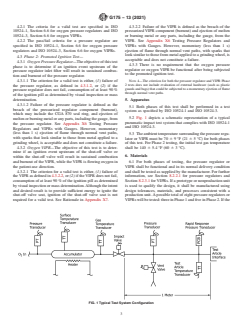
5.2 Fig. 1 depicts a schematic representation of a typical
moltenorburningmetaloranyparts,includingthegauge,from
pneumatic impact test system that complies with ISO 10524-1
the pressure regulator. See Appendix X6 Testing Pressure
and ISO 10524-3.
Regulators and VIPRs with Gauges. However, momentary
(less than 1 s) ejection of flame through normal vent paths,
5.3 Theambienttemperaturesurroundingthepressureregu-
with sparks that look similar to those from metal applied to a
lator or VIPR must be 70 6 9°F (21 6 5°C) for both phases
grinding wheel, is acceptable and does not constitute a failure.
of this test. For Phase 2 testing, the initial test gas temperature
4.3.2 Oxygen VIPR—The objective of this test is to deter-
shall be 140 6 5.4°F (60 6 3°C).
mine if an ignition event upstream of the shut-off valve or
6. Materials
within the shut-off valve will result in sustained combustion
and burnout of theVIPR, while theVIPR is flowing oxygen in 6.1 For both phases of testing, the pressure regulator or
the patient-use direction. VIPR shall be functional and in its normal delivery condition
4.3.2.1 The criterion for a valid test is either, (1) failure of andshallbetestedassuppliedbythemanufacturer.Forfurther
theVIPR as defined in 4.3.2.2,or (2) if theVIPR does not fail, information, see Section 8.2.2.1 for pressure regulators and
consumption of at least 90 % of the ignition pill as determined Section8.2.3.1forVIPRs.Ifaprototypeornonproductionunit
byvisualinspectionormassdetermination.Althoughtheintent is used to qualify the design, it shall be manufactured using
and desired result is to provide sufficient energy to ignite the
design tolerances, materials, and processes consistent with a
shut-off valve seat, ignition of the shut-off valve seat is not production unit.Apossible total of eight pressure regulators or
required for a valid test. See Rationale in Appendix X7.
VIPRswillbetested:threeinPhase1andfiveinPhase2.Ifthe
FIG. 1 Typical Test System Configuration
G175 − 13 (2021)
test articles from Phase 1 are undamaged, they may be 6.2.2.1 Putthecupandpolyamidepushtool(Fig.5)intothe
reassembled and used for Phase 2. brass sealing fixture and adjust the push tool so that the top of
the cup is just slightly below the surface of the sealing fixture.
6.2 Ignition Pill Manufacture and Assembly—Follow these
steps to manufacture and assemble the ignition pill used for
NOTE 9—If the top of the cup is not situated in the sealing fixture just
Phase 2 testing. Use the materials listed in Table 1 to slightly below the surface, the heat of the soldering iron could deform the
top of the cup.
manufacturetheignitionpills.Thetotalrequiredenergyforthe
ignition pill is 500 6 50 cal (2093 6 209 J) for pressure
6.2.2.2 Place one layer of polyamide sheet in the bottom of
regulators and 200 6 20 cal (837 6 84 J) for VIPRs. See
thecupandcoveritwithpolyimidetape(PI),withtheadhesive
AppendixX7,Developmentof200CalIgnitionPillforVIPRs.
side facing away from the pill.
Theignitionpillcasingconsistsofacupandlayersofsheeting.
NOTE 10—The PI tape is used as a mold release and does not remain
The cup and sheeting shall be constructed of polyamide (PA66
attached to the final pill. If the adhesive side faces the pill, it will add an
or PA6). Both the PA66 and PA6 shall be procured using the
undesired residue to the pill. The recommended PI tape for mold release
appropriateclassificationperClassificationsD4066,orD6779,
isa1mil(25.4micron)PIfilmwithasinglesidecoatofacrylicadhesive.
or both.This classification shall be documented and made part
6.2.2.3 Seal the polyamide to the bottom of the cup using a
of the quality record.
soldering iron tip (Fig. 6). Ensure that heat is applied evenly
around the perimeter of the inside cup bottom so as to melt the
NOTE 5—The ignition pill was developed to simulate both particle
impact events and cylinder valve seat ignition. Particle impact events are
polyamide sheet to the bottom of the cup.
simulated by iron/aluminum powder within the ignition pill. Nonmetallic
NOTE 11—The soldering iron temperature should be approximately
promoters within the ignition pill simulate cylinder valve seat ignition for
450°F (232°C).
pressure regulators. The nonmetallic promoters are also used to bind and
kindle ignition of the metallic powder and the shut-off valve seat for
6.2.2.4 Remove the PI tape and the remaining polyamide
VIPRs.
sheet.
6.2.1 Forming the Cup:
NOTE 12—The polyamide sheet should easily tear away from the
6.2.1.1 Turn the polyamide rod (see Table 1) down to 0.28
bottom of the cup, leaving a disc of polyamide sealed to the bottom of the
+0/-0.0025in.(7.11+0/-0.064mm)ODforthe500calpilland
cup. If it does not, the ignition pill has not been sealed properly, and the
0.188 +0/-0.0025 in. (4.78+0/-0.064mm) OD for the 200 cal
procedure should be repeated.
pill.
6.2.3 Filling the Cup:
6.2.1.2 Place the rod in the brass sealing fixture (Fig. 2),
6.2.3.1 Place the cup on a scale capable of resolution to 0.1
sand the rod face flat, and remove any noticeable burrs.
mg and zero the scale.
NOTE 6—Fig. 3 shows the polymide rod held in the sealing fixture for
6.2.3.2 For the 500 cal pill, add 10 6 1 mg aluminum
sanding.
powder and 3 6 1 mg iron powder to the cup. For the 200 cal
6.2.1.3 Usea ⁄16in.(4.76mm)diaendmilltoborean~0.06
pill, add 6 6 1 mg aluminum powder and 3 6 1 mg iron
in. (1.52 mm) deep cavity in the rod to form a cup for the 500
powder to the cup. Put the aluminum powder in the cup first,
cal pill. Use a ⁄32 in. (3.97 mm) dia end mill to bore an ~0.025
then the iron.
in. (0.64 mm) deep cavity in the rod to form a cup for the 200
NOTE 13—If too much iron is added to the pill, a magnetic spatula may
cal pill.
be used to remove iron from the cup.
6.2.1.4 Cut the cup from the rod.
6.2.3.3 After filling the cup, push any metallic powder on
NOTE 7—The cup should be slightly taller than 0.13 in. (3.30 mm) for
the top surface of the cup into the cup.
the 500 cal pill and slightly taller than 0.065 in. (1.65 mm) for the 200 cal
pill. This is an initial pill height; the final pill height is achieved after
NOTE 14—A small paintbrush can be used for this purpose. This is a
sanding and is based on the required final pill weight.
critical step in making the pill, and it is important to ensure that no
material remains on the surface to inhibit a proper heat seal.
6.2.1.5 Usinga#69drill,drillaholecompletelythroughthe
centerofthebottomofthecup.Ifnecessary,squarethebottom 6.2.4 Sealing the Cup:
of the cup with a file to ensure it sits flat and will not tip over. 6.2.4.1 Put the cup and the polyamide push tool into the
brass sealing fixture and adjust the push tool so that the top of
NOTE 8—The pill base and dimensions are shown in Fig. 4 and Fig. 18
the cup is just slightly below the surface of the sealing fixture.
for the 500 and 200 cal pills, respectively.
6.2.2 Sealing the Bottom of the Cup: NOTE 15—If the top of the cup is not situated in the sealing fixture just
TABLE 1 Ignition Pill Materials and Characteristics
Materials for Phase 2 Representing Possible Source of Combustion
Standard or Specification
Ignition Pills (both 500 and 200 cal) Energy
Polyamide (PA66 or PA6) rod stock D4066 or D6779, or both Cylinder valve seat or shut-off valve seat
Polyamide (PA66 or PA6) sheet, 2 mil D4066 or D6779, or both Cylinder valve stem lubricant or shut-off valve
stem lubricant
Aluminum powder (325 mesh) $ 99.5% Al Contaminant from cylinder
Iron powder (325 mesh) $ 99.5% Fe Contaminant from cylinder
G175 − 13 (2021)
FIG. 2 Brass Sealing Fixture
FIG. 3 Polymide Rod in Sealing Fixture
slightly below the surface, the heat of the soldering iron could deform the
top of the cup.
G175 − 13 (2021)
FIG. 4 Pill Base (500 cal)
metallic powder and ruining the pill.
6.2.4.2 Place one layer of polyamide sheet over the top of
the cup, then cover the polyamide sheet with PI tape.
6.2.4.6 Usingabeltorpalmsander,sandthepilluntilafinal
6.2.4.3 Place a copper seal tip (Fig. 7) onto the tip of the
weight of 67 6 1 mg and 29 6 1 mg is achieved for the 500
soldering iron.
and 200 cal pills, respectively. Use the push tool to remove the
pill from the sealing fixture.
NOTE 16—The copper seal tip temperature should be approximately
450°F (232°C). 6.2.5 Storing the Pill—The manufactured pills shall be
stored in a dry atmosphere (e.g. in a desiccant container or in
6.2.4.4 Hold the soldering iron perpendicular to the top of
asealedbagwithadesiccant)foraminimumof24hoursprior
the cup, rotate the soldering iron slightly, and apply heat until
to use. Conditioning at 24/23/0 per Guide D618 has been
the polyamide sheet is sealed to the top of the cup (Fig. 8). Let
showntoyieldsuccessfulresultsforthepolyamidematerialsin
the cup cool for ~1 min before removing the remaining
this application.
polyamide sheet and PI tape. Repeat this process until the cup
is capped with five layers of polyamide sheet (Fig. 9).
6.3 Adapter Block and Pill Holder Manufacture—Adapter
blocks and pill holders for pressure regulators with CGA 540
NOTE 17—If the cup is sealed properly, a disc of the polyamide sheet
inlet connections shall be made according to the drawings
will be sealed to it and the remainder of the sheet will easily pull off. It is
especiallycriticaltoensurethefirstlayerofpolyamidesheetiscompletely shown in Figs. 10 and 11. An alternative CGA 540 adaptor
sealed to the top of the cup, or else the pill contents will leak out and
block and pill holder is provided in Fig. X4.1 and Fig. X4.2.
render the pill unusable.
Adapter blocks and pill holders, adapter couplings and pill
6.2.4.5 Once the pill is properly sealed and cooled, remove
retainers for VIPRs shall be made according to the drawings
it from the brass sealing fixture. Place the pill upside down in
shown in Figs. 12 and 13. Pill holders, adapter couplings and
the sealing fixture so that the pill bottom is exposed.
pill retainers for VIPRs shall be made according to the
drawings shown in Fig. 16, Fig. 17, Fig. 19 and Fig. 20. All
NOTE 18—Take care to ensure that the pill is properly squared in the
adapterblocks,pillholders,adaptercouplingsandpillretainers
fixture so that it can be properly sanded. If the pill is not squared in the
sealing fixture, the cup bottom can be sanded open, thus exposing the shall be constructed of Brass UNS C36000.
G175 − 13 (2021)
FIG. 18 VIPR Pill Base (200 Cal)
6.4 For Phase 1 testing, the minimum oxygen concentration from the test cell. Visual observation of the test cell shall be
shall be of 99.5% purity and shall not contain more than 10 accomplished by an indirect means such as a periscope,
ppm hydrocarbons. For Phase 2 testing, the minimum oxygen mirrors, or closed-circuit television.
concentration shall conform to USP24-NF 19,Type 1, or shall
7.1.3 Equipment used in a high-pressure oxygen system
be of 99.0% purity. Oxygen of higher purity may be used, if shallbeproperlydesignedandratedforoxygenservice.Proper
desired. design of high-pressure oxygen systems includes designing for
minimum internal volumes, thereby limiting the magnitude of
7. Safety Precautions
catastrophic reactions that may occur while testing a pressure
7.1 This test can be hazardous. The test cell shall be regulatororVIPR.Componentsusedinthetestsystem,suchas
valves,pressureregulators,gauges,filters,andthelikeshallbe
constructed of fire- and shrapnel-resistant materials in a man-
ner that shall provide protection from the effects of test system fabricatedfrommaterialsthathaveaprovenrecordofsuitabil-
ity for high-pressure oxygen service. Examples of such mate-
component rupture or fire that could result from test article
reaction or failure of a test system component. Normal safety rials are Monel 400, nickel, and selected stainless steels.
precautions applicable to the operation and maintenance of
7.1.3.1 High-pressure oxygen systems require the utmost
high-pressure gas systems shall be followed when working cleanliness (see Practice G93). Therefore, test system compo-
with the test system.
nents should be designed to facilitate disassembly, thorough
7.1.1 Complete isolation of personnel from the test system cleaning, and reassembly without compromise of the cleanli-
is required whenever the test cell contains a test article and is ness level. Screening tests performed on nonmetallic materials
pressurized above atmospheric pressure with oxygen. Violent have shown that the impact sensitivity of these materials can
reactions between test articles and high-pressure oxygen must vary from batch to batch. Because nonmetallic materials are
be expected at all times.Test cell component failure caused by usually the most easily ignited components in a high-pressure
violent test article reaction has produced shrapnel, flying oxygen system, nonmetallic items to be used in this test
ejecta, dense smoke, and high-pressure gas jets and flames apparatus such as seats, seals, and gaskets should be chosen
inside the test cell.Test cell design and layout, test procedures, from the best (that is, least sensitive) available batch of
personnel access controls, and emergency shutdown proce- material. Preferably, two valves should be provided between
duresshallbedesignedwiththistypeoffailureexpectedatany the high-pressure oxygen source and the test article interface.
time the test system contains oxygen. These valves shall be closed, and the test cell and the volume
7.1.2 Complete isolation can be assured by locating the test between the two valves shall be continuously vented to
apparatus in an enclosure and behind a barricade.The operator atmospheric pressure, before personnel perform work on the
should be stationed in a control room opposite the barricade test article.
G175 − 13 (2021)
FIG. 5 Polyamide Push Tool
FIG. 6 Sealing the Bottom of the Cup
G175 − 13 (2021)
FIG. 7 Copper Seal Tip
FIG. 8 Sealing the Top of the Pil
...