

ASTM D5184-22
(Test Method)Standard Test Methods for Determination of Aluminum and Silicon in Fuel Oils by Ashing, Fusion, Inductively Coupled Plasma Atomic Emission Spectrometry, and Atomic Absorption Spectrometry
General Information
- Abstract
SIGNIFICANCE AND USE
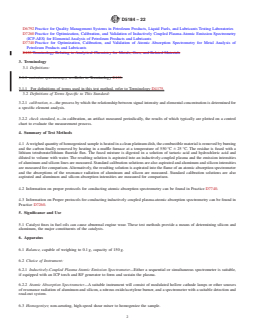
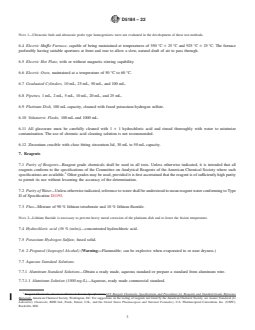
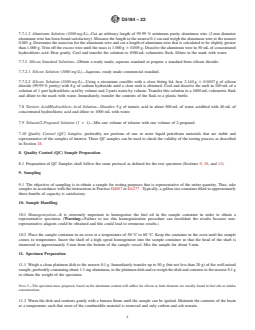
5.1 Catalyst fines in fuel oils can cause abnormal engine wear. These test methods provide a means of determining silicon and aluminum, the major constituents of the catalysts.
SCOPE
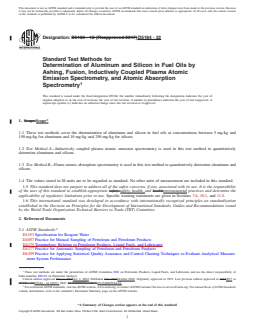
1.1 These test methods cover the determination of aluminum and silicon in fuel oils at concentrations between 5 mg/kg and 150 mg/kg for aluminum and 10 mg/kg and 250 mg/kg for silicon.
1.2 Test Method A—Inductively coupled plasma atomic emission spectrometry is used in this test method to quantitatively determine aluminum and silicon.
1.3 Test Method B—Flame atomic absorption spectrometry is used in this test method to quantitatively determine aluminum and silicon.
1.4 The values stated in SI units are to be regarded as standard. No other units of measurement are included in this standard.
1.5 This standard does not purport to address all of the safety concerns, if any, associated with its use. It is the responsibility of the user of this standard to establish appropriate safety, health, and environmental practices and determine the applicability of regulatory limitations prior to use. Specific warning statements are given in Sections 7.6, 10.1, and 11.5.
1.6 This international standard was developed in accordance with internationally recognized principles on standardization established in the Decision on Principles for the Development of International Standards, Guides and Recommendations issued by the World Trade Organization Technical Barriers to Trade (TBT) Committee.
- Status
- Published
- Publication Date
- 30-Sep-2022
- Technical Committee
- D02 - Petroleum Products, Liquid Fuels, and Lubricants
- Drafting Committee
- D02.03 - Elemental Analysis
Buy Documents
ASTM D5184-22 - Standard Test Methods for Determination of Aluminum and Silicon in Fuel Oils by Ashing, Fusion, Inductively Coupled Plasma Atomic Emission Spectrometry, and Atomic Absorption Spectrometry
REDLINE ASTM D5184-22 - Standard Test Methods for Determination of Aluminum and Silicon in Fuel Oils by Ashing, Fusion, Inductively Coupled Plasma Atomic Emission Spectrometry, and Atomic Absorption Spectrometry
Overview
ASTM D5184-22: Standard Test Methods for Determination of Aluminum and Silicon in Fuel Oils by Ashing, Fusion, Inductively Coupled Plasma Atomic Emission Spectrometry, and Atomic Absorption Spectrometry provides reliable procedures for quantifying aluminum and silicon in fuel oils. Accurate determination of these elements is vital, since catalyst fines-primarily aluminum and silicon compounds-are a common source of engine wear in applications such as marine and power generation.
These test methods enable laboratories, fuel suppliers, and users to monitor and control the levels of catalyst fines, helping to minimize abnormal engine wear, support quality assurance, and meet regulatory or contractual requirements regarding fuel cleanliness.
Key Topics
Scope
- Applicable for aluminum concentrations from 5 mg/kg to 150 mg/kg and for silicon from 10 mg/kg to 250 mg/kg in fuel oils.
- Two analytical procedures:
- Test Method A: Inductively Coupled Plasma Atomic Emission Spectrometry (ICP-AES).
- Test Method B: Flame Atomic Absorption Spectrometry (AAS).
- Designed for use with SI units.
Significance and Use
- Measures levels of silicon and aluminum-main constituents of catalyst fines-in fuel oils.
- Results help prevent engine damage, inform condition monitoring, and support quality control in the fuel supply chain.
Referenced Documents
- Draws on related ASTM standards for terms, sampling, and quality control, such as ASTM D4057 (manual sampling), ASTM D6299 (statistical quality control), and ASTM D7260/D7740 (instrument calibration procedures).
Quality Assurance
- Includes instructions for quality control (QC) sample analysis to confirm laboratory and instrument performance.
- Encourages the use of control charts and statistical evaluation as per ASTM D6299 for ongoing process validity.
Applications
Fuel Oil Quality Control
- Used by laboratories and refineries to certify fuel oil batches prior to shipment or use.
- Essential for ships, power plants, and other large engines using heavy fuel oil, where catalyst fines can lead to excessive wear and damage.
Compliance and Specification Testing
- Supports compliance with fuel specifications that limit aluminum and silicon content.
- Assists fuel purchasers in verifying that delivered product meets contract or regulatory limits.
Engine Condition Monitoring
- Enables operators to trend aluminum and silicon concentrations over time, providing early warning of quality changes that may necessitate filtration or maintenance.
Research and Product Development
- Used in research labs and for new fuel formulations to evaluate the impact of varying catalyst fin concentrations.
Related Standards
- ASTM D1193: Specification for Reagent Water.
- ASTM D4057: Practice for Manual Sampling of Petroleum and Petroleum Products.
- ASTM D4175: Terminology Relating to Petroleum Products, Liquid Fuels, and Lubricants.
- ASTM D6299: Practice for Applying Statistical Quality Assurance and Control Charting Techniques.
- ASTM D6792: Practice for Quality Management Systems in Petroleum Products Testing Laboratories.
- ASTM D7260: Practice for Optimization and Calibration of ICP-AES for Elemental Analysis.
- ASTM D7740: Practice for Optimization and Calibration of Atomic Absorption Spectrometry.
Practical Value
Adopting ASTM D5184-22 ensures consistent, accurate determination of aluminum and silicon in fuel oils, which is critical for engine protection, regulatory compliance, and fuel quality assurance. Its well-defined procedures support laboratories and operational personnel in detecting catalyst fines, managing risk, and maintaining reliability in heavy-duty engine applications. Integrating these test methods into fuel testing protocols enables proactive maintenance and strengthens supplier-customer confidence in petroleum product quality.
Keywords: aluminum determination, silicon determination, fuel oil analysis, ASTM D5184, catalyst fines, ICP-AES, atomic absorption spectrometry, fuel quality control, engine protection, elemental analysis in fuel oils.
Relations
- Refers
ASTM D4175-23a - Standard Terminology Relating to Petroleum Products, Liquid Fuels, and Lubricants - Effective Date
- 15-Dec-2023
- Effective Date
- 01-Dec-2023
- Effective Date
- 01-Nov-2023
- Effective Date
- 01-Oct-2023
- Refers
ASTM D4175-23e1 - Standard Terminology Relating to Petroleum Products, Liquid Fuels, and Lubricants - Effective Date
- 01-Jul-2023
- Effective Date
- 01-Jul-2020
- Effective Date
- 01-May-2019
- Effective Date
- 15-Dec-2017
- Effective Date
- 15-Nov-2017
- Effective Date
- 01-Jan-2017
- Effective Date
- 01-Oct-2013
- Effective Date
- 01-Jul-2011
- Refers
ASTM D4057-06(2011) - Standard Practice for Manual Sampling of Petroleum and Petroleum Products - Effective Date
- 01-Jun-2011
- Effective Date
- 01-Mar-2010
- Effective Date
- 01-Mar-2010
Buy Documents
ASTM D5184-22 - Standard Test Methods for Determination of Aluminum and Silicon in Fuel Oils by Ashing, Fusion, Inductively Coupled Plasma Atomic Emission Spectrometry, and Atomic Absorption Spectrometry
REDLINE ASTM D5184-22 - Standard Test Methods for Determination of Aluminum and Silicon in Fuel Oils by Ashing, Fusion, Inductively Coupled Plasma Atomic Emission Spectrometry, and Atomic Absorption Spectrometry
Get Certified
Connect with accredited certification bodies for this standard

Element Materials Technology
Materials testing and product certification.

ABS Group Brazil
ABS Group certification services in Brazil.

ABS Quality Evaluations Inc.
American Bureau of Shipping quality certification.
Sponsored listings
Frequently Asked Questions
ASTM D5184-22 is a standard published by ASTM International. Its full title is "Standard Test Methods for Determination of Aluminum and Silicon in Fuel Oils by Ashing, Fusion, Inductively Coupled Plasma Atomic Emission Spectrometry, and Atomic Absorption Spectrometry". This standard covers: SIGNIFICANCE AND USE 5.1 Catalyst fines in fuel oils can cause abnormal engine wear. These test methods provide a means of determining silicon and aluminum, the major constituents of the catalysts. SCOPE 1.1 These test methods cover the determination of aluminum and silicon in fuel oils at concentrations between 5 mg/kg and 150 mg/kg for aluminum and 10 mg/kg and 250 mg/kg for silicon. 1.2 Test Method A—Inductively coupled plasma atomic emission spectrometry is used in this test method to quantitatively determine aluminum and silicon. 1.3 Test Method B—Flame atomic absorption spectrometry is used in this test method to quantitatively determine aluminum and silicon. 1.4 The values stated in SI units are to be regarded as standard. No other units of measurement are included in this standard. 1.5 This standard does not purport to address all of the safety concerns, if any, associated with its use. It is the responsibility of the user of this standard to establish appropriate safety, health, and environmental practices and determine the applicability of regulatory limitations prior to use. Specific warning statements are given in Sections 7.6, 10.1, and 11.5. 1.6 This international standard was developed in accordance with internationally recognized principles on standardization established in the Decision on Principles for the Development of International Standards, Guides and Recommendations issued by the World Trade Organization Technical Barriers to Trade (TBT) Committee.
SIGNIFICANCE AND USE 5.1 Catalyst fines in fuel oils can cause abnormal engine wear. These test methods provide a means of determining silicon and aluminum, the major constituents of the catalysts. SCOPE 1.1 These test methods cover the determination of aluminum and silicon in fuel oils at concentrations between 5 mg/kg and 150 mg/kg for aluminum and 10 mg/kg and 250 mg/kg for silicon. 1.2 Test Method A—Inductively coupled plasma atomic emission spectrometry is used in this test method to quantitatively determine aluminum and silicon. 1.3 Test Method B—Flame atomic absorption spectrometry is used in this test method to quantitatively determine aluminum and silicon. 1.4 The values stated in SI units are to be regarded as standard. No other units of measurement are included in this standard. 1.5 This standard does not purport to address all of the safety concerns, if any, associated with its use. It is the responsibility of the user of this standard to establish appropriate safety, health, and environmental practices and determine the applicability of regulatory limitations prior to use. Specific warning statements are given in Sections 7.6, 10.1, and 11.5. 1.6 This international standard was developed in accordance with internationally recognized principles on standardization established in the Decision on Principles for the Development of International Standards, Guides and Recommendations issued by the World Trade Organization Technical Barriers to Trade (TBT) Committee.
ASTM D5184-22 is classified under the following ICS (International Classification for Standards) categories: 75.160.20 - Liquid fuels. The ICS classification helps identify the subject area and facilitates finding related standards.
ASTM D5184-22 has the following relationships with other standards: It is inter standard links to ASTM D4175-23a, ASTM D6299-23a, ASTM D6792-23c, ASTM D6792-23b, ASTM D4175-23e1, ASTM D7740-20, ASTM D7260-19, ASTM D6299-17b, ASTM D6299-17a, ASTM D6299-17, ASTM D6299-13e1, ASTM D7740-11, ASTM D4057-06(2011), ASTM D6299-10e2, ASTM D6299-10. Understanding these relationships helps ensure you are using the most current and applicable version of the standard.
ASTM D5184-22 is available in PDF format for immediate download after purchase. The document can be added to your cart and obtained through the secure checkout process. Digital delivery ensures instant access to the complete standard document.
Standards Content (Sample)
This international standard was developed in accordance with internationally recognized principles on standardization established in the Decision on Principles for the
Development of International Standards, Guides and Recommendations issued by the World Trade Organization Technical Barriers to Trade (TBT) Committee.
Designation: D5184 − 22
Standard Test Methods for
Determination of Aluminum and Silicon in Fuel Oils by
Ashing, Fusion, Inductively Coupled Plasma Atomic
Emission Spectrometry, and Atomic Absorption
Spectrometry
This standard is issued under the fixed designation D5184; the number immediately following the designation indicates the year of
original adoption or, in the case of revision, the year of last revision. A number in parentheses indicates the year of last reapproval. A
superscript epsilon (´) indicates an editorial change since the last revision or reapproval.
1. Scope* 2. Referenced Documents
2.1 ASTM Standards:
1.1 These test methods cover the determination of alumi-
num and silicon in fuel oils at concentrations between 5 mg⁄kg D1193 Specification for Reagent Water
D4057 Practice for Manual Sampling of Petroleum and
and150 mg⁄kgforaluminumand10 mg⁄kgand250 mg⁄kgfor
silicon. Petroleum Products
D4175 Terminology Relating to Petroleum Products, Liquid
1.2 Test Method A—Inductively coupled plasma atomic
Fuels, and Lubricants
emission spectrometry is used in this test method to quantita-
D4177 Practice for Automatic Sampling of Petroleum and
tively determine aluminum and silicon.
Petroleum Products
1.3 Test Method B—Flame atomic absorption spectrometry
D6299 Practice for Applying Statistical Quality Assurance
is used in this test method to quantitatively determine alumi-
and Control Charting Techniques to Evaluate Analytical
num and silicon.
Measurement System Performance
D6792 Practice for Quality Management Systems in Petro-
1.4 The values stated in SI units are to be regarded as
leum Products, Liquid Fuels, and Lubricants Testing
standard. No other units of measurement are included in this
Laboratories
standard.
D7260 Practice for Optimization, Calibration, and Valida-
1.5 This standard does not purport to address all of the
tion of Inductively Coupled Plasma-Atomic Emission
safety concerns, if any, associated with its use. It is the
Spectrometry (ICP-AES) for ElementalAnalysis of Petro-
responsibility of the user of this standard to establish appro-
leum Products and Lubricants
priate safety, health, and environmental practices and deter-
D7740 Practice for Optimization, Calibration, and Valida-
mine the applicability of regulatory limitations prior to use.
tion ofAtomicAbsorption Spectrometry for MetalAnaly-
Specific warning statements are given in Sections 7.6, 10.1,
sis of Petroleum Products and Lubricants
and 11.5.
1.6 This international standard was developed in accor-
3. Terminology
dance with internationally recognized principles on standard-
3.1 Definitions:
ization established in the Decision on Principles for the
3.1.1 For definitions of terms used in this test method, refer
Development of International Standards, Guides and Recom-
to Terminology D4175.
mendations issued by the World Trade Organization Technical
3.2 Definitions of Terms Specific to This Standard:
Barriers to Trade (TBT) Committee.
3.2.1 calibration, n—the process by which the relationship
between signal intensity and elemental concentration is deter-
mined for a specific element analysis.
These test methods are under the jurisdiction of ASTM Committee D02 on
Petroleum Products, Liquid Fuels, and Lubricants and are the direct responsibility
of Subcommittee D02.03 on Elemental Analysis. For referenced ASTM standards, visit the ASTM website, www.astm.org, or
Current edition approved Oct. 1, 2022. Published October 2022. Originally contact ASTM Customer Service at service@astm.org. For Annual Book of ASTM
approved in 1991. Last previous edition approved in 2017 as D5184 – 12 (2017). Standards volume information, refer to the standard’s Document Summary page on
DOI: 10.1520/D5184-22. the ASTM website.
*A Summary of Changes section appears at the end of this standard
Copyright © ASTM International, 100 Barr Harbor Drive, PO Box C700, West Conshohocken, PA 19428-2959. United States
D5184 − 22
3.2.2 check standard, n—incalibration,anartifactmeasured 6.6 Electric Oven, maintained at a temperature of 50 °C to
periodically, the results of which typically are plotted on a 60 °C.
control chart to evaluate the measurement process.
6.7 Graduated Cylinders, 10 mL, 25 mL, 50 mL, and
100 mL.
4. Summary of Test Methods
6.8 Pipettes, 1 mL, 2 mL, 5 mL, 10 mL, 20 mL, and 25 mL.
4.1 Aweighed quantity of homogenized sample is heated in
6.9 Platinum Dish, 100 mL capacity, cleaned with fused
a clean platinum dish, the combustible material is removed by
potassium hydrogen sulfate.
burning and the carbon finally removed by heating in a muffle
furnace at a temperature of 550 °C 6 25 °C. The residue is 6.10 Volumetric Flasks, 100 mL and 1000 mL.
fusedwithalithiumtetraborate/lithiumfluorideflux.Thefused
6.11 All glassware must be carefully cleaned with 1 + 1
mixture is digested in a solution of tartaric acid and hydrochlo-
hydrochloric acid and rinsed thoroughly with water to mini-
ric acid and diluted to volume with water. The resulting
mize contamination.The use of chromic acid cleaning solution
solution is aspirated into an inductively-coupled plasma and
is not recommended.
the emission intensities of aluminum and silicon lines are
6.12 Zirconium crucible with close fitting zirconium lid,
measured. Standard calibration solutions are also aspirated and
30 mL to 50 mL capacity.
aluminum and silicon intensities are measured for comparison.
Alternatively, the resulting solution is aspirated into the flame
7. Reagents
ofanatomicabsorptionspectrometerandtheabsorptionsofthe
7.1 Purity of Reagents—Reagent grade chemicals shall be
resonance radiation of aluminum and silicon are measured.
used in all tests. Unless otherwise indicated, it is intended that
Standard calibration solutions are also aspirated and aluminum
all reagents conform to the specifications of the Committee on
andsiliconabsorptionintensitiesaremeasuredforcomparison.
Analytical Reagents of the American Chemical Society where
4.2 Information on proper protocols for conducting atomic 3
such specifications are available. Other grades may be used,
absorption spectrometry can be found in Practice D7740.
provided it is first ascertained that the reagent is of sufficiently
4.3 Information on Proper protocols for conducting induc- high purity to permit its use without lessening the accuracy of
tively coupled plasma-atomic absorption spectrometry can be the determination.
found in Practice D7260.
7.2 Purity of Water—Unless otherwise indicated, reference
towatershallbeunderstoodtomeanreagentwaterconforming
5. Significance and Use
to Type II of Specification D1193.
5.1 Catalyst fines in fuel oils can cause abnormal engine
7.3 Flux—Mixture of 90 % lithium tetraborate and 10 %
wear. These test methods provide a means of determining
lithium fluoride.
silicon and aluminum, the major constituents of the catalysts.
NOTE 2—Lithium fluoride is necessary to prevent heavy metal corro-
sion of the platinum dish and to lower the fusion temperature.
6. Apparatus
7.4 Hydrochloric acid (36 % (m/m))—concentrated hydro-
6.1 Balance, capable of weighing to 0.1 g, capacity of
chloric acid.
150 g.
7.5 Potassium Hydrogen Sulfate, fused solid.
6.2 Choice of Instrument:
7.6 2-Propanol (Isopropyl Alcohol) (Warning—
6.2.1 Inductively-Coupled Plasma Atomic Emission
Flammable; can be explosive when evaporated to or near
Spectrometer—Either a sequential or simultaneous spectrom-
dryness.)
eter is suitable, if equipped with an ICPtorch and RF generator
to form and sustain the plasma. 7.7 Aqueous Standard Solutions.
7.7.1 Aluminum Standard Solutions—Obtain a ready made,
6.2.2 Atomic Absorption Spectrometer—A suitable instru-
ment will consist of modulated hollow cathode lamps or other aqueous standard or prepare a standard from aluminum wire.
7.7.1.1 Aluminum Solution (1000 mg ⁄L)—Aqueous, ready
sources of resonance radiation of aluminum and silicon, a
nitrous oxide/acetylene burner, and a spectrometer with a made commercial standard.
7.7.1.2 Aluminum Solution (1000 mg ⁄L)—Cut an arbitrary
suitable detection and read-out system.
length of 99.99 % minimum purity aluminum wire (2 mm
6.3 Homogenizer, non-aerating, high-speed shear mixer to
diameteraluminumwirehasbeenfoundsatisfactory).Measure
homogenize the sample.
the length to the nearest 0.1 cm and weigh the aluminum wire
NOTE 1—Ultrasonic bath and ultrasonic probe type homogenizers were
to the nearest 0.001 g. Determine the mass/cm for the alumi-
not evaluated in the development of these test methods.
num wire and cut a length of aluminum wire that is calculated
6.4 Electric Muffle Furnace, capable of being maintained at
temperatures of 550 °C 6 25 °C and 925 °C 6 25 °C. The
ACS Reagent Chemicals, Specifications and Procedures for Reagents and
furnacepreferablyhavingsuitableaperturesatfrontandrearto
Standard-Grade Reference Materials, American Chemical Society, Washington,
allow a slow, natural draft of air to pass through. DC. For suggestions on the testing of reagents not listed by theAmerican Chemical
Society, see Analar Standards for Laboratory Chemicals, BDH Ltd., Poole, Dorset,
6.5 Electric Hot Plate, with or without magnetic stirring
U.K., and the United States Pharmacopeia and National Formulary, U.S. Pharma-
capability. copeial Convention, Inc. (USPC), Rockville, MD.
D5184 − 22
to be slightly greater than 1.000 g. Trim off the excess wire 11. Specimen Preparation
until the mass is 1.000 g 6 0.005 g. Dissolve the aluminum
11.1 Weigh a clean platinum dish to the nearest 0.1 g.
wire in 50 mL of concentrated hydrochloric acid. Heat gently.
Immediately transfer up to 50 g (but not less than 20 g) of the
Cool and transfer the solution to 1000 mL volumetric flask.
well-mixed sample, preferably containing about 1.3 mg
Dilute to the mark with water.
aluminum, to the platinum dish and re-weigh the dish and
7.7.2 Silicon Standard Solutions—Obtain a ready made,
contents to the nearest 0.1 g to obtain the weight of the
aqueous standard or prepare a standard from silicon dioxide.
specimen.
7.7.2.1 Silicon Solution (1000 mg ⁄L)—Aqueous, ready
NOTE 3—The specimen mass proposed, based on the aluminum content
made commercial standard.
will suffice for silicon as both elements are usually found in fuel oils at
7.7.2.2 Silicon Solution (1000 mg ⁄L)—Using a zirconium
similar concentrations.
crucible with a close fitting lid, fuse 2.140 g 6 0.0107 g of
11.2 Warm the dish and contents gently with a bunsen flame
silicon dioxide (99.99 % purity) with 8 g of sodium hydroxide
until the sample can be ignited. Maintain the contents of the
until a clear melt is obtained. Cool and dissolve the melt in
basin at a temperature such that most of the combustible
100 mLofasolutionof1parthydrochloricacidbyvolumeand
material is removed and only carbon and ash remain.
2 parts water by volume. Transfer this solution to a 1000 mL
volumetric flask and dilute to the mark with water.
NOTE 4—If the specimen contains considerable amounts of moisture,
Immediately, transfer the contents of the flask to a plastic
foaming and frothing can cause loss of material. If this is the case, discard
thespecimenandtoafreshportionadd1 mLto2 mLof2-propanolbefore
bottle.
heating. If this is not satisfactory, add 10 mL of a mixture of equal parts
7.8 Tartaric Acid/Hydrochloric Acid Solution—Dissolve 5 g
of toluene and 2-propanol and mix thoroughly. Place several strips of
ashlessfilterpaperinthemixtureandwarmgently.Whenthepaperbegins
of tartaric acid in about 500 mL of water acidified with 40 mL
to burn, the greater part of the water will have been removed.
of concentrated hydrochloric acid and dilute to 1000 mL with
water.
11.3 Place the dish and contents in a muffle furnace main-
tainedatatemperatureof550 °C 6 25 °C.Maintainthemuffle
7.9 Toluene/2-Propanol Solution (1 + 1)—Mix one vol-
furnace at this temperature until all the carbon is removed and
ume of toluene with one volume of 2-propanol.
only ash remains. This may require more than 10 h in the
7.10 Quality Control (QC) Samples, preferably are portions
muffle furnace and may conveniently be done overnight.
of one or more liquid petroleum materials that are stable and
11.4 Cool the dish to room temperature, add 0.4 g of flux
representative of the samples of interest. These QC samples
and mix with the ash. Place the dish in a muffle furnace
can be used to check the validity of the testing process as
maintained at a temperature of 925 °C 6 25 °C for 5 min.
described in Section 18.
Remove the dish and ensure contact of the flux with the ash.
Replace the dish in the muffle furnace and maintain at a
8. Quality Control (QC) Sample Preparation
temperature of 925 °C 6 25 °C for 10 min.
8.1 Preparation of QC Samples shall follow the same
11.5 Remove the dish, cool the fusion melt to room tem-
protocol as defined for the test specimen (Sections 9, 10, and
perature and add 50 mL of the tartaric acid/hydrochloric acid
11).
solution. Place the dish and contents on the hot plate main-
tained at a temperature of approximately 80 °C. Heat until the
9. Sampling
melt is dissolved. (Warning—Vaporization of a significant
9.1 The objective of sampling is to obtain a sample for
amount of the liquid can lead to precipitation of an insoluble
testing purposes that is representative of the entire quantity.
form of silica leading to erroneous results.)
Thus, take samples in accordance with the instructions in
NOTE 5—Prolonged heating can be necessary to dissolve the melt
Practice D4057 or D4177 . Typically, a gallon size container
completely and obtain a solution.Agitation or the use of magnetic stirring
filled to approximately three-fourths of capacity is satisfactory.
can be employed to speed dissolution of the melt.
11.6 Allow the solution to cool and then transfer it to a
10. Sample Handling
100 mL flask with water, washing the dish several times to
10.1 Homogenization—It is extremely important to homog-
ensure transfer is complete. Make up to the mark with water.
enize the fuel oil in the sample container in order to obtain a
Then, transfer the solution to a plastic bottle.
representative specimen. (Warning—Failure to use this ho-
NOTE 6—Transferring the test solution to a plastic bottle is desirable
mogenization procedure can invalidate the results because
becausethediluteacidsolutioncontainsfluoboricacidfromdissolutionof
non-representative aliquots could be obtained and this could
the flux. Storage tests have shown that there is no significant attack of
lead to erroneous results.)
glasswareintheshortterm(uptooneweek),andthatthesolutiondoesnot
contain fluoride ion above the 5 mg⁄L concentration.
10.2 Place the sample container in an oven at a temperature
of 50 °C to 60 °C. Keep the container in the oven until the
12. Preparation of Calibration Solutions
sample comes to temperature. Insert the shaft of a high speed
homogenizer into the sample container so that the head of the 12.1 Blank Solution—Prepare a blank solution containing
shaft is immersed to approximately 5 mm from the bottom of only 0.4 g flux and 50 mLof the tartaric acid/hydrochloric acid
the sample vessel. Mix the sample for about 5 min. solution diluted to 100 mL. Transfer it to a plastic bottle.
D5184 − 22
12.2 Aluminum—Prepare a 250 mg⁄L aluminum working check standard is outside 5 % of the expected value for
...
This document is not an ASTM standard and is intended only to provide the user of an ASTM standard an indication of what changes have been made to the previous version. Because
it may not be technically possible to adequately depict all changes accurately, ASTM recommends that users consult prior editions as appropriate. In all cases only the current version
of the standard as published by ASTM is to be considered the official document.
Designation: D5184 − 12 (Reapproved 2017) D5184 − 22
Standard Test Methods for
Determination of Aluminum and Silicon in Fuel Oils by
Ashing, Fusion, Inductively Coupled Plasma Atomic
Emission Spectrometry, and Atomic Absorption
Spectrometry
This standard is issued under the fixed designation D5184; the number immediately following the designation indicates the year of
original adoption or, in the case of revision, the year of last revision. A number in parentheses indicates the year of last reapproval. A
superscript epsilon (´) indicates an editorial change since the last revision or reapproval.
1. Scope Scope*
1.1 These test methods cover the determination of aluminum and silicon in fuel oils at concentrations between 5 mg ⁄kg and
150 mg ⁄kg for aluminum and 10 mg ⁄kg and 250 mg ⁄kg for silicon.
1.2 Test Method A—Inductively coupled plasma atomic emission spectrometry is used in this test method to quantitatively
determine aluminum and silicon.
1.3 Test Method B—Flame atomic absorption spectrometry is used in this test method to quantitatively determine aluminum and
silicon.
1.4 The values stated in SI units are to be regarded as standard. No other units of measurement are included in this standard.
1.5 This standard does not purport to address all of the safety concerns, if any, associated with its use. It is the responsibility
of the user of this standard to establish appropriate safety safety, health, and healthenvironmental practices and determine the
applicability of regulatory limitations prior to use. Specific warning statements are given in Sections 7.6, 10.1, and 11.5.
1.6 This international standard was developed in accordance with internationally recognized principles on standardization
established in the Decision on Principles for the Development of International Standards, Guides and Recommendations issued
by the World Trade Organization Technical Barriers to Trade (TBT) Committee.
2. Referenced Documents
2.1 ASTM Standards:
D1193 Specification for Reagent Water
D4057 Practice for Manual Sampling of Petroleum and Petroleum Products
D4175 Terminology Relating to Petroleum Products, Liquid Fuels, and Lubricants
D4177 Practice for Automatic Sampling of Petroleum and Petroleum Products
D6299 Practice for Applying Statistical Quality Assurance and Control Charting Techniques to Evaluate Analytical Measure-
ment System Performance
These test methods are under the jurisdiction of ASTM Committee D02 on Petroleum Products, Liquid Fuels, and Lubricants and are the direct responsibility of
Subcommittee D02.03 on Elemental Analysis.
Current edition approved May 1, 2017Oct. 1, 2022. Published June 2017October 2022. Originally approved in 1991. Last previous edition approved in 20122017 as
D5184 – 12.D5184 – 12 (2017). DOI: 10.1520/D5184-12R17.10.1520/D5184-22.
For referenced ASTM standards, visit the ASTM website, www.astm.org, or contact ASTM Customer Service at service@astm.org. For Annual Book of ASTM Standards
volume information, refer to the standard’s Document Summary page on the ASTM website.
*A Summary of Changes section appears at the end of this standard
Copyright © ASTM International, 100 Barr Harbor Drive, PO Box C700, West Conshohocken, PA 19428-2959. United States
D5184 − 22
D6792 Practice for Quality Management Systems in Petroleum Products, Liquid Fuels, and Lubricants Testing Laboratories
D7260 Practice for Optimization, Calibration, and Validation of Inductively Coupled Plasma-Atomic Emission Spectrometry
(ICP-AES) for Elemental Analysis of Petroleum Products and Lubricants
D7740 Practice for Optimization, Calibration, and Validation of Atomic Absorption Spectrometry for Metal Analysis of
Petroleum Products and Lubricants
E135 Terminology Relating to Analytical Chemistry for Metals, Ores, and Related Materials
3. Terminology
3.1 Definitions:
3.1.1 emission spectroscopy, n—Refer to Terminology E135.
3.1.1 For definitions of terms used in this test method, refer to Terminology D4175.
3.2 Definitions of Terms Specific to This Standard:
3.2.1 calibration, n—the process by which the relationship between signal intensity and elemental concentration is determined for
a specific element analysis.
3.2.2 check standard, n—in calibration, an artifact measured periodically, the results of which typically are plotted on a control
chart to evaluate the measurement process.
4. Summary of Test Methods
4.1 A weighed quantity of homogenized sample is heated in a clean platinum dish, the combustible material is removed by burning
and the carbon finally removed by heating in a muffle furnace at a temperature of 550 °C 6 25 °C. The residue is fused with a
lithium tetraborate/lithium fluoride flux. The fused mixture is digested in a solution of tartaric acid and hydrochloric acid and
diluted to volume with water. The resulting solution is aspirated into an inductively-coupled plasma and the emission intensities
of aluminum and silicon lines are measured. Standard calibration solutions are also aspirated and aluminum and silicon intensities
are measured for comparison. Alternatively, the resulting solution is aspirated into the flame of an atomic absorption spectrometer
and the absorptions of the resonance radiation of aluminum and silicon are measured. Standard calibration solutions are also
aspirated and aluminum and silicon absorption intensities are measured for comparison.
4.2 Information on proper protocols for conducting atomic absorption spectrometry can be found in Practice D7740.
4.3 Information on Proper protocols for conducting inductively coupled plasma-atomic absorption spectrometry can be found in
Practice D7260.
5. Significance and Use
5.1 Catalyst fines in fuel oils can cause abnormal engine wear. These test methods provide a means of determining silicon and
aluminum, the major constituents of the catalysts.
6. Apparatus
6.1 Balance, capable of weighing to 0.1 g, capacity of 150 g.
6.2 Choice of Instrument:
6.2.1 Inductively-Coupled Plasma Atomic Emission Spectrometer—Either a sequential or simultaneous spectrometer is suitable,
if equipped with an ICP torch and RF generator to form and sustain the plasma.
6.2.2 Atomic Absorption Spectrometer—A suitable instrument will consist of modulated hollow cathode lamps or other sources
of resonance radiation of aluminum and silicon, a nitrous oxide/acetylene burner, and a spectrometer with a suitable detection and
read-out system.
6.3 Homogenizer, non-aerating, high-speed shear mixer to homogenize the sample.
D5184 − 22
NOTE 1—Ultrasonic bath and ultrasonic probe type homogenizers were not evaluated in the development of these test methods.
6.4 Electric Muffle Furnace, capable of being maintained at temperatures of 550 °C 6 25 °C and 925 °C 6 25 °C. The furnace
preferably having suitable apertures at front and rear to allow a slow, natural draft of air to pass through.
6.5 Electric Hot Plate, with or without magnetic stirring capability.
6.6 Electric Oven, maintained at a temperature of 50 °C to 60 °C.
6.7 Graduated Cylinders, 10 mL, 25 mL, 50 mL, and 100 mL.
6.8 Pipettes, 1 mL, 2 mL, 5 mL, 10 mL, 20 mL, and 25 mL.
6.9 Platinum Dish, 100 mL capacity, cleaned with fused potassium hydrogen sulfate.
6.10 Volumetric Flasks, 100 mL and 1000 mL.
6.11 All glassware must be carefully cleaned with 1 + 1 hydrochloric acid and rinsed thoroughly with water to minimize
contamination. The use of chromic acid cleaning solution is not recommended.
6.12 Zirconium crucible with close fitting zirconium lid, 30 mL to 50 mL capacity.
7. Reagents
7.1 Purity of Reagents—Reagent grade chemicals shall be used in all tests. Unless otherwise indicated, it is intended that all
reagents conform to the specifications of the Committee on Analytical Reagents of the American Chemical Society where such
specifications are available. Other grades may be used, provided it is first ascertained that the reagent is of sufficiently high purity
to permit its use without lessening the accuracy of the determination.
7.2 Purity of Water—Unless otherwise indicated, reference to water shall be understood to mean reagent water conforming to Type
II of Specification D1193.
7.3 Flux—Mixture of 90 % lithium tetraborate and 10 % lithium fluoride.
NOTE 2—Lithium fluoride is necessary to prevent heavy metal corrosion of the platinum dish and to lower the fusion temperature.
7.4 Hydrochloric acid (36 % (m/m))—concentrated hydrochloric acid.
7.5 Potassium Hydrogen Sulfate, fused solid.
7.6 2-Propanol (Isopropyl Alcohol) (Warning—Flammable; can be explosive when evaporated to or near dryness.)
7.7 Aqueous Standard Solutions.
7.7.1 Aluminum Standard Solutions—Obtain a ready made, aqueous standard or prepare a standard from aluminum wire.
7.7.1.1 Aluminum Solution (1000 mg ⁄L)—Aqueous, ready made commercial standard.
Reagent Chemicals, American Chemical Society Specifications,ACS Reagent Chemicals, Specifications and Procedures for Reagents and Standard-Grade Reference
Materials, American Chemical Society, Washington, DC. For suggestions on the testing of reagents not listed by the American Chemical Society, see Analar Standards for
Laboratory Chemicals, BDH Ltd., Poole, Dorset, U.K., and the United States Pharmacopeia and National Formulary, U.S. Pharmacopeial Convention, Inc. (USPC),
Rockville, MD.
D5184 − 22
7.7.1.2 Aluminum Solution (1000 mg ⁄L)—Cut an arbitrary length of 99.99 % minimum purity aluminum wire (2 mm diameter
aluminum wire has been found satisfactory). Measure the length to the nearest 0.1 cm and weigh the aluminum wire to the nearest
0.001 g. Determine the mass/cm for the aluminum wire and cut a length of aluminum wire that is calculated to be slightly greater
than 1.000 g. Trim off the excess wire until the mass is 1.000 g 6 0.005 g. Dissolve the aluminum wire in 50 mL of concentrated
hydrochloric acid. Heat gently. Cool and transfer the solution to 1000 mL volumetric flask. Dilute to the mark with water.
7.7.2 Silicon Standard Solutions—Obtain a ready made, aqueous standard or prepare a standard from silicon dioxide.
7.7.2.1 Silicon Solution (1000 mg ⁄L)—Aqueous, ready made commercial standard.
7.7.2.2 Silicon Solution (1000 mg ⁄L)—Using a zirconium crucible with a close fitting lid, fuse 2.140 g 6 0.0107 g of silicon
dioxide (99.99 % purity) with 8 g of sodium hydroxide until a clear melt is obtained. Cool and dissolve the melt in 100 mL of a
solution of 1 part hydrochloric acid by volume and 2 parts water by volume. Transfer this solution to a 1000 mL volumetric flask
and dilute to the mark with water. Immediately, transfer the contents of the flask to a plastic bottle.
7.8 Tartaric Acid/Hydrochloric Acid Solution—Dissolve 5 g of tartaric acid in about 500 mL of water acidified with 40 mL of
concentrated hydrochloric acid and dilute to 1000 mL with water.
7.9 Toluene/2-Propanol Solution (1 + 1)—Mix one volume of toluene with one volume of 2-propanol.
7.10 Quality Control (QC) Samples, preferably are portions of one or more liquid petroleum materials that are stable and
representative of the samples of interest. These QC samples can be used to check the validity of the testing process as described
in Section 18.
8. Quality Control (QC) Sample Preparation
8.1 Preparation of QC Samples shall follow the same protocol as defined for the test specimen (Sections 9, 10, and 11).
9. Sampling
9.1 The objective of sampling is to obtain a sample for testing purposes that is representative of the entire quantity. Thus, take
samples in accordance with the instructions in Practice D4057 or D4177 . Typically, a gallon size container filled to approximately
three-fourths of capacity is satisfactory.
10. Sample Handling
10.1 Homogenization—It is extremely important to homogenize the fuel oil in the sample container in order to obtain a
representative specimen. (Warning—Failure to use this homogenization procedure can invalidate the results because non-
representative aliquots could be obtained and this could lead to erroneous results.)
10.2 Place the sample container in an oven at a temperature of 50 °C to 60 °C. Keep the container in the oven until the sample
comes to temperature. Insert the shaft of a high speed homogenizer into the sample container so that the head of the shaft is
immersed to approximately 5 mm from the bottom of the sample vessel. Mix the sample for about 5 min.
11. Specimen Preparation
11.1 Weigh a clean platinum dish to the nearest 0.1 g. Immediately transfer up to 50 g (but not less than 20 g) of the well-mixed
sample, preferably containing about 1.3 mg aluminum, to the platinum dish and re-weigh the dish and contents to the nearest 0.1 g
to obtain the weight of the specimen.
NOTE 3—The specimen mass proposed, based on the aluminum content will suffice for silicon as both elements are usually found in fuel oils at similar
concentrations.
11.2 Warm the dish and contents gently with a bunsen flame until the sample can be ignited. Maintain the contents of the basin
at a temperature such that most of the combustible material is removed and only carbon and ash remain.
D5184 − 22
NOTE 4—If the specimen contains considerable amounts of moisture, foaming and frothing can cause loss of material. If this is the case, discard the
specimen and to a fresh portion add 1 mL to 2 mL of 2-propanol before heating. If this is not satisfactory, add 10 mL of a mixture of equal parts of toluene
and 2-propanol and mix thoroughly. Place several strips of ashless filter paper in the mixture and warm gently. When the paper begins to burn, the greater
part of the water will have been removed.
11.3 Place the dish and contents in a muffle furnace maintained at a temperature of 550 °C 6 25 °C. Maintain the muffle furnace
at this temperature until all the carbon is removed and only ash remains. This may require more than 10 h in the muffle furnace
and may conveniently be done overnight.
11.4 Cool the dish to room temperature, add 0.4 g of flux and mix with the ash. Place the dish in a muffle furnace maintained at
a temperature of 925 °C 6 25 °C for 5 min. Remove the dish and ensure contact of the flux with the ash. Replace the dish in the
muffle furnace and maintain at a temperature of 925 °C 6 25 °C for 10 min.
11.5 Remove the dish, cool the fusion melt to room temperature and add 50 mL of the tartaric acid/hydrochloric acid solution.
Place the dish and contents on the hot plate maintained at a temperature of approximately 80 °C. Heat until the melt is dissolved.
(Warning—Vaporization of a significant amount of the liquid can lead to precipitation of an insoluble form of silica leading to
erroneous results.)
NOTE 5—Prolonged heating can be necessary to dissolve the melt completely and obtain a solution. Agitation or the use of magnetic stirring can be
employed to speed dissolution of the melt.
11.6 Allow the solution to cool and then transfer it to a 100 mL flask with water, washing the dish several times to ensure transfer
is complete. Make up to the mark with water. Then, transfer the solution to a plastic bottle.
NOTE 6—Transferring the test solution to a plastic bottle is desirable because the dilute acid solution contains fluoboric acid from dissolution of the flux.
Storage tests have shown that there is no significant attack of glassware in the short term (up to one week), and that the solution does not contain fluoride
ion above the 5 mg ⁄L concentration.
12. Preparation of Calibration Solutions
12.1 Blank Solution—Prepare a blank solution containing only 0.4 g flux and 50 mL of the tartaric acid/hydrochloric acid solution
diluted to 100 mL. Transfer it to a plastic bottle
...