

ASTM D5776-21
(Test Method)Standard Test Method for Bromine Index of Aromatic Hydrocarbons by Electrometric Titration
General Information
- Abstract
SIGNIFICANCE AND USE
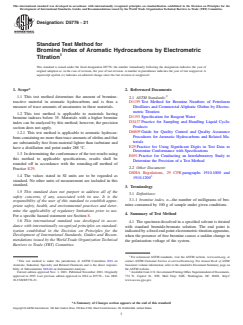
5.1 This test method is suitable for setting specifications, for use as an internal quality control tool, and for use in development or research work on industrial aromatic hydrocarbons and related material. This test method gives a broad indication of olefinic content. It does not differentiate between the types of aliphatic unsaturation.
SCOPE
1.1 This test method determines the amount of bromine-reactive material in aromatic hydrocarbons and is thus a measure of trace amounts of unsaturates in these materials.
1.2 This test method is applicable to materials having bromine indexes below 35. Materials with a higher bromine index can be analyzed by this method; however, the precision section does not apply.
1.2.1 This test method is applicable to aromatic hydrocarbons containing no more than trace amounts of olefins and that are substantially free from material lighter than isobutane and have a distillation end point under 288 °C.
1.3 In determining the conformance of the test results using this method to applicable specifications, results shall be rounded off in accordance with the rounding-off method of Practice E29.
1.4 The values stated in SI units are to be regarded as standard. No other units of measurement are included in this standard.
1.5 This standard does not purport to address all of the safety concerns, if any, associated with its use. It is the responsibility of the user of this standard to establish appropriate safety, health, and environmental practices and determine the applicability of regulatory limitations prior to use. For a specific hazard statement see Section 8.
1.6 This international standard was developed in accordance with internationally recognized principles on standardization established in the Decision on Principles for the Development of International Standards, Guides and Recommendations issued by the World Trade Organization Technical Barriers to Trade (TBT) Committee.
- Status
- Published
- Publication Date
- 31-Oct-2021
- Technical Committee
- D16 - Aromatic, Industrial, Specialty and Related Chemicals
- Drafting Committee
- D16.04 - Instrumental Analysis
Buy Documents

ASTM D5776-21 - Standard Test Method for Bromine Index of Aromatic Hydrocarbons by Electrometric Titration
REDLINE ASTM D5776-21 - Standard Test Method for Bromine Index of Aromatic Hydrocarbons by Electrometric Titration
Overview
ASTM D5776-21: Standard Test Method for Bromine Index of Aromatic Hydrocarbons by Electrometric Titration establishes a procedure to determine the bromine index in aromatic hydrocarbons. This test method provides a measurement of bromine-reactive substances present, particularly trace amounts of unsaturated compounds, in industrial aromatic hydrocarbons. It is widely used by refiners, chemical manufacturers, and analytical laboratories to set product specifications, conduct quality control, and support research and product development efforts.
The bromine index is a critical quality indicator reflecting the content of olefinic (unsaturated) impurities, which can influence product stability, reactivity, and suitability for downstream processing.
Key Topics
Scope of Application
- Applicable to aromatic hydrocarbons containing trace levels of olefins
- Particularly suited to materials with bromine indexes below 35 mg Br/100 g
- Covers substances substantially free from lighter components than isobutane and with a boiling end point below 288 °C
Test Method
- Utilizes an electrometric titration to indicate endpoint via a voltage change when free bromine appears
- Requires fixed end-point electrometric titration apparatus, specific chemical reagents, and controlled titration process
Significance and Use
- Used for setting product specifications and internal quality control
- Assists in research and development on aromatic hydrocarbons
- Provides an overall indication of olefin content but does not differentiate between types of aliphatic unsaturation
Results and Reporting
- Bromine index reported in milligrams of bromine consumed per 100 grams of sample
- Results are rounded in accordance with ASTM E29 practice on significant digits
Quality Assurance
- Recommends following established QA/QC protocols such as those found in ASTM D6809
- Suggests interlaboratory studies to ensure reproducibility and comparability of results
Applications
ASTM D5776-21 is valuable across various sectors in the chemical and petrochemical industries. Its practical applications include:
- Product Specification
- Verification of aromatic hydrocarbon streams for compliance with regulatory and customer specifications regarding unsaturate content.
- Process and Quality Control
- Routine monitoring during production of chemicals such as xylenes, toluene, and benzene to ensure low levels of reactive impurities that could affect process equipment or product quality.
- Research and Development
- Supporting analysis for formulation development or process modification, where knowing unsaturate content is essential for reaction design or stability trials.
- Interlaboratory Comparability
- Facilitates consistent and reliable reporting between suppliers, manufacturers, and clients, ensuring trust in test results.
Related Standards
The following ASTM standards are commonly utilized in conjunction with ASTM D5776-21:
- ASTM D1159: Test Method for Bromine Numbers of Petroleum Distillates and Commercial Aliphatic Olefins by Electrometric Titration
- ASTM D1193: Specification for Reagent Water
- ASTM D3437: Practice for Sampling and Handling Liquid Cyclic Products
- ASTM D6809: Guide for Quality Control and Quality Assurance Procedures for Aromatic Hydrocarbons and Related Materials
- ASTM E29: Practice for Using Significant Digits in Test Data to Determine Conformance with Specifications
- ASTM E691: Practice for Conducting an Interlaboratory Study to Determine the Precision of a Test Method
These referenced standards provide additional guidance on quality control, test procedures, and proper sampling relevant to the effective implementation of ASTM D5776-21.
Keywords: ASTM D5776-21, bromine index, aromatic hydrocarbons, electrometric titration, quality control, olefin content, specification testing, chemical analysis, laboratory test method.
Relations
- Effective Date
- 01-Nov-2023
- Effective Date
- 01-Nov-2016
- Effective Date
- 01-May-2013
- Effective Date
- 15-Apr-2012
- Effective Date
- 01-Nov-2011
- Effective Date
- 01-Jan-2011
- Effective Date
- 01-Jun-2010
- Effective Date
- 01-Oct-2008
- Effective Date
- 01-Oct-2008
- Effective Date
- 01-Jun-2008
- Effective Date
- 01-Jun-2007
- Effective Date
- 15-Nov-2006
- Effective Date
- 15-Sep-2006
- Effective Date
- 01-May-2006
- Effective Date
- 01-Mar-2006
Buy Documents
ASTM D5776-21 - Standard Test Method for Bromine Index of Aromatic Hydrocarbons by Electrometric Titration
REDLINE ASTM D5776-21 - Standard Test Method for Bromine Index of Aromatic Hydrocarbons by Electrometric Titration
Get Certified
Connect with accredited certification bodies for this standard

ECOCERT
Organic and sustainability certification.

Eurofins Food Testing Global
Global leader in food, environment, and pharmaceutical product testing.

Intertek Bangladesh
Intertek certification and testing services in Bangladesh.
Sponsored listings
Frequently Asked Questions
ASTM D5776-21 is a standard published by ASTM International. Its full title is "Standard Test Method for Bromine Index of Aromatic Hydrocarbons by Electrometric Titration". This standard covers: SIGNIFICANCE AND USE 5.1 This test method is suitable for setting specifications, for use as an internal quality control tool, and for use in development or research work on industrial aromatic hydrocarbons and related material. This test method gives a broad indication of olefinic content. It does not differentiate between the types of aliphatic unsaturation. SCOPE 1.1 This test method determines the amount of bromine-reactive material in aromatic hydrocarbons and is thus a measure of trace amounts of unsaturates in these materials. 1.2 This test method is applicable to materials having bromine indexes below 35. Materials with a higher bromine index can be analyzed by this method; however, the precision section does not apply. 1.2.1 This test method is applicable to aromatic hydrocarbons containing no more than trace amounts of olefins and that are substantially free from material lighter than isobutane and have a distillation end point under 288 °C. 1.3 In determining the conformance of the test results using this method to applicable specifications, results shall be rounded off in accordance with the rounding-off method of Practice E29. 1.4 The values stated in SI units are to be regarded as standard. No other units of measurement are included in this standard. 1.5 This standard does not purport to address all of the safety concerns, if any, associated with its use. It is the responsibility of the user of this standard to establish appropriate safety, health, and environmental practices and determine the applicability of regulatory limitations prior to use. For a specific hazard statement see Section 8. 1.6 This international standard was developed in accordance with internationally recognized principles on standardization established in the Decision on Principles for the Development of International Standards, Guides and Recommendations issued by the World Trade Organization Technical Barriers to Trade (TBT) Committee.
SIGNIFICANCE AND USE 5.1 This test method is suitable for setting specifications, for use as an internal quality control tool, and for use in development or research work on industrial aromatic hydrocarbons and related material. This test method gives a broad indication of olefinic content. It does not differentiate between the types of aliphatic unsaturation. SCOPE 1.1 This test method determines the amount of bromine-reactive material in aromatic hydrocarbons and is thus a measure of trace amounts of unsaturates in these materials. 1.2 This test method is applicable to materials having bromine indexes below 35. Materials with a higher bromine index can be analyzed by this method; however, the precision section does not apply. 1.2.1 This test method is applicable to aromatic hydrocarbons containing no more than trace amounts of olefins and that are substantially free from material lighter than isobutane and have a distillation end point under 288 °C. 1.3 In determining the conformance of the test results using this method to applicable specifications, results shall be rounded off in accordance with the rounding-off method of Practice E29. 1.4 The values stated in SI units are to be regarded as standard. No other units of measurement are included in this standard. 1.5 This standard does not purport to address all of the safety concerns, if any, associated with its use. It is the responsibility of the user of this standard to establish appropriate safety, health, and environmental practices and determine the applicability of regulatory limitations prior to use. For a specific hazard statement see Section 8. 1.6 This international standard was developed in accordance with internationally recognized principles on standardization established in the Decision on Principles for the Development of International Standards, Guides and Recommendations issued by the World Trade Organization Technical Barriers to Trade (TBT) Committee.
ASTM D5776-21 is classified under the following ICS (International Classification for Standards) categories: 71.080.15 - Aromatic hydrocarbons; 71.080.20 - Halogenated hydrocarbons. The ICS classification helps identify the subject area and facilitates finding related standards.
ASTM D5776-21 has the following relationships with other standards: It is inter standard links to ASTM D1159-23, ASTM D6809-02(2016), ASTM E691-13, ASTM D1159-07(2012), ASTM E691-11, ASTM D3437-11, ASTM D3437-10, ASTM E691-08, ASTM E29-08, ASTM D3437-08, ASTM D6809-02(2007), ASTM E29-06b, ASTM E29-06a, ASTM E29-06, ASTM D1193-06. Understanding these relationships helps ensure you are using the most current and applicable version of the standard.
ASTM D5776-21 is available in PDF format for immediate download after purchase. The document can be added to your cart and obtained through the secure checkout process. Digital delivery ensures instant access to the complete standard document.
Standards Content (Sample)
This international standard was developed in accordance with internationally recognized principles on standardization established in the Decision on Principles for the
Development of International Standards, Guides and Recommendations issued by the World Trade Organization Technical Barriers to Trade (TBT) Committee.
Designation: D5776 − 21
Standard Test Method for
Bromine Index of Aromatic Hydrocarbons by Electrometric
Titration
This standard is issued under the fixed designation D5776; the number immediately following the designation indicates the year of
original adoption or, in the case of revision, the year of last revision.Anumber in parentheses indicates the year of last reapproval.A
superscript epsilon (´) indicates an editorial change since the last revision or reapproval.
1. Scope* 2. Referenced Documents
1.1 This test method determines the amount of bromine-
2.1 ASTM Standards:
reactive material in aromatic hydrocarbons and is thus a
D1159Test Method for Bromine Numbers of Petroleum
measure of trace amounts of unsaturates in these materials.
Distillates and Commercial Aliphatic Olefins by Electro-
metric Titration
1.2 This test method is applicable to materials having
D1193Specification for Reagent Water
bromine indexes below 35. Materials with a higher bromine
D3437Practice for Sampling and Handling Liquid Cyclic
index can be analyzed by this method; however, the precision
Products
section does not apply.
D6809Guide for Quality Control and Quality Assurance
1.2.1 This test method is applicable to aromatic hydrocar-
Procedures for Aromatic Hydrocarbons and Related Ma-
bonscontainingnomorethantraceamountsofolefinsandthat
terials
are substantially free from material lighter than isobutane and
E29Practice for Using Significant Digits in Test Data to
have a distillation end point under 288°C.
Determine Conformance with Specifications
1.3 In determining the conformance of the test results using
E691Practice for Conducting an Interlaboratory Study to
this method to applicable specifications, results shall be
Determine the Precision of a Test Method
rounded off in accordance with the rounding-off method of
2.2 Other Document:
Practice E29.
OSHA Regulations, 29 CFRparagraphs 1910.1000 and
1.4 The values stated in SI units are to be regarded as 3
1910.1200
standard. No other units of measurement are included in this
standard.
3. Terminology
1.5 This standard does not purport to address all of the
3.1 Definitions:
safety concerns, if any, associated with its use. It is the
3.1.1 bromine index, n—the number of milligrams of bro-
responsibility of the user of this standard to establish appro-
mine consumed by 100 g of sample under given conditions.
priate safety, health, and environmental practices and deter-
mine the applicability of regulatory limitations prior to use.
4. Summary of Test Method
For a specific hazard statement see Section 8.
1.6 This international standard was developed in accor-
4.1 The specimen dissolved in a specified solvent is titrated
dance with internationally recognized principles on standard-
with standard bromide-bromate solution. The end point is
ization established in the Decision on Principles for the
indicatedbyafixedend-pointelectrometrictitrationapparatus,
Development of International Standards, Guides and Recom-
when the presence of free bromine causes a sudden change in
mendations issued by the World Trade Organization Technical
the polarization voltage of the system.
Barriers to Trade (TBT) Committee.
For referenced ASTM standards, visit the ASTM website, www.astm.org, or
This test method is under the jurisdiction of ASTM Committee D16 on contact ASTM Customer Service at service@astm.org. For Annual Book of ASTM
Aromatic, Industrial, Specialty and Related Chemicals and is the direct responsi- Standards volume information, refer to the standard’s Document Summary page on
bility of Subcommittee D16.04 on Instrumental Analysis. the ASTM website.
Current edition approved Nov. 1, 2021. Published November 2021. Originally AvailablefromU.S.GovernmentPrintingOfficeSuperintendentofDocuments,
approved in 1995. Last previous edition approved in 2014 as D5776–14a. DOI: 732 N. Capitol St., NW, Mail Stop: SDE, Washington, DC 20401, http://
10.1520/D5776-21. www.access.gpo.gov.
*A Summary of Changes section appears at the end of this standard
Copyright © ASTM International, 100 Barr Harbor Drive, PO Box C700, West Conshohocken, PA 19428-2959. United States
D5776 − 21
5. Significance and Use of glacial acetic acid and 1.0 mLof concentrated hydrochloric
acid (HCl, sp gr 1.19) in a 500mL iodine number flask. Chill
5.1 Thistestmethodissuitableforsettingspecifications,for
the solution in an ice bath for approximately 10 min and with
use as an internal quality control tool, and for use in develop-
constant swirling of the flask, add from a 50mL buret 40 to
mentorresearchworkonindustrialaromatichydrocarbonsand
45mL of bromide bromate solution, estimated to the nearest
related material. This test method gives a broad indication of
0.01 mL, at a rate such that the addition takes between 90 and
olefinic content. It does not differentiate between the types of
120s. Stopper the flask immediately, shake the contents, place
aliphatic unsaturation.
it again in the ice bath, and add 5.0 mL of potassium iodide
(KI) solution in the lip of the flask. After 5 min remove the
6. Apparatus
flask from the ice bath and allow the KI solution to flow into
6.1 Fixed End Point Electrometric Titration Apparatus—
the flask by slowly removing the stopper. Shake vigorously,
Any fixed end-point apparatus may be used incorporating a
add 100 mLof water in such a manner as to rinse the stopper,
high resistance polarizing current supply capable of maintain-
lip, and walls of flask, and titrate promptly with the standard
ing approximately 1 to 50µA across two platinum plate
sodium thiosulphate (Na S O ) solution. Near the end of the
2 2 3
electrodes or a combination platinum electrode and with a
titrationadd1mLofstarchindicatorsolutionandtitrateslowly
sensitivity such that a voltage change of approximately
to the disappearance of the blue color.
500mV at these electrodes is sufficient to indicate the end
7.4 Electronic Standardization of Bromide-Bromate
point (see Note 1).
Solution—Standardize to four significant figures as follows:
NOTE 1—The reagents and techniques may be checked by determining
Place 50 mLof glacial acetic acid and 1.0 mLof concentrated
the bromine index of a 100 mg/kg cyclohexene in heptane. This is
hydrochloricacid(HCl,spgr1.19)ina500mLiodinenumber
expected to give a bromine index of 18 to 20 mg/100 g sample. Refer to
flask.Chillthesolutioninanicebathforapproximately10min
Test Method D1159 for a list of expected bromine indexes of various
compounds.
with constant swirling of the flask; add 4.00 mL of bromide
bromate solution from the auto buret. Stopper the flask
6.2 Titration Vessel—A tall form glass beaker of approxi-
immediatelyand,shakethecontents,thencoolitinanicebath
mately 250mL capacity or a water jacketed titration vessel of
for5min.Add4.0mLofpotassiumiodide(KI)tothelipofthe
approximately 250mL capacity connected to a refrigerated
flask, remove the flask from the ice bath and allow the KI
circulating water bath controlling the temperature at 0 to 5°C.
solution to slowly flow into the flask by removing the stopper.
Apairofplatinumelectrodesspacednotmorethan5mmapart,
Shake vigorously, transfer to a chilled beaker and rinse the
shallbemountedtoextendwellbelowtheliquidlevel.Stirring
flask including stopper with 100 mL of water. Immerse the
shallbebyamechanicalorelectromagneticstirrerandshallbe
electrodes into the solution, titrate with standard sodium
rapid but not so vigorous as to draw air bubbles down to the
thiosulphate (Na S O ) to an end point indicated by a signifi-
electrodes.
2 2 3
cant change in potential that persists for 30 s (see Note 2).
6.3 Iodine Number Flasks, glass-stoppered, 500-mL capac-
ity. NOTE 2—With commercial titrators, a sudden change in potential
indicated on the meter or dial of the instrument as the endpoint is
approached. When this change persists for 30 s it marks the end of the
7. Reagents and Materials
titration. With each instrument, the manufacturer’s instructions should be
7.1 Purity of Reagents—Reagent grade chemicals shall be
followed to achieve the sensitivity achieved in the platinum electrode
circuit.
used in all tests. Unless otherwise indicated, it is intended that
allreagentsshallconformtothespecificationsoftheAmerican
7.5 Potassium Iodide Solution (150 g/L)—Dissolve150gof
Chemical Society where such specifications are available.
potassium iodide (KI) in water and dilute to 1.0 L.
Other grades may be used, providing it is first ascertained that
7.6 Sodium Thiosulphate, Standard Solution (0.10 N)—
the reagent is of sufficiently high purity to permit its use
Dissolve 25.0 g of sodium thiosulphate pentahydrate
without lessening the accuracy of the determination.
(Na S O ·5H O) in water and add 0.02 g of sodium carbonate
2 2 3 2
7.2 Purity of Water—Unless otherwise indicated references
(Na CO ) to stabilize the solution. Dilute to 1.0 L and mix
2 3
towatershallbeunderstoodtomeanreagentwaterconforming
thoroughlybyshaking.Standardizebyanyacceptedprocedure
to Type I or II of Specification D1193.
that determines the normality with an error not
...
This document is not an ASTM standard and is intended only to provide the user of an ASTM standard an indication of what changes have been made to the previous version. Because
it may not be technically possible to adequately depict all changes accurately, ASTM recommends that users consult prior editions as appropriate. In all cases only the current version
of the standard as published by ASTM is to be considered the official document.
Designation: D5776 − 14a D5776 − 21
Standard Test Method for
Bromine Index of Aromatic Hydrocarbons by Electrometric
Titration
This standard is issued under the fixed designation D5776; the number immediately following the designation indicates the year of
original adoption or, in the case of revision, the year of last revision. A number in parentheses indicates the year of last reapproval. A
superscript epsilon (´) indicates an editorial change since the last revision or reapproval.
1. Scope*
1.1 This test method determines the amount of bromine-reactive material in aromatic hydrocarbons and is thus a measure of trace
amounts of unsaturates in these materials. It is applicable to materials having bromine indexes below 35. Materials with a higher
bromine index can be analyzed by this method; however, the precision section does not apply.
1.2 This test method is applicable to aromatic hydrocarbons containing no more than trace amounts of olefins and that are
substantially free from material lighter than isobutane and have a distillation end point under 288°C.materials having bromine
indexes below 35. Materials with a higher bromine index can be analyzed by this method; however, the precision section does not
apply.
1.2.1 This test method is applicable to aromatic hydrocarbons containing no more than trace amounts of olefins and that are
substantially free from material lighter than isobutane and have a distillation end point under 288 °C.
1.3 In determining the conformance of the test results using this method to applicable specifications, results shall be rounded off
in accordance with the rounding-off method of Practice E29.
1.4 The values stated in SI units are to be regarded as standard. No other units of measurement are included in this standard.
1.5 This standard does not purport to address all of the safety concerns, if any, associated with its use. It is the responsibility
of the user of this standard to establish appropriate safety safety, health, and healthenvironmental practices and determine the
applicability of regulatory limitations prior to use. For a specific hazard statement see Section 8.
1.6 This international standard was developed in accordance with internationally recognized principles on standardization
established in the Decision on Principles for the Development of International Standards, Guides and Recommendations issued
by the World Trade Organization Technical Barriers to Trade (TBT) Committee.
2. Referenced Documents
2.1 ASTM Standards:
D1159 Test Method for Bromine Numbers of Petroleum Distillates and Commercial Aliphatic Olefins by Electrometric Titration
D1193 Specification for Reagent Water
D3437 Practice for Sampling and Handling Liquid Cyclic Products
This test method is under the jurisdiction of ASTM Committee D16 on Aromatic Hydrocarbons Aromatic, Industrial, Specialty and Related Chemicals and is the direct
responsibility of Subcommittee D16.04 on Instrumental Analysis.
Current edition approved July 1, 2014Nov. 1, 2021. Published August 2014November 2021. Originally approved in 1995. Last previous edition approved in 2014 as
D5776 – 14.D5776 – 14a. DOI: 10.1520/D5776-14A.10.1520/D5776-21.
For referenced ASTM standards, visit the ASTM website, www.astm.org, or contact ASTM Customer Service at service@astm.org. For Annual Book of ASTM Standards
volume information, refer to the standard’s Document Summary page on the ASTM website.
*A Summary of Changes section appears at the end of this standard
Copyright © ASTM International, 100 Barr Harbor Drive, PO Box C700, West Conshohocken, PA 19428-2959. United States
D5776 − 21
D6809 Guide for Quality Control and Quality Assurance Procedures for Aromatic Hydrocarbons and Related Materials
E29 Practice for Using Significant Digits in Test Data to Determine Conformance with Specifications
E691 Practice for Conducting an Interlaboratory Study to Determine the Precision of a Test Method
2.2 Other Document:
OSHA Regulations, 29 CFR paragraphs 1910.1000 and 1910.1200
3. Terminology
3.1 Definitions:
3.1.1 bromine index, n—the number of milligrams of bromine consumed by 100 g of sample under given conditions.
4. Summary of Test Method
4.1 The specimen dissolved in a specified solvent is titrated with standard bromide-bromate solution. The end point is indicated
by a fixed end-point electrometric titration apparatus, when the presence of free bromine causes a sudden change in the polarization
voltage of the system.
5. Significance and Use
5.1 This test method is suitable for setting specification,specifications, for use as an internal quality control tool, and for use in
development or research work on industrial aromatic hydrocarbons and related material. This test method gives a broad indication
of olefinic content. It does not differentiate between the types of aliphatic unsaturation.
6. Apparatus
6.1 Fixed End Point Electrometric Titration Apparatus—Any fixed end-point apparatus may be used incorporating a high
resistance polarizing current supply capable of maintaining approximately 1 to 50 μA 50 μA across two platinum plate electrodes
or a combination platinum electrode and with a sensitivity such that a voltage change of approximately 500 mV 500 mV at these
electrodes is sufficient to indicate the end point (see Note 1).
NOTE 1—The reagents and techniques may be checked by determining the bromine index of a 100 mg/kg cyclohexene in heptane. This is expected to
give a bromine index of 18 to 20 mg/100 g sample. Refer to Test Method D1159 for a list of expected bromine indexes of various compounds.
6.2 Titration Vessel—A tall form glass beaker of approximately 250-mL250 mL capacity or a water jacketed titration vessel of
approximately 250-mL250 mL capacity connected to a refrigerated circulating water bath controlling the temperature at 0 to
5°C.5 °C. A pair of platinum electrodes spaced not more than 5 mm apart, shall be mounted to extend well below the liquid level.
Stirring shall be by a mechanical or electromagnetic stirrer and shall be rapid but not so vigorous as to draw air bubbles down to
the electrodes.
6.3 Iodine Number Flasks, glass-stoppered, 500-mL capacity.
7. Reagents and Materials
7.1 Purity of Reagents—Reagent grade chemicals shall be used in all tests. Unless otherwise indicated, it is intended that all
reagents shall conform to the specifications of the American Chemical Society where such specifications are available. Other
grades may be used, providing it is first ascertained that the reagent is of sufficiently high purity to permit its use without lessening
the accuracy of the determination.
7.2 Purity of Water—Unless otherwise indicated references to water shall be understood to mean reagent water conforming to Type
III I or II of Specification D1193.
Available from U.S. Government Printing Office Superintendent of Documents, 732 N. Capitol St., NW, Mail Stop: SDE, Washington, DC 20401, http://
www.access.gpo.gov.
Reagent Chemicals, American Chemical Society Specifications,ACS Reagent Chemicals, Specifications and Procedures for Reagents and Standard-Grade Reference
Materials, American Chemical Society, Washington, DC. For suggestions on the testing of reagents not listed by the American Chemical Society, see Analar Standards for
Laboratory Chemicals, BDH Ltd., Poole, Dorset, U.K., and the United States Pharmacopeia and National Formulary, U.S. Pharmacopeial Convention, Inc. (USPC),
Rockville, MD.
D5776 − 21
7.3 Bromide-Bromate Standard Solution (0.10 N) —Dissolve 10.1 g of potassium bromide (KBr) and 2.8 g potassium bromate
(KBrO ) in water and dilute to 1.0 L. Standardize to four significant figures as follows: Place 50 mL of glacial acetic acid and 1.0
mL of concentrated hydrochloric acid (HCl, sp gr 1.19) in a 500-mL500 mL iodine number flask. Chill the solution in an ice bath
for approximately 10 min and with constant swirling of the flask, add from a 50-mL50 mL buret 40 to 45 mL 45 mL of bromide
bromate solution, estimated to the nearest 0.01 mL, at a rate such that the addition takes between 90 and 120 s. 120 s. Stopper the
flask immediately, shake the contents, place it again in the ice bath, and add 5.0 mL of potassium iodide (KI) solution in the lip
of the flask. After 5 min remove the flask from the ice bath and allow the KI solution to flow into the flask by slowly removing
the stopper. Shake vigorously, add 100 mL of water in such a manner as to rinse the stopper, lip, and walls of flask, and titrate
promptly with the standard sodium thiosulphate (Na S O ) solution. Near the end of the titration add 1 mL of starch indicator
2 2 3
solution and titrate slowly to the disappearance of the blue color.
7.4 Electronic Standardization of Bromide-Bromate Solution—Standardize to four significant figures as follows: Place 50 mL of
glacial acetic acid and 1.0 mL of concentrated hydrochloric acid (HCl, sp gr 1.19) in a 500-mL500 mL iodine number flask. Chill
the solution in an ice bath for approximately 10 min with constant swirling of the flask; add 4.00 mL of bromide bromate solution
from the auto buret. Stopper the flask immediately and, shake the contents, then cool it in an ice bath for 5 min. Add 4.0 mL of
potassium iodide (KI) to the lip of the flask, remove the flask from the ice bath and allow the KI solution to slowly flow into the
flask by removing the stopper. Shake vigorously, transfer to a chilled beaker and rinse the flask including stopper with 100 mL of
water. Immerse the electrodes into the solution, titrate with standard sodium thiosulphate (Na S O ) to an end point indicated by
2 2 3
a significant change in potential that persists for 30 s (see Note 2).
NOTE 2—With commercial titrators, a sudden change in potential indicated on the meter or dial of the instrument as the endpoint is approached. When
this change persists for 30 s it marks the end of the titration. With each instr
...