

ASTM B708-12(2019)
(Specification)Standard Specification for Tantalum and Tantalum Alloy Plate, Sheet, and Strip
General Information
- Abstract
ABSTRACT
This specification covers the standard requirements for tantalum and tantalum alloy plate, sheet, and strip in the following grades: R05200, R05400, R05255, R05252, and R05240. The various tantalum mill products covered by this specification shall be formed with the conventional extrusion, forging, and rolling equipment normally available in metal working plants. Materials shall be made from vacuum-arc or electron-beam melted ingots or powder metallurgy consolidated unalloyed tantalum and shall be supplied in the annealed condition. Chemical analysis shall be conducted to determine the chemical composition of the materials which shall conform to the requirements for carbon, oxygen, nitrogen, hydrogen, iron, molybdenum, niobium, nickel, silicon, titanium, tungsten, and tantalum. The mechanical properties of the materials shall also meet the specified tensile strength, yield strength, and elongation limits as shall be determined by a longitudinal or transverse tension test method.
SCOPE
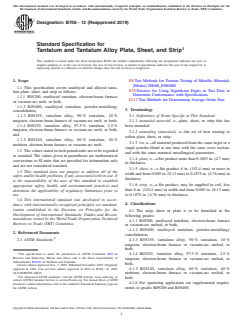
1.1 This specification covers unalloyed and alloyed tantalum plate, sheet, and strip as follows.
1.1.1 R05200, unalloyed tantalum, electron-beam furnace or vacuum-arc melt, or both,
1.1.2 R05400, unalloyed tantalum, powder-metallurgy consolidation,
1.1.3 R05255, tantalum alloy, 90 % tantalum, 10 % tungsten, electron-beam furnace of vacuum-arc melt, or both,
1.1.4 R05252, tantalum alloy, 97.5 % tantalum, 2.5 % tungsten, electron-beam furnace or vacuum-arc melt, or both, and
1.1.5 R05240, tantalum alloy, 60 % tantalum, 40 % niobium, electron-beam furnace or vacuum-arc melt.
1.2 The values stated in inch-pound units are to be regarded as standard. The values given in parentheses are mathematical conversions to SI units that are provided for information only and are not considered standard.
1.3 This standard does not purport to address all of the safety and/or health problems, if any, associated with its use. It is the responsibility of the user of this standard to establish appropriate safety, health, and environmental practices and determine the applicability of regulatory limitations prior to use.
1.4 This international standard was developed in accordance with internationally recognized principles on standardization established in the Decision on Principles for the Development of International Standards, Guides and Recommendations issued by the World Trade Organization Technical Barriers to Trade (TBT) Committee.
- Status
- Published
- Publication Date
- 31-Oct-2019
- Technical Committee
- B10 - Reactive and Refractory Metals and Alloys
- Drafting Committee
- B10.03 - Niobium, Tantalum, and Vanadium
Overview
ASTM B708-12(2019): Standard Specification for Tantalum and Tantalum Alloy Plate, Sheet, and Strip provides comprehensive requirements for the production, testing, and supply of flat-rolled mill products made from tantalum and tantalum alloys. Developed by ASTM International, this standard ensures material quality, mechanical performance, chemical composition, and precise dimensional tolerances, thus supporting critical applications in advanced manufacturing and high-technology industries. The specification covers various grades of tantalum and tantalum alloys, including unalloyed and those with tungsten or niobium content, and guides purchasers and manufacturers in their contractual and quality assurance processes.
Key Topics
Material Grades
ASTM B708 covers several tantalum grades, each with specific alloy content and production methods:- R05200: Unalloyed tantalum (electron-beam or vacuum-arc melted)
- R05400: Unalloyed tantalum (powder-metallurgy consolidation)
- R05255: 90% tantalum, 10% tungsten alloy
- R05252: 97.5% tantalum, 2.5% tungsten alloy
- R05240: 60% tantalum, 40% niobium alloy
Product Forms
The standard applies to:- Plate (thickness > 0.1853 in. / 4.7 mm)
- Sheet (≥6 in. width, 0.005–0.1875 in. thickness)
- Strip (width < 6 in., 0.005–0.1875 in. thickness)
Manufacturing Methods
Materials are formed using conventional extrusion, forging, and rolling equipment and are typically provided in an annealed or fully recrystallized condition, depending on customer requirements.Chemical and Mechanical Requirements
- Strict limits on impurity levels, covering elements such as carbon, oxygen, nitrogen, hydrogen, iron, molybdenum, niobium, nickel, silicon, titanium, tungsten, and tantalum.
- Mechanical properties such as tensile strength, yield strength, and elongation are specified according to grade and product form.
Quality Assurance
- Detailed guidance on sampling, inspection, testing procedures (e.g., tension testing, grain size analysis), and rejection or retesting protocols.
- Certification and documentation requirements for traceability and compliance.
Applications
ASTM B708-12(2019) is widely used by industries requiring reliable and high-performance tantalum products. Key application areas include:
- Electronics and Semiconductors: Tantalum sheets and plates are crucial in the fabrication of sputtering targets and capacitors due to their excellent corrosion resistance and high melting point.
- Chemical Processing Equipment: Tantalum's resistance to corrosive environments makes these products ideal for use in heat exchangers, liners, and reactor vessels.
- Medical Devices: Biocompatibility and physical properties enable use in surgical implants and specialized instruments.
- Aerospace and Defense: Tantalum alloys are selected for applications that demand robust mechanical properties under extreme conditions.
The specification also addresses specialized needs, such as flatness requirements for explosive bonding applications and tighter purity standards for sputtering targets.
Related Standards
When working with tantalum and tantalum alloy flat products, the following related standards and practices are also relevant:
- ASTM E8/E8M: Test Methods for Tension Testing of Metallic Materials
- ASTM E29: Practice for Using Significant Digits in Test Data to Determine Conformance with Specifications
- ASTM E112: Test Methods for Determining Average Grain Size
ASTM B708-12(2019) aligns with internationally recognized quality principles, making it a key reference for global supply chains. For more detailed material data or updated requirements, always consult the most current ASTM publication and related documentation.
Keywords: tantalum, tantalum alloy, ASTM B708, tantalum plate, tantalum sheet, tantalum strip, R05200, R05400, R05255, R05252, R05240, vacuum-arc melt, electron-beam melt, powder metallurgy, mechanical properties, chemical requirements.
Relations
- Replaces
ASTM B708-12 - Standard Specification for Tantalum and Tantalum Alloy Plate, Sheet, and Strip - Effective Date
- 01-Nov-2019
- Effective Date
- 15-Nov-2012
- Effective Date
- 01-Nov-2010
- Effective Date
- 01-Oct-2008
- Effective Date
- 15-Nov-2006
- Effective Date
- 23-Oct-2006
- Effective Date
- 15-Sep-2006
- Effective Date
- 01-May-2006
- Effective Date
- 01-Dec-2004
- Effective Date
- 01-Nov-2004
- Effective Date
- 01-Nov-2004
- Effective Date
- 01-Apr-2004
- Effective Date
- 10-Jul-2003
- Effective Date
- 10-May-2002
- Effective Date
- 10-Oct-2001
Get Certified
Connect with accredited certification bodies for this standard

Element Materials Technology
Materials testing and product certification.

Inštitut za kovinske materiale in tehnologije
Institute of Metals and Technology. Materials testing, metallurgical analysis, NDT.
Sponsored listings
Frequently Asked Questions
ASTM B708-12(2019) is a technical specification published by ASTM International. Its full title is "Standard Specification for Tantalum and Tantalum Alloy Plate, Sheet, and Strip". This standard covers: ABSTRACT This specification covers the standard requirements for tantalum and tantalum alloy plate, sheet, and strip in the following grades: R05200, R05400, R05255, R05252, and R05240. The various tantalum mill products covered by this specification shall be formed with the conventional extrusion, forging, and rolling equipment normally available in metal working plants. Materials shall be made from vacuum-arc or electron-beam melted ingots or powder metallurgy consolidated unalloyed tantalum and shall be supplied in the annealed condition. Chemical analysis shall be conducted to determine the chemical composition of the materials which shall conform to the requirements for carbon, oxygen, nitrogen, hydrogen, iron, molybdenum, niobium, nickel, silicon, titanium, tungsten, and tantalum. The mechanical properties of the materials shall also meet the specified tensile strength, yield strength, and elongation limits as shall be determined by a longitudinal or transverse tension test method. SCOPE 1.1 This specification covers unalloyed and alloyed tantalum plate, sheet, and strip as follows. 1.1.1 R05200, unalloyed tantalum, electron-beam furnace or vacuum-arc melt, or both, 1.1.2 R05400, unalloyed tantalum, powder-metallurgy consolidation, 1.1.3 R05255, tantalum alloy, 90 % tantalum, 10 % tungsten, electron-beam furnace of vacuum-arc melt, or both, 1.1.4 R05252, tantalum alloy, 97.5 % tantalum, 2.5 % tungsten, electron-beam furnace or vacuum-arc melt, or both, and 1.1.5 R05240, tantalum alloy, 60 % tantalum, 40 % niobium, electron-beam furnace or vacuum-arc melt. 1.2 The values stated in inch-pound units are to be regarded as standard. The values given in parentheses are mathematical conversions to SI units that are provided for information only and are not considered standard. 1.3 This standard does not purport to address all of the safety and/or health problems, if any, associated with its use. It is the responsibility of the user of this standard to establish appropriate safety, health, and environmental practices and determine the applicability of regulatory limitations prior to use. 1.4 This international standard was developed in accordance with internationally recognized principles on standardization established in the Decision on Principles for the Development of International Standards, Guides and Recommendations issued by the World Trade Organization Technical Barriers to Trade (TBT) Committee.
ABSTRACT This specification covers the standard requirements for tantalum and tantalum alloy plate, sheet, and strip in the following grades: R05200, R05400, R05255, R05252, and R05240. The various tantalum mill products covered by this specification shall be formed with the conventional extrusion, forging, and rolling equipment normally available in metal working plants. Materials shall be made from vacuum-arc or electron-beam melted ingots or powder metallurgy consolidated unalloyed tantalum and shall be supplied in the annealed condition. Chemical analysis shall be conducted to determine the chemical composition of the materials which shall conform to the requirements for carbon, oxygen, nitrogen, hydrogen, iron, molybdenum, niobium, nickel, silicon, titanium, tungsten, and tantalum. The mechanical properties of the materials shall also meet the specified tensile strength, yield strength, and elongation limits as shall be determined by a longitudinal or transverse tension test method. SCOPE 1.1 This specification covers unalloyed and alloyed tantalum plate, sheet, and strip as follows. 1.1.1 R05200, unalloyed tantalum, electron-beam furnace or vacuum-arc melt, or both, 1.1.2 R05400, unalloyed tantalum, powder-metallurgy consolidation, 1.1.3 R05255, tantalum alloy, 90 % tantalum, 10 % tungsten, electron-beam furnace of vacuum-arc melt, or both, 1.1.4 R05252, tantalum alloy, 97.5 % tantalum, 2.5 % tungsten, electron-beam furnace or vacuum-arc melt, or both, and 1.1.5 R05240, tantalum alloy, 60 % tantalum, 40 % niobium, electron-beam furnace or vacuum-arc melt. 1.2 The values stated in inch-pound units are to be regarded as standard. The values given in parentheses are mathematical conversions to SI units that are provided for information only and are not considered standard. 1.3 This standard does not purport to address all of the safety and/or health problems, if any, associated with its use. It is the responsibility of the user of this standard to establish appropriate safety, health, and environmental practices and determine the applicability of regulatory limitations prior to use. 1.4 This international standard was developed in accordance with internationally recognized principles on standardization established in the Decision on Principles for the Development of International Standards, Guides and Recommendations issued by the World Trade Organization Technical Barriers to Trade (TBT) Committee.
ASTM B708-12(2019) is classified under the following ICS (International Classification for Standards) categories: 77.150.99 - Other products of non-ferrous metals. The ICS classification helps identify the subject area and facilitates finding related standards.
ASTM B708-12(2019) has the following relationships with other standards: It is inter standard links to ASTM B708-12, ASTM E112-12, ASTM E112-10, ASTM E29-08, ASTM E29-06b, ASTM E112-96(2004)e2, ASTM E29-06a, ASTM E29-06, ASTM E29-04, ASTM E112-96(2004), ASTM E112-96(2004)e1, ASTM E8-04, ASTM E8-03, ASTM E29-02e1, ASTM E8-01e1. Understanding these relationships helps ensure you are using the most current and applicable version of the standard.
ASTM B708-12(2019) is available in PDF format for immediate download after purchase. The document can be added to your cart and obtained through the secure checkout process. Digital delivery ensures instant access to the complete standard document.
Standards Content (Sample)
This international standard was developed in accordance with internationally recognized principles on standardization established in the Decision on Principles for the
Development of International Standards, Guides and Recommendations issued by the World Trade Organization Technical Barriers to Trade (TBT) Committee.
Designation:B708 −12 (Reapproved 2019)
Standard Specification for
Tantalum and Tantalum Alloy Plate, Sheet, and Strip
This standard is issued under the fixed designation B708; the number immediately following the designation indicates the year of
original adoption or, in the case of revision, the year of last revision. A number in parentheses indicates the year of last reapproval. A
superscript epsilon (´) indicates an editorial change since the last revision or reapproval.
1. Scope E8 Test Methods for Tension Testing of Metallic Materials
[Metric] E0008_E0008M
1.1 This specification covers unalloyed and alloyed tanta-
E29 Practice for Using Significant Digits in Test Data to
lum plate, sheet, and strip as follows.
Determine Conformance with Specifications
1.1.1 R05200, unalloyed tantalum, electron-beam furnace
E112 Test Methods for Determining Average Grain Size
or vacuum-arc melt, or both,
1.1.2 R05400, unalloyed tantalum, powder-metallurgy
3. Terminology
consolidation,
1.1.3 R05255, tantalum alloy, 90 % tantalum, 10 %
3.1 Definitions of Terms Specific to This Standard:
tungsten, electron-beam furnace of vacuum-arc melt, or both,
3.1.1 annealed material, n—plate, sheet, or strip that has
1.1.4 R05252, tantalum alloy, 97.5 % tantalum, 2.5 %
been annealed.
tungsten, electron-beam furnace or vacuum-arc melt, or both,
3.1.2 annealing (annealed), n—the act of heat treating to
and
soften plate, sheet, or strip.
1.1.5 R05240, tantalum alloy, 60 % tantalum, 40 %
3.1.3 lot, n—all material produced from the same ingot or a
niobium, electron-beam furnace or vacuum-arc melt.
single powder blend at one time with the same cross section,
1.2 The values stated in inch-pound units are to be regarded
and with the same nominal metallurgical parameters.
as standard. The values given in parentheses are mathematical
3.1.4 plate, n—a flat product more than 0.1853 in. (4.7 mm)
conversions to SI units that are provided for information only
in thickness.
and are not considered standard.
3.1.5 sheet, n—a flat product 6 in. (152.4 mm) or more in
1.3 This standard does not purport to address all of the
width and from 0.005 in. (0.13 mm) to 0.1875 in. (4.76 mm) in
safety and/or health problems, if any, associated with its use. It
thickness.
is the responsibility of the user of this standard to establish
3.1.6 strip, n—a flat product, may be supplied in coil, less
appropriate safety, health, and environmental practices and
than 6 in. (152.4 mm) in width and from 0.005 in. (0.13 mm)
determine the applicability of regulatory limitations prior to
to 0.1875 in. (4.76 mm) in thickness.
use.
1.4 This international standard was developed in accor-
4. Classifications
dance with internationally recognized principles on standard-
ization established in the Decision on Principles for the
4.1 The strip, sheet or plate is to be furnished in the
Development of International Standards, Guides and Recom-
following grades:
mendations issued by the World Trade Organization Technical
4.1.1 R05200, unalloyed tantalum, electron-beam furnace
Barriers to Trade (TBT) Committee.
or vacuum-arc melted, or both,
4.1.2 R05400, unalloyed tantalum, powder-metallurgy
2. Referenced Documents
consolidation,
2.1 ASTM Standards:
4.1.3 R05255, tantalum alloy, 90 % tantalum, 10 %
tungsten, electron-beam furnace or vacuum-arc melted, or
both,
This specification is under the jurisdiction of ASTM Committee B10 on 4.1.4 R05252, tantalum alloy, 97.5 % tantalum, 2.5 %
Reactive and Refractory Metals and Alloys and is the direct responsibility of
tungsten, electron-beam furnace or vacuum-arc melted, or
Subcommittee B10.03 on Niobium and Tantalum.
both,
Current edition approved Nov. 1, 2019. Published November 2019. Originally
4.1.5 R05240, tantalum alloy, 60 % tantalum, 40 %
approved in 1982. Last previous edition approved in 2012 as B708 – 12. DOI:
10.1520/B0708-12R19.
niobium, electron-beam furnace or vacuum-arc melted, or
For referenced ASTM standards, visit the ASTM website, www.astm.org, or
both.
contact ASTM Customer Service at service@astm.org. For Annual Book of ASTM
4.1.6 For sputtering application see supplemental require-
Standards volume information, refer to the standard’s Document Summary page on
the ASTM website. ments to grades R05200 and R05400.
Copyright © ASTM International, 100 Barr Harbor Drive, PO Box C700, West Conshohocken, PA 19428-2959. United States
B708−12 (2019)
5. Ordering Information 7.2 The manufacturer’s ingot (or powder metallurgy con-
solidated bar) analysis may be considered the chemical analy-
5.1 Orders for material under this specification shall include
sis for products supplied under this specification. Alternately,
the following information as applicable:
an analysis of a representative sample of in-process material
5.1.1 Quantity (weight, number of pieces or other suitable
(or the final product) from the same ingot may be substituted.
measure of quantity),
5.1.2 Name of material (tantalum plate, sheet, or strip),
7.3 When requested by the purchaser at the time of
5.1.3 Grade (alloy and method of manufacture) (see 4.1.1 –
purchase, the seller shall furnish a report certifying the values
4.1.6),
of carbon, oxygen, nitrogen, and hydrogen of the finished
5.1.4 ASTM Standard (Specification B708) and year of
productasspecifiedinTable2foreachlotofmaterialsupplied.
issue, and
The performance of this special provision shall be negotiated.
5.1.5 Additions to the specification and supplementary re-
quirements if required.
8. Mechanical Properties
6. Materials and Manufacture
8.1 Annealed materials supplied under this specification
6.1 Material covered by this specification shall be made shall conform to the requirements for mechanical properties as
from vacuum-arc melted or electron-beam melted ingots or
specified in Table 3. No mechanical property requirements for
powder metallurgy consolidated unalloyed tantalum. unannealed (not heat treated) plate, sheet, or strip have been
established by this specification. Unless otherwise specified,
6.2 The various tantalum mill products covered by this
material supplied under this specification will be supplied in
specification are formed with the conventional extrusion,
the annealed condition.
forging, and rolling equipment normally available in metal
working plants.
9. Metallurgical Properties
6.3 All material shall be supplied in the annealed condition
unless otherwise specified by the purchaser.
9.1 Unless otherwise stated, the materials supplied under
6.3.1 If specified on the purchase order, the material can be
these specifications shall be in the fully annealed condition.
supplied in the “fully recrystallized” condition. In this case the
9.2 Other conditions, such as cold-worked or stress-
plate, sheet, strip, or foil shall be 90 % minimum recrystallized
relieved, can be specified as agreed upon between the pur-
as measured in accordance with 16.3. The terms “fully
chaser and the manufacturer at the time of the purchase.
annealed,” “completely,” and other similar terms shall be
considered the same as “fully recrystallized.”
10. Special Requirements
7. Chemical Composition
10.1 None specified.
7.1 The tantalum and tantalum alloy ingots and the tantalum
powder metallurgy consolidated ingots for conversion to fin-
11. Significance of Numerical Limits
ished products covered by this specification shall conform to
11.1 For the purpose of determining compliance with the
the requirements for chemical composition as prescribed in
specified limits for requirements of the properties listed in the
Table 1.
following table, an observed value or a calculated value shall
7.1.1 Analysis for elements not listed in Table 1 and not
normally expected in tantalum shall not be required unless be rounded as indicated in accordance with the rounding
specified at time of purchase. methods of Practice E29.
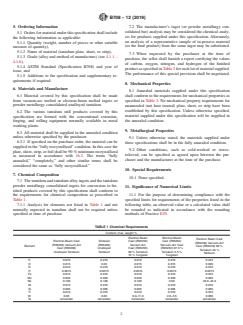
TABLE 1 Chemical Requirements
Content, max, weight %
Electron-Beam Electron-Beam
Electron Beam Cast
Electron-Beam Cast Sintered Cast (R05255) Cast (R05252)
(R05240) Vacuum-Arc
(R05200) Vacuum-Arc (R05400) Vacuum-Arc Vacuum-Arc Cast
Element Cast (R05240) 60 %
Cast (R05200) Unalloyed Cast (R05255) (R05252) 97.5 %
Tantalum 40 %
Unalloyed Tantalum Tantalum 90 % Tantalum Tantalum 2.5 %
Niobium
10 % Tungsten Tungsten
C 0.010 0.010 0.010 0.010 0.010
O 0.015 0.03 0.015 0.015 0.020
N 0.010 0.010 0.010 0.010 0.010
H 0.0015 0.0015 0.0015 0.0015 0.0015
Fe 0.010 0.010 0.010 0.010 0.010
Mo 0.020 0.020 0.020 0.020 0.020
Nb 0.100 0.100 0.100 0.50 35.0–42.0
Ni 0.010 0.010 0.010 0.010 0.010
Si 0.005 0.005 0.005 0.005 0.005
Ti 0.010 0.010 0.010 0.010 0.010
W 0.05 0.05 9.0–11.0 2.0–3.5 0.050
Ta remainder remainder remainder remainder remainder
B708−12 (2019)
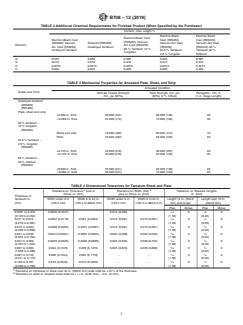
TABLE 2 Additional Chemical Requirements for Finished Product (When Specified by the Purchaser)
Content, max, weight %
Electron-Beam Electron Beam
Electron-Beam Cast
Electron-Beam Cast Cast (R05252) Cast (R05240)
(R05255) Vacuum-
(R05200) Vacuum- Sintered (R05400) Vacuum-Arc Cast Vacuum-Arc Cast
Element Arc Cast (R05255)
Arc Cast (R05200) Unalloyed Tantalum (R05252) (R05240) 60 %
90 % Tantalum 10 %
Unalloyed Tantalum 97.5 % Tantalum Tantalum 40 %
Tungsten
2.5 % Tungsten Niobium
O 0.025 0.035 0.025 0.025 0.025
N 0.010 0.010 0.010 0.010 0.010
H 0.0015 0.0015 0.0015 0.0015 0.0015
C 0.020 0.020 0.020 0.020 0.020
TABLE 3 Mechanical Properties for Annealed Plate, Sheet, and Strip
Annealed Condition
Grade and Form
Ultimate Tensile Strength, Yield Strength, min, psi Elongation, min, %
min, psi (MPa) (MPa) (2 % Offset) (1-in. Gage Length)
Unalloyed tantalum
(R05200)
(R05400)
Plate, sheet and strip
<0.060 in. thick 30 000 (207) 20 000 (138) 20
$0.060 in. thick 25 000 (172) 15 000 (103) 30
90 % tantalum –
10 % tungsten
(R05255)
Sheet and strip 70 000 (482) 60 000 (414) 15
Plate 70 000 (482) 55 000 (379) 20
97.5 % tantalum –
2.5 % tungsten
(R05252)
<0.125 in. thick 40 000 (276) 30 000 (207) 20
$0.125 in. thick 40 000 (276) 22 000 (152) 25
60 % tantalum –
40 % niobium
(R05240)
<0.060 in. thick 35 000 (241) 20 000 (138) 25
$0.060 in. thick 35 000 (241) 15 000 (103) 25
TABLE 4 Dimensional Tolerances for Tantalum Sheet and Plate
A B
Tolerance on Thickness, plus or Tolerance on Width (Slit), Tolerance on Sheared Lengths,
minus, in. (mm) plus or minus, in. (mm)
in. (mm)
Thickness of
Tantalum in. Width under 6 in Width6to24in. Width under 6 in. Width6to24in. Length 12 in. (304.8 Length over 12 in.
(mm) (152.4 mm) (152.4 to 609.6 mm) (152.4 mm) (152.4 to 609.6 mm) mm) and Under (304.8 mm)
Plus Minus Plus Minus
1 1
0.0051 to 0.010 0.0005 (0.0127) 0.012 (0.305) ⁄16 0 ⁄4 0
(0.129 to 0.254) (1.59) (6.35)
1 1
0.011 to 0.015 0.0007 (0.0178) 0.001 (0.0254) 0.015 (0.381) 0.015 (0.381) ⁄16 0 ⁄4 0
(0.279 to 0.381) (1.59) (6.35)
1 1
0.016 to 0.020 0.0008 (0.0203) 0.0015 (0.0381) 0.015 (0.381) 0.015 (0.381) ⁄16 0 ⁄4 0
(0.406 to 0.508) (1.59) (6.35)
1 1
0.021 to 0.030 0.0015 (0.0381) 0.0025 (0.0635) 0.020 (0.508) 0.025 (0.635) ⁄16 0 ⁄4 0
(0.533 to 0.762) (1.59) (6.35)
1 1
0.031 to 0.060 0.0025 (0.0635) 0.0035 (0.0889) 0.025 (0.635) 0.030 (0.762) ⁄16 0 ⁄4 0
(0.787 to 1.524) (1.59) (6.35)
1 1
0.061 to 0.090 0.004 (0.1016) 0.005 (0.1270) 0.025 (0.635) 0.035 (0.889) ⁄16 0 ⁄4 0
(1.549 to 2.286) (1.59) (6.35)
1 1
0.091 to 0.125 0.006 (0.1524) 0.007 (0.1778) . . ⁄16 0 ⁄4 0
(2.311 to 3.175) (1.59) (6.35)
1 1
0.126 to 0.187 0.010 (0.2540) 0.010 (0.2540) . . ⁄16 0 ⁄4 0
(3.200 to 4.750) (1.59) (6.35)
A
Tolerance on thickness of sheet over 24 in. (609.6 mm) wide shall be ±10 % of the thickness.
B
Tolerance on width of sheared sheet shall be + ⁄4 in. (6.35 mm), − 0 in. (0 mm).
B708−12 (2019)
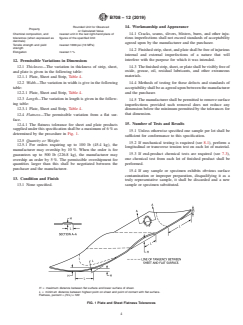
14. Workmanship and Appearance
Rounded Unit for Observed
Property
or Calculated Value
14.1 Cracks, seams, slivers, blisters, burrs, and other inju-
Chemical composition, and nearest unit in the last right-hand place of
tolerances (when expressed as figures of the specified limit
rious imperfections shall not exceed standards of acceptability
decimals)
agreed upon by the manufacturer and the purchaser.
Tensile strength and yield nearest 1000 psi (10 MPa)
strength
14.2 Finishedstrip,sheet,andplateshallbefreeofinjurious
Elongation nearest 1 %
internal and external imperfections of a nature that will
interfere with the purpose for which it was intended.
12. Permissible Variations in Dimensions
12.1 Thickness—The variation in thickness of strip, sheet, 14.3 Thefinishedstrip,sheet,orplateshallbevisiblyfreeof
oxide, grease, oil, residual lubricants, and other extraneous
and plate is given in the following table:
materials.
12.1.1 Plate, Sheet and Strip, Table 4.
12.2 Width—The variation in width is give in the following 14.4 Methods of testing for these defects and standards of
table:
acceptabilityshallbeasagreeduponbetweenthemanufacturer
12.2.1 Plate, Sheet and Strip, Table 4. and the purchaser.
12.3 Length—The variation in length is given in the follow-
14.5 The manufacturer shall be permitted to remove sur
...