

ASTM D7407-07(2020)
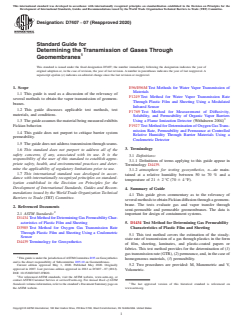
(Guide)Standard Guide for Determining the Transmission of Gases Through Geomembranes
General Information
- Abstract
ABSTRACT
This guide discusses the relevancy of applicable test methods, including the materials and conditions involved, in obtaining the vapor transmission in geomembranes. This guide does not purport to critique barrier system permeability, nor does it address transmission through seams. The guide assumes the material being examined exhibits Fickian diffusion behavior. The tests discussed here evaluate gas and vapor transfer through semi-permeable and permeable geomembranes. The data is important for design of containment systems.
SCOPE
1.1 This guide is used as a discussion of the relevancy of several methods to obtain the vapor transmission of geomembranes.
1.2 This guide discusses applicable test methods, test materials, and conditions.
1.3 The guide assumes the material being measured exhibits Fickian behavior.
1.4 This guide does not purport to critique barrier system permeability.
1.5 The guide does not address transmission through seams.
1.6 This standard does not purport to address all of the safety concerns, if any, associated with its use. It is the responsibility of the user of this standard to establish appropriate safety, health, and environmental practices and determine the applicability of regulatory limitations prior to use.
1.7 This international standard was developed in accordance with internationally recognized principles on standardization established in the Decision on Principles for the Development of International Standards, Guides and Recommendations issued by the World Trade Organization Technical Barriers to Trade (TBT) Committee.
- Status
- Published
- Publication Date
- 30-Apr-2020
- Technical Committee
- D35 - Geosynthetics
- Drafting Committee
- D35.10 - Geomembranes

Overview
ASTM D7407-07(2020): Standard Guide for Determining the Transmission of Gases Through Geomembranes provides a framework for understanding how various test methods are relevant when measuring the vapor and gas transmission characteristics of geomembranes. Geomembranes are synthetic membrane liners or barriers often used in containment and environmental protection applications. This guide is intended to support users in selecting appropriate test methods for evaluating the transmission properties of geomembrane materials under specific conditions, assuming that the materials follow Fickian diffusion behavior. It does not evaluate the overall barrier system or address transmission through seams.
Key Topics
- Gas and Vapor Transmission Testing: The guide discusses the importance of measuring gas and vapor transfer rates through geomembranes, which is critical for the effective design of containment systems.
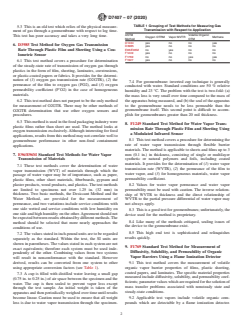
- Relevancy of Test Methods: Multiple ASTM test methods are referenced, including D1434, D3985, E96/E96M, F1249, and F1927, each with specific applications depending on the type of gas, vapor, and material.
- Testing Conditions: Emphasizes maintaining controlled temperature and relative humidity conditions, and highlights the challenges associated with testing thick or low-permeability membranes.
- Fickian Diffusion: Assumes material behavior follows Fick’s laws of diffusion, which is typical for many polymeric geomembranes under standard conditions.
- Limitations: The guide does not assess the permeability of entire barrier systems or seams, nor does it address safety or regulatory requirements, leaving those responsibilities to the user.
Applications
The principles and guidelines in ASTM D7407-07(2020) have direct practical value in several industries and scenarios:
- Containment System Design: Engineers and designers utilize vapor and gas transmission data to select appropriate geomembranes for applications like landfills, waste containment, pond liners, and mining leach pads.
- Material Quality Assessment: Manufacturers and quality-control labs use the referenced test methods to verify the diffusion, permeability, and permeance properties of geomembrane products.
- Regulatory Compliance: Accurate determination of gas and vapor transmission is vital for meeting environmental protection and industrial standards, particularly for applications where volatile contents or gases must be contained.
- Selection of Testing Protocols: Users rely on this guide to choose the most suitable ASTM method for their material type and performance criteria-such as water vapor transmission for hydrological barriers or oxygen permeability for chemical containment.
Related Standards
To effectively implement or complement ASTM D7407-07(2020), familiarity with the following referenced ASTM standards is beneficial:
- ASTM D1434: Test Method for Determining Gas Permeability Characteristics of Plastic Film and Sheeting
- ASTM D3985: Test Method for Oxygen Gas Transmission Rate Through Plastic Film and Sheeting Using a Coulometric Sensor
- ASTM E96/E96M: Test Methods for Water Vapor Transmission of Materials
- ASTM F1249: Test Method for Water Vapor Transmission Rate Through Plastic Film and Sheeting Using a Modulated Infrared Sensor
- ASTM F1927: Test Method for Determination of Oxygen Gas Transmission Rate, Permeability and Permeance at Controlled Relative Humidity Through Barrier Materials Using a Coulometric Detector
- ASTM D4439: Terminology for Geosynthetics
Practical Value
By referencing ASTM D7407-07(2020), professionals can ensure standardized, reliable approaches to measuring the transmission of gases and vapors through geomembranes. This consistency is essential for high-stakes applications in environmental engineering, civil infrastructure, and industrial containment, where material selection and verification directly impact safety, regulatory acceptance, and long-term system performance.
Keywords: geomembrane, gas transmission, vapor transmission, permeability, Fickian diffusion, ASTM D7407, barrier materials, containment system, test methods.
Relations
- Replaces
ASTM D7407-07(2012) - Standard Guide for Determining The Transmission of Gases Through Geomembranes - Effective Date
- 01-May-2020
- Effective Date
- 01-Mar-2024
- Effective Date
- 01-Feb-2024
- Effective Date
- 15-Nov-2023
- Effective Date
- 01-Jun-2020
- Effective Date
- 01-Jun-2020
- Effective Date
- 15-Apr-2018
- Effective Date
- 01-Aug-2017
- Effective Date
- 01-Sep-2015
- Effective Date
- 01-Jul-2015
- Effective Date
- 01-May-2015
- Effective Date
- 15-Oct-2014
- Effective Date
- 01-Apr-2014
- Effective Date
- 01-Mar-2014
- Effective Date
- 01-Nov-2013
Get Certified
Connect with accredited certification bodies for this standard

Control Union Certifications
Global certification for agriculture and sustainability.

Hohenstein Institut
Textile testing and certification.

Bureau Veritas Bangladesh
Bureau Veritas certification services in Bangladesh.
Sponsored listings
Frequently Asked Questions
ASTM D7407-07(2020) is a guide published by ASTM International. Its full title is "Standard Guide for Determining the Transmission of Gases Through Geomembranes". This standard covers: ABSTRACT This guide discusses the relevancy of applicable test methods, including the materials and conditions involved, in obtaining the vapor transmission in geomembranes. This guide does not purport to critique barrier system permeability, nor does it address transmission through seams. The guide assumes the material being examined exhibits Fickian diffusion behavior. The tests discussed here evaluate gas and vapor transfer through semi-permeable and permeable geomembranes. The data is important for design of containment systems. SCOPE 1.1 This guide is used as a discussion of the relevancy of several methods to obtain the vapor transmission of geomembranes. 1.2 This guide discusses applicable test methods, test materials, and conditions. 1.3 The guide assumes the material being measured exhibits Fickian behavior. 1.4 This guide does not purport to critique barrier system permeability. 1.5 The guide does not address transmission through seams. 1.6 This standard does not purport to address all of the safety concerns, if any, associated with its use. It is the responsibility of the user of this standard to establish appropriate safety, health, and environmental practices and determine the applicability of regulatory limitations prior to use. 1.7 This international standard was developed in accordance with internationally recognized principles on standardization established in the Decision on Principles for the Development of International Standards, Guides and Recommendations issued by the World Trade Organization Technical Barriers to Trade (TBT) Committee.
ABSTRACT This guide discusses the relevancy of applicable test methods, including the materials and conditions involved, in obtaining the vapor transmission in geomembranes. This guide does not purport to critique barrier system permeability, nor does it address transmission through seams. The guide assumes the material being examined exhibits Fickian diffusion behavior. The tests discussed here evaluate gas and vapor transfer through semi-permeable and permeable geomembranes. The data is important for design of containment systems. SCOPE 1.1 This guide is used as a discussion of the relevancy of several methods to obtain the vapor transmission of geomembranes. 1.2 This guide discusses applicable test methods, test materials, and conditions. 1.3 The guide assumes the material being measured exhibits Fickian behavior. 1.4 This guide does not purport to critique barrier system permeability. 1.5 The guide does not address transmission through seams. 1.6 This standard does not purport to address all of the safety concerns, if any, associated with its use. It is the responsibility of the user of this standard to establish appropriate safety, health, and environmental practices and determine the applicability of regulatory limitations prior to use. 1.7 This international standard was developed in accordance with internationally recognized principles on standardization established in the Decision on Principles for the Development of International Standards, Guides and Recommendations issued by the World Trade Organization Technical Barriers to Trade (TBT) Committee.
ASTM D7407-07(2020) is classified under the following ICS (International Classification for Standards) categories: 59.080.70 - Geotextiles. The ICS classification helps identify the subject area and facilitates finding related standards.
ASTM D7407-07(2020) has the following relationships with other standards: It is inter standard links to ASTM D7407-07(2012), ASTM E96/E96M-24, ASTM D4439-24, ASTM E96/E96M-23, ASTM F1249-20, ASTM F1927-20, ASTM D4439-18, ASTM D4439-17, ASTM D4439-15a, ASTM D4439-15, ASTM E96/E96M-15, ASTM E96/E96M-14, ASTM F1927-14, ASTM D4439-14, ASTM E96/E96M-13. Understanding these relationships helps ensure you are using the most current and applicable version of the standard.
ASTM D7407-07(2020) is available in PDF format for immediate download after purchase. The document can be added to your cart and obtained through the secure checkout process. Digital delivery ensures instant access to the complete standard document.
Standards Content (Sample)
This international standard was developed in accordance with internationally recognized principles on standardization established in the Decision on Principles for the
Development of International Standards, Guides and Recommendations issued by the World Trade Organization Technical Barriers to Trade (TBT) Committee.
Designation: D7407 − 07 (Reapproved 2020)
Standard Guide for
Determining the Transmission of Gases Through
Geomembranes
This standard is issued under the fixed designation D7407; the number immediately following the designation indicates the year of
original adoption or, in the case of revision, the year of last revision.Anumber in parentheses indicates the year of last reapproval.A
superscript epsilon (´) indicates an editorial change since the last revision or reapproval.
1. Scope E96/E96MTest Methods for Water Vapor Transmission of
Materials
1.1 This guide is used as a discussion of the relevancy of
F1249Test Method for Water Vapor Transmission Rate
several methods to obtain the vapor transmission of geomem-
Through Plastic Film and Sheeting Using a Modulated
branes.
Infrared Sensor
1.2 This guide discusses applicable test methods, test
F1769 Test Method for Measurement of Diffusivity,
materials, and conditions.
Solubility, and Permeability of Organic Vapor Barriers
Using a Flame Ionization Detector (Withdrawn 2004)
1.3 Theguideassumesthematerialbeingmeasuredexhibits
Fickian behavior. F1927TestMethodforDeterminationofOxygenGasTrans-
mission Rate, Permeability and Permeance at Controlled
1.4 This guide does not purport to critique barrier system
Relative Humidity Through Barrier Materials Using a
permeability.
Coulometric Detector
1.5 Theguidedoesnotaddresstransmissionthroughseams.
3. Terminology
1.6 This standard does not purport to address all of the
safety concerns, if any, associated with its use. It is the
3.1 Definitions:
responsibility of the user of this standard to establish appro-
3.1.1 Definitions of terms applying to this guide appear in
priate safety, health, and environmental practices and deter-
Terminology D4439.
mine the applicability of regulatory limitations prior to use.
3.1.2 atmosphere for testing geosynthetics, n—air main-
1.7 This international standard was developed in accor-
tained at a relative humidity between 50 to 70 % and a
dance with internationally recognized principles on standard-
temperature of 21 6 2°C (70 6 4°F).
ization established in the Decision on Principles for the
Development of International Standards, Guides and Recom-
4. Summary of Guide
mendations issued by the World Trade Organization Technical
4.1 This guide gives commentary as to the relevancy of
Barriers to Trade (TBT) Committee.
severalmethodstoobtainFickiandiffusionthroughageomem-
brane. The tests evaluate gas and vapor transfer through
2. Referenced Documents
semi-permeable and permeable geomembranes. The data is
2.1 ASTM Standards:
important for design of containment systems.
D1434TestMethodforDeterminingGasPermeabilityChar-
acteristics of Plastic Film and Sheeting
5. D1434 Test Method for Determining Gas Permeability
D3985Test Method for Oxygen Gas Transmission Rate
Characteristics of Plastic Film and Sheeting
Through Plastic Film and Sheeting Using a Coulometric
5.1 This test method covers the estimation of the steady-
Sensor
state rate of transmission of a gas through plastics in the form
D4439Terminology for Geosynthetics
of film, sheeting, laminates, and plastic-coated papers or
fabrics. This test method provides for the determination of (1)
gastransmissionrate(GTR),(2)permeance,and,inthecaseof
ThisguideisunderthejurisdictionofASTMCommitteeD35onGeosynthetics
homogeneous materials, (3) permeability.
and is the direct responsibility of Subcommittee D35.10 on Geomembranes.
5.2 Two procedures are provided: M, Manometric and V,
Current edition approved May 1, 2020. Published May 2020. Originally
approved in 2007. Last previous edition approved in 2012 as D7407–07 (2012).
Volumetric.
DOI: 10.1520/D7407-07R20.
For referenced ASTM standards, visit the ASTM website, www.astm.org, or
contact ASTM Customer Service at service@astm.org. For Annual Book of ASTM
Standards volume information, refer to the standard’s Document Summary page on The last approved version of this historical standard is referenced on
the ASTM website. www.astm.org.
Copyright © ASTM International, 100 Barr Harbor Drive, PO Box C700, West Conshohocken, PA 19428-2959. United States
D7407 − 07 (2020)
TABLE 1 Grouping of Test Methods for Measuring Gas
5.3 This is an old test which relies of the physical measure-
Transmission with Respect to Application
ment of gas through a geomembrane with respect to log time.
ASTM Volatile Organic
This test has poor accuracy and takes a very long time.
Oxygen OTRM Vapor MVTR Methane
Method OTM
D1434 yes no no yes
6. D3985 Test Method for Oxygen Gas Transmission
D3985 yes no no no
E96/E96M no yes no no
Rate Through Plastic Film and Sheeting Using a Cou-
F1249 yes no no no
lometric Sensor
F1769 no no yes yes
F1927 yes no no no
6.1 This test method covers a procedure for determination
of the steady-state rate of transmission of oxygen gas through
plastics in the form of film, sheeting, laminates, coextrusions,
or plastic-coated papers or fabrics. It provides for the determi-
nation of (1) oxygen gas transmission rate (O2GTR), (2) the
7.4 For geomembrane: inverted cup technique is generally
permeance of the film to oxygen gas (PO2), and (3) oxygen
conducted with water. Standard conditions are 50 % relative
permeability coefficient (P’O2) in the case of homogeneous
humidity and 23 °C.The problem with the test is two-fold: (a)
materials.
the mass loss is very small over time compared to the mass of
theapparatusbeingmeasured,and(b)thesealoftheapparatus
6.2 Thistestmethoddoesnotpurporttobetheonlymethod
to the geomembrane needs to be less permeable than the
for measurement of O2GTR. There may be other methods of
geomembrane itself. This second point is difficult to accom-
O2GTR determination that use other oxygen sensors and
procedures. plish for geomembranes greater than 20 mil thickness.
6.3 Thismethodisusedinthefoodpackagingindustrywere
8. F1249 Standard Test Method for Water Vapor Trans-
plastic films rather than sheet are used. The method looks at
mission Rate Through Plastic Film and Sheeting Using
oxygentransmissionexclusively.Althoughinterestingforfood
a Modulated Infrared Sensor
applications,resultsfromthismethodmaynotcorrelatewellto
8.1 Thistestmethodcoversaprocedurefordeterminingthe
geomembrane performance in other non-food containment
rate of water vapor transmission through flexible barrier
applications.
materials.The method is applicable to sheets and films up to 3
7. E96/E96M Standard Test Methods for Water Vapor mm (0.1 in.) in thickness, consisting of single or multilayer
Transmission of Materials synthetic or natural polymers and foils, including coated
materials. It provides for the determination of (1) water vapor
7.1 These test methods cover the determination of water
transmission rate (WVTR), (2) the permeance of the film to
vapor transmission (WVT) of materials through which the
water vapor, and (3) for homogeneous materials, water vapor
passage of water vapor may be of importance, such as paper,
permeability coefficient.
plastic films, other sheet materials, fiberboards, gypsum and
plasterproducts,woodproducts,andplastics.Thetestmethods 8.2 Values for water vapor permeance and water vapor
are limited to specimens not over 1.25 in. (32 mm) in permeability must be used with caution. The inverse relation-
thickness. Two basic methods, the Desiccant Method and the ship of WVTR to thickness and the direct relationship of
Water Method, are provided for the measurement of WVTR to the partial pressure differential of water vapor may
permeance, and two variations include service conditions with not always apply.
one side wetted and service conditions with low humidity on
8.3 Thisisagoodtestforgeomembranes;unfortunately,the
onesideandhighhumidityontheother.Agreementshouldnot
device used for the method is proprietary.
beexpectedbetweenresultsobtainedbydifferentmethods.The
8.4 Like many of the methods critiqued, sealing issues of
method should be selected that more nearly approaches the
the device to the geomembrane exist.
conditions of use.
8.5 This high end test is sophisticated and relinquishes
7.2 Thevaluesstatedininch-poundunitsaretoberegarded
results quickly.
separately as the standard. Within the text, the SI units are
showninparentheses.Thevaluesstatedineachsystemarenot
9. F1769 Standard Test Method for Measurement of
exact equivalents; therefore each system must be used inde-
Diffusivity, Solubility, and Permeability of Organic
pendently of the other. Combining values from two systems
Vapor Barriers Using a Flame Ionization Detector
will result in nonconformance with the standard. However
derived, results can be converted from one system to other 9.1 This test method covers the measurement of volatile
using appropriate conversion factors (see Table 1). organic vapor barr
...