

ASTM C233/C233M-18
(Test Method)Standard Test Method for Air-Entraining Admixtures for Concrete
General Information
- Abstract
SIGNIFICANCE AND USE
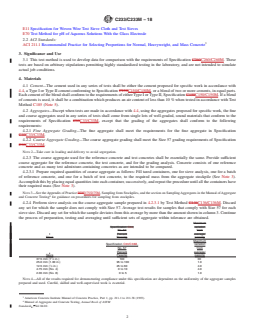
3.1 This test method is used to develop data for comparison with the requirements of Specification C260/C260M. These tests are based on arbitrary stipulations permitting highly standardized testing in the laboratory, and are not intended to simulate actual job conditions.
SCOPE
1.1 This test method covers the testing of materials proposed for use as air-entraining admixtures in the field.
1.2 The text of this test method references notes and footnotes which provide explanatory material. These notes and footnotes (excluding those in tables and figures) shall not be considered as requirements of the standard.
1.3 The values stated in either SI units or inch-pound units are to be regarded separately as standard. The values stated in each system may not be exact equivalents; therefore, each system shall be used independently of the other. Combining values from the two systems may result in non-conformance with the standard. Some values have only SI units because the inch-pound equivalents are not used in practice.
Note 1: Sieve size is identified by its standard designation in Specification E11. The alternative designation given in parentheses is for information only and does not represent a different standard sieve size.
1.4 This standard does not purport to address all of the safety concerns, if any, associated with its use. It is the responsibility of the user of this standard to establish appropriate safety, health, and environmental practices and determine the applicability of regulatory limitations prior to use.
1.5 This international standard was developed in accordance with internationally recognized principles on standardization established in the Decision on Principles for the Development of International Standards, Guides and Recommendations issued by the World Trade Organization Technical Barriers to Trade (TBT) Committee.
- Status
- Published
- Publication Date
- 14-Dec-2018
- Technical Committee
- C09 - Concrete and Concrete Aggregates
- Drafting Committee
- C09.23 - Chemical Admixtures
Overview
ASTM C233/C233M-18 - Standard Test Method for Air-Entraining Admixtures for Concrete provides a highly standardized laboratory protocol for evaluating materials intended for use as air-entraining admixtures in concrete. Issued by ASTM International, this standard enables manufacturers, specifiers, and laboratories to compare performance of air-entraining agents against the requirements of ASTM C260/C260M. While the methods do not directly simulate field conditions, the resulting data is essential for compliance verification and quality control in the selection of admixtures for durable concrete.
Key Topics
- Scope and Laboratory Standardization: This test method covers procedures for assessing materials proposed as air-entraining admixtures for field use. Laboratory testing is designed to deliver consistent, repeatable results regardless of local variables, providing a benchmark evaluation rather than a simulation of job site conditions.
- Material Requirements: Specifies the use of defined types and gradations of cement and aggregate, referencing standards such as ASTM C33/C33M (Concrete Aggregates) and ASTM C150/C150M (Portland Cement). Mixture proportions and properties are based on referenced practices, adjusted for each test application.
- Testing Protocols: Details preparation of concrete mixtures containing the test admixture and a reference admixture, measurement of slump, air content, bleeding, time of setting, compressive and flexural strength, freeze-thaw resistance, and length change. Admixture quantities are adjusted to achieve targeted air contents.
- Residue Determination: Includes both oven drying and halogen lamp-based methods for determining residue content of liquid admixtures, covering necessary calculations, procedural steps, and required equipment.
- Precision and Bias: Presents guidelines and statistical thresholds for repeatability (single-operator) and reproducibility (multi-laboratory) in residue content tests, helping ensure data reliability and validation.
Applications
ASTM C233/C233M-18 is essential for:
- Product Certification: Used by manufacturers to demonstrate conformance of air-entraining admixtures with ASTM C260/C260M, supporting product claims and regulatory approval.
- Quality Assurance: Employed by independent laboratories, ready-mix concrete producers, and specifiers to assess batch-to-batch consistency, uniformity, and performance of admixtures.
- Specification and Procurement: Referenced in construction project specifications to ensure that only tested and compliant air-entraining agents are used, enhancing freeze-thaw durability, workability, and service life of concrete structures.
- Research and Development: Provides a foundation for academic and industry research in improving admixture formulations and evaluating new materials.
Common use cases include:
- Selection of admixtures for highways, bridges, precast elements, and exposed concrete subject to freeze-thaw cycles
- Verification of admixture performance prior to large-scale procurement
- Routine checks in quality control laboratories
Related Standards
- ASTM C260/C260M - Specification for Air-Entraining Admixtures for Concrete (referenced for performance requirements)
- ASTM C33/C33M - Specification for Concrete Aggregates
- ASTM C192/C192M - Practice for Making and Curing Concrete Test Specimens in the Laboratory
- ASTM C143/C143M - Test Method for Slump of Hydraulic-Cement Concrete
- ASTM C231/C231M and C173/C173M - Test Methods for Air Content of Freshly Mixed Concrete
- ASTM C666/C666M - Test Method for Resistance of Concrete to Rapid Freezing and Thawing
- ASTM E11 - Specification for Woven Wire Test Sieve Cloth and Test Sieves
- ASTM E70 - Test Method for pH of Aqueous Solutions
- ACI 211.1 - Recommended Practice for Selecting Proportions for Concrete
By referencing ASTM C233/C233M-18 and related standards, stakeholders ensure robust, internationally recognized methods are used in the evaluation and selection of air-entraining admixtures, directly supporting the durability and long-term performance of concrete infrastructure.
Relations
- Effective Date
- 15-Dec-2018
- Effective Date
- 01-Feb-2024
- Effective Date
- 01-Jan-2024
- Effective Date
- 01-Jan-2024
- Effective Date
- 01-Jan-2024
- Effective Date
- 01-Jan-2024
- Refers
ASTM C39/C39M-23 - Standard Test Method for Compressive Strength of Cylindrical Concrete Specimens - Effective Date
- 01-Dec-2023
- Effective Date
- 01-Sep-2023
- Effective Date
- 01-Apr-2020
- Effective Date
- 01-Dec-2019
- Effective Date
- 01-Nov-2019
- Effective Date
- 01-Apr-2019
- Effective Date
- 01-Apr-2019
- Effective Date
- 15-Aug-2017
- Refers
ASTM C39/C39M-17b - Standard Test Method for Compressive Strength of Cylindrical Concrete Specimens - Effective Date
- 01-Aug-2017
Get Certified
Connect with accredited certification bodies for this standard

DIBt (Deutsches Institut für Bautechnik)
German Institute for Building Technology.
DIN CERTCO
DIN Group product certification.

Aboma Certification B.V.
Specialized in construction, metal, and transport sectors.
Sponsored listings
Frequently Asked Questions
ASTM C233/C233M-18 is a standard published by ASTM International. Its full title is "Standard Test Method for Air-Entraining Admixtures for Concrete". This standard covers: SIGNIFICANCE AND USE 3.1 This test method is used to develop data for comparison with the requirements of Specification C260/C260M. These tests are based on arbitrary stipulations permitting highly standardized testing in the laboratory, and are not intended to simulate actual job conditions. SCOPE 1.1 This test method covers the testing of materials proposed for use as air-entraining admixtures in the field. 1.2 The text of this test method references notes and footnotes which provide explanatory material. These notes and footnotes (excluding those in tables and figures) shall not be considered as requirements of the standard. 1.3 The values stated in either SI units or inch-pound units are to be regarded separately as standard. The values stated in each system may not be exact equivalents; therefore, each system shall be used independently of the other. Combining values from the two systems may result in non-conformance with the standard. Some values have only SI units because the inch-pound equivalents are not used in practice. Note 1: Sieve size is identified by its standard designation in Specification E11. The alternative designation given in parentheses is for information only and does not represent a different standard sieve size. 1.4 This standard does not purport to address all of the safety concerns, if any, associated with its use. It is the responsibility of the user of this standard to establish appropriate safety, health, and environmental practices and determine the applicability of regulatory limitations prior to use. 1.5 This international standard was developed in accordance with internationally recognized principles on standardization established in the Decision on Principles for the Development of International Standards, Guides and Recommendations issued by the World Trade Organization Technical Barriers to Trade (TBT) Committee.
SIGNIFICANCE AND USE 3.1 This test method is used to develop data for comparison with the requirements of Specification C260/C260M. These tests are based on arbitrary stipulations permitting highly standardized testing in the laboratory, and are not intended to simulate actual job conditions. SCOPE 1.1 This test method covers the testing of materials proposed for use as air-entraining admixtures in the field. 1.2 The text of this test method references notes and footnotes which provide explanatory material. These notes and footnotes (excluding those in tables and figures) shall not be considered as requirements of the standard. 1.3 The values stated in either SI units or inch-pound units are to be regarded separately as standard. The values stated in each system may not be exact equivalents; therefore, each system shall be used independently of the other. Combining values from the two systems may result in non-conformance with the standard. Some values have only SI units because the inch-pound equivalents are not used in practice. Note 1: Sieve size is identified by its standard designation in Specification E11. The alternative designation given in parentheses is for information only and does not represent a different standard sieve size. 1.4 This standard does not purport to address all of the safety concerns, if any, associated with its use. It is the responsibility of the user of this standard to establish appropriate safety, health, and environmental practices and determine the applicability of regulatory limitations prior to use. 1.5 This international standard was developed in accordance with internationally recognized principles on standardization established in the Decision on Principles for the Development of International Standards, Guides and Recommendations issued by the World Trade Organization Technical Barriers to Trade (TBT) Committee.
ASTM C233/C233M-18 is classified under the following ICS (International Classification for Standards) categories: 91.100.30 - Concrete and concrete products. The ICS classification helps identify the subject area and facilitates finding related standards.
ASTM C233/C233M-18 has the following relationships with other standards: It is inter standard links to ASTM C233/C233M-14, ASTM C670-24a, ASTM E70-24, ASTM C670-24, ASTM C231/C231M-24, ASTM C173/C173M-24, ASTM C39/C39M-23, ASTM C173/C173M-23, ASTM C185-20, ASTM C185-19, ASTM D75/D75M-19, ASTM C150/C150M-19, ASTM C232/C232M-14(2019), ASTM C157/C157M-17, ASTM C39/C39M-17b. Understanding these relationships helps ensure you are using the most current and applicable version of the standard.
ASTM C233/C233M-18 is available in PDF format for immediate download after purchase. The document can be added to your cart and obtained through the secure checkout process. Digital delivery ensures instant access to the complete standard document.
Standards Content (Sample)
This international standard was developed in accordance with internationally recognized principles on standardization established in the Decision on Principles for the
Development of International Standards, Guides and Recommendations issued by the World Trade Organization Technical Barriers to Trade (TBT) Committee.
Designation: C233/C233M − 18
Standard Test Method for
Air-Entraining Admixtures for Concrete
This standard is issued under the fixed designation C233/C233M; the number immediately following the designation indicates the year
of original adoption or, in the case of revision, the year of last revision.Anumber in parentheses indicates the year of last reapproval.
A superscript epsilon (´) indicates an editorial change since the last revision or reapproval.
1. Scope* C78/C78MTest Method for Flexural Strength of Concrete
(Using Simple Beam with Third-Point Loading)
1.1 This test method covers the testing of materials pro-
C136/C136MTest Method for Sieve Analysis of Fine and
posed for use as air-entraining admixtures in the field.
Coarse Aggregates
1.2 The text of this test method references notes and
C143/C143MTest Method for Slump of Hydraulic-Cement
footnotes which provide explanatory material.These notes and
Concrete
footnotes (excluding those in tables and figures) shall not be
C150/C150MSpecification for Portland Cement
considered as requirements of the standard.
C157/C157MTest Method for Length Change of Hardened
1.3 The values stated in either SI units or inch-pound units Hydraulic-Cement Mortar and Concrete
C172/C172MPractice for Sampling Freshly Mixed Con-
are to be regarded separately as standard. The values stated in
each system may not be exact equivalents; therefore, each crete
C173/C173MTestMethodforAirContentofFreshlyMixed
system shall be used independently of the other. Combining
values from the two systems may result in non-conformance Concrete by the Volumetric Method
C185Test Method for Air Content of Hydraulic Cement
with the standard. Some values have only SI units because the
inch-pound equivalents are not used in practice. Mortar
NOTE 1—Sieve size is identified by its standard designation in Speci- C192/C192MPracticeforMakingandCuringConcreteTest
fication E11. The alternative designation given in parentheses is for
Specimens in the Laboratory
information only and does not represent a different standard sieve size.
C231/C231MTestMethodforAirContentofFreshlyMixed
1.4 This standard does not purport to address all of the
Concrete by the Pressure Method
safety concerns, if any, associated with its use. It is the
C232/C232MTest Method for Bleeding of Concrete
responsibility of the user of this standard to establish appro-
C260/C260MSpecification for Air-Entraining Admixtures
priate safety, health, and environmental practices and deter-
for Concrete
mine the applicability of regulatory limitations prior to use.
C403/C403MTest Method for Time of Setting of Concrete
1.5 This international standard was developed in accor-
Mixtures by Penetration Resistance
dance with internationally recognized principles on standard-
C666/C666MTest Method for Resistance of Concrete to
ization established in the Decision on Principles for the
Rapid Freezing and Thawing
Development of International Standards, Guides and Recom-
C670Practice for Preparing Precision and Bias Statements
mendations issued by the World Trade Organization Technical
for Test Methods for Construction Materials
Barriers to Trade (TBT) Committee.
D75/D75MPractice for Sampling Aggregates
D1193Specification for Reagent Water
2. Referenced Documents
E11Specification forWovenWireTest Sieve Cloth andTest
2.1 ASTM Standards:
Sieves
C33/C33MSpecification for Concrete Aggregates
E70Test Method for pH of Aqueous Solutions With the
C39/C39MTest Method for Compressive Strength of Cylin-
Glass Electrode
drical Concrete Specimens
2.2 ACI Standards:
ACI 211.1Recommended Practice for Selecting Proportions
for Normal, Heavyweight, and Mass Concrete
This test method is under the jurisdiction of ASTM Committee C09 on
Concrete and ConcreteAggregatesand is the direct responsibility of Subcommittee
3. Significance and Use
C09.23 on Chemical Admixtures.
Current edition approved Dec. 15, 2018. Published March 2019. Originally
3.1 This test method is used to develop data for comparison
approved in 1949. Last previous edition approved in 2014 as C233/C233M–14.
with the requirements of Specification C260/C260M. These
DOI: 10.1520/C0233_C0233M-18.
For referenced ASTM standards, visit the ASTM website, www.astm.org, or
contact ASTM Customer Service at service@astm.org. For Annual Book of ASTM
Standards volume information, refer to the standard’s Document Summary page on American Concrete Institute Manual of Concrete Practice, Part 1, pp. 211-1 to
the ASTM website. 211-38 (1993).
*A Summary of Changes section appears at the end of this standard
Copyright © ASTM International, 100 Barr Harbor Drive, PO Box C700, West Conshohocken, PA 19428-2959. United States
C233/C233M − 18
tests are based on arbitrary stipulations permitting highly
Maximum
Specification C33/C33M, variation
standardized testing in the laboratory, and are not intended to
No. 57 from
simulate actual job conditions.
Percent average/
Sieve Passing passing
37.5mm(1 ⁄2 in.) 100 00
4. Materials
25.0 mm (1.00 in.) 95 to 100 1.0
12.5mm( ⁄2 in.) 25 to 60 4.0
4.1 Cement—The cement used in any series of tests shall be
4.75 mm (No. 4) 0 to 10 4.0
either the cement proposed for specific work in accordance
2.36 mm (No. 8) 0 to 5 1.0
with 4.4, a Type I or Type II cement conforming to Specifica-
NOTE 4—All of the results required for demonstrating compliance
tionC150/C150M,orablendoftwoormorecements,inequal
under this specification are dependent on the uniformity of the aggregate
parts. Each cement of the blend shall conform to the require-
samples prepared and used. Careful, skilled and well-supervised work is
ments of either Type I or Type II, Specification C150/C150M.
essential.
If a blend of cements is used, it shall be a combination which
4.3 Reference Admixture—For this test method, unless oth-
produces an air content of less than 10% when tested in
erwise requested by the purchaser, the reference admixture
accordance with Test Method C185 (Note 5).
used in the concrete mixture specified in Section 4 shall be
4.2 Aggregates—Except when tests are made in accordance “neutralized Vinsol resin.”
with 4.4, using the aggregates proposed for specific work, the
4.4 Materials for Tests for Specific Uses—Whenitisdesired
fineandcoarseaggregatesusedinanyseriesoftestsshallcome
to test an air-entraining admixture for use in specific work, the
from single lots of well-graded, sound materials that conform
cement and aggregates used shall be representative of those
totherequirementsofSpecificationC33/C33M,exceptthatthe
proposed for use in the work, and the concrete mixtures shall
grading of the aggregates shall conform to the following
be designed to have the cement content specified for use in the
requirements:
work (Note 5). If the maximum size of coarse aggregate is
4.2.1 Fine Aggregate Grading—The fine aggregate shall
greater than 25.0 mm [1 in.], the freshly mixed concrete shall
meet the requirements for the fine aggregate in Specification
be screened over a 25.0-mm (1-in.) sieve prior to fabricating
C33/C33M.
the test specimens in accordance with the wet sieving proce-
4.2.2 Coarse Aggregate Grading—The coarse aggregate
dure described in Practice C172/C172M.
grading shall meet the Size 57 grading requirements of
4.5 Preparation and Weighing—All materials shall be pre-
Specification C33/C33M.
paredandallweighingsshallbemadeasprescribedinPractice
NOTE 2—Take care in loading and delivery to avoid segregation.
C192/C192M.
4.2.3 The coarse aggregate used for the reference concrete
NOTE5—Itisrecommendedthatwheneverpracticable,testsbemadein
and test concretes shall be essentially the same. Provide
accordance with 4.4 using the cement and pozzolanic or chemical
sufficient coarse aggregate for the reference concrete, the test
admixtures, if any, proposed for specific work.
concrete,andforthegradinganalysis.Concreteconsistsofone
5. Concrete Mixtures
reference concrete and as many test admixture-containing
5.1 Proportions—Using ACI 211.1, all concrete shall be
concretes as are intended to be compared.
proportioned to conform to the following requirements:
4.2.3.1 Prepare required quantities of coarse aggregate as
5.1.1 The cement content shall be 307 6 3 kg/m [517 6 5
follows: Fill tared containers, one for sieve analysis, one for a
batch of reference concrete, and one for a batch of test lb/yd ] except when tests are being made for specific uses (see
4.4).
concrete, to the required mass from the aggregate stockpile
(See Note 3).Accomplish this by placing equal quantities into 5.1.2 The first trial mixture shall contain the amount of
coarse aggregate shown in Table6.3.6 of ACI 211.1 for the
each container, successively, and repeat the procedure until all
the containers have their required mass (See Note 3). maximumsizeofaggregateandforthefinenessmodulusofthe
sand being used.
NOTE 3—See the Appendix of Practice D75/D75M, Sampling from
Stockpiles, and the section on Sampling Aggregates in the Manual of
NOTE 6—The volumes of coarse aggregate recommended inACI 211.1
AggregateandConcreteTesting forguidanceonproceduresforsampling
are intended to ensure workable mixtures with the least favorable
from stockpiles.
combinationsofaggregatelikelytobeused.Itissuggested,therefore,that
for a closer approximation of the proportions required for this test, the
4.2.4 Performsieveanalysisonthecoarseaggregatesample
recommended values inACI 211.1 be multiplied by 1.07 for the first trial
prepared in 4.2.3.1 byTest Method C136/C136M. Discard any
mixture.
set for which the sample does not comply with Size 57.
5.1.3 Theaircontentusedinthecomputationofproportions
Average test results for samples that comply with Size 57 for
for all concrete shall be 5.5% except where the admixture
each sieve size. Discard any set for which the sample deviates
from this average by more than the amount shown in column
The sole source of supply of Vinsol resin known to the committee at this time
3. Continue the process of preparation, testing and averaging
is Hercules Inc., Wilmington, DE. If you are aware of alternative suppliers, please
until sufficient sets of aggregate within tolerance are obtained.
provide this information toASTM International Headquarters.Your comments will
receive careful consideration at a meeting of the responsible technical committee,
whichyoumayattend.Neutralizationmaybeaccomplishedbytreating100partsof
the Vinsol resin with 9 to 15 parts of NaOH by weight. In an aqueous solution, the
Manual of Aggregate and Concrete Testing, Annual Book of ASTM ratioofreagentwater(SeeSpecificationD1193)totheresinateshallnotexceed12:1
Standards, Vol 04.02. by weight.
C233/C233M − 18
under test is for use in specific work (see 4.4). In this case the 7.1.2 Air Content—Test Method C231/C231M.When light-
air content used in selecting proportions shall be the median of weight aggregates, air-cooled blast furnace slag, or aggregates
therangetobepermittedinthework.Iflightweightaggregates of high porosity, for which the aggregate correction factor
aretobeusedinspecificwork,theunitweightofconcreteused defined in Test Method C231/C231M exceeds 0.5%, are used
in selecting proportions shall be the median of the range under the provisions of 4.4, use Test Method C173/C173M.
permitted in the work. 7.1.3 Bleeding—Test Methods C232/C232M.
5.1.4 The water content and sand content shall be adjusted 7.1.4 Time of Setting—Test Method C403/C403M, except
1 1
to obtain a slump of 90 6 15 mm [3 ⁄2 6 ⁄2 in.]. The that the temperature of each of the ingredients of the concrete
workability of the concrete mixture shall be suitable for mixtures,justpriortomixing,andthetemperatureatwhichthe
consolidation by hand rodding and the concrete mixture shall timeofsettingspecimensarestoredduringthetestperiodshall
have the minimum water content possible. These conditions be 23.0 6 2 °C [73.5 6 3.5 °F].
shall be achieved by final adjustments in the proportion of fine
8. Preparation of Test Specimens
aggregate to total aggregate, in the amount of total aggregate,
8.1 Specimens for test of hardened concrete, representing
or both, while maintaining the yield and slump in the required
each test and age of test and each condition of concrete being
ranges.
compared, shall be made from at least three separate batches,
5.2 Conditions—Concrete mixtures shall be prepared both
and the minimum number of specimens shall be as prescribed
with the air-entraining admixture under test and with the
in Table 1. On a given day at least one specimen shall be made
reference admixture. For the reference mixture, the reference
for each test and age of test from each condition of concrete
admixture shall be added in amounts necessary to produce an
exceptthatatleasttwospecimensforthefreezingandthawing
average air content of 5.5 6 0.5%, or within the range
test shall be made from each condition of concrete. The
permitted for the specific work in accordance with 5.1.3. For
preparationofallspecimensshallbecompletedinthreedaysof
the test mixture, the test admixture shall be added in amounts
mixing.
necessarytoproduceanaverageaircontentwithin0.5%ofthe
8.2 Manifestly Faulty Specimens—Eachgroupofspecimens
average air content of the reference mixture.
representing a given test or a given age of test, including tests
NOTE 7—As an example, if three batches of the reference mixture have
offreshlymixedconcrete,shallbeexaminedvisuallybeforeor
air contents of 5.2, 5.3
...
This document is not an ASTM standard and is intended only to provide the user of an ASTM standard an indication of what changes have been made to the previous version. Because
it may not be technically possible to adequately depict all changes accurately, ASTM recommends that users consult prior editions as appropriate. In all cases only the current version
of the standard as published by ASTM is to be considered the official document.
Designation: C233/C233M − 14 C233/C233M − 18
Standard Test Method for
Air-Entraining Admixtures for Concrete
This standard is issued under the fixed designation C233/C233M; the number immediately following the designation indicates the year
of original adoption or, in the case of revision, the year of last revision. A number in parentheses indicates the year of last reapproval.
A superscript epsilon (´) indicates an editorial change since the last revision or reapproval.
1. Scope*
1.1 This test method covers the testing of materials proposed for use as air-entraining admixtures in the field.
1.2 The text of this test method references notes and footnotes which provide explanatory material. These notes and footnotes
(excluding those in tables and figures) shall not be considered as requirements of the standard.
1.3 The values stated in either SI units or inch-pound units are to be regarded separately as standard. The values stated in each
system may not be exact equivalents; therefore, each system shall be used independently of the other. Combining values from the
two systems may result in non-conformance with the standard. Some values have only SI units because the inch-pound equivalents
are not used in practice.
NOTE 1—Sieve size is identified by its standard designation in Specification E11. The alternative designation given in parentheses is for information
only and does not represent a different standard sieve size.
1.4 This standard does not purport to address all of the safety concerns, if any, associated with its use. It is the responsibility
of the user of this standard to establish appropriate safety safety, health, and healthenvironmental practices and determine the
applicability of regulatory limitations prior to use.
1.5 This international standard was developed in accordance with internationally recognized principles on standardization
established in the Decision on Principles for the Development of International Standards, Guides and Recommendations issued
by the World Trade Organization Technical Barriers to Trade (TBT) Committee.
2. Referenced Documents
2.1 ASTM Standards:
C33C33/C33M Specification for Concrete Aggregates
C39/C39M Test Method for Compressive Strength of Cylindrical Concrete Specimens
C78C78/C78M Test Method for Flexural Strength of Concrete (Using Simple Beam with Third-Point Loading)
C136C136/C136M Test Method for Sieve Analysis of Fine and Coarse Aggregates
C143/C143M Test Method for Slump of Hydraulic-Cement Concrete
C150C150/C150M Specification for Portland Cement
C157/C157M Test Method for Length Change of Hardened Hydraulic-Cement Mortar and Concrete
C172C172/C172M Practice for Sampling Freshly Mixed Concrete
C173/C173M Test Method for Air Content of Freshly Mixed Concrete by the Volumetric Method
C185 Test Method for Air Content of Hydraulic Cement Mortar
C192/C192M Practice for Making and Curing Concrete Test Specimens in the Laboratory
C231C231/C231M Test Method for Air Content of Freshly Mixed Concrete by the Pressure Method
C232C232/C232M Test Method for Bleeding of Concrete
C260C260/C260M Specification for Air-Entraining Admixtures for Concrete
C403/C403M Test Method for Time of Setting of Concrete Mixtures by Penetration Resistance
C666/C666M Test Method for Resistance of Concrete to Rapid Freezing and Thawing
C670 Practice for Preparing Precision and Bias Statements for Test Methods for Construction Materials
D75D75/D75M Practice for Sampling Aggregates
D1193 Specification for Reagent Water
This test method is under the jurisdiction of ASTM Committee C09 on Concrete and Concrete Aggregatesand is the direct responsibility of Subcommittee C09.23 on
Chemical Admixtures.
Current edition approved Oct. 1, 2014Dec. 15, 2018. Published November 2014March 2019. Originally approved in 1949. Last previous edition approved in 20112014
as C233/C233MC233/C233M – 14.–11. DOI: 10.1520/C0233_C0233M-14.10.1520/C0233_C0233M-18.
For referenced ASTM standards, visit the ASTM website, www.astm.org, or contact ASTM Customer Service at service@astm.org. For Annual Book of ASTM Standards
volume information, refer to the standard’s Document Summary page on the ASTM website.
*A Summary of Changes section appears at the end of this standard
Copyright © ASTM International, 100 Barr Harbor Drive, PO Box C700, West Conshohocken, PA 19428-2959. United States
C233/C233M − 18
E11 Specification for Woven Wire Test Sieve Cloth and Test Sieves
E70 Test Method for pH of Aqueous Solutions With the Glass Electrode
2.2 ACI Standards:
ACI 211.1 Recommended Practice for Selecting Proportions for Normal, Heavyweight, and Mass Concrete
3. Significance and Use
3.1 This test method is used to develop data for comparison with the requirements of Specification C260C260/C260M. These
tests are based on arbitrary stipulations permitting highly standardized testing in the laboratory, and are not intended to simulate
actual job conditions.
4. Materials
4.1 Cement—The cement used in any series of tests shall be either the cement proposed for specific work in accordance with
4.4, a Type I or Type II cement conforming to Specification C150C150/C150M, or a blend of two or more cements, in equal parts.
Each cement of the blend shall conform to the requirements of either Type I or Type II, Specification C150C150/C150M. If a blend
of cements is used, it shall be a combination which produces an air content of less than 10 % when tested in accordance with Test
Method C185 (Note 5).
4.2 Aggregates—Except when tests are made in accordance with 4.4, using the aggregates proposed for specific work, the fine
and coarse aggregates used in any series of tests shall come from single lots of well-graded, sound materials that conform to the
requirements of Specification C33C33/C33M, except that the grading of the aggregates shall conform to the following
requirements:
4.2.1 Fine Aggregate Grading—The fine aggregate shall meet the requirements for the fine aggregate in Specification
C33C33/C33M.
4.2.2 Coarse Aggregate Grading—The coarse aggregate grading shall meet the Size 57 grading requirements of Specification
C33C33/C33M.
NOTE 2—Take care in loading and delivery to avoid segregation.
4.2.3 The coarse aggregate used for the reference concrete and test concretes shall be essentially the same. Provide sufficient
coarse aggregate for the reference concrete, the test concrete, and for the grading analysis. Concrete consists of one reference
concrete and as many test admixture-containing concretes as are intended to be compared.
4.2.3.1 Prepare required quantities of coarse aggregate as follows: Fill tared containers, one for sieve analysis, one for a batch
of reference concrete, and one for a batch of test concrete, to the required mass from the aggregate stockpile (See Note 3).
Accomplish this by placing equal quantities into each container, successively, and repeat the procedure until all the containers have
their required mass (See Note 3).
NOTE 3—See the Appendix of Practice D75D75/D75M, Sampling from Stockpiles, and the section on Sampling Aggregates in the Manual of Aggregate
and Concrete Testing for guidance on procedures for sampling from stockpiles.
4.2.4 Perform sieve analysis on the coarse aggregate sample prepared in 4.2.3.1 by Test Method C136C136/C136M. Discard
any set for which the sample does not comply with Size 57. Average test results for samples that comply with Size 57 for each
sieve size. Discard any set for which the sample deviates from this average by more than the amount shown in column 3. Continue
the process of preparation, testing and averaging until sufficient sets of aggregate within tolerance are obtained.
Maximum
Specification C33, variation
No. 57 from
Percent average/
Sieve Passing passing
Maximum
Specification C33/C33M, variation
No. 57 from
Percent average/
Sieve Passing passing
37.5 mm (1 ⁄2 in.) 100 00
25.0 mm (1.00 in.) 95 to 100 1.0
12.5 mm ( ⁄2 in.) 25 to 60 4.0
4.75 mm (No. 4) 0 to 10 4.0
2.36 mm (No. 8) 0 to 5 1.0
NOTE 4—All of the results required for demonstrating compliance under this specification are dependent on the uniformity of the aggregate samples
prepared and used. Careful, skilled and well-supervised work is essential.
American Concrete Institute Manual of Concrete Practice, Part 1, pp. 211-1 to 211-38 (1993).
Manual of Aggregate and Concrete Testing, Annual Book of ASTM
Standards, , Vol 04.02.
C233/C233M − 18
4.3 Reference Admixture—For this test method, unless otherwise requested by the purchaser, the reference admixture used in
the concrete mixture specified in Section 4 shall be “neutralized Vinsol resin.”
4.4 Materials for Tests for Specific Uses—When it is desired to test an air-entraining admixture for use in specific work, the
cement and aggregates used shall be representative of those proposed for use in the work, and the concrete mixtures shall be
designed to have the cement content specified for use in the work (Note 5). If the maximum size of coarse aggregate is greater
than 25.0 mm [1 in.], the freshly mixed concrete shall be screened over a 25.0-mm (1-in.) sieve prior to fabricating the test
specimens in accordance with the wet sieving procedure described in Practice C172C172/C172M.
4.5 Preparation and Weighing—All materials shall be prepared and all weighings shall be made as prescribed in Practice
C192/C192M.
NOTE 5—It is recommended that whenever practicable, tests be made in accordance with 4.4 using the cement and pozzolanic or chemical admixtures,
if any, proposed for specific work.
5. Concrete Mixtures
5.1 Proportions—Using ACI 211.1, all concrete shall be proportioned to conform to the following requirements:
3 3
5.1.1 The cement content shall be 307 6 3 kg/m [517 6 5 lb/yd ] except when tests are being made for specific uses (see 4.4).
5.1.2 The first trial mixture shall contain the amount of coarse aggregate shown in Table 6.3.6 of ACI 211.1 for the maximum
size of aggregate and for the fineness modulus of the sand being used.
NOTE 6—The volumes of coarse aggregate recommended in ACI 211.1 are intended to ensure workable mixtures with the least favorable combinations
of aggregate likely to be used. It is suggested, therefore, that for a closer approximation of the proportions required for this test, the recommended values
in ACI 211.1 be multiplied by 1.07 for the first trial mixture.
5.1.3 The air content used in the computation of proportions for all concrete shall be 5.5 % except where the admixture under
test is for use in specific work (see 4.4). In this case the air content used in selecting proportions shall be the median of the range
to be permitted in the work. If lightweight aggregates are to be used in specific work, the unit weight of concrete used in selecting
proportions shall be the median of the range permitted in the work.
1 1
5.1.4 The water content and sand content shall be adjusted to obtain a slump of 90 6 15 mm [3 ⁄2 6 ⁄2 in.]. The workability
of the concrete mixture shall be suitable for consolidation by hand rodding and the concrete mixture shall have the minimum water
content possible. These conditions shall be achieved by final adjustments in the proportion of fine aggregate to total aggregate, in
the amount of total aggregate, or both, while maintaining the yield and slump in the required ranges.
5.2 Conditions—Concrete mixtures shall be prepared both with the air-entraining admixture under test and with the reference
admixture. For the reference mixture, the reference admixture shall be added in amounts necessary to produce an average air
content of 5.5 6 0.5 %, or within the range permitted for the specific work in accordance with 5.1.3. For the test mixture, the test
admixture shall be added in amounts necessary to produce an average air content within 0.5 % of the average air content of the
reference mixture.
NOTE 7—As an example, if three batches of the reference mixture have air contents of 5.2, 5.3, and 5.2 %, and three batches of the test mixture have
air contents of 5.6, 5.9, and 5.7 %, the reference and test mixtures would be in compliance with Section 5.2 because the average air content of the reference
mixture, 5.2 %, falls between 5.5 6 0.5 %, and the average air content of the test mixture, 5.7 %, is within 0.5 % of the average air content of the reference
mixture.
6. Mixing
6.1 Machine mix the concrete as prescribed in Practice C192/C192M.
7. Tests and Properties of Freshly Mixed Concrete
7.1 Test samples of freshly mixed concrete from at least three separate batches for each condition of concrete in accordance with
the following methods and the minimum number of tests shall be as prescribed in Table 1.
7.1.1 Slump—Test Method C143/C143M.
7.1.2 Air Content—Test Method C231C231/C231M. When lightweight aggregates, air-cooled blast furnace slag, or aggregates
of high porosity, for which the aggregate correction factor defined in Test Method C231C231/C231M exceeds 0.5 %, are used
under the provisions of 4.4, use Test Method C173/C173M.
7.1.3 Bleeding—Test Methods C232C232/C232M.
7.1.4 Time of Setting—Test Method C403/C403M, except that the temperature of each of the ingredients of the concrete
mixtures, just prior to mixing, and the temperature at which the time of setting specimens are stored during the test period shall
be 23.06 23.0 6 2 °C [73.5 6 3.5 °F].
The sole source of supply of Vinsol resin known to the committee at this time is Hercules Inc., Wilmington, DE. If you are aware of alternative suppliers, please provide
this information to ASTM International Headquarters. Your comments will receive careful consideration at a meeting of the responsible technical committee, which you may
attend. Neutralization may be accomplished by treating 100 parts of the Vinsol resin with 9 to 15 parts of NaOH by weight. In an aqueous solution, the ratio of reagent water
(See Specification D1193) to the resinate shall not exceed 12:1 by weight.
C233/C233M − 18
TABLE 1 Types and Minimum Number of Specimens and Tests
Number of Number of Minimum
Number of
Test Types of Conditions of Number of
Test Ages
A B
Specimens Concrete Specimens
C
Slump 1 1 2
C
Air content 1 1 2
Bleeding 1 1 2 6
D
Time of setting 1 2 6
Compressive strength 1 3 2 18
E
Flexural strength 1 3 2 18
F
Freezing and thawing 1 1 2 12
E
Length change 1 1 2 6
A
See Section 7 and 9.2.
B
See 4.2.
C
Determined on each batch of concrete mixed.
D
See 7.1.4.
E
Optional tests, see 10.1.5.
F
Specimens for duplicate tests from each batch.
8. Preparation of Test Specimens
8.1 Specimens for test of hardened concrete, representing each test
...