

ASTM D1912-00(2023)
(Test Method)Standard Test Method for Cold-Crack Resistance of Upholstery Leather
General Information
- Abstract
SIGNIFICANCE AND USE
4.1 The results are reproducible5 and correlate with the cold impact test6 and also correlate with actual practice conditions.7 A comparison of the significance of this test method with other test methods has also been made.5
SCOPE
1.1 This test method2 covers the measurement of the cold-crack resistance on all types of upholstery leathers, but especially in the field of automotive upholstery.3 This test method does not apply to wet blue.
1.2 The values stated in inch-pound units are to be regarded as the standard. The values given in parentheses are provided for information only.
1.3 This standard does not purport to address all of the safety concerns, if any, associated with its use. It is the responsibility of the user of this standard to establish appropriate safety, health, and environmental practices and determine the applicability of regulatory limitations prior to use.
1.4 This international standard was developed in accordance with internationally recognized principles on standardization established in the Decision on Principles for the Development of International Standards, Guides and Recommendations issued by the World Trade Organization Technical Barriers to Trade (TBT) Committee.
- Status
- Published
- Publication Date
- 31-Dec-2022
- Technical Committee
- D31 - Leather
- Drafting Committee
- D31.05 - Upholstery


Overview
ASTM D1912-00(2023) - Standard Test Method for Cold-Crack Resistance of Upholstery Leather is an internationally recognized method developed by ASTM to assess how well upholstery leather withstands cracking when exposed to low temperatures. This test is especially valued in the automotive industry, where leather interiors must resist cold-induced damage. The standard offers a reproducible way to compare the cold-crack resistance of different leather types, excluding wet blue leather.
Key Topics
- Cold-Crack Resistance: This method evaluates the durability of upholstery leather under cold conditions by mechanically stressing a pre-conditioned leather specimen.
- Applicability: Relevant for all types of upholstery leather with particular significance in automotive applications.
- Test Conditions: The method uses specific machinery and environmental controls, such as the Greuel Rotary Cold-Fold Test Machine and a cold cabinet capable of maintaining temperatures from −50°F to +20°F (−45°C to −6°C).
- Test Procedure: Specimens are conditioned in a controlled humidity and temperature environment, then exposed to mechanical flexing in the cold. Cracks in the leather finish or substrate are assessed to determine failure.
- Reporting and Reproducibility: Results are considered reproducible and correlate well with other tests and real-world practice. Details such as the temperature at which failure occurs must be reported.
Applications
The cold-crack resistance test is vital for evaluating leathers used in:
- Automotive Upholstery: Ensuring vehicle interiors maintain durability and appearance even in harsh winter climates. High cold-crack resistance extends the service life of automotive seats and panels.
- Commercial and Residential Furniture: Specifying materials for sofas, chairs, and other furniture expected to perform in cooler environments.
- Quality Assurance and Compliance: Manufacturers and suppliers use this standard to certify products meet required performance specifications for cold environments.
- Research and Development: Assists in the development of innovative leather finish systems, such as urethane, vinyl, and water-based acrylics, that offer improved cold performance.
Related Standards
To comprehensively evaluate leather products for upholstery, consider these related ASTM standards:
- ASTM D3818 – Standard Test Method for Water Resistance of Upholstery Leather
- ASTM D3517 – Standard Test Method for Flex Resistance of Leather
- ASTM D4706 – Standard Specification for Finished Cattle Upholstery Leather
- ASTM D2612 – Standard Test Method for Determination of pH of Leather
- ISO/TC 120 – International standards for leather, including cold-crack and weathering resistance
By using ASTM D1912-00(2023), manufacturers and buyers can objectively compare the cold-crack resistance of upholstery leathers, supporting product longevity and consumer satisfaction in demanding environments.
Keywords: ASTM D1912, cold-crack resistance, upholstery leather, automotive upholstery, leather testing standards, cold-fold test, durability, leather quality, furniture leather, leather performance, reproducible test method.
Get Certified
Connect with accredited certification bodies for this standard

Control Union Certifications
Global certification for agriculture and sustainability.

Hohenstein Institut
Textile testing and certification.

Bureau Veritas Bangladesh
Bureau Veritas certification services in Bangladesh.
Sponsored listings
Frequently Asked Questions
ASTM D1912-00(2023) is a standard published by ASTM International. Its full title is "Standard Test Method for Cold-Crack Resistance of Upholstery Leather". This standard covers: SIGNIFICANCE AND USE 4.1 The results are reproducible5 and correlate with the cold impact test6 and also correlate with actual practice conditions.7 A comparison of the significance of this test method with other test methods has also been made.5 SCOPE 1.1 This test method2 covers the measurement of the cold-crack resistance on all types of upholstery leathers, but especially in the field of automotive upholstery.3 This test method does not apply to wet blue. 1.2 The values stated in inch-pound units are to be regarded as the standard. The values given in parentheses are provided for information only. 1.3 This standard does not purport to address all of the safety concerns, if any, associated with its use. It is the responsibility of the user of this standard to establish appropriate safety, health, and environmental practices and determine the applicability of regulatory limitations prior to use. 1.4 This international standard was developed in accordance with internationally recognized principles on standardization established in the Decision on Principles for the Development of International Standards, Guides and Recommendations issued by the World Trade Organization Technical Barriers to Trade (TBT) Committee.
SIGNIFICANCE AND USE 4.1 The results are reproducible5 and correlate with the cold impact test6 and also correlate with actual practice conditions.7 A comparison of the significance of this test method with other test methods has also been made.5 SCOPE 1.1 This test method2 covers the measurement of the cold-crack resistance on all types of upholstery leathers, but especially in the field of automotive upholstery.3 This test method does not apply to wet blue. 1.2 The values stated in inch-pound units are to be regarded as the standard. The values given in parentheses are provided for information only. 1.3 This standard does not purport to address all of the safety concerns, if any, associated with its use. It is the responsibility of the user of this standard to establish appropriate safety, health, and environmental practices and determine the applicability of regulatory limitations prior to use. 1.4 This international standard was developed in accordance with internationally recognized principles on standardization established in the Decision on Principles for the Development of International Standards, Guides and Recommendations issued by the World Trade Organization Technical Barriers to Trade (TBT) Committee.
ASTM D1912-00(2023) is classified under the following ICS (International Classification for Standards) categories: 59.140.30 - Leather and furs. The ICS classification helps identify the subject area and facilitates finding related standards.
ASTM D1912-00(2023) is available in PDF format for immediate download after purchase. The document can be added to your cart and obtained through the secure checkout process. Digital delivery ensures instant access to the complete standard document.
Standards Content (Sample)
This international standard was developed in accordance with internationally recognized principles on standardization established in the Decision on Principles for the
Development of International Standards, Guides and Recommendations issued by the World Trade Organization Technical Barriers to Trade (TBT) Committee.
Designation: D1912 − 00 (Reapproved 2023)
Standard Test Method for
Cold-Crack Resistance of Upholstery Leather
This standard is issued under the fixed designation D1912; the number immediately following the designation indicates the year of
original adoption or, in the case of revision, the year of last revision.Anumber in parentheses indicates the year of last reapproval.A
superscript epsilon (´) indicates an editorial change since the last revision or reapproval.
1. Scope pressure to a cone-shaped specimen of leather after both the
specimen and the pressure-device have been conditioned in a
1.1 This test method covers the measurement of the cold-
carefully controlled cold cabinet. Both the specimen and the
crack resistance on all types of upholstery leathers, but
3 machine remain in the cold cabinet during testing.
especially in the field of automotive upholstery. This test
method does not apply to wet blue.
4. Significance and Use
1.2 The values stated in inch-pound units are to be regarded
4.1 Theresultsarereproducible andcorrelatewiththecold
6 7
as the standard. The values given in parentheses are provided
impact test and also correlate with actual practice conditions.
for information only.
Acomparisonofthesignificanceofthistestmethodwithother
test methods has also been made.
1.3 This standard does not purport to address all of the
safety concerns, if any, associated with its use. It is the
5. Apparatus
responsibility of the user of this standard to establish appro-
4,8
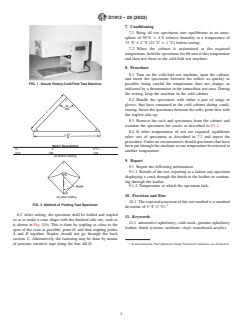
5.1 Greuel Rotary Cold-Fold Test Machine, as shown in
priate safety, health, and environmental practices and deter-
Fig. 1 and consisting of two tangential knurled rollers driven
mine the applicability of regulatory limitations prior to use.
by a chain drive.
1.4 This international standard was developed in accor-
5.2 Steel Die or Other Shearing Device.
dance with internationally recognized principles on standard-
ization established in the Decision on Principles for the
5.3 Cold Cabinet, capable of maintaining temperatures
Development of International Standards, Guides and Recom-
from −50 °F to +20 °F (−45 °C to −6 °C) within 61°F
mendations issued by the World Trade Organization Technical
(0.5°C) and flexible enough so that temperatures can be
Barriers to Trade (TBT) Committee.
adjusted easily and quickly in 5° increments.
5.4 Specimen Racks, constructed so that the specimens may
2. Referenced Documents
be suspended in the air by attachment at point C with a paper
2.1 ASTM Adjuncts:
clip (see Fig. 2).
Greuel rotary cold-fold test machine (14 drawings, 1 list)
5.5 Pliers-Type Stapler.
5.6 Temperature Indicator, with a range from −50 °F
3. Summary of Test Method
to+20°F(−45°Cto−6°C)andanaccuracyof 61°F(0.5°C)
3.1 In this test method, the cold-crack resistance of uphol-
for measuring the temperature of the area adjacent to the
stery leather is measured by means of a mechanically-applied
specimens in the cabinet.
6. Test Specimen
This test method is under the jurisdiction ofASTM Committee D31 on Leather
6.1 The specimen shall be cut with a die or other shearing
and is the direct responsibility of Subcommittee D31.05 on Upholstery. This
standard was developed in cooperation with the American Leather Chemists Assn.
device to a size shown in Fig. 2(a). The specimen may be cut
Current edition approved Jan. 1, 2023. Published January 2023. Originally
from any area on the hide.
ɛ1
approved in 1961. Last previous edition approved in 2016 as D1912–00 (2016) .
DOI: 10.1520/D1912-00R23.
2 5
Sometimes referred to as the Greuel Cold-Fold Test in Upholstery Group Good reproducibility is evidenced by correlation tests conducted by the
literature. Upholstery Leather Group Technical Committee in April 1956 and reported by
In the past, cold-crack resistance has been measured by various methods which Fopma, R. J., “Study of Cold-Crack Test for Upholstery Leathers,” The Journal of
were evaluated by the Upholstery Group Technical Committee in April 1957, and the American Leather Chemists’ Association, Vol LIV, No. 4, April 1959, p. 194.
the Cold-Fold Test was adopted as a standard test in the industry. The method has ALCA Test Method E42, Provisional, April 1953.
been adopted by the following groups: Upholstery Group Technical Committee, Tanners’ Council of America files,
The Upholstery Leather Group, Tanners’ Council of America. “CorrelationofCold-FoldversusColdImpactTestsversusActualCushionTesting.”
Fisher Body Division of General Mot
...