

ASTM F3248-17
(Test Method)Standard Test Method for Determining Vertical Deformation and Area Deflection of Area Elastic, Point Elastic, Combined Elastic and Mixed Elastic Sport and Dance Surfaces
General Information
- Abstract
SIGNIFICANCE AND USE
4.1 The dynamic interaction between the athlete and the surface is significant to the performance and comfort of the athlete. Therefore, the ability of the surface to deform under load is important. Too high a vertical deformation can affect the athlete through instability of the foot. Area elastic and combination elastic floors may be further characterized by evaluating the area deflection properties of the surface. Floors with low area deflection levels prevent or remove vibrations through damping mechanisms or design components.
4.2 Vertical deformation is a widely used and recognized property of sports surfaces. Governing bodies, trade associations, and a number of international standards recognize the significance of vertical deformation. A partial list of these organizations includes: FIBA, MFMA, ASTM, EN. Even FIFA utilizes a variation of this property. Area deflection is still commonly specified within North America and one governing body (FIBA) and one trade association (MFMA) currently use this property to certify systems within the required testing for their performance programs.
4.3 Vertical deformation and area deflection testing are performed with a Stuttgart Artificial Athlete (SAA) which can be created by slightly modifying the BAA (Berlin Artificial Athlete) from Test Method F2569. Laboratory experiments are to be conducted at the standard 23 ± 2°C (72 ± 4°F), but tests at additional temperatures may be performed at the request of the client. When evaluating the deflective properties of sports surfaces in the field, testing is to be conducted at the ambient temperature. Deviations from the standard temperature may cause significantly different performance levels.
SCOPE
1.1 This method covers the quantitative measurement and normalization of deflections generated within a sports surface as an indication of the stability and comfort provided by the system.
1.2 Vertical deformation provides a measure for the vertical motion generated within the sports surface system directly below the point of impact which has been normalized to a standard impact force.
1.3 Area deflection provides a measure of the vibrations generated during an impact and their strength at a pre-determined distance from the point of impact.
1.4 This method is not applicable to natural turf, synthetic turf or playground safety surfaces.
1.5 This method is applicable to indoor and outdoor surfaces including but not limited to: wood and synthetic courts, walk/jog/run tracks, tennis courts, dance surfaces, aerobics and general fitness surfaces.
1.6 The methods described are applicable in both laboratory and field settings.
1.7 Area deflection testing is optional, and only applicable to area-elastic, combined elastic and mixed elastic sport surfaces. These include wood surfaces, synthetic surfaces on a sprung wood subfloor, and point elastic surfaces with an internal area elastic component.
1.8 The values stated in SI units are to be regarded as standard. Units provided in parenthesis are informational only.
1.9 This standard does not purport to address all of the safety concerns, if any, associated with its use. It is the responsibility of the user of this standard to establish appropriate safety, health, and environmental practices and determine the applicability of regulatory limitations prior to use.
1.10 This international standard was developed in accordance with internationally recognized principles on standardization established in the Decision on Principles for the Development of International Standards, Guides and Recommendations issued by the World Trade Organization Technical Barriers to Trade (TBT) Committee.
- Status
- Published
- Publication Date
- 30-Nov-2017
- Technical Committee
- F08 - Sports Equipment, Playing Surfaces, and Facilities
- Drafting Committee
- F08.52 - Miscellaneous Playing Surfaces
Overview
ASTM F3248-17 establishes a standardized test method for determining vertical deformation and area deflection in area elastic, point elastic, combined elastic, and mixed elastic sport and dance surfaces. These properties are closely associated with surface stability, impact absorption, and user comfort, making this standard vital for specifiers, manufacturers, and facility operators seeking to optimize athlete performance and reduce injury risk.
Vertical deformation measures how much a sports surface compresses directly beneath an impact, while area deflection quantifies the spread and damping of impact vibrations across the surface. Testing under ASTM F3248-17 uses specialized apparatus like the Stuttgart Artificial Athlete (SAA) to quantify these metrics, ensuring reliable and comparable results for both laboratory and field conditions.
Key Topics
- Vertical Deformation: Provides a quantitative measure of the surface’s compression under standard loads, directly reflecting the stability and comfort experienced by athletes.
- Area Deflection: Indicates the extent and distribution of vibrations caused by an impact, assessed at specific distances from the impact site. This property is crucial for area elastic and mixed elastic surfaces, often used to evaluate vibration control.
- Testing Techniques: Requires standardized methods, temperature, and humidity controls. The SAA is a central apparatus, and results must be normalized to specified conditions for accurate comparison.
- Scope Exclusions: The method is not applicable to natural turf, synthetic turf, or playground safety surfaces.
- Applicability: Suitable for a broad range of surfaces including wood and synthetic courts, jogging tracks, tennis courts, dance floors, and general fitness surfaces.
- Reporting Requirements: Test reports must include average, maximum, and minimum values for vertical deformation and area deflection, along with descriptions of system construction and test point locations.
Applications
ASTM F3248-17 supports stakeholders in the following ways:
- Compliance and System Certification: Governing bodies such as FIBA and associations like MFMA use these metrics for official system certification and to ensure compliance with international standards for athlete performance and safety.
- Performance Optimization: Designers and architects use test results to select flooring systems that optimize stability, comfort, and vibration damping, enhancing athlete performance and reducing fatigue or injuries.
- Quality Control: Manufacturers leverage the test method during quality control and product development to ensure consistent material behavior and competitive performance specifications.
- Facility Operations: Facility managers use this standard in routine maintenance checks or when assessing new surfaces for installation, ensuring ongoing compliance and optimal user experience.
Related Standards
Several international and association-led standards are related to or referenced by ASTM F3248-17:
- ASTM F2569: Test Method for Evaluating the Force Reduction Properties of Surfaces for Athletic Use.
- EN 14809: European standard method for determining the vertical deformation of sports surfaces.
- DIN 18032-2: German standard covering sports floors requirements and testing for gymnasiums and multipurpose halls.
- MFMA PUR: Maple Flooring Manufacturers Association standard for performance and uniformity ratings.
- FIBA Official Rules: Governing certification requirements for global basketball courts.
Keywords
sports surface testing, vertical deformation, area deflection, area elastic, point elastic, combined elastic, mixed elastic, dance surfaces, athletic flooring, sports floor standards, vibration damping, laboratory testing, field testing, SAA, surface stability, ASTM F3248-17.
Relations
- Effective Date
- 01-Dec-2019
- Effective Date
- 01-Nov-2011
- Effective Date
- 15-Jul-2007
Frequently Asked Questions
ASTM F3248-17 is a standard published by ASTM International. Its full title is "Standard Test Method for Determining Vertical Deformation and Area Deflection of Area Elastic, Point Elastic, Combined Elastic and Mixed Elastic Sport and Dance Surfaces". This standard covers: SIGNIFICANCE AND USE 4.1 The dynamic interaction between the athlete and the surface is significant to the performance and comfort of the athlete. Therefore, the ability of the surface to deform under load is important. Too high a vertical deformation can affect the athlete through instability of the foot. Area elastic and combination elastic floors may be further characterized by evaluating the area deflection properties of the surface. Floors with low area deflection levels prevent or remove vibrations through damping mechanisms or design components. 4.2 Vertical deformation is a widely used and recognized property of sports surfaces. Governing bodies, trade associations, and a number of international standards recognize the significance of vertical deformation. A partial list of these organizations includes: FIBA, MFMA, ASTM, EN. Even FIFA utilizes a variation of this property. Area deflection is still commonly specified within North America and one governing body (FIBA) and one trade association (MFMA) currently use this property to certify systems within the required testing for their performance programs. 4.3 Vertical deformation and area deflection testing are performed with a Stuttgart Artificial Athlete (SAA) which can be created by slightly modifying the BAA (Berlin Artificial Athlete) from Test Method F2569. Laboratory experiments are to be conducted at the standard 23 ± 2°C (72 ± 4°F), but tests at additional temperatures may be performed at the request of the client. When evaluating the deflective properties of sports surfaces in the field, testing is to be conducted at the ambient temperature. Deviations from the standard temperature may cause significantly different performance levels. SCOPE 1.1 This method covers the quantitative measurement and normalization of deflections generated within a sports surface as an indication of the stability and comfort provided by the system. 1.2 Vertical deformation provides a measure for the vertical motion generated within the sports surface system directly below the point of impact which has been normalized to a standard impact force. 1.3 Area deflection provides a measure of the vibrations generated during an impact and their strength at a pre-determined distance from the point of impact. 1.4 This method is not applicable to natural turf, synthetic turf or playground safety surfaces. 1.5 This method is applicable to indoor and outdoor surfaces including but not limited to: wood and synthetic courts, walk/jog/run tracks, tennis courts, dance surfaces, aerobics and general fitness surfaces. 1.6 The methods described are applicable in both laboratory and field settings. 1.7 Area deflection testing is optional, and only applicable to area-elastic, combined elastic and mixed elastic sport surfaces. These include wood surfaces, synthetic surfaces on a sprung wood subfloor, and point elastic surfaces with an internal area elastic component. 1.8 The values stated in SI units are to be regarded as standard. Units provided in parenthesis are informational only. 1.9 This standard does not purport to address all of the safety concerns, if any, associated with its use. It is the responsibility of the user of this standard to establish appropriate safety, health, and environmental practices and determine the applicability of regulatory limitations prior to use. 1.10 This international standard was developed in accordance with internationally recognized principles on standardization established in the Decision on Principles for the Development of International Standards, Guides and Recommendations issued by the World Trade Organization Technical Barriers to Trade (TBT) Committee.
SIGNIFICANCE AND USE 4.1 The dynamic interaction between the athlete and the surface is significant to the performance and comfort of the athlete. Therefore, the ability of the surface to deform under load is important. Too high a vertical deformation can affect the athlete through instability of the foot. Area elastic and combination elastic floors may be further characterized by evaluating the area deflection properties of the surface. Floors with low area deflection levels prevent or remove vibrations through damping mechanisms or design components. 4.2 Vertical deformation is a widely used and recognized property of sports surfaces. Governing bodies, trade associations, and a number of international standards recognize the significance of vertical deformation. A partial list of these organizations includes: FIBA, MFMA, ASTM, EN. Even FIFA utilizes a variation of this property. Area deflection is still commonly specified within North America and one governing body (FIBA) and one trade association (MFMA) currently use this property to certify systems within the required testing for their performance programs. 4.3 Vertical deformation and area deflection testing are performed with a Stuttgart Artificial Athlete (SAA) which can be created by slightly modifying the BAA (Berlin Artificial Athlete) from Test Method F2569. Laboratory experiments are to be conducted at the standard 23 ± 2°C (72 ± 4°F), but tests at additional temperatures may be performed at the request of the client. When evaluating the deflective properties of sports surfaces in the field, testing is to be conducted at the ambient temperature. Deviations from the standard temperature may cause significantly different performance levels. SCOPE 1.1 This method covers the quantitative measurement and normalization of deflections generated within a sports surface as an indication of the stability and comfort provided by the system. 1.2 Vertical deformation provides a measure for the vertical motion generated within the sports surface system directly below the point of impact which has been normalized to a standard impact force. 1.3 Area deflection provides a measure of the vibrations generated during an impact and their strength at a pre-determined distance from the point of impact. 1.4 This method is not applicable to natural turf, synthetic turf or playground safety surfaces. 1.5 This method is applicable to indoor and outdoor surfaces including but not limited to: wood and synthetic courts, walk/jog/run tracks, tennis courts, dance surfaces, aerobics and general fitness surfaces. 1.6 The methods described are applicable in both laboratory and field settings. 1.7 Area deflection testing is optional, and only applicable to area-elastic, combined elastic and mixed elastic sport surfaces. These include wood surfaces, synthetic surfaces on a sprung wood subfloor, and point elastic surfaces with an internal area elastic component. 1.8 The values stated in SI units are to be regarded as standard. Units provided in parenthesis are informational only. 1.9 This standard does not purport to address all of the safety concerns, if any, associated with its use. It is the responsibility of the user of this standard to establish appropriate safety, health, and environmental practices and determine the applicability of regulatory limitations prior to use. 1.10 This international standard was developed in accordance with internationally recognized principles on standardization established in the Decision on Principles for the Development of International Standards, Guides and Recommendations issued by the World Trade Organization Technical Barriers to Trade (TBT) Committee.
ASTM F3248-17 is classified under the following ICS (International Classification for Standards) categories: 97.220.10 - Sports facilities. The ICS classification helps identify the subject area and facilitates finding related standards.
ASTM F3248-17 has the following relationships with other standards: It is inter standard links to ASTM F2569-11(2019), ASTM F2569-11, ASTM F2569-07. Understanding these relationships helps ensure you are using the most current and applicable version of the standard.
ASTM F3248-17 is available in PDF format for immediate download after purchase. The document can be added to your cart and obtained through the secure checkout process. Digital delivery ensures instant access to the complete standard document.
Standards Content (Sample)
This international standard was developed in accordance with internationally recognized principles on standardization established in the Decision on Principles for the
Development of International Standards, Guides and Recommendations issued by the World Trade Organization Technical Barriers to Trade (TBT) Committee.
Designation:F3248 −17
Standard Test Method for
Determining Vertical Deformation and Area Deflection of
Area Elastic, Point Elastic, Combined Elastic and Mixed
Elastic Sport and Dance Surfaces
This standard is issued under the fixed designation F3248; the number immediately following the designation indicates the year of
original adoption or, in the case of revision, the year of last revision. A number in parentheses indicates the year of last reapproval. A
superscript epsilon (´) indicates an editorial change since the last revision or reapproval.
INTRODUCTION
This standard provides the methods to measure the deflective properties of a sports surface. These
deflective properties provide estimates on the stability and comfort from a sport surface. Vertical
deformationisapropertythatprovidesaquickandcost-effectivemeansofestimatingthestabilitythat
a sport surface provides during lower extremity loading.Area deflection is a property that provides a
quick and cost-effective estimate of the vibration properties of a sports surface.Area deflection testing
is limited to area elastic, combination elastic, and mixed elastic flooring systems. It is not applicable
to natural turf, synthetic turf, or playground surfaces.
1. Scope sprung wood subfloor, and point elastic surfaces with an
internal area elastic component.
1.1 This method covers the quantitative measurement and
normalization of deflections generated within a sports surface 1.8 The values stated in SI units are to be regarded as
as an indication of the stability and comfort provided by the standard. Units provided in parenthesis are informational only.
system.
1.9 This standard does not purport to address all of the
safety concerns, if any, associated with its use. It is the
1.2 Vertical deformation provides a measure for the vertical
responsibility of the user of this standard to establish appro-
motion generated within the sports surface system directly
priate safety, health, and environmental practices and deter-
below the point of impact which has been normalized to a
mine the applicability of regulatory limitations prior to use.
standard impact force.
1.10 This international standard was developed in accor-
1.3 Area deflection provides a measure of the vibrations
dance with internationally recognized principles on standard-
generated during an impact and their strength at a pre-
ization established in the Decision on Principles for the
determined distance from the point of impact.
Development of International Standards, Guides and Recom-
1.4 This method is not applicable to natural turf, synthetic
mendations issued by the World Trade Organization Technical
turf or playground safety surfaces.
Barriers to Trade (TBT) Committee.
1.5 This method is applicable to indoor and outdoor sur-
2. Referenced Documents
faces including but not limited to: wood and synthetic courts,
walk/jog/run tracks, tennis courts, dance surfaces, aerobics and
2.1 ASTM Standards:
general fitness surfaces.
F2569 Test Method for Evaluating the Force Reduction
Properties of Surfaces for Athletic Use
1.6 The methods described are applicable in both laboratory
and field settings.
2.2 Other Standards:
EN 14809 Surfaces for sports areas – Determination of
1.7 Area deflection testing is optional, and only applicable
vertical deformation
to area-elastic, combined elastic and mixed elastic sport
DIN 18032-2 Halls for Gymnastics, Games and Multipur-
surfaces. These include wood surfaces, synthetic surfaces on a
pose Use, Part 2: Sports Floors Requirements, Testing
This test method is under the jurisdiction of ASTM Committee F08 on Sports
Equipment, Playing Surfaces, and Facilities and is the direct responsibility of For referenced ASTM standards, visit the ASTM website, www.astm.org, or
Subcommittee F08.52 on Miscellaneous Playing Surfaces. contact ASTM Customer Service at service@astm.org. For Annual Book of ASTM
Current edition approved Dec. 1, 2017. Published January 2018. DOI: 10.1520/ Standards volume information, refer to the standard’s Document Summary page on
F3248-17. the ASTM website.
Copyright © ASTM International, 100 Barr Harbor Drive, PO Box C700, West Conshohocken, PA 19428-2959. United States
F3248−17
TM
MFMA PUR Standard Performance and Uniformity Rat- surfaces in the field, testing is to be conducted at the ambient
ing: Maple Flooring Manufacturer’s Association, Inc. temperature. Deviations from the standard temperature may
FIBA Official Basketball Rules 20155 International Basket- cause significantly different performance levels.
ball Federation
5. Apparatus
3. Terminology
5.1 This standard utilizes the SAA (Stuttgart Artificial
3.1 Definitions of Terms Specific to This Standard:
Athlete). The SAA can be created by making the following
3.1.1 area deflection, n—downward vertical displacement a
modifications to the BAA (Berlin Artificial Athlete) described
given distance (100 mm or 500 mm) from the center point of
within Section 6 of Test Method F2569. The modified SAA is
an impacted area expressed as a percent of the displacement
shown in Fig. 1.
produced at the center of the impacted area.
5.2 Modifications to BAA described in Test Method F2569:
3.1.2 area elastic sport surface, n—sports surface of which
5.2.1 Thespringinsubsection6.1.1.3ofTestMethodF2569
a relatively large area around the point of an applied force is
shall be replaced with one with a spring rate 40 6 1.5 kN/m
deflected (such as a wood floor).
(228 6 8.6 lb/in.), an outside diameter of 70.0 6 0.1 mm (2.75
3.1.3 combination elastic sports surface, n—sport surface
6 0.004 in.), a free length of 75 6 10 mm (3.95 6 0.39 in.).
with a point-elastic top layer over an area elastic subfloor 5.2.2 The test foot described in subsection 6.1.1.6 of Test
which responds with both point and area elastic deflections
Method F2569 must include horizontal projections that extend
under a point load (such as a padded urethane system over a a minimum of 135 mm (5.3 in.) out from the central fall axis
wood subfloor system).
of the drop mass.
5.2.3 The mass of the test foot assembly, which includes
3.1.4 mixed elastic sport surface, n—point elastic system
force sensor, the spring, both spring end caps, shall be 3.5 6
withanarea-stiffeningcomponent(suchasavinylsurfaceover
0.35 kg (7.72 6 0.77 lb). It is possible to design one test foot
a thin steel sheet over a foam underlayment).
that meets the requirements of Test Method F2569 and this
3.1.5 point elastic sports surface, n—sports surface of
standard.
which only the area directly beneath, or very near, the point of
5.3 Additional Requirements:
an applied force is deflected (such as a pad and pour, poured
5.3.1 A separate stand that holds the linear position sensors
urethane or vinyl).
used to measure the deflection of the sports surface must be
3.1.6 vertical deformation, n—normalized displacement at
utilized. This stand shall have a length of 2.25 6 0.1 m (7.4 6
the center of an impact point representing the downward
0.33 ft) and each end of the stand shall be positioned a
displacement produced by a 1500 N vertical load.
minimum of 1.0 m (39 in.) from the falling weight axis. The
4. Significance and Use stand can be made such that it breaks down into shorter pieces
for transport. Segments shall be constructed so that they form
4.1 The dynamic interaction between the athlete and the
a rigid beam when re-assembled.The beam shall be made such
surface is significant to the performance and comfort of the
that area deformation can be measured at 2 different distances
athlete. Therefore, the ability of the surface to deform under
from the point of impact, 500 and 100 mm away from the
loadisimportant.Toohighaverticaldeformationcanaffectthe
impact point.
athlete through instability of the foot. Area elastic and combi-
5.3.2 Two electronic displacement sensors are required to
nation elastic floors may be further characterized by evaluating
measure the vertical deformation. Area deflection may be
the area deflection properties of the surface. Floors with low
measured using only two displacement sensors but it requires
area deflection levels prevent or remove vibrations through
rotatingthesensorsthroughthethreedifferentpositionsneeded
damping mechanisms or design components.
tocalculateareadeflectioninall4directionsaroundtheimpact
4.2 Vertical deformation is a widely used and recognized
point. The preferred method of measuring involves the use of
property of sports surfaces. Governing bodies, trade
4 displacement sensors and allows all of the data needed to
associations,andanumberofinternationalstandardsrecognize
computer area deflection to be computed using data from the
the significance of vertical deformation. A partial list of these
same impact. All displacement sensors shall have range of at
organizations includes: FIBA, MFMA,ASTM, EN. Even FIFA
least 612 mm (0.39 to 0.5 in.) and an accuracy no larger than
utilizes a variation of this property. Area deflection is still
0.05mm(0.002in.).PositionSensorsaremountedonthestand
commonly specified within North America and one governing
described in 5.3.1. Sensors should interface with a data
body (FIBA) and one trade association (MFMA) currently use
acquisition system with at least 12 bits of resolution, creating
this property to certify systems within the required testing for
a resolution of 0.001 mm (0.0004 in.) or smaller.All displace-
their performance programs.
ment sensors shall be recorded at 2 kHz or twice the upper
4.3 Vertical deformation and area deflection testing are frequency response of the amplifier/filter system preceding the
performed with a Stuttgart Artificial Athlete (SAA) which can digital system, whichever is greater.
be created by slightly modifying the BAA (Berlin Artificial 5.3.2.1 When measuring vertical deformation, the displace-
Athlete) from Test Method F2569. Laboratory experiments are ment sensors shall be mounted such that they contact the
to be conducted at the standard 23 6 2°C (72 6 4°F), but tests horizontal projections from 5.2.2, and must be mounted less
at additional temperatures may be performed at the request of than 125 mm from the falling weight vertical axis, as shown in
the client. When evaluating the deflective properties of sports Fig. 2.
F3248−17
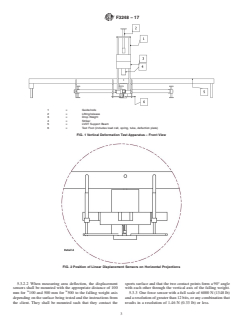
1 = Guide/rods
2 = Lifting/release
3 = Drop Weight
4 = Striker
5 = LVDT Support Beam
6 = Test Foot (includes load cell, spring, tube, deflection plate)
FIG. 1 Vertical Deformation Test Apparatus – Front View
FIG. 2 Position of Linear Displacement Sensors on Horizontal Projections
5.3.2.2 When measuring area deflection, the displacement sports surface and that the two contact points form a 90° angle
sensors shall be mounted with the appropriate distance of 100 with each other through the vertical axis of the falling weight.
w w
mm for 100 and 500 mm for 500 to the falling weight axis 5.3.3 One force sensor with a full scale of 6000 N (1348 lb)
dependingonthesurfacebeingtestedandtheinstructionsfrom andaresolutionofgreaterthan12bits,oranycombinationthat
the client. They shall be mounted such that they contact the results in a resolution of 1.46 N (0.33 lb) or less.
F3248−17
5.3.4 The SAA must be designed to generate a release resilient track will allow internal temperature measurements to
height of at least 120 6 0.25 mm (4.72 6 0.0098 in.). be made without damaging the surfaces.
Recording equipment shall be capable of storing data from all 6.4.2.2 Record the ambient temperature, the temperature of
sensors for at least 0.15 s and to calculate data or display the surface, the internal temperature (if recorded) and the
readings. location that the measurements were made, either surface or
internal.
5.3.5 All position sensors (pick-ups) should be zeroed with
the weight suspended from the electromagnet.
7. Test Method
5.3.6 All sensors shall be recorded at 2 kHz or twice the
upper frequency response of the amplifier/filter system preced-
7.1 General Test Methods—Locate, identify and document
ing the digital system, whichever is greater.The signal from all
all test points.
sensors shall be filtered with a low-pass filter having a 2nd
7.1.1 Be no closer than 150 mm (6 in.) to another test point.
order Butterworth characteristic with a –3 dB frequency of 120
7.2 Vertical Deformation:
Hz. Filtration may be implemented in hardware or software.
7.2.1 Description:
The response of the system at any given frequency shall be
7.2.1.1 Vertical Deflection results are reported in units of
within 6 0.5 dB of the expected response, calculated on the
millimeters, and represent the magnitude of the negative
basis of the Butterworth function. All sensors must have an
vertical deformation of the point of impact under a 1500 N
uncertainty no greater than 62%.
(337 lb) impact.
5.3.7 The test program, or software, must be able to store
7.2.1.2 This test is performed with a Stuttgart Artificial
and record the maximum force and deflections generated
Athlete (SAA). A modified version of the Berlin Artificial
during the first impact, or approximately 0.2 s of data.
Athlete described in Test Method F2569 is shown in Fig. 1.A
massof20kgisallowedtofallonaspring,whichtransmitsthe
6. Testing Conditions
load to a test foot with a rounded base resting on the surface.
6.1 Laboratory Conditions: The foot is fitted with a force transducer which enables the
force generated during the impact event to be recorded. The
6.1.1 Temperature—Testing performed in the lab shall be
deformation of point of impact is measured by means of the
conducted at 23 6 2°C (72 6 4°F). Testing at additional
simultaneously sampling the signal from the deformation
temperatures can be evaluated at the request of the client.
sensors mounted so that they read the deformation of the test
6.1.2 Relative Humidity—The relative humidity of the lab
foot on opposite sides of the impact point.
shall be between 35 and 55 %.
7.2.2 Test Method:
6.2 Sample Conditioning:
7.2.2.1 The apparatus is set vertically (62°) with the test
6.2.1 Synthetic samples shall be conditioned to the labora-
foot resting directly on the test surface. The distance between
tory environment for a minimum of 24 h.
the bottom of the drop weight and the top end-cap of the spring
6.2.2 Woodsamples,orthecomponentsthemselves(suchas
is adjusted to 120 6 0.25 mm. The force gauge is described in
strip flooring, plywood, and sleepers) shall be conditioned to
5.3.3, and the position sensors are described in 5.3.2 of this
the laboratory environment for a minimum of 48 h. Once
standard. The zero position of all displacement transducers
constructed wood samples must be monitored to ensure that
shall be determined with the impact mass suspended from the
they have not expanded or contracted so as to form a hump in
electromagnet, and with the test foot resting on the sports
the system, or loose boards within the playing surface.
surface.
7.2.2.2 Activate the recording and release the drop weight.
6.3 Laboratory Sample Sizes—Standards that reference this
Record the force and deformation of the surface generated by
method shall ensure that the sample size is sufficiently large
the first impact of the falling mass. The data from 0.025 s prior
and that test points are sufficiently far from the edge of the
to initiation of the 1st impact and 0.125 s after the initiation of
sample that edge effects are prevented from altering the
the first impact shall be used to determine the maximum force
outcome of the results. General recommendations are at least 1
(F ) and maximum deformation (d ) at the test point
max max
by 1 m (29 by 39 in.) for point elastic systems, and at least 3.5
generated during the impact.
by 3.5 m for area, mixed, and combination elastic systems.
7.2.2.3 Return the drop weight to the holding device and
6.4 On Site Testing:
adjust the drop height as necessary. Without moving the test
6.4.1 Tests on site shall be carried out at the ambient
device, repeat this for a total of 3 impacts with a resting time
temperature and humidity conditions present. These values
between impacts of 1 min 6 30 s.
shall be measured 0.8 6 0.1 m (31 6 4 in.) above the playing
7.2.3 Calculations: Vertical Deformation:
surface, and they shall be recorded and reported. Some
7.2.3.1 The portion of the force and deflection curves
materials produce significantly different results for seemingly
collected during the first impact of the drop mass and the
minor temperature changes.
spring, as defined in 7.2.2.2 is to be isolated.
6.4.2 The temperature of the surface shall be recorded using
7.2.3.2 The signal from the two position sensors placed on
a temperature sensor, such as an Infrared temperature sensor.
the horizontal projections 125 mm from the impact, shall be
6.4.2.1 There may be times when it is appropriate to record averaged in the time domain. These signals are then used to
the internal temperature. Most indoor systems will not allow obtain the maximum downward deflection of the sport surface
this without damaging the surface. Some systems such as a at the point of impact. Obtain the maximum deflection at the
F3248−17
pointofimpact(d )fromthisaveragedsignalduringthefirst 7.2.3.10 Maximum vertical deformation on the system ob-
max
impact generated by the drop mass. tained from the average vertical deformation values for each
point.
d 5 d 1 d ⁄2 (1)
~ !
impact 1 2
7.2.3.11 Minimum vertical deformation on the system ob-
where:
tained from the average vertical deformation values for each
d = deformation versus time of one of the two vertical
point.
deformation sensors,
7.3 Area Deflection (Optional):
d = deformation versus time of the other vertical defor-
7.3.1 Description:
mation sensor, and
7.3.1.1 Area Deflection measurements are optional. Area
d = computed deformation of the surface at the point of
impact
elastic, mixed elastic and combined elastic sports floors may
impact.
opt to have the area deflection property of the surface evalu-
7.2.3.3 The maximum force generated during the first im-
ated. Point elastic floors produce area deflection levels of 0 %.
pact (F ) shall be selected from the filtered force signal.
max
7.3.1.2 Area Deflection measures how strongly vibrations
...