

ASTM D2094-00(2023)
(Practice)Standard Practice for Preparation of Bar and Rod Specimens for Adhesion Tests
General Information
- Abstract
SIGNIFICANCE AND USE
4.1 The procedures outlined in this practice are designed to standardize the test specimens, surface preparations, combinations of materials, and adhesive selection. Because of the flexibility in the procedure, it is important to have some idea of the kind of properties that will be observed during testing.
SCOPE
1.1 This practice describes bar- and rod-type butt-joined adhesion test specimens and procedures for preparing and bonding them. The specimens are intended to be used with various adherend materials in like or unlike combinations for determining the strength properties of adhesives in accordance with Test Method D2095.
1.2 The values stated in SI units are considered to be the standard. The values in parentheses are for information only.
1.3 This standard does not purport to address all of the safety concerns, if any, associated with its use. It is the responsibility of the user of this standard to establish appropriate safety, health, and environmental practices and determine the applicability of regulatory limitations prior to use.
1.4 This international standard was developed in accordance with internationally recognized principles on standardization established in the Decision on Principles for the Development of International Standards, Guides and Recommendations issued by the World Trade Organization Technical Barriers to Trade (TBT) Committee.
- Status
- Published
- Publication Date
- 31-Dec-2022
- Technical Committee
- D14 - Adhesives
- Drafting Committee
- D14.80 - Metal Bonding Adhesives
Overview
ASTM D2094-00(2023) - Standard Practice for Preparation of Bar and Rod Specimens for Adhesion Tests provides standardized methods for preparing, machining, and bonding bar- and rod-type test specimens for the evaluation of adhesive strength. Developed by ASTM International, this standard ensures consistency and comparability in adhesion testing across different materials and applications, supporting the accurate determination of adhesive properties in accordance with ASTM D2095.
ASTM D2094 is essential for laboratories, manufacturers, and researchers who require a reliable approach to specimen preparation when testing adhesive strength in both similar and dissimilar adherend (substrate) combinations.
Key Topics
- Standardization of Test Specimens: Defines the geometry, dimensions, and machining requirements for bar and rod specimens used in adhesion testing.
- Surface Preparation: Outlines detailed procedures for preparing metallic and plastic adherend surfaces, including degreasing, machining, and cleaning methods to ensure optimal bond performance.
- Adhesive Application: Emphasizes the use of manufacturer-recommended methods for adhesive preparation and curing, enhancing test reproducibility.
- Fixture Alignment: Provides guidance on the use of alignment fixtures for specimen assembly and bonding, with specified tolerances to ensure accurate and repeatable test results.
- Reuse of Adherends: Describes when and how test substrates can be reused, as well as limitations on reuse based on previous exposure to harsh environments.
- Flexibility and Safety: Acknowledges that the practice allows for procedural flexibility and underscores the importance of evaluating safety and regulatory considerations for each use case.
Applications
ASTM D2094 is widely used in various industries that rely on adhesive bonding and require stringent testing of adhesive strength. Practical applications include:
- Adhesive Evaluation: Preparation of standardized bar and rod specimens facilitates the reliable comparison of different adhesives, bond strengths, and surface treatments.
- Material Compatibility Studies: Supports testing of adhesion between like or unlike adherend combinations (such as metal-to-metal, plastic-to-plastic, or metal-to-plastic), critical in product development.
- Quality Control: Ensures uniform specimen preparation for routine production quality checks or research and development projects in aerospace, automotive, electronics, and construction sectors.
- Adhesive Selection: Provides a standardized foundation for determining the best adhesive for specific material pairings and usage scenarios through comparative testing.
- Laboratory Testing: Enables certified testing laboratories to offer services for evaluating adhesive strength under controlled, repeatable conditions, increasing the reliability of their results.
Related Standards
For comprehensive adhesion testing and specimen preparation, ASTM D2094 is often used in conjunction with the following standards:
- ASTM D2095: Test Method for Tensile Strength of Adhesives by Means of Bar and Rod Specimens, which specifies how to conduct tensile strength tests using specimens prepared according to D2094.
- ASTM D907: Terminology of Adhesives, providing standard definitions for adhesive-related terms used throughout D2094.
- ASTM D2093: Practice for Preparation of Surfaces of Plastics Prior to Adhesive Bonding, detailing methods for readying plastic substrates.
- ASTM D2651: Guide for Preparation of Metal Surfaces for Adhesive Bonding, with procedures for optimizing the bondability of metallic surfaces.
Summary
ASTM D2094-00(2023) establishes a consistent, repeatable practice for preparing bar and rod specimens used in adhesion tests, promoting quality and reliability in adhesive strength measurement. Adherence to this standard ensures accuracy across laboratories, enhances product development, and supports manufacturers in meeting international compliance requirements. Proper specimen preparation, as defined by D2094, is a critical first step in any adhesive evaluation or comparison effort.
Relations
- Effective Date
- 01-Apr-2017
- Effective Date
- 01-May-2016
- Effective Date
- 01-Jul-2012
- Effective Date
- 01-May-2012
- Effective Date
- 01-Dec-2011
- Effective Date
- 01-Jan-2011
- Effective Date
- 01-Jan-2011
- Effective Date
- 01-Oct-2008
- Effective Date
- 15-Aug-2008
- Effective Date
- 01-Apr-2008
- Effective Date
- 01-Apr-2008
- Effective Date
- 01-Mar-2008
- Effective Date
- 01-Dec-2006
- Effective Date
- 01-Apr-2005
- Effective Date
- 01-Apr-2005
Get Certified
Connect with accredited certification bodies for this standard

DIN CERTCO
DIN Group product certification.

Smithers Quality Assessments
US management systems and product certification.
Sponsored listings
Frequently Asked Questions
ASTM D2094-00(2023) is a standard published by ASTM International. Its full title is "Standard Practice for Preparation of Bar and Rod Specimens for Adhesion Tests". This standard covers: SIGNIFICANCE AND USE 4.1 The procedures outlined in this practice are designed to standardize the test specimens, surface preparations, combinations of materials, and adhesive selection. Because of the flexibility in the procedure, it is important to have some idea of the kind of properties that will be observed during testing. SCOPE 1.1 This practice describes bar- and rod-type butt-joined adhesion test specimens and procedures for preparing and bonding them. The specimens are intended to be used with various adherend materials in like or unlike combinations for determining the strength properties of adhesives in accordance with Test Method D2095. 1.2 The values stated in SI units are considered to be the standard. The values in parentheses are for information only. 1.3 This standard does not purport to address all of the safety concerns, if any, associated with its use. It is the responsibility of the user of this standard to establish appropriate safety, health, and environmental practices and determine the applicability of regulatory limitations prior to use. 1.4 This international standard was developed in accordance with internationally recognized principles on standardization established in the Decision on Principles for the Development of International Standards, Guides and Recommendations issued by the World Trade Organization Technical Barriers to Trade (TBT) Committee.
SIGNIFICANCE AND USE 4.1 The procedures outlined in this practice are designed to standardize the test specimens, surface preparations, combinations of materials, and adhesive selection. Because of the flexibility in the procedure, it is important to have some idea of the kind of properties that will be observed during testing. SCOPE 1.1 This practice describes bar- and rod-type butt-joined adhesion test specimens and procedures for preparing and bonding them. The specimens are intended to be used with various adherend materials in like or unlike combinations for determining the strength properties of adhesives in accordance with Test Method D2095. 1.2 The values stated in SI units are considered to be the standard. The values in parentheses are for information only. 1.3 This standard does not purport to address all of the safety concerns, if any, associated with its use. It is the responsibility of the user of this standard to establish appropriate safety, health, and environmental practices and determine the applicability of regulatory limitations prior to use. 1.4 This international standard was developed in accordance with internationally recognized principles on standardization established in the Decision on Principles for the Development of International Standards, Guides and Recommendations issued by the World Trade Organization Technical Barriers to Trade (TBT) Committee.
ASTM D2094-00(2023) is classified under the following ICS (International Classification for Standards) categories: 83.180 - Adhesives. The ICS classification helps identify the subject area and facilitates finding related standards.
ASTM D2094-00(2023) has the following relationships with other standards: It is inter standard links to ASTM D2093-03(2017), ASTM D2651-01(2016), ASTM D907-12a, ASTM D907-12, ASTM D907-11a, ASTM D2093-03(2011), ASTM D907-11, ASTM D907-08b, ASTM D907-08a, ASTM D2095-96(2008), ASTM D2651-01(2008), ASTM D907-08, ASTM D907-06, ASTM D907-05e1, ASTM D907-05. Understanding these relationships helps ensure you are using the most current and applicable version of the standard.
ASTM D2094-00(2023) is available in PDF format for immediate download after purchase. The document can be added to your cart and obtained through the secure checkout process. Digital delivery ensures instant access to the complete standard document.
Standards Content (Sample)
This international standard was developed in accordance with internationally recognized principles on standardization established in the Decision on Principles for the
Development of International Standards, Guides and Recommendations issued by the World Trade Organization Technical Barriers to Trade (TBT) Committee.
Designation: D2094 − 00 (Reapproved 2023)
Standard Practice for
Preparation of Bar and Rod Specimens for Adhesion Tests
This standard is issued under the fixed designation D2094; the number immediately following the designation indicates the year of
original adoption or, in the case of revision, the year of last revision. A number in parentheses indicates the year of last reapproval. A
superscript epsilon (´) indicates an editorial change since the last revision or reapproval.
1. Scope 2.2 ASTM Adjuncts:
Alignment Fixture Drawings
1.1 This practice describes bar- and rod-type butt-joined
adhesion test specimens and procedures for preparing and
3. Terminology
bonding them. The specimens are intended to be used with
3.1 Definitions—Many terms in this practice are defined in
various adherend materials in like or unlike combinations for
Terminology D907.
determining the strength properties of adhesives in accordance
with Test Method D2095.
4. Significance and Use
1.2 The values stated in SI units are considered to be the
4.1 The procedures outlined in this practice are designed to
standard. The values in parentheses are for information only.
standardize the test specimens, surface preparations, combina-
1.3 This standard does not purport to address all of the
tions of materials, and adhesive selection. Because of the
safety concerns, if any, associated with its use. It is the
flexibility in the procedure, it is important to have some idea of
responsibility of the user of this standard to establish appro-
the kind of properties that will be observed during testing.
priate safety, health, and environmental practices and deter-
5. Test Specimens
mine the applicability of regulatory limitations prior to use.
1.4 This international standard was developed in accor-
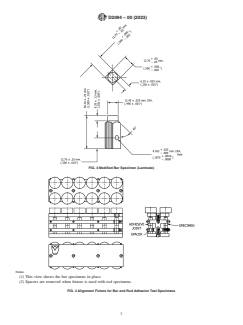
5.1 Geometry—Test specimens conform to the forms and
dance with internationally recognized principles on standard-
dimensions shown in Fig. 1, Fig. 2,or Fig. 3. Only the bar
ization established in the Decision on Principles for the
specimen (Fig. 1) shall be used for cleavage strength tests.
Development of International Standards, Guides and Recom-
Only the rod specimen (Fig. 2) or the modified bar specimen
mendations issued by the World Trade Organization Technical
(Fig. 3) shall be used for tests in torsional shear.Amodification
Barriers to Trade (TBT) Committee.
of the specimen is permissible in tensile tests with dissimilar
adherends, particularly if one of the adherend materials is
2. Referenced Documents
difficulttomachine(forexample,glass)orifthestrengthofthe
2.1 ASTM Standards:
adherend is such that failure under stress occurs at the drilled
D907 Terminology of Adhesives
hole. This modification consists of a sheet of the material
3 1 1
D2093 Practice for Preparation of Surfaces of Plastics Prior
approximately 19 mm ( ⁄4 in.) square and 1 ⁄2to6mm( ⁄16 to
to Adhesive Bonding
⁄4 in.) thick inserted and bonded between the ends of the bar or
D2095 Test Method for Tensile Strength of Adhesives by
rod specimens. For comparison purposes, specimen geometry
Means of Bar and Rod Specimens
shall be the same unless the effect of insert dimensions is under
D2651 GuideforPreparationofMetalSurfacesforAdhesive
study.
Bonding
5.2 Machining of Adherends:
5.2.1 Use metal adherends machined from bar or rod stock
This practice is under the jurisdiction of ASTM Committee D14 on Adhesives
with the surface to be bonded finished to 1 µm.
and is the direct responsibility of Subcommittee D14.80 on Metal Bonding
5.2.2 Machine plastic from laminated flat panels using a
Adhesives.
diamond charged wheel for rough machining and a carbide-
Current edition approved Jan. 1, 2023. Published January 2023. Originally
approved in 1962. Last previous edition approved in 2014 as D2094 – 00 (2014). tipped tool for finish machining. Do all machining dry using
DOI: 10.1520/D2094-00R23.
For referenced ASTM standards, visit the ASTM website, www.astm.org, or
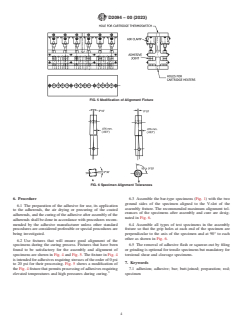
contact ASTM Customer Service at service@astm.org. For Annual Book of ASTM Detailed working drawings of the fixtures shown in Fig. 4 and Fig. 5 and their
Standards volume information, refer to the standard’s Document Summary page on parts are available from ASTM International Headquarters. Order Adjunct No.
the ASTM website. ADJD2094. Original adjunct produced in 1966.
Copyright © ASTM International, 100 Barr Harbor Drive, PO Box C700, West Conshohocken, PA 19428-2959. United States
D2094 − 00 (2023)
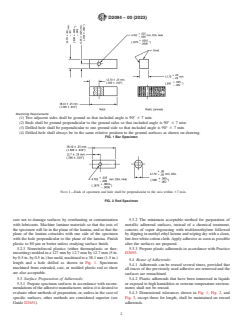
Machining Requirements:
(1) Two adjacent sides shall be ground so that included angle is 90° 6 7 min.
(2) Ends shall be ground perpendicular to the ground sides so that included angle is 90° 6 7 min.
(3) Drilled hole shall be perpendicular to one ground side so that included angle is 90° 6 7 min.
(4) Drilled hole shall always be in the same relative position to the ground surfaces as shown on drawing.
FIG. 1 Bar Specimen
NOTE 1—Ends of specimen and hole shall be perpendicular to the axis within 67 min.
FIG. 2 Rod Specimen
care not to damage surfaces by overheating or contamination 5.3.2 The minimum acce
...