

ASTM B246-15(2021)
(Specification)Standard Specification for Tinned Hard-Drawn and Medium-Hard-Drawn Copper Wire for Electrical Purposes
General Information
- Abstract
ABSTRACT
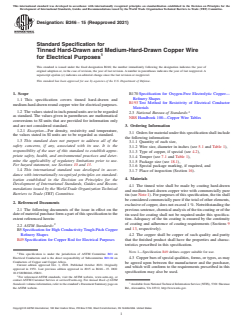
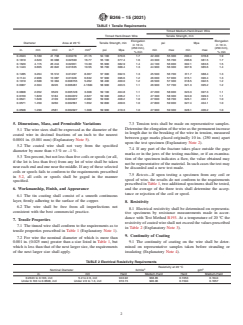
This specification covers tinned hard-drawn and medium-hard-drawn round copper wire for electrical properties. The tinned wire shall be made by coating hard-drawn and medium-hard-drawn copper wire with commercially pure tin. The copper shall be of such quality and purity that the finished product shall have the properties and characteristics prescribed in this specification. The tin coating shall consist of a smooth continuous layer, firmly adhering to the surface of the copper. The wire shall be free from all imperfections not consistent with the best commercial practice. The tinned wire shall conform to the requirements as to the tensile properties prescribed. Tension tests shall be made on representative samples. The elongation of the wire shall be determined as the permanent increase in length due to the breaking of the wire in tension, measured between gage marks. Electrical resistivity shall be determined by resistance measurements made in accordance with the test method prescribed in this specification. The continuity of coating on the wire shall be determined by the sodium polysulfide test. The specimens shall be thoroughly cleaned by immersion in a suitable solvent for the appropriate time required to remove oil or grease from surface; then removed and wiped dry with clean, soft cloth. Mechanical test for adhesion of coating shall be performed. Any cracking or parting of the coating in the area shown by blackening of the copper shall be cause for rejection.
SCOPE
1.1 This specification covers tinned hard-drawn and medium-hard-drawn round copper wire for electrical purposes.
1.2 The values stated in inch-pound units are to be regarded as standard. The values given in parentheses are mathematical conversions to SI units that are provided for information only and are not considered standard.
1.2.1 Exception—For density, resistivity and temperature, the values stated in SI units are to be regarded as standard.
1.3 This standard does not purport to address all of the safety concerns, if any, associated with its use. It is the responsibility of the user of this standard to establish appropriate safety, health, and environmental practices and determine the applicability of regulatory limitations prior to use. For hazard statement, see Sections 10 and 13.
1.4 This international standard was developed in accordance with internationally recognized principles on standardization established in the Decision on Principles for the Development of International Standards, Guides and Recommendations issued by the World Trade Organization Technical Barriers to Trade (TBT) Committee.
- Status
- Published
- Publication Date
- 30-Sep-2021
- Technical Committee
- B01 - Electrical Conductors
- Drafting Committee
- B01.04 - Conductors of Copper and Copper Alloys
Overview
ASTM B246-15(2021) is the internationally recognized ASTM standard specification for tinned hard-drawn and medium-hard-drawn copper wire used in electrical applications. This standard ensures that tinned copper wire products meet specific requirements for quality, mechanical and electrical properties, and coating continuity, making them suitable for use in electrical wiring, power transmission, and other critical applications. Developed by ASTM Committee B01 on Electrical Conductors, it outlines manufacturing, testing, and inspection criteria to promote safety, performance, and global trade compliance.
Key Topics
- Material Requirements: Specifies the use of copper of adequate purity and quality, coated with commercially pure tin to form a smooth, continuous, and firmly adherent layer.
- Mechanical Properties: Details requirements for tensile strength and elongation, ensuring wire durability and performance under mechanical stress.
- Dimensional Tolerances: Defines acceptable diameter variations and packaging requirements for consistency in manufacturing and application.
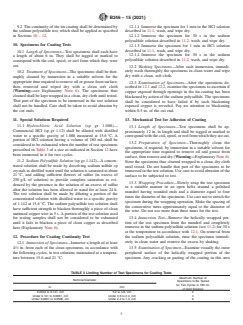
- Coating Continuity and Adhesion: Mandates testing of the tin coating for continuity using the sodium polysulfide method, and mechanical tests for coating adhesion.
- Electrical Properties: Requires verification of electrical resistivity, aligning with industry needs for conductivity and reliability.
- Testing and Inspection: Outlines sampling, tension tests, resistivity measurements, and procedures for visual and chemical evaluation of coatings.
- Ordering Information: Provides guidance on necessary details to include in purchase orders, such as wire size, temper, and type of copper.
Applications
ASTM B246-15(2021) is integral across industries where tinned copper wire is employed for its optimal balance of electrical conductivity, mechanical strength, and corrosion resistance. Key applications include:
- Electrical Wiring: Used in building wiring, control panels, and appliance manufacturing for its reliable conductivity and ease of soldering.
- Power Distribution: Applied in power transmission lines and substation equipment where high purity and strong mechanical performance are critical.
- Electronics: Essential in circuit assembly, component leads, and printed circuit boards due to its solderability and surface stability.
- Aerospace and Defense: Tinned copper wire is favored for robust performance and compliance with governmental standards, including those used by the U.S. Department of Defense.
- Automotive and Transportation: Used in vehicle wiring harnesses and signaling systems where resistance to corrosion extends operational life.
Related Standards
For organizations and manufacturers dealing with tinned copper wire, several related ASTM and industry standards complement ASTM B246-15(2021):
- ASTM B170: Specification for Oxygen-Free Electrolytic Copper-ensures raw copper material quality.
- ASTM B193: Test Method for Resistivity of Electrical Conductor Materials-covers resistivity testing, critical for electrical performance.
- ASTM B5 and ASTM B49: Relate to copper refinery shapes and rods for electrical purposes.
- NBS Handbook 100: Provides comprehensive wire tables and further technical reference for copper conductors.
- International Standards Principles: Alignment with WTO TBT Committee guidelines supports global acceptance and interoperability.
Practical Value
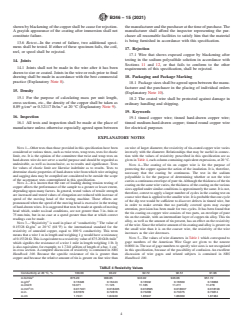
Complying with ASTM B246-15(2021) assures consistently high-quality tinned copper wire, minimizes the risk of failures in electrical systems, and simplifies global sourcing and specification. Its detailed testing and inspection requirements foster trust in supplied materials, while adherence to international trade principles broadens market opportunities. For electrical engineers, manufacturers, and purchasers, referencing this standard is crucial for performance, safety, and regulatory compliance in all sectors utilizing tinned copper wire for electrical purposes.
Relations
- Effective Date
- 15-Apr-2020
- Effective Date
- 01-Apr-2017
- Effective Date
- 01-Apr-2016
- Effective Date
- 01-Apr-2016
- Effective Date
- 15-Oct-2015
- Effective Date
- 15-Sep-2015
- Effective Date
- 01-May-2015
- Effective Date
- 01-Apr-2014
- Effective Date
- 01-Oct-2010
- Effective Date
- 01-Apr-2010
- Effective Date
- 01-Nov-2009
- Effective Date
- 01-Nov-2008
- Effective Date
- 01-Sep-2008
- Effective Date
- 01-Apr-2008
- Refers
ASTM B5-00(2005) - Standard Specification for High Conductivity Tough-Pitch Copper Refinery Shapes - Effective Date
- 01-Oct-2005
Get Certified
Connect with accredited certification bodies for this standard

IMQ S.p.A. (Certification)
Italian electrical product certification.

SLG Prüf- und Zertifizierungs GmbH
German testing and certification body.

UL Solutions
Global safety science company with testing, inspection and certification.
Sponsored listings
Frequently Asked Questions
ASTM B246-15(2021) is a technical specification published by ASTM International. Its full title is "Standard Specification for Tinned Hard-Drawn and Medium-Hard-Drawn Copper Wire for Electrical Purposes". This standard covers: ABSTRACT This specification covers tinned hard-drawn and medium-hard-drawn round copper wire for electrical properties. The tinned wire shall be made by coating hard-drawn and medium-hard-drawn copper wire with commercially pure tin. The copper shall be of such quality and purity that the finished product shall have the properties and characteristics prescribed in this specification. The tin coating shall consist of a smooth continuous layer, firmly adhering to the surface of the copper. The wire shall be free from all imperfections not consistent with the best commercial practice. The tinned wire shall conform to the requirements as to the tensile properties prescribed. Tension tests shall be made on representative samples. The elongation of the wire shall be determined as the permanent increase in length due to the breaking of the wire in tension, measured between gage marks. Electrical resistivity shall be determined by resistance measurements made in accordance with the test method prescribed in this specification. The continuity of coating on the wire shall be determined by the sodium polysulfide test. The specimens shall be thoroughly cleaned by immersion in a suitable solvent for the appropriate time required to remove oil or grease from surface; then removed and wiped dry with clean, soft cloth. Mechanical test for adhesion of coating shall be performed. Any cracking or parting of the coating in the area shown by blackening of the copper shall be cause for rejection. SCOPE 1.1 This specification covers tinned hard-drawn and medium-hard-drawn round copper wire for electrical purposes. 1.2 The values stated in inch-pound units are to be regarded as standard. The values given in parentheses are mathematical conversions to SI units that are provided for information only and are not considered standard. 1.2.1 Exception—For density, resistivity and temperature, the values stated in SI units are to be regarded as standard. 1.3 This standard does not purport to address all of the safety concerns, if any, associated with its use. It is the responsibility of the user of this standard to establish appropriate safety, health, and environmental practices and determine the applicability of regulatory limitations prior to use. For hazard statement, see Sections 10 and 13. 1.4 This international standard was developed in accordance with internationally recognized principles on standardization established in the Decision on Principles for the Development of International Standards, Guides and Recommendations issued by the World Trade Organization Technical Barriers to Trade (TBT) Committee.
ABSTRACT This specification covers tinned hard-drawn and medium-hard-drawn round copper wire for electrical properties. The tinned wire shall be made by coating hard-drawn and medium-hard-drawn copper wire with commercially pure tin. The copper shall be of such quality and purity that the finished product shall have the properties and characteristics prescribed in this specification. The tin coating shall consist of a smooth continuous layer, firmly adhering to the surface of the copper. The wire shall be free from all imperfections not consistent with the best commercial practice. The tinned wire shall conform to the requirements as to the tensile properties prescribed. Tension tests shall be made on representative samples. The elongation of the wire shall be determined as the permanent increase in length due to the breaking of the wire in tension, measured between gage marks. Electrical resistivity shall be determined by resistance measurements made in accordance with the test method prescribed in this specification. The continuity of coating on the wire shall be determined by the sodium polysulfide test. The specimens shall be thoroughly cleaned by immersion in a suitable solvent for the appropriate time required to remove oil or grease from surface; then removed and wiped dry with clean, soft cloth. Mechanical test for adhesion of coating shall be performed. Any cracking or parting of the coating in the area shown by blackening of the copper shall be cause for rejection. SCOPE 1.1 This specification covers tinned hard-drawn and medium-hard-drawn round copper wire for electrical purposes. 1.2 The values stated in inch-pound units are to be regarded as standard. The values given in parentheses are mathematical conversions to SI units that are provided for information only and are not considered standard. 1.2.1 Exception—For density, resistivity and temperature, the values stated in SI units are to be regarded as standard. 1.3 This standard does not purport to address all of the safety concerns, if any, associated with its use. It is the responsibility of the user of this standard to establish appropriate safety, health, and environmental practices and determine the applicability of regulatory limitations prior to use. For hazard statement, see Sections 10 and 13. 1.4 This international standard was developed in accordance with internationally recognized principles on standardization established in the Decision on Principles for the Development of International Standards, Guides and Recommendations issued by the World Trade Organization Technical Barriers to Trade (TBT) Committee.
ASTM B246-15(2021) is classified under the following ICS (International Classification for Standards) categories: 29.060.10 - Wires. The ICS classification helps identify the subject area and facilitates finding related standards.
ASTM B246-15(2021) has the following relationships with other standards: It is inter standard links to ASTM B49-20, ASTM B49-17, ASTM B49-16, ASTM B193-16, ASTM B170-99(2015), ASTM B49-15a, ASTM B49-15, ASTM B193-02(2014), ASTM B49-10, ASTM B170-99(2010), ASTM B49-09, ASTM B49-08a, ASTM B193-02(2008), ASTM B49-08, ASTM B5-00(2005). Understanding these relationships helps ensure you are using the most current and applicable version of the standard.
ASTM B246-15(2021) is available in PDF format for immediate download after purchase. The document can be added to your cart and obtained through the secure checkout process. Digital delivery ensures instant access to the complete standard document.
Standards Content (Sample)
This international standard was developed in accordance with internationally recognized principles on standardization established in the Decision on Principles for the
Development of International Standards, Guides and Recommendations issued by the World Trade Organization Technical Barriers to Trade (TBT) Committee.
Designation:B246 −15 (Reapproved 2021)
Standard Specification for
Tinned Hard-Drawn and Medium-Hard-Drawn Copper Wire
for Electrical Purposes
This standard is issued under the fixed designation B246; the number immediately following the designation indicates the year of
original adoption or, in the case of revision, the year of last revision. A number in parentheses indicates the year of last reapproval. A
superscript epsilon (´) indicates an editorial change since the last revision or reapproval.
This standard has been approved for use by agencies of the U.S. Department of Defense.
1. Scope B170 Specification for Oxygen-Free Electrolytic Copper—
Refinery Shapes
1.1 This specification covers tinned hard-drawn and
B193 Test Method for Resistivity of Electrical Conductor
medium-hard-drawn round copper wire for electrical purposes.
Materials
1.2 The values stated in inch-pound units are to be regarded 3
2.3 National Bureau of Standards:
as standard. The values given in parentheses are mathematical
NBS Handbook 100—Copper Wire Tables
conversions to SI units that are provided for information only
and are not considered standard.
3. Ordering Information
1.2.1 Exception—For density, resistivity and temperature,
3.1 Orders for material under this specification shall include
the values stated in SI units are to be regarded as standard.
the following information:
1.3 This standard does not purport to address all of the
3.1.1 Quantity of each size,
safety concerns, if any, associated with its use. It is the
3.1.2 Wire size, diameter in inches (see 5.1 and Table 1),
responsibility of the user of this standard to establish appro-
3.1.3 Type of copper, if special (see 4.2),
priate safety, health, and environmental practices and deter-
3.1.4 Temper (see 7.1 and Table 1),
mine the applicability of regulatory limitations prior to use.
3.1.5 Package size (see 18.1),
For hazard statement, see Sections 10 and 13.
3.1.6 Special package marking, if required, and
1.4 This international standard was developed in accor-
3.1.7 Place of inspection (Section 16).
dance with internationally recognized principles on standard-
ization established in the Decision on Principles for the 4. Materials
Development of International Standards, Guides and Recom-
4.1 The tinned wire shall be made by coating hard-drawn
mendations issued by the World Trade Organization Technical
and medium-hard-drawn copper wire with commercially pure
Barriers to Trade (TBT) Committee.
tin (see Note 1). For purposes of this specification, the tin shall
be considered commercially pure if the total of other elements,
2. Referenced Documents
exclusive of copper, does not exceed 1 %. Notwithstanding the
2.1 The following documents of the issue in effect on the previoussentence,chemicalanalysisofthetincoatingorofthe
dateofmaterialpurchaseformapartofthisspecificationtothe
tin used for coating shall not be required under this specifica-
extent referenced herein: tion. Adequacy of the tin coating is ensured by the continuity
of coating and adherence of coating requirements (Sections 9
2.2 ASTM Standards:
and 13, respectively).
B5 Specification for High Conductivity Tough-Pitch Copper
Refinery Shapes
4.2 The copper shall be copper of such quality and purity
B49 Specification for Copper Rod for Electrical Purposes that the finished product shall have the properties and charac-
teristics prescribed in this specification.
NOTE 1—Specification B49 defines copper suitable for use.
This specification is under the jurisdiction of ASTM Committee B01 on
Electrical Conductors and is the direct responsibility of Subcommittee B01.04 on 4.3 Copper bars of special qualities, forms, or types, as may
Conductors of Copper and Copper Alloys.
be agreed upon between the manufacturer and the purchaser,
Current edition approved Oct. 1, 2021. Published October 2021. Originally
and which will conform to the requirements prescribed in this
approved in 1951. Last previous edition approved in 2015 as B246 – 15. DOI:
specification may also be used.
10.1520/B0246-15R21.
For referenced ASTM standards, visit the ASTM website, www.astm.org, or
contact ASTM Customer Service at service@astm.org. For Annual Book of ASTM
Standards volume information, refer to the standard’s Document Summary page on Available from National Technical Information Service (NTIS), 5301 Shawnee
the ASTM website. Rd., Alexandria, VA 22312, http://www.ntis.gov.
Copyright © ASTM International, 100 Barr Harbor Drive, PO Box C700, West Conshohocken, PA 19428-2959. United States
B246−15 (2021)
TABLE 1 Tensile Requirements
Tinned Medium-Hard-Drawn Wire
Tinned Hard-Drawn Wire Tensile Strength, min
Elongation Elongation
Diameter Area at 20 °C Tensile Strength, min psi Mpa
in 10 in. in 10 in.
(250 mm), (250 mm),
2 2
in. mm cmil in. mm psi Mpa min max min max
%min %min
0.2043 5.189 41 738 0.03278 21.15 54 100 370.6 1.7 42 400 55 300 290.4 378.8 1.9
0.1819 4.620 33 088 0.02599 16.77 55 100 377.4 1.6 43 300 55 700 296.6 381.5 1.7
0.1620 4.115 26 244 0.02061 13.30 55 900 382.9 1.4 44 100 56 000 302.1 383.6 1.5
0.1443 3.665 20 822 0.01635 10.55 56 700 388.4 1.3 44 900 56 300 307.6 385.6 1.4
0.1285 3.264 16 512 0.01297 8.367 57 300 392.5 1.3 45 500 56 700 311.7 388.4 1.3
0.1144 2.906 13 087 0.01028 6.632 57 900 396.6 1.2 46 000 57 000 315.1 390.4 1.3
0.1019 2.588 10 384 0.008155 5.262 58 400 400.0 1.2 46 500 57 300 318.5 392.5 1.2
0.0907 2.304 8226 0.006461 4.1684 58 900 403.5 1.1 46 900 57 700 321.3 395.2 1.2
0.0808 2.052 6529 0.005128 3.308 59 100 404.8 1.1 47 200 58 000 323.3 397.3 1.1
0.0720 1.829 5184 0.004072 2.627 59 300 406.2 1.1 47 300 58 300 324.0 399.3 1.1
0.0641 1.628 4109 0.003227 2.082 59 600 408.2 1.0 47 600 58 700 326.1 402.1 1.0
0.0571 1.450 3260 0.002561 1.652 59 800 409.6 1.0 47 800 59 000 327.4 404.1 1.0
0.0508 1.290 2581 0.002027 1.308 59 900 410.3 1.0 47 900 59 300 328.1 406.2 1.0
5. Dimensions, Mass, and Permissible Variations 7.3 Tension tests shall be made on representative samples.
Determine the elongation of the wire as the permanent increase
5.1 The wire sizes shall be expressed as the diameter of the
in length due to the breaking of the wire in tension, measured
coated wire in decimal fractions of an inch to the nearest
between gage marks placed originally 10 in. (250 mm) apart
0.0001 in. (0.001 mm) (Explanatory Note 5).
upon the test specimen (Explanatory Note 2).
5.2 The coated wire shall not vary from the specified
7.4 If any part of the fracture takes place outside the gage
diameter by more than +3 % or –1 %.
marks or in the jaws of the testing machine, or if an examina-
5.3 Ten percent, but not less than five coils or spools (or all,
tion of the specimen indicates a flaw, the value obtained may
if the lot is less than five) from any lot of wire shall be taken
not be representative of the material. In such cases the test may
near each end and one near the middle. If any of these selected
be discarded and a new test made.
coils or spools fails to conform to the requirements prescribed
7.5 Retests—If upon testing a specimen from any coil or
in 5.2, all coils or spools shall be gaged in the manner
spool of wire, the results do not conform to the requirements
specified.
prescribed in Table 1, two additional specimens shall be tested,
6. Workmanship, Finish, and Appearance and the average of the three tests shall determine the accep-
tance or rejection of the coil or spool.
6.1 The tin coating shall consist of a smooth continuous
layer, firmly adhering to the surface of the copper.
8. Resistivity
6.2 The wire shall be free from all imperfections not
8.1 Electrical resistivity shall be determined on representa-
consistent with the best commercial practice.
tive specimens by resistance measurements made in accor-
dance with Test Method B193. At a temperature of 20 °C the
7. Tensile Properties
resistivity of coated wire shall not exceed the values prescribed
7.1 The tinned wire shall conform to the requirements as to
in Table 2 (Explanatory Note 3).
tensile properties prescribed in Table 1 (Explanatory Note 1).
9. Continuity of Coating
7.2 For wire the nominal diameter of which is more than
0.001 in. (0.025 mm) greater than a size listed in Table 1, but 9.1 The continuity of coating on the wire shall be deter-
which is less than that of the next larger size, the requirements mined on representative samples taken before stranding or
of the next larger size shall apply. insulating (Explanatory Note 4).
TABLE 2 Electrical Resistivity Requirements
Resistivity at 20 °C
2 2
Nominal Diameter lb/mile g/m
in. mm Hard Medium-Hard Hard Medium-Hard
0.2043 to 0.103, incl 5.2 to 2.6, incl 943.92 938.85 0.1653 0.1644
Under 0.103 to 0.0508, incl Under 2.6 to 1.3, incl 910.15 946.06 0.1594 0.1657
B246−15 (2021)
9.2 The continuity of the tin coating shall be determined by 12.1.1 Immerse the specimen for 1 min in the HCl solution
the sodium polysulfide test, which shall be applied as specified described in 11.1, wash, and wipe dry.
in Sections10–12. 12.1.2 Immerse the specimen for 30 s in the sodium
polysulfide solution described in 11.2, wash, and wipe dry.
10. Specimens for Coating Tests
12.1.3 Immerse the specimen for 1 min in HCl solution
described in 11.1, wash, and wipe dry.
10.1 Length of Specimens—Test specimens shall each have
12.1.4 Immerse the specimen for 30 s in the sodium
a length of about 6 in. They shall be tagged or marked to
polysulfide solution described in 11.2, wash, and wipe dry.
correspond with the coil, spool, or reel from which they were
cut.
12.2 Washing Specimens—After each immersion, immedi-
ately wash thoroughly the specimens in clean water and wipe
10.2 Treatment of Specimens—The specimens shall be thor-
dry with a clean, soft cloth.
oughly cleaned by immersion in a suitable solvent for the
appropriate time required to remove oil or grease from surface;
12.3 Examination of Specimens—After the operations de-
then removed and wiped dry with a clean soft cloth
scribed in 12.1 and 12.2, examine the specimens to ascertain if
(Warning—see Explanatory Note 6). The specimens thus
copper exposed through openings in the tin coating has been
cleaned shall be kept wrapped in a clean, dry cloth until tested.
blackened by action of the sodium polysulfide. The specimens
That part of the specimen to be immersed in the test solution
shall be considered to have failed if by such blackening
shall not be handled. Care shall be taken to avoid abrasion by
exposed copper is revealed. Pay no attention to blackening
the cut ends.
within 0.5 in. of the cut end.
11. Special Solutions Required
13. Mechanical Test for Adhesion of Coating
11.1 Hydrochloric Acid Solution (sp gr 1.088)—
13.1 Length of Specimens—Test specimens shall be ap-
Commercial HCl (sp gr 1.12) shall be diluted with distilled
proximately 12 in. in length and shall be tagged or marked to
water to a specific gravity of 1.088 measured at 15.6 °C. A
correspondwiththecoil,spool,orreelfromwhichtheyarecut.
portion of HCl solution having a volume of 180 mL shall be
13.2 Preparation of Specimen—Thoroughly clean the
considered to be exhausted when the number of test specimens
specimens, if required, by immersion in a suitable solvent for
prescribed in Table 3 of a size as indicated in Section 12 have
the appropriate time required to remove oil and grease from
been immersed in it for two cycles.
surface,thenremoveanddry(Warning—ExplanatoryNote6).
11.2 Sodium Polysulfide Solution (sp gr 1.142)—A concen-
Store the specimens thus cleaned wrapped in a clean, dry cloth
trated solution shall be made by dissolving sodium sulfide cp
until tested. Do not handle that part of the specimens to be
crystals in distilled water until the solution is saturated at about
immersed in the test solution. Use care to avoid abrasion of the
21 °C, and adding sufficient flowers
...