

ASTM D2570-16
(Test Method)Standard Test Method for Simulated Service Corrosion Testing of Engine Coolants
General Information
- Abstract
SIGNIFICANCE AND USE
4.1 This test method, by a closer approach to engine cooling system conditions, provides better evaluation and selective screening of engine coolants than is possible from glassware testing (Test Method D1384). The improvement is achieved by controlled circulation of the coolant, by the use of automotive cooling system components, and by a greater ratio of metal surface area to coolant volume.
4.2 Although this test method provides improved discrimination, it cannot conclusively predict satisfactory corrosion inhibition and service life. If greater assurance of satisfactory performance is desired, it should be obtained from full-scale engine tests (Test Method D2758) and from field testing in actual service (Practice D2847).
4.3 Significance and interpretation of the test and its limitations are discussed further in Appendix X1.
4.4 If this test method is used as a qualification test for Specification D3306 and Specification D4985, the recommended components listed in Section 5 shall be used. If it is not being used for such qualification purposes, then suitable substitution components may be used, if agreed upon between the contracting parties.
SCOPE
1.1 This test method evaluates the effect of a circulating engine coolant on metal test specimens and automotive cooling system components under controlled, essentially isothermal laboratory conditions.
1.2 This test method specifies test material, cooling system components, type of coolant, and coolant flow conditions that are considered typical of current automotive use.
1.3 The values stated in foot-pound-second units are to be regarded as the standard. The values given in parentheses (SI units) are approximate equivalents for information only.
1.4 This standard does not purport to address all of the safety concerns, if any, associated with its use. It is the responsibility of the user of this standard to establish appropriate safety and health practices and determine the applicability of regulatory limitations prior to use. Specific precautionary statements are given in Section 6.
- Status
- Published
- Publication Date
- 31-Mar-2016
- Technical Committee
- D15 - Engine Coolants and Related Fluids
- Drafting Committee
- D15.09 - Simulated Service Tests
Buy Documents
ASTM D2570-16 - Standard Test Method for Simulated Service Corrosion Testing of Engine Coolants
REDLINE ASTM D2570-16 - Standard Test Method for Simulated Service Corrosion Testing of Engine Coolants
Overview
ASTM D2570-16 is a widely recognized standard developed by ASTM International that specifies the standard test method for simulated service corrosion testing of engine coolants. This test method enables manufacturers and laboratories to evaluate the corrosion-inhibiting effectiveness of engine coolants under conditions that closely replicate real-world automotive cooling systems. By incorporating automotive components, circulating coolant, and increased metal surface area relative to coolant volume, this method provides a more reliable assessment than traditional glassware tests such as ASTM D1384.
Key Topics
- Realistic Testing Conditions: The methodology utilizes actual automotive cooling system components (reservoirs, radiators, pumps, hoses) and replicates typical engine cooling flow and temperature conditions.
- Corrosion Evaluation: Metal specimens representative of automotive materials (such as copper, solder, brass, steel, cast iron, and aluminum) are exposed to the circulating coolant, mimicking service environments.
- Simulated Service Duration: The test is conducted over an extended period, totaling 1064 hours at 190°F (88°C), including scheduled shutdown intervals to simulate actual engine usage patterns.
- Coolant and Water Recirculation: Specifies the preparation of glycol-based coolant mixtures with corrosive water to challenge the corrosion inhibition performance.
- Data Reporting: Test outcomes are determined by measuring mass loss of specimens and visually examining both metal samples and component interiors for signs of corrosion.
- Limitations and Recommendations: While significantly more selective than glassware methods, simulated service tests should be complemented with full-scale engine and field tests (ASTM D2758, D2847) for comprehensive validation.
Applications
The ASTM D2570-16 standard is especially valuable for:
- Coolant Manufacturers: Screening and qualifying formulations for use in automotive and heavy-duty engine cooling systems.
- Automotive OEMs and Suppliers: Assessing the corrosion protection performance of coolants against a variety of commonly used metals and alloys.
- Quality Assurance: Supporting compliance with industry specifications such as ASTM D3306 (glycol base coolant for automobiles and light-duty service) and ASTM D4985 (low silicate ethylene glycol base coolant for heavy-duty engines).
- Research & Development: Evaluating new coolant technologies or additives under controlled, accelerated, and repeatable laboratory conditions that approximate service environments more closely than static glassware tests.
- Comparative Testing: Benchmarking new or alternative products against established reference coolants, ensuring optimal protection and compatibility with modern engine materials.
Related Standards
The following standards are commonly referenced alongside ASTM D2570-16 when evaluating the corrosion performance and chemical properties of automotive engine coolants:
- ASTM D1384 - Test Method for Corrosion Test for Engine Coolants in Glassware
- ASTM D1121 - Test Method for Reserve Alkalinity of Engine Coolants and Antirusts
- ASTM D1287 - Test Method for pH of Engine Coolants and Antirusts
- ASTM D1176 - Practice for Sampling and Preparing Aqueous Solutions of Engine Coolants or Antirusts for Testing Purposes
- ASTM D1193 - Specification for Reagent Water
- ASTM D2758 - Test Method for Engine Coolants by Engine Dynamometer
- ASTM D2847 - Practice for Testing Engine Coolants in Car and Light Truck Service
- ASTM D3306 - Specification for Glycol Base Engine Coolant for Automobile and Light-Duty Service
- ASTM D4985 - Specification for Low Silicate Ethylene Glycol Base Engine Coolant for Heavy Duty Engines
Practical Value
By more closely approximating actual engine cooling system conditions, ASTM D2570-16 enables improved evaluation, selective screening, and development of engine coolants that meet the demands of today's vehicles. Laboratories, manufacturers, and automotive professionals can rely on this standard for a consistent, reproducible, and industry-accepted approach to coolant corrosion testing-leading to better product quality, enhanced engine protection, and extended system life.
Keywords: ASTM D2570-16, simulated service corrosion test, engine coolant, automotive cooling system, metal corrosion, coolant qualification, glycol-based coolant, automotive standards, corrosion inhibition.
Relations
- Effective Date
- 01-Jan-2024
- Effective Date
- 01-Jan-2020
- Refers
ASTM D1121-11(2020) - Standard Test Method for Reserve Alkalinity of Engine Coolants and Antirusts - Effective Date
- 01-Jan-2020
- Refers
ASTM D1384-05(2019) - Standard Test Method for Corrosion Test for Engine Coolants in Glassware - Effective Date
- 01-Oct-2019
- Effective Date
- 01-Oct-2019
- Effective Date
- 01-Apr-2019
- Effective Date
- 01-Dec-2014
- Effective Date
- 01-Apr-2014
- Refers
ASTM D2847-07(2012) - Standard Practice for Testing Engine Coolants in Car and Light Truck Service - Effective Date
- 01-Oct-2012
- Refers
ASTM D1384-05(2012) - Standard Test Method for Corrosion Test for Engine Coolants in Glassware - Effective Date
- 01-Apr-2012
- Effective Date
- 01-Oct-2011
- Effective Date
- 01-Apr-2010
- Effective Date
- 01-Apr-2010
- Effective Date
- 01-Nov-2009
- Effective Date
- 01-Sep-2009
Buy Documents
ASTM D2570-16 - Standard Test Method for Simulated Service Corrosion Testing of Engine Coolants
REDLINE ASTM D2570-16 - Standard Test Method for Simulated Service Corrosion Testing of Engine Coolants
Get Certified
Connect with accredited certification bodies for this standard

ECOCERT
Organic and sustainability certification.

Eurofins Food Testing Global
Global leader in food, environment, and pharmaceutical product testing.

Intertek Bangladesh
Intertek certification and testing services in Bangladesh.
Sponsored listings
Frequently Asked Questions
ASTM D2570-16 is a standard published by ASTM International. Its full title is "Standard Test Method for Simulated Service Corrosion Testing of Engine Coolants". This standard covers: SIGNIFICANCE AND USE 4.1 This test method, by a closer approach to engine cooling system conditions, provides better evaluation and selective screening of engine coolants than is possible from glassware testing (Test Method D1384). The improvement is achieved by controlled circulation of the coolant, by the use of automotive cooling system components, and by a greater ratio of metal surface area to coolant volume. 4.2 Although this test method provides improved discrimination, it cannot conclusively predict satisfactory corrosion inhibition and service life. If greater assurance of satisfactory performance is desired, it should be obtained from full-scale engine tests (Test Method D2758) and from field testing in actual service (Practice D2847). 4.3 Significance and interpretation of the test and its limitations are discussed further in Appendix X1. 4.4 If this test method is used as a qualification test for Specification D3306 and Specification D4985, the recommended components listed in Section 5 shall be used. If it is not being used for such qualification purposes, then suitable substitution components may be used, if agreed upon between the contracting parties. SCOPE 1.1 This test method evaluates the effect of a circulating engine coolant on metal test specimens and automotive cooling system components under controlled, essentially isothermal laboratory conditions. 1.2 This test method specifies test material, cooling system components, type of coolant, and coolant flow conditions that are considered typical of current automotive use. 1.3 The values stated in foot-pound-second units are to be regarded as the standard. The values given in parentheses (SI units) are approximate equivalents for information only. 1.4 This standard does not purport to address all of the safety concerns, if any, associated with its use. It is the responsibility of the user of this standard to establish appropriate safety and health practices and determine the applicability of regulatory limitations prior to use. Specific precautionary statements are given in Section 6.
SIGNIFICANCE AND USE 4.1 This test method, by a closer approach to engine cooling system conditions, provides better evaluation and selective screening of engine coolants than is possible from glassware testing (Test Method D1384). The improvement is achieved by controlled circulation of the coolant, by the use of automotive cooling system components, and by a greater ratio of metal surface area to coolant volume. 4.2 Although this test method provides improved discrimination, it cannot conclusively predict satisfactory corrosion inhibition and service life. If greater assurance of satisfactory performance is desired, it should be obtained from full-scale engine tests (Test Method D2758) and from field testing in actual service (Practice D2847). 4.3 Significance and interpretation of the test and its limitations are discussed further in Appendix X1. 4.4 If this test method is used as a qualification test for Specification D3306 and Specification D4985, the recommended components listed in Section 5 shall be used. If it is not being used for such qualification purposes, then suitable substitution components may be used, if agreed upon between the contracting parties. SCOPE 1.1 This test method evaluates the effect of a circulating engine coolant on metal test specimens and automotive cooling system components under controlled, essentially isothermal laboratory conditions. 1.2 This test method specifies test material, cooling system components, type of coolant, and coolant flow conditions that are considered typical of current automotive use. 1.3 The values stated in foot-pound-second units are to be regarded as the standard. The values given in parentheses (SI units) are approximate equivalents for information only. 1.4 This standard does not purport to address all of the safety concerns, if any, associated with its use. It is the responsibility of the user of this standard to establish appropriate safety and health practices and determine the applicability of regulatory limitations prior to use. Specific precautionary statements are given in Section 6.
ASTM D2570-16 is classified under the following ICS (International Classification for Standards) categories: 71.100.45 - Refrigerants and antifreezes. The ICS classification helps identify the subject area and facilitates finding related standards.
ASTM D2570-16 has the following relationships with other standards: It is inter standard links to ASTM D1384-24, ASTM D1287-11(2020), ASTM D1121-11(2020), ASTM D1384-05(2019), ASTM D1176-14(2019), ASTM D3306-19, ASTM D2847-14, ASTM D1176-14, ASTM D2847-07(2012), ASTM D1384-05(2012), ASTM D1287-11, ASTM D3306-10, ASTM D4985-10, ASTM D1287-09, ASTM D3306-09. Understanding these relationships helps ensure you are using the most current and applicable version of the standard.
ASTM D2570-16 is available in PDF format for immediate download after purchase. The document can be added to your cart and obtained through the secure checkout process. Digital delivery ensures instant access to the complete standard document.
Standards Content (Sample)
This international standard was developed in accordance with internationally recognized principles on standardization established in the Decision on Principles for the
Development of International Standards, Guides and Recommendations issued by the World Trade Organization Technical Barriers to Trade (TBT) Committee.
Designation: D2570 − 16
Standard Test Method for
Simulated Service Corrosion Testing of Engine Coolants
This standard is issued under the fixed designation D2570; the number immediately following the designation indicates the year of
original adoption or, in the case of revision, the year of last revision. A number in parentheses indicates the year of last reapproval. A
superscript epsilon (´) indicates an editorial change since the last revision or reapproval.
1. Scope* Automobile and Light-Duty Service
D4985 Specification for Low Silicate Ethylene Glycol Base
1.1 This test method evaluates the effect of a circulating
Engine Coolant for Heavy Duty Engines Requiring a
enginecoolantonmetaltestspecimensandautomotivecooling
Pre-Charge of Supplemental Coolant Additive (SCA)
system components under controlled, essentially isothermal
laboratory conditions. 2.2 SAE Standard:
SAE J20e Standard for Coolant System Hoses
1.2 This test method specifies test material, cooling system
components, type of coolant, and coolant flow conditions that 2.3 ASTM Adjuncts:
are considered typical of current automotive use. Coolant reservoir (1 drawing)
Framework for test equipment (3 drawings and B/M)
1.3 The values stated in foot-pound-second units are to be
regarded as the standard. The values given in parentheses (SI
3. Summary of Test Method
units) are approximate equivalents for information only.
3.1 An engine coolant is circulated for 1064 h at 190°F
1.4 This standard does not purport to address all of the
(88°C) in a flow loop consisting of a metal reservoir, an
safety concerns, if any, associated with its use. It is the
automotivecoolantpump,anautomotiveradiator,andconnect-
responsibility of the user of this standard to establish appro-
ing rubber hoses. Test specimens representative of engine
priate safety and health practices and determine the applica-
cooling system metals are mounted inside the reservoir, which
bility of regulatory limitations prior to use. Specific precau-
simulates an engine cylinder block. At the end of the test
tionary statements are given in Section 6.
period, the corrosion-inhibiting properties of the coolant are
determined by measuring the mass losses of the test specimens
2. Referenced Documents
and by visual examination of the interior surfaces of the
2.1 ASTM Standards:
components.
D1121 Test Method for Reserve Alkalinity of Engine Cool-
ants and Antirusts
4. Significance and Use
D1176 Practice for Sampling and Preparing Aqueous Solu-
tions of Engine Coolants orAntirusts forTesting Purposes 4.1 This test method, by a closer approach to engine cooling
D1193 Specification for Reagent Water system conditions, provides better evaluation and selective
D1287 TestMethodforpHofEngineCoolantsandAntirusts screening of engine coolants than is possible from glassware
D1384 Test Method for Corrosion Test for Engine Coolants testing (Test Method D1384).The improvement is achieved by
in Glassware controlled circulation of the coolant, by the use of automotive
D2758 Test Method for Engine Coolants by Engine Dyna- cooling system components, and by a greater ratio of metal
mometer surface area to coolant volume.
D2847 PracticeforTestingEngineCoolantsinCarandLight
4.2 Although this test method provides improved
Truck Service
discrimination, it cannot conclusively predict satisfactory cor-
D3306 Specification for Glycol Base Engine Coolant for
rosion inhibition and service life. If greater assurance of
satisfactory performance is desired, it should be obtained from
full-scale engine tests (Test Method D2758) and from field
This test method is under the jurisdiction ofASTM Committee D15 on Engine
testing in actual service (Practice D2847).
Coolants and Related Fluids and is the direct responsibility of Subcommittee
D15.09 on Simulated Service Tests.
4.3 Significance and interpretation of the test and its limi-
Current edition approved April 1, 2016. Published May 2016. Originally
tations are discussed further in Appendix X1.
approved in 1966. Last previous edition approved in 2010 as D2570 - 10. DOI:
10.1520/D2570-16.
For referenced ASTM standards, visit the ASTM website, www.astm.org, or
contact ASTM Customer Service at service@astm.org. For Annual Book of ASTM
Standards volume information, refer to the standard’s Document Summary page on Available from SAE International (SAE), 400 Commonwealth Dr.,Warrendale,
the ASTM website. PA 15096, http://www.sae.org.
*A Summary of Changes section appears at the end of this standard
Copyright © ASTM International, 100 Barr Harbor Drive, PO Box C700, West Conshohocken, PA 19428-2959. United States
D2570 − 16
4.4 If this test method is used as a qualification test for The flow rate at operating temperature may be determined by
Specification D3306 and Specification D4985, the recom- a flow measurement device located between pump discharge
mendedcomponentslistedinSection5shallbeused.Ifitisnot and reservoir inlet, as indicated in Fig. 2. The pressure drop
being used for such qualification purposes, then suitable between pump discharge and reservoir inlet, measured by the
substitution components may be used, if agreed upon between pressure gages shown in Fig. 2, must be maintained when the
the contracting parties. flow measurement device is removed from the system. This
can be done by substituting for the flow measurement device a
5. Apparatus
variable-flow restriction, such as a valve, which can be
adjusted to produce the same pressure drop as that measured
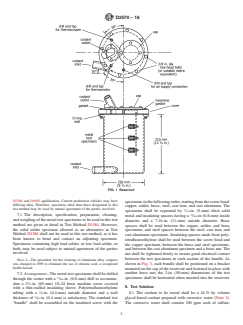
5.1 Reservoir—An assembly drawing of this component is
across the flow measurement device at the specified flow rate.
shown in Fig. 1.The material of construction, representing that
oftheenginecylinderblock,shallbeSAEG3500GrayIronfor
5.6 Electric Heater—About 2000 W, either a hot plate
Automotive Castings. Install a right angle fitting on the top of
installed under the reservoir or a circumferential, metal-clad
the reservoir for attachment of an air line. Install a shutoff
heater band around the reservoir.
valve in the air line to avoid backing up the solution into the
5.7 Thermoregulator—A suitable temperature regulator
pressure hose.
shall be used to maintain the coolant temperature between the
5.2 AutomotiveComponents—Theseshallbethosenormally
limits specified by 9.3. The sensing unit of the regulator shall
used with a 4, 6, or 8-cylinder automobile engine used in
be installed in an opening on the reservoir cover.
currentautomobilesintheUnitedStates,inthe1.6to5.0-L(98
5.8 Temperature Measuring Device—An instrument ca-
to 305-in. ) range of piston displacement. General character-
pable of indicating coolant temperature to the nearest 1°F or
istics shall be as follows:
1°C shall be installed in an opening on the reservoir cover.
5.2.1 Radiator—Brass, GM part No. 3056740 (cross flow),
5.9 Framework—A suitable framework shall be used to
with coolant recovery tank. An aluminum radiator, GM part
mount all the components as a unit.
No. 3093506, may be used subject to mutual agreement of the
parties involved.
6. Safety Precautions
5.2.2 Radiator Pressure Cap—Normally open 12 to 15 psi
6.1 Reservoir—Protection against bursting shall be
(80 to 100 kPa), GM part No. 6410427.
provided, either by a pressure-relief valve on the cover or by a
5.2.3 Coolant Pump —GM part No. 14033483 (aluminum
safety enclosure.
matching front end cover). GM part No. 14033526 (aluminum
provides back cover), coolant discharge parts and mounting for
6.2 Pump Drive—Asafety guard for the coolant pump drive
pump.
belt and pulleys shall be provided.
5.2.4 Coolant Outlet—GM part No. 14033198 (aluminum).
6.3 Electrical—Electrical circuits required for operation of
5.2.5 Hoses—Reinforced elastomer, meeting the require-
motor, heater, and thermoregulator shall be installed with
ments of SAE J20e.
suitable precautions against electrical shock to operating per-
5.2.6 Hose Clamps—Preferably worm-screw type (constant
sonnel in the event of accidental spills of electrically conduc-
tension may be used).
tive liquids.
5.2.7 Hose Sight Tube—Aborosilicate glass sight tube shall
6.4 Thermal—Protection of operating personnel against
be installed in the top radiator hose. The tube should have a
burns from exposed metal surfaces, especially those of the
slight bead on each end. (The primary purpose of the sight tube
heater, shall be provided.
is to see that there is entrained air in the system.)
6.5 Plumbing—Protection of operating personnel against
5.3 Pipe Fittings—The preferred material for the fittings
burns or scalds from hot fluid escaping from burst hoses or
requiredinthehoseconnectionsbetweenpumpdischargeports
failed plumbing connections shall be provided.
and reservoir inlet is malleable cast iron. A satisfactory
alternative is steel.
7. Metal Test Specimens
5.4 ElectricMotor—1 ⁄2 hp (1.1 kW) or larger, drip-proof or
NOTE 1—The specimens prescribed for this test method have been
explosion-proof in accordance with local safety regulations. accepted by automobile manufacturers and are required for Specifications
5.5 Pulleys and Drive Belt—Sized to drive the pump at a
speed that will produce a flow rate of 20 to 25 gal/min (1.3 to Fischer and Porter Series 10A2235A Ratosight Flow Rate Indicator, 4 to 50
gal/min (0.3 to 3.0 L/s), of bronze construction, has been found satisfactory.
1.6 L/s) for the General Motors 173-in. (2.8-L) V-6 engine.
Equivalent flow measuring devices may be used.
Chromalox No. ROPH-204 has been found satisfactory. Equivalent hot plates
may be used.
4 9
Detail drawings are available from ASTM International Headquarters. Order Chromalox No. HB-8415 has been found satisfactory. Equivalent heater bands
Adjunct No. ADJD257001. Original adjunct produced in 1982. Reservoirs of cast may be used.
iron or cast aluminum, made in accordance with these drawings, may be obtained Chromalox No. AR-2524P has been found satisfactory. Equivalent thermo-
from Commercial Machine Service, 1099TouhyAve., Elk GroveVillage, IL60007, regulators may be used.
(847) 806-1901. Fischer Scientific No. 15-076D and Weston No. 2261 dial-type thermometers
Aluminum or iron may be used if mutually agreed upon between the parties have been found satisfactory. Equivalent thermometers may be used.
involved. Detail and assembly drawings of a suitable framework and arrangement of
Gates “Vulco Straight” bulk-length radiator hose, Product Type 4178, has been components thereon are available from ASTM International Headquarters. Order
found satisfactory. Equivalent radiator hoses may be used. Adjunct No. ADJD257002. Original adjunct produced in 1982.
D2570 − 16
FIG. 1 Reservoir
D3306 and D4985 qualification. Current production vehicles may have
specimens in the following order, starting from the screw head:
differing alloy. Therefore, specimens other than those designated in this
copper, solder, brass, steel, cast iron, and cast aluminum. The
test method may be used by mutual agreement of the parties involved.
specimens shall be separated by ⁄16-in. (5-mm) thick solid
7.1 The description, specification, preparation, cleaning, 17
metal and insulating spacers having a ⁄64-in (6.8-mm) inside
and weighing of the metal test specimens to be used in this test
diameter and a 7.16-in. (11-mm) outside diameter. Brass
method are given in detail in Test Method D1384. However,
spacers shall be used between the copper, solder, and brass
the solid solder specimen allowed as an alternative in Test
specimens, and steel spacers between the steel, cast iron, and
Method D1384 shall not be used in this test method, as it has
cast aluminum specimens. Insulating spacers made from poly-
been known to bend and contact an adjoining specimen.
tetrafluoroethylene shall be used between the screw head and
Specimens containing high lead solder, or low lead solder, or
the copper specimen, between the brass and steel specimens,
both, may be used subject to mutual agreement of the parties
and between the cast aluminum specimen and a brass nut. The
involved.
nut shall be tightened firmly to ensure good electrical contact
between the test specimens in each section of the bundle. As
NOTE 2—The procedure for the cleaning of aluminum alloy coupons
shown in Fig. 3, each bundle shall be positioned on a bracket
was changed in 1995 to eliminate the use of chromic acid, a recognized
health hazard.
mounted on the cap of the reservoir and fastened in place with
another brass nut; the 2-in. (50-mm) dimensions of the test
7.2 Arrangement—The metal test specimens shall be drilled
specimens shall be horizontal when inserted into the reservoir.
through the center with a ⁄64-in. (6.8-mm) drill to accommo-
date a 2 ⁄2-in. (65-mm) 10–24 brass machine screw covered
8. Test Solution
with a thin-walled insulating sleeve. Polytetrafluoroethylene
tubing with a ⁄4-in. (6.4-mm) outside diameter and a wall 8.1 The coolant to be tested shall be a 44 % by volume
thickness of ⁄64 in. (0.4 mm) is satisfactory. The standard test glycol-based coolant prepared w
...
This document is not an ASTM standard and is intended only to provide the user of an ASTM standard an indication of what changes have been made to the previous version. Because
it may not be technically possible to adequately depict all changes accurately, ASTM recommends that users consult prior editions as appropriate. In all cases only the current version
of the standard as published by ASTM is to be considered the official document.
Designation: D2570 − 10 D2570 − 16
Standard Test Method for
Simulated Service Corrosion Testing of Engine Coolants
This standard is issued under the fixed designation D2570; the number immediately following the designation indicates the year of
original adoption or, in the case of revision, the year of last revision. A number in parentheses indicates the year of last reapproval. A
superscript epsilon (´) indicates an editorial change since the last revision or reapproval.
1. Scope Scope*
1.1 This test method evaluates the effect of a circulating engine coolant on metal test specimens and automotive cooling system
components under controlled, essentially isothermal laboratory conditions.
1.2 This test method specifies test material, cooling system components, type of coolant, and coolant flow conditions that are
considered typical of current automotive use.
1.3 The values stated in foot-pound-second units are to be regarded as the standard. The values given in parentheses (SI units)
are approximate equivalents for information only.
1.4 This standard does not purport to address all of the safety concerns, if any, associated with its use. It is the responsibility
of the user of this standard to establish appropriate safety and health practices and determine the applicability of regulatory
limitations prior to use. Specific precautionary statements are given in Section 6.
2. Referenced Documents
2.1 ASTM Standards:
D1121 Test Method for Reserve Alkalinity of Engine Coolants and Antirusts
D1176 Practice for Sampling and Preparing Aqueous Solutions of Engine Coolants or Antirusts for Testing Purposes
D1193 Specification for Reagent Water
D1287 Test Method for pH of Engine Coolants and Antirusts
D1384 Test Method for Corrosion Test for Engine Coolants in Glassware
D2758 Test Method for Engine Coolants by Engine Dynamometer
D2847 Practice for Testing Engine Coolants in Car and Light Truck Service
D3306 Specification for Glycol Base Engine Coolant for Automobile and Light-Duty Service
D4985 Specification for Low Silicate Ethylene Glycol Base Engine Coolant for Heavy Duty Engines Requiring a Pre-Charge
of Supplemental Coolant Additive (SCA)
2.2 SAE Standard:
SAE J20e Standard for Coolant System Hoses
2.3 ASTM Adjuncts:
Coolant reservoir (1 drawing)
Framework for test equipment (3 drawings and B/M)
3. Summary of Test Method
3.1 An engine coolant is circulated for 1064 h at 190°F (88°C) in a flow loop consisting of a metal reservoir, an automotive
coolant pump, an automotive radiator, and connecting rubber hoses. Test specimens representative of engine cooling system metals
are mounted inside the reservoir, which simulates an engine cylinder block. At the end of the test period, the corrosion-inhibiting
properties of the coolant are determined by measuring the mass losses of the test specimens and by visual examination of the
interior surfaces of the components.
This test method is under the jurisdiction of ASTM Committee D15 on Engine Coolants and Related Fluids and is the direct responsibility of Subcommittee D15.09 on
Simulated Service Tests.
Current edition approved Dec. 1, 2010April 1, 2016. Published January 2011May 2016. Originally approved in 1966. Last previous edition approved in 20092010 as
D2570 - 09.D2570 - 10. DOI: 10.1520/D2570-10.10.1520/D2570-16.
For referenced ASTM standards, visit the ASTM website, www.astm.org, or contact ASTM Customer Service at service@astm.org. For Annual Book of ASTM Standards
volume information, refer to the standard’s Document Summary page on the ASTM website.
Available from Society of Automotive Engineers, SAE International (SAE), 400 Commonwealth Dr., Warrendale, PA 15096.15096, http://www.sae.org.
*A Summary of Changes section appears at the end of this standard
Copyright © ASTM International, 100 Barr Harbor Drive, PO Box C700, West Conshohocken, PA 19428-2959. United States
D2570 − 16
4. Significance and Use
4.1 This test method, by a closer approach to engine cooling system conditions, provides better evaluation and selective
screening of engine coolants than is possible from glassware testing (Test Method D1384). The improvement is achieved by
controlled circulation of the coolant, by the use of automotive cooling system components, and by a greater ratio of metal surface
area to coolant volume.
4.2 Although this test method provides improved discrimination, it cannot conclusively predict satisfactory corrosion inhibition
and service life. If greater assurance of satisfactory performance is desired, it should be obtained from full-scale engine tests (Test
Method D2758) and from field testing in actual service (Practice D2847).
4.3 Significance and interpretation of the test and its limitations are discussed further in Appendix X1.
4.4 If this test method is used as a qualification test for Specification D3306 and Specification D4985, the recommended
components listed in Section 5 shall be used. If it is not being used for such qualification purposes, then suitable substitution
components may be used, if agreed upon between the contracting parties.
5. Apparatus
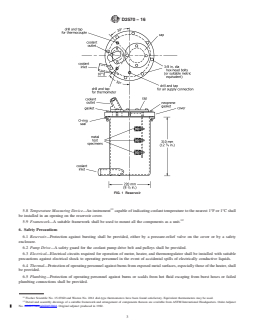
5.1 Reservoir—An assembly drawing of this component is shown in Fig. 1. The material of construction, representing that of
the engine cylinder block, shall be SAE G3500 Gray Iron for Automotive Castings. Install a right angle fitting on the top of the
reservoir for attachment of an air line. Install a shutoff valve in the air line to avoid backing up the solution into the pressure hose.
5.2 Automotive Components—These shall be those normally used with a 4, 6, or 8-cylinder automobile engine used in current
automobiles in the United States, in the 1.6 to 5.0-L (98 to 305-in. ) range of piston displacement. General characteristics shall
be as follows:
5.2.1 Radiator—Brass, GM part No. 3056740 (cross flow), with coolant recovery tank. An aluminum radiator, GM part No.
3093506, may be used subject to mutual agreement of the parties involved.
5.2.2 Radiator Pressure Cap—Normally open 12 to 15 psi (80 to 100 kPa), GM part No. 6410427.
5.2.3 Coolant Pump —GM part No. 14033483 (aluminum matching front end cover). GM part No. 14033526 (aluminum
provides back cover), coolant discharge parts and mounting for pump.
5.2.4 Coolant Outlet—GM part No. 14033198 (aluminum).
5.2.5 Hoses—Reinforced elastomer, meeting the requirements of SAE J20e.
5.2.6 Hose Clamps—Preferably worm-screw type (constant tension may be used).
5.2.7 Hose Sight Tube—A borosilicate glass sight tube shall be installed in the top radiator hose. The tube should have a slight
bead on each end. (The primary purpose of the sight tube is to see that there is entrained air in the system.)
5.3 Pipe Fittings—The preferred material for the fittings required in the hose connections between pump discharge ports and
reservoir inlet is malleable cast iron. A satisfactory alternative is steel.
5.4 Electric Motor—1 ⁄2 hp (1.1 kW) or larger, drip-proof or explosion-proof in accordance with local safety regulations.
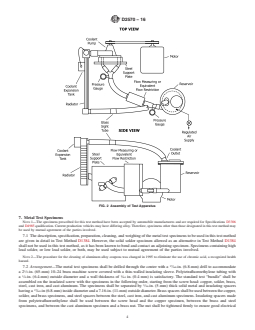
5.5 Pulleys and Drive Belt—Sized to drive the pump at aspeed a speed that will produce a flow rate of 20 to 25 gal/min (1.3
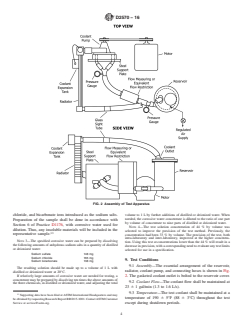
to 1.6 L/s) for the General Motors 173-in. (2.8-L) V-6 engine. The flow rate at operating temperature may be determined by a
flow measurement device located between pump discharge and reservoir inlet, as indicated in Fig. 2. The pressure drop between
pump discharge and reservoir inlet, measured by the pressure gages shown in Fig. 2, must be maintained when the flow
measurement device is removed from the system. This can be done by substituting for the flow measurement device a variable-flow
restriction, such as a valve, which can be adjusted to produce the same pressure drop as that measured across the flow measurement
device at the specified flow rate.
5.6 Electric Heater—About 2000 W, either a hot plate installed under the reservoir or a circumferential, metal-clad heater
band around the reservoir.
5.7 Thermoregulator—A suitable temperature regulator shall be used to maintain the coolant temperature between the limits
specified by 9.3. The sensing unit of the regulator shall be installed in an opening on the reservoir cover.
Detail drawings are available from ASTM International Headquarters. Order Adjunct No. ADJ257001ADJD257001. Original adjunct produced in 1982. Reservoirs of
cast iron or cast aluminum, made in accordance with these drawings, may be obtained from Commercial Machine Service, 1099 Touhy Ave., Elk Grove Village, IL 60007,
(847) 806-1901.
Aluminum or iron may be used if mutually agreed upon between the parties involved.
Gates “Vulco Straight” bulk-length radiator hose, Product Type 4178, has been found satisfactory. Equivalent radiator hoses may be used.
Fischer and Porter Series 10A2235A Ratosight Flow Rate Indicator, 4 to 50 gal/min (0.3 to 3.0 L/s), of bronze construction, has been found satisfactory. Equivalent flow
measuring devices may be used.
Chromalox No. ROPH-204 has been found satisfactory. Equivalent hot plates may be used.
Chromalox No. HB-8415 has been found satisfactory. Equivalent heater bands may be used.
Chromalox No. AR-2524P has been found satisfactory. Equivalent thermoregulators may be used.
D2570 − 16
FIG. 1 Reservoir
5.8 Temperature Measuring Device—An instrument capable of indicating coolant temperature to the nearest 1°F or 1°C shall
be installed in an opening on the reservoir cover.
5.9 Framework—A suitable framework shall be used to mount all the components as a unit.
6. Safety Precautions
6.1 Reservoir—Protection against bursting shall be provided, either by a pressure-relief valve on the cover or by a safety
enclosure.
6.2 Pump Drive—A safety guard for the coolant pump drive belt and pulleys shall be provided.
6.3 Electrical—Electrical circuits required for operation of motor, heater, and thermoregulator shall be installed with suitable
precautions against electrical shock to operating personnel in the event of accidental spills of electrically conductive liquids.
6.4 Thermal—Protection of operating personnel against burns from exposed metal surfaces, especially those of the heater, shall
be provided.
6.5 Plumbing—Protection of operating personnel against burns or scalds from hot fluid escaping from burst hoses or failed
plumbing connections shall be provided.
Fischer Scientific No. 15-076D and Weston No. 2261 dial-type thermometers have been found satisfactory. Equivalent thermometers may be used.
Detail and assembly drawings of a suitable framework and arrangement of components thereon are available from ASTM International Headquarters. Order Adjunct
No. ADJ257002ADJD257002. Original adjunct produced in 1982.
D2570 − 16
FIG. 2 Assembly of Test Apparatus
7. Metal Test Specimens
NOTE 1—The specimens prescribed for this test method have been accepted by automobile manufacturers and are required for Specifications D3306
and D4985 qualification. Current production vehicles may have differing alloy. Therefore, specimens other than those designated in this test method may
be used by mutual agreement of the parties involved.
7.1 The description, specification, preparation, cleaning, and weighing of the metal test specimens to be used in this test method
are given in detail in Test Method D1384. However, the solid solder specimen allowed as an alternative in Test Method D1384
shall not be used in this test method, as it has been known to bend and contact an adjoining specimen. Specimens containing high
lead solder, or low lead solder, or both, may be used subject to mutual agreement of the parties involved.
NOTE 2—The procedure for the cleaning of aluminum alloy coupons was changed in 1995 to eliminate the use of chromic acid, a recognized health
hazard.
7.2 Arrangement—The metal test specimens shall be drilled through the center with a ⁄64-in. (6.8-mm) drill to accommodate
a 2 ⁄2-in. (65-mm) 10–24 brass machine screw covered with a thin-walled insulating sleeve. Polytetrafluoroethylene tubing with
1 1
a ⁄4-in. (6.4-mm) outside diameter and a wall thickness of ⁄64 in. (0.4 mm) is satisfactory. The standard test “bundle” shall be
assembled on the insulated screw with the specimens in the following order, starting from the screw head: copper, solder, brass,
steel, cast iron, and cast aluminum. The specimens shall be separated by ⁄16-in. (5-mm) thick solid metal and insulating spacers
having a ⁄64-in (6.8-mm) inside diameter and a 7.16-in. (11-mm) outside diameter. Brass spacers shall be used between the copper,
solder, and brass specimens, and steel spacers between the steel, cast iron, and cast aluminum specimens. Insulating spacers made
from polytetrafluoroethylene shall be used between the screw head and the copper specimen, between the brass and steel
specimens, and between the cast aluminum specimen and a brass nut. The nut shall be tightened firmly to ensure good electrical
D2570 − 16
contact between the test specimens in each section of the bundle. As shown in Fig. 3, each bundle shall be positioned
...