

ASTM E143-20
(Test Method)Standard Test Method for Shear Modulus at Room Temperature
General Information
- Abstract
SIGNIFICANCE AND USE
5.1 Shear modulus is a material property useful in calculating compliance of structural materials in torsion provided they follow Hooke's law, that is, the angle of twist is proportional to the applied torque. Examples of the use of shear modulus are in the design of rotating shafts and helical compression springs.
5.2 The procedural steps and precision of the apparatus and the test specimens should be appropriate to the shape and the material type, since the method applies to a wide variety of materials and sizes.
5.3 Precise determination of shear modulus depends on the numerous variables that may affect such determinations.
5.3.1 These factors include characteristics of the specimen such as residual stress, concentricity, wall thickness in the case of tubes, deviation from nominal value, previous strain history, and specimen dimension.
5.3.2 Testing conditions that influence the results include axial position of the specimen, temperature and temperature variations, and maintenance of the apparatus.
5.3.3 Interpretation of data also influences results.
SCOPE
1.1 This test method covers the determination of shear modulus of structural materials. This test method is limited to materials in which, and to stresses at which, creep is negligible compared to the strain produced immediately upon loading. Elastic properties such as shear modulus, Young's modulus, and Poisson's ratio are not determined routinely and are generally not specified in materials specifications.
1.2 For materials that follow nonlinear elastic stress-strain behavior, the value of tangent or chord shear modulus is useful for estimating the change in torsional strain to corresponding stress for a specified stress or stress-range, respectively. Such determinations are, however, outside the scope of this standard. (See for example Ref (1).)2
1.3 Units—The values stated in SI units are to be regarded as standard. No other units of measurement are included in this standard.
1.4 This standard does not purport to address all of the safety concerns, if any, associated with its use. It is the responsibility of the user of this standard to establish appropriate safety, health, and environmental practices and determine the applicability of regulatory limitations prior to use.
1.5 This international standard was developed in accordance with internationally recognized principles on standardization established in the Decision on Principles for the Development of International Standards, Guides and Recommendations issued by the World Trade Organization Technical Barriers to Trade (TBT) Committee.
- Status
- Published
- Publication Date
- 30-Nov-2020
- Technical Committee
- E28 - Mechanical Testing
- Drafting Committee
- E28.04 - Uniaxial Testing

Overview
ASTM E143-20 specifies the Standard Test Method for Shear Modulus at Room Temperature. Developed by ASTM International, this standard provides guidelines for the determination of the shear modulus of structural materials under conditions where creep is negligible and the material follows Hooke’s law. The test method is essential for accurate mechanical characterization in engineering and quality assurance, particularly for materials and components subjected to torsion.
This standard applies to a wide range of material shapes and sizes, including solid cylinders and tubes, and is focused on testing at room temperature using SI units as the standard for measurement. It is crucial for engineers and laboratories involved in mechanical testing, design, and verification of material properties.
Key Topics
Significance and Use
- Shear modulus (also called modulus of rigidity or torsional modulus) is a fundamental material property used in the calculation of compliance and deformation in structures subjected to torsion.
- Accurate determination is critical for the design of rotating shafts, helical compression springs, and other torsion-loaded structural elements.
- The test must be performed under conditions where immediate elastic strain dominates and creep behavior is negligible.
Factors Influencing Results
Several factors affect the precision and applicability of the test method, including:
- Physical characteristics of test specimens (e.g., residual stress, concentricity, diameter/wall thickness uniformity, previous strain history)
- Testing conditions (e.g., specimen alignment, torque measurement, temperature control)
- Interpretation and reporting of test data
Apparatus and Procedure
- Torsion testing machines must be calibrated to ensure torque readings fall within the required range and maintain accuracy.
- Gripping methods must avoid introducing bending or compressive forces, especially for tubular specimens.
- The measurement of torque and angle of twist is performed either incrementally or continuously, and data are analyzed to determine shear modulus via stress-strain or torque-twist diagrams.
Applications
ASTM E143-20 is widely used in materials science, structural engineering, and quality assurance roles:
- Design validation of components such as drive shafts, springs, and other torsion-sensitive parts where shear modulus is critical to performance and safety
- Material qualification and comparison, supporting the selection of appropriate materials based on mechanical properties
- Quality control and acceptance testing in manufacturing environments for both metallic and non-metallic structural materials
The test method is essential in contexts where elastic properties like shear modulus are not routinely specified in material specifications, providing a standardized method to obtain this information for engineering calculations.
Related Standards
Several ASTM standards are referenced or provide additional procedures relevant to ASTM E143-20, including:
- ASTM E6 - Terminology Relating to Methods of Mechanical Testing
- ASTM E8/E8M - Test Methods for Tension Testing of Metallic Materials
- ASTM E111 - Test Method for Young’s Modulus, Tangent Modulus, and Chord Modulus
- ASTM E1012 - Practice for Verification of Testing Frame and Specimen Alignment Under Tensile and Compressive Axial Force Application
- ASTM E2624 - Practice for Torque Calibration of Testing Machines
Understanding and implementing ASTM E143-20 helps ensure high precision and consistency in the measurement of shear modulus, enables reliable engineering designs, and supports compliance with international testing standards.
Relations
- Effective Date
- 01-Jan-2024
- Effective Date
- 01-Sep-2017
- Effective Date
- 15-Jul-2016
- Effective Date
- 01-Dec-2015
- Effective Date
- 01-Feb-2015
- Effective Date
- 01-Jun-2013
- Effective Date
- 01-Jun-2012
- Effective Date
- 01-Jun-2012
- Effective Date
- 01-Dec-2011
- Refers
ASTM E111-04(2010) - Standard Test Method for Young's Modulus, Tangent Modulus, and Chord Modulus - Effective Date
- 15-Sep-2010
- Effective Date
- 15-May-2009
- Effective Date
- 15-May-2009
- Effective Date
- 01-Apr-2009
- Effective Date
- 01-Apr-2009
- Effective Date
- 01-Jan-2009
Get Certified
Connect with accredited certification bodies for this standard

Element Materials Technology
Materials testing and product certification.

Inštitut za kovinske materiale in tehnologije
Institute of Metals and Technology. Materials testing, metallurgical analysis, NDT.
Sponsored listings
Frequently Asked Questions
ASTM E143-20 is a standard published by ASTM International. Its full title is "Standard Test Method for Shear Modulus at Room Temperature". This standard covers: SIGNIFICANCE AND USE 5.1 Shear modulus is a material property useful in calculating compliance of structural materials in torsion provided they follow Hooke's law, that is, the angle of twist is proportional to the applied torque. Examples of the use of shear modulus are in the design of rotating shafts and helical compression springs. 5.2 The procedural steps and precision of the apparatus and the test specimens should be appropriate to the shape and the material type, since the method applies to a wide variety of materials and sizes. 5.3 Precise determination of shear modulus depends on the numerous variables that may affect such determinations. 5.3.1 These factors include characteristics of the specimen such as residual stress, concentricity, wall thickness in the case of tubes, deviation from nominal value, previous strain history, and specimen dimension. 5.3.2 Testing conditions that influence the results include axial position of the specimen, temperature and temperature variations, and maintenance of the apparatus. 5.3.3 Interpretation of data also influences results. SCOPE 1.1 This test method covers the determination of shear modulus of structural materials. This test method is limited to materials in which, and to stresses at which, creep is negligible compared to the strain produced immediately upon loading. Elastic properties such as shear modulus, Young's modulus, and Poisson's ratio are not determined routinely and are generally not specified in materials specifications. 1.2 For materials that follow nonlinear elastic stress-strain behavior, the value of tangent or chord shear modulus is useful for estimating the change in torsional strain to corresponding stress for a specified stress or stress-range, respectively. Such determinations are, however, outside the scope of this standard. (See for example Ref (1).)2 1.3 Units—The values stated in SI units are to be regarded as standard. No other units of measurement are included in this standard. 1.4 This standard does not purport to address all of the safety concerns, if any, associated with its use. It is the responsibility of the user of this standard to establish appropriate safety, health, and environmental practices and determine the applicability of regulatory limitations prior to use. 1.5 This international standard was developed in accordance with internationally recognized principles on standardization established in the Decision on Principles for the Development of International Standards, Guides and Recommendations issued by the World Trade Organization Technical Barriers to Trade (TBT) Committee.
SIGNIFICANCE AND USE 5.1 Shear modulus is a material property useful in calculating compliance of structural materials in torsion provided they follow Hooke's law, that is, the angle of twist is proportional to the applied torque. Examples of the use of shear modulus are in the design of rotating shafts and helical compression springs. 5.2 The procedural steps and precision of the apparatus and the test specimens should be appropriate to the shape and the material type, since the method applies to a wide variety of materials and sizes. 5.3 Precise determination of shear modulus depends on the numerous variables that may affect such determinations. 5.3.1 These factors include characteristics of the specimen such as residual stress, concentricity, wall thickness in the case of tubes, deviation from nominal value, previous strain history, and specimen dimension. 5.3.2 Testing conditions that influence the results include axial position of the specimen, temperature and temperature variations, and maintenance of the apparatus. 5.3.3 Interpretation of data also influences results. SCOPE 1.1 This test method covers the determination of shear modulus of structural materials. This test method is limited to materials in which, and to stresses at which, creep is negligible compared to the strain produced immediately upon loading. Elastic properties such as shear modulus, Young's modulus, and Poisson's ratio are not determined routinely and are generally not specified in materials specifications. 1.2 For materials that follow nonlinear elastic stress-strain behavior, the value of tangent or chord shear modulus is useful for estimating the change in torsional strain to corresponding stress for a specified stress or stress-range, respectively. Such determinations are, however, outside the scope of this standard. (See for example Ref (1).)2 1.3 Units—The values stated in SI units are to be regarded as standard. No other units of measurement are included in this standard. 1.4 This standard does not purport to address all of the safety concerns, if any, associated with its use. It is the responsibility of the user of this standard to establish appropriate safety, health, and environmental practices and determine the applicability of regulatory limitations prior to use. 1.5 This international standard was developed in accordance with internationally recognized principles on standardization established in the Decision on Principles for the Development of International Standards, Guides and Recommendations issued by the World Trade Organization Technical Barriers to Trade (TBT) Committee.
ASTM E143-20 is classified under the following ICS (International Classification for Standards) categories: 77.040.10 - Mechanical testing of metals. The ICS classification helps identify the subject area and facilitates finding related standards.
ASTM E143-20 has the following relationships with other standards: It is inter standard links to ASTM E8/E8M-24, ASTM E2624-17, ASTM E8/E8M-16, ASTM E2624-15, ASTM E8/E8M-15, ASTM E8/E8M-13, ASTM E1012-12e1, ASTM E1012-12, ASTM E8/E8M-11, ASTM E111-04(2010), ASTM E6-09b, ASTM E6-09be1, ASTM E6-09a, ASTM E2624-09, ASTM E6-09. Understanding these relationships helps ensure you are using the most current and applicable version of the standard.
ASTM E143-20 is available in PDF format for immediate download after purchase. The document can be added to your cart and obtained through the secure checkout process. Digital delivery ensures instant access to the complete standard document.
Standards Content (Sample)
This international standard was developed in accordance with internationally recognized principles on standardization established in the Decision on Principles for the
Development of International Standards, Guides and Recommendations issued by the World Trade Organization Technical Barriers to Trade (TBT) Committee.
Designation: E143 − 20
Standard Test Method for
Shear Modulus at Room Temperature
This standard is issued under the fixed designation E143; the number immediately following the designation indicates the year of
original adoption or, in the case of revision, the year of last revision.Anumber in parentheses indicates the year of last reapproval.A
superscript epsilon (´) indicates an editorial change since the last revision or reapproval.
1. Scope* E8/E8MTest Methods for Tension Testing of Metallic Ma-
terials
1.1 This test method covers the determination of shear
E111Test Method for Young’s Modulus, Tangent Modulus,
modulus of structural materials. This test method is limited to
and Chord Modulus
materialsinwhich,andtostressesatwhich,creepisnegligible
E1012Practice for Verification of Testing Frame and Speci-
compared to the strain produced immediately upon loading.
men Alignment Under Tensile and Compressive Axial
Elastic properties such as shear modulus, Young’s modulus,
Force Application
and Poisson’s ratio are not determined routinely and are
E2624Practice for Torque Calibration of Testing Machines
generally not specified in materials specifications.
1.2 For materials that follow nonlinear elastic stress-strain
3. Terminology
behavior,thevalueoftangentorchordshearmodulusisuseful
3.1 Definitions:
for estimating the change in torsional strain to corresponding
stress for a specified stress or stress-range, respectively. Such 3.1.1 Definitions that appear in Terminology E6 apply to
this test method, including accuracy, chord modulus, creep,
determinationsare,however,outsidethescopeofthisstandard.
(See for example Ref (1).) eccentricity, Poisson’s ratio, proportional limit, resolution,
shear modulus, shear strain, stress-strain curve, stress-strain
1.3 Units—The values stated in SI units are to be regarded
diagram, tangent modulus, testing machine, torsional stress,
asstandard.Nootherunitsofmeasurementareincludedinthis
yield strength, and Young’s modulus.
standard.
−2
3.1.2 shear modulus, G, [FL ],n—the ratio of shear stress
1.4 This standard does not purport to address all of the
tocorrespondingshearstrainbelowtheproportionallimit,also
safety concerns, if any, associated with its use. It is the
called torsional modulus and modulus of rigidity.
responsibility of the user of this standard to establish appro-
priate safety, health, and environmental practices and deter-
3.1.2.1 Discussion—Thevalueofshearmoduluscandepend
mine the applicability of regulatory limitations prior to use.
on the direction in which it is measured if the material is not
1.5 This international standard was developed in accor-
isotropic. Wood, many plastics, and certain metals are mark-
dance with internationally recognized principles on standard-
edlyanisotropic.Deviationsfromisotropyshouldbesuspected
ization established in the Decision on Principles for the
if the shear modulus, G, differs from that determined by
Development of International Standards, Guides and Recom-
substituting independently measured values of Young’s
mendations issued by the World Trade Organization Technical
modulus, E, and Poisson’s ratio, µ, in the relation
Barriers to Trade (TBT) Committee.
E
G 5 (1)
2. Referenced Documents 2 11µ
~ !
3.1.2.2 Discussion—When reporting values of shear
2.1 ASTM Standards:
modulus, the stress range over which it is measured should be
E6Terminology Relating to Methods of Mechanical Testing
stated.
3.1.3 torque,[FL],n—amoment(offorces)thatproducesor
This test method is under the jurisdiction of ASTM Committee E28 on
tends to produce rotation or torsion.
Mechanical Testing and is the direct responsibility of Subcommittee E28.04 on
Uniaxial Testing.
−2
3.1.4 torsional stress [FL ],n—the shear stress in a body,
Current edition approved Dec. 1, 2020. Published January 2021. Originally
approved in 1959. Last previous edition approved in 20138 as E143– 13. DOI: in a plane normal to the axis or rotation, resulting from the
10.1520/E0143-20.
application of torque.
The boldface numbers in parentheses refer to a list of references at the end of
this standard. 3.2 Definitions of Terms Specific to This Standard:
For referenced ASTM standards, visit the ASTM website, www.astm.org, or
3.2.1 angle of twist (torsion test)—the angle of relative
contact ASTM Customer Service at service@astm.org. For Annual Book of ASTM
rotation measured in a plane normal to the torsion specimen’s
Standards volume information, refer to the standard’s Document Summary page on
the ASTM website. longitudinal axis over the gauge length.
*A Summary of Changes section appears at the end of this standard
Copyright © ASTM International, 100 Barr Harbor Drive, PO Box C700, West Conshohocken, PA 19428-2959. United States
E143 − 20
4. Summary of Test Method where:
D = outside diameter, and
4.1 The cylindrical or tubular test specimen is loaded either o
D = inside diameter.
incrementally or continuously by applying an external torque i
so as to cause a uniform twist within the gauge length.
7. Apparatus
4.1.1 Changes in torque and the corresponding changes in
7.1 The torsion testing machine shall conform to the re-
angle of twist are determined either incrementally or continu-
quirements of Practice E2624.
ously. The appropriate slope is then calculated from the shear
stress-strain curve, which may be derived under conditions of
7.2 Grips—Theendsofthespecimenshallbegrippedfirmly
either increasing or decreasing torque (increasing from pre-
between the jaws of a testing machine that have been designed
torque to maximum torque or decreasing from maximum
to produce a state of uniform twist within the gauge length. In
torque to pretorque).
the case of tubes, closely fitting rigid plugs, such as are shown
in Fig. 11 (Metal Plugs forTestingTubular Specimens) ofTest
5. Significance and Use
Methods E8/E8M, may be inserted in the ends to permit
5.1 Shear modulus is a material property useful in calculat-
tightening the grips without crushing the specimen. The grips
ing compliance of structural materials in torsion provided they
shall be such that axial alignment can be obtained and
followHooke’slaw,thatis,theangleoftwistisproportionalto
maintained in order to prevent the application of bending
the applied torque. Examples of the use of shear modulus are
moments. One grip shall be free to move axially to prevent the
inthedesignofrotatingshaftsandhelicalcompressionsprings.
application of axial forces.
5.2 The procedural steps and precision of the apparatus and
7.3 Twist Gauges—The angle of twist may be measured by
the test specimens should be appropriate to the shape and the
two pairs of lightweight but rigid arms, each pair fastened
material type, since the method applies to a wide variety of
diametrically to a ring attached at three points to the section at
materials and sizes.
an end of the gauge length and at least one diameter removed
from the grips. The relative rotational displacement of the two
5.3 Precise determination of shear modulus depends on the
sections may be measured by mechanical, optical, or electrical
numerous variables that may affect such determinations.
means; for example, the displacement of a pointer on one arm
5.3.1 These factors include characteristics of the specimen
such as residual stress, concentricity, wall thickness in the case relative to a scale on the other (2), or the reflection of a light
beamfrommirrorsorprismsattachedtothearms (3).Readings
oftubes,deviationfromnominalvalue,previousstrainhistory,
and specimen dimension. shouldbetakenforbothsetsofarmsandaveragedtoeliminate
errors due to bending of the specimen (see 12.3.2).
5.3.2 Testing conditions that influence the results include
axial position of the specimen, temperature and temperature
8. Test Specimens
variations, and maintenance of the apparatus.
5.3.3 Interpretation of data also influences results.
8.1 Selection and Preparation of Specimens:
8.1.1 Specimensshallbechosenfromsound,cleanmaterial.
6. General Considerations
NOTE 1—Slight imperfections near the surface, such as fissures that
6.1 Shear modulus for a specimen of circular cross-section
would have negligible effect in determining Young’s modulus, can cause
is given by the equation
appreciable errors in shear modulus.
TL
8.1.2 Inthecaseofmachinedspecimenstakecaretoprevent
G 5 (2)
Jθ
changing the properties of the material at the surface of the
specimen.
where:
8.1.3 Specimens in the form of solid cylinders should be
G = shear modulus of the specimen,
straightandofuniformdiameterforalengthequaltothegauge
T = torque,
length plus two to four
...
This document is not an ASTM standard and is intended only to provide the user of an ASTM standard an indication of what changes have been made to the previous version. Because
it may not be technically possible to adequately depict all changes accurately, ASTM recommends that users consult prior editions as appropriate. In all cases only the current version
of the standard as published by ASTM is to be considered the official document.
Designation: E143 − 13 E143 − 20
Standard Test Method for
Shear Modulus at Room Temperature
This standard is issued under the fixed designation E143; the number immediately following the designation indicates the year of
original adoption or, in the case of revision, the year of last revision. A number in parentheses indicates the year of last reapproval. A
superscript epsilon (´) indicates an editorial change since the last revision or reapproval.
1. Scope*
1.1 This test method covers the determination of shear modulus of structural materials. This test method is limited to materials
in which, and to stresses at which, creep is negligible compared to the strain produced immediately upon loading. Elastic properties
such as shear modulus, Young’s modulus, and Poisson’s ratio are not determined routinely and are generally not specified in
materials specifications. Precision and bias statements for these test methods are therefore not available.
1.2 For materials that follow nonlinear elastic stress-strain behavior, the value of tangent or chord shear modulus is useful for
estimating the change in torsional strain to corresponding stress for a specified stress or stress-range, respectively. Such
determinations are, however, outside the scope of this standard. (See for example Ref (1).)
1.3 Units—The values stated in inch-poundSI units are to be regarded as standard. The values given in parentheses are
mathematical conversions to SI units that are provided for information only and are not considered No other units of measurement
are included in this standard.
1.4 This standard may involve hazardous materials, operations, and equipment. This standard does not purport to address all
of the safety concerns, if any, associated with its use. It is the responsibility of the user of this standard to establish appropriate
safety safety, health, and healthenvironmental practices and determine the applicability of regulatory limitations prior to use.
1.5 This international standard was developed in accordance with internationally recognized principles on standardization
established in the Decision on Principles for the Development of International Standards, Guides and Recommendations issued
by the World Trade Organization Technical Barriers to Trade (TBT) Committee.
2. Referenced Documents
2.1 ASTM Standards:
E6 Terminology Relating to Methods of Mechanical Testing
E8/E8M Test Methods for Tension Testing of Metallic Materials
E111 Test Method for Young’s Modulus, Tangent Modulus, and Chord Modulus
E1012 Practice for Verification of Testing Frame and Specimen Alignment Under Tensile and Compressive Axial Force
Application
E2624 Practice for Torque Calibration of Testing Machines
3. Terminology
3.1 Definitions:
This test method is under the jurisdiction of ASTM Committee E28 on Mechanical Testing and is the direct responsibility of Subcommittee E28.04 on Uniaxial Testing.
Current edition approved Nov. 1, 2013Dec. 1, 2020. Published May 2014January 2021. Originally approved in 1959. Last previous edition approved in 200820138 as
E143– 02(2008).13. DOI: 10.1520/E0143-13.10.1520/E0143-20.
The boldface numbers in parentheses refer to a list of references at the end of this standard.
For referenced ASTM standards, visit the ASTM website, www.astm.org, or contact ASTM Customer Service at service@astm.org. For Annual Book of ASTM Standards
volume information, refer to the standard’s Document Summary page on the ASTM website.
*A Summary of Changes section appears at the end of this standard
Copyright © ASTM International, 100 Barr Harbor Drive, PO Box C700, West Conshohocken, PA 19428-2959. United States
E143 − 20
3.1.1 Definitions that appear in Terminology E6 apply to this test method, including accuracy, chord modulus, creep, eccentricity,
Poisson’s ratio, proportional limit, resolution, shear modulus, shear strain, stress-strain curve, stress-strain diagram, tangent
modulus, testing machine, torsional stress, yield strength, and Young’s modulus. Terms common to mechanical testing.
3.1.1 angle of twist (torsion test)— the angle of relative rotation measured in a plane normal to the torsion specimen’s longitudinal
axis over the gauge length.
−2
3.1.2 shear modulus, G, [FL ],n—the ratio of shear stress to corresponding shear strain below the proportional limit, also called
torsional modulus and modulus of rigidity. (See Fig. 1.)
3.1.2.1 Discussion—
The value of shear modulus maycan depend on the direction in which it is measured if the material is not isotropic. Wood, many
plastics, and certain metals are markedly anisotropic. Deviations from isotropy should be suspected if the shear modulus, G, differs
from that determined by substituting independently measured values of Young’s modulus, E, and Poisson’s ratio, μ, in the relation
E
G 5 (1)
2 11μ
~ !
3.1.2.2 Discussion—
In general, it is advisable, in When reporting values of shear modulus to state modulus, the stress range over which it is
measured.measured should be stated.
3.1.3 torque, [FL],n—a moment (of forces) that produces or tends to produce rotation or torsion.
−2
3.1.4 torsional stress [FL ],n—the shear stress in a body, in a plane normal to the axis or rotation, resulting from the application
of torque.
3.2 Definitions of Terms Specific to This Standard:
3.2.1 angle of twist (torsion test)—the angle of relative rotation measured in a plane normal to the torsion specimen’s longitudinal
axis over the gauge length.
4. Summary of Test Method
4.1 The cylindrical or tubular test specimen is loaded either incrementally or continuously by applying an external torque so as
to cause a uniform twist within the gauge length.
4.1.1 Changes in torque and the corresponding changes in angle of twist are determined either incrementally or continuously. The
appropriate slope is then calculated from the shear stress-strain curve, which may be derived under conditions of either increasing
or decreasing torque (increasing from pretorque to maximum torque or decreasing from maximum torque to pretorque).
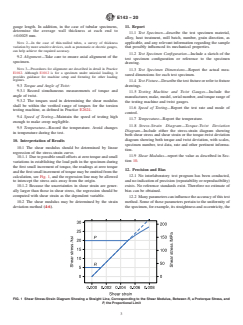
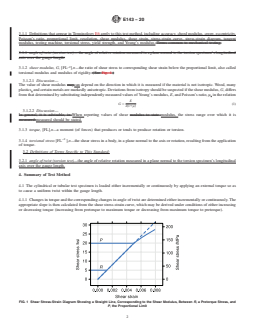
FIG. 1 Shear Stress-Strain Diagram Showing a Straight Line, Corresponding to the Shear Modulus, Between R, a Pretorque Stress, and
P, the Proportional Limit
E143 − 20
5. Significance and Use
5.1 Shear modulus is a material property useful in calculating compliance of structural materials in torsion provided they follow
Hooke’s law, that is, the angle of twist is proportional to the applied torque. Examples of the use of shear modulus are in the design
of rotating shafts and helical compression springs.
NOTE 1—For materials that follow nonlinear elastic stress-strain behavior, the value of tangent or chord shear modulus is useful for estimating the change
in torsional strain to corresponding stress for a specified stress or stress-range, respectively. Such determinations are, however, outside the scope of this
standard. (See for example Ref (1).)
5.2 The procedural steps and precision of the apparatus and the test specimens should be appropriate to the shape and the material
type, since the method applies to a wide variety of materials and sizes.
5.3 Precise determination of shear modulus depends on the numerous variables that may affect such determinations.
5.3.1 These factors include characteristics of the specimen such as residual stress, concentricity, wall thickness in the case of tubes,
deviation from nominal value, previous strain history, and specimen dimension.
5.3.2 Testing conditions that influence the results include axial position of the specimen, temperature and temperature variations,
and maintenance of the apparatus.
5.3.3 Interpretation of data also influences results.
6. General Considerations
6.1 Shear modulus for a specimen of circular cross-section is given by the equation
G 5 TL/Jθ (2)
TL
G 5 (2)
Jθ
where:
G = shear modulus of the specimen,
T = torque,
L = gauge length,
J = polar moment of inertia of the section about its center, and
θ = angle of twist, in radians.
6.1.1 For a solid cylinder:
J 5πD /32 (3)
πD
J 5 (3)
where:
D = diameter.
6.1.2 For a tube:
π
4 4
J 5 ~D 2 D ! (4)
0 i
π
4 4
J 5 ~D 2 D ! (4)
o i
See any standard text in Mechanics of Materials.
E143 − 20
where:
D = outside diameter, and
D = outside diameter, and
o
D = inside diameter.
i
7. Apparatus
7.1 Testing Machine—The torsion testing machine, which is to be used for applying the required torque to the specimen, shall be
calibrated for the range of torques used in the determination. Corrections may be applied for demonstrated systematic errors. The
torques should be chosen such as to bring the error Δmachine shall conform to the requirements ofG inPractice E2624shear
modulus, due to errors in torque Δ.T, well within the required accuracy (see 12.3.1).
7.2 Grips—The ends of the specimen shall be gripped firmly between the jaws of a testing machine that have been designed to
produce a state of uniform twist within the gauge length. In the case of tubes, closely fitting rigid plugs, such as are shown in Fig.
11 (Metal Plugs for Testing Tubular Specimens) of Test Methods E8/E8M, may be inserted in the ends to permit tightening the
grips without crushing the specimen. The grips shall be such that axial alignment can be obtained and maintained in order to
prevent the application of bending moments. One grip shall be free to move axially to prevent the application of axial forces.
7.3 Twist Gages—Gauges—The angle of twist may be measured by two pairs of lightweight but rigid arms, each pair fastened
diametrically to a ring attached at three points to the section at an end of the gauge length and at least one diameter removed from
the grips. The relative rotational displacement of the two sections may be measured by mechanical, optical, or electrical means;
for example, the displacement of a pointer on one arm relative to a scale on the other (2), or the reflection of a light beam from
mirrors or prisms attached to the arms (3). Readings should be taken for both sets of arms and averaged to eliminate errors due
to bending of the specimen (see 12.3.2).
8. Test Specimens
8.1 Selection and Preparation of Specimens:
8.1.1 Specimens shall be chosen from sound, clean material.
NOTE 1—Slight imperfections near the surface, such as fissures that would have negligible effect in determining Young’s modulus, can cause appreciable
errors in shear modulus.
8.1.2 In the case of machined specimens take care to prevent changing the properties of the material at the surface of the specimen.
8.1.3 Specimens in the form of solid cylinders should be straight and of uniform diameter for a length equal to the gauge length
plus two to four diameters (see 12.2.1).
8.1.4 Specimens shall be chosen from sound, clean material. Slight imperfections near the surface, such as fissures that would have
negligible effect in determining Young’s modulus, may cause appreciable errors in shear modulus. In the case of machined
specimens take care to prevent changing the properties of the material at the surface of the specimen.tubes, the specimen should
be straight and of uniform diameter and wall thickness for a length equal to the gauge length plus at least four outside diameters
(see 12.2.1 and 12.3.2).
8.1.1.1 Specimens in the form of solid cylinders should be straight and of uniform diameter for a length equal to the gauge length
plus two to four diameters (see 12.2.1).
8.1.1.2 In the case of tubes, the specimen should be straight and of uniform diameter and wall thickness for a length equal to the
gauge length plus at least four outside diameters (see 12.2.1 and 12.3.2).
8.2 Length—The gauge length should be at least four diameters. T
...