

ASTM D2207-00(2021)
(Test Method)Standard Test Method for Bursting Strength of Leather by the Ball Method
General Information
- Abstract
SIGNIFICANCE AND USE
5.1 This test method is designed to measure the bursting strength of leather by measuring the force required to force a spherical ended plunger through a piece of leather. The bursting load and extension will be generally proportional to the diameter of the plunger. This test method is suitable for development, control and service evaluation of the leather. There is good correlation between bursting strength and tensile strength. This test method may not apply when the conditions of the test employed differ widely from those specified in the test method.
SCOPE
1.1 This test method covers the determination of the bursting strength of leather by the ball method. It may be used to test a large variety of leathers and leather products. It is particularly applicable to light- and medium-weight leathers, such as shoe uppers and garments. This test method does not apply to wet blue.
1.2 The values stated in inch-pound units are to be regarded as standard. The values given in parentheses are mathematical conversions to SI units that are provided for information only and are not considered standard.
1.3 This standard does not purport to address all of the safety concerns, if any, associated with its use. It is the responsibility of the user of this standard to establish appropriate safety, health, and environmental practices and determine the applicability of regulatory limitations prior to use.
1.4 This international standard was developed in accordance with internationally recognized principles on standardization established in the Decision on Principles for the Development of International Standards, Guides and Recommendations issued by the World Trade Organization Technical Barriers to Trade (TBT) Committee.
- Status
- Published
- Publication Date
- 31-Aug-2021
- Technical Committee
- D31 - Leather
- Drafting Committee
- D31.07 - Physical Properties


Overview
ASTM D2207-00(2021), Standard Test Method for Bursting Strength of Leather by the Ball Method, is a key international standard developed by ASTM International to assess the bursting strength of leather materials. This method utilizes a ball-shaped plunger to measure the force necessary to rupture a leather specimen. It is especially suitable for light- and medium-weight leathers, such as those used in shoe uppers and garments, and provides valuable data for product development, quality control, and service evaluation within the leather industry.
Key Topics
- Bursting Strength Evaluation: The core objective is to determine leather's ability to withstand splitting or rupture under pressure, mimicking real-world use.
- Ball Method: A spherical-ended plunger is forced through leather, and the force required for rupture (bursting load) is measured.
- Correlation to Tensile Strength: There is a strong relationship between a leather’s bursting strength and its tensile strength, making this test suitable for comprehensive performance analysis.
- Specimen and Testing: The method outlines specific requirements for specimen size, conditioning, and apparatus, ensuring standardized and repeatable results.
- Result Reporting: Measurements such as specimen thickness, bursting load, and extension at rupture must be accurately recorded and reported.
- Precision and Reproducibility: The standard addresses expected variations and reproducibility when tested by different operators or laboratories.
Applications
ASTM D2207-00(2021) is widely used across the leather and footwear industries, providing practical benefits in:
- Product Development: By assessing material performance, manufacturers can select and refine leather types for specific uses, particularly where flexibility and resistance to rupture are critical.
- Quality Control: Routine testing according to ASTM D2207 helps ensure that leather goods such as shoes, garments, and accessories meet consistent quality thresholds before reaching consumers.
- Service Evaluation: Understanding the bursting strength supports predictions about product durability during normal use.
- Regulatory and Specification Compliance: Adoption of internationally recognized methods fosters compliance with internal and external quality requirements, including those for government and defense contracts.
- Cross-industry Material Comparison: The method’s standardized approach enables objective comparison of leathers from various suppliers or production runs.
Related Standards
Organizations implementing ASTM D2207-00(2021) may also reference related standards to ensure comprehensive material assessment:
- ASTM D1517: Terminology Relating to Leather - Provides definitions of key terms used in leather standards.
- ASTM D1610: Practice for Conditioning Leather and Leather Products for Testing - Outlines specimen conditioning protocols.
- ASTM D1813: Test Method for Measuring Thickness of Leather Test Specimens - Specifies the accurate measurement of specimen thickness.
- ASTM D2209: Test Method for Tensile Strength of Leather - Tests leather’s resistance to tension, complementing bursting strength data.
Conclusion
Adopting ASTM D2207-00(2021) for testing the bursting strength of leather by the ball method ensures reliable, reproducible, and internationally recognized evaluation of leather material performance. Its widespread use helps organizations in the leather industry maintain product quality, comply with regulations, and deliver durable goods to market. For comprehensive quality assurance and material specification, ASTM D2207 should be used in conjunction with related standards and established industry practices.
Keywords: bursting strength, leather, ASTM D2207, ball method, quality control, leather testing, tensile strength, shoe uppers, garment leather.
Relations
- Effective Date
- 01-Dec-2015
- Refers
ASTM D1610-01(2013) - Standard Practice for Conditioning Leather and Leather Products for Testing - Effective Date
- 01-May-2013
- Effective Date
- 01-May-2013
- Effective Date
- 01-Oct-2010
- Effective Date
- 01-Oct-2010
- Effective Date
- 01-Apr-2010
- Refers
ASTM D1610-01(2007) - Standard Practice for Conditioning Leather and Leather Products for Testing - Effective Date
- 01-Apr-2007
- Effective Date
- 01-Oct-2006
- Effective Date
- 01-Apr-2005
- Effective Date
- 01-Sep-2004
- Effective Date
- 01-Sep-2004
- Effective Date
- 01-Sep-2004
- Effective Date
- 01-Apr-2004
- Effective Date
- 10-May-2001
- Effective Date
- 10-May-2001
Get Certified
Connect with accredited certification bodies for this standard

Control Union Certifications
Global certification for agriculture and sustainability.

Hohenstein Institut
Textile testing and certification.

Bureau Veritas Bangladesh
Bureau Veritas certification services in Bangladesh.
Sponsored listings
Frequently Asked Questions
ASTM D2207-00(2021) is a standard published by ASTM International. Its full title is "Standard Test Method for Bursting Strength of Leather by the Ball Method". This standard covers: SIGNIFICANCE AND USE 5.1 This test method is designed to measure the bursting strength of leather by measuring the force required to force a spherical ended plunger through a piece of leather. The bursting load and extension will be generally proportional to the diameter of the plunger. This test method is suitable for development, control and service evaluation of the leather. There is good correlation between bursting strength and tensile strength. This test method may not apply when the conditions of the test employed differ widely from those specified in the test method. SCOPE 1.1 This test method covers the determination of the bursting strength of leather by the ball method. It may be used to test a large variety of leathers and leather products. It is particularly applicable to light- and medium-weight leathers, such as shoe uppers and garments. This test method does not apply to wet blue. 1.2 The values stated in inch-pound units are to be regarded as standard. The values given in parentheses are mathematical conversions to SI units that are provided for information only and are not considered standard. 1.3 This standard does not purport to address all of the safety concerns, if any, associated with its use. It is the responsibility of the user of this standard to establish appropriate safety, health, and environmental practices and determine the applicability of regulatory limitations prior to use. 1.4 This international standard was developed in accordance with internationally recognized principles on standardization established in the Decision on Principles for the Development of International Standards, Guides and Recommendations issued by the World Trade Organization Technical Barriers to Trade (TBT) Committee.
SIGNIFICANCE AND USE 5.1 This test method is designed to measure the bursting strength of leather by measuring the force required to force a spherical ended plunger through a piece of leather. The bursting load and extension will be generally proportional to the diameter of the plunger. This test method is suitable for development, control and service evaluation of the leather. There is good correlation between bursting strength and tensile strength. This test method may not apply when the conditions of the test employed differ widely from those specified in the test method. SCOPE 1.1 This test method covers the determination of the bursting strength of leather by the ball method. It may be used to test a large variety of leathers and leather products. It is particularly applicable to light- and medium-weight leathers, such as shoe uppers and garments. This test method does not apply to wet blue. 1.2 The values stated in inch-pound units are to be regarded as standard. The values given in parentheses are mathematical conversions to SI units that are provided for information only and are not considered standard. 1.3 This standard does not purport to address all of the safety concerns, if any, associated with its use. It is the responsibility of the user of this standard to establish appropriate safety, health, and environmental practices and determine the applicability of regulatory limitations prior to use. 1.4 This international standard was developed in accordance with internationally recognized principles on standardization established in the Decision on Principles for the Development of International Standards, Guides and Recommendations issued by the World Trade Organization Technical Barriers to Trade (TBT) Committee.
ASTM D2207-00(2021) is classified under the following ICS (International Classification for Standards) categories: 59.140.30 - Leather and furs. The ICS classification helps identify the subject area and facilitates finding related standards.
ASTM D2207-00(2021) has the following relationships with other standards: It is inter standard links to ASTM D1517-15, ASTM D1610-01(2013), ASTM D1813-13, ASTM D1517-10, ASTM D1813-00(2010), ASTM D2209-00(2010), ASTM D1610-01(2007), ASTM D1517-06, ASTM D1813-00(2005), ASTM D2209-00(2004), ASTM D1517-04, ASTM D1517-04e1, ASTM D1517-99(2004), ASTM D1610-01, ASTM D1610-00. Understanding these relationships helps ensure you are using the most current and applicable version of the standard.
ASTM D2207-00(2021) is available in PDF format for immediate download after purchase. The document can be added to your cart and obtained through the secure checkout process. Digital delivery ensures instant access to the complete standard document.
Standards Content (Sample)
This international standard was developed in accordance with internationally recognized principles on standardization established in the Decision on Principles for the
Development of International Standards, Guides and Recommendations issued by the World Trade Organization Technical Barriers to Trade (TBT) Committee.
Designation: D2207 −00 (Reapproved 2021)
Standard Test Method for
Bursting Strength of Leather by the Ball Method
This standard is issued under the fixed designation D2207; the number immediately following the designation indicates the year of
original adoption or, in the case of revision, the year of last revision. A number in parentheses indicates the year of last reapproval. A
superscript epsilon (´) indicates an editorial change since the last revision or reapproval.
This standard has been approved for use by agencies of the U.S. Department of Defense.
1. Scope 3. Terminology
1.1 This test method covers the determination of the burst- 3.1 For definitions of leather terms used in this standard
ingstrengthofleatherbytheballmethod.Itmaybeusedtotest refer to Terminology D1517.
a large variety of leathers and leather products. It is particularly
applicable to light- and medium-weight leathers, such as shoe 4. Summary of Test Method
uppers and garments. This test method does not apply to wet
4.1 The leather specimen is mounted in the ball burst fixture
blue.
which is attached to a testing machine, as described in Test
1.2 The values stated in inch-pound units are to be regarded
Method D2209. The machine is operated at a jaw separation of
as standard. The values given in parentheses are mathematical 4 6 1 in./min. The maximum load registered is recorded. The
conversions to SI units that are provided for information only
bursting strength in lb/in. of thickness is calculated by dividing
and are not considered standard. the bursting load by the thickness of the specimen.
1.3 This standard does not purport to address all of the
5. Significance and Use
safety concerns, if any, associated with its use. It is the
responsibility of the user of this standard to establish appro-
5.1 This test method is designed to measure the bursting
priate safety, health, and environmental practices and deter-
strength of leather by measuring the force required to force a
mine the applicability of regulatory limitations prior to use.
spherical ended plunger through a piece of leather. The
1.4 This international standard was developed in accor-
bursting load and extension will be generally proportional to
dance with internationally recognized principles on standard-
the diameter of the plunger. This test method is suitable for
ization established in the Decision on Principles for the
development, control and service evaluation of the leather.
Development of International Standards, Guides and Recom-
There is good correlation between bursting strength and tensile
mendations issued by the World Trade Organization Technical
strength. This test method may not apply when the conditions
Barriers to Trade (TBT) Committee.
of the test employed differ widely from those specified in the
test method.
2. Referenced Documents
2.1 ASTM Standards: 6. Apparatus
D1517 Terminology Relating to Leather
6.1 Testing Machine, as described in Test Method D2209.
D1610 Practice for Conditioning Leather and Leather Prod-
NOTE 1—The machine shall have a cross-head speed of 4 6 1 in./min
ucts for Testing
(1.6 6 0.4 mm/s).
D1813 Test Method for Measuring Thickness of Leather
6.2 ThicknessGauge—Adead-mass type of thickness gauge
Test Specimens
as described in Test Method D1813.
D2209 Test Method for Tensile Strength of Leather
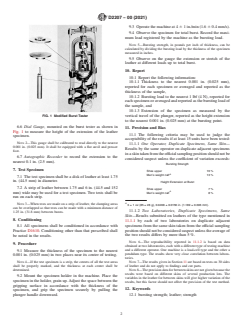
6.3 Burst Tester, as shown in Fig. 1. The diameter of the
ball or plunger shall be ⁄4 in. (0.250 in. (6.4 mm)).
This test method is under the jurisdiction ofASTM Committee D31 on Leather
6.4 Parts Required to Modify Burst Tester, as illustrated in
and is the direct responsibility of Subcommittee D31.07 onPhysical Properties This
test method was developed in cooperation with the American Leather Chemists Fig. 2, or equivalent.
Assn. (Standard Method E14 – 1965).
6.5 Die, Knife, or Shears, for cutting the test specimen.
Current edition approved Sept. 1, 2021. Published October 2021. Originally
approved in 1964. Last previous edition approved in 2015 as D2207 – 00 (2015).
DOI: 10.1520/D2207-00R21.
For referenced ASTM standards, visit the ASTM website, www.astm.org, or
contact ASTM Customer Service at service@astm.org. For Annual Book of ASTM A modified Scott Model W Burst Tester has been found satisfactory for this
Standards volume information, refer to the standard’s Document Summary page on purpose.Available from Precision Scientific, 3737 W. Cortland, Chicago, IL60647.
the ASTM website. Request Ball Burst Fixture Catalog, No. 26651.
Copyright © ASTM International, 100 Barr Harbor Drive, PO Box C700, West Conshohocken, PA 19428-2959. United States
D2207 − 00 (2021)
9.3 Operate the machine at 4 6 1 in./min (1.6 6 0.4 mm/s).
9.4 Observe the specimen for total burst. Record the maxi-
mum load registered by the machine as the bursting load.
NOTE 5—Bursting strength, in pounds per inch of thickness, can be
calculated by dividing the bursting load by the thickness of the specimen
measured in inches.
9.5 Observe on the gauge the extension or stretch of the
leather at different loads up to total burst.
10. Report
10.1 Report the following information:
10.1.1 Thickness to t
...