

ASTM D6096-21
(Specification)Standard Specification for Poly(Vinyl Chloride) Insulation for Wire and Cable, 90 °C Operation
General Information
- Abstract
ABSTRACT
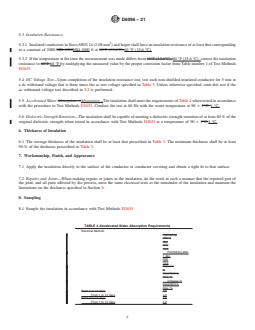
This specification covers poly(vinyl chloride) thermoplastic insulation for conducting wires and cables operating continuously at a specified conductor temperature, within the specified voltage range, and under wet or dry conditions. The insulation has potential low-temperature installation limitations. The prescribed tests cannot be performed unless the insulation is formed around a conductor, but these are done solely to determine the insulation properties and not to test the conductor or completed cable. Each test sample should be subjected to an ac and dc voltage withstand tests and insulation resistance test and should comply with the required values for unaged and aged requirements of tensile strength and elongation at rupture, heat shock, heat distortion, vertical flame test results, oil resistance, and cold bend test results. All joints and repairs in the insulation should be done in such a way as the affected parts meet the same electrical requirements as the rest of the insulation.
SCOPE
1.1 This specification covers a thermoplastic insulation of poly (vinyl chloride) or the copolymer of vinyl chloride and vinyl acetate. This insulation is recommended for use at conductor temperatures not in excess of 90 °C.
1.2 Depending on the thickness of the insulation, the maximum voltage used, and whether the location is wet or dry, this insulation is acceptable for use in 300 V (dry) and 600 V (wet or dry) power and control circuits.
1.3 This insulation has potential low-temperature installation limitations. Consult the manufacturer for specific recommendations for installation.
1.4 In many instances, the insulation material cannot be tested unless it has been formed around a conductor or cable. Therefore, tests are done on insulated wire or cable in this specification solely to determine the relevant property of the insulation material and not to test the conductor or completed cable.
1.5 The values stated in inch-pound units are to be regarded as standard. The values given in parentheses are mathematical conversions to SI units that are provided for information only and are not considered standard.
1.5.1 In some cases (including the title), temperatures are described in degrees Celsius only.
1.6 This international standard was developed in accordance with internationally recognized principles on standardization established in the Decision on Principles for the Development of International Standards, Guides and Recommendations issued by the World Trade Organization Technical Barriers to Trade (TBT) Committee.
- Status
- Published
- Publication Date
- 31-Dec-2020
- Technical Committee
- D09 - Electrical and Electronic Insulating Materials
- Drafting Committee
- D09.07 - Electrical Insulating Materials
Buy Documents


ASTM D6096-21 - Standard Specification for Poly(Vinyl Chloride) Insulation for Wire and Cable, 90 °C Operation
REDLINE ASTM D6096-21 - Standard Specification for Poly(Vinyl Chloride) Insulation for Wire and Cable, 90 °C Operation
Overview
ASTM D6096-21 is the standard specification developed by ASTM International for poly(vinyl chloride) (PVC) thermoplastic insulation used in wires and cables intended for operation at continuous conductor temperatures up to 90 °C. This standard is designed to ensure consistent quality, safety, and performance of PVC-insulated cables in electrical applications, particularly where conductor temperature and environmental factors are critical. The specification outlines testing, material requirements, application considerations, and compliance guidelines for manufacturers, installers, and end-users.
Key Topics
- Material Coverage: The standard applies to thermoplastic insulation made from poly(vinyl chloride) or a copolymer of vinyl chloride and vinyl acetate. This insulation is ideal for environmental conditions where the maximum continuous conductor temperature does not exceed 90 °C.
- Voltage Ratings: PVC insulation under this standard is suitable for power and control circuits rated up to 300 V (dry locations) and 600 V (wet or dry locations), depending on insulation thickness and installation environment.
- Testing and Performance:
- Physical and Mechanical Properties: Requirements include minimum tensile strength and elongation, both unaged and aged, as well as resistance to oil, heat deformation, and heat shock.
- Electrical Properties: Includes AC and DC voltage withstand tests, insulation resistance, accelerated water absorption, and dielectric strength retention.
- Flame, Oil, and Cold Resistance: Insulation must pass vertical flame tests and demonstrate resilience against oil and cold temperatures (cold bend tests).
- Installation Considerations: The standard notes potential low-temperature installation limitations for PVC insulation and recommends consulting manufacturers for specific guidelines.
- Sampling and Test Methods: References ASTM D2633 for standardized sampling and test procedures, ensuring accurate assessment of insulation quality on the finished wire or cable.
- Workmanship and Repairs: All joints or repairs must meet original electrical and mechanical requirements to preserve overall insulation integrity.
Applications
ASTM D6096-21 is widely referenced when specifying or evaluating PVC-insulated wire and cable for electrical installations requiring reliable insulation at elevated temperatures. Key applications include:
- Building wiring: Power and control circuits in residential, commercial, and industrial environments.
- Electrical panels and control systems: Where consistent, long-term insulation performance at 90 °C is required.
- Machine and equipment wiring: Especially for machines operating in environments subject to moisture, oil exposure, or temperature fluctuations.
- Utility and transport: Suitable for cables in conduits, above-ground installations, and various outdoor or damp conditions.
- Cable manufacturing and quality assurance: Ensures compliance with recognized safety and functional requirements.
Adhering to ASTM D6096-21 helps manufacturers, designers, and engineers achieve standardized performance, durability, and safety in PVC-insulated electrical wiring products.
Related Standards
To ensure comprehensive compliance and compatibility, consider the following related ASTM standards:
- ASTM D1711: Terminology Relating to Electrical Insulation
- ASTM D2633: Test Methods for Thermoplastic Insulations and Jackets for Wire and Cable
These supporting standards provide key definitions and detailed testing methodologies referenced in ASTM D6096-21.
Keywords: poly(vinyl chloride) insulation, PVC insulated wire, ASTM D6096-21, 90°C wire insulation, insulation resistance test, AC voltage test, DC voltage test, electrical cable standards, thermoplastic cable insulation, wire and cable testing, flame resistance, oil resistance, cold bend test.
Relations
- Effective Date
- 01-Mar-2024
- Effective Date
- 01-Nov-2015
- Effective Date
- 01-Nov-2014
- Effective Date
- 01-May-2014
- Effective Date
- 01-Nov-2013
- Effective Date
- 01-Aug-2011
- Effective Date
- 01-May-2008
- Effective Date
- 10-Mar-2002
- Effective Date
- 10-Oct-1999
Buy Documents
ASTM D6096-21 - Standard Specification for Poly(Vinyl Chloride) Insulation for Wire and Cable, 90 °C Operation
REDLINE ASTM D6096-21 - Standard Specification for Poly(Vinyl Chloride) Insulation for Wire and Cable, 90 °C Operation
Get Certified
Connect with accredited certification bodies for this standard

IMQ S.p.A. (Certification)
Italian electrical product certification.

SLG Prüf- und Zertifizierungs GmbH
German testing and certification body.

UL Solutions
Global safety science company with testing, inspection and certification.
Sponsored listings
Frequently Asked Questions
ASTM D6096-21 is a technical specification published by ASTM International. Its full title is "Standard Specification for Poly(Vinyl Chloride) Insulation for Wire and Cable, 90 °C Operation". This standard covers: ABSTRACT This specification covers poly(vinyl chloride) thermoplastic insulation for conducting wires and cables operating continuously at a specified conductor temperature, within the specified voltage range, and under wet or dry conditions. The insulation has potential low-temperature installation limitations. The prescribed tests cannot be performed unless the insulation is formed around a conductor, but these are done solely to determine the insulation properties and not to test the conductor or completed cable. Each test sample should be subjected to an ac and dc voltage withstand tests and insulation resistance test and should comply with the required values for unaged and aged requirements of tensile strength and elongation at rupture, heat shock, heat distortion, vertical flame test results, oil resistance, and cold bend test results. All joints and repairs in the insulation should be done in such a way as the affected parts meet the same electrical requirements as the rest of the insulation. SCOPE 1.1 This specification covers a thermoplastic insulation of poly (vinyl chloride) or the copolymer of vinyl chloride and vinyl acetate. This insulation is recommended for use at conductor temperatures not in excess of 90 °C. 1.2 Depending on the thickness of the insulation, the maximum voltage used, and whether the location is wet or dry, this insulation is acceptable for use in 300 V (dry) and 600 V (wet or dry) power and control circuits. 1.3 This insulation has potential low-temperature installation limitations. Consult the manufacturer for specific recommendations for installation. 1.4 In many instances, the insulation material cannot be tested unless it has been formed around a conductor or cable. Therefore, tests are done on insulated wire or cable in this specification solely to determine the relevant property of the insulation material and not to test the conductor or completed cable. 1.5 The values stated in inch-pound units are to be regarded as standard. The values given in parentheses are mathematical conversions to SI units that are provided for information only and are not considered standard. 1.5.1 In some cases (including the title), temperatures are described in degrees Celsius only. 1.6 This international standard was developed in accordance with internationally recognized principles on standardization established in the Decision on Principles for the Development of International Standards, Guides and Recommendations issued by the World Trade Organization Technical Barriers to Trade (TBT) Committee.
ABSTRACT This specification covers poly(vinyl chloride) thermoplastic insulation for conducting wires and cables operating continuously at a specified conductor temperature, within the specified voltage range, and under wet or dry conditions. The insulation has potential low-temperature installation limitations. The prescribed tests cannot be performed unless the insulation is formed around a conductor, but these are done solely to determine the insulation properties and not to test the conductor or completed cable. Each test sample should be subjected to an ac and dc voltage withstand tests and insulation resistance test and should comply with the required values for unaged and aged requirements of tensile strength and elongation at rupture, heat shock, heat distortion, vertical flame test results, oil resistance, and cold bend test results. All joints and repairs in the insulation should be done in such a way as the affected parts meet the same electrical requirements as the rest of the insulation. SCOPE 1.1 This specification covers a thermoplastic insulation of poly (vinyl chloride) or the copolymer of vinyl chloride and vinyl acetate. This insulation is recommended for use at conductor temperatures not in excess of 90 °C. 1.2 Depending on the thickness of the insulation, the maximum voltage used, and whether the location is wet or dry, this insulation is acceptable for use in 300 V (dry) and 600 V (wet or dry) power and control circuits. 1.3 This insulation has potential low-temperature installation limitations. Consult the manufacturer for specific recommendations for installation. 1.4 In many instances, the insulation material cannot be tested unless it has been formed around a conductor or cable. Therefore, tests are done on insulated wire or cable in this specification solely to determine the relevant property of the insulation material and not to test the conductor or completed cable. 1.5 The values stated in inch-pound units are to be regarded as standard. The values given in parentheses are mathematical conversions to SI units that are provided for information only and are not considered standard. 1.5.1 In some cases (including the title), temperatures are described in degrees Celsius only. 1.6 This international standard was developed in accordance with internationally recognized principles on standardization established in the Decision on Principles for the Development of International Standards, Guides and Recommendations issued by the World Trade Organization Technical Barriers to Trade (TBT) Committee.
ASTM D6096-21 is classified under the following ICS (International Classification for Standards) categories: 29.035.20 - Plastics and rubber insulating materials. The ICS classification helps identify the subject area and facilitates finding related standards.
ASTM D6096-21 has the following relationships with other standards: It is inter standard links to ASTM D1711-24, ASTM D1711-15, ASTM D1711-14a, ASTM D1711-14, ASTM D1711-13, ASTM D1711-11a, ASTM D1711-08, ASTM D1711-02, ASTM D1711-99. Understanding these relationships helps ensure you are using the most current and applicable version of the standard.
ASTM D6096-21 is available in PDF format for immediate download after purchase. The document can be added to your cart and obtained through the secure checkout process. Digital delivery ensures instant access to the complete standard document.
Standards Content (Sample)
This international standard was developed in accordance with internationally recognized principles on standardization established in the Decision on Principles for the
Development of International Standards, Guides and Recommendations issued by the World Trade Organization Technical Barriers to Trade (TBT) Committee.
Designation:D6096 −21
Standard Specification for
Poly(Vinyl Chloride) Insulation for Wire and Cable, 90 °C
Operation
This standard is issued under the fixed designation D6096; the number immediately following the designation indicates the year of
original adoption or, in the case of revision, the year of last revision. A number in parentheses indicates the year of last reapproval. A
superscript epsilon (´) indicates an editorial change since the last revision or reapproval.
1. Scope* 1.6 This international standard was developed in accor-
dance with internationally recognized principles on standard-
1.1 This specification covers a thermoplastic insulation of
ization established in the Decision on Principles for the
poly (vinyl chloride) or the copolymer of vinyl chloride and
Development of International Standards, Guides and Recom-
vinyl acetate. This insulation is recommended for use at
mendations issued by the World Trade Organization Technical
conductor temperatures not in excess of 90 °C.
Barriers to Trade (TBT) Committee.
1.2 Depending on the thickness of the insulation, the maxi-
mum voltage used, and whether the location is wet or dry, this
2. Referenced Documents
insulation is acceptable for use in 300 V (dry) and 600 V (wet
2.1 ASTM Standards:
or dry) power and control circuits.
D1711 Terminology Relating to Electrical Insulation
1.3 This insulation has potential low-temperature installa-
D2633 Test Methods for Thermoplastic Insulations and
tion limitations. Consult the manufacturer for specific recom-
Jackets for Wire and Cable
mendations for installation.
3. Terminology
1.4 In many instances, the insulation material cannot be
tested unless it has been formed around a conductor or cable.
3.1 Definitions:
Therefore, tests are done on insulated wire or cable in this 3.1.1 Fordefinitionsoftermsusedinthisspecification,refer
specification solely to determine the relevant property of the
to Terminology D1711.
insulation material and not to test the conductor or completed 3.2 Definitions of Terms Specific to This Standard:
cable.
3.2.1 aging (act of), n—exposure of materials to air or oil at
a temperature and for an interval of time as required in Table
1.5 The values stated in inch-pound units are to be regarded
1.
as standard. The values given in parentheses are mathematical
conversions to SI units that are provided for information only
4. Physical Properties
and are not considered standard.
1.5.1 In some cases (including the title), temperatures are 4.1 The insulation shall conform to the requirements for
physical properties prescribed in Table 1. (See Table 2 for
described in degrees Celsius only.
optional oil resistance requirements.)
This specification is under the jurisdiction of ASTM Committee D09 on
Electrical and Electronic Insulating Materials and is the direct responsibility of
Subcommittee D09.07 on Electrical Insulating Materials. For referenced ASTM standards, visit the ASTM website, www.astm.org, or
Current edition approved Jan. 1, 2021. Published February 2021. Originally contact ASTM Customer Service at service@astm.org. For Annual Book of ASTM
approved in 1997. Last previous edition approved in 2016 as D6096 – 11 (2016). Standards volume information, refer to the standard’s Document Summary page on
DOI: 10.1520/D6096-21. the ASTM website.
*A Summary of Changes section appears at the end of this standard
Copyright © ASTM International, 100 Barr Harbor Drive, PO Box C700, West Conshohocken, PA 19428-2959. United States
D6096−21
TABLE 1 Physical Properties Requirements for Insulation
risers, it is possible that the minimum conductor sizes in Table
Unaged requirements: 3 are not strong enough.
Tensile strength, min, psi (MPa) 2000 (13.8)
5.2.2 The thicknesses given in Table 3 apply to aerial cables
Elongation at rupture, min, % 150
andtosingleconductorsinstalledinconduitsabovegroundand
Aged requirements:
After air oven test at 136±1°Cfor 168 h: to the individual conductors of all multiple-conductor cables
Tubular Specimens - up to size AWG 6 (13.3 mm ):
having a common jacket, metallic sheath, or protective cover-
Tensile strength, min, percent of unaged value 70
ing over the assembly, excerpt as shown in 5.2.2.1.
Elongation at rupture, min, percent of unaged value 65
Buffed die-cut Specimens, sizes AWG 6 and larger:
5.2.2.1 For single-conductor cables for installation in under-
Tensile strength, min, percent of unaged value 70
groundductsordirectearthburialandforallsubmarinecables,
Elongation at rupture, min, percent of unaged value 45
add 15 mil (0.38 mm) to the insulation thicknesses given in
Heat shock, 121±1°C nocracks
Heat deformation, 121± 1 °C, max, percent decrease 25 Table 3, when such cables do not have a thermoplastic jacket
Vertical flame test, af passes
or metallic sheath over the assembly.
Oil resistance:
5.2.3 Where the thickness of the insulation is increased for
After oil immersion at 70±1°Cfor 4h:
Tubular Specimens - up to size AWG 6 (13.3 mm )
mechanical reasons or for special service conditions, determine
Tensile strength, min, percent of unaged value 85
the test voltage in Table 3 by the size of the conductor and the
Elongation, min, percent of unaged value 85
rated voltage.
Buffed die-cut Specimens sizes AWG 6 and larger
Tensile strength, min, percent of unaged value 80
5.3 Insulation Resistance:
Elongation, min, percent of unaged value 60
5.3.1 Insulatedconduc
...
This document is not an ASTM standard and is intended only to provide the user of an ASTM standard an indication of what changes have been made to the previous version. Because
it may not be technically possible to adequately depict all changes accurately, ASTM recommends that users consult prior editions as appropriate. In all cases only the current version
of the standard as published by ASTM is to be considered the official document.
Designation: D6096 − 11 (Reapproved 2016) D6096 − 21
Standard Specification for
Poly(Vinyl Chloride) Insulation for Wire and Cable,
90°C90 °C Operation
This standard is issued under the fixed designation D6096; the number immediately following the designation indicates the year of
original adoption or, in the case of revision, the year of last revision. A number in parentheses indicates the year of last reapproval. A
superscript epsilon (´) indicates an editorial change since the last revision or reapproval.
1. Scope*
1.1 This specification covers a thermoplastic insulation of poly (vinyl chloride) or the copolymer of vinyl chloride and vinyl
acetate. This insulation is recommended for use at conductor temperatures not in excess of 90°C.90 °C.
1.2 Depending on the thickness of the insulation, the maximum voltage used, and whether the location is wet or dry, this insulation
is acceptable for use in 300 V (dry) and 600 V (wet or dry) power and control circuits.
1.3 This insulation has potential low-temperature installation limitations. Consult the manufacturer for specific recommendations
for installation.
1.4 In many instances, the insulation material cannot be tested unless it has been formed around a conductor or cable. Therefore,
tests are done on insulated wire or cable in this specification solely to determine the relevant property of the insulation material
and not to test the conductor or completed cable.
1.5 The values stated in inch-pound units are to be regarded as standard. The values given in parentheses are mathematical
conversions to SI units that are provided for information only and are not considered standard.
1.5.1 In some cases (including the title), temperatures are described in degrees Celsius only.
1.6 This international standard was developed in accordance with internationally recognized principles on standardization
established in the Decision on Principles for the Development of International Standards, Guides and Recommendations issued
by the World Trade Organization Technical Barriers to Trade (TBT) Committee.
2. Referenced Documents
2.1 ASTM Standards:
D1711 Terminology Relating to Electrical Insulation
D2633 Test Methods for Thermoplastic Insulations and Jackets for Wire and Cable
This specification is under the jurisdiction of ASTM Committee D09 on Electrical and Electronic Insulating Materials and is the direct responsibility of Subcommittee
D09.07 on Electrical Insulating Materials.
Current edition approved Feb. 1, 2016Jan. 1, 2021. Published February 2016February 2021. Originally approved in 1997. Last previous edition approved in 20112016 as
D6096 – 11.D6096 – 11 (2016). DOI: 10.1520/D6096-11R16.10.1520/D6096-21.
For referenced ASTM standards, visit the ASTM website, www.astm.org, or contact ASTM Customer Service at service@astm.org. For Annual Book of ASTM Standards
volume information, refer to the standard’s Document Summary page on the ASTM website.
*A Summary of Changes section appears at the end of this standard
Copyright © ASTM International, 100 Barr Harbor Drive, PO Box C700, West Conshohocken, PA 19428-2959. United States
D6096 − 21
3. Terminology
3.1 Definitions: For definitions of terms used in this specification, refer to Terminology D1711.
3.1 Definitions:
3.1.1 For definitions of terms used in this specification, refer to Terminology D1711.
3.2 Definitions of Terms Specific to This Standard:
3.2.1 aging (act of), n—exposure of materials to air or oil at a temperature and for an interval of time as required in Table 1.
4. Physical Properties
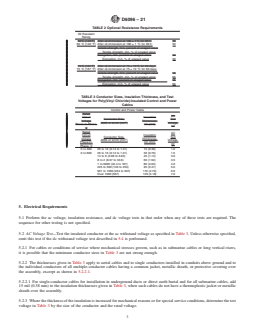
4.1 The insulation shall conform to the requirements for physical properties prescribed in Table 1. (See Table 2 for optional oil
resistance requirements.)
TABLE 1 Physical Properties Requirements for Insulation
Unaged requirements:
Tensile strength, 2000 (13.8)
min, psi (MPa)
Tensile strength,2000 (13.8)
min, psi (MPa)
Elongation at 150
rupture, min, %
Elongation at150
rupture, min, %
Aged requirements:
After air oven
test at 136 ± 1°C
for 168 h:
After air oven
test at 136 ± 1
°C for 168 h:
Tubular Specimens - up to size AWG 6 (13.3 mm )
Tubular Specimens - up to size AWG 6 (13.3 mm ):
Tensile strength, min, percent of unaged value:
Tensile strength, min, percent of unaged value
Elongation at rupture, min, percent of unaged value:
Elongation at rupture, min, percent of unaged value
Buffed die-cut Specimens - sizes AWG 6 and larger
Buffed die-cut Specimens, sizes AWG 6 and larger:
Tensile strength, min, percent of unaged value:
Tensile strength, min, percent of unaged value
Elongation at rupture, min, percent of unaged value:
Elongation at rupture, min, percent of unaged value
Heat shock, 121 ± 1°C no cracks
Heat shock, 121 ± 1 °C no cracks
Heat distortion, 121± 1°C, max, percent decrease 25
Heat deformation, 121± 1 °C, max, percent decrease 25
Vertical flame test, after five 15-s applications: passes
Vertical flame test, af passes
Oil resistance:
After oil immersion at 70 ± 1°C for 4 h:
After oil immersion at 70 ± 1 °C for 4 h:
Tubular Specimens - up to size AWG 6 (13.3 mm )
Tubular Specimens - up to size AWG 6 (13.3 mm )
Tensile strength, min, percent of unaged value
Tensile strength, min, percent of unaged value
Elongation, min, percent of unaged value
Elongation, min, percent of unaged value
Buffed die-cut Specimens - sizes AWG 6 and larger
Buffed die-cut Specimens sizes AWG 6 and larger
Tensile strength, min, percent of unaged value
Tensile strength, min, percent of unaged value
Elongation, min, percent of unaged value
Elongation, min, percent of unaged value
Cold bend test, –30 ± 1°C for 1 h no cracks
Cold bend test, –30 ± 1 °C for 1 h no cracks
D6096 − 21
TABLE 2 Optional Resistance Requirements
Oil Resistant
Rating
60°C (140°F) After oil immersion at 100 ± 1°C for 96 h: 50
60 °C (140 °F) After oil immersion at 100 ± 1 °C for 96 h: 50
Tensile strength, min, percent of unaged value
Tensile strength, min, % of unaged value
Elongation, min, percent of unaged value 50
Elongation, min, % of unaged value 50
75°C (167°F) After oil immersion at 75 ± 10°C for 60 days:
75 °C (167 °F) After oil immersion at 75 ± 10 °C for 60 days:
Tensile strength, min, percent of unaged value 65
Tensile strength, min, % of unaged value 65
Elongation, min, percent of unaged value 65
Elongation, min, % of unaged value 65
TABLE 3 Conductor Sizes, Insulation Th
...