

ASTM E372-21
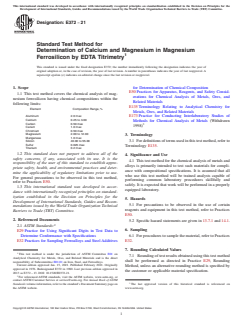
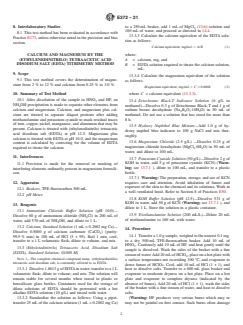
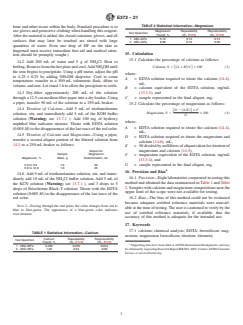
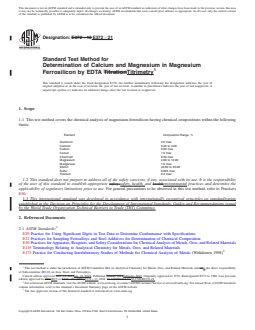
(Test Method)Standard Test Method for Determination of Calcium and Magnesium in Magnesium Ferrosilicon by EDTA Titrimetry
General Information
- Abstract
SIGNIFICANCE AND USE
4.1 This test method for the chemical analysis of metals and alloys is primarily intended to test such materials for compliance with compositional specifications. It is assumed that all who use this test method will be trained analysts capable of performing common laboratory procedures skillfully and safely. It is expected that work will be performed in a properly equipped laboratory.
SCOPE
1.1 This test method covers the chemical analysis of magnesium ferrosilicon having chemical compositions within the following limits:
Element
Composition Range, %
Aluminum
2.0 max
Calcium
0.25 to 3.00
Carbon
0.50 max
Cerium
1.0 max
Chromium
0.50 max
Magnesium
2.00 to 12.00
Manganese
1.0 max
Silicon
40.00 to 55.00
Sulfur
0.025 max
Titanium
0.2 max
1.2 This standard does not purport to address all of the safety concerns, if any, associated with its use. It is the responsibility of the user of this standard to establish appropriate safety, health, and environmental practices and determine the applicability of regulatory limitations prior to use. For general precautions to be observed in this test method, refer to Practices E50.
1.3 This international standard was developed in accordance with internationally recognized principles on standardization established in the Decision on Principles for the Development of International Standards, Guides and Recommendations issued by the World Trade Organization Technical Barriers to Trade (TBT) Committee.
- Status
- Published
- Publication Date
- 14-Jan-2021
- Technical Committee
- E01 - Analytical Chemistry for Metals, Ores, and Related Materials
- Drafting Committee
- E01.01 - Iron, Steel, and Ferroalloys
Buy Documents

ASTM E372-21 - Standard Test Method for Determination of Calcium and Magnesium in Magnesium Ferrosilicon by EDTA Titrimetry
REDLINE ASTM E372-21 - Standard Test Method for Determination of Calcium and Magnesium in Magnesium Ferrosilicon by EDTA Titrimetry
Overview
ASTM E372-21: Standard Test Method for Determination of Calcium and Magnesium in Magnesium Ferrosilicon by EDTA Titrimetry provides a reliable, standardized procedure for the chemical analysis of magnesium ferrosilicon alloys. This method specifically determines the concentrations of calcium and magnesium using ethylenedinitrilo-tetraacetic acid (EDTA) titrimetric techniques. Designed for analytical laboratories, the standard ensures quality control in compliance with specified compositional limits for these key alloying elements.
The test method is applicable to magnesium ferrosilicon with defined composition ranges:
- Calcium: 0.25% to 3.00%
- Magnesium: 2.00% to 12.00%
- Silicon: 40.00% to 55.00%
- Other elements (aluminum, carbon, cerium, chromium, manganese, sulfur, and titanium) with specified maximum concentrations
Key Topics
- Chemical Analysis by EDTA Titrimetry: The method utilizes EDTA as a titrating agent to measure calcium and magnesium content accurately.
- Sample Preparation: The alloy sample is dissolved using a combination of nitric and hydrofluoric acids, followed by separation steps to isolate calcium and magnesium.
- Interferences and Masking Agents: The procedure includes steps to eliminate or mask interfering elements such as iron, copper, nickel, manganese, and aluminum using appropriate chemical reagents.
- Titration Procedures: Separate aliquots are titrated at distinct pH levels to determine calcium alone and combined magnesium and calcium concentrations. Magnesium is calculated by difference.
- Quality Assurance: The method’s repeatability and reproducibility are established through interlaboratory studies, supporting precision in analytical results.
Applications
- Quality Control for Alloy Production: Manufacturers and laboratories use this standard to confirm that magnesium ferrosilicon meets compositional specifications required for steelmaking and other metallurgical processes.
- Compliance Testing: The method assists producers and buyers in verifying material certification and regulatory compliance, ensuring product quality and consistency.
- Research and Development: Laboratories use the standard in the development of new ferrosilicon materials and in the refinement of existing processes where calcium and magnesium balance is critical.
- Material Certification: The accurate determination of calcium and magnesium content supports traceability and certification for international trade and procurement.
Related Standards
- ASTM E29: Practice for Using Significant Digits in Test Data to Determine Conformance with Specifications
- ASTM E32: Practices for Sampling Ferroalloys and Steel Additives for Chemical Composition
- ASTM E50: Practices for Apparatus, Reagents, and Safety Considerations for Chemical Analysis of Metals, Ores, and Related Materials
- ASTM E135: Terminology Relating to Analytical Chemistry for Metals, Ores, and Related Materials
These standards are referenced to ensure proper sampling, safety, quality, and terminology across all procedures involving the chemical analysis of metal alloys.
By following ASTM E372-21, laboratories and manufacturers benefit from a globally recognized procedure for determining calcium and magnesium content in magnesium ferrosilicon. This supports precise chemical analysis, process consistency, and adherence to industry standards, contributing to robust quality assurance in alloy production and application.
Relations
- Effective Date
- 01-Jan-2020
- Effective Date
- 15-May-2019
- Effective Date
- 01-Sep-2017
- Effective Date
- 01-Aug-2016
- Effective Date
- 15-May-2016
- Effective Date
- 01-Jul-2015
- Effective Date
- 15-May-2015
- Effective Date
- 15-Aug-2014
- Effective Date
- 01-Apr-2014
- Effective Date
- 15-Feb-2014
- Effective Date
- 01-Dec-2013
- Effective Date
- 15-Oct-2011
- Effective Date
- 15-Sep-2011
- Effective Date
- 15-Jun-2011
- Effective Date
- 15-Jan-2011
Buy Documents
ASTM E372-21 - Standard Test Method for Determination of Calcium and Magnesium in Magnesium Ferrosilicon by EDTA Titrimetry
REDLINE ASTM E372-21 - Standard Test Method for Determination of Calcium and Magnesium in Magnesium Ferrosilicon by EDTA Titrimetry
Get Certified
Connect with accredited certification bodies for this standard

Element Materials Technology
Materials testing and product certification.

Inštitut za kovinske materiale in tehnologije
Institute of Metals and Technology. Materials testing, metallurgical analysis, NDT.
Sponsored listings
Frequently Asked Questions
ASTM E372-21 is a standard published by ASTM International. Its full title is "Standard Test Method for Determination of Calcium and Magnesium in Magnesium Ferrosilicon by EDTA Titrimetry". This standard covers: SIGNIFICANCE AND USE 4.1 This test method for the chemical analysis of metals and alloys is primarily intended to test such materials for compliance with compositional specifications. It is assumed that all who use this test method will be trained analysts capable of performing common laboratory procedures skillfully and safely. It is expected that work will be performed in a properly equipped laboratory. SCOPE 1.1 This test method covers the chemical analysis of magnesium ferrosilicon having chemical compositions within the following limits: Element Composition Range, % Aluminum 2.0 max Calcium 0.25 to 3.00 Carbon 0.50 max Cerium 1.0 max Chromium 0.50 max Magnesium 2.00 to 12.00 Manganese 1.0 max Silicon 40.00 to 55.00 Sulfur 0.025 max Titanium 0.2 max 1.2 This standard does not purport to address all of the safety concerns, if any, associated with its use. It is the responsibility of the user of this standard to establish appropriate safety, health, and environmental practices and determine the applicability of regulatory limitations prior to use. For general precautions to be observed in this test method, refer to Practices E50. 1.3 This international standard was developed in accordance with internationally recognized principles on standardization established in the Decision on Principles for the Development of International Standards, Guides and Recommendations issued by the World Trade Organization Technical Barriers to Trade (TBT) Committee.
SIGNIFICANCE AND USE 4.1 This test method for the chemical analysis of metals and alloys is primarily intended to test such materials for compliance with compositional specifications. It is assumed that all who use this test method will be trained analysts capable of performing common laboratory procedures skillfully and safely. It is expected that work will be performed in a properly equipped laboratory. SCOPE 1.1 This test method covers the chemical analysis of magnesium ferrosilicon having chemical compositions within the following limits: Element Composition Range, % Aluminum 2.0 max Calcium 0.25 to 3.00 Carbon 0.50 max Cerium 1.0 max Chromium 0.50 max Magnesium 2.00 to 12.00 Manganese 1.0 max Silicon 40.00 to 55.00 Sulfur 0.025 max Titanium 0.2 max 1.2 This standard does not purport to address all of the safety concerns, if any, associated with its use. It is the responsibility of the user of this standard to establish appropriate safety, health, and environmental practices and determine the applicability of regulatory limitations prior to use. For general precautions to be observed in this test method, refer to Practices E50. 1.3 This international standard was developed in accordance with internationally recognized principles on standardization established in the Decision on Principles for the Development of International Standards, Guides and Recommendations issued by the World Trade Organization Technical Barriers to Trade (TBT) Committee.
ASTM E372-21 is classified under the following ICS (International Classification for Standards) categories: 77.040.30 - Chemical analysis of metals. The ICS classification helps identify the subject area and facilitates finding related standards.
ASTM E372-21 has the following relationships with other standards: It is inter standard links to ASTM E135-20, ASTM E135-19, ASTM E50-17, ASTM E50-11(2016), ASTM E135-16, ASTM E135-15a, ASTM E135-15, ASTM E135-14b, ASTM E135-14a, ASTM E135-14, ASTM E135-13a, ASTM E50-11, ASTM E135-11b, ASTM E135-11a, ASTM E135-11. Understanding these relationships helps ensure you are using the most current and applicable version of the standard.
ASTM E372-21 is available in PDF format for immediate download after purchase. The document can be added to your cart and obtained through the secure checkout process. Digital delivery ensures instant access to the complete standard document.
Standards Content (Sample)
This international standard was developed in accordance with internationally recognized principles on standardization established in the Decision on Principles for the
Development of International Standards, Guides and Recommendations issued by the World Trade Organization Technical Barriers to Trade (TBT) Committee.
Designation: E372 − 21
Standard Test Method for
Determination of Calcium and Magnesium in Magnesium
Ferrosilicon by EDTA Titrimetry
This standard is issued under the fixed designation E372; the number immediately following the designation indicates the year of
original adoption or, in the case of revision, the year of last revision. A number in parentheses indicates the year of last reapproval. A
superscript epsilon (´) indicates an editorial change since the last revision or reapproval.
1. Scope for Determination of Chemical Composition
E50 Practices for Apparatus, Reagents, and Safety Consid-
1.1 This test method covers the chemical analysis of mag-
erations for Chemical Analysis of Metals, Ores, and
nesium ferrosilicon having chemical compositions within the
Related Materials
following limits:
E135 Terminology Relating to Analytical Chemistry for
Element Composition Range, %
Metals, Ores, and Related Materials
Aluminum 2.0 max E173 Practice for Conducting Interlaboratory Studies of
Calcium 0.25 to 3.00
Methods for Chemical Analysis of Metals (Withdrawn
Carbon 0.50 max
1998)
Cerium 1.0 max
Chromium 0.50 max
Magnesium 2.00 to 12.00
3. Terminology
Manganese 1.0 max
3.1 For definitions of terms used in this test method, refer to
Silicon 40.00 to 55.00
Sulfur 0.025 max
Terminology E135.
Titanium 0.2 max
1.2 This standard does not purport to address all of the
4. Significance and Use
safety concerns, if any, associated with its use. It is the
4.1 This test method for the chemical analysis of metals and
responsibility of the user of this standard to establish appro-
alloys is primarily intended to test such materials for compli-
priate safety, health, and environmental practices and deter-
ance with compositional specifications. It is assumed that all
mine the applicability of regulatory limitations prior to use.
who use this test method will be trained analysts capable of
For general precautions to be observed in this test method,
performing common laboratory procedures skillfully and
refer to Practices E50.
safely. It is expected that work will be performed in a properly
1.3 This international standard was developed in accor-
equipped laboratory.
dance with internationally recognized principles on standard-
ization established in the Decision on Principles for the
5. Hazards
Development of International Standards, Guides and Recom-
5.1 For precautions to be observed in the use of certain
mendations issued by the World Trade Organization Technical
reagents and equipment in this test method, refer to Practices
Barriers to Trade (TBT) Committee.
E50.
2. Referenced Documents
5.2 Specific hazard statements are given in 13.7.1 and 14.1.
2.1 ASTM Standards:
6. Sampling
E29 Practice for Using Significant Digits in Test Data to
Determine Conformance with Specifications
6.1 For procedures to sample the material, refer to Practices
E32 Practices for Sampling Ferroalloys and Steel Additives
E32.
7. Rounding Calculated Values
This test method is under the jurisdiction of ASTM Committee E01 on
7.1 Rounding of test results obtained using this test method
Analytical Chemistry for Metals, Ores, and Related Materials and is the direct
shall be performed as directed in Practice E29, Rounding
responsibility of Subcommittee E01.01 on Iron, Steel, and Ferroalloys.
Current edition approved Jan. 15, 2021. Published February 2021. Originally
Method, unless an alternative rounding method is specified by
approved in 1976. Redesignated E372 in 1980. Last previous edition approved in
the customer or applicable material specification.
2013 as E372 – 13. DOI: 10.1520/E0372-21.
For referenced ASTM standards, visit the ASTM website, www.astm.org, or
contact ASTM Customer Service at service@astm.org. For Annual Book of ASTM
Standards volume information, refer to the standard’s Document Summary page on The last approved version of this historical standard is referenced on
the ASTM website. www.astm.org.
Copyright © ASTM International, 100 Barr Harbor Drive, PO Box C700, West Conshohocken, PA 19428-2959. United States
E372 − 21
8. Interlaboratory Studies to a 250 mL beaker, add 1 mL of MgCl (13.6) solution and
100 mL of water, and proceed as directed in 14.4.
8.1 This test method has been evaluated in accordance with
13.3.3 Calculate the calcium equivalent of the EDTA solu-
Practice E173, unless otherwise noted in the precision and bias
tion as follows:
section.
Calcium equivalent, mg/mL 5 A/B (1)
where:
CALCIUM AND MAGNESIUM BY THE
(ETHYLENEDINITRILO) TETRAACETIC ACID
A = calcium, mg, and
DISODIUM SALT (EDTA) TITRIMETRY METHOD B = EDTA solution required to titrate the calcium solution,
mL.
9. Scope
13.3.4 Calculate the magnesium equivalent of the solution
9.1 This test method covers the determination of magne-
as follows:
sium from2%to12%and calcium from 0.25 % to 3.0 %.
Magnesium equivalent, mg/mL 5 C 30.6068 (2)
10. Summary of Test Method
where C = calcium equivalent (13.3.3).
10.1 After dissolution of the sample in HNO and HF, an 13.4 Eriochrome Black-T Indicator Solution (6 g/L in
NH OH precipitation is made to separate other elements from
methanol)—Dissolve 0.3 g of Eriochrome Black-T and1gof
calcium and magnesium. Calcium, and magnesium plus cal- sodium borate decahydrate (Na B O ·10H O) in 50 mL of
2 4 7 2
cium are titrated in separate aliquot portions after adding
methanol. Do not use a solution that has stood for more than
triethanolamine and potassium cyanide to mask residual traces 8h.
of iron, copper, nickel, manganese, and aluminum that may be
13.5 Hydroxy Naphthol Blue Mixture—Add 1.0 g of hy-
present. Calcium is titrated with (ethylenedinitrilo) tetraacetic
droxy napthol blue indicator to 100 g NaCl and mix thor-
acid disodium salt (EDTA) at pH 12.5. Magnesium plus
oughly.
calcium is titrated with EDTA at pH 10.0, and the magnesium
13.6 Magnesium Chloride (2.5 g/L) —Dissolve 0.25 g of
content is calculated by correcting for the volume of EDTA
magnesium chloride hexahydrate (MgCl ·6H O) in 50 mL of
required to titrate the calcium. 2 2
water, and dilute to 100 mL.
11. Interferences
13.7 Potassium Cyanide Solution (50 g/L)—Dissolve2gof
KOH in water, add5gof potassium cyanide (KCN) (Warn-
11.1 Provision is made for the removal or masking of
ing; see 13.7.1 ), dilute to 100 mL, and transfer to a plastic
interfering elements ordinarily present in magnesium ferrosili-
bottle.
con.
13.7.1 Warning: The preparation, storage, and use of KCN
12. Apparatus requires care and attention. Avoid inhalation of fumes and
exposure of the skin to the chemical and its solutions. Work in
12.1 Beakers, TFE-fluorocarbon 500 mL.
a well-ventilated hood. Refer to Section 8 of Practices E50.
12.2 pH Meter.
13.8 KOH Buffer Solution (pH 12.5)—Dissolve 531 g of
KOH in water, add 50 g of KCN (Warning; see 13.7.1 ), and
13. Reagents
dilute to 1 L. Store the solution in a plastic container.
13.1 Ammonium Chloride Buffer Solution (pH 10.0)—
13.9 Triethanolamine Solution (200 mL/L)—Dilute 20 mL
Dissolve 60 g of ammonium chloride (NH Cl) in 200 mL of
...
This document is not an ASTM standard and is intended only to provide the user of an ASTM standard an indication of what changes have been made to the previous version. Because
it may not be technically possible to adequately depict all changes accurately, ASTM recommends that users consult prior editions as appropriate. In all cases only the current version
of the standard as published by ASTM is to be considered the official document.
Designation: E372 − 13 E372 − 21
Standard Test Method for
Determination of Calcium and Magnesium in Magnesium
Ferrosilicon by EDTA TitrationTitrimetry
This standard is issued under the fixed designation E372; the number immediately following the designation indicates the year of
original adoption or, in the case of revision, the year of last revision. A number in parentheses indicates the year of last reapproval. A
superscript epsilon (´) indicates an editorial change since the last revision or reapproval.
1. Scope
1.1 This test method covers the chemical analysis of magnesium ferrosilicon having chemical compositions within the following
limits:
Element Composition Range, %
Aluminum 2.0 max
Calcium 0.25 to 3.00
Carbon 0.50 max
Cerium 1.0 max
Chromium 0.50 max
Magnesium 2.00 to 12.00
Manganese 1.0 max
Silicon 40.00 to 55.00
Sulfur 0.025 max
Titanium 0.2 max
1.2 This standard does not purport to address all of the safety concerns, if any, associated with its use. It is the responsibility
of the user of this standard to establish appropriate safety safety, health, and healthenvironmental practices and determine the
applicability of regulatory limitations prior to use. For general precautions to be observed in this test method, refer to Practices
E50.
1.3 This international standard was developed in accordance with internationally recognized principles on standardization
established in the Decision on Principles for the Development of International Standards, Guides and Recommendations issued
by the World Trade Organization Technical Barriers to Trade (TBT) Committee.
2. Referenced Documents
2.1 ASTM Standards:
E29 Practice for Using Significant Digits in Test Data to Determine Conformance with Specifications
E32 Practices for Sampling Ferroalloys and Steel Additives for Determination of Chemical Composition
E50 Practices for Apparatus, Reagents, and Safety Considerations for Chemical Analysis of Metals, Ores, and Related Materials
E135 Terminology Relating to Analytical Chemistry for Metals, Ores, and Related Materials
E173 Practice for Conducting Interlaboratory Studies of Methods for Chemical Analysis of Metals (Withdrawn 1998)
This test method is under the jurisdiction of ASTM Committee E01 on Analytical Chemistry for Metals, Ores, and Related Materials and areis the direct responsibility
of Subcommittee E01.01 on Iron, Steel, and Ferroalloys.
Current edition approved Nov. 15, 2013Jan. 15, 2021. Published January 2014February 2021. Originally approved in 1976. Redesignated E372 in 1980. Last previous
edition approved in 20062013 as E372 – 01 (2006).E372 – 13. DOI: 10.1520/E0372-13.10.1520/E0372-21.
For referenced ASTM standards, visit the ASTM website, www.astm.org, or contact ASTM Customer Service at service@astm.org. For Annual Book of ASTM Standards
volume information, refer to the standard’s Document Summary page on the ASTM website.
The last approved version of this historical standard is referenced on www.astm.org.
Copyright © ASTM International, 100 Barr Harbor Drive, PO Box C700, West Conshohocken, PA 19428-2959. United States
E372 − 21
3. Terminology
3.1 For definitions of terms used in this test method, refer to Terminology E135.
4. Significance and Use
4.1 This test method for the chemical analysis of metals and alloys is primarily intended to test such materials for compliance with
compositional specifications. It is assumed that all who use this test method will be trained analysts capable of performing common
laboratory procedures skillfully and safely. It is expected that work will be performed in a properly equipped laboratory.
5. Hazards
5.1 For precautions to be observed in the use of certain reagents and equipment in this test method, refer to Practices E50.
5.2 Specific hazard statements are given in 13.7.1 and 14.1.
6. Sampling
6.1 For procedures for samplingto sample the material, refer to Practices E32.
7. Rounding Calculated Values
7.1 Calculated values shall be rounded to the desired number of places Rounding of test results obtained using this test method
shall be performed as directed in Practice E29., Rounding Method, unless an alternative rounding method is specified by the
customer or applicable material specification.
8. Interlaboratory Studies
8.1 This test method has been evaluated in accordance with Practice E173, unless otherwise noted in the precision and bias section.
CALCIUM AND MAGNESIUM BY THE (ETHYLENEDINITRILO)TETRAACETIC ACID (EDTA)
TITRIMETRIC(ETHYLENEDINITRILO) TETRAACETIC ACID DISODIUM SALT (EDTA) TITRIMETRY
METHOD
9. Scope
9.1 This test method covers the determination of magnesium in compositions from 2 % to 12 % and calcium in compositions from
0.25 % to 3.0 %.
9. Scope
9.1 This test method covers the determination of magnesium from 2 % to 12 % and calcium from 0.25 % to 3.0 %.
10. Summary of Test Method
10.1 After dissolution of the sample in nitricHNO and hydrofluoric acids, HF, an ammoniumNH hydroxide OH precipitation is
3 4
made to separate other elements from calcium and magnesium. Calcium, and magnesium plus calcium are titrated in separate
aliquot portions after adding triethanolamine and potassium cyanide to mask residual traces of iron, copper, nickel, manganese,
and aluminum that may be present. Calcium is titrated with disodium (ethylenedinitrilo)tetraacetate(ethylenedinitrilo) tetraacetic
acid disodium salt (EDTA) at pH 12.12.5. Magnesium plus calcium is titrated with EDTA at pH 10.010.0, and the magnesium
content is calculated by correcting for the volume of EDTA required to titrate the calcium.
11. Interferences
11.1 Provision is made for the removal or masking of interfering elements ordinarily present in magnesium ferrosilicon.
E372 − 21
12. Apparatus
12.1 Beakers, TFE-fluorocarbon 500-mL.500 mL.
12.2 pH Meter.
13. Reagents
13.1 Ammonium Chloride Buffer Solution (pH 10.0)—Dissolve 60 g of ammonium chloride (NH Cl) in 200 mL of water, add 570
mL of NH OH, and dilute to 1 L.
13.2 Calcium, Standard Solution (1 mL = 0.2002 mg Ca)—Dissolve 0.5000 g of calcium carbonate (CaCO ) (purity: 99.9 % min)
in 100 mL of HCl (5 + 95). Boil 1 min, cool, transfer to a 1-L1 L volumetric flask, dilute to volume, and mix.
13.3 Disodium Ethylenedinitrilo-Tetraacetate Dihydrate (Ethylenedinitrilo) Tetraacetic Acid, Disodium Salt (EDTA), Standard
Solution: (0.005 M)
NOTE 1—The complete chemical compound name, (ethylenedinitrilo) tetraacetic acid disodium salt, is commonly referred to as EDTA.
13.3.1 Dissolve 1.8613 g of EDTA in water; transfer to a 1-L1 L volumetric flask; dilute to volume; and mix. The solution will
remain stable for several months when stored in plastic or borosilicate glass bottles. Containers used for the storage of dilute
solutions of EDTA should be pretreated with a hot alkaline EDTA solution (10 g/L) and rinsed with water.
13.3.2 Standardize the solution as follows: Using a pipet, tranfertransfer 25 mL of the calcium solution (1 mL = 0.2002 mg Ca)
to a 250-mL250 mL beaker, add 1 mL of MgCl (13.6) solution and 100 mL of water, and proceed as directed in 14.4.
NOTE 1—Containers used for the storage of dilute solutions of EDTA should be pretreated with a hot alkaline EDTA solution (10 g/L), and rinsed with
water.
13.3.3 Calculate the calcium equivalent of the EDTA solution as follows:
Calcium equivalent, mg/mL 5 A/B (1)
where:
A = calcium, mg, and
B = EDTA solution required to titrate the calcium solution, mL.
13.3.4 Calculate the magnesium equivalent of the solutio
...