

ASTM B836-00(2021)
(Specification)Standard Specification for Compact Round Stranded Aluminum Conductors Using Single Input Wire Construction
General Information
- Abstract
ABSTRACT
This specification covers compact round stranded aluminium conductors using single input wire construction. Joints may be made in any of the wires of any stranding by electric-butt welding, cold-pressure welding, or electric-butt, cold-upset welding. No joint or splice shall be made in a stranded conductor as a whole. The rated-strength and breaking-strength requirements of conductor are presented in details. Tests for the mechanical and electrical properties of wire composing the conductor shall be made before, but not after, stranding unless otherwise agreed upon by the manufacturer and the purchaser as provided by the reference materials.
SCOPE
1.1 This specification covers aluminum/single input wire (SIW) stranded conductors made from round or shaped wires for use in covered or insulated electrical wires or cables. These conductors shall be composed of one or more roller or die compacted layers of helically applied wires (Explanatory Note 1, Explanatory Note 2, and Explanatory Note 3).
1.2 The values stated in inch-pound units are to be regarded as standard. The values given in parentheses are mathematical conversions to SI units that are provided for information only and are not considered standard.
1.2.1 For density, resistivity, and temperature, the values stated in SI units are to be regarded as standard.
Note 1: The aluminum and temper designations conform to ANSI H35.1. Aluminum 1350 and Aluminum-Alloy 8XXX correspond to Unified Numbering System A91350 and A98XXX, in accordance with Practice E527.
1.3 This standard does not purport to address all of the safety concerns, if any, associated with its use. It is the responsibility of the user of this standard to establish appropriate safety, health, and environmental practices and determine the applicability of regulatory limitations prior to use.
1.4 This international standard was developed in accordance with internationally recognized principles on standardization established in the Decision on Principles for the Development of International Standards, Guides and Recommendations issued by the World Trade Organization Technical Barriers to Trade (TBT) Committee.
- Status
- Published
- Publication Date
- 31-Jan-2021
- Technical Committee
- B01 - Electrical Conductors
- Drafting Committee
- B01.07 - Conductors of Light Metals
Overview
ASTM B836-00(2021), Standard Specification for Compact Round Stranded Aluminum Conductors Using Single Input Wire Construction, sets out requirements for the manufacture, testing, and performance of compact round stranded aluminum conductors made with single input wire (SIW) construction. These conductors are primarily designed for use in covered or insulated electrical wires and cables, supporting a wide range of industrial, utility, and construction applications where reliable electrical performance is essential.
This specification details conductor construction, joint methods, mechanical and electrical property testing, dimensional requirements, and marking and packaging of the product. The standard ensures consistency in quality and performance for aluminum conductors in global markets, supporting both end-user safety and regulatory compliance.
Key Topics
- Conductor Construction: The standard covers aluminum SIW stranded conductors made from round or shaped wires. The final conductor consists of one or more helically applied, roller or die-compacted layers.
- Jointing Methods: Permitted joint methods in individual wires include electric-butt welding, cold-pressure welding, or electric-butt, cold-upset welding. No joint or splice may be made in the conductor as a whole.
- Mechanical and Electrical Testing: Wires must be tested for mechanical and electrical properties before stranding unless the buyer and manufacturer agree otherwise. These include tensile strength and resistance tests to ensure conformity with rated-strength and breaking-strength requirements.
- Dimensional Tolerances: Strict tolerances are set for cross-sectional area and diameter, maintaining product reliability and consistency. The cross-sectional area must be no less than 98% of the specified minimum, and diameter variations are closely controlled.
- Mass and Resistance: The specification details permissible limits for mass and DC resistance per unit length, factoring in the conductor’s lay length and temperature.
- Marking and Packaging: Clear requirements ensure traceability, delivery integrity, and ease of inventory management, with each package identified by size, length, and relevant ordering details.
Applications
The conductors specified in ASTM B836-00(2021) are primarily used in the following areas:
- Electrical Power Distribution: Utilized in overhead and underground power cables, these conductors support the robust, efficient transmission and distribution of electricity.
- Covered or Insulated Cables: The compact design is ideal for use in cables where space, reduced reactance, and improved aesthetics are critical.
- Industrial and Utility Projects: Their mechanical strength and electrical efficiency make them suitable for demanding industrial environments and utility infrastructure upgrades.
- Building Wiring: Compact aluminum stranded conductors are frequently specified for large-scale and commercial building wiring, where weight and installation efficiency are important.
- Renewable Energy Installations: Used in solar and wind power infrastructure due to their favorable strength-to-weight ratio and cost-effectiveness.
Related Standards
For comprehensive specification and compatibility, ASTM B836-00(2021) references several related standards and practices:
- ASTM B230/B230M: Specification for Aluminum 1350–H19 Wire for Electrical Purposes
- ASTM B263: Test Method for Cross-Sectional Area Determination
- ASTM B400: Specification for Compact Round Concentric-Lay-Stranded Aluminum 1350 Conductors
- ASTM B609/B609M: Specification for Aluminum 1350 Round Wire, Annealed and Intermediate Tempers
- ASTM B800/B801: Specifications for 8000 Series Aluminum Alloy Wire and Conductors
- ASTM B830: Specification for Uniform Test Methods and Frequency
- ASTM B354: Terminology for Uninsulated Metallic Electrical Conductors
- ANSI H35.1: Alloy and Temper Designation Systems for Aluminum
- NIST Handbook 100: Copper Wire Tables
These related documents support detailed testing, numerical tolerances, and consistent terminology, helping manufacturers, suppliers, and end users ensure full regulatory compliance and product interoperability.
Keywords: ASTM B836, aluminum stranded conductors, compact round conductors, single input wire, SIW construction, electrical conductors, aluminum cable, concentric-lay, cable standards, conductor specification.
Relations
- Effective Date
- 01-Oct-2023
- Effective Date
- 15-Jun-2018
- Effective Date
- 01-Mar-2018
- Effective Date
- 01-Sep-2016
- Effective Date
- 01-Apr-2016
- Effective Date
- 01-Dec-2012
- Effective Date
- 15-Oct-2012
- Effective Date
- 15-Oct-2012
- Effective Date
- 01-Apr-2012
- Effective Date
- 01-Apr-2012
- Effective Date
- 01-Oct-2011
- Effective Date
- 01-Apr-2011
- Effective Date
- 01-Oct-2010
- Effective Date
- 01-Oct-2010
- Effective Date
- 01-Oct-2008
Get Certified
Connect with accredited certification bodies for this standard

IMQ S.p.A. (Certification)
Italian electrical product certification.

SLG Prüf- und Zertifizierungs GmbH
German testing and certification body.

UL Solutions
Global safety science company with testing, inspection and certification.
Sponsored listings
Frequently Asked Questions
ASTM B836-00(2021) is a technical specification published by ASTM International. Its full title is "Standard Specification for Compact Round Stranded Aluminum Conductors Using Single Input Wire Construction". This standard covers: ABSTRACT This specification covers compact round stranded aluminium conductors using single input wire construction. Joints may be made in any of the wires of any stranding by electric-butt welding, cold-pressure welding, or electric-butt, cold-upset welding. No joint or splice shall be made in a stranded conductor as a whole. The rated-strength and breaking-strength requirements of conductor are presented in details. Tests for the mechanical and electrical properties of wire composing the conductor shall be made before, but not after, stranding unless otherwise agreed upon by the manufacturer and the purchaser as provided by the reference materials. SCOPE 1.1 This specification covers aluminum/single input wire (SIW) stranded conductors made from round or shaped wires for use in covered or insulated electrical wires or cables. These conductors shall be composed of one or more roller or die compacted layers of helically applied wires (Explanatory Note 1, Explanatory Note 2, and Explanatory Note 3). 1.2 The values stated in inch-pound units are to be regarded as standard. The values given in parentheses are mathematical conversions to SI units that are provided for information only and are not considered standard. 1.2.1 For density, resistivity, and temperature, the values stated in SI units are to be regarded as standard. Note 1: The aluminum and temper designations conform to ANSI H35.1. Aluminum 1350 and Aluminum-Alloy 8XXX correspond to Unified Numbering System A91350 and A98XXX, in accordance with Practice E527. 1.3 This standard does not purport to address all of the safety concerns, if any, associated with its use. It is the responsibility of the user of this standard to establish appropriate safety, health, and environmental practices and determine the applicability of regulatory limitations prior to use. 1.4 This international standard was developed in accordance with internationally recognized principles on standardization established in the Decision on Principles for the Development of International Standards, Guides and Recommendations issued by the World Trade Organization Technical Barriers to Trade (TBT) Committee.
ABSTRACT This specification covers compact round stranded aluminium conductors using single input wire construction. Joints may be made in any of the wires of any stranding by electric-butt welding, cold-pressure welding, or electric-butt, cold-upset welding. No joint or splice shall be made in a stranded conductor as a whole. The rated-strength and breaking-strength requirements of conductor are presented in details. Tests for the mechanical and electrical properties of wire composing the conductor shall be made before, but not after, stranding unless otherwise agreed upon by the manufacturer and the purchaser as provided by the reference materials. SCOPE 1.1 This specification covers aluminum/single input wire (SIW) stranded conductors made from round or shaped wires for use in covered or insulated electrical wires or cables. These conductors shall be composed of one or more roller or die compacted layers of helically applied wires (Explanatory Note 1, Explanatory Note 2, and Explanatory Note 3). 1.2 The values stated in inch-pound units are to be regarded as standard. The values given in parentheses are mathematical conversions to SI units that are provided for information only and are not considered standard. 1.2.1 For density, resistivity, and temperature, the values stated in SI units are to be regarded as standard. Note 1: The aluminum and temper designations conform to ANSI H35.1. Aluminum 1350 and Aluminum-Alloy 8XXX correspond to Unified Numbering System A91350 and A98XXX, in accordance with Practice E527. 1.3 This standard does not purport to address all of the safety concerns, if any, associated with its use. It is the responsibility of the user of this standard to establish appropriate safety, health, and environmental practices and determine the applicability of regulatory limitations prior to use. 1.4 This international standard was developed in accordance with internationally recognized principles on standardization established in the Decision on Principles for the Development of International Standards, Guides and Recommendations issued by the World Trade Organization Technical Barriers to Trade (TBT) Committee.
ASTM B836-00(2021) is classified under the following ICS (International Classification for Standards) categories: 29.060.10 - Wires. The ICS classification helps identify the subject area and facilitates finding related standards.
ASTM B836-00(2021) has the following relationships with other standards: It is inter standard links to ASTM B801-18(2023), ASTM B830-18, ASTM B801-18, ASTM B354-16, ASTM B801-16, ASTM B354-12, ASTM B230/B230M-07(2012), ASTM B801-07(2012), ASTM B609/B609M-12e1, ASTM B609/B609M-12, ASTM B830-11, ASTM B800-05(2011), ASTM B263-04(2010), ASTM B609/B609M-99(2010), ASTM E29-08. Understanding these relationships helps ensure you are using the most current and applicable version of the standard.
ASTM B836-00(2021) is available in PDF format for immediate download after purchase. The document can be added to your cart and obtained through the secure checkout process. Digital delivery ensures instant access to the complete standard document.
Standards Content (Sample)
This international standard was developed in accordance with internationally recognized principles on standardization established in the Decision on Principles for the
Development of International Standards, Guides and Recommendations issued by the World Trade Organization Technical Barriers to Trade (TBT) Committee.
Designation: B836 −00 (Reapproved 2021)
Standard Specification for
Compact Round Stranded Aluminum Conductors Using
Single Input Wire Construction
This standard is issued under the fixed designation B836; the number immediately following the designation indicates the year of
original adoption or, in the case of revision, the year of last revision. A number in parentheses indicates the year of last reapproval. A
superscript epsilon (´) indicates an editorial change since the last revision or reapproval.
1. Scope 2.2 ASTM Standards:
B230/B230M Specification for Aluminum 1350–H19 Wire
1.1 This specification covers aluminum/single input wire
for Electrical Purposes
(SIW) stranded conductors made from round or shaped wires
B263 Test Method for Determination of Cross-Sectional
for use in covered or insulated electrical wires or cables.These
Area of Stranded Conductors
conductors shall be composed of one or more roller or die
B354 Terminology Relating to Uninsulated Metallic Electri-
compacted layers of helically applied wires (Explanatory Note
cal Conductors
1, Explanatory Note 2, and Explanatory Note 3).
B400 Specification for Compact Round Concentric-Lay-
Stranded Aluminum 1350 Conductors
1.2 The values stated in inch-pound units are to be regarded
B609/B609M Specification for Aluminum 1350 Round
as standard. The values given in parentheses are mathematical
Wire, Annealed and Intermediate Tempers, for Electrical
conversions to SI units that are provided for information only
Purposes
and are not considered standard.
B800 Specification for 8000 Series Aluminum Alloy Wire
1.2.1 For density, resistivity, and temperature, the values
for Electrical Purposes—Annealed and IntermediateTem-
stated in SI units are to be regarded as standard.
pers
NOTE 1—The aluminum and temper designations conform to ANSI
B801 SpecificationforConcentric-Lay-StrandedConductors
H35.1. Aluminum 1350 and Aluminum-Alloy 8XXX correspond to
of 8000 SeriesAluminumAlloy for Subsequent Covering
Unified Numbering System A91350 and A98XXX, in accordance with
or Insulation
Practice E527.
B830 Specification for Uniform Test Methods and Fre-
1.3 This standard does not purport to address all of the
quency
safety concerns, if any, associated with its use. It is the
E29 Practice for Using Significant Digits in Test Data to
responsibility of the user of this standard to establish appro-
Determine Conformance with Specifications
priate safety, health, and environmental practices and deter-
E527 Practice for Numbering Metals and Alloys in the
mine the applicability of regulatory limitations prior to use.
Unified Numbering System (UNS)
1.4 This international standard was developed in accor-
2.3 ANSI Standard:
dance with internationally recognized principles on standard-
ANSI H35.1 Alloy and Temper Designation Systems for
ization established in the Decision on Principles for the
Aluminum
Development of International Standards, Guides and Recom-
2.4 NIST Standard:
mendations issued by the World Trade Organization Technical
Handbook 100 Copper Wire Tables NBS
Barriers to Trade (TBT) Committee.
3. Classification
2. Referenced Documents
3.1 The conductors described in this specification are in-
2.1 The following documents of the issue in effect on date tendedforsubsequentinsulationorcovering.Theclassification
of these conductors is SIW Compact.
of material purchase form a part of this specification to the
extent referenced herein.
For referenced ASTM standards, visit the ASTM website, www.astm.org, or
contact ASTM Customer Service at service@astm.org. For Annual Book of ASTM
This specification is under the jurisdiction of ASTM Committee B01 on Standards volume information, refer to the standard’s Document Summary page on
Electrical Conductors and is the direct responsibility of Subcommittee B01.07 on the ASTM website.
Conductors of Light Metals. Available fromAmerican National Standards Institute (ANSI), 25 W. 43rd St.,
Current edition approved Feb. 1, 2021. Published February 2021. Originally 4th Floor, New York, NY 10036, http://www.ansi.org.
approved in 1993. Last previous edition approved in 2015 as B836 – 00 (2015). Available from National Institute of Standards and Technology (NIST), 100
DOI: 10.1520/B0836-00R21. Bureau Dr., Stop 1070, Gaithersburg, MD 20899-1070, http://www.nist.gov.
Copyright © ASTM International, 100 Barr Harbor Drive, PO Box C700, West Conshohocken, PA 19428-2959. United States
B836 − 00 (2021)
4. Ordering Information 7. Construction
4.1 Orders for material in accordance with this specification 7.1 The construction of the conductors shall be as given in
shall include the following information: Table 1.
4.1.1 Quantity of each size and class (Table 1);
7.2 Wire used in the fabrication of conductors shall be of
4.1.2 Conductor size, circular-mil area orAWG (Section 7);
such dimensions as to produce a finished conductor as pre-
4.1.3 Temper (Section 12);
scribed in Table 1.
4.1.4 Lay direction, if nonstandard (see 6.2 and 6.3);
4.1.5 Special tension test, if required (see 16.2); 8. Rated Strength of Conductor
4.1.6 Place of inspection (Section 17);
8.1 The rated strength of SIW conductors made from any
4.1.7 Packaging and package marking (Section 18), and
and all alloys and tempers covered in this specification shall be
4.1.8 Material for conductor.
taken as the percentage, indicated in Table 2, of the sum of the
strengthsofthecomponentwires,calculatedonthebasisofthe
5. Joints
equivalent diameter of these wires and the specified minimum
5.1 Joints may be made in any of the wires of any stranding
average tensile strengths given in Specifications B230/B230M,
by electric-butt welding, cold-pressure welding, or electric-
B609/B609M, and B800.
butt, cold-upset welding.
8.2 Rated-strength and breaking-strength values shall be
5.1.1 Joints in the individual wires in a finished conductor
rounded to three significant figures, in the final value only, in
shall not be closer together than 1 ft (0.3 m) for conductors of
accordance with the rounding method of Practice E29.
19 wires or less, or closer than 1 ft (0.3 m) in a layer for
8.3 Rated strengths of conductors are given in Table 3 of
conductors of more than 19 wires.
Specification B400 for conductors made ofAluminum 1350 in
5.2 No joint or splice shall be made in a stranded conductor
all tempers.
as a whole.
8.4 Rated strengths of conductors made from any and all
6. Lay tempers of 8000 series aluminum alloys are given in Table 3 of
Specification B801.
6.1 The length of lay of each layer for SIWconductors shall
not be less than 8 or more than 17.5 times the outside diameter
9. Density
of the finished conductor.
9.1 For the purpose of calculating mass, cross-sections, and
6.2 The direction of lay of the outer layer shall be left-hand
so forth, the density ofAluminum 1350 shall be taken as 2705
and may be reversed or unidirectional in successive layers. 3 3
kg/m (0.0975 lb/in. ) at 20°C, and the density of 8000 series
3 3
6.3 Other lay requirements may be furnished upon special aluminum alloys shall be taken as 2710 kg/m (0.098 lb/in. )
agreement between the manufacturer and the purchaser. at 20°C.
TABLE 1 Construction of Compact Round, Concentric-Lay-Stranded Aluminum Conductors
Nominal Compact Conductor
Minimum Nominal
Conductor Size Nominal dc Resistance at 20°C
Nominal
Diameter
Number of Mass/1000
Mass/km, kg
A
Wires ft, lb
Circular, mils AWG mm in. mm Ω/1000 ft Ω/km
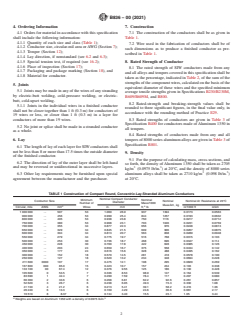
1 000 000 . 507 53 1.060 26.9 937 1394 0.0173 0.0563
900 000 . 456 53 0.999 25.4 844 1257 0.0193 0.0632
800 000 . 405 53 0.938 23.8 750 1116 0.0217 0.0712
750 000 . 380 53 0.908 23.1 703 1046 0.0231 0.0759
700 000 . 355 34 0.877 22.3 656 976 0.0248 0.0813
650 000 . 329 34 0.845 21.5 609 906 0.0267 0.0875
600 000 . 304 34 0.813 20.7 563 838 0.0289 0.0948
550 000 . 279 34 0.775 19.7 516 768 0.0315 0.103
500 000 . 253 30 0.736 18.7 468 696 0.0347 0.114
450 000 . 228 30 0.700 17.8 422 628 0.0385 0.126
400 000 . 203 24 0.659 16.7 375 558 0.0434 0.142
350 000 . 177 24 0.616 15.6 328 488 0.0495 0.162
300 000 . 152 18 0.570 14.5 281 418 0.0578 0.190
250 000 . 127 18 0.520 13.2 234 348 0.0694 0.228
211 600 0000 107 17 0.475 12.1 198 295 0.0820 0.269
167 800 000 85.0 15 0.423 10.7 157 234 0.103 0.338
133 100 00 67.4 12 0.376 9.55 125 186 0.130 0.428
105 600 0 53.5 7 0.336 8.53 98.9 147 0.164 0.539
83 690 1 42.4 7 0.299 7.59 78.4 117 0.207 0.680
66 360 2 33.6 6 0.268 6.81 62.2 92.6 0.261 0.857
52 620 3 26.7 6 0.238 6.05 49.3 73.3 0.330 1.08
41 740 4 21.2 6 0.213 5.41 39.1 58.2 0.416 1.36
26 240 6 13.3 6 0.169 4.29 24.6 36.6 0.661 2.17
16 510 8 8.37 6 0.134 3.40 15.5 23.1 1.05 3.44
A 3
Weights are based on Aluminum 1350 with a density of 0.0975 lb/in.
B836 − 00 (2021)
TABLE 2 Rating Factors
For the 1350-H19 temper, the minimum tensile and elongation
Stranding Rating Factor, % requirements shall be 96 % of those for round wire of the same
Number of Layers
nominal area, provided the completed conductor is capable of
meeting the requirements of Sections 8 and 16.
12.3 For conductors made from all other alloys and tempers
covered in this specification with shaped wires, the tensile
requirements for the wires shall be the same as those for round
input wires of equal nominal area. The area tolerances for
TABLE 3 Temperature Correction Factors for Conductor
shaped wire of all alloys and tempers shall be such that the
Resistance
finished conductor conforms to Section 13.
Temperature, °C Multiplying Factor for Conversion to 20°C
0 1.088
13. Variation in Area
5 1.064
10 1.042
13.1 The cross-sectional area of the conductor shall not be
15 1.020
less than 98 % of the cross-sectional area as specified in
20 1.000
25 0.980 Colu
...