

ASTM B1021-21
(Test Method)Standard Test Method for Peel Resistance of Metal Sheets Joined by High Strength Bonds
General Information
- Abstract
SIGNIFICANCE AND USE
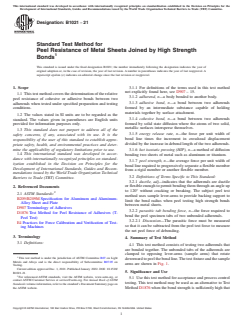
5.1 Use this test method for acceptance and process control testing. This test method may be used as an alternative to Test Method D1876 when the bond strength is sufficiently high that failure of the pulling tabs may occur before peeling initiates. This test method extends the bond strength measurement range by limiting the bend radius of the sample to concentrate the peeling action at the bond line. The test fixture also uses a smaller specimen size than Test Method D1876.
SCOPE
1.1 This test method covers the determination of the relative peel resistance of cohesive or adhesive bonds between two adherends when tested under specified preparation and testing conditions.
1.2 The values stated in SI units are to be regarded as the standard. The values given in parentheses are English units provided for information purposes only.
1.3 This standard does not purport to address all of the safety concerns, if any, associated with its use. It is the responsibility of the user of this standard to establish appropriate safety, health, and environmental practices and determine the applicability of regulatory limitations prior to use.
1.4 This international standard was developed in accordance with internationally recognized principles on standardization established in the Decision on Principles for the Development of International Standards, Guides and Recommendations issued by the World Trade Organization Technical Barriers to Trade (TBT) Committee.
- Status
- Published
- Publication Date
- 30-Nov-2021
- Technical Committee
- B07 - Light Metals and Alloys
- Drafting Committee
- B07.05 - Testing
Overview
ASTM B1021-21 is the Standard Test Method for Peel Resistance of Metal Sheets Joined by High Strength Bonds, developed by ASTM International. This standard provides a reliable method for assessing the relative peel resistance of both cohesive and adhesive bonds between metal sheets. It is specifically designed for situations where traditional methods, such as ASTM D1876, may be insufficient-particularly when bond strength is so high that pulling tabs fail before the bond itself does.
Developed in accordance with internationally recognized principles, ASTM B1021-21 uses a controlled test fixture and a smaller specimen size to measure peel resistance. This allows for precise and reproducible results in laboratory and quality control settings.
Key Topics
- Peel Resistance Measurement: The standard outlines how to determine the force required to progressively separate adhered metal sheets, capturing the peel strength as force per unit width.
- Applicability to High Strength Bonds: Suitable for cases where very high bond strengths make other test methods impractical, ensuring the actual bond is tested without premature failure of specimen tabs.
- Test Apparatus & Procedure: Use of a specialized lever-arm fixture maintains a defined bend radius, ensuring the peeling force is localized at the bond line for accurate measurement.
- Specimen Preparation: Details on preparing, aligning, and handling specimens-mostly aluminum alloys-ensure consistency in test results.
- Data Collection & Reporting: Guidelines on measuring force, displacement, and reporting critical details, including specimen characteristics, testing parameters, and type of bond failure.
Applications
This standard is highly valued in industries where metal-to-metal bonds require verification for both manufacturing acceptance and process control. Its main practical uses include:
- Quality Assurance: Ensuring high reliability of adhesive or diffusion-bonded metal laminates in sectors such as aerospace, automotive, electronics, and defense.
- Process Development: Evaluating and optimizing manufacturing processes involving hot isostatic pressing (HIP) or advanced adhesive techniques.
- Material Comparison: Comparing performance of different alloys, adhesives, or diffusion bonding protocols under controlled conditions.
- Failure Analysis: Investigating types of bond failures, such as cohesive failure at the joint or tab failure, to improve product safety and performance.
By employing ASTM B1021-21, manufacturers can detect subtle variances in peel resistance and optimize their joining processes, ultimately resulting in better quality and more durable metal assemblies.
Related Standards
Organizations and laboratories utilizing ASTM B1021-21 often employ related standards to ensure comprehensive evaluation. Key related ASTM documents include:
- ASTM D1876: Standard Test Method for Peel Resistance of Adhesives (T-Peel Test), suitable for lower-strength bonds.
- ASTM B209/B209M: Specification for Aluminum and Aluminum-Alloy Sheet and Plate, frequently referenced for material requirements.
- ASTM D907: Terminology of Adhesives, providing definitions applicable to this and similar standards.
- ASTM E4: Practices for Force Calibration and Verification of Testing Machines, ensuring accurate and consistent force measurements.
Incorporating these related standards alongside ASTM B1021-21 supports a holistic approach to mechanical testing, metal laminates, adhesives, and bond strength verification.
Keywords: ASTM B1021-21, peel resistance, metal sheets, high strength bonds, adhesive bond testing, diffusion bonding, quality control, hot isostatic pressing, peel strength test, mechanical testing standards.
Relations
- Effective Date
- 01-Jun-2014
- Effective Date
- 01-Jul-2012
- Effective Date
- 01-May-2012
- Effective Date
- 01-Dec-2011
- Effective Date
- 01-Jan-2011
- Effective Date
- 01-Jun-2010
- Effective Date
- 01-Nov-2009
- Effective Date
- 01-Apr-2009
- Effective Date
- 01-Dec-2008
- Effective Date
- 01-Oct-2008
- Effective Date
- 01-Oct-2008
- Effective Date
- 15-Aug-2008
- Effective Date
- 01-Mar-2008
- Effective Date
- 01-Jan-2007
- Effective Date
- 01-Dec-2006
Get Certified
Connect with accredited certification bodies for this standard

Element Materials Technology
Materials testing and product certification.

Inštitut za kovinske materiale in tehnologije
Institute of Metals and Technology. Materials testing, metallurgical analysis, NDT.
Sponsored listings
Frequently Asked Questions
ASTM B1021-21 is a standard published by ASTM International. Its full title is "Standard Test Method for Peel Resistance of Metal Sheets Joined by High Strength Bonds". This standard covers: SIGNIFICANCE AND USE 5.1 Use this test method for acceptance and process control testing. This test method may be used as an alternative to Test Method D1876 when the bond strength is sufficiently high that failure of the pulling tabs may occur before peeling initiates. This test method extends the bond strength measurement range by limiting the bend radius of the sample to concentrate the peeling action at the bond line. The test fixture also uses a smaller specimen size than Test Method D1876. SCOPE 1.1 This test method covers the determination of the relative peel resistance of cohesive or adhesive bonds between two adherends when tested under specified preparation and testing conditions. 1.2 The values stated in SI units are to be regarded as the standard. The values given in parentheses are English units provided for information purposes only. 1.3 This standard does not purport to address all of the safety concerns, if any, associated with its use. It is the responsibility of the user of this standard to establish appropriate safety, health, and environmental practices and determine the applicability of regulatory limitations prior to use. 1.4 This international standard was developed in accordance with internationally recognized principles on standardization established in the Decision on Principles for the Development of International Standards, Guides and Recommendations issued by the World Trade Organization Technical Barriers to Trade (TBT) Committee.
SIGNIFICANCE AND USE 5.1 Use this test method for acceptance and process control testing. This test method may be used as an alternative to Test Method D1876 when the bond strength is sufficiently high that failure of the pulling tabs may occur before peeling initiates. This test method extends the bond strength measurement range by limiting the bend radius of the sample to concentrate the peeling action at the bond line. The test fixture also uses a smaller specimen size than Test Method D1876. SCOPE 1.1 This test method covers the determination of the relative peel resistance of cohesive or adhesive bonds between two adherends when tested under specified preparation and testing conditions. 1.2 The values stated in SI units are to be regarded as the standard. The values given in parentheses are English units provided for information purposes only. 1.3 This standard does not purport to address all of the safety concerns, if any, associated with its use. It is the responsibility of the user of this standard to establish appropriate safety, health, and environmental practices and determine the applicability of regulatory limitations prior to use. 1.4 This international standard was developed in accordance with internationally recognized principles on standardization established in the Decision on Principles for the Development of International Standards, Guides and Recommendations issued by the World Trade Organization Technical Barriers to Trade (TBT) Committee.
ASTM B1021-21 is classified under the following ICS (International Classification for Standards) categories: 77.040.10 - Mechanical testing of metals. The ICS classification helps identify the subject area and facilitates finding related standards.
ASTM B1021-21 has the following relationships with other standards: It is inter standard links to ASTM E4-14, ASTM D907-12a, ASTM D907-12, ASTM D907-11a, ASTM D907-11, ASTM E4-10, ASTM E4-09a, ASTM E4-09, ASTM E4-08, ASTM D1876-08, ASTM D907-08b, ASTM D907-08a, ASTM D907-08, ASTM E4-07, ASTM D907-06. Understanding these relationships helps ensure you are using the most current and applicable version of the standard.
ASTM B1021-21 is available in PDF format for immediate download after purchase. The document can be added to your cart and obtained through the secure checkout process. Digital delivery ensures instant access to the complete standard document.
Standards Content (Sample)
This international standard was developed in accordance with internationally recognized principles on standardization established in the Decision on Principles for the
Development of International Standards, Guides and Recommendations issued by the World Trade Organization Technical Barriers to Trade (TBT) Committee.
Designation: B1021 − 21
Standard Test Method for
Peel Resistance of Metal Sheets Joined by High Strength
Bonds
This standard is issued under the fixed designation B1021; the number immediately following the designation indicates the year of
original adoption or, in the case of revision, the year of last revision. A number in parentheses indicates the year of last reapproval. A
superscript epsilon (´) indicates an editorial change since the last revision or reapproval.
1. Scope 3.1.1 For definitions of the terms used in this test method
not explicitly found here, see D907 – 15.
1.1 This test method covers the determination of the relative
3.1.2 adherend, n—a body bonded to another body.
peel resistance of cohesive or adhesive bonds between two
3.1.3 adhesive bond, n—a bond between two adherends
adherends when tested under specified preparation and testing
formed by an intermediate substance capable of holding
conditions.
materials together by surface attachment.
1.2 The values stated in SI units are to be regarded as the
3.1.4 cohesive bond, n—a bond between two adherends
standard. The values given in parentheses are English units
formed by solid state diffusion where the atoms of two solid,
provided for information purposes only.
metallic surfaces intersperse themselves.
1.3 This standard does not purport to address all of the
3.1.5 energy release rate, n—the force per unit width of
safety concerns, if any, associated with its use. It is the
bond line times the increment in crosshead displacement
responsibility of the user of this standard to establish appro-
divided by the increase in debond length of the two adherends.
priate safety, health, and environmental practices and deter-
mine the applicability of regulatory limitations prior to use.
3.1.6 hot isostatic pressing (HIP), n—a method of diffusion
1.4 This international standard was developed in accor-
bonding two sheets of metal such as aluminum or titanium.
dance with internationally recognized principles on standard-
3.1.7 peel strength, n—the average force per unit width of
ization established in the Decision on Principles for the
bond line required to progressively separate a flexible member
Development of International Standards, Guides and Recom-
from a rigid member or another flexible member.
mendations issued by the World Trade Organization Technical
3.2 Definitions of Terms Specific to This Standard:
Barriers to Trade (TBT) Committee.
3.2.1 ductile, adj—indicates that the adherends are ductile
or flexible enough to permit bending them through an angle up
2. Referenced Documents
to 120° without cracking or breaking. The subject peel test
2.1 ASTM Standards:
method uses sample lever-arms to provide backing support to
B209/B209M Specification for Aluminum and Aluminum-
limit the bend radius when peel testing high strength bonds
Alloy Sheet and Plate
between metal sheets.
D907 Terminology of Adhesives
3.2.2 parasitic tab bending force, n—the force required to
D1876 Test Method for Peel Resistance of Adhesives (T-
bend the peel specimen tabs of two unbonded adherends.
Peel Test)
3.2.2.1 Discussion—The parasitic force must be measured
E4 Practices for Force Calibration and Verification of Test-
so that it can be subtracted from the peel test force to measure
ing Machines
the net peel force of debonding.
3. Terminology
4. Summary of Test Method
3.1 Definitions:
4.1 This test method consists of testing two adherends that
are bonded together. The unbonded tabs of the adherends are
clamped to opposing lever-arms (sample arms) that rotate
This test method is under the jurisdiction of ASTM Committee B07 on Light
downwardtopeelthebondline.Thetestfixtureandthesample
Metals and Alloys and is the direct responsibility of Subcommittee B07.05 on
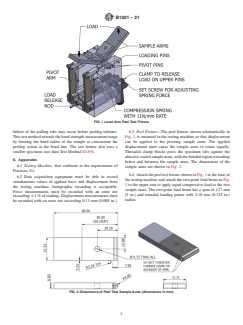
arms are shown in Fig. 1.
Testing.
Current edition approved Dec. 1, 2021. Published January 2022. DOI: 10.1520/
5. Significance and Use
B1021-21.
For referenced ASTM standards, visit the ASTM website, www.astm.org, or
5.1 Use this test method for acceptance and process control
contact ASTM Customer Service at service@astm.org. For Annual Book of ASTM
testing. This test method may be used as an alternative to Test
Standards volume information, refer to the standard’s Document Summary page on
the ASTM website. Method D1876 when the bond strength is sufficiently high that
Copyright © ASTM International, 100 Barr Harbor Drive, PO Box C700, West Conshohocken, PA 19428-2959. United States
B1021 − 21
FIG. 1 Lever-Arm Peel Test Fixture
failure of the pulling tabs may occur before peeling initiates. 6.3 Peel Fixture—The peel fixture, shown schematically in
This test method extends the bond strength measurement range
Fig. 1, is mounted in the testing machine so that displacement
by limiting the bend radius of the sample to concentrate the
can be applied to the pivoting sample arms. The applied
peeling action at the bond line. The test fixture also uses a
displacement must cause the sample arms to rotate equally.
smaller specimen size than Test Method D1876.
Threaded clamp blocks press the specimen tabs against the
abrasivecoatedsamplearms,withthebondedregionextending
6. Apparatus
below and between the sample arms. The dimensions of the
6.1 Testing Machine, that conforms to the requirements of
sample arms are shown in Fig. 2.
Practices E4.
6.4 Attach the peel test fixture shown in Fig. 1 to the base of
6.2 Data acquisition equipment must be able to record
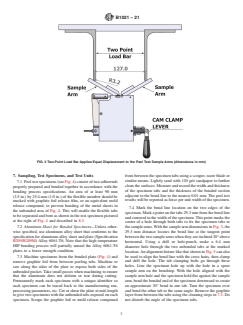
the testing machine and attach the two-point load beam in Fig.
simultaneous values of applied force and displacement from
3 to the upper ram to apply equal compressive load to the two
the testing machine. Autographic recording is acceptable.
sample arms. The two-point load beam has a span of 127 mm
Force measurements must be recorded with an error not
(5 in.) and rounded loading points with 3.18 mm (0.125 in.)
exceeding 61 % of reading. Displacement measurements must
radius.
be recorded with an error not exceeding 0.13 mm (0.005 in.).
FIG. 2 Dimensions of Peel Test Sample Arms (dimensions in mm)
B1021 − 21
FIG. 3 Two-Point Load Bar Applies Equal Displacement to the Peel Test Sample Arms (dimensions in mm)
7. Sampling, Test Specimens, and Test Units from between the specimen tabs using a scraper, razor blade or
similar means. Lightly sand with 120 grit sandpaper to further
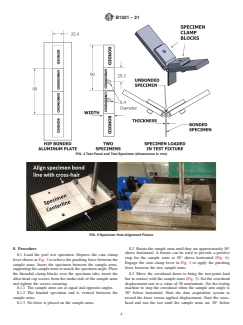
7.1 Peeltestspecimens(seeFig.4)consistoftwoadherends
clean the surfaces. Measure and record the width and thickness
properly prepared and bonded together in accordance with the
of the specimen tabs and the thickness of the bonded section
bonding process specifications. An area of at least 90 mm
adjacent to the bond line to the nearest 0.01 mm. The peel test
(3.5 in.) by 25.4 mm (1.0 in.) of the flexible member should be
results will be reported as force per unit width of the specimen.
masked with graphite foil release film, or an equivalent mold
release compound, to prevent bonding of the metal sheets in
7.4 Mark the bond line location on the two edges of the
the unbonded area of Fig. 4. This will enable the flexible tabs
specimen.Markapointonthetabs29.3mmfromthebondline
to be separated and bent as shown in the test specimen pictured
andcenteredinthewidthofthespecimen.Thispointmarksthe
at the right of Fig. 4 and described in 8.3.
center of a hole through both tabs to fix the specimen tabs to
7.2 Aluminum Sheet for Bonded Specimens—Unless other-
thesamplearms.WiththesamplearmdimensionsinFig.3,the
wise specified, use aluminum alloy sheet that conforms to the
29.3 mm distance locates the bond line at the tangent point
specification for aluminum-alloy sheet and plate (Specification
betweenthetwosamplearmswhentheyareinclined30°above
B209/B209M) Alloy 6061-T6. Note that the high temperature
horizontal. Using a drill or hole-punch, make a 6.4 mm
HIP bonding process will partially anneal the Alloy 6061-T6
diameter hole through the two unbonded tabs at the marked
plates to a lower strength condition.
location.AnalignmentfixturelikethatshowninFig.5canalso
be used to align the bond line with the cross hairs, then clamp
7.3 Machine specimens from the bonded plate (Fig. 4) and
and drill the hole. The tab clamping bolts go through these
remove graphite foil from between peeling tabs. Machine or
holes. Line the specimen hole up with the hole in a spare
saw along the sides of the plate to expose both sides of the
sample arm on the benchtop. With the hole aligned with the
unbonded pocket.Take small passes when machining to ensure
sample arm hole and the specimen held flat against the sample
that the aluminum does not deform or tear during cutting.
arm, bend the bonded end of the specimen downward to create
Permanently mark each specimen with a unique identifier so
each specimen can be traced back to the manufacturing run, an approximate 30° bend in one tab. Turn the specimen over
processing parameters, etc. Cut or shear the plate at mid-length and bend the other tab to the same angle. Remove the graphite
to give two specimens with the unbonded tabs exposed on each layer from between the tabs using the cleaning steps in 7.3.Do
specimen. Scrape the graphite foil or mold release compound not disturb the angle of the specimen tabs.
B1021 − 21
FIG. 4 Test Panel and Test Specimen (dimensions in mm)
FIG. 5 Specimen Hole Alignment Fixture
8. Procedure 8.2 Rotate the sample arms until they are approximately 30°
above horizontal. A fixture can be used to provide a positive
8.1 Load the peel test specimen. Depress the cam clamp
stop for the sample arms at 30° above horizontal (Fig. 6).
lever shown in Fig. 3 to relieve the pinching force between the
Engage the cam clamp lever in Fig. 3 to apply the pinching
sample arms. Insert the specimen between the sample arms,
force between the two sample arms.
supportingthesamplearmstomatchthespecimenangle.Place
the threaded clamp blocks over the specimen tabs, insert the 8.3 Move the crosshead down to bring the two-point load
allen head cap screws from the under-side of the sample arms bar in contact with the sample arms (Fig. 3). Set the crosshead
and tighten the screws ensuring: displacement rate to a value of 30 mm/minute. Set the testing
8.1.1 The sample arms are at equal and opposite angles. machine to stop the crosshead when the sample arm angle is
8.1.2 The bonded specimen end is vertical between the 30° below horizontal. Start the data acquisition system to
sample arms. record the force versus applied displacement. Start the cross-
8.1.3 No force is placed on the sample arms. head and run the test until the sample arms are 30° below
B1021 − 21
Afixturecanbeusedtoalignthesamplearmsatthe30°positiontostartthepeeltest.Theredhandleactivatestheclamptoapplypinchingforcebetweenthetwosample
arms.
FIG. 6 Alignment Fixture
horizontal. The peel strength is calculated as the maximum tabsmustbemeasuredsothatitcanbesubtractedfromthepeel
force during the test divided by the specimen width. Using the test
...