

ASTM E3270-21
(Guide)Standard Guide for Operational Qualification of Gamma Irradiators
General Information
- Abstract
SIGNIFICANCE AND USE
4.1 Operational qualification (OQ) will be used to demonstrate that the irradiator, as installed, is capable of operating and delivering dose to product being irradiated with defined acceptance criteria by determining dose distribution and magnitude through dose mapping exercises and relating these distributions to process parameters.
4.2 The principle objectives of OQ are to:
4.2.1 Establish the dose distribution and create a baseline PQ grid for mapping actual product,
4.2.2 Establish the relationship for dose uniformity ratio (DUR) as a function of density,
4.2.3 Establish the relationship for cycle time (CT) as a function of density and source activity, and
4.2.4 Establish the relationship for minimum dose (kGy) as a function of density, cycle time and source activity.
4.3 OQ exercises could augment or replace PQ exercises. It is the facility’s responsibility to document the rationale when using OQ data for PQ purposes.
4.4 A design of experiments approach may help rationalize the types of OQ tests needed. For some irradiator changes, the minimum number of densities may be different depending on the degree of anticipated change in dose distribution. These decisions should be covered through a documented change control process. See ISO/ASTM 52701.
4.5 This guide is not intended to address OQ requirements in research or experimental irradiators.
4.6 An irradiation facility is able to process different process load configurations. For example, an irradiation container may be designed to accommodate boxes, sacks and drums. It is important to consider OQ studies that characterize the irradiator for different irradiation geometries.
4.7 The bulk density, dimensions and atomic composition are important properties in dose mapping. See Appendix X2 for examples of materials for potential use in OQ studies.
SCOPE
1.1 This document provides guidance on operational qualification (OQ) tests to meet the OQ requirements defined in ISO 11137-1, ISO 14470, ISO/ASTM 51702, and ISO/ASTM 52303 for gamma irradiators.
1.1.1 The types of OQ tests are discussed to help the user gain an increased understanding of operational aspects of their irradiator and determine which OQ tests are appropriate for the assessment of irradiator change.
1.1.2 The facility should assess the rationale for the OQ tests chosen and for the ones that have been deemed to be unnecessary.
1.2 Specific requirements for OQ are dependent on the application of the irradiation process and are not within the scope of this guide. For example, requirements for OQ when sterilizing healthcare products can be found in ISO 11137-1.
1.3 A change to the irradiator is a component of the change control process. The OQ testing following the irradiator change is determined as part of the change control documentation and should include rationale to support decision(s) on which tests are required to be completed.
1.4 For an OQ study following an irradiator change, the required OQ tests are defined procedurally with established acceptance criteria. (The OQ tests in the appendixes have examples of defined acceptance criteria with a rationale for the acceptance.) When multiple tests are used in the assessment of change, no individual OQ test should be solely relied upon; rather, the composite of OQ test results should be used to help provide a clear justification for the conclusion regarding irradiator change.
1.5 Many calculations in this guide were completed using Microsoft Excel (for example, ANOVA, t-test, p-value), but numerous other software tools are commercially available.
1.6 This standard does not purport to address all of the safety concerns, if any, associated with its use. It is the responsibility of the user of this standard to establish appropriate safety, health, and environmental practices and determine the applicability of regulatory limitations prior to use.
1.7 This international standard...
- Status
- Published
- Publication Date
- 14-Aug-2021
- Technical Committee
- E61 - Radiation Processing
- Drafting Committee
- E61.03 - Dosimetry Application
Overview
ASTM E3270-21 - Standard Guide for Operational Qualification of Gamma Irradiators provides comprehensive guidance for conducting operational qualification (OQ) tests on gamma irradiators used in industrial and medical applications. Developed by ASTM International, this standard helps users ensure that gamma irradiators, as installed, are capable of delivering the required dose consistently and safely to products, with clearly defined acceptance criteria. The OQ process involves dose distribution mapping, assessment of irradiator performance after changes, and establishment of baseline operational parameters.
This guide aligns with international standards such as ISO 11137-1 and ISO 14470, ensuring global relevance and compliance with quality, safety, and regulatory requirements for gamma irradiation processes.
Key Topics
- Operational Qualification (OQ): Framework and methodology for demonstrating that a gamma irradiator operates within predetermined limits post-installation or modification.
- Dose Mapping: Procedures for measuring and mapping the absorbed dose within a product, providing essential data for process validation.
- Acceptance Criteria: Requirements and rationale for defining, documenting, and applying acceptance standards to OQ tests.
- Change Control: Processes for documenting and justifying changes to irradiation equipment or procedures, including rationale for test selection post-change.
- Statistical Analysis: Application of statistical tools such as ANOVA and t-tests to assess dose distribution, uniformity, and change impact.
- Dosimeter Usage and Grid Design: Guidelines for selecting dosimeter types and establishing grids for effective dose measurement across different process loads and irradiation geometries.
- Simulation and Mathematical Methods: Use of validated models to simulate dose distribution, optimize irradiator configuration, and complement physical dosimetry exercises.
- Facility Responsibility: Emphasis on documentation, data analysis, and compliance with both facility-specific and international regulatory requirements.
Applications
ASTM E3270-21 is essential for organizations that utilize gamma irradiators for:
- Medical Device Sterilization: Providing evidence that irradiators used for sterilizing healthcare products comply with established international standards, safeguarding patient safety.
- Food Processing: Ensuring uniform and effective irradiation of food products for microbial reduction and extended shelf life.
- Industrial Product Treatment: Reliable irradiation of various materials, including packaging and raw materials, necessitating consistent and traceable dose delivery.
- Change Management: Re-qualification of irradiators following upgrades, repairs, or modifications, ensuring continued compliance with operational and regulatory requirements.
- Routine Quality Assurance: Periodic validation of irradiators to guarantee ongoing process performance and product safety.
Following ASTM E3270-21 fosters reliable, consistent, and auditable operation of gamma irradiators across diverse industry sectors.
Related Standards
When implementing or auditing gamma irradiator operational qualification in accordance with ASTM E3270-21, the following standards provide important complementary requirements and terminology:
- ISO 11137-1: Requirements for the development, validation, and routine control of radiation sterilization for medical devices.
- ISO 14470: Requirements for development, validation, and routine control of food irradiation using ionizing radiation.
- ISO/ASTM 51702: Practice for dosimetry in a gamma facility for radiation processing.
- ISO/ASTM 52303: Guide for absorbed-dose mapping in radiation processing facilities.
- ASTM E2232: Guide for the use of mathematical methods for dose calculation in radiation processing applications.
- Other related ISO/ASTM dosimetry and calibration standards relevant for facility setup and routine checks.
By following ASTM E3270-21 alongside these referenced standards, organizations ensure the highest levels of process reliability, safety, and regulatory compliance in gamma irradiation operations.
Keywords: ASTM E3270-21, operational qualification, gamma irradiator, dose mapping, acceptance criteria, dosimetry, radiation processing, change control, ISO 11137-1, ISO 14470, quality assurance, industrial irradiation standards, process validation
Relations
- Refers
ASTM E3083-17 - Standard Terminology Relating to Radiation Processing: Dosimetry and Applications - Effective Date
- 01-Oct-2017
- Effective Date
- 01-Jul-2010
- Effective Date
- 10-Sep-2002
Get Certified
Connect with accredited certification bodies for this standard

BSMI (Bureau of Standards, Metrology and Inspection)
Taiwan's standards and inspection authority.
Sponsored listings
Frequently Asked Questions
ASTM E3270-21 is a guide published by ASTM International. Its full title is "Standard Guide for Operational Qualification of Gamma Irradiators". This standard covers: SIGNIFICANCE AND USE 4.1 Operational qualification (OQ) will be used to demonstrate that the irradiator, as installed, is capable of operating and delivering dose to product being irradiated with defined acceptance criteria by determining dose distribution and magnitude through dose mapping exercises and relating these distributions to process parameters. 4.2 The principle objectives of OQ are to: 4.2.1 Establish the dose distribution and create a baseline PQ grid for mapping actual product, 4.2.2 Establish the relationship for dose uniformity ratio (DUR) as a function of density, 4.2.3 Establish the relationship for cycle time (CT) as a function of density and source activity, and 4.2.4 Establish the relationship for minimum dose (kGy) as a function of density, cycle time and source activity. 4.3 OQ exercises could augment or replace PQ exercises. It is the facility’s responsibility to document the rationale when using OQ data for PQ purposes. 4.4 A design of experiments approach may help rationalize the types of OQ tests needed. For some irradiator changes, the minimum number of densities may be different depending on the degree of anticipated change in dose distribution. These decisions should be covered through a documented change control process. See ISO/ASTM 52701. 4.5 This guide is not intended to address OQ requirements in research or experimental irradiators. 4.6 An irradiation facility is able to process different process load configurations. For example, an irradiation container may be designed to accommodate boxes, sacks and drums. It is important to consider OQ studies that characterize the irradiator for different irradiation geometries. 4.7 The bulk density, dimensions and atomic composition are important properties in dose mapping. See Appendix X2 for examples of materials for potential use in OQ studies. SCOPE 1.1 This document provides guidance on operational qualification (OQ) tests to meet the OQ requirements defined in ISO 11137-1, ISO 14470, ISO/ASTM 51702, and ISO/ASTM 52303 for gamma irradiators. 1.1.1 The types of OQ tests are discussed to help the user gain an increased understanding of operational aspects of their irradiator and determine which OQ tests are appropriate for the assessment of irradiator change. 1.1.2 The facility should assess the rationale for the OQ tests chosen and for the ones that have been deemed to be unnecessary. 1.2 Specific requirements for OQ are dependent on the application of the irradiation process and are not within the scope of this guide. For example, requirements for OQ when sterilizing healthcare products can be found in ISO 11137-1. 1.3 A change to the irradiator is a component of the change control process. The OQ testing following the irradiator change is determined as part of the change control documentation and should include rationale to support decision(s) on which tests are required to be completed. 1.4 For an OQ study following an irradiator change, the required OQ tests are defined procedurally with established acceptance criteria. (The OQ tests in the appendixes have examples of defined acceptance criteria with a rationale for the acceptance.) When multiple tests are used in the assessment of change, no individual OQ test should be solely relied upon; rather, the composite of OQ test results should be used to help provide a clear justification for the conclusion regarding irradiator change. 1.5 Many calculations in this guide were completed using Microsoft Excel (for example, ANOVA, t-test, p-value), but numerous other software tools are commercially available. 1.6 This standard does not purport to address all of the safety concerns, if any, associated with its use. It is the responsibility of the user of this standard to establish appropriate safety, health, and environmental practices and determine the applicability of regulatory limitations prior to use. 1.7 This international standard...
SIGNIFICANCE AND USE 4.1 Operational qualification (OQ) will be used to demonstrate that the irradiator, as installed, is capable of operating and delivering dose to product being irradiated with defined acceptance criteria by determining dose distribution and magnitude through dose mapping exercises and relating these distributions to process parameters. 4.2 The principle objectives of OQ are to: 4.2.1 Establish the dose distribution and create a baseline PQ grid for mapping actual product, 4.2.2 Establish the relationship for dose uniformity ratio (DUR) as a function of density, 4.2.3 Establish the relationship for cycle time (CT) as a function of density and source activity, and 4.2.4 Establish the relationship for minimum dose (kGy) as a function of density, cycle time and source activity. 4.3 OQ exercises could augment or replace PQ exercises. It is the facility’s responsibility to document the rationale when using OQ data for PQ purposes. 4.4 A design of experiments approach may help rationalize the types of OQ tests needed. For some irradiator changes, the minimum number of densities may be different depending on the degree of anticipated change in dose distribution. These decisions should be covered through a documented change control process. See ISO/ASTM 52701. 4.5 This guide is not intended to address OQ requirements in research or experimental irradiators. 4.6 An irradiation facility is able to process different process load configurations. For example, an irradiation container may be designed to accommodate boxes, sacks and drums. It is important to consider OQ studies that characterize the irradiator for different irradiation geometries. 4.7 The bulk density, dimensions and atomic composition are important properties in dose mapping. See Appendix X2 for examples of materials for potential use in OQ studies. SCOPE 1.1 This document provides guidance on operational qualification (OQ) tests to meet the OQ requirements defined in ISO 11137-1, ISO 14470, ISO/ASTM 51702, and ISO/ASTM 52303 for gamma irradiators. 1.1.1 The types of OQ tests are discussed to help the user gain an increased understanding of operational aspects of their irradiator and determine which OQ tests are appropriate for the assessment of irradiator change. 1.1.2 The facility should assess the rationale for the OQ tests chosen and for the ones that have been deemed to be unnecessary. 1.2 Specific requirements for OQ are dependent on the application of the irradiation process and are not within the scope of this guide. For example, requirements for OQ when sterilizing healthcare products can be found in ISO 11137-1. 1.3 A change to the irradiator is a component of the change control process. The OQ testing following the irradiator change is determined as part of the change control documentation and should include rationale to support decision(s) on which tests are required to be completed. 1.4 For an OQ study following an irradiator change, the required OQ tests are defined procedurally with established acceptance criteria. (The OQ tests in the appendixes have examples of defined acceptance criteria with a rationale for the acceptance.) When multiple tests are used in the assessment of change, no individual OQ test should be solely relied upon; rather, the composite of OQ test results should be used to help provide a clear justification for the conclusion regarding irradiator change. 1.5 Many calculations in this guide were completed using Microsoft Excel (for example, ANOVA, t-test, p-value), but numerous other software tools are commercially available. 1.6 This standard does not purport to address all of the safety concerns, if any, associated with its use. It is the responsibility of the user of this standard to establish appropriate safety, health, and environmental practices and determine the applicability of regulatory limitations prior to use. 1.7 This international standard...
ASTM E3270-21 is classified under the following ICS (International Classification for Standards) categories: 17.240 - Radiation measurements. The ICS classification helps identify the subject area and facilitates finding related standards.
ASTM E3270-21 has the following relationships with other standards: It is inter standard links to ASTM E3083-17, ASTM E2232-10, ASTM E2232-02. Understanding these relationships helps ensure you are using the most current and applicable version of the standard.
ASTM E3270-21 is available in PDF format for immediate download after purchase. The document can be added to your cart and obtained through the secure checkout process. Digital delivery ensures instant access to the complete standard document.
Standards Content (Sample)
This international standard was developed in accordance with internationally recognized principles on standardization established in the Decision on Principles for the
Development of International Standards, Guides and Recommendations issued by the World Trade Organization Technical Barriers to Trade (TBT) Committee.
Designation:E3270 −21
Standard Guide for
Operational Qualification of Gamma Irradiators
This standard is issued under the fixed designation E3270; the number immediately following the designation indicates the year of
original adoption or, in the case of revision, the year of last revision. A number in parentheses indicates the year of last reapproval. A
superscript epsilon (´) indicates an editorial change since the last revision or reapproval.
1. Scope priate safety, health, and environmental practices and deter-
mine the applicability of regulatory limitations prior to use.
1.1 This document provides guidance on operational quali-
1.7 This international standard was developed in accor-
fication(OQ)teststomeettheOQrequirementsdefinedinISO
dance with internationally recognized principles on standard-
11137-1, ISO 14470, ISO/ASTM 51702, and ISO/ASTM
ization established in the Decision on Principles for the
52303 for gamma irradiators.
Development of International Standards, Guides and Recom-
1.1.1 The types of OQ tests are discussed to help the user
mendations issued by the World Trade Organization Technical
gain an increased understanding of operational aspects of their
Barriers to Trade (TBT) Committee.
irradiator and determine which OQ tests are appropriate for the
assessment of irradiator change.
2. Referenced Documents
1.1.2 The facility should assess the rationale for the OQ
2.1 ASTM Standards:
tests chosen and for the ones that have been deemed to be
E2232 Guide for Selection and Use of Mathematical Meth-
unnecessary.
ods for Calculating Absorbed Dose in Radiation Process-
1.2 Specific requirements for OQ are dependent on the
ing Applications
application of the irradiation process and are not within the
E3083 Terminology Relating to Radiation Processing: Do-
scope of this guide. For example, requirements for OQ when
simetry and Applications
sterilizing healthcare products can be found in ISO 11137-1.
2.2 ISO/ASTM Standards:
1.3 Achange to the irradiator is a component of the change
51261 Practice for Calibration of Routine Dosimetry Sys-
controlprocess.TheOQtestingfollowingtheirradiatorchange
tems for Radiation Processing
is determined as part of the change control documentation and
51702 Practice for Dosimetry in a Gamma Facility for
should include rationale to support decision(s) on which tests
Radiation Processing
are required to be completed.
52303 Guide forAbsorbed-Dose Mapping in Radiation Pro-
1.4 For an OQ study following an irradiator change, the cessing Facilities
required OQ tests are defined procedurally with established 52628 Practice for Dosimetry in Radiation Processing
acceptance criteria. (The OQ tests in the appendixes have 52701 Guide for Performance Characterization of Dosim-
examples of defined acceptance criteria with a rationale for the eters and Dosimetry Systems for Use in Radiation Pro-
acceptance.) When multiple tests are used in the assessment of cessing
change, no individual OQ test should be solely relied upon;
2.3 ISO Standards:
rather, the composite of OQ test results should be used to help
ISO 11137-1:2006 Sterilization of health care products —
provide a clear justification for the conclusion regarding
Radiation — Part 1: Requirements for the development,
irradiator change.
validation and routine control of a sterilization process for
medical devices
1.5 Many calculations in this guide were completed using
ISO 11137-3:2017 Sterilization of health care products —
Microsoft Excel (for example, ANOVA, t-test, p-value), but
Radiation — Part 3: Guidance on dosimetric aspects of
numerous other software tools are commercially available.
development, validation and routine control
1.6 This standard does not purport to address all of the
ISO/TS 11137-4:2020 Sterilization of health care products –
safety concerns, if any, associated with its use. It is the
Radiation – Part 4: Guidance on process control
responsibility of the user of this standard to establish appro-
For referenced ASTM standards, visit the ASTM website, www.astm.org, or
This guide is under the jurisdiction of ASTM Committee E61 on Radiation contact ASTM Customer Service at service@astm.org. For Annual Book of ASTM
Processing and is the direct responsibility of Subcommittee E61.03 on Dosimetry Standards volume information, refer to the standard’s Document Summary page on
Application. the ASTM website.
Current edition approved Aug. 15, 2021. Published October 2021. DOI: Available fromAmerican National Standards Institute (ANSI), 25 W. 43rd St.,
10.1520/E3270-21. 4th Floor, New York, NY 10036, http://www.ansi.org.
Copyright © ASTM International, 100 Barr Harbor Drive, PO Box C700, West Conshohocken, PA 19428-2959. United States
E3270−21
ISO 14470:2011 Food irradiation — Requirements for the 3.1.9.1 Discussion—An irradiator may have more than one
development, validation and routine control of the process pathway; each pathway requires OQ dosimetry. An irradiator
of irradiation using ionizing radiation for the treatment of mayhavemultiplesourcerackconfigurations;eachsourcerack
food configuration is considered a separate pathway, and requires
ISO/IEC 17043:2010 Conformity assessment — General OQ dosimetry. Off-carrier and research loop irradiations are
requirements for proficiency testing considered separate pathways.
3.1.10 maximum product stack dimensions, n—the maxi-
3. Terminology
mum width, length and height of the process load.
3.1.10.1 Discussion—The process load volume is less than
3.1 Definitions:
3.1.1 absorbed-dose mapping, n—measurementofabsorbed the available irradiation container volume to allow the de-
signed airgap between the process load and the irradiation
dose within an irradiated product to produce a one-, two-, or
three-dimensionaldistributionofabsorbeddose,thusrendering container wall.
a map of absorbed-dose values.
3.1.11 mini-grid, n—an OQ grid with a reduced set of
3.1.1.1 Discussion—Absorbed-dose mapping is often re-
dosimeter placements developed from the results of quiet
ferred to as dose mapping (DM). Dose mapping is the
system studies as part of a full OQ.
measurement of dose distribution and variability in material
3.1.11.1 Discussion—The mini-grid typically includes the
irradiated under defined conditions (ISO 11137 Part 1).
absoluteandequivalentD andD positionsthatarewithin
max min
3.1.2 critical path (of an irradiator), n—positions within an the minimum detectable difference.As a guideline, a mini-grid
irradiator that significantly contribute to the total absorbed could be used where the variable under study is a dose
dose. distribution characteristic. A mini-grid is not used when the
variable under study is exclusively dose magnitude.
3.1.3 dose uniformity ratio (DUR), n—ratio of the maxi-
mum to the minimum absorbed dose within the irradiated 3.1.12 mini-map, n—an OQ study using a mini-grid.
product.
3.1.12.1 Discussion—When a mini-map is used, dosimeters
are placed in expected D and D zones.
3.1.4 dose zone, n—a volume of discrete point(s) within a min max
process load that receives doses that are defined as equivalent.
3.1.13 operationalqualification(OQ),n—processofobtain-
3.1.4.1 Discussion—(1) The dose zone is also referred to as
ing and documenting evidence that installed equipment oper-
a dose position. (2) Equivalency is generally determined based
ates within predetermined limits when used in accordance with
on a standard error about a mean and is often defined as a level
its operational procedures.
ofsignificance(thatis,0.05alphaforasamplingdistributionof
3.1.14 OQ grid, n—facility-defined dosimeter positions uti-
the mean (t-distribution)). See ISO/ASTM 52303 for a discus-
lized during the OQ quiet system studies that contain adequate
sion of Minimum Detectable Difference using the
positions to measure the absolute and equivalent D and
max
t-distribution.
D positions for a defined density range.
min
3.1.5 effective density, n—bulk density multiplied by the
3.1.14.1 Discussion—The OQ grid contains intermediate-
ratio of product width to the designed maximum width where
dose positions that are not equivalent D or D zones. The
min max
width dimension is the dimension perpendicular to the source
OQ grid is also referred to as the Irradiator Qualification Grid,
of radiation.
or facility-defined baseline grid. The OQ grid is irradiator
3.1.5.1 Discussion—The effective density helps to correlate
specific. A validated mathematical method may be used to
the minimum dose rate for the bulk density (that is, fully
establish or verify the OQ grid.
loaded irradiation container) to the minimum dose rate for the
3.1.15 performance qualification (PQ), n—process of ob-
effective density (that is, center-loaded product).
taining and documenting evidence that the equipment, as
3.1.6 installation qualification (IQ), n—processofobtaining
installed and operated in accordance with operational
and documenting evidence that equipment has been provided
procedures, consistently performs in accordance with predeter-
and installed in accordance with its specification.
mined criteria and thereby yields product meeting specifica-
tion.
3.1.7 irradiation container, n—holder in which process load
is transported through the irradiator.
3.1.16 process load, n—a volume of material with a speci-
3.1.8 full OQ, n—a process to establish the irradiator per- fied product loading configuration irradiated as a single entity.
formance baseline for a new irradiator or an existing irradiator
3.1.17 quiet system, n—a processing condition in the irra-
following a major irradiator change.
diator whereby only fully-loaded irradiation containers of
3.1.8.1 Discussion—The dose mapping experiments per-
product or simulated product are present in the irradiator with
formed directly after a major change activity to determine the
a defined variation in density.
effects of the change(s) on the magnitude of dose, dose
3.1.17.1 Discussion—During the quiet system study, there
distribution and variability of dose is often called an irradiator
are no changes in process load dimensions, cycle time or
requalification. The full OQ process is used to initially estab-
product density. The fully loaded irradiation containers may
lish or to re-establish the irradiator baseline.
occupy the entire irradiator, or for an irradiator with two or
3.1.9 irradiator pathway, n—unique product path through more parallel source racks, the critical path of the irradiator.
the irradiator. (Refer to 3.1.2.) Fully-loaded irradiation containers occupy the
E3270−21
entire irradiator, or as a minimum, any irradiation container 4.3 OQ exercises could augment or replace PQ exercises. It
adjacent to or between the source and a container being is the facility’s responsibility to document the rationale when
mapped should contain material of the same density. See the using OQ data for PQ purposes.
definition of critical path for further detail.
4.4 A design of experiments approach may help rationalize
3.1.18 reduced height OQ, n—an OQ study utilizing a
the types of OQ tests needed. For some irradiator changes, the
phantom material height that is less than the height available
minimum number of densities may be different depending on
within the irradiation container.
the degree of anticipated change in dose distribution. These
3.1.18.1 Discussion—The reduced height OQ dose mapping
decisions should be covered through a documented change
may be performed to determine the effects of the change(s) on
control process. See ISO/ASTM 52701.
the magnitude of dose, dose distribution and variability of
4.5 This guide is not intended to address OQ requirements
dose. The reduced height OQ process is used to confirm that
in research or experimental irradiators.
there has been no significant change in the dose distribution.
The reduced height OQ is sometimes referred to as a reduced
4.6 Anirradiationfacilityisabletoprocessdifferentprocess
OQ (that is. a subset of full OQ tests). load configurations. For example, an irradiation container may
be designed to accommodate boxes, sacks and drums. It is
3.1.19 reduced length OQ, n—an OQ study utilizing a
important to consider OQ studies that characterize the irradia-
phantom material height that is less than the length available
tor for different irradiation geometries.
within the irradiation container.
3.1.19.1 Discussion—The reduced length OQ dose mapping
4.7 The bulk density, dimensions and atomic composition
may be performed to determine the effects of the change(s) on
are important properties in dose mapping. See Appendix X2
the magnitude of dose, dose distribution and variability of
for examples of materials for potential use in OQ studies.
dose.
5. OQ Validation Activities
3.1.20 reference material, n—homogenous material of
known radiation absorption and scattering properties used to
5.1 OQ tests for assessment of irradiator changes are de-
establish characteristics of the irradiation process, such as dose
scribedinTable1.AlsorefertoISO11137-1:2006,TableA.11,
distribution and reproducibility of dose delivery.
Table A.1 (for healthcare products), and ISO 14470 (for food
3.1.20.1 Discussion—Reference material is sometimes re-
products).
ferred to as phantom material. Refer to Appendix X2 for a list
5.2 When OQ dosimetry is completed following an irradia-
of reference materials.
tor change, the irradiator is assessed for change relative to the
3.1.21 spatial resolution, n—the physical space a dosimeter
baseline irradiator qualification, and possibly relative to the
occupies and the subsequent dose gradient the dosimeter is
irradiator commissioning. This allows the detection of change
understood to represent.
in dose magnitude and dose distribution. Even though great
3.1.22 timer setting, n—defined time interval during which
care is taken to minimize change following irradiator loadings,
product is exposed to radiation at an individual irradiation
change in the dose distribution may still occur over time.
position.
5.3 A repeat of the full OQ or a portion thereof (at a
3.1.22.1 Discussion—Forashuffle-dwellirradiatorthetimer
frequency defined by the facility) will help to determine the
setting is the time interval from the start of one shuffle-dwell
degree of change, redefine the irradiator characteristics and
cycle to the start of the next shuffle-dwell cycle. For a
helptodemonstratethecontinuedeffectivenessoftheradiation
stationary irradiator, the timer setting is the total irradiation
process.
time.Thetimersettingisalsoreferredtoas‘CycleTime’(CT).
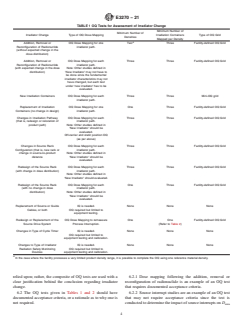
5.4 Table 2 describes potential types of OQ dose mapping
4. Significance and Use associated with full OQ activities.
4.1 Operational qualification (OQ) will be used to demon-
5.5 Tables 1 and 2 refer to facility-defined OQ grid or a
strate that the irradiator, as installed, is capable of operating
mini-OQgrid.Itmaybenecessarytodemonstratethemini-OQ
and delivering dose to product being irradiated with defined
grid will include the D and D zones before it is utilized.
min max
acceptance criteria by determining dose distribution and mag-
For example, it may be necessary to utilize the facility-defined
nitude through dose mapping exercises and relating these
OQ grid until it has been demonstrated that the mini-OQ grid
distributions to process parameters.
is accurate for all tests to demonstrate the mini-OQ grid is
adequate.
4.2 The principle objectives of OQ are to:
4.2.1 Establish the dose distribution and create a baseline
6. OQ Acceptance Criteria
PQ grid for mapping actual product,
4.2.2 Establish the relationship for dose uniformity ratio
6.1 For an OQ study following an irradiator change, the set
(DUR) as a function of density,
ofOQtestsisdefinedprocedurallywithestablishedacceptance
4.2.3 Establish the relationship for cycle time (CT) as a
criteria. (The OQ tests in the appendixes have examples of
function of density and source activity, and
defined acceptance criteria with a rationale behind the accep-
4.2.4 Establish the relationship for minimum dose (kGy) as tance.) It is important to state that when multiple tests are used
a function of density, cycle time and source activity. in the determination of change, that no single test is solely
E3270−21
TABLE 1 OQ Tests for Assessment of Irradiator Change
Minimum Number of
Minimum Number of
Irradiator Change Type of OQ Dose Mapping Irradiation Containers Type of OQ Grid
Densities
Mapped per Density
A
Addition, Removal or OQ Dose Mapping for one Two Three Facility-defined OQ Grid
Reconfiguration of Radionuclide irradiator path.
(without expected change in the
dose distribution)
Addition, Removal or OQ Dose Mapping for each Three Three Facility-defined OQ Grid
Reconfiguration of Radionuclide irradiator path.
(with expected change in the dose Note: Other studies defined in
distribution) ‘New Irradiator’ may not have to
be done since the fundamental
irradiator characteristics may not
have changed, but each test
under ‘new irradiator’ has to be
evaluated.
New Irradiation Containers OQ Dose Mapping for each Three Three Mini-OQ grid
irradiator path.
Replacement of Irradiation OQ Dose Mapping for one One Three Facility-defined OQ Grid
Containers (no change in design) irradiator path.
Changes in Irradiation Pathway OQ Dose Mapping for each Three Three Facility-defined OQ Grid
(that is, redesign or relocation of irradiator path.
product path) Note: Other studies defined in
‘New Irradiator’ should be
evaluated.
Off-carrier and static position OQ
(as per above)
Changes in Source Rack OQ Dose Mapping for each Three Three Facility-defined OQ Grid
Configuration (that is, new rack or irradiator path.
change in source-to-product Note: Other studies defined in
distance ‘New Irradiator’ should be
evaluated.
Redesign of the Source Rack OQ Dose Mapping for each Three Three Facility-defined OQ Grid
(with change in dose distribution) irradiator path.
Note: Other studies defined in
‘New Irradiator’ should evaluated.
Redesign of the Source Rack OQ Dose Mapping for each One Three Facility-defined OQ Grid
(with no change in dose irradiator path.
distribution) Note: Other studies defined in
‘New Irradiator’ should be
evaluated.
Replacement of Source or Guide IQ is needed. None None None
Cables, or both OQ required but limited to
equipment testing.
Redesign or Replacement of the OQ Dose Mapping to remeasure One One Facility-defined OQ Grid
Source Drive System Process Interruption. (Refer to Table 2)
Changes in Type of Cycle Timer IQ is needed. None None None
OQ required but limited to
equipment testing and calibration.
Changes to Type of Irradiator IQ is needed. None None None
Radiation Safety Monitoring OQ required but limited to
Devices equipment testing and calibration.
A
In the case where the facility processes a very limited product density range, it is possible to complete the OQ using one reference material density.
relied upon; rather, the composite of OQ tests are used with a 6.2.1 Dose mapping following the addition, removal or
clear justification behind the conclusion regarding irradiator
reconfiguration of radionuclide is an example of an OQ test
change. that requires documented acceptance criteria.
6.2.2 Source interrupt studies are an example of an OQ test
6.2 The OQ tests given in Tables 1 and 2 should have
that may not require acceptance criteria since the test is
documented acceptance criteria, or a rationale as to why one is
not required. conducted to determine the impact of source interrupts on D
min
E3270−21
TABLE 2 Types of OQ Dose Mapping
Minimum Number of Irradiation
Type of OQ Dose Mapping Minimum Number of Densities OQ Dose Mapping Grid
Containers Mapped per Density
A
OQ Dose Mapping for each Three Three Facility-defined OQ Grid
irradiator path.
See 9.1, 9.2
Off-carrier OQ for each location. One (represents routine Three Facility-defined OQ Grid
See 9.3 processing density).
It may be acceptable for a mini-
map to replace OQ.
Static irradiation. One (represents routine One Facility-defined OQ Grid
See 9.4 processing density) depending on
the required processing range.
Mini-map may suffice if completed
routinely.
Cycle time change. One One at the beginning or end of Mini-OQ grid
See 9.5 each product row
B
Process Interruption. One One located where maximum Facility-defined grid for
See 9.6 process interrupt dose characterization of process
contribution is most significant. interruption
Additional containers may be
used to ensure maximum dose is
captured.
Center Loading. One One center loaded container, and Mini-OQ grid
See 9.7 one adjacent full container.
Reduced length irradiation One One reduced length irradiation Mini-OQ grid
container. container, and one adjacent full
See 9.8 container.
Repeatability of dwell through the One Facility specific (that is, every One dosimeter near D location.
min
irradiator. irradiation container, or with a One dosimeter near D location
max
See 9.9 defined number of irradiation
containers depending on size of
source pass).
Density Variation within irradiator. Two or Three One at the beginning, one near Mini-OQ grid
See 9.10 the middle and one at the end of
each density.
Reduced height irradiation One One reduced height irradiation Mini-OQ grid
container. container, and one adjacent full
See 9.11 container.
Mixed density within irradiation Multiple densities within one One, Two or Three Facility-defined OQ Grid
C
container. irradiation container
See 9.12
A
In the case where the facility processes a very limited product density range, it is possible to complete the full OQ using one reference material density.
B
The impact of process interruption will likely be dependent on the bulk density. The quantification of impact from a single density may not fully assess the impact over
a range of densities.
C
Depending on what is representative of actual processing conditions.
and D (thatis,Gy/transit/MCi).Thosevaluescanbeusedto 6.3.1.1 The ANOVA test indicates, at a chosen level of
max
establish facility rules for source interrupts. confidence, where a statistically significant difference exists in
the DUR mean or throughput mean between the current study
6.3 Different tools may be used to remove potential subjec-
and the defined baseline OQ study. See Appendix X14.
tivity from the analysis since the results often provide unam-
6.3.2 The T-test (PairedTwo Sample for MeansAnalysis) is
biguous information regarding change in the DUR or through-
a pair-wise comparison of two samples where data points in
put.
each sample are concurrently generated.
6.3.1 The ANOVA is a test of equivalency of multiple
means by comparison of ‘between’ and ‘within’ treatment 6.3.2.1 The T-test (Paired Two Sample for MeansAnalysis)
means by an F-test. can be used to determine whether measurements following an
E3270−21
irradiator change are likely to have come from distributions doses) where the actual time to shuffle the irradiation container
with equal population means (assuming that the variances of becomes more significant relative to the cycle time.
both populations are not equal). See Appendix X15.
6.8 The facility is responsible for selecting a confidence
6.3.3 The ANOVA test for curve coefficients (p-value) can
level as part of establishing acceptance criteria.
be used to compare DUR and throughput following an irradia-
tor change and can be performed at one or more reference
7. Mathematical Methods
material densities. See Appendix X16.
7.1 Mathematical methods can simulate the transport of
6.3.3.1 This test is a comparison of two samples where
photons and electrons through the irradiator and product,
elements of each population are paired by category using an
taking into account the absorption and scattering by materials.
F-test and resulting p-value.
The application requires an accurate knowledge of the sources,
6.3.4 The chi-square (χ2) goodness of fit test is a test of fit
their activity distribution and their composition and position
of a distribution estimate from a sample equivalent to a
within the source rack, as well as the irradiation containers, the
specified distribution where elements are categorically parti-
irradiatorsupportstructuresandtheactualproductorsimulated
tioned.
material.
6.3.4.1 The chi-square (χ2) goodness of fit test can used to
7.2 Mathematical methods can be used in the estimation of
compare the observed sample distribution with the expected
absorbed dose in radiation-processing applications.
probability distribution. Chi-Square goodness of fit test deter-
7.3 Mathematical methods should first be validated through
mines how well theoretical distribution (for example, normal
comparison with reliable and traceable dosimetric measure-
distribution) fits the empirical distribution. See Appendix X17.
ments. This process is known as benchmarking and provides
6.3.5 Normalizederror(E )testisaversionofatwo-sample
n
confidence that the mathematical methods may be used to
t-test to determine if two independent samples are drawn from
complement or replace some OQ dosimetry exercises. Refer to
the same population.
Guide E2232.
6.3.5.1 Normalized error (E ) is a statistical evaluation that
n
can be used to compare absorbed-dose distributions before and 7.4 Mathematical methods that have been validated can be
used to:
aftertheirradiatorchange.Inthisevaluation,theuncertaintyin
the measurement result is taken into account. See Appendix 7.4.1 Assist in establishing and optimizing OQ grids and in
X18. the application of dose measurements or of the analysis
thereof,
6.4 Foranewirradiator,theOQstudiesareusedtoestablish
7.4.2 Design irradiators, and optimize a subsequent change
the fundamental irradiator relationships such as CT as a
in the irradiator,
function of density, and DUR as a function of density. The
7.4.3 Optimize the source loading in a gamma irradiator,
acceptance criteria may be based on the irradiator manufactur-
7.4.4 Identify the positions of dosimeters used in an OQ
er’s performance estimate, or on the measured performance
coordinate system,
from similar irradiator designs.
7.4.5 Estimate the effect of source transits in gamma
6.5 For an irradiator change that is not expected to lead to a
applications,
significant change in the dose distribution (for example, source
7.4.6 Estimate the impact of reduced height irradiation
loading), the OQ studies are used to confirm that there has not
container(s), including the adjacent full irradiation container,
been a significant change in the dose distribution. The accep-
7.4.7 EstimatetheeffectofCTchangeswithintheirradiator,
tance criteria may be based on the OQ studies that were used
7.4.8 Estimate the effect of density variations within an
to establish the original baseline performance.
irradiation container and within the irradiator,
7.4.9 Estimate the dose distribution within a complex medi-
6.6 For an irradiator change that has led to a significant
cal device, and assist in the validation of a process before PQ
change in the dose distribution (for example, adding structural
dose mapping, and
material to the irradiation container), the OQ studies are used
7.4.10 Estimate the impact of changes in product
to re-establish the fundamental irradiator relationships such as
composition, or configuration.
CT and DUR as a function of density. The acceptance criteria
may be based on the originally measured irradiator perfor-
7.5 For more information on the use of mathematical
mance. modelling as a compliment to dose mapping, refer to Guide
E2232.
6.7 In a typical shuffle-and-dwell irradiator, the actual cycle
time consists of time when the irradiation container dwells
8. Prerequisites for the Completion of OQ
statically and the time for the irradiation container to move to
the next dwell position (or from the last dwell position). For 8.1 Facility IQ to be completed:
8.1.1 Dosimetry system calibration (with a defined uncer-
many irradiator designs, the proportion of static dwell time and
movement time may vary through the irradiator. The potential tainty) traceable to a national or international standard,
8.1.2 Operating procedures for the irradiator and associated
impact is considered during OQ dosimetry, and scalability of
dose exists over a large dose range. Care should be taken when conveyance system(s),
applying the OQ performed at high-dose levels (that is, 8.1.3 Process and ancillary equipment, including associated
sterilization doses) to low-dose levels (that is, phytosanitary software, tested to verify operation to design specifications,
E3270−21
8.1.4 Verification that irradiation containers are built to valid, it is important to demonstrate the proportionality be-
specification within manufacturer’s tolerance, tween key irradiator parameters of the facility and dose to
8.1.4.1 Examples of irradiation container checks are total product.
weight,thicknessofkeystructuralmaterialsandoveralllength, 9.1.6 The use of mathematical methods to identify appro-
width of the internal and external dimensions,
priate dosimeter locations for OQ dose mapping, or to predict
8.1.5 Any modifications made to the irradiator during in- dose map results may be valuable. Refer to Guide E2232 for
stallation documented, and
guidance.
8.1.6 The total activity of the radiation sources and a record
9.2 OQ Dose Mapping Study Execution:
of the location of each radiation source recorded.
9.2.1 In ISO/ASTM Practice 51702, ISO 11137-1 (health-
8.1.6.1 Performing an independent radiation source audit
care products) and ISO 14470 (food products), OQ dose
during installation and confirmation that the modules have
mapping is performed to characterize the irradiator with
been removed and installed correctly will help to ensure the
respect to the dose distribution and reproducibility of absorbed
source loading is executed as planned.
dose delivery. This should be performed in accordance with a
formalvalidationprogramandcoverthedensityrangethatwill
9. OQ Dose Mapping Study Procedures
be used in actual processing.
9.1 Dosimeter Selection and Placement Strategy:
9.2.2 OQ dose mapping studies require an established OQ
9.1.1 Information from previous irradiator studies, mainly
grid. The OQ grid defines all facility-defined dosimeter posi-
OQ studies at similar densities, may be used to concentrate
tions used for dose mapping homogeneous reference material.
dosimeter placement in order to capture minimum and maxi-
The reference material may occupy the maximum product
mum dose zones.
stack dimensions, or use a reduced-length, reduced-width or
9.1.2 Selection of dosimeter positions for dose mapping
reduced-height stack, depending on the type of OQ study.
should include areas of suspected high dose gradients based on
9.2.3 Statistical analyses of the results can be applied to
a physical assessment of the materials and their composition.
establishthevaluesofminimumandmaximumdoses,zonesof
9.1.3 Gamma OQ generally utilizes homogeneous reference
equivalent extrema doses, and, if necessary, identification of
materials, although materials that simulate actual product can
dose zones that are not likely to be either D or D zones.
max min
be used. As such, there may be dose gradients within the
9.2.4 Material densities should be within the density range
material that can be measured by the strategic placement of
for which the irradiator is used, and this range may be less than
dosimeters.
the facility’s design range. Refer to Table 2 for details
9.1.3.1 Dose gradients within process loads are typically
associated with the type of OQ grid to be used, and the
measured over distances on the order of centimeters (for
minimum number of irradiation containers and the minimum
higher-density materials) to tens of centimeters (for lower-
number of densities for each OQ study.
density materials). The source-product geometry and irradiator
NOTE 1—The facility may consider dose mapping additional densities
design will also be a factor in the dose gradients within the
in order to gain additional performance information.
process load.
9.2.5 Determine the absorbed-dose distribution for all irra-
9.1.4 When placing dosimeters for OQ dose mapping, it
diator pathways using the defined dosimeter grid in Table 2.
may be necessary to use a different dosimeter type than used in
9.2.6 For a given OQ test, select a sufficient number of
routine processing, or for other locations during the dose map
routine dosimeters for dose mapping the irradiation containers
(for example, radiochromic films with alanine pellets). If
multiple dosimeter types are employed, there should be some defined in Table 2 with the applicable dosimeter grid. Refer to
Fig. 2 for an example of a dosimeter grid.All dosimeters used
locationschosenwherebothtypescanbeco-locatedinorderto
confirm if a bias in dose exists. It may necessary to correct any for a set of OQ studies should come from the same dosimeter
stock, if possible.
bias.
9.1.5 ItispossibletoutilizeadosimetrysystemforOQdose 9.2.7 Perform OQ dose mapping by placing dosimeters in a
mapping at an operating range that is different than the range number of process loads of reference material that fills the
used for routine processing. In order for this method to be container to its design volume limits. The number of process
FIG. 1Dosimeter Board Template
E3270−21
FIG. 2Dosimeter Placement Array – 3D Grid as Viewed from the Load Station
loads to be dose mapped should be sufficient (as per Table 2) 9.2.12 Adhere dosimeters to paperboard sheets or template,
to determine the variability of dose. ifused,inaccordancewiththeapplicabledosimetergrid.Place
9.2.8 Quiet system studies and trailing effects during tran-
dosimeter sheets when loading the reference material in the
sitioning should be considered as both conditions may exist at
respective irradiation container. Dosimeter strips or sheets may
different times during processing.Additional ways to influence
be used to increase the spatial resolution of the dose map.
the absorbed-dose distribution include multiple source rack(s)
9.2.13 In some cases, the dosimeter can be physically
or source rack position changes.
displaced within its packaging to ensure a more precise
9.2.9 Dose mapping should be carried out over a range of
position. Although the Perspex dosimeter is illustrated in Fig.
selected operating parameters which cover the operational
1, the principle is applicable to other types of dosimeters. The
limits used in the irradiation of products.
illustratedsheetshowsahorizontaltemplate;asimilartemplate
9.2.10 Adosimeter labeling scheme should be developed to
can be assembled for a vertical plane. Following irradiation,
define the location of each dosimeter.
confirm that the dosimeter position and dosimeter label are
9.2.11 A template may be used to ensure dosimeter place-
correct. Retrieve and measure each dosimeter. Ensure all
ment is consistent throughout the irradiation container as well
dosimeters have been retrieved, and evaluate the data in
as from one OQ test to the next. The dosimeter template may
accordance with the facility’s procedures.
be used for any OQ tests that have replicate dosimeter
9.2.14 The use of temperature strips may be required
placements. An example of a dosimeter template is shown in
depending on the impact of temperature on the dosimetry
Fig.1.Thedosimeterplacementtemplatecanapplytoanytype
of dosimeter. system in use. In addition, placing temperature strips at
E3270−21
the calibration curve is derived under conditions of use. Refer to
maximum dose/maximum dose rate locations will provide an
ISO/ASTM 51261.
estimate of irradiation temperature.
9.3.2 Refer to Table 2 for details associated with the type of
NOTE 2—The source rack is typically parallel to the “ACE” planes. Fig.
OQ grid to be used, and the minimum number of irradiation
2 is typically known as the “ACE” coordinate system. The dosimeter
coordinate is defined as Level-Plane-Column where ‘level’ refers to the containers and the minimum number of densities for the OQ
height of the product or reference material above the bottom of the
study.
irradiationcontainer(thatis,Levels0to21asinFig.2).The‘Plane’refers
9.3.3 Off-carrier OQ dose mapping data may not mimic
to the width coordinate (that is, Planes A, C and E), and the ‘column’ is
routine irradiation conditions due to the impact of material
the length coordinate (that is, Positions 1, 3, 5, 7 and 9). For example,
density and level of fill of material for irradiation containers
15-A-2 refers to Level 15, Plane A and Column 2. In this example, the
Levels, Planes and Positions are spaced at equal increments; however,
surrounding the source rack (for example, irradiation tempera-
based on the expected dose distribution, a facility may choose to include
ture and dose rate). Consideration should be given to whether
non-integer Levels (for example, Levels 0.5, 1.5 and 20.5) or even
irradiation of off-carrier materials will occur in a static (non-
Positions (that is, Positions 2, 4, 6, or 8).
movement) or rotation condition. The placement of dosimeters
NOTE3—Theuseofreduced-heightloads,includingthecenter-loading,
for the dose mapping may be different depending on the
may mean that the design of the OQ grid for these applications might be
modified. Document the rationale for the OQ grid(s) used for these
irradiation condition. In general, off-carrier OQ dose mapping
studies. For example, Level T may replace Level 21 and ‘float’ with the
involves placement of dosimeters throughout the reference
topoftheprocessload.Whentheprocessloadisreducedinheight,Levels
material.
19 and 20 may be eliminated in which case Level 18 becomes Level T.
9.3.4 Aschematic of the irradiator with off-carrier locations
Similarly Planes A and E may be defined to compress with the process
load width, and Positions 1 to 9 may also compress with the length of the
should be produced showing the location of the off-carrier
process load.
processing positions relative to the source rack, which may
NOTE 4—The spacing between dosimeters depends on the size and
require physical measurements. Fig. 3 is an example of an
density of the materials, and the irradiator design. The OQ grid might not
off-carrier schematic.
utilize all available dosimeter positions defined within a grid, but the
dosimeter positions are chosen to ensure that the D and D zones are
min max
NOTE 8—In Fig. 3, the source pass is illustrated as ‘A.’ Off-carrier
included. The use of mathematical modelling (Guide E2232), and results
positionsareillustratedas‘B’and‘C.’Thesourceracksareshowninblue.
from irradiators of similar or identical design, and experience from the
manufacturer and the experience and expertise of the facility staff can
9.4 Static Source Pass OQ Dose Mapping Study—See
assist with the rationalization of the OQ grid.
Appendix X4.
NOTE 5—Note that Planes B and D are illustrated in Fig. 2. They are
9.4.1 A static OQ dose mapping determines the measured
sometimes referred to as the ‘quarter planes’and may contain an absolute
dose and the relative percentage of dose distribution within
or equivalent D zone. Mathematical modelling, other OQ results and
min
irradiator knowledge may allow the facility to remove Planes B and D each irradiation container dwell position within the source
from the OQ grid.
pass.
9.3 Off-carrier OQ Dose Mapping Study—See Appendix
NOTE 9—The use of mathematical methods can be beneficial in the
X3.
assessment of static dose mapping. See Guide E2232 for further guidance.
9.3.1 The off-carrier radiation process utilizes available
9.4.2 Information from static dose studies will be useful in
areas inside the radiation shield, but outside the irradiator
irradiator scheduling, specifically in understanding the relative
pathway to irradiate materials.
dose contribution at each dwell position to help determine
NOTE 6—This OQ study will not be required if the facility does not
cycle timer setting changes.
utilize off-carrier processing. This OQ study may not be required if the
9.4.3 While advantageous for a facility to perform, this
facility employs a 100 % verification ‘mini-map’ strategy.
study is not necessary for normal operation, specifically if
NOTE 7—For off-carrier and static irradiations, either the dosimetry
system’s calibration curve requires verification for conditions of use, or cycle time changes are not routinely performed.
FIG. 3Sample Schematic for Off-Carrier Processing Locations
E3270−21
9.4.4 Information from static dose map studies can be used tainer with dosimeters is located at the beginning of each
to estimate dose delivered due to deviations from routine irradiator pass. For example, in a four-pass, one-level source
processing conditions. Anomalies that impact the qualified pass containing 16 dwell positions (with four irradiation
state of the irradiator that result in a change in the intended positions per pass), the irradiation containers with dosimeters
time at dwell position(s) may result in dose delivered that are represented by Positions #A, #B, #C and #D. Refer to Fig.
cannot be quantified from routine OQ data. X5.1.
9.4.5 If both sides of the source pass mirror each other, as
NOTE 10—The impact of one CT change study (for example, -25 % CT
confirmed via physical/dosimetric measurement, it may be
change) may enable conclusions to be reached for other CT changes (for
possible to complete the static study using only one side of the
example, -5 %, +10 % CT changes).
irradiator.
9.5.6 Data collected from the CT change OQ study can be
9.4.6 Static tests may provide data that can support the dose
compared to the quiet system OQ studies. This analysis
estimate for these types of unplanned events:
includes:
9.4.6.1 Asource rack does not move to the DOWN position
9.5.6.1 Location and magnitude of minimum and maximum
when expected, and
doses,
9.4.6.2 An additional or skipped dwell cycle.
9.5.6.2 Relativechangeinminimumandmaximumdosesas
9.4.7 Refer to Table 2 for details associated with the type of
compared to the quiet system OQ study, and
OQ grid to be used, and the minimum number of irradiation
9.5.6.3 Effect on adjustment factor relationships if using
containers and the minimum number of densities for the OQ
reference point monitoring.
study.
9.5.7 Results should be able to provide information regard-
9.4.8 Move irradiation containers containing dosimeters to
ing dose at each dosimeter position, and the impact of CT
the defined dwell positions in the irradiator.
change.
9.4.9 Set the control system timer to raise the source rack
9.6 Process Interruption Dose Mapping OQ Study—See
for the pre-determined time. Ensure the irradiation containers
Appendix X6.
do not index during this OQ study.
9.6.1 Process interruption OQ studies determine the
9.4.9.1 Thetimeselectedshouldbesufficienttodeliverdose
absorbed-dose contribution to the process load when the
to the minimum and maximum positions in the irradiation
radiation source moves from the down position (storage) to the
container within the calibrated range of the dosimetry system.
up position (irradiation), and back to the down position.
However,theremaybedwellpositionsthatdonotsignificantly
9.6.2 Events that result in multiple process interruptions
contribute to the overall dose. It is still acceptable to place
may not be captured by routine dosimeters. This OQ study
dosimeters in those locations since the outcome is to determine
allowsthefacilitytodeterminethedoseimpactforoneormore
which dwell positions do not significantly contribute to the
process interruptions. The location of the source rack and the
overalldoseandarethereforelessimportantindeterminingthe
source rack travel time for the process interruption study
impact on cycle time changes.
relative to the baseline process interrupt OQ test should be
9.4.10 Results should be analyzed in order to provide
assessed.
information regarding dose at each dosimeter position as well
9.6.3 The dose delivered and dose distribution during the
as relative percent contribution by dwell position.
process interruptions depend on:
9.4.11 The use of mathematical modelling techniques
9.6.3.1 the irradiation container location,
(Guide E2232) can facilitate estimation of doses and dose rates
9.6.3.2 the total source activity and source distribution,
at positions where dosimetry placement might be challenging.
9.6.3.3 the number of source transitions,
9.5 Cycle-Time Transi
...