

ASTM F2833-11(2017)
(Specification)Standard Specification for Corrosion Protective Fastener Coatings with Zinc Rich Base Coat and Aluminum Organic/Inorganic Type
General Information
- Abstract
ABSTRACT
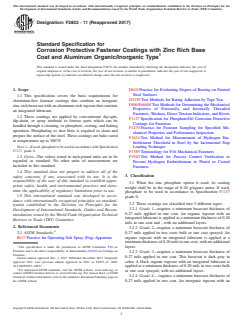
This specification covers the basic requirements for chromium-free fastener coatings that combine an inorganic zinc-rich basecoat with an aluminum-rich topcoat that contains an integrated lubricant. These coatings are applied by conventional dip-spin, dip-drain, or spray methods to ferrous parts which can be handled through a cleaning, or phosphate, coating, and baking operation. Phosphating or shot blast is required to clean and prepare the surface of the steel. These coatings are bake cured at temperatures up to 500°F.
SCOPE
1.1 This specification covers the basic requirements for chromium-free fastener coatings that combine an inorganic zinc-rich basecoat with an aluminum-rich topcoat that contains an integrated lubricant.
1.2 These coatings are applied by conventional dip-spin, dip-drain, or spray methods to ferrous parts which can be handled through a cleaning, or phosphate, coating, and baking operation. Phosphating or shot blast is required to clean and prepare the surface of the steel. These coatings are bake cured at temperatures up to 500°F.
Note 1: If used, phosphate to be used in accordance with Specification F1137, grade 0.
1.3 Units—The values stated in inch-pound units are to be regarded as standard. No other units of measurement are included in this standard.
1.4 This standard does not purport to address all of the safety concerns, if any, associated with its use. It is the responsibility of the user of this standard to establish appropriate safety, health, and environmental practices and determine the applicability of regulatory limitations prior to use.
1.5 This international standard was developed in accordance with internationally recognized principles on standardization established in the Decision on Principles for the Development of International Standards, Guides and Recommendations issued by the World Trade Organization Technical Barriers to Trade (TBT) Committee.
- Status
- Published
- Publication Date
- 30-Nov-2017
- Technical Committee
- F16 - Fasteners
- Drafting Committee
- F16.03 - Coatings on Fasteners


Overview
ASTM F2833-11(2017) is a comprehensive international standard by ASTM that outlines the specifications for chromium-free corrosion protective coatings applied to fasteners. Specifically, these coatings consist of an inorganic zinc-rich basecoat and an aluminum-rich topcoat with an integrated lubricant. The standard aims to deliver enhanced corrosion resistance for fasteners while complying with environmental requirements through the elimination of chromium.
The standard details suitable application methods, covering dip-spin, dip-drain, or spray processes, intended for ferrous parts that can undergo cleaning, phosphating, coating, and baking procedures. The finished coatings are bake-cured at temperatures up to 500°F, ensuring optimal adhesion and performance.
Key Topics
- Chromium-Free Fastener Coatings: The coatings specified are free from chromium, responding to global regulatory trends for safer, environmentally friendly materials.
- Inorganic Zinc-Rich Basecoat and Aluminum Topcoat: The dual-layer system provides robust protection, with the zinc base offering sacrificial protection and the aluminum top enhancing barrier properties.
- Integrated Lubricant: The topcoat includes a lubricant, improving assembly and service performance by reducing friction.
- Surface Preparation: Steel surfaces must be cleaned by phosphating (as per ASTM F1137, grade 0) or shot blasting prior to coating application, ensuring maximum adhesion and durability.
- Grades and Types: Five specific grades are defined, each with minimum requirements for coating thickness, composition, color options, and corrosion resistance performance.
- Testing and Quality Assurance: The standard specifies test methods for corrosion resistance (ASTM B117 Salt Spray Test), adhesion (ASTM D3359 Tape Test), thread fit, and optional tests for hydrogen embrittlement and mechanical properties.
- Ordering Requirements: Guidance is provided on specifying orders, including quantities, coating color, grade, and any supplementary requirements.
Applications
ASTM F2833-11(2017) applies wherever high-performance, corrosion-resistant fasteners are essential, especially in environments where chromium-based coatings are restricted or undesirable. Typical applications include:
- Automotive industry: Fasteners in chassis, engines, and underbody components exposed to harsh environments.
- Construction: Bolts, screws, and anchors used in steel structures, bridges, and outdoor installations.
- Infrastructure and utilities: Fasteners in utility poles, cable supports, and other external fixtures.
- Industrial machinery: Equipment parts subject to high moisture or corrosive atmospheres.
- Renewable energy: Wind turbines and solar installation fasteners, where extended outdoor life is critical.
These coatings not only extend the operational life of fasteners but also ensure reliability in critical connections while supporting compliance with environmental regulations.
Related Standards
To fully implement or specify coatings under ASTM F2833-11(2017), awareness of the following related ASTM standards is essential:
- ASTM F1137 - Specification for Phosphate/Oil Corrosion Protective Coatings for Fasteners
- ASTM B117 - Practice for Operating Salt Spray (Fog) Apparatus
- ASTM D610 - Practice for Evaluating Degree of Rusting on Painted Steel Surfaces
- ASTM D3359 - Test Methods for Rating Adhesion by Tape Test
- ASTM F606/F606M - Test Methods for Determining Mechanical Properties of Fasteners
- ASTM F1470 - Practice for Fastener Sampling for Mechanical Properties and Performance Inspection
- ASTM F1940 - Test Method for Process Control Verification to Prevent Hydrogen Embrittlement in Coated Fasteners
- ASTM F1789 - Terminology for F16 Mechanical Fasteners
- ASTM F1624 - Test Method for Hydrogen Embrittlement Threshold Measurement
By adhering to ASTM F2833-11(2017), manufacturers and specifiers can achieve consistent performance, improved corrosion resistance, and environmental compliance for a wide range of fastener applications.
Relations
- Effective Date
- 01-Dec-2017
- Effective Date
- 01-Jan-2024
- Effective Date
- 01-Nov-2023
- Effective Date
- 01-Aug-2019
- Refers
ASTM D610-08(2019) - Standard Practice for Evaluating Degree of Rusting on Painted Steel Surfaces - Effective Date
- 01-Jan-2019
- Effective Date
- 01-Nov-2018
- Effective Date
- 01-Feb-2018
- Effective Date
- 01-Jun-2017
- Effective Date
- 01-Sep-2016
- Effective Date
- 01-Aug-2016
- Effective Date
- 01-Mar-2015
- Effective Date
- 01-Feb-2015
- Effective Date
- 01-Nov-2014
- Effective Date
- 01-Sep-2014
- Effective Date
- 01-Aug-2014
Get Certified
Connect with accredited certification bodies for this standard

DVS-ZERT GmbH
German welding certification society.
CARES (UK Certification Authority for Reinforcing Steels)
UK certification for reinforcing steels and construction.
EWF/IIW (European/International Welding Federation)
International welding personnel certification.
Sponsored listings
Frequently Asked Questions
ASTM F2833-11(2017) is a technical specification published by ASTM International. Its full title is "Standard Specification for Corrosion Protective Fastener Coatings with Zinc Rich Base Coat and Aluminum Organic/Inorganic Type". This standard covers: ABSTRACT This specification covers the basic requirements for chromium-free fastener coatings that combine an inorganic zinc-rich basecoat with an aluminum-rich topcoat that contains an integrated lubricant. These coatings are applied by conventional dip-spin, dip-drain, or spray methods to ferrous parts which can be handled through a cleaning, or phosphate, coating, and baking operation. Phosphating or shot blast is required to clean and prepare the surface of the steel. These coatings are bake cured at temperatures up to 500°F. SCOPE 1.1 This specification covers the basic requirements for chromium-free fastener coatings that combine an inorganic zinc-rich basecoat with an aluminum-rich topcoat that contains an integrated lubricant. 1.2 These coatings are applied by conventional dip-spin, dip-drain, or spray methods to ferrous parts which can be handled through a cleaning, or phosphate, coating, and baking operation. Phosphating or shot blast is required to clean and prepare the surface of the steel. These coatings are bake cured at temperatures up to 500°F. Note 1: If used, phosphate to be used in accordance with Specification F1137, grade 0. 1.3 Units—The values stated in inch-pound units are to be regarded as standard. No other units of measurement are included in this standard. 1.4 This standard does not purport to address all of the safety concerns, if any, associated with its use. It is the responsibility of the user of this standard to establish appropriate safety, health, and environmental practices and determine the applicability of regulatory limitations prior to use. 1.5 This international standard was developed in accordance with internationally recognized principles on standardization established in the Decision on Principles for the Development of International Standards, Guides and Recommendations issued by the World Trade Organization Technical Barriers to Trade (TBT) Committee.
ABSTRACT This specification covers the basic requirements for chromium-free fastener coatings that combine an inorganic zinc-rich basecoat with an aluminum-rich topcoat that contains an integrated lubricant. These coatings are applied by conventional dip-spin, dip-drain, or spray methods to ferrous parts which can be handled through a cleaning, or phosphate, coating, and baking operation. Phosphating or shot blast is required to clean and prepare the surface of the steel. These coatings are bake cured at temperatures up to 500°F. SCOPE 1.1 This specification covers the basic requirements for chromium-free fastener coatings that combine an inorganic zinc-rich basecoat with an aluminum-rich topcoat that contains an integrated lubricant. 1.2 These coatings are applied by conventional dip-spin, dip-drain, or spray methods to ferrous parts which can be handled through a cleaning, or phosphate, coating, and baking operation. Phosphating or shot blast is required to clean and prepare the surface of the steel. These coatings are bake cured at temperatures up to 500°F. Note 1: If used, phosphate to be used in accordance with Specification F1137, grade 0. 1.3 Units—The values stated in inch-pound units are to be regarded as standard. No other units of measurement are included in this standard. 1.4 This standard does not purport to address all of the safety concerns, if any, associated with its use. It is the responsibility of the user of this standard to establish appropriate safety, health, and environmental practices and determine the applicability of regulatory limitations prior to use. 1.5 This international standard was developed in accordance with internationally recognized principles on standardization established in the Decision on Principles for the Development of International Standards, Guides and Recommendations issued by the World Trade Organization Technical Barriers to Trade (TBT) Committee.
ASTM F2833-11(2017) is classified under the following ICS (International Classification for Standards) categories: 25.220.40 - Metallic coatings. The ICS classification helps identify the subject area and facilitates finding related standards.
ASTM F2833-11(2017) has the following relationships with other standards: It is inter standard links to ASTM F2833-11, ASTM F1470-24, ASTM F1789-23, ASTM F1940-07a(2019), ASTM D610-08(2019), ASTM F1624-12(2018), ASTM F1470-18, ASTM F1789-17, ASTM F606/F606M-16, ASTM F1789-16, ASTM F1789-15a, ASTM F1789-15, ASTM F606/F606M-14a, ASTM F1789-14a, ASTM F1940-07a(2014). Understanding these relationships helps ensure you are using the most current and applicable version of the standard.
ASTM F2833-11(2017) is available in PDF format for immediate download after purchase. The document can be added to your cart and obtained through the secure checkout process. Digital delivery ensures instant access to the complete standard document.
Standards Content (Sample)
This international standard was developed in accordance with internationally recognized principles on standardization established in the Decision on Principles for the
Development of International Standards, Guides and Recommendations issued by the World Trade Organization Technical Barriers to Trade (TBT) Committee.
Designation: F2833 −11 (Reapproved 2017)
Standard Specification for
Corrosion Protective Fastener Coatings with Zinc Rich Base
Coat and Aluminum Organic/Inorganic Type
This standard is issued under the fixed designation F2833; the number immediately following the designation indicates the year of
original adoption or, in the case of revision, the year of last revision. A number in parentheses indicates the year of last reapproval. A
superscript epsilon (´) indicates an editorial change since the last revision or reapproval.
1. Scope D610 Practice for Evaluating Degree of Rusting on Painted
Steel Surfaces
1.1 This specification covers the basic requirements for
D3359 Test Methods for Rating Adhesion by Tape Test
chromium-free fastener coatings that combine an inorganic
F606/F606M Test Methods for Determining the Mechanical
zinc-rich basecoat with an aluminum-rich topcoat that contains
Properties of Externally and Internally Threaded
an integrated lubricant.
Fasteners, Washers, Direct Tension Indicators, and Rivets
1.2 These coatings are applied by conventional dip-spin,
F1137 Specification for Phosphate/Oil Corrosion Protective
dip-drain, or spray methods to ferrous parts which can be
Coatings for Fasteners
handled through a cleaning, or phosphate, coating, and baking
F1470 Practice for Fastener Sampling for Specified Me-
operation. Phosphating or shot blast is required to clean and
chanical Properties and Performance Inspection
prepare the surface of the steel. These coatings are bake cured
F1624 Test Method for Measurement of Hydrogen Em-
at temperatures up to 500°F.
brittlement Threshold in Steel by the Incremental Step
NOTE1—Ifused,phosphatetobeusedinaccordancewithSpecification
Loading Technique
F1137, grade 0.
F1789 Terminology for F16 Mechanical Fasteners
1.3 Units—The values stated in inch-pound units are to be
F1940 Test Method for Process Control Verification to
regarded as standard. No other units of measurement are
Prevent Hydrogen Embrittlement in Plated or Coated
included in this standard.
Fasteners
1.4 This standard does not purport to address all of the
3. Classification
safety concerns, if any, associated with its use. It is the
responsibility of the user of this standard to establish appro-
3.1 When the zinc phosphate option is used, its coating
priate safety, health, and environmental practices and deter-
weight shall be in the range of 8-20 g/square meter. If used,
mine the applicability of regulatory limitations prior to use.
phosphate to be used in accordance to Specification F1137
1.5 This international standard was developed in accor-
grade 0.
dance with internationally recognized principles on standard-
3.2 These coatings are classified into 5 different types:
ization established in the Decision on Principles for the
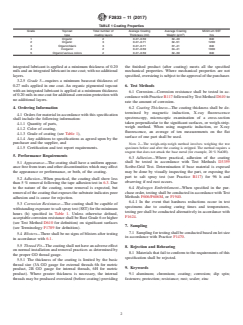
3.2.1 Grade 1—requires a minimum basecoat thickness of
Development of International Standards, Guides and Recom-
0.27 mils applied in one coat. An organic topcoat with an
mendations issued by the World Trade Organization Technical
integrated lubricant is applied at a minimum thickness of 0.20
Barriers to Trade (TBT) Committee.
mils in one coat and ; with no additional layers.
2. Referenced Documents
3.2.2 Grade 2—requires a minimum basecoat thickness of
2.1 ASTM Standards: 0.27 mils applied in two coats bulk or one coat sprayed. An
organic topcoat with an integrated lubricant is applied at a
B117 Practice for Operating Salt Spray (Fog) Apparatus
minimumthicknessof0.20milsinonecoat;withnoadditional
This specification is under the jurisdiction of ASTM Committee F16 on layers.
Fasteners and is the direct responsibility of Subcommittee F16.03 on Coatings on
3.2.3 Grade 3—requires a minimum basecoat thickness of
Fasteners.
0.27 mils applied in one coat. This basecoat is dark gray in
Current edition approved Dec. 1, 2017. Published December 2017. Originally
color. A black organic topcoat with an integrated lubricant is
approved 2011. Last previous edition approved in 2011 as F2833–11. DOI:
10.1520/F2833–11R17.
applied at a minimum thickness of 0.20 mils in two coats bulk
For referenced ASTM standards, visit the ASTM website, www.astm.org, or
or one coat sprayed; with no additional layers.
contact ASTM Customer Service at service@astm.org. For Annual Book of ASTM
3.2.4 Grade 4— requires a minimum basecoat thickness of
Standards volume information, refer to the standard’s Document Summary page on
the ASTM website. 0.27 mils applied in one coat. An inorganic topcoat with an
Copyright © ASTM International, 100 Barr Harbor Drive, PO Box C700, West Conshohocken, PA 19428-2959. United States
F2833 − 11 (2017)
TABLE 1 Coating Properties
Grade Topcoat Total number of Average Coating Average Coating Minimum SST
type coating layers Thickness (mil) Weight (g/m ) hrs
1 Organic 2 0.47–0.59 32–40 840
2 Organic 3 0.47–0.71 32–51 1200
3 Organic/black 3 0.47–0.71 37–41 840
4 Inorganic 2 0.47–0.59 34–41 1000
5 Organic/various colors 2 0.47–0.59 32–39 840
integrated lubricant is applied at a minimum thickness of 0.20 the finished product (after coating) meets all the specified
mils and an inte
...