


ASTM A1058-08
(Test Method)Standard Test Methods for Mechanical Testing of Steel Products-Metric
Standard Test Methods for Mechanical Testing of Steel Products<span class='unicode'>-</span>Metric
SCOPE
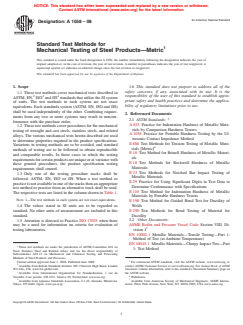
1.1 These test methods cover mechanical tests described in ASTM, EN, ISO and JIS standards that utilize the SI system of units. The test methods in each system are not exact equivalents. Each standards system (ASTM, EN, ISO and JIS) shall be used independently of the other. Combining requirements from any two or more systems may result in nonconformance with the purchase order.
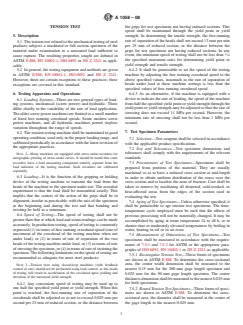
1.2 These test methods cover procedures for the mechanical testing of wrought and cast steels, stainless steels, and related alloys. The various mechanical tests herein described are used to determine properties required in the product specifications. Variations in testing methods are to be avoided, and standard methods of testing are to be followed to obtain reproducible and comparable results. In those cases in which the testing requirements for certain products are unique or at variance with these general procedures, the product specification testing requirements shall control.
1.3 Only one of the testing procedure tracks shall be followed: ASTM, EN, ISO or JIS. When a test method or practice is not available in one of the tracks then an appropriate test method or practice from an alternative track shall be used. The respective tests are listed in the column shown in Table 1.
Note 1-The test methods in each system are not exact equivalents.
1.4 The values stated in SI units are to be regarded as standard. No other units of measurement are included in this standard.
1.5 Attention is directed to Practice ISO 17025 when there may be a need for information on criteria for evaluation of testing laboratories.
1.6 This standard does not purport to address all of the safety concerns, if any, associated with its use. It is the responsibility of the user of this standard to establish appropriate safety and health practices and determine the applicability of regulatory limitations prior to use.
General Information
Relations
Frequently Asked Questions
ASTM A1058-08 is a standard published by ASTM International. Its full title is "Standard Test Methods for Mechanical Testing of Steel Products<span class='unicode'>-</span>Metric". This standard covers: SCOPE 1.1 These test methods cover mechanical tests described in ASTM, EN, ISO and JIS standards that utilize the SI system of units. The test methods in each system are not exact equivalents. Each standards system (ASTM, EN, ISO and JIS) shall be used independently of the other. Combining requirements from any two or more systems may result in nonconformance with the purchase order. 1.2 These test methods cover procedures for the mechanical testing of wrought and cast steels, stainless steels, and related alloys. The various mechanical tests herein described are used to determine properties required in the product specifications. Variations in testing methods are to be avoided, and standard methods of testing are to be followed to obtain reproducible and comparable results. In those cases in which the testing requirements for certain products are unique or at variance with these general procedures, the product specification testing requirements shall control. 1.3 Only one of the testing procedure tracks shall be followed: ASTM, EN, ISO or JIS. When a test method or practice is not available in one of the tracks then an appropriate test method or practice from an alternative track shall be used. The respective tests are listed in the column shown in Table 1. Note 1-The test methods in each system are not exact equivalents. 1.4 The values stated in SI units are to be regarded as standard. No other units of measurement are included in this standard. 1.5 Attention is directed to Practice ISO 17025 when there may be a need for information on criteria for evaluation of testing laboratories. 1.6 This standard does not purport to address all of the safety concerns, if any, associated with its use. It is the responsibility of the user of this standard to establish appropriate safety and health practices and determine the applicability of regulatory limitations prior to use.
SCOPE 1.1 These test methods cover mechanical tests described in ASTM, EN, ISO and JIS standards that utilize the SI system of units. The test methods in each system are not exact equivalents. Each standards system (ASTM, EN, ISO and JIS) shall be used independently of the other. Combining requirements from any two or more systems may result in nonconformance with the purchase order. 1.2 These test methods cover procedures for the mechanical testing of wrought and cast steels, stainless steels, and related alloys. The various mechanical tests herein described are used to determine properties required in the product specifications. Variations in testing methods are to be avoided, and standard methods of testing are to be followed to obtain reproducible and comparable results. In those cases in which the testing requirements for certain products are unique or at variance with these general procedures, the product specification testing requirements shall control. 1.3 Only one of the testing procedure tracks shall be followed: ASTM, EN, ISO or JIS. When a test method or practice is not available in one of the tracks then an appropriate test method or practice from an alternative track shall be used. The respective tests are listed in the column shown in Table 1. Note 1-The test methods in each system are not exact equivalents. 1.4 The values stated in SI units are to be regarded as standard. No other units of measurement are included in this standard. 1.5 Attention is directed to Practice ISO 17025 when there may be a need for information on criteria for evaluation of testing laboratories. 1.6 This standard does not purport to address all of the safety concerns, if any, associated with its use. It is the responsibility of the user of this standard to establish appropriate safety and health practices and determine the applicability of regulatory limitations prior to use.
ASTM A1058-08 is classified under the following ICS (International Classification for Standards) categories: 77.040.10 - Mechanical testing of metals. The ICS classification helps identify the subject area and facilitates finding related standards.
ASTM A1058-08 has the following relationships with other standards: It is inter standard links to ASTM A1058-09, ASTM A266/A266M-21, ASTM A994-23a, ASTM A1100-16(2022), ASTM A960/A960M-23, ASTM A999/A999M-23, ASTM A276/A276M-23, ASTM A450/A450M-21, ASTM A781/A781M-21, ASTM A530/A530M-18, ASTM A788/A788M-23, ASTM A381/A381M-18, ASTM A965/A965M-21a, ASTM A961/A961M-23, ASTM A1016/A1016M-18a. Understanding these relationships helps ensure you are using the most current and applicable version of the standard.
You can purchase ASTM A1058-08 directly from iTeh Standards. The document is available in PDF format and is delivered instantly after payment. Add the standard to your cart and complete the secure checkout process. iTeh Standards is an authorized distributor of ASTM standards.
Standards Content (Sample)
NOTICE: This standard has either been superseded and replaced by a new version or withdrawn.
Contact ASTM International (www.astm.org) for the latest information
An American National Standard
Designation:A1058–08
Standard Test Methods for
Mechanical Testing of Steel Products—Metric
This standard is issued under the fixed designation A 1058; the number immediately following the designation indicates the year of
original adoption or, in the case of revision, the year of last revision. A number in parentheses indicates the year of last reapproval. A
superscript epsilon (´) indicates an editorial change since the last revision or reapproval.
This standard has been approved for use by agencies of the Department of Defense.
1. Scope 1.6 This standard does not purport to address all of the
safety concerns, if any, associated with its use. It is the
1.1 These test methods cover mechanical tests described in
2 3 4
responsibility of the user of this standard to establish appro-
ASTM, EN, ISO and JIS standards that utilize the SI system
priate safety and health practices and determine the applica-
of units. The test methods in each system are not exact
bility of regulatory limitations prior to use.
equivalents. Each standards system (ASTM, EN, ISO and JIS)
shall be used independently of the other. Combining require-
2. Referenced Documents
ments from any two or more systems may result in noncon-
2.1 ASTM Standards:
formance with the purchase order.
A 833 Practice for Indentation Hardness of Metallic Mate-
1.2 These test methods cover procedures for the mechanical
rials by Comparison Hardness Testers
testing of wrought and cast steels, stainless steels, and related
A 1038 Practice for Portable Hardness Testing by the Ul-
alloys. The various mechanical tests herein described are used
trasonic Contact Impedance Method
to determine properties required in the product specifications.
E8M Test Methods for Tension Testing of Metallic Mate-
Variations in testing methods are to be avoided, and standard
rials [Metric]
methods of testing are to be followed to obtain reproducible
E10 Test Method for Brinell Hardness of Metallic Materi-
and comparable results. In those cases in which the testing
als
requirementsforcertainproductsareuniqueoratvariancewith
E18 Test Methods for Rockwell Hardness of Metallic
these general procedures, the product specification testing
Materials
requirements shall control.
E23 Test Methods for Notched Bar Impact Testing of
1.3 Only one of the testing procedure tracks shall be
Metallic Materials
followed: ASTM, EN, ISO or JIS. When a test method or
E29 Practice for Using Significant Digits in Test Data to
practice is not available in one of the tracks then an appropriate
Determine Conformance with Specifications
test method or practice from an alternative track shall be used.
E110 Test Method for Indentation Hardness of Metallic
The respective tests are listed in the column shown in Table 1.
Materials by Portable Hardness Testers
NOTE 1—The test methods in each system are not exact equivalents.
E 190 Test Method for Guided Bend Test for Ductility of
Welds
1.4 The values stated in SI units are to be regarded as
standard. No other units of measurement are included in this E 290 Test Methods for Bend Testing of Material for
Ductility
standard.
1.5 Attention is directed to Practice ISO 17025 when there 2.2 Other Documents:
ASME Boiler and Pressure Vessel Code Section VIII, Di-
may be a need for information on criteria for evaluation of
testing laboratories. vision I
EN 10002-1 Metallic Materials—Tensile Testing—Part 1:
Method of Test (at Ambient Temperature)
EN 10045-1 Metallic Materials—Charpy ImpactTest—Part
These test methods are under the jurisdiction of ASTM Committee A01 on
1: Test Method
Steel, Stainless Steel and Related Alloys and are the direct responsibility of
Subcommittee A01.13 on Mechanical and Chemical Testing and Processing
Methods of Steel Products and Processes.
Current edition approved June 1, 2008. Published June 2008. For referenced ASTM standards, visit the ASTM website, www.astm.org, or
Available from British Standards Institute 389, Chiswick High Road, London contact ASTM Customer Service at service@astm.org. For Annual Book of ASTM
W4 4AL, UK, www.bsi-global.com Standards volume information, refer to the standard’s Document Summary page on
Available from International Organization for Standardization, 1 rue de the ASTM website.
Varembé, Case postale, CH-1211, Genève 20, Switzerland, www.iso.org Withdrawn.
4 7
Available from Japanese Standards Association, 4-1-24, Akasaka, Minato-ku, Available from American Society of Mechanical Engineers, ASME Interna-
Tokyo, 107-8440, Japan, www.jsa.or.jp tional, Three Park Avenue, New York, NY 10016-5990, USA www.asme.org
Copyright © ASTM International, 100 Barr Harbor Drive, PO Box C700, West Conshohocken, PA 19428-2959, United States.
A1058–08
TABLE 1 Tests and Applicable Standards
3. General Precautions
Test Sections ASTM EN ISO JIS
3.1 The ASTM track is the default track; if other than the
Tension 5 to 12 E 8M 10002-1 6892 Z 2241
ASTM track is used that track shall be reported.
A
Bend 13 E 190 7438 7438 Z 2248
E 290
3.2 Certain methods of fabrication, such as bending, form-
Bend (tube) 13 … 10232 8491 …
ing, and welding, or operations involving heating, may affect
Hardness 14
A
the properties of the material under test.Therefore, the product
Brinell 15 E 10 6506-1 6506-1 Z 2243
A
Rockwell 16 E 18 6508-1 6508-1 Z 2245
specifications cover the stage of manufacture at which me-
Portable 17 A 833 …… …
chanical testing is to be performed. The properties shown by
E110
testing prior to fabrication may not necessarily be representa-
A 1038
Impact 18 to 26 E 23 10045-1 148-1 Z 2242
tive of the product after it has been completely fabricated.
Keywords 27 …… … …
3.3 Improper machining or preparation of test specimens
A
These standards are designated EN ISO; this identifies the adoption of ISO
may give erroneous results. Care should be exercised to assure
standards by EN. “EN ISO” is part of the designation.
good workmanship in machining. Improperly machined speci-
mens should be discarded and other specimens substituted.
EN 10045-2 Charpy Impact Test on Metallic Materials—
3.4 Flaws in the specimen may also affect results. If any test
Method for the Verification of Impact Testing Machines
specimen develops flaws, the retest provision of the applicable
EN 10232 Metallic Materials—Tube (in Full Section)—
product specification shall govern.
Bend Test
3.5 If any test specimen fails because of mechanical reasons
EN ISO 2566-1 Steel—Conversion of Elongation Values—
such as failure of testing equipment or improper specimen
Part 1: Carbon and Low Alloy Steels
preparation, it may be discarded and another specimen taken.
EN ISO 2566-2 Steel—Conversion of Elongation Values—
Part 2: Austenitic Steels
4. Orientation of Test Specimens
EN ISO 6506-1 Metallic Materials—Brinell Hardness
Test—Part 1: Test Method
4.1 The terms “longitudinal test” and “transverse test” are
EN ISO 6508-1 Metallic Materials—Rockwell Hardness
used only in material specifications for wrought products and
Test—Part 1: Test Method (ScalesA, B, C, D, E, F, G, H,
are not applicable to castings. When such reference is made to
K, N, T)
a test coupon or test specimen, the following definitions apply:
EN ISO 7438 Metallic Materials—Bend Test
4.1.1 Longitudinal Test, unless specifically defined other-
ISO 148-1 Metallic Materials—Charpy Pendulum Impact
wise, signifies that the lengthwise axis of the specimen is
Test—Part 1: Test Method
parallel to the direction of the greatest extension of the steel
ISO 148-2 Metallic Materials—Charpy Pendulum Impact
during rolling or forging. The stress applied to a longitudinal
Test—Part 2: Verification of Test Machines
tension test specimen is in the direction of the greatest
ISO 2566-1 Steel—Conversion of Elongation Values—Part
extension, and the axis of the fold of a longitudinal bend test
1: Carbon and Low Alloy Steels
specimen is at right angles to the direction of greatest exten-
ISO 2566-2 Steel—Conversion of Elongation Values—Part
sion.
2: Austenitic Steels
ISO 6506-1 Metallic Materials—Brinell Hardness Test— 4.1.2 Transverse Test, unless specifically defined otherwise,
signifies that the lengthwise axis of the specimen is at right
Part 1: Test Method
ISO 6508-1 Metallic Materials—Rockwell HardnessTest— angles to the direction of the greatest extension of the steel
Part 1: Test Method (Scales A, B, C, D, E, F, G, H, K, N, during rolling or forging. The stress applied to a transverse
T)
tension test specimen is at right angles to the greatest exten-
ISO 6892 Metallic Materials—Tensile Testing at Ambient
sion, and the axis of the fold of a transverse bend test specimen
Temperature
is parallel to the greatest extension.
ISO 7438 Metallic Materials—Bend Test
4.2 The terms “radial test” and “tangential test” are used in
ISO 8491 Metallic Materials—Tube (in Full Section)—
material specifications for some wrought circular products and
Bend Test
are not applicable to castings. When such reference is made to
ISO 17025 General Requirements for the Competence of
a test coupon or test specimen, the following definitions apply:
Testing and Calibration Laboratories
4.2.1 Radial Test, unless specifically defined otherwise,
JIS B 7722 Charpy Pendulum Impact Test—Verification of
signifies that the lengthwise axis of the specimen is perpen-
Testing Machines
diculartotheaxisoftheproductandcoincidentwithoneofthe
JIS Z 2201 Test Pieces for Tensile Test for Metallic Mate-
radii of a circle drawn with a point on the axis of the product
rials
as a center.
JIS Z 2241 Method of Tensile Test for Metallic Materials
4.2.2 Tangential Test, unless specifically defined otherwise,
JIS Z 2242 Method of Charpy Pendulum Impact Test for
signifies that the lengthwise axis of the specimen is perpen-
Metallic Materials
diculartoaplanecontainingtheaxisoftheproductandtangent
JIS Z 2243 Brinell Hardness Test—Test Method
to a circle drawn with a point on the axis of the product as a
JIS Z 2245 Rockwell Hardness Test—Test Method
JIS Z 2248 Method of Bend Test for Metallic Materials center.
A1058–08
TENSION TEST the grips for test specimens not having reduced sections. This
speed shall be maintained through the yield point or yield
5. Description
strength. In determining the tensile strength, the free-running
rate of separation of the heads shall not exceed 13 mm per min
5.1 Thetensiontestrelatedtothemechanicaltestingofsteel
per 25 mm of reduced section, or the distance between the
products subjects a machined or full-section specimen of the
grips for test specimens not having reduced sections. In any
material under examination to a measured load sufficient to
event, the minimum speed of testing shall not be less than ⁄10
cause rupture. The resulting properties sought are defined in
the specified maximum rates for determining yield point or
ASTME8M, EN 10002-1, ISO 6892 or JIS Z 2241 as appli-
yield strength and tensile strength.
cable.
6.4.2 It shall be permissible to set the speed of the testing
5.2 In general, the testing equipment and methods are given
machine by adjusting the free running crosshead speed to the
in ASTM E8M, EN 10002-1, ISO 6892 and JIS Z 2241.
above specified values, inasmuch as the rate of separation of
However, there are certain exceptions to these practices; these
heads under load at these machine settings is less than the
exceptions are covered in this standard.
specified values of free running crosshead speed.
6. TestingApparatus and Operations
6.4.3 As an alternative, if the machine is equipped with a
device to indicate the rate of loading, the speed of the machine
6.1 Loading Systems—There are two general types of load-
from half the specified yield point or yield strength through the
ing systems, mechanical (screw power) and hydraulic. These
yield point or yield strength may be adjusted so that the rate of
differ chiefly in the variability of the rate of load application.
stressing does not exceed 11 MPa per second. However, the
The older screw power machines are limited to a small number
minimum rate of stressing shall not be less than 1 MPa per
of fixed free running crosshead speeds. Some modern screw
second.
power machines, and all hydraulic machines permit stepless
variation throughout the range of speeds.
7. Test Specimen Parameters
6.2 The tension testing machine shall be maintained in good
operating condition, used only in the proper loading range, and
7.1 Selection—Test coupons shall be selected in accordance
calibrated periodically in accordance with the latest revision of
with the applicable product specifications.
the appropriate practices.
7.2 Size and Tolerances—Test specimen dimensions and
tolerances shall comply with the requirements of the relevant
NOTE 2—Many machines are equipped with stress-strain recorders for
standards.
autographic plotting of stress-strain curves. It should be noted that some
recorders have a load measuring component entirely separate from the
7.3 Procurement of Test Specimens—Specimens shall be
load indicator of the testing machine. Such recorders are calibrated
prepared from portions of the material. They are usually
separately.
machined so as to have a reduced cross section at mid-length
6.3 Loading—It is the function of the gripping or holding
in order to obtain uniform distribution of the stress over the
device of the testing machine to transmit the load from the
cross section and to localize the zone of fracture. Care shall be
heads of the machine to the specimen under test. The essential
taken to remove by machining all distorted, cold-worked, or
requirement is that the load shall be transmitted axially. This
heat-affected areas from the edges of the section used in
implies that the centers of the action of the grips shall be in
evaluating the test.
alignment, insofar as practicable, with the axis of the specimen
7.4 Aging of Test Specimens—Unless otherwise specified, it
at the beginning and during the test and that bending and
shall be permissible to age tension test specimens. The time-
twisting be held to a minimum.
temperature cycle employed must be such that the effects of
6.4 Speed of Testing—The speed of testing shall not be
previous processing will not be materially changed. It may be
greater than that at which load and strain readings can be made
accomplished by aging at room temperature 24 to 48 h, or in
accurately. In production testing, speed of testing is commonly
shorter time at moderately elevated temperatures by boiling in
expressed (1) in terms of free running crosshead speed (rate of
water, heating in oil or in an oven.
movement of the crosshead of the testing machine when not
7.5 Measurement of Dimensions of Test Specimens—Test
under load), or (2) in terms of rate of separation of the two
specimens shall be measured in accordance with the require-
heads of the testing machine under load, or (3) in terms of rate
ments of 7.5.1 and 7.5.2 for ASTM or the appropriate para-
ofstressingthespecimen,or (4)intermsofrateofstrainingthe
graphs of ISO 6892, EN 10002-1 or JIS Z 2241 as applicable.
specimen.The following limitations on the speed of testing are
7.5.1 Rectangular Tension Test—These forms of specimens
recommended as adequate for most steel products:
are shown in ASTM E8M. To determine the cross-sectional
area, the center width dimension shall be measured to the
NOTE 3—Tension tests using closed-loop machines (with feedback
control of rate) should not be performed using load control, as this mode nearest 0.15 mm for the 200-mm gage length specimen and
of testing will result in acceleration of the crosshead upon yielding and
0.025 mm for the 50-mm gage length specimen. The center
elevation of the measured yield strength.
thicknessdimensionshallbemeasuredtothenearest0.025mm
6.4.1 Any convenient speed of testing may be used up to for both specimens.
one half the specified yield point or yield strength. When this 7.5.2 Round Tension Test Specimens—Theseformsofspeci-
point is reached, the free-running rate of separation of the mens are shown in ASTM E8M. To determine the cross-
crossheads shall be adjusted so as not to exceed 0.025 mm per sectional area, the diameter shall be measured at the center of
second per 25 mm of reduced section, or the distance between the gage length to the nearest 0.025 mm.
A1058–08
TABLE 2 Conversion Factors for 4d and 5d Gage Lengths
7.6 General—Test specimens shall be either substantially
(ISO2566-1 and ISO2566-2)
full size or machined, as prescribed in the product specifica-
Conversion from 4d to 5d 5d to 4d
tions for the material being tested.
Carbon and low alloy steels 0.916 1.093
7.6.1 Improperly prepared test specimens often cause unsat-
Austenitic steels 0.972 1.029
isfactory test results. It is important, therefore, that care be
exercised in the preparation of specimens, particularly in the
machining, to assure good workmanship.
7.6.2 It is desirable to have the cross-sectional area of the length to a 5d gage length or vice versa by use of the
specimen smallest at the center of the gage length to ensure multiplication factors shown in Table 2.
fracture within the gage length. This is provided for by the 12.2.1 Example 1—Conversion of Carbon and low alloy
taper in the gage length permitted for each of the specimens steel elongation derived from 4d gage length to a 5d gage
described in the following sections. length elongation value:
7.6.3 For low ductility materials it is desirable to have fillets 23 % 3 0.916 = 21%
of large radius at the ends of the gage length. 12.2.2 Example 2—Conversion of Austenitic steel elonga-
tionderivedfrom5dgagelengthtoa4dgagelengthelongation
8. Plate-Type Specimen
value:
23 % 3 1.029 = 24%
8.1 The standard plate-type test specimen is shown in
12.3 Reduction of Area—Fit the ends of the fractured
ASTM E8M, EN 10002-1, ISO 6892 or JIS Z 2241. This
specimen together and measure the mean diameter or the width
specimen is used for testing metallic materials in the form of
andthicknessatthesmallestcrosssectiontothesameaccuracy
plate, structural and bar-size shapes, and flat material having a
as the original dimensions. The difference between the area
nominal thickness of 5 mm or over. When product specifica-
thus found and the area of the original cross section expressed
tions so permit, other types of specimens may be used.
as a percentage of the original area is the reduction of area.
9. Sheet-Type Specimen
BEND TEST
9.1 The standard sheet-type test specimen is shown in
ASTM E8M, EN 10002-1, ISO 6892 or JIS Z 2241. This
13. Description
specimen is used for testing metallic materials in the form of
13.1 The bend test is one method for evaluating ductility,
sheet, plate, flat wire, strip, band, and hoop ranging in nominal
but it cannot be considered as a quantitative means of predict-
thickness from 0.13 to 19 mm. When product specifications so
ing service performance in bending operations. The severity of
permit, other types of specimens may be used, as specified in
the bend test is primarily a function of the angle of bend and
ASTME8M.
inside diameter to which the specimen is bent, and of the cross
section of the specimen. These conditions are varied according
10. Round Specimens
to location and orientation of the test specimen and the
10.1 Thestandarddiameterroundtestspecimenasshownin
chemical composition, tensile properties, hardness, type, and
ASTM E8M, EN 10002-1, ISO 6892 or JIS Z 2241 is used
quality of the steel specified. ASTM E 190, ASTM E 290, EN
quite generally for testing metallic materials, both cast and
ISO 7438, EN 10232 (tube), ISO 7438 or, ISO 8491 (tube) and
wrought.
JIS Z 2248 may be consulted for methods of performing the
10.2 Small size specimens proportional to standard speci-
test.
mens may be used when it is necessary to test material from
13.2 Unless otherwise specified, it shall be permissible to
which the standard specimens cannot be prepared. Other sizes
agebendtestspecimens.Thetime-temperaturecycleemployed
of small round specimens may be used. In any such small size
must be such that the effects of previous processing will not be
specimen it is important that the gage length for measurement
materially changed. It may be accomplished by aging at room
of elongation be five times the diameter of the specimen.
temperature 24 to 48 h, or in shorter time at moderately
10.3 The shape of the ends of the specimens outside of the
elevated temperatures by boiling in water or by heating in oil
gage length shall be suitable to the material and of a shape to
or in an oven.
fit the holders or grips of the testing machine so that the loads
13.3 Bend the test specimen at room temperature to an
are applied axially.
inside diameter, as designated by the applicable product
specifications, to the extent specified without major cracking
11. Gage Marks
on the outside of the bent portion. The speed of bending is
11.1 Test specimens shall be marked in accordance with the
ordinarily not an important factor.
requirements of the relevant standards.
HARDNESS TEST
12. Determination of Tensile Properties
14. General
12.1 The determination and description of the tensile prop-
erties shall be in accordance with the requirements of the 14.1 Ahardness test is a means of determining resistance to
relevant standards. penetration and is occasionally employed to obtain a quick
12.2 Subject to agreement between the purchaser and sup- approximation of tensile strength. Table 3, Table 4, Table 5,
plier, elongation values may be converted from a 4d gage and Table 6 are for the conversion of hardness measurements
A1058–08
A
TABLE 3 Approximate Hardness Conversion Numbers for Nonaustenitic Steels (Rockwell C to Other Hardness Numbers)
Rockwell Superficial Hardness
Rockwell Rockwell
Brinell Knoop
15N Scale, 30N Scale 45N Scale,
C Scale, Vickers A Scale,
Approximate
Hardness, Hardness,
15-kgf 30-kgf 45-kgf
150-kgf Load, Hardness 60-kgf Load,
Tensile
3000-kgf Load, 500-gf Load
Load, Load, Load,
Diamond Number Diamond
Strength,
10-mm Ball and Over
Diamond Diamond Diamond
Penetrator Penetrator
ksi (MPa)
Penetrator Penetrator Penetrator
68 940 . . . 920 85.6 93.2 84.4 75.4 . . .
67 900 . . . 895 85.0 92.9 83.6 74.2 . . .
66 865 . . . 870 84.5 92.5 82.8 73.3 . . .
65 832 739 846 83.9 92.2 81.9 72.0 . . .
64 800 722 822 83.4 91.8 81.1 71.0 . . .
63 772 706 799 82.8 91.4 80.1 69.9 . . .
62 746 688 776 82.3 91.1 79.3 68.8 . . .
61 720 670 754 81.8 90.7 78.4 67.7 . . .
60 697 654 732 81.2 90.2 77.5 66.6 . . .
59 674 634 710 80.7 89.8 76.6 65.5 351 (2420)
58 653 615 690 80.1 89.3 75.7 64.3 338 (2330)
57 633 595 670 79.6 88.9 74.8 63.2 325 (2240)
56 613 577 650 79.0 88.3 73.9 62.0 313 (2160)
55 595 560 630 78.5 87.9 73.0 60.9 301 (2070)
54 577 543 612 78.0 87.4 72.0 59.8 292 (2010)
53 560 525 594 77.4 86.9 71.2 58.6 283 (1950)
52 544 512 576 76.8 86.4 70.2 57.4 273 (1880)
51 528 496 558 76.3 85.9 69.4 56.1 264 (1820)
50 513 482 542 75.9 85.5 68.5 55.0 255 (1760)
49 498 468 526 75.2 85.0 67.6 53.8 246 (1700)
48 484 455 510 74.7 84.5 66.7 52.5 238 (1640)
47 471 442 495 74.1 83.9 65.8 51.4 229 (1580)
46 458 432 480 73.6 83.5 64.8 50.3 221 (1520)
45 446 421 466 73.1 83.0 64.0 49.0 215 (1480)
44 434 409 452 72.5 82.5 63.1 47.8 208 (1430)
43 423 400 438 72.0 82.0 62.2 46.7 201 (1390)
42 412 390 426 71.5 81.5 61.3 45.5 194 (1340)
41 402 381 414 70.9 80.9 60.4 44.3 188 (1300)
40 392 371 402 70.4 80.4 59.5 43.1 182 (1250)
39 382 362 391 69.9 79.9 58.6 41.9 1
...
Questions, Comments and Discussion
Ask us and Technical Secretary will try to provide an answer. You can facilitate discussion about the standard in here.
Loading comments...